Unistellar Odyssey
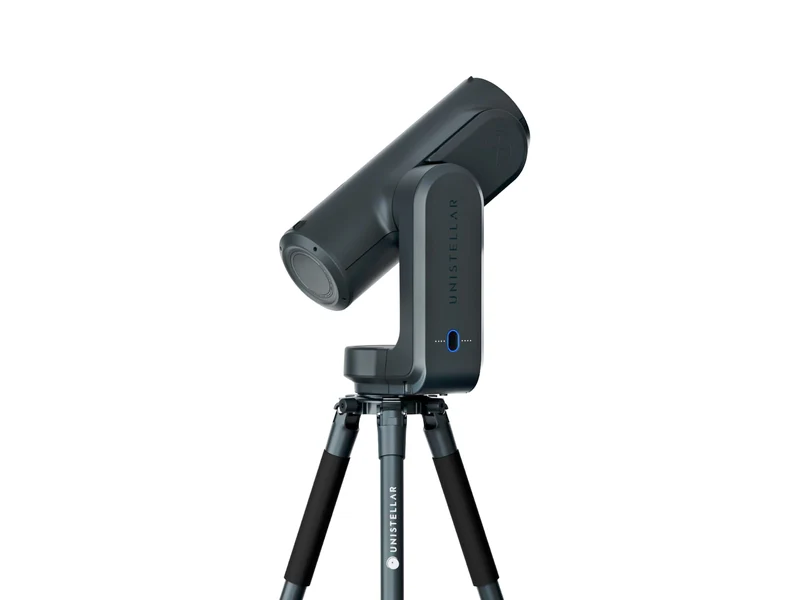
Image: Unistellar
The Unistellar Odyssey is what you buy when 50mm is not enough. Every smart telescope under £1,500 is a small refractor; the Odyssey is an 85mm mirror telescope with optics developed with Nikon, and it gathers nearly three times the light of a Seestar S50 Pro or Vespera II. Unistellar made their name with the eVscope, the first smart telescope most people heard of. The Odyssey is that experience made smaller, quieter and cheaper: no collimation, no focusing, a tripod in the box, and a citizen-science programme that lets owners feed data to NASA and the SETI Institute. At £2,099 it costs more than twice a Seestar S50 Pro, so the question is whether the aperture is worth it for the targets you actually image.
| Key Specifications: Unistellar Odyssey | |
|---|---|
| Aperture | 85mm mirror, Nikon-developed optics, no collimation required |
| Focal length | 320mm, f/3.9 |
| Field of view | 33.6 × 45 arcminutes (about 0.56° × 0.75°) |
| Sensor | Colour, 1.45µm pixels, 0.93 arcseconds per pixel; Unistellar do not publish the sensor model |
| Resolving power | 1.68 arcseconds; magnitude limit 17.2 (Unistellar figure) |
| Mount | Motorised alt-az, one-tap GoTo, automatic star-field alignment, Stellar AutoFocus |
| Light pollution | Deep Dark Technology software background subtraction; no built-in dual-band filter |
| Battery | About 5 hours; USB-C |
| Storage | 64GB |
| Connectivity | Wi-Fi; Unistellar app (iOS and Android), 37-million-star database, 5,000-object catalogue, citizen science modes |
| Eyepiece | None (the Odyssey Pro adds a Nikon electronic eyepiece) |
| Weight | About 4kg telescope; 2.5kg tripod |
| In the box | Telescope, full-height tripod, USB-C cable |
| Launched | January 2024 |
| Warranty | 2 years |
| UK price | £2,099 at First Light Optics; Odyssey Pro £3,699 |
What makes the Odyssey different?
- 85mm of aperture. Until the DwarfLab Draco ships, this is the only smart telescope you can buy in the UK today with more than 50mm. Light-gathering area scales with the square of the aperture, so 85mm against 50mm is 2.9 times the light. On faint galaxies and globular clusters that is the difference between a smudge and a shape.
- Mirror optics with no maintenance. Reflectors normally need collimating, which is the single thing that puts beginners off them. Unistellar and Nikon fixed the optical train at the factory and added an autofocus that runs every session. You get reflector aperture with refractor convenience.
- Deep Dark Technology. Rather than a physical filter, the Odyssey models the sky background and subtracts it in the live stack. From a suburban UK garden it produces cleaner results than you would expect from an unfiltered telescope, and it works on broadband targets like galaxies where a dual-band filter would not help anyway.
- Citizen science. Unistellar's network of owners contributes to real observations: asteroid occultations, exoplanet transits, comet monitoring. The app schedules the campaigns and uploads the data. It is a hobby within the hobby and nothing else in this category offers it.
- A proper tripod in the box. Full-height, and sturdy enough for the 4kg telescope. The Vespera II charges extra for one.
Who is the Odyssey for?
Galaxy and cluster imagers first. The 320mm focal length and 0.75-degree field are matched to M51, M81 and M82, M13 and the small planetary nebulae, the targets that stay tiny in a 250mm-focal-length Seestar or Vespera. Anyone who wants to do citizen science with a smart telescope. And anyone who wants a smart telescope with real aperture that exists today, has been reviewed, and comes with UK dealer support, rather than waiting on a pre-order.
It is not the right buy for wide-field nebula work: the Veil, the North America Nebula and Andromeda overflow the Odyssey's field, and the Vespera II's mosaics or the Seestar's wider view suit them better. It is not for planets. And if £2,099 is the whole budget, a Seestar S50 Pro plus a 200mm Dobsonian for visual observing is a more rounded way to spend it.
What can the Odyssey photograph?
Galaxies
The Odyssey's home ground. The Whirlpool's spiral arms, M81 and M82 as distinct shapes, the Leo Triplet in one frame. Aperture and focal length both work in its favour here.
Globular clusters
M13, M3 and M5 resolve into individual stars towards the edges, which no 50mm smart telescope manages.
Nebulae
Orion, the Dumbbell and the Ring are excellent. The big emission nebulae overflow the field and lack a dual-band filter, so from a town they are the Seestar's territory.
The Moon
Good crater detail at 320mm and 1.68-arcsecond resolving power. The whole disc fits the field.
Planets
The weak spot. Digital Camera World found Jupiter soft and belt-less on the Pro. It will find and track them; it will not impress.
Citizen science
Asteroid occultations, exoplanet transits and comet campaigns, scheduled from the app and uploaded to Unistellar's science partners.
Odyssey vs Vespera II vs Seestar S50 Pro vs Draco: how it compares
Against the Vaonis Vespera II (£1,398), the Odyssey has nearly three times the light-gathering, a tripod included and a longer focal length; the Vespera has a much wider field, automatic mosaics, a nicer app and a £700 lower price. Small targets, Odyssey. Big targets, Vespera.
Against the Seestar S50 Pro (£999), the Odyssey wins on aperture and nothing else. The Seestar has a built-in dual-band filter, a second 4K wide camera, a longer battery, twice the storage, a hard case and a community many times the size, for less than half the money. Unless you specifically want galaxies and globulars, the Seestar is the better-rounded telescope.
Against the DwarfLab Draco (£1,299, pre-order until November 2026), the Odyssey is the known quantity: 85mm against the Draco's 90mm, shipping now against a spec sheet, with Nikon optics and an established dealer network against a first-generation product from a value brand. If the Draco's reviews are good it undercuts the Odyssey by £800; until then the Odyssey is the only big-aperture smart telescope you can actually use this autumn.
The Odyssey Pro (£3,699) is the same telescope with a Nikon micro-OLED eyepiece that shows the live stacked image. Reviewers were lukewarm about paying £1,600 for a view that is also on your phone; the standard Odyssey is the one to buy.
Known limitations and trade-offs
- Narrow field. Three quarters of a degree means Andromeda, the Pleiades and the big nebulae do not fit. There is no mosaic mode to compensate.
- No physical light-pollution filter. Deep Dark processing helps, but for emission nebulae from a town a dual-band filter is better, and you cannot fit one.
- No manual override. Autofocus and fixed collimation are wonderful until they are not. Space.com's review unit arrived defocused, a fault Unistellar said affected a small batch of early models that were recalled; there is nothing an owner can adjust.
- Planets are poor. Not a planetary instrument, despite the focal length.
- Price. £2,099 is more than two Seestar S50 Pros. You are paying for aperture, Nikon optics and the Unistellar ecosystem, not for features.
- Stock. First Light Optics list it as awaiting stock with 10 to 15 working days lead time at the time of writing. Check before ordering if you want it for a specific dark-sky trip.
Accessories for the Odyssey
Very little. The tripod is in the box and there is no filter to buy. A USB-C power bank for five-hours-plus sessions and a padded case for travel are the only additions most owners make. Spend the rest on a trip to a UK dark sky site, where 85mm of aperture pays off most, and check what you can see in the sky tonight before you set up.
Is the Odyssey worth £2,099?
Yes, for one kind of buyer: someone who wants galaxies, globular clusters and small planetary nebulae from a smart telescope, and wants it now, with UK dealer support, rather than waiting on a Draco pre-order. The 85mm mirror and 320mm focal length do things no 50mm smart telescope can. For everyone else, no. It costs more than two Seestar S50 Pros, its field is too narrow for the big nebulae, and it has no physical light-pollution filter, so a Seestar S50 Pro or Vespera II will make most people happier for a lot less.
Odyssey and the alternatives
Kit we've tested and reviewed in full
All three are sold by First Light Optics with UK warranty and returns. Prices are pulled from our product data.
85mm f/3.9 Nikon-designed mirror optics, no collimation, Deep Dark light-pollution mode, tripod in the box.
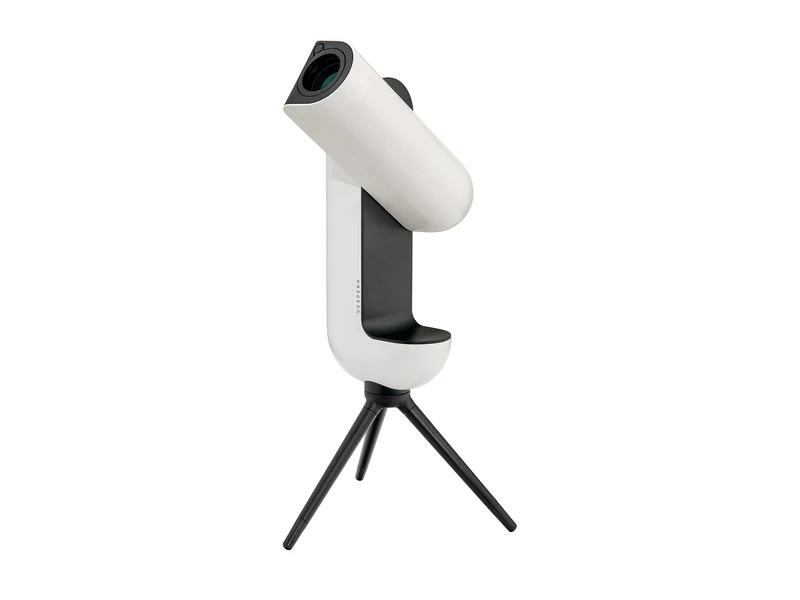
50mm f/5 with an 8.3MP sensor and automatic mosaics up to 4.3 degrees. Tripod and filters extra.
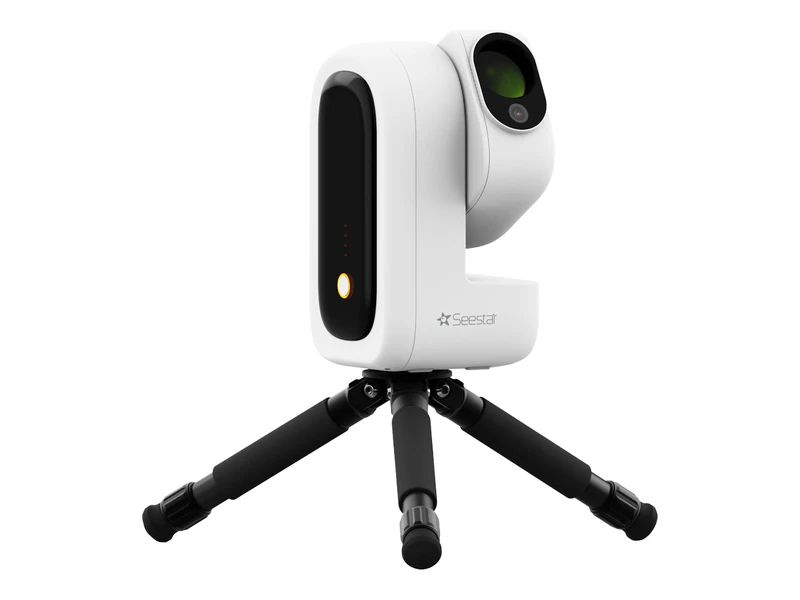
50mm APO, dual 8.3MP cameras, built-in dual-band filter, tripod and case, for less than half the Odyssey's price.
Affiliate links: you pay the same price, we earn a small commission that helps keep WatchTheStars free.