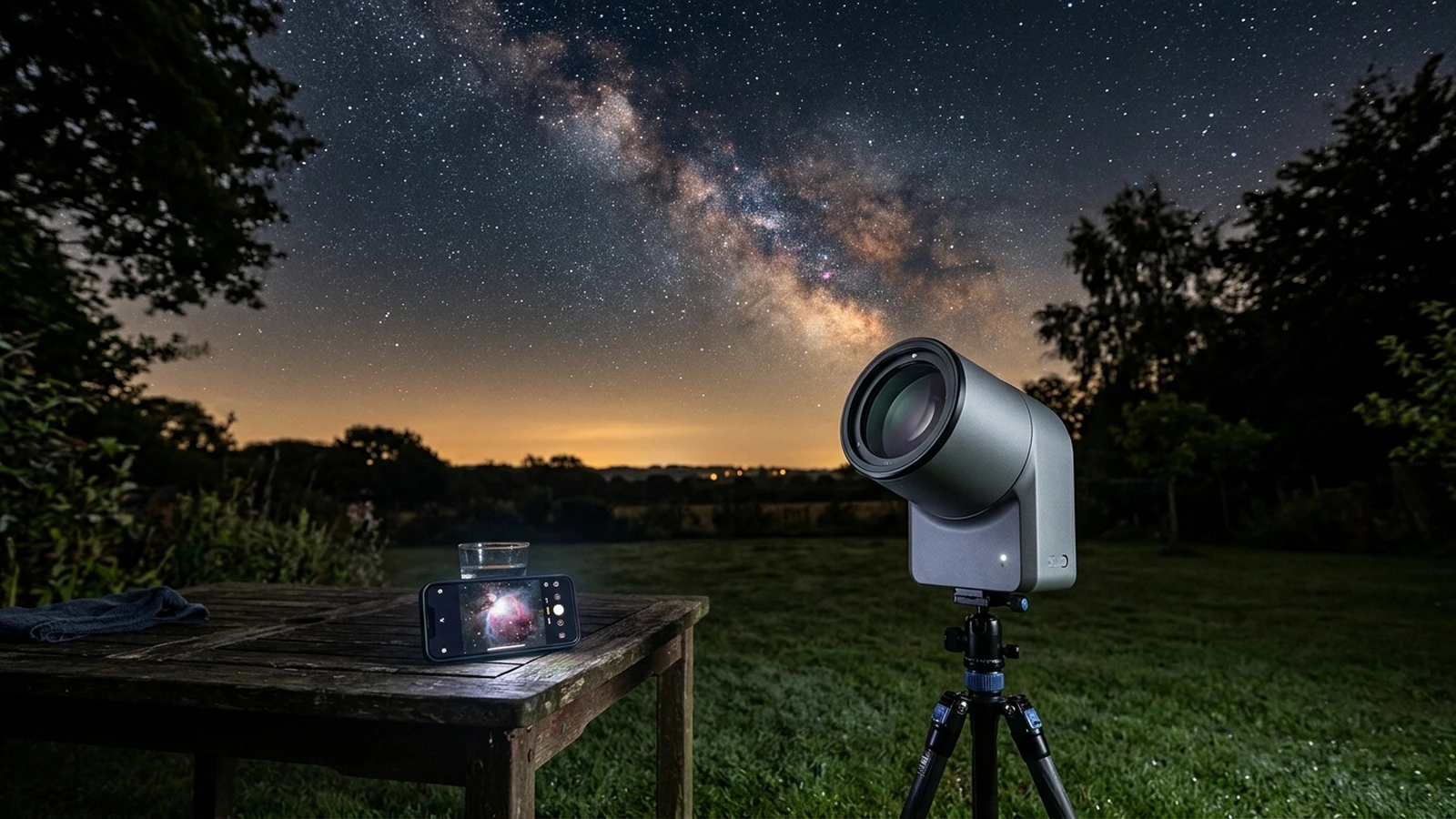
DwarfLab Draco
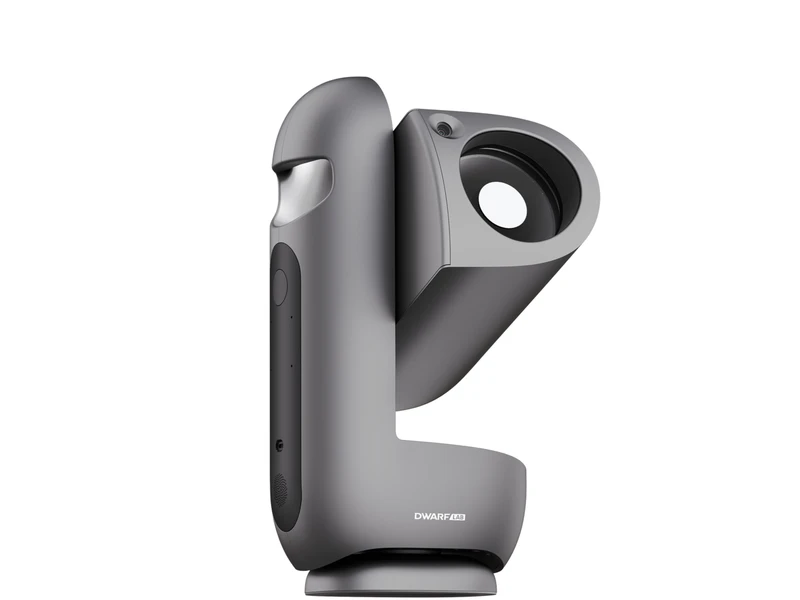
Image: DwarfLab
Updated 18 September 2026. Nobody outside DwarfLab has tested a production Draco yet. Everything below comes from DwarfLab's own specifications and launch material, cross-checked against the Dwarf 3 and its rivals. We'll rewrite the verdict once we have hands-on results. Wondering whether it's worth the jump from the Dwarf 3? The Draco vs Dwarf 3 section below goes through what the extra £890 buys. Weighing it against the Seestar S50 Pro or Vespera II instead? Our Seestar S50 Pro vs Dwarf Draco vs Vespera II comparison goes through it target by target.
The DwarfLab Draco is a 90mm smart telescope that costs £1,349 on pre-order at First Light Optics, with deliveries expected in November or December 2026. It is the first smart telescope with more than 50mm of aperture to come in under £2,000, and it lands in a gap in the market that has been empty since smart telescopes arrived: above the £400 to £1,000 beginner class of the Dwarf 3 and Seestar, below the £2,000-plus Vaonis and Unistellar models. That is why it matters, and why the specs deserve a careful look before you pre-order.
| Key Specifications: DwarfLab Draco (manufacturer figures) | |
|---|---|
| Aperture | 90mm, folded optical design |
| Focal length | 340mm, f/3.8 (1200mm full-frame equivalent) |
| Main sensor | 1/1.3-inch, 50MP, 1.2µm native pixels; 2×2 binned to about 12MP (2.4µm) for deep sky |
| Telephoto field of view | About 1.9° × 1.1° (DwarfLab app data) |
| Wide-angle camera | 1/1.55-inch sensor, 23.3mm equivalent, 85.7° diagonal field |
| Exposure range | 1/10000s to 300s, with built-in guiding |
| Mount | Motorised alt-azimuth; equatorial mode with no extra mount; physical sensor rotation for framing |
| Built-in filters | Astro, dark frame, Hα + OIII dual-narrowband (13nm ± 3nm). Standard Edition adds ND (solar); SHO Edition adds SII + OIII |
| Calibration | Built-in flat and bias data; darks captured automatically during stacking |
| Battery | 10,000mAh, about 5 hours; USB-C |
| Connectivity | Wi-Fi, NFC tap-to-connect, USB 3.0, USB Ethernet, PhotonLink remote control |
| File formats | JPG, PNG, TIFF, FITS |
| Weight | 5.5kg body; 480g tripod |
| In the box | Draco, aluminium tripod, USB-C cable, cleaning cloth (SHO Edition adds an external magnetic ND filter) |
| Warranty | 2 years (DwarfLab) |
| UK price | Standard £1,349; SHO £1,499, both pre-order at First Light Optics |
| Availability | Pre-order at First Light Optics; deliveries expected November or December 2026 |
DwarfLab Draco specs: what the 90mm aperture actually buys you
Aperture is the spec that matters most, and 90mm is a different league from anything DwarfLab has made. The Dwarf 3 has a 35mm lens. Light grasp scales with the area of the lens, so the Draco gathers about six and a half times as much light per second, and it does it at f/3.8 rather than f/4.3. In practice that means a faint galaxy that needs two hours of stacking on a Dwarf 3 should reach the same depth in well under half an hour on the Draco, and targets that a small smart telescope can only hint at, such as the outer arms of M33 or the faint nebulosity around the Pleiades, come into range from a dark site.
The folded optical path is how DwarfLab has squeezed a 90mm, 340mm focal length telescope into a 386mm body. An analysis reported by Skies & Scopes before launch traced a Chinese patent filed in February 2026 describing a compact folded catadioptric design, which fits what DwarfLab has now confirmed. A folded design bounces light inside the tube to shorten it, the same trick Maksutovs and Schmidt-Cassegrains use. The trade-off is usually a central obstruction that costs a little contrast, and until we see real star fields we can't say how well corrected the edges are.
Resolution follows aperture too. A 90mm lens resolves detail about two and a half times finer than a 35mm one, which is why DwarfLab is talking about lunar craters and Saturn's rings, targets the Dwarf 3 struggles with.
The 50MP sensor, and why it's really a 12MP camera
The 50-megapixel headline needs unpacking. The Draco's main sensor is a 1/1.3-inch phone-class chip with tiny 1.2-micron pixels. For deep-sky work the telescope bins those 2×2, combining four pixels into one 2.4-micron pixel, and outputs roughly 12MP images. That is the right call: binning quadruples the signal each output pixel collects, and 2.4 microns on a 340mm focal length gives a sampling of about 1.5 arcseconds per pixel, which is well matched to typical UK seeing. For comparison the Dwarf 3 gives 8MP from a 1/1.8-inch sensor, and the Seestar S50 just 2.1MP.
The full 50MP native readout is used for the Sun, Moon and planets, where there is light to spare and the telescope crops around the target. That's where the 1.2-micron pixels pay off: the same optics deliver a much larger image of a crater or a planetary disc than a coarser sensor could.
The second camera is a genuine wide-angle: 23.3mm equivalent on a 1/1.55-inch sensor, an 86° diagonal view. It is meant for the Milky Way, star trails and timelapses while the main camera stacks a deep-sky target, the same dual-shooting trick the Dwarf 3 introduced but with a far larger sensor. If you've read our guide to seeing the Milky Way from the UK, this camera is the one you'd use.
300-second exposures with built-in guiding
This is the spec that separates the Draco from every sub-£1,000 smart telescope. The Dwarf 3 tops out at 60-second sub-exposures in equatorial mode, and the Seestars build their images from subs of well under a minute. The Draco claims 300 seconds, five full minutes, using built-in guiding to correct tracking errors as the frame builds. Long subs are what pull faint nebulosity above the noise floor, and they are the reason conventional astrophotographers spend money on autoguiders.
It does this in an equatorial mode that needs no separate mount: the all-metal base sits in the frame at an angle the app helps you set. Our polar alignment guide explains why tilting a telescope to match the Earth's axis stops stars trailing and field rotation ruining long exposures. The Draco also has physical sensor rotation, so you can turn the frame to fit a target without turning the whole telescope.
Calibration frames are handled for you: flats and bias data are built in, and darks are captured live during stacking. Darks shot at the sensor's actual temperature on the night are a step up from the fixed dark libraries some smart telescopes rely on.
How much does the DwarfLab Draco cost in the UK?
£1,349 for the Standard Edition, £1,499 for the SHO Edition, both on pre-order at First Light Optics. Both include the tripod and a carrying case, which the Dwarf 3 does not, so the like-for-like gap to a Dwarf 3 plus DwarfLab's £73 tripod is about £820. DwarfLab sell the same telescopes direct for £50 less (£1,299 / £1,449), but you lose UK dealer returns and warranty handling, which is why we point readers at First Light Optics.
Against the market: the Seestar S50 is £539 and the Seestar S50 Pro £999 at First Light Optics. The Vaonis Vespera II, a 50mm f/5 with an 8.3MP sensor, is £1,398. The Unistellar Odyssey, the only other smart telescope near this aperture at 85mm, is £2,099. The Celestron Origin Mark II, with 152mm of aperture, is £3,699. So the Draco is asking close to Vespera II money for nearly twice the aperture, and about 65% of Odyssey money for slightly more.
First Light Optics are taking pre-orders now, and buying from a UK dealer matters on a first-generation product: it gives you UK returns and warranty handling instead of dealing with DwarfLab direct.
When is the Draco release date?
Pre-orders opened on 7 September 2026, and First Light Optics are now taking UK pre-orders too, with deliveries expected in November or December 2026. There is no independent review yet, and the Cloudy Nights Draco thread, which had run to 25 pages before launch, is still speculation and unboxing anticipation rather than results.
If you want a telescope for the Orion season this winter, that timing works. If you want one for the last of the Milky Way core in September, it doesn't, and one of the in-stock scopes below is the honest answer.
Standard or SHO Edition: which Draco should you buy?
Both editions share the optics, sensor, Astro filter, dark-frame cover and an upgraded Hα + OIII dual-narrowband filter with a 13nm bandpass. That filter is the one that lets you image emission nebulae from a light-polluted UK garden, and it's on both.
The Standard Edition (£1,349) adds a built-in ND filter, so solar imaging is a one-tap job in the app and the telescope can switch to the Sun on its own when you're running it remotely.
The SHO Edition (£1,499) replaces that slot with a built-in SII + OIII filter. The telescope then shoots the Hα + OIII and SII + OIII filters in sequence and maps the three bands into the blue-and-gold Hubble palette automatically. For the Sun you get an external magnetic ND filter instead, which you must fit by hand before pointing at it. Read our guide to observing the Sun safely before you do; a smart telescope's sensor is as vulnerable as an eye.
Our advice: Standard, unless narrowband nebula images in the Hubble palette are the specific reason you're buying. The SHO Edition is £150 more, but it makes solar imaging a manual step and the SHO palette is a niche taste.
Who is the DwarfLab Draco for?
- Dwarf 3 or Seestar owners who've hit the ceiling. If you've spent a year stacking nebulae on a small smart telescope and want galaxies with structure, planetary nebulae with detail and the faint stuff at the edge of your dark-site sessions, aperture is the only cure, and this is the cheapest 90mm you can get with everything automated.
- People who want a remote observatory without building one. USB Ethernet, PhotonLink remote control, motorised filters and a dark-frame cover mean the Draco can live in a garden shed or a friend's dark-sky field and be run from the sofa. That is a first at this price.
- Imagers who'd rather not learn PixInsight. Stellar Studio in the app does stretching, star reduction, star removal and noise reduction on the phone. FITS and TIFF export is there when you outgrow it.
It is not for you if you want a telescope you can throw in a rucksack (5.5kg is four Dwarf 3s), if you mainly want to look through an eyepiece (there isn't one), or if this is your first telescope and £1,349 is a stretch. For a first smart telescope, our best smart telescopes guide still points at the Seestar and Dwarf 3.
What can the Draco photograph?
Emission nebulae
The Orion, Rosette, Heart and North America Nebulae through the 13nm dual-narrowband filter. With 300-second subs from a suburban garden these should show detail the Dwarf 3 only sketches. The SHO Edition adds Hubble-palette versions.
Galaxies
This is where 90mm earns its keep. M81 and M82, the Whirlpool, the Leo Triplet and the Pinwheel are all small targets that reward aperture and resolution. From one of the UK dark sky sites the Draco should make real galaxy images, not smudges.
The Moon
Full-resolution 50MP readout and 340mm focal length give a large, sharp lunar disc. Craters, rilles and the terminator should be its best showcase target. Our Moon photography guide covers when to shoot.
The Sun
Sunspots and eclipses through the ND filter, tracked automatically. With the 2027 solar eclipse from the UK less than a year away, one-tap solar imaging is a real selling point.
Planets
Jupiter's belts and Great Red Spot and Saturn's rings are within reach, but 340mm is short for planets. Expect small, clean discs rather than the detail a dedicated planetary imaging setup gives.
Milky Way and star trails
The wide camera handles the arch, meteor-shower nights and star-trail timelapses while the main camera stacks. Mosaic mode expands the main camera's field to about three times its area for big targets like Andromeda.
What we don't know yet, and what to watch for in reviews
- Real image quality. Every figure here is DwarfLab's. Folded optics with a fast f/3.8 ratio are hard to make well, and star shapes at the edge of the frame will tell the story. Wait for FITS files from independent testers.
- Sensor noise. A phone-class sensor with 1.2-micron pixels is an unusual choice for deep sky. Binning helps, but read noise and hot pixels on 300-second subs are the thing to check.
- Battery in the cold. Five hours is DwarfLab's figure at room temperature. Guiding, motorised filters and a big sensor all draw power; a UK January will be shorter. USB-C power banks work, and the USB port makes mains power easy for a fixed setup.
- App maturity. DwarfLab's app has improved a lot since the Dwarf II, but ZWO's Seestar app is still the smoother experience. Guiding, scheduling and the SHO workflow are all new code.
- The tripod. 175mm tall is a tabletop tripod. On grass with a 5.5kg telescope you'll want a table, a wall or a sturdier photo tripod with a 3/8-inch stud.
- Dew. There is no mention of a built-in dew heater. The Seestar S30 Pro has one. A folded design with a front corrector plate will dew up on a damp UK night, so budget for a heater band.
Dwarf Draco vs Dwarf 3: is it worth £890 more?
Here is what the money buys. Aperture: 90mm against 35mm, so a galaxy that takes two hours to build on the Dwarf 3 should reach the same depth in well under half an hour, and objects the Dwarf 3 can't reach at all come into range. Exposure: 300-second guided subs against 60 seconds, which is the single biggest difference for faint nebulae, because long subs lift faint signal above the sensor's read noise in a way that stacking short ones never quite does. Resolution: the Draco's lens resolves detail two and a half times finer, which is what you'll notice on the Moon and on small galaxies like M81 and M82. Filters: a narrower 13nm dual-band on the Draco against the Dwarf 3's wider one, so more sky glow is rejected from a town garden. Calibration: the Draco captures real dark frames on the night. And a tripod in the box, which the Dwarf 3 charges £73 for.
What you give up: portability, £890, and certainty. The Dwarf 3 is a known product with two years of firmware behind it, 23 reviews at First Light Optics and a solved list of quirks. The Draco has a spec sheet. Its folded optics are hard to make well at f/3.8, its 1.2-micron phone-class pixels are an unusual choice for deep sky, and its guiding, scheduling and Hubble-palette workflow are all new code. It's also 5.5kg against 1.35kg: the Dwarf 3 is a smart telescope you carry, the Draco is one you set up.
Verdict: on paper the Draco, comfortably. In practice, wait for review units before spending £1,349, unless you'd rather be first than sure. If you already own a Dwarf 3, don't sell it as a stopgap: you'd lose more than the difference.
Dwarf Mini vs Dwarf 3 vs Draco: which DwarfLab should you buy?
DwarfLab now sell three smart telescopes. The Dwarf Mini (around £389) and Dwarf 3 (around £459) are the same idea at two price points: a 150mm focal length lens the size of a paperback, a wide-angle camera alongside it, a dual-band filter for nebulae and a battery that lasts the night. The Mini has a 30mm lens and a 2MP sensor; the Dwarf 3 a 35mm lens, an 8MP sensor with four times the detail and a better wide camera. For £70 more the Dwarf 3 is the one to buy of the two. The Draco is not a bigger Dwarf 3; it's a different class of instrument that happens to run the same app, with six and a half times the Dwarf 3's light and nine times the Mini's. Dwarf 3 for almost everyone starting out; Mini only if £70 matters; Draco for Dwarf 3 owners who've hit its limits and know they'll use the extra aperture.
Draco vs Seestar S50 Pro and Vespera II
Against the Seestar S50 Pro it's £350 more for 80% more aperture and much longer exposures, but the Seestar is lighter, comes with a case and has the more polished app. Against the Vaonis Vespera II at £1,398 the Draco has nearly twice the aperture for less money, and against the £2,099 Unistellar Odyssey it has slightly more aperture for £750 less. Whether DwarfLab's optics and software can deliver on that spec sheet is the question that decides all of it. We've written the full head-to-head as a separate page: Seestar S50 Pro vs Dwarf Draco vs Vespera II. For the budget end of the market, our Seestar S50 vs Dwarf 3 comparison is the place to start.
The Draco and the alternatives
Kit we've tested and reviewed in full
All four are sold by First Light Optics with UK warranty and returns. The Draco is pre-order; the other three are in stock. Prices are pulled from our product data.
90mm f/3.8, 50MP sensor binned to 12MP, 300-second guided subs, tripod in the box. Pre-order, deliveries from November.
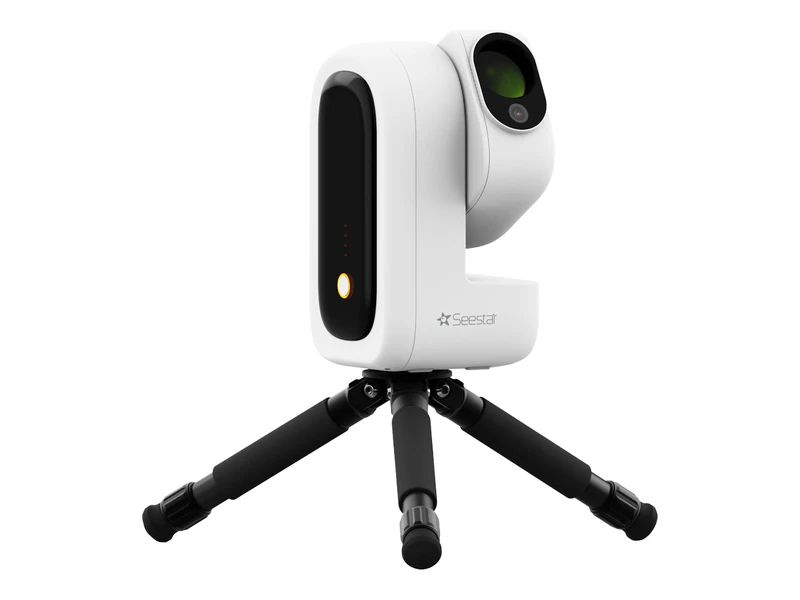
50mm aperture, dual 8.3MP 4K cameras, tripod and case in the box. Launched August 2026 and £350 cheaper than the Draco.
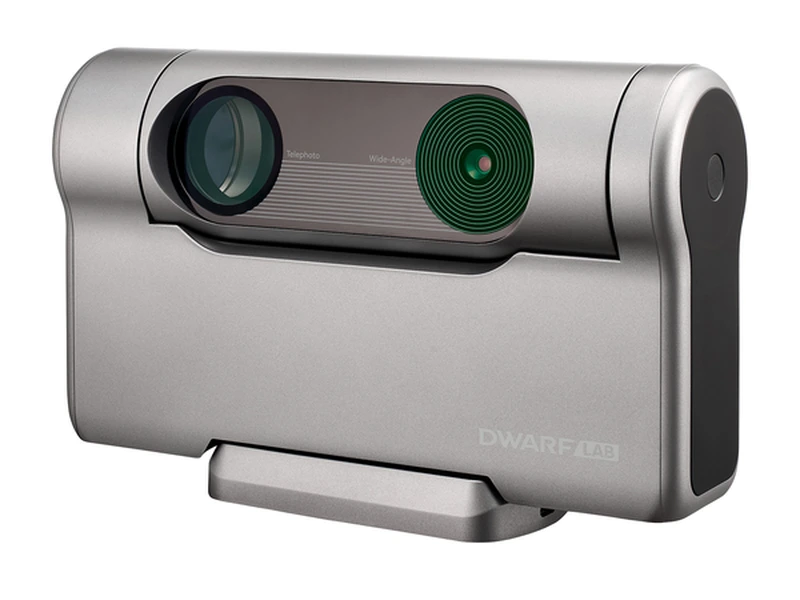
The Draco's little brother. 35mm f/4.3, 8MP sensor, wide-angle lens and equatorial mode. Add a tripod.
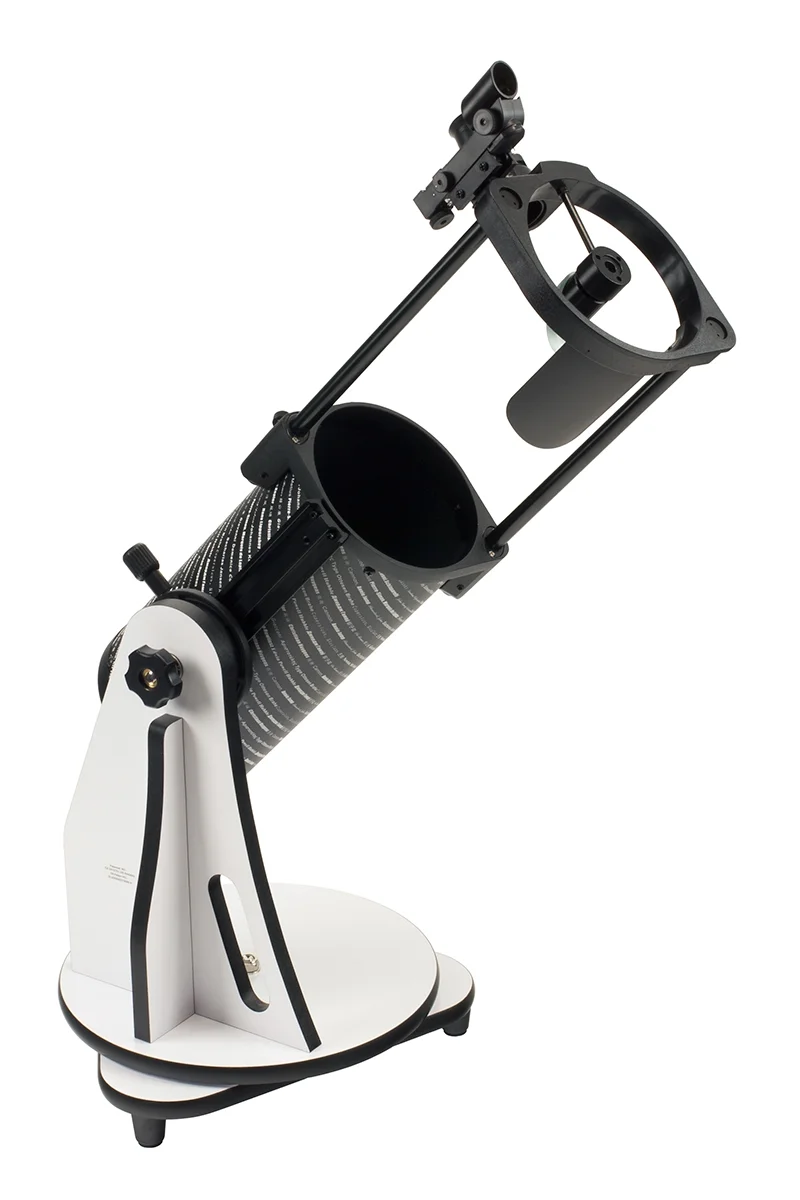
No smart telescope has an eyepiece. If you want to see Saturn's rings with your own eye, this does it for under £200.
Affiliate links: you pay the same price, we earn a small commission that helps keep WatchTheStars free.