Vaonis Vespera II
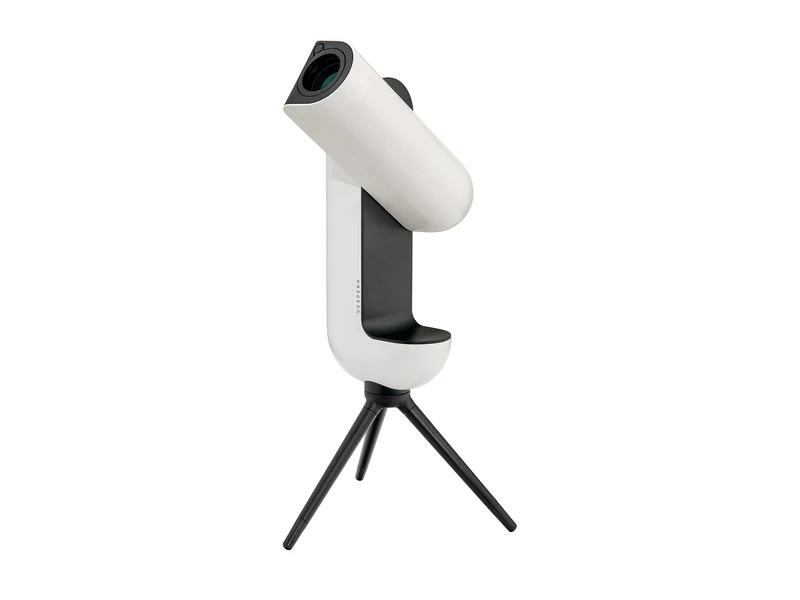
Image: Vaonis
The Vaonis Vespera II is the smart telescope for people who care how the thing looks on the patio as much as what it puts on the screen. Vaonis are a French design-led company. The Vespera II is the best-looking telescope in this category by some distance, and the Singularity app is the most polished piece of software in this market. Underneath is a 50mm f/5 lens and an 8.3MP Sony IMX585 sensor, the same chip ZWO use in the Seestar S30 Pro. The question for a UK buyer is whether design, the CovalENS mosaic mode and a nicer app are worth about £500 more than a Seestar S50 Pro with the same aperture.
| Key Specifications: Vaonis Vespera II | |
|---|---|
| Aperture | 50mm refractor |
| Focal length | 250mm, f/5 |
| Sensor | Sony IMX585 colour, 8.3MP (3840×2160), 2.9µm pixels |
| Field of view | 2.5° × 1.4° native; up to 4.33° × 2.43° (about 24MP) with CovalENS mosaics |
| Image scale | About 2.4 arcseconds per pixel |
| Mount | Motorised alt-az, automatic star-field alignment, autofocus, live stacking |
| Filters | None built in; optional clip-on dual-band, light pollution and solar filters |
| Battery | About 4 hours; charges and runs over USB-C |
| Storage | 25GB internal |
| Connectivity | Wi-Fi to phone or tablet; Singularity app (iOS and Android), 4,300-object catalogue, Plan My Night scheduling |
| Weight and size | 5kg; 48 × 20 × 9cm |
| In the box | Telescope, USB-C cable. Tripod sold separately or as a bundle |
| Launched | 2024 |
| Warranty | 2 years via First Light Optics |
| UK price | £1,398 at First Light Optics (telescope only) |
What makes the Vespera II different?
- CovalENS mosaics. Rather than stacking on one fixed field, the Vespera II shifts its pointing slightly between exposures and stitches the frames, so a finished image can cover 4.3 by 2.4 degrees at around 24 megapixels. Andromeda fits with room to spare, the whole of the North America and Pelican nebulae go in one frame, and the Pleiades sit in a wide, natural field. No other smart telescope at this price does mosaics automatically.
- The Singularity app. It is the best-looking and most coherent app in the category: object suggestions ranked for your sky, a Plan My Night scheduler that runs a list of targets unattended, and clean export of stacked images and raw data. ZWO's app has caught up on features, but Vaonis's is still nicer to use.
- Build and design. The Vespera II is a sealed, sculpted unit that looks like a product rather than a piece of kit. It is heavier than it looks at 5kg, but it feels expensive in a way the Seestar does not.
- Sensor. The Sony IMX585 is a good choice for a 50mm f/5: big enough pixels to keep noise down, 8.3MP for detail, and a wide field. The jump from the original Vespera's 2MP sensor is the main reason to buy the II over a used first-generation unit.
Who is the Vespera II for?
There are three sorts of buyer here. One wants a smart telescope that does not look like a security camera on a stick and is happy to pay for design; the Vespera II is the only one that fits. Another wants wide-field mosaics of big targets without learning mosaic planning in a dedicated rig; CovalENS is the answer and nothing at £899 has it. A third already owns an original Vespera and wants the sensor upgrade in the same ecosystem.
It is not for the buyer whose priority is the most image per pound. That is the Seestar S50 Pro, and the gap is not small once you add a tripod and a dual-band filter to the Vespera's price. It is also not for anyone who wants planets, and if aperture is the goal, the Unistellar Odyssey at 85mm or the pre-order DwarfLab Draco at 90mm are the ones to look at.
What can the Vespera II photograph?
Nebulae
The Orion Nebula, the North America Nebula and the Veil are the showcase targets, and the mosaic mode is what makes the big ones work. From a town garden you will want the dual-band filter.
Galaxies
Andromeda in one mosaic frame is the image every Vespera owner posts first. Smaller galaxies like M81 and M82 come out as soft ovals with a hint of structure at 250mm focal length.
Star clusters
The Pleiades, the Double Cluster and the Beehive suit the wide field well. Globulars like M13 resolve into a grainy ball rather than individual stars.
The Moon
A full disc with mare and major craters. Not a lunar instrument, but pleasant.
The Sun
With Vaonis's solar filter, sunspots and the full disc. Reviewers found solar targets slower to acquire than night ones.
Planets
Small discs only. Jupiter's moons, yes; cloud belts, barely. Look elsewhere for planets.
Vespera II vs Seestar S50 Pro vs Odyssey: how it compares
Against the Seestar S50 Pro (£999), the Vespera II has the same aperture, a comparable 8.3MP sensor, a nicer app and the mosaic mode. The Seestar has a built-in dual-band filter, a second wide-angle 4K camera, more than twice the battery, five times the storage, and a tripod and hard case in the box, for about £500 less. On a like-for-like image of the Orion Nebula from a UK garden, most people would struggle to tell them apart.
Against the Unistellar Odyssey (£2,099), the Vespera II is £700 cheaper and wider-field; the Odyssey has nearly three times the light-gathering area, a longer focal length that suits galaxies and globulars, and a tripod included. Choose by target: big nebulae and mosaics, Vespera; small galaxies and clusters, Odyssey.
Within Vaonis's own range, the Vespera III (£2,199) and Vespera Pro II (£2,599) add apochromatic quadruplet optics and an 11-hour battery but stay at 50mm. Unless the battery is the deal-breaker, the II is the sensible Vaonis.
Known limitations and trade-offs
- No tripod in the box. Budget for one, or take the FLO bundle. The Seestar S50 Pro and Odyssey both include theirs.
- No filter in the box. Vaonis's dual-band filter is an extra purchase, and from a UK town you will need it for nebulae. ZWO and DwarfLab build theirs in.
- Four-hour battery. The shortest here. Fine for an evening, not for an all-night Plan My Night run without a power bank.
- Images can be a little soft. Sky at Night's 4.5-star review noted softness and the occasional need to refocus twice. It is a 50mm f/5 lens, and it behaves like one.
- 25GB of storage. Enough for a few nights of stacked images, but you will be offloading regularly if you keep the raw frames.
- Smaller UK community. Seestar owners outnumber Vespera owners many times over on Stargazers Lounge, which matters when something will not connect at 11pm.
Accessories for the Vespera II
Two are close to essential: a tripod, and the dual-band filter if you image from anywhere with streetlights. Vaonis's own tripod is the tidy option and folds to match the telescope; any solid photo tripod with a 3/8-inch stud works. A USB-C power bank stretches the four-hour battery to a full night. A dark sky site does more for a 50mm telescope than any accessory, and our guide to the best smart telescopes has the full comparison if you are still deciding.
Is the Vespera II worth £1,398?
Yes, if design, the CovalENS mosaic mode and the Singularity app are what you are paying for, and you accept that a tripod and a dual-band filter push the real cost towards £1,600. No, if you are measuring image per pound: the Seestar S50 Pro has the same aperture, a comparable sensor, a filter, a case and a tripod for about £500 less, and from a UK garden the two produce images most people could not tell apart. Buy the Vespera II because you want it, not because it out-images the alternatives.
Vespera II and the alternatives
Kit we've tested and reviewed in full
All three are stocked by First Light Optics with UK warranty and returns. Prices are pulled from our product data.
50mm f/5, Sony IMX585 8.3MP, CovalENS mosaics to 4.3 degrees, Plan My Night scheduling. Tripod and filters extra.
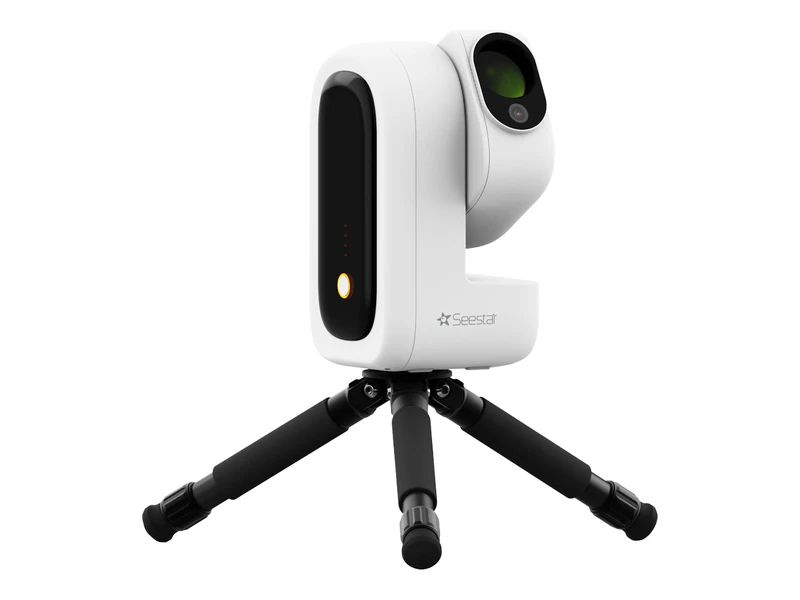
50mm quadruplet APO, dual 8.3MP cameras, built-in dual-band filter, tripod and case included. The value pick.
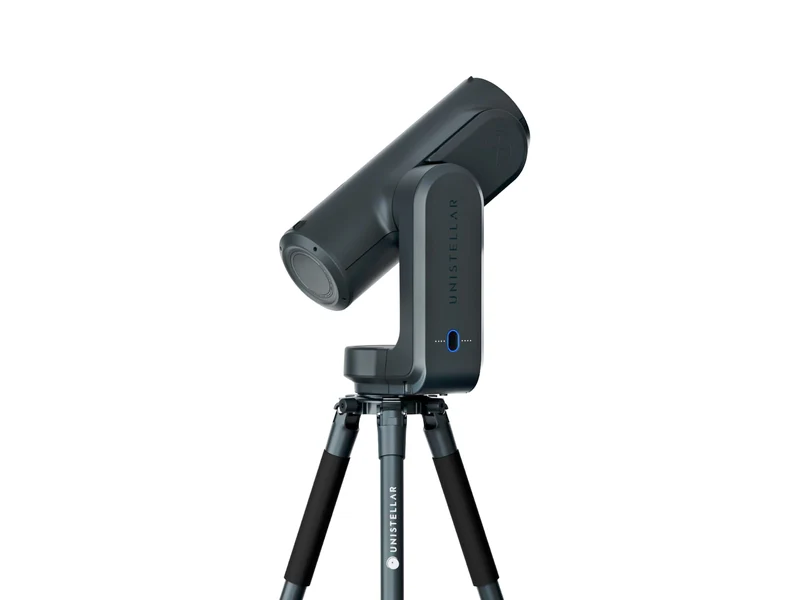
85mm f/3.9 mirror telescope with Nikon optics and no collimation to worry about. Tripod included.
Affiliate links: you pay the same price, we earn a small commission that helps keep WatchTheStars free.