Optical Design
Schmidt-Cassegrain (SCT)
Mount Type
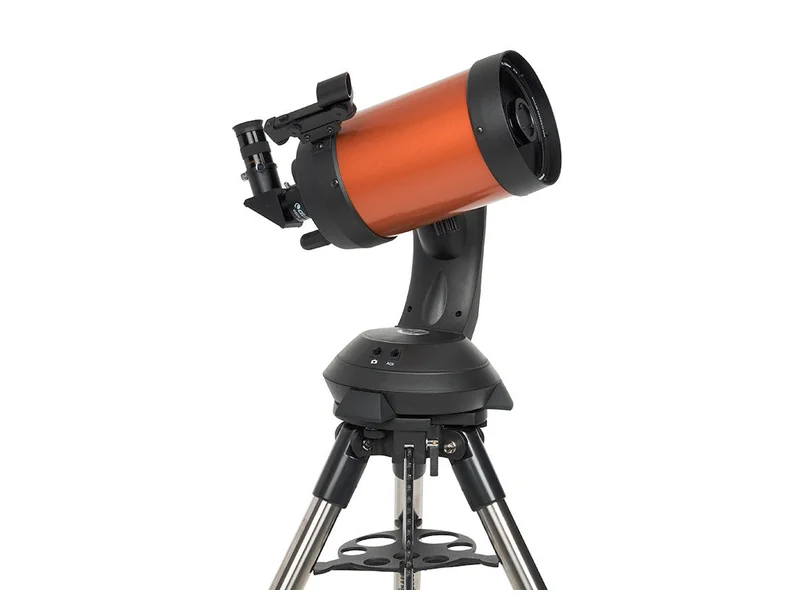
Single-arm alt-az fork (GoTo)
Weight
8kg scope + mount, 4.5kg tripod
Highest Useful Magnification
300×
Power Source
8× AA batteries or 12V DC
Celestron NexStar 5SE Review: What Is It?
The Celestron NexStar 5SE is a 125mm Schmidt-Cassegrain telescope on a computerised GoTo mount. It is the smallest SE model that still uses the proper Schmidt-Cassegrain design (the 6SE and 8SE share the same optical layout, the 4SE is a Maksutov). The tube is 33cm long and weighs about 4kg, which is why it has a loyal following among people who want a telescope they can carry in a rucksack to a UK dark sky site.
The price is around £945 at full RRP. First Light Optics regularly runs it under £900, and open-box units appear for less, so check before assuming the RRP.
How the Schmidt-Cassegrain works: light enters through a thin corrector plate at the front, bounces off the main mirror at the back, hits a small secondary mirror, and leaves through a hole in the main mirror to the eyepiece. That folded path is how a 1250mm focal length fits in a 33cm tube.
Who the 5SE suits
People who want a telescope to find things for them and who care about portability. If you drive to dark skies, go caravanning, or live in a flat with no garden, the 5SE makes more sense than the 6SE. It also works as a very good daytime spotting scope: the C5 optical tube has been used that way for decades.
Who should skip it
Anyone who wants the most telescope for the money. A Sky-Watcher Skyliner 200P review will tell you an 8-inch Dobsonian costs around £340 and collects two and a half times as much light. The 5SE sells convenience, not aperture.
NexStar 5SE vs 6SE: Which Should You Buy?
This is the question most people arrive with, so here is the short answer. At full price, buy the 6SE. On offer, or if weight matters, buy the 5SE.
What the extra £250 buys with the 6SE: 150mm aperture instead of 125mm, which is 44% more light-gathering area. A bigger, steadier mount (the 6SE and 8SE share one, the 4SE and 5SE share a smaller one). Noticeably better views of faint galaxies and planetary detail on good nights.
What the 5SE does better: weighs 12.5kg all in against the 6SE's 14kg, and the tube is about 8cm shorter. Cools down faster on a cold evening. Fits in a rucksack. Costs less, and the gap widens when it is on offer.
The honest view
The 5SE is Celestron's awkward middle child. The 4SE is cheaper, the 6SE is better. Where the 5SE earns its place is as a travel scope, a second scope for someone who already owns a big Dobsonian, or simply as the one you can afford when it is on sale at £850. Several owners on Stargazers Lounge bought a 5SE for exactly that reason and have no regrets.
What Can You See with the NexStar 5SE?
The Moon
This is where a 125mm f/10 scope shines. Crater floors, rilles, mountain shadows along the terminator, all crisp. The supplied 25mm eyepiece gives 50×, which is a comfortable whole-disc view. A 10mm eyepiece takes you to 125× for close-ups of Clavius, Copernicus and the Apennines. Check is it a full moon tonight before you plan a session: the best lunar detail is near first and last quarter, not at full Moon.
Jupiter and Saturn
Jupiter shows its two main cloud belts and four Galilean moons at 50×. At 125× to 150× you can catch the Great Red Spot when it is facing Earth and watch moon shadows cross the disc. Saturn's rings are obvious at any magnification; the Cassini Division appears on nights of steady air. One FLO customer described keeping Saturn centred at 156× while they went indoors to make a cup of tea. That is the GoTo tracking doing its job.
Venus and Mars
Venus shows a clean crescent with no false colour, because an SCT has no lens to cause it. Mars is small except around opposition, when the 5SE will show the polar cap and the darker markings such as Syrtis Major. Use our guide to what you can see in the sky tonight to check which planets are up.
Deep sky
M42 (Orion Nebula)
Bright and clearly shaped. The four Trapezium stars split easily. Good from a town garden.
M13 (Hercules Cluster)
Grainy ball of light from suburbs; outer stars resolve from a dark site at 125×.
M31 (Andromeda)
Bright core and a smudge of halo. The 1° field is too narrow to frame the whole galaxy.
M57 (Ring Nebula)
A small smoke ring. Clearly non-stellar even from light-polluted skies.
Double stars
Albireo, Mizar, the Double Double. Excellent: this is where f/10 SCTs excel.
Faint galaxies
M51 and M81 are dim smudges. The Virgo cluster galaxies need a dark site and averted vision.
The pattern is clear. The 5SE is a Moon, planet, double star and bright-cluster telescope. It will show you deep-sky objects, but 125mm is the limit on faint ones, and the narrow 1° field means you never get the wide sweeping views an 8-inch Dob at f/6 gives.
How Does the GoTo Work?
Alignment
Set the tripod level, point the tube roughly north, enter the date in American format (month first, which catches most UK owners out at least once) and your location. Then centre two or three bright stars in the eyepiece. SkyAlign lets you pick any three bright objects without knowing their names. The whole thing takes 5 to 10 minutes.
A tip shared by a FLO reviewer: enter your exact latitude and longitude rather than the nearest city, defocus each alignment star into a doughnut so you can centre it precisely, and finish each adjustment moving up and right. Owners who do this report the GoTo landing objects in the eyepiece almost every time.
Finding and tracking
Type M13 or Saturn into the hand controller, press Enter, and the mount slews there. The tracking then holds the object in view for as long as you like. At 150× this is a real comfort compared with nudging a manual scope every 30 seconds.
Solar System Align
Useful at dusk when only one planet is visible. Centre Venus or Jupiter and the scope will track it. Do not rely on it for GoTo accuracy across the sky, one object is not enough for that.
What Buyers Say About the NexStar 5SE
The 5SE has been on sale for the best part of twenty years, so there is a lot of owner feedback on UK forums and on First Light Optics' own reviews. The picture is consistent.
- The optics get no complaints. Several owners call the C5 tube the best 5-inch optical tube short of an apochromatic refractor. It cools quicker than a Maksutov and gives slightly wider views.
- The GoTo is reliable once learned. First-night frustration is common, usually from the date format or a sloppy alignment. By the third session most people describe it as second nature.
- Everyone buys a power supply. Eight AAs last a few hours. A PowerTank or 12V mains adapter is the universal day-one purchase.
- The lens cap and hand-controller holder are weak points. The cap falls off; the holder bracket is fiddly in the dark. Minor, but mentioned repeatedly.
- Deep-sky photography disappoints. Owners who bought it hoping to image galaxies ended up with 10-second subs and a lot of field rotation. It is a visual and lunar-planetary imaging scope.
- Price is the main gripe. More than one reviewer says it would be an easy recommendation at £100 less. On offer, that gripe disappears.
Known Limitations
Narrow field of view
The maximum true field is about 1°, twice the width of the full Moon. Fine for planets and clusters, frustrating for the Pleiades or sweeping the Milky Way. If wide views matter to you, look at a Dobsonian or at best binoculars for stargazing as a companion.
Single-arm wobble
Tap the tube at 150× and the image shakes for two or three seconds. A gust of wind does the same. It is the price of a light, portable fork mount. Hanging a bag from the tripod tray helps.
Dew on the corrector plate
The front glass faces the sky and dews over fast on UK nights. A flexible dew shield for 5-inch scopes is about £23 at FLO and should be in your basket with the telescope.
Not for long-exposure deep-sky imaging
The alt-azimuth mount rotates the field during long exposures, and the tripod's built-in wedge is not stable enough to fix that properly. Keep imaging to the Moon, planets and short-exposure bright objects.
Battery life
Three to four hours on fresh AAs, less in the cold. Treat the batteries as a backup, not the main power source.
Essential Day-One Purchases
12V power (£25 to £125): Baader's outdoor power supply is £25 if you have a socket nearby, or Celestron's car battery adaptor is £29. Observing away from the house, a Celestron PowerTank Lithium LT is £125. Either way, do not rely on AAs.
Flexible dew shield (£23): Astro Essentials make one for 5-inch scopes. It also cuts stray light from streetlamps.
A 10mm or 12mm eyepiece (£55 to £80): The supplied 25mm gives 50×. You want 100× to 125× for the Moon and planets. The BST StarGuider 12mm at £55 is the standard UK recommendation.
Moon filter (£11): At 125× the full Moon is uncomfortably bright. An ND 0.9 filter fixes that.
Best Upgrades
Eyepieces
At f/10 you do not need expensive eyepieces to get sharp views. A 12mm and an 8mm BST StarGuider cover 104× and 156×, which is as much magnification as UK seeing usually allows. A 32mm Plössl gives the widest possible field in the 1.25" focuser.
Collimation knobs
Bob's Knobs (£25) replace the tiny secondary mirror screws with hand-turnable ones. SCTs rarely need collimating, but when they do, this makes it a two-minute job without a screwdriver near the corrector plate.
WiFi control
Celestron's SkyPortal WiFi module (£189 at FLO) replaces the hand controller with your phone. Handy for star parties and for warm-room observing in winter, but at that price it is a luxury, not a day-one buy.
Spend your first ten sessions with the supplied eyepiece, a power supply and a dew shield. You will know by then whether you want more magnification or a wider field, and that decides the next purchase.
Upgrade Path
- Step up to the NexStar 6SE: same system, bigger aperture, steadier mount. The natural move if portability turns out to matter less than you thought.
- Jump to the 8SE: 203mm aperture, around £1,615. Serious planetary and deep-sky views at the cost of a 15kg package.
- Go the other way: keep the 5SE for travel and add a Skyliner 200P for home. Many owners end up with exactly this pairing.
- Want to image instead? A star tracker and a camera lens will produce better deep-sky photos than the 5SE ever can, for half the price.
Celestron NexStar 5SE: Is It Worth It?
The NexStar 5SE is a well-made, portable GoTo telescope with excellent optics for the Moon, planets and double stars. The GoTo works, the tracking works, and the whole thing fits in a rucksack. Owners keep them for years.
At the £945 RRP it is hard to recommend over the 6SE, which costs about £250 more and is a clearly better telescope for someone who observes from home. At the £850 offer price FLO often runs, or lower for an open-box unit, the 5SE becomes the sensible choice for anyone who values portability, or who wants a computerised scope for travel alongside a bigger one at home.
Buy it on offer, add a power supply and a dew shield, and you will have a scope that finds and tracks Saturn while you make the tea. Just do not buy it expecting to photograph galaxies.
Affiliate disclosure: This guide is community-sourced research from UK astronomy forums (Stargazers Lounge, BBC Sky at Night forums) and verified First Light Optics customer reviews. I do not have personal hands-on experience with this scope. Specifications verified against official Celestron documentation. This page is not affiliated with Celestron or any retailer, though links may contain affiliate codes.
Back to Best Beginner Telescopes UK • Home