Key takeaways
- SETI Institute and University College London scientists propose searching one cubic metre of lunar soil (about 1.5 tonnes) for microscopic particles made by alien technology
- The paper by Lewis Pinault, Brian Lacki, Ian Crawford and Andrew Siemion reports no evidence of alien technology; it sets out a way to test the idea for the first time
- Engineered grains about 0.3 microns across could cross thousands of light years in 100 million to a billion years and survive landing on the airless Moon
- Finding nothing in a cubic metre would still be a result: it would put the first hard upper limit on how much artificial debris the galaxy's civilisations have ever shed
- Every Apollo mission combined brought back 382 kg of Moon rock, about a quarter of what the search needs, so Artemis, Chang'e and a future Moon base are the way it gets done
Jump to section 7 sections
- Alien Technology on the Moon: What the SETI Paper Actually Says
- How Alien Debris Could Reach the Moon
- Why the Moon Is a Four-Billion-Year Archive
- What Finding Nothing Would Prove
- How Scientists Would Search a Cubic Metre of Moon Dust
- Artemis, Chang'e and Who Collects the Sample
- From Arthur C. Clarke to Arkhipov: The Idea's History
Alien technology on the Moon sounds like the plot of 2001: A Space Odyssey, and in one sense it is. But a paper published this month by SETI Institute and University College London scientists takes the idea seriously in a way nobody has before. The claim is not that anything has been found. It is that a single cubic metre of lunar soil, examined properly, could either turn up microscopic debris from a civilisation that died before the Earth formed, or prove for the first time that such debris is rare enough to put a number on.
The lead author is Lewis Pinault, a planetary scientist at UCL and an affiliate scientist at the SETI Institute. His co-authors are Brian Lacki of Breakthrough Listen, Ian Crawford of Birkbeck, University of London, and Andrew Siemion of the SETI Institute and Breakthrough Listen. Their paper, Micron-Scale Technosignatures: How a Cubic Metre of Lunar Regolith May Begin to Constrain the Number of Past Technological Civilisations in the Galaxy, is on the arXiv preprint server and under review at the International Journal of Astrobiology. The SETI Institute announced it on 8 September 2026.
Alien Technology on the Moon: What the SETI Paper Actually Says
The paper proposes searching the Moon's soil, known as regolith, for engineered particles a fraction of a micron across that may have drifted in from other star systems and been buried there over billions of years. It reports no evidence of alien technology. What it offers is the first quantitative framework for the search: how such particles could travel, how they could survive, how many might be sitting in the regolith, and what it would take to find one.
That last point is what makes this different from the usual "aliens on the Moon" story. Most of the coverage this week has run with headlines about the Moon being littered with alien tech. The paper says something more careful and more interesting. Traditional SETI listens for radio or laser signals, which only works if someone is transmitting right now. A search for physical particles integrates over billions of years. It could detect a civilisation that went extinct before there was life on Earth.
Bill Diamond, the SETI Institute's president, called the concept "at once extraordinarily original and eminently reasonable". That is roughly where we land on it too. It is speculative, but it is speculation with a test attached.
How Alien Debris Could Reach the Moon
Alien debris could reach the Moon the same way natural interstellar dust does: pushed out of its home star system, carried across the galaxy by the motion of the stars and the gas between them, and eventually swept up by the Solar System. Our own satellites shed paint flakes, metal chips and insulation constantly. The paper's argument is that any civilisation that builds in space does the same, and that some of that material is tough enough to travel.
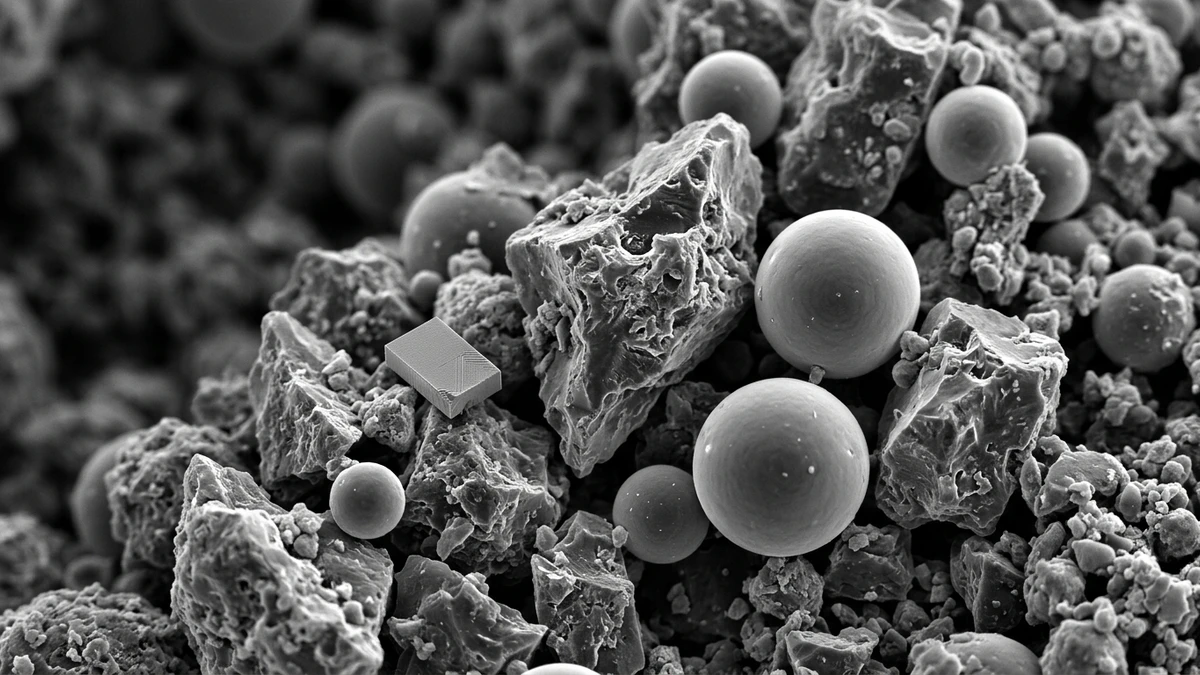
The authors modelled grains about 0.3 microns across. A human hair is around 70 microns wide, so these are a few hundred times thinner. At that size a grain of something hard and heat-resistant, such as a ceramic or a refractory metal, can drift through the interstellar medium for 100 million to a billion years, covering thousands of light years, before gas drag and erosion by fast-moving atoms wear it away.
Getting to the Moon in one piece is the hard part. A grain arriving at typical interstellar speeds would hit the airless surface at more than 2 km per second and vaporise. But the Sun's radiation pressure and its magnetic bubble, the heliosphere, filter incoming dust and slow some of it. The paper identifies what it calls a slow-arrival channel: a small but non-zero fraction of grains that reach the Earth–Moon system gently enough to survive, partly or wholly intact. We already know interstellar dust gets this far. NASA's OSIRIS-REx found grains of it in the samples it brought back from the asteroid Bennu, and the Stardust mission returned a handful of candidate grains in 2006.
The paper gives the two kinds of particle names. Unintentional debris, the cosmic equivalent of the space junk in Earth orbit, it calls Arkhipov particles, after the Ukrainian astronomer who first proposed the idea in the 1990s. Deliberately made micro-probes, seeded across space to sense, log or even self-replicate, it calls Bracewell particles, after Ronald Bracewell's 1960 proposal for interstellar probes. The whole quantitative case rests on the first, conservative kind. The second is flagged as speculative and set aside.
Why the Moon Is a Four-Billion-Year Archive
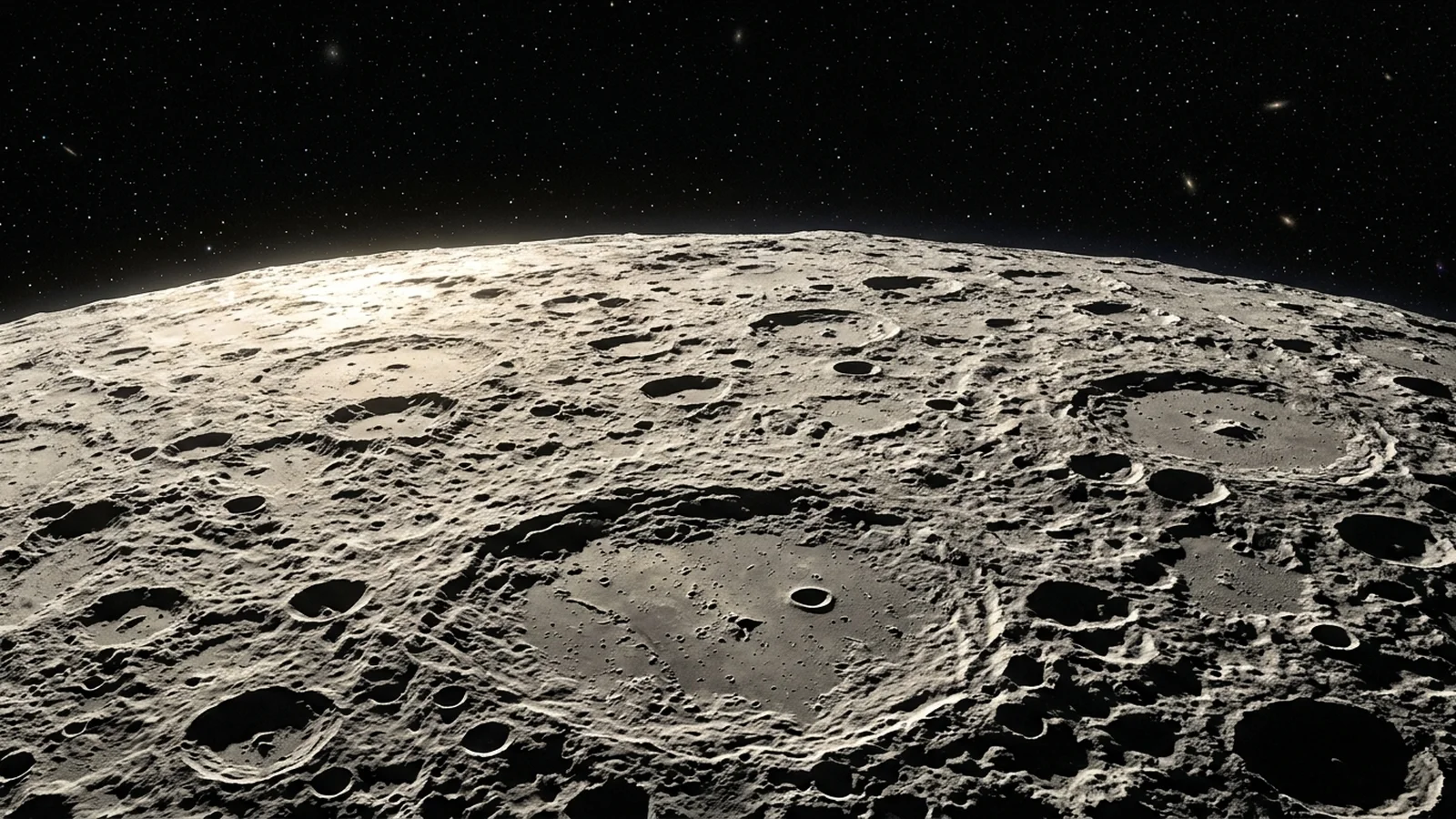
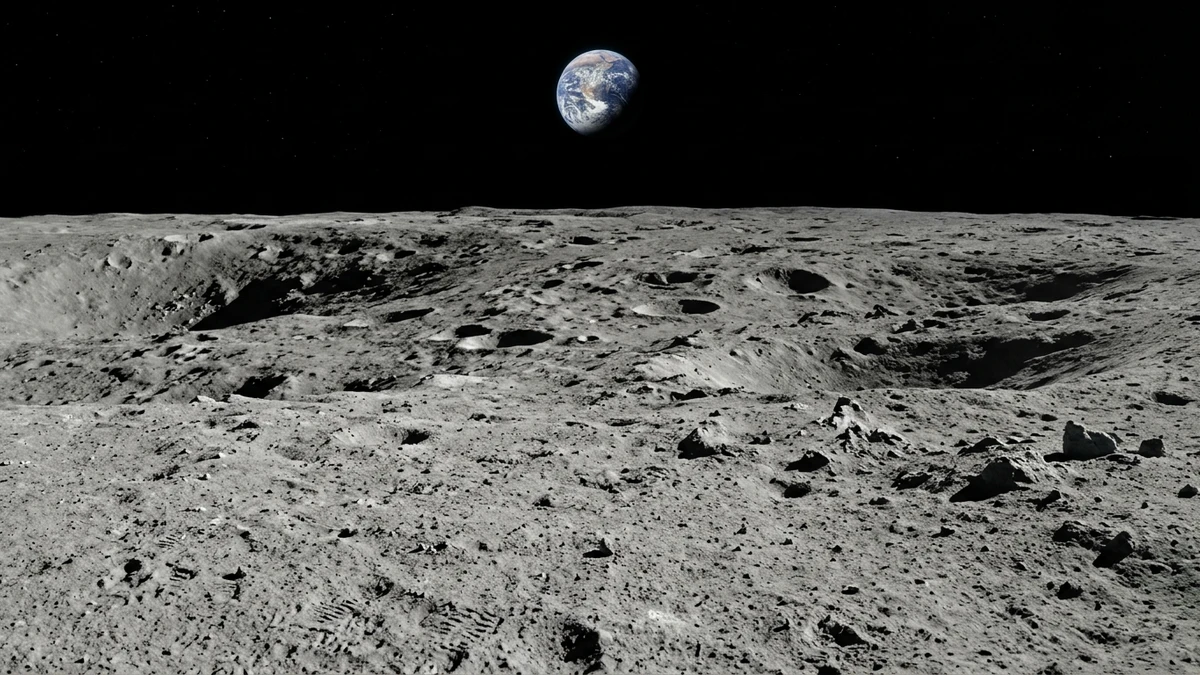
The Moon is a four-billion-year archive because nothing on it erases anything. There is no atmosphere to burn incoming grains, no water to wash them away, no plate tectonics to bury them and no life to recycle them. Whatever lands on the surface stays there, slowly churned into the regolith by the constant rain of micrometeorites, a process geologists call gardening.
Earth is the opposite. Weather, rivers, oceans, volcanoes and living things turn the surface over so thoroughly that a microscopic grain from a billion years ago has essentially no chance of surviving where we could find it. That is why the search for physical evidence of other civilisations has always looked outward, to the Moon, asteroids and the outer Solar System, rather than down.
"The Moon has been quietly accumulating material from space for billions of years, much of it likely billions of years older than the Moon itself," Pinault said in the SETI Institute's announcement. "We're asking whether that ancient collection might contain microscopic traces of technologies that existed long before humans ever looked up at the sky."
The paper compares several Solar System environments as collectors. The Moon wins on stability, exposure time and, crucially, access. It is three days away and there are more sample-return missions heading there than anywhere else. The downsides are the impact speeds and the gardening, which mixes old and new material together. Both are built into the model.
What Finding Nothing Would Prove
Finding nothing in a cubic metre of regolith would set the first hard upper limit on how much artificial debris technological civilisations have ever shed into the galaxy. That is the paper's central result, and it is why the authors think the search is worth doing even if, as seems likely, the first cubic metre comes up empty.
The specific figure is this: a null detection in one cubic metre rules out any scenario in which Sun-like stars typically disperse more than about 0.09 Earth masses of long-lived artificial particulate matter over the history of the Milky Way. That number does not tell you how many civilisations there have been. But it puts a ceiling on a quantity that has never had one, and every further cubic metre lowers it.
This is the same logic that runs through most of modern SETI. Decades of radio searches have not found a signal, but they have ruled out whole classes of loud, nearby transmitters, and that absence is itself information. The lunar search would do the same for physical artefacts, a field the authors call exo-archaeology.
If, on the other hand, a single grain turned out to be a confirmed non-natural alloy or structure, one that could not be a meteorite, a lunar mineral, a contaminant from the lab or a fragment of one of our own spacecraft, it would be direct material evidence of another technological civilisation. The bar for confirmation would be extremely high. The authors know it and say so.
See the archive for yourself
Kit we've reviewed in full
The regolith in this story is the same grey surface you can study from a back garden. The craters, the dark lava plains and the bright ray systems are all records of what has hit the Moon over four billion years. Check whether it is a full Moon tonight first; the best detail is along the shadow line when the Moon is half lit.
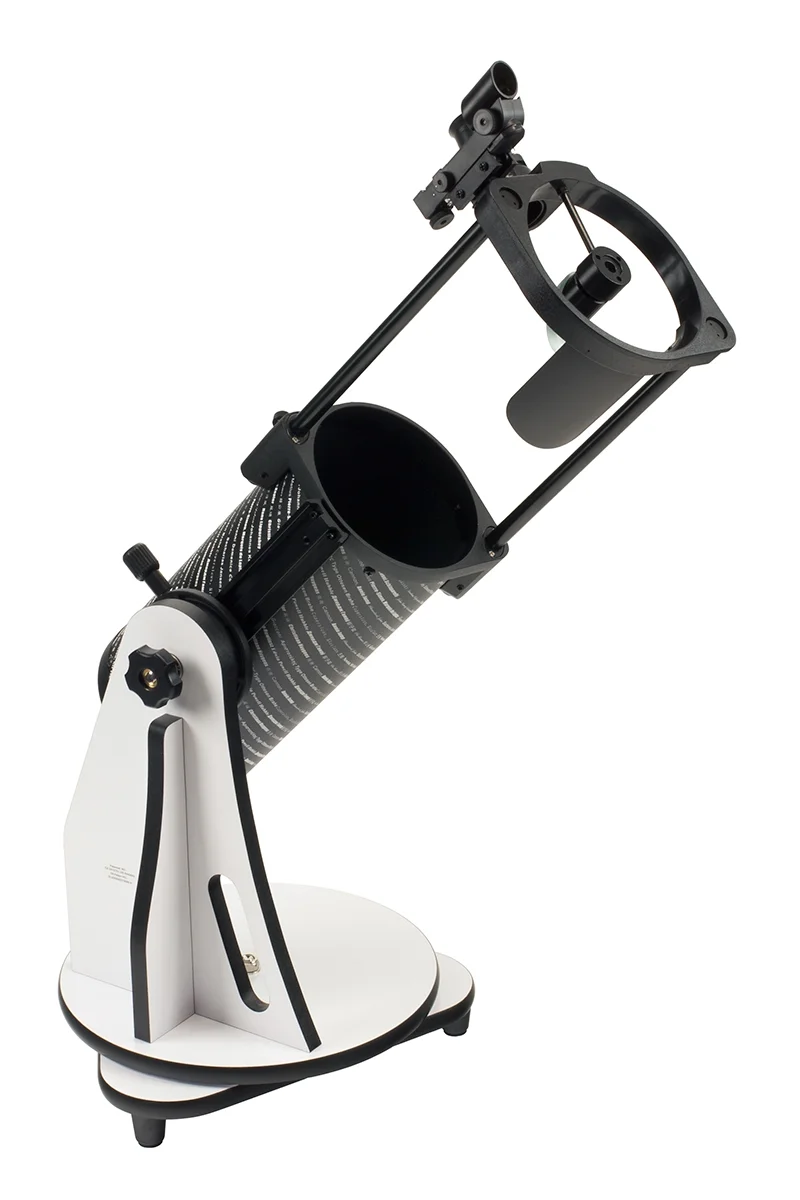
Craters down to a few miles across, the terminator in sharp relief, and Saturn's rings for the same money. Sits on a garden table.

The maria, the big craters and earthshine on a crescent. Steady them on a wall and the Moon stops being a blob.
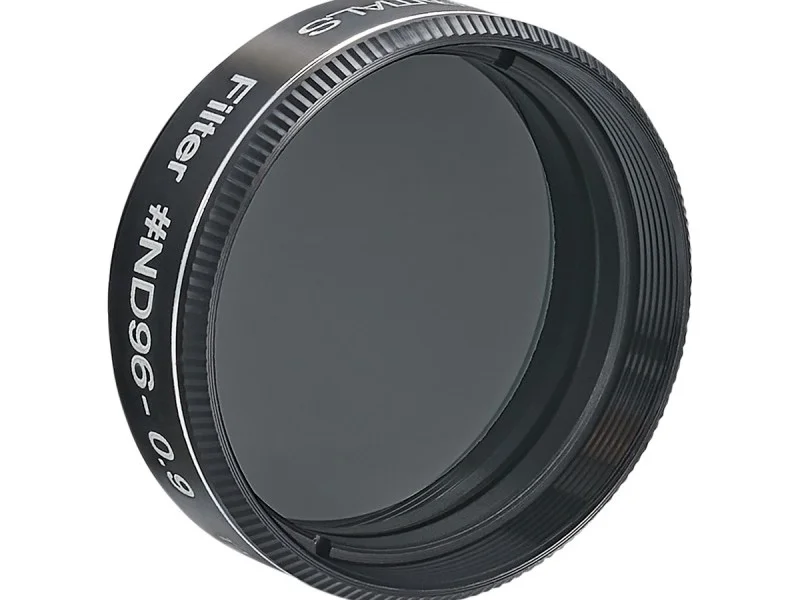
Astro Essentials ND96 Moon Filter
A near-full Moon through a telescope is painfully bright. This cuts it to a comfortable level for £11.
Affiliate links: you pay the same price, we earn a small commission that helps keep WatchTheStars free.
How Scientists Would Search a Cubic Metre of Moon Dust
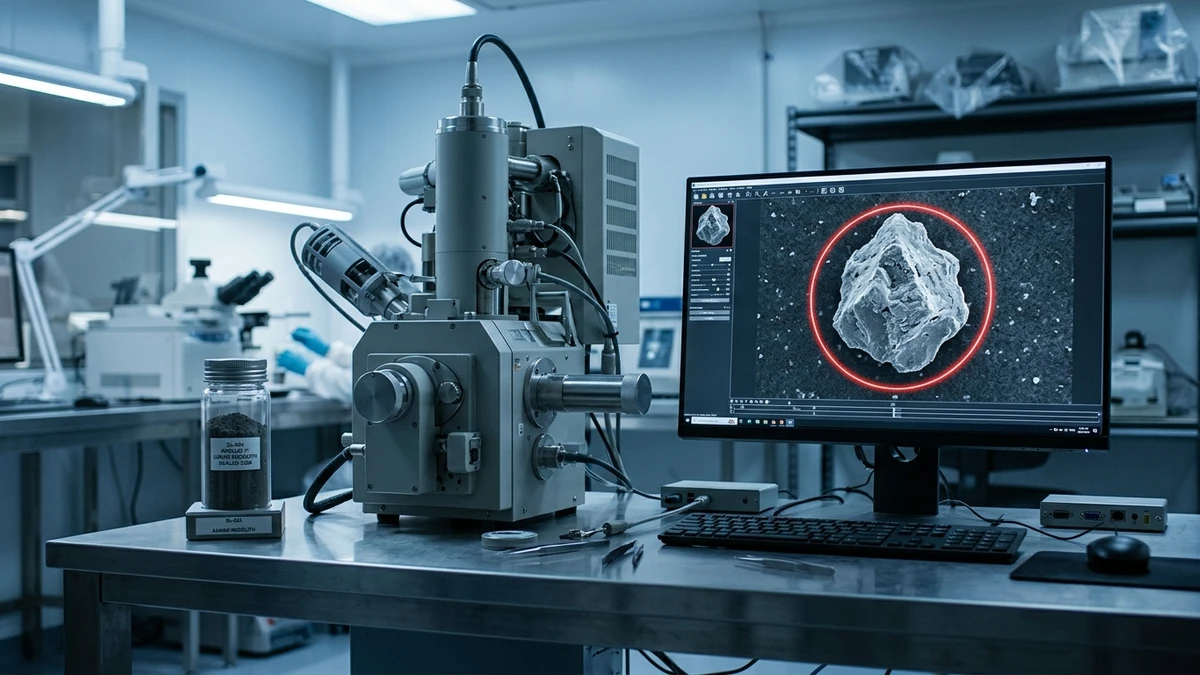
Scientists would search the cubic metre in two stages: fast automated screening to flag odd grains, then slow laboratory forensics to confirm or dismiss each one. A cubic metre of regolith weighs about 1.5 tonnes and holds far more sub-micron grains than any human team could inspect, so nobody is doing this with a hand lens.
The first stage uses high-throughput electron microscopy, X-ray micro-tomography and spectroscopy, with machine-vision software trained on the natural background of lunar material. Anything with a non-natural geometry, an unexpected alloy or an isotope ratio that does not match the Moon, meteorites or Earth gets pulled out for a closer look. Most of the tools already exist. They were developed for planetary science and for the semiconductor and materials industries, where finding a single defective particle on a wafer is routine.
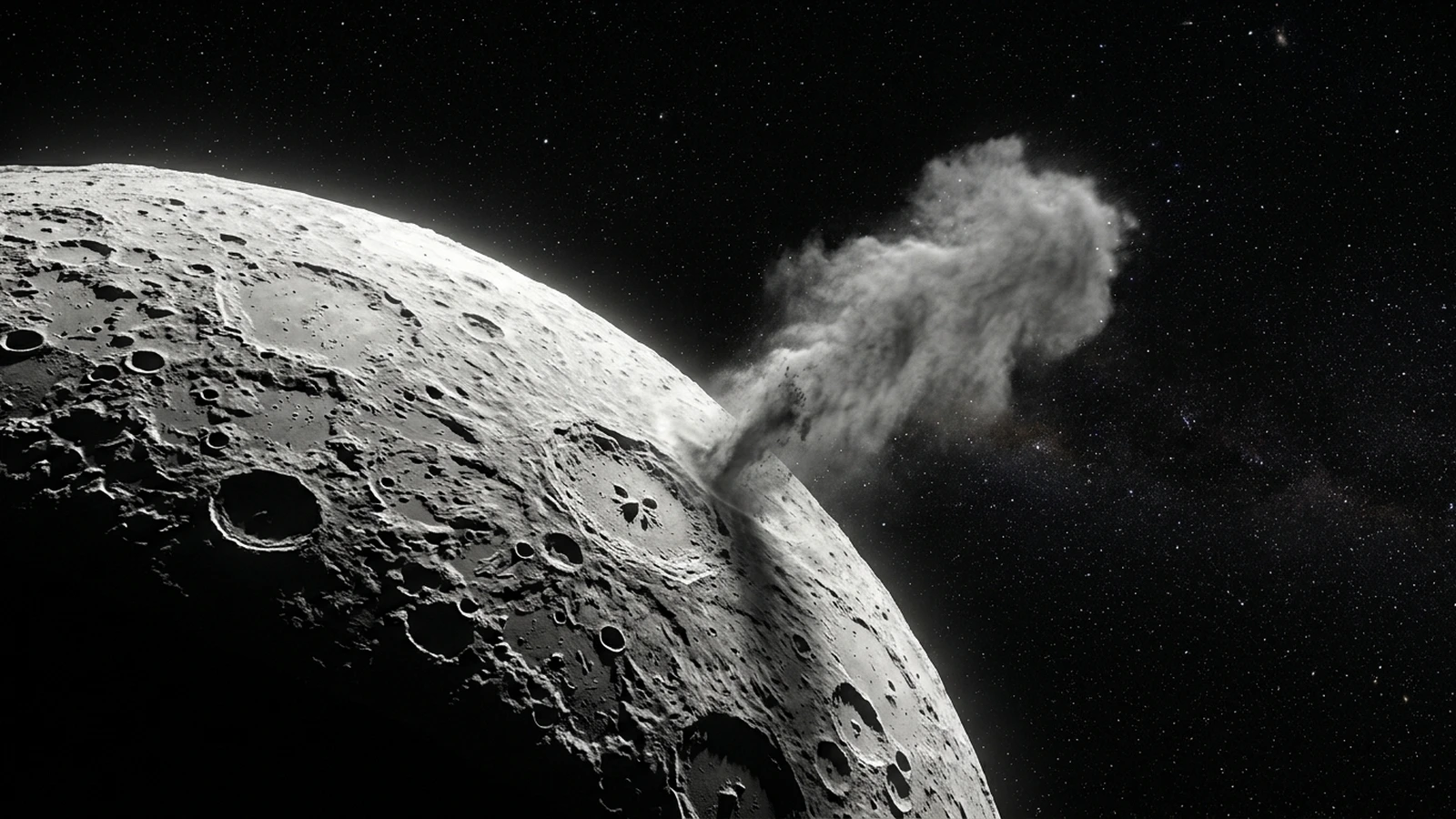
The second stage is where candidates would go to die. Each flagged grain would face isotopic, chemical and structural analysis to rule out the boring explanations, and there are a lot of them. Human spacecraft have been shedding material on and around the Moon since 1959, and a spent SpaceX Falcon 9 stage hit the Moon in August and scattered its own metal across a fresh crater. Any search has to know exactly where its sample came from and what humans have dropped nearby.
Artemis, Chang'e and Who Collects the Sample
Nobody has a cubic metre of Moon dust, and nobody will for a while. The six Apollo landings brought back 382 kg between them, about a quarter of what the search needs, and those samples have been handled, split and studied for more than 50 years. China's Chang'e 5 returned 1.7 kg in 2020 and Chang'e 6 brought back 1.9 kg from the far side in 2024. The Soviet Luna probes managed 326 grams in total.
So this is a job for the next phase of lunar exploration. NASA's Artemis programme is working towards crewed landings and a sustained presence at the south pole, and China's Moon programme has Chang'e 7 and 8 lined up ahead of its planned International Lunar Research Station in the 2030s. Either could collect regolith at the scale the search needs, with the careful documentation of where every scoop came from that the analysis depends on. The authors also suggest that some of the screening could be done on the Moon itself, which would avoid shipping 1.5 tonnes of soil home.
That makes this paper, in a quiet way, part of the case for going back at all. The race between the US and China to the Moon is usually framed around water ice, helium-3 and prestige. A search for evidence of other civilisations is a stranger goal, but it is one you can only pursue with people and machines on the surface.
From Arthur C. Clarke to Arkhipov: The Idea's History
The idea of alien artefacts on the Moon is older than the space age. Arthur C. Clarke's 1951 short story The Sentinel, which grew into 2001, imagined a beacon left on the Moon to wait for humanity. Carl Sagan suggested in 1963 that orbital surveys might reveal automated bases, particularly on the far side. After Apollo, a 1972 study by Foster set out where deliberate installations would most plausibly be found, and in 1985 Robert Freitas and Francisco Valdes coined the term SETA, the Search for Extraterrestrial Artefacts.
All of those searches looked for big things put there on purpose. The shift came in the early 1990s from Oleksiy Arkhipov, a Ukrainian radio astronomer, who argued the opposite: that the most durable and widespread alien artefacts would not be monuments but rubbish. Industrial byproducts are made inevitably, in vast quantities, and scattered by natural processes. Arkhipov proposed that micron-scale technological particles could ride the interstellar dust and pile up on airless surfaces like the Moon. Nobody had the tools to check.
Now they do, which is the real news in this paper. The transport physics of interstellar dust is far better understood than it was in 1993, thanks partly to spacecraft like Stardust, Cassini and OSIRIS-REx actually catching the stuff. Electron microscopy and AI-assisted image analysis can sort grains at a scale no human team could manage. And for the first time since 1972, there are serious plans to put people back on the surface who could pick up the sample.
It sits alongside the other search strategies we have covered this year, from Avi Loeb's arguments about interstellar objects to the NASA administrator's unexplained images, but it is a different kind of claim. It asks for nothing to be believed. It asks for a cubic metre of dirt and a microscope, and it tells you in advance what both possible answers would mean.
In the meantime, the archive is up there most nights. Our UK night sky this week page has the Moon's phase and times, and the Harvest Moon rises on 26 September. New to all this? Start with stargazing for beginners. None of what you see through a telescope has changed in four billion years, and that is exactly the point.
Sources:
- Micron-Scale Technosignatures: How a Cubic Metre of Lunar Regolith May Begin to Constrain the Number of Past Technological Civilisations in the Galaxy — Pinault, Lacki, Crawford & Siemion, arXiv 2606.24028, submitted to the International Journal of Astrobiology
- Researchers Propose Searching the Moon for Microscopic Technosignatures — SETI Institute press release, 8 September 2026
- Tech from long-lost alien civilizations may be hiding in moon dust, scientists claim — Live Science, 11 September 2026
- Could Scoop of Moon Dust Reveal Alien Technology? — Sci.News, 8 September 2026
- Alien tech on the moon? Scientists propose search for microscopic debris — EarthSky, 13 September 2026
Frequently Asked Questions
Equipment guides
Related topics

Ian ClaytonAmateur astronomer and founder of WatchTheStars.co.uk, dedicated to helping others explore the wonders of our universe. Full profile →