The Tremonton and Great Falls Film Analysis
What the Navy's Photo Interpreters Concluded About the Two Most Famous UFO Films
In 1952 the US Air Force handed two reels of film to the Navy's photographic interpretation specialists, the people whose day job was reading reconnaissance imagery, and asked them what was on them. One reel had been shot in Utah that July; the other in Montana two years earlier. The Navy took months over it, measuring frame by frame, and delivered its report on 4 May 1953. It found objects moving at up to 2,457 mph, decelerating at nearly 1,500 times the force of gravity, and it ruled out birds, aircraft and balloons in a single sentence. The full report was declassified on 7 August 2026.
| Document | DOW-UAP-D098, 'Interpretation of Movies of Unidentified Objects; progress report on' |
| Issued by | US Naval Photographic Interpretation Center, Photogrammetry Division, Evaluation Department |
| Dated | 4 May 1953: supersedes an earlier report of 5 December 1952 |
| Requested by | US Air Force, AFOIN Topical Division, October–November 1952 |
| Addressed to | Director of Naval Intelligence, with copies to the Chief of Naval Operations and the Bureau of Aeronautics |
| Classification | Confidential / Security Information at the time |
| Films analysed | Utah, 2 July 1952 (Tremonton) and Montana, 1950 (Great Falls) |
| Measurements | 55 velocity measurements from the Utah film, 322 from the Montana film, plus densitometry on seven objects |
| Headline finding | Objects could not be identified as natural phenomena or known man-made objects; birds, aircraft and balloons ruled out |
| Released | 7 August 2026, fifth PURSUE release |
The Tremonton film analysis is a 1953 US Navy study of two UFO films, one shot in Utah in July 1952, one in Montana in 1950, carried out by the Navy's photographic interpretation specialists at the request of the Air Force. Its conclusion was that the objects were most likely self-luminous light sources of a kind the analysts could not identify as either natural phenomena or known man-made objects, and that birds, aircraft and balloons were ruled out. The report was declassified on 7 August 2026.
These two films are not new. They have been argued over for seventy years and both are freely available online. What is new is the Navy's own working: the measurements, the methods, the g-forces, and the flat sentences in which trained image analysts said they could not account for what they were looking at.
Who Analysed the Films, and Why That Matters
The report came from the US Naval Photographic Interpretation Center, the organisation that would later become the National Photographic Interpretation Center, the outfit that read the U-2 imagery during the Cuban Missile Crisis. Its job was to look at photographs of things and work out what they were, usually with a foreign military at the other end of the question.
The Air Force asked for the work in the autumn of 1952. The Photogrammetry Division took it, produced a first report that December, and then a fuller one on 4 May 1953 signed by the Officer in Charge and sent to the Director of Naval Intelligence. This second report supersedes the first and is the one now public.
The report is also candid about its own limits, in a way that reads well seventy years on. It states that "because of the lack of proper equipment, money and personnel, the investigation was limited", and it asks for further tests. It is a working document, not a proclamation.
The Two Films: Tremonton and Great Falls
One detail in the report is a quiet reminder of how nearly this evidence was lost. The original Utah film arrived "in very poor condition; dry, brittle", and had to be duplicated with colour correction before anyone could work on it. What survives, and what everyone has argued about since, is a copy of a copy.
How the Navy Measured a UFO Film in 1953
There were no computers involved. The method was patient, physical and entirely reproducible, which is part of why the report still carries weight.
| Projection | Each frame projected at 22x magnification onto ground glass in a 14.2-inch format |
| Position plots | Object positions traced onto overlays frame by frame, producing twelve chart enclosures |
| Brightness | Measured with a Welch Densichron Model 2150 densitometer, sky background fixed at density 3.0, three readings per object |
| Objects tracked | Seven objects tracked through the first part of the Utah film |
| Velocity work | 55 measurements from Utah part three; 322 measurements from the Montana film |
| Correlation | Brightness plotted against apparent size to test whether the two varied together |
| Requested next | A spectrophotometric analysis of the Utah film, requested by the Air Force on 16 February 1953 |
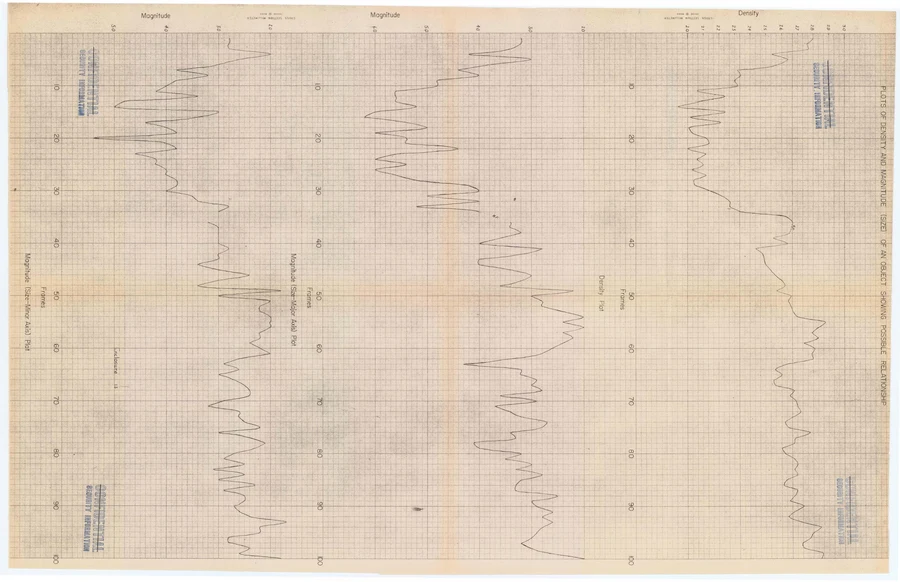
The Numbers: 2,457 mph and 1,479 g
Any speed derived from a film depends entirely on how far away the objects were, and nobody knew. The Navy handled this by choosing a distance it could defend: five miles. Its reasoning was that at five miles, an object 50 feet across would show resolvable detail on the film, and none of these objects did.
On that assumption the analysts produced the figures the report is now known for.
For scale: a fighter pilot in a modern jet blacks out somewhere around 9 g. Airframes are built to survive an order of magnitude more than that, not two. Nothing flying in 1953 could produce 1,479 g, and nothing flying now can either. That is precisely why the distance assumption matters. Halve the range and every figure falls with it. The Navy knew this, which is why it stated its assumption plainly rather than burying it.
What the Navy Actually Concluded
The report answers a set of numbered questions put to it by the Air Force. The first answer is the one that matters.
"It is the majority opinion of the group conducting this analysis that these images are light sources... In either case, light source or reflective surface, it appears as if the objects are of a nature which we are not able to identify in terms of natural phenomena or commonly known man-made objects."· US Naval Photographic Interpretation Center, 4 May 1953
The second answer is blunter still.
"There is no indication of what kind of objects could have caused the images except that they must be of a construction, design, and material not commonly known... For the same reasons, birds, aircraft and balloons are ruled out."· US Naval Photographic Interpretation Center, 4 May 1953
The team also tested the obvious alternative directly. If these were reflective spheroids, balloons catching sunlight, they should blink as they rotated through a 60-degree arc over 90 seconds at 16 frames per second. They do not. And, the report adds, "the velocity and acceleration computations rule this possibility out."
Then the analysts did something careful: they took the data outside their own building. Cleared experts in astronomy and physics were shown the preliminary findings. They offered natural-phenomena theories, but according to the report they "were not able to do so under the conditions during which the photography was taken, nor were they able to recognize these objects as man-made."
Judging lights in the sky, then and now
Kit we've tested and reviewed in full
The Navy needed a densitometer and a thousand hours to work out how bright those objects were, because film is a poor witness. For anything you see yourself, the shortcut is simpler: a pair of binoculars turns a bright unknown into a planet, a satellite or an aircraft almost immediately.
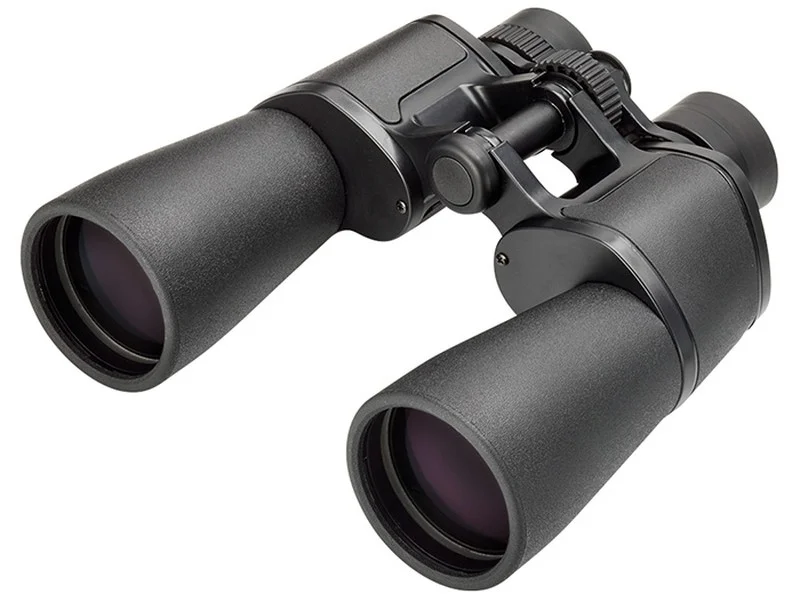
Bright, wide and quick to aim, which is what you need when the thing you are looking at will not sit still for a photogrammetry team.
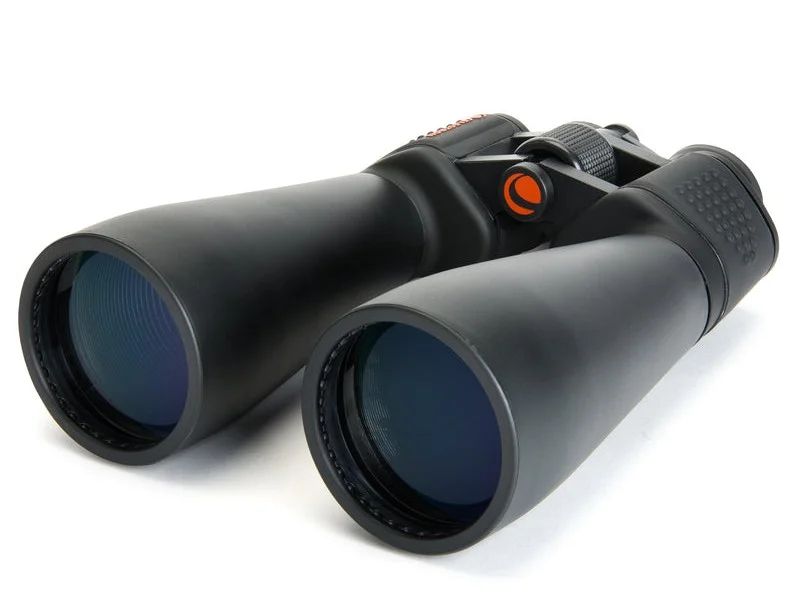
The extra aperture separates close pairs of lights and shows real detail on anything low and far off. Worth a tripod at this magnification.
Affiliate links: you pay the same price, we earn a small commission that helps keep WatchTheStars free.
How the Objects Behaved on Film
Beyond the headline numbers, the report contains a frame-by-frame description of the objects' behaviour that is rarely quoted.
That last line is the most tantalising in the document. A quantised pattern in a set of measurements usually points at something in the method: a rounding step, a frame-rate artefact, a limit of the projection rig. It might mean nothing at all. But the analysts saw it, thought it worth recording, and then ran out of equipment, money and personnel before anyone could chase it. As far as the public record shows, nobody ever has.
The Seagull Problem: This Report Versus the Robertson Panel
Here is the context that makes the document historically interesting rather than merely thorough.
In January 1953 the CIA convened a panel of scientists chaired by physicist H. P. Robertson to review the UFO problem. The panel looked at the Tremonton film among other material and concluded the objects were birds: seagulls, catching the sun. That verdict shaped official US policy on UFO reports for years afterwards and is still the standard sceptical explanation for the film today. It is often described as the unanimous official finding. The Air Force's own file, released in September 2026 and covered below, shows it was nothing of the sort: the Air Force did not state a firm seagull verdict of its own until 1956.
This Navy report is dated 4 May 1953, months after the panel reported, and says birds are ruled out. It does not mention the panel at all, so we should be careful how we characterise it: this is not the Navy publicly contradicting the CIA. It is a technical unit completing the job it was given and putting its own finding on the record, apparently unmoved by the conclusion that had already been reached elsewhere.
Which of the two was right is still open. Seagulls do soar in loose groups, they do catch the light, and a bird at close range can be mistaken for a large object far away. The entire argument turns on the distance assumption. What the released report shows is that the people best qualified to read the film, and the first to measure it frame by frame, did not agree with the seagull verdict, and neither, in early 1953, did the Air Force's own lab.
"They were not able to do so under the conditions during which the photography was taken, nor were they able to recognize these objects as man-made."
· On the astronomers and physicists shown the data, 4 May 1953What Does the Project Blue Book File Show About the Tremonton Film?
The Project Blue Book file on the Tremonton film shows that the Air Force did not settle on seagulls in 1953. Its own lab still rated the film unidentified in February 1953, and the firm seagull verdict first appears in a memo dated 1 June 1956. The file was released on 18 September 2026 as DOW-UAP-D102, and it is the Air Force's half of a story the Navy report above only half tells.
| Case file | DOW-UAP-D102, Project Blue Book File on Tremonton Film, Utah, 1952 (156 pages) |
| Photo file | DOW-UAP-D103, the Blue Book photo card and a General Mills balloon comparison print (5 pages) |
| The photographer | DOW-UAP-D104, Delbert Newhouse's Navy personnel record (585 pages) |
| HQ USAF desk file | DOW-UAP-D105, 'Flying Discs' file for September to December 1952; pages 26 to 36 cover Tremonton |
| The film | PR159, a National Archives digitisation of a surviving 16mm print (DVIDS 1023402) |
| Released | 18 September 2026, sixth PURSUE release |
Was the seagull explanation there from the start?
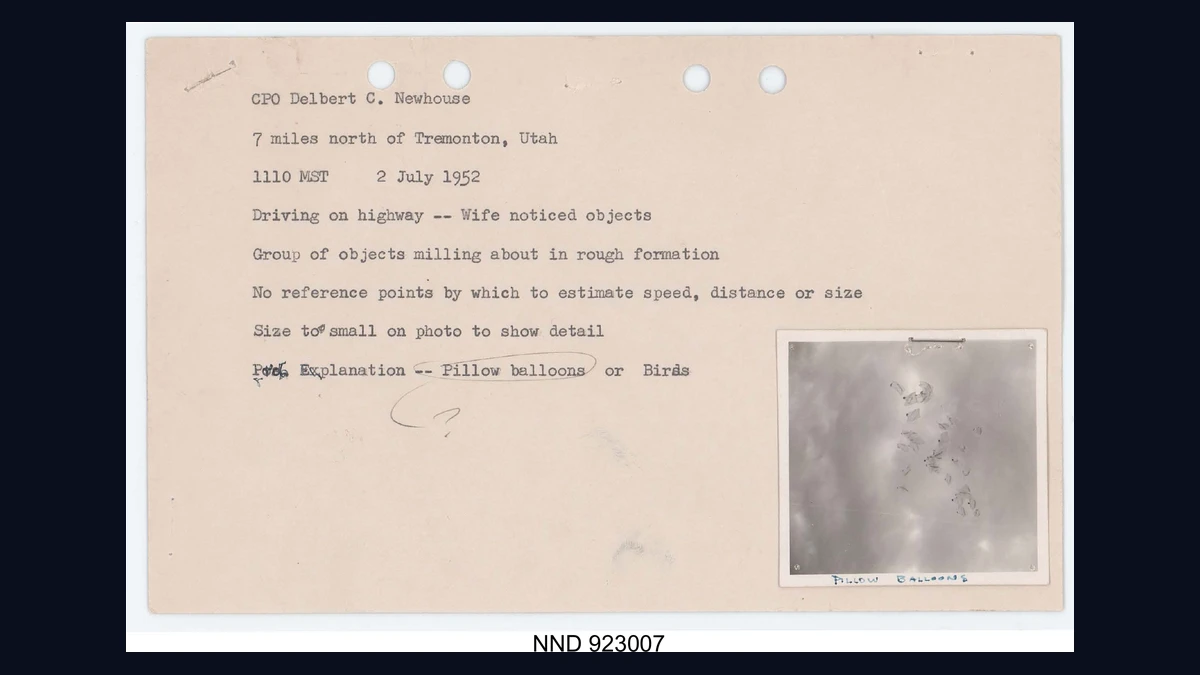
No. In the Tremonton case, birds began as a question the Air Force asked itself, not an answer. A letter from the Air Technical Intelligence Center (ATIC) dated 15 October 1952 suggests sending the film to an ornithologist, perhaps at the Smithsonian, to ask "whether the objects may not possibly be birds in flight." The Blue Book photo file shows the same doubt: the summary card for the case reads "Explanation -- Pillow balloons or Birds", with a pencilled question mark underneath. That December ATIC sent an officer to General Mills in Minneapolis to film "pillow balloons" for comparison.
Who disputed the Navy's Tremonton analysis?
Two unnamed astronomers did. A memorandum for record from February 1953 says they heard a Navy briefing and argued "the method used to measure the brightness of each spot was wrong, therefore, the results of the entire study were wrong." The file gives no names and no Navy reply.
The Air Force lab did not swing to seagulls as a result. In the same memo it says it is "reasonably certain that the brightness of the images on the film exceeds that of any bird", and it recommends asking the Navy to "re-do the study using the methods of density measurement that are prescribed by the astronomers." So in February 1953, a month after the Robertson Panel, the Air Force's own technical people still had an unidentified film on their hands.
What was the Air Force's "balloons or gulls" press plan?
The press had heard about the film and a public statement was needed, so the same February 1953 memo drafts one. Here is its conclusion.
"If it is deemed advisable to release the movies quickly, state that the Air Force cannot positively identify the objects but they are reasonably sure that they are balloons or gulls consequently no further effort is going to be put into the incident. If the Navy and Air Force reports are requested, state that due to the meager data they used, the reports must be discounted."· Memorandum for record, Project Blue Book, February 1953 (DOW-UAP-D102)
The next line, badly scanned but still legible, adds that it would be poor policy to say the Navy had made an error. The draft public statement that followed on 26 February 1953 hedges both ways, putting the images down to "surfaces having good reflective qualities" such as seagulls or balloons, or to high-intensity light sources. That wording covers gulls, balloons and the Navy's conclusion at once, and commits to none of them. The full story of that month is in our post on how the Air Force settled on "balloons or gulls".
What did the 1956 Douglas Aircraft study conclude?
It concluded that no single natural explanation fits. R. M. L. Baker Jr of Douglas Aircraft examined about 1,200 frames of a 35mm reprint for the makers of the 1956 documentary "Unidentified Flying Objects", and his report of 16 May 1956 sits in the Blue Book file. He tested birds, balloons, aluminium chaff, ballooning spiders, mirage and light leaks in the camera one by one, and wrote that "no single hypothesis of a natural phenomenon yet suggested seems to completely account for the UFO involved." It was not an Air Force study, and it is the most careful document in the folder.
When did the Air Force decide the Tremonton UFOs were seagulls?
The Air Force first called the Tremonton UFOs seagulls with confidence on 1 June 1956, in a memo signed by Colonel John G. Eriksen for the Pentagon press room, which had asked for the Air Force's position once the documentary put the film back in the news. It cites a fresh look by Air Force photo specialists "totally unaware of the previous history of this case", and it ends like this.
"The unanimity of opinion present in all evaluations made in this case leaves little reasonable doubt that the UFOs in the Newhouse film were indeed seagulls."
· Col. John G. Eriksen, memo for the Director of Intelligence, 1 June 1956The rest of the folder does not bear that out. The Navy said not birds. The astronomers said the Navy's method was wrong but did not say what the objects were. ATIC's lab said the images were brighter than any bird. Douglas found no single natural explanation. None of that proves the objects were not gulls, but the "unanimity" was written three years after the technical work stopped, not produced by it. The file also reproduces Major Donald Keyhoe's own account of the row, including his claim that a planned public disclosure was cancelled. That is Keyhoe's version, not an Air Force admission.
Who was Delbert Newhouse?
Delbert C. Newhouse was a US Navy Chief Photographer, a warrant officer with 19 years' service when he shot the film. Air Force interviewers who visited the family in September 1952 recorded that he graduated from the Naval Photographic School in 1935 and claimed over 1,000 hours in the air as a photographer. They described him and his wife as extremely honest and reliable, and judged he could be classed as an expert photographer.
His own statement puts the problem that nobody has solved since in one line: "There was no reference point in the sky and it was impossible for me to make any estimate of speed, size, altitude or distance." Every number on this page, the Navy's 1,479 g included, rests on an assumed distance for exactly that reason.
Can you watch the original Tremonton UFO film?
Not the original, which probably no longer exists in usable form. A Navy letter from January 1954 in the Blue Book file reports that the original may already have deteriorated past the point where it could be safely copied. The film released in September 2026 is PR159, a National Archives digitisation of a surviving 16mm print, not the reel the Navy measured. It is dark, the objects are faint specks from roughly 12 to 18 seconds in, and from about 55 seconds the reel cuts to unrelated sewing-machine footage. The Pentagon's own note says the print may be a composite or reused.
How is the Great Falls UFO film connected to Tremonton?
Only on paper. The HQ USAF desk file (D105) records a plan to have the Navy analyse the 1950 Great Falls film "in conjunction" with the Tremonton movies, which is why one Navy report covers both. They are separate events, two years apart in different states, and the Air Force reached different answers for each: the 1956 Eriksen memo puts the Montana objects down to two F-94 jets, and the Utah ones to seagulls.
You can open D102, D103 and the film yourself in our PURSUE files browser, and the wider release is covered in our guide to the sixth UFO file release. Newhouse's film shows the same problem any of us face when we look up: without a reference point, a bright dot can't be identified afterwards. If something odd crosses your sky, check what you can see in the sky tonight and whether the ISS passes tonight over your area before you assume anything, and our stargazing for beginners guide covers the usual suspects.
Timeline
Montana: the Great Falls film
Two bright objects are filmed crossing the sky over Great Falls, Montana. Buildings in the frame will later give the Navy its reference points.
2 July: Utah
Roughly 30 feet of 16mm colour film is shot near Tremonton, Utah, capturing a group of bright objects over about 90 seconds.
October–November: the Air Force asks
AFOIN Topical Division requests photogrammetric analysis of both films from the US Naval Photographic Interpretation Center.
15 October: an ornithologist is suggested
ATIC suggests asking an ornithologist whether the objects might be birds in flight. It is a question, not a finding.
5 December: first report
An initial report is issued. It will later be superseded.
January: the Robertson Panel
A CIA-convened scientific panel reviews UFO material and concludes the Tremonton objects are birds.
February: still unidentified
Two astronomers dispute the Navy's brightness method. The Air Force lab says the images are brighter than any bird, asks the Navy to redo the study, and drafts a 'balloons or gulls' press line.
16 February: further tests requested
The Air Force asks for a spectrophotometric analysis of the Utah film.
4 May: the final report
The Navy delivers its full analysis: light sources, not identifiable as natural phenomena or known man-made objects, with birds, aircraft and balloons ruled out.
January: the original film
A Navy letter reports the original film may have deteriorated too far to be safely copied.
16 May: Douglas Aircraft study
R. M. L. Baker Jr examines about 1,200 frames and finds no single natural explanation that fits.
1 June: 'unanimity' for seagulls
Col. John G. Eriksen's memo for the Pentagon press room is the first firm Air Force seagull verdict.
7 August: declassified
The 23-page report and its hand-drawn charts are published at war.gov/ufo as DOW-UAP-D098.
18 September: the Blue Book file
The Air Force's 156-page case file (D102), the photo file, Newhouse's personnel record and the digitised film are released.
What It Adds Up To
This report does not prove anything flew over Utah that could not have been made on Earth. Its central number rests on an assumption about distance that cannot be verified, and its authors say so. Read it as a measurement exercise with a stated premise, and it is honest work.
What it does establish is narrower and more durable. In 1953, a unit of professional image analysts spent months on two films, measured them properly, consulted cleared scientists, tested the balloon hypothesis and rejected it, wrote down that birds and aircraft were ruled out, and sent that conclusion to the Director of Naval Intelligence. Then the file was classified for seventy-three years, while the public account of the same film settled on seagulls.
That gap between what was concluded internally and what was said publicly is the recurring theme of the whole 2026 release programme. We found the same pattern in the 1947–48 Air Force correspondence covered in the Project SIGN file, and in the wider batch these documents came from, covered in our breakdown of the fifth UFO file release.
Read the Report Yourself
The full 23-page report is public domain and free to download from war.gov/ufo as DOW-UAP-D098. Pages 1 to 9 carry the written analysis; the rest are the hand-plotted charts. The Air Force's Blue Book file on the same film is DOW-UAP-D102 in the sixth release, and both can be opened in our PURSUE files browser. Both films themselves have been in the public domain for decades. Our catalogue of the primary sources is in the UAP document archive.
Related Cases
More UAP cases
- The Puerto Rico Encounters, November 196418–24 NOVEMBER 1964 · ATLANTIC FLEET WEAPONS RANGE, PUERTO RICO · RELEASED 7 AUGUST 2026
- Types of Aliens & the EvidenceGreys · Reptilians · Robots · Monsters · Men in Black
- The Pentagon UFO Files: A Complete Guide to the PURSUE ReleasesRELEASES 01–06 · 8 MAY TO 18 SEPTEMBER 2026 · 447 RECORDS
- UAP and Nuclear Weapons: A 70-Year PatternCOVERAGE PERIOD: 1945–PRESENT | DECLASSIFIED INCIDENTS: 150+ | US + SOVIET CASES
- The Pantex Plant UFO IncidentSEPTEMBER 2015 · PANTEX PLANT, AMARILLO, TEXAS · FULL REPORT RELEASED 10 JULY 2026
- UAP Document Archive: Official UFO Files from the US, UK & BrazilUS DoD PURSUE Releases · UK MOD & National Archives Files · Brazilian Air Force Records · NSA UMBRA Files