Key takeaways
- On 18 September 2026 the Pentagon released its sixth batch of UFO files: 72 entries dated 1952 to 2025, including 56 PDFs, 15 videos and one audio recording
- The 37 AAWSAP papers on warp drives, wormholes and antigravity have been public for years. The contract paperwork, released for the first time, puts the programme's cost at $21,948,810 and never mentions UFOs
- A 2010 AAWSAP study takes a real 1997 radio-frequency accident involving three antenna engineers and argues their injuries match those of UFO witnesses such as the Cash-Landrum case
- The 156-page Blue Book file on the 1952 Tremonton film shows the Air Force still rated the case unidentified in February 1953, and wrote down a plan to tell the press 'balloons or gulls' anyway
- A 1952 recording of Captain Edward Ruppelt, who ran Project Blue Book, says about 20% of 800 Air Force UFO reports could not be explained
Jump to section 7 sections
- What's in the Sixth UFO File Release
- What Was AAWSAP? The Pentagon's Warp Drive and Wormhole Papers
- What Does the UFO Injury Study Say? Three Engineers and 'Signs of Radiation Illness'
- New UFO Videos: Six Spheres Over the Middle East and the Colorado Police Clips
- What Is on the 1952 Project Blue Book Ruppelt Recording?
- Tremonton UFO Film: The Blue Book File Behind the Seabird Verdict
- When Is the Next UFO File Release?
The Pentagon UFO files got their sixth instalment on Friday 18 September 2026. Seventy-two files went up at war.gov/ufo, and the headlines have all gone for the same thing: warp drives, wormholes, antigravity. Those papers are real, and they are in the release. They have also been sitting on the Internet Archive for years.
The new material is quieter and, to my mind, stranger. A military-funded study that takes a real radio-frequency accident and uses it to argue UFO witnesses are being injured by something the US doesn't understand. An hour of tape from 1952 in which the man running Project Blue Book admits a fifth of his cases have no answer. A minute of infrared video from last year in which an aircrew logged six small spheres over the Middle East. And, best of all, the Air Force's own 156-page file on the Tremonton film, which shows how a case rated "unidentified" in 1953 became "seagulls" by 1956. We've now read all 2,600 pages. Here's what's in there, and if you'd rather see the files for yourself, our browsable archive of all 447 PURSUE records has every document and video from all six releases.
What's in the Sixth UFO File Release
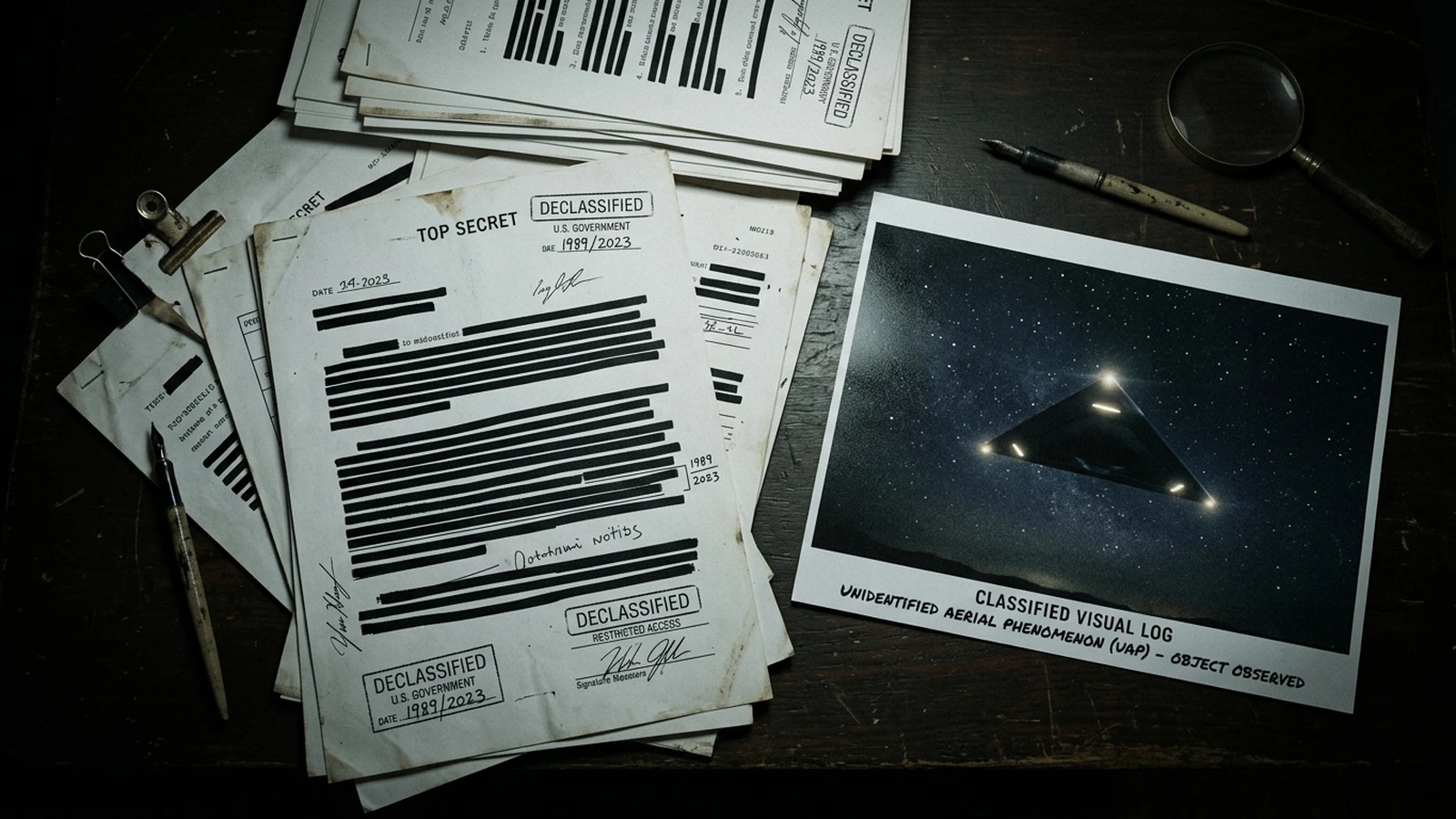
The sixth Pentagon UFO file release, published on 18 September 2026, contains 72 entries: 67 from the Department of War and five from local police in Colorado. That breaks down as 56 PDF documents (two of them single still images), 15 videos and one audio recording, dated from 1952 to 2025. Sixty-five of the 72 carry redactions, which the Pentagon says protect witness identities and the locations of military sites, not anything about the nature of the encounters themselves.
It's the sixth batch under PURSUE, the programme set up after President Trump's January executive order, and it follows releases on 8 May, 22 May, 12 June, 10 July and 7 August. If you're new to all this, our explainer on how the 2026 UFO file releases work has the background, and our write-up of the fifth batch covers last month's Bagram triangle and the Gulf of Oman gunship footage.
This batch has a different flavour to the last one. Release 05 was full of FBI witness interviews. Release 06 is mostly paperwork from one programme, with a handful of modern military videos and some historical gems around the edges.
What Was AAWSAP? The Pentagon's Warp Drive and Wormhole Papers
AAWSAP, the Advanced Aerospace Weapon System Applications Program, was a Defense Intelligence Agency effort contracted to Robert Bigelow's company, Bigelow Aerospace Advanced Space Studies, in September 2008. Its statement of objectives, dated 18 July 2008 and included in this release, is plain about the brief: understand "the physics and engineering" of advanced aerospace weapons "as they apply to the foreign threat out to the far term, i.e., from now through the year 2050", with a focus on "breakthrough technologies and applications that create discontinuities in currently evolving technology trends."
In practice, that meant commissioning 38 papers known as Defense Intelligence Reference Documents, or DIRDs. The titles are the ones doing the rounds on social media this weekend: warp drives, traversable wormholes, antigravity, negative-mass propulsion, invisibility cloaking, metallic glasses for aerospace applications. Thirty-seven of the 38 are in the sixth release.
Here's the bit the headlines skip. Those papers have been public for years. The DIA released them under the Freedom of Information Act, and the set has been on the Internet Archive for anyone to download. The authors' names are still blacked out, replaced by codes like "AAP Person 58". What is new is the contract file that sat behind them, and it tells a plainer story than the titles do.
The solicitation went out on 1 September 2008, bids closed nine days later, and the contract was awarded on 22 September. The base year was priced at exactly $10,000,000. The first option year was priced at $25 million but funded at $11,948,810, with a note about "impacts to deliverables as a result of reduced funding". The three further option years were never taken up. The last document is a no-cost extension to 21 December 2010. Total paid: $21,948,810, which is where the "$22 million" figure everyone quotes comes from. Nowhere in the seven contract documents do the words UFO, UAP, anomalous or paranormal appear. The Pentagon dates the programme to 2012; the contract in this release ends in 2010.

Read in full, the papers are more honest than their reputation. About a third are ordinary literature reviews on metallic glasses, biomaterials, lasers, ultracapacitors and brain-machine interfaces. The exotic ones do their own debunking. The warp-drive paper tabulates the negative energy needed for a 50-metre bubble at a mere 3 km/s: minus 3 × 10⁴⁰ joules, roughly a hundred times the total rest-mass energy of the Sun. The wormhole paper puts the exotic mass needed at 0.71 Jupiter masses per metre of throat. The antigravity paper concludes a working device is "highly unlikely, if not impossible" in the near future. The negative-mass paper proposes tunnelling to the Moon's core with "a sequence of thermonuclear shape charges" to mine the stuff, which tells you where the far end of the series sits.
The Pentagon is careful about this too. Its notes describe the DIRDs as "best understood as reference and synthesis products rather than as original research" and say they "should not be read as implying current validation of the concepts discussed." In other words: the DIA paid physicists to survey what was theoretically possible. It did not build a warp drive, and nothing in the files suggests it found one.
Only two of the 37 papers say anything about unidentified craft in their own text. One proposes a sensor array "for surveillance and detection of any anomalous aerospace platforms that might use engineered spacetime effects for propulsion". The other is the injury study.
What Does the UFO Injury Study Say? Three Engineers and 'Signs of Radiation Illness'
The most striking document in the sixth release is a 38-page AAWSAP study dated 11 March 2010, titled "Anomalous Acute and Subacute Field Effects on Human Biological Tissues". Its stated purpose is "to argue that data exists to 'reverse engineer' propulsion systems of anomalous aerospace vehicles, independent of origin, based on biology". In plain terms: if people get hurt standing near an unknown craft, a doctor might work out what powered it from their injuries.
The paper opens with three "previously fit and active" antenna engineers who "experienced an anomalous aerospace-related event". Within 72 hours they had skin redness, fever, headaches, hair loss and heart palpitations. One "showed signs of radiation illness" and "over several years developed signs of malignant transformations."
Here is the detail most coverage has missed. Those three men are not UFO witnesses. The paper's own first reference is a 1997 article in the journal Occupational and Environmental Medicine describing an industrial accident: three engineers accidentally exposed, at a range of a few metres, to broadband radio-frequency radiation centred on about 785 MHz. The author uses that known case as a yardstick. He then states there are "no significant differences" between their symptoms and those recorded in the 1980 Cash-Landrum case, in which two Texas women and a boy reported burns, hair loss and sickness after a close encounter with a diamond-shaped object, and adds a catalogue of 356 UFO cases with reported physical effects as an appendix.
The conclusion is worded cautiously but lands hard. "Sufficient incidents/accidents have been accurately reported, and medical data acquired, as to support a hypothesis that some advanced systems are already deployed, and opaque to full US understanding."
The medical physics in the paper is mainstream: how radio-frequency energy heats tissue, the exposure limits, the well-known "microwave hearing" effect. The leap is in treating decades of uncorroborated UFO case reports as equal in weight to a peer-reviewed accident report. The study does not identify what, if anything, injured the UFO witnesses, and the Pentagon's own notes say it "does not establish a direct causal link" between the injuries and any source. But the DIA commissioned it, and its author concluded that something was hurting people and the United States didn't know what it was. That deserves more attention than a wormhole paper everyone has already read.

Seen something odd yourself?
Kit we've tested and reviewed in full
Most lights that get reported as UFOs turn out to be satellites, planets or aircraft, and a pair of binoculars settles it in seconds. Before you reach for them, check what you can see in the sky tonight and whether the ISS passes tonight. That alone clears up a good share of sightings.
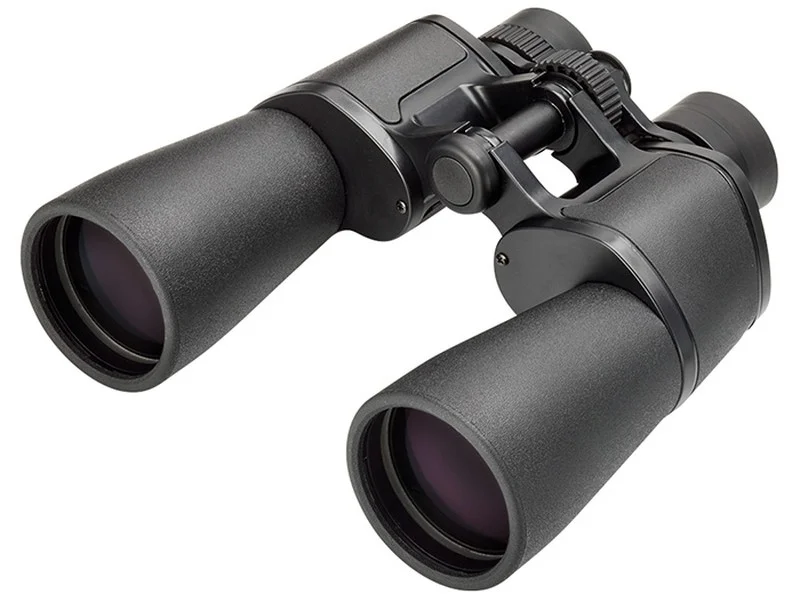
Wide field, 50mm lenses and light enough to hand-hold, so you can get onto a moving light before it's gone. The pair we point most UK beginners to first.
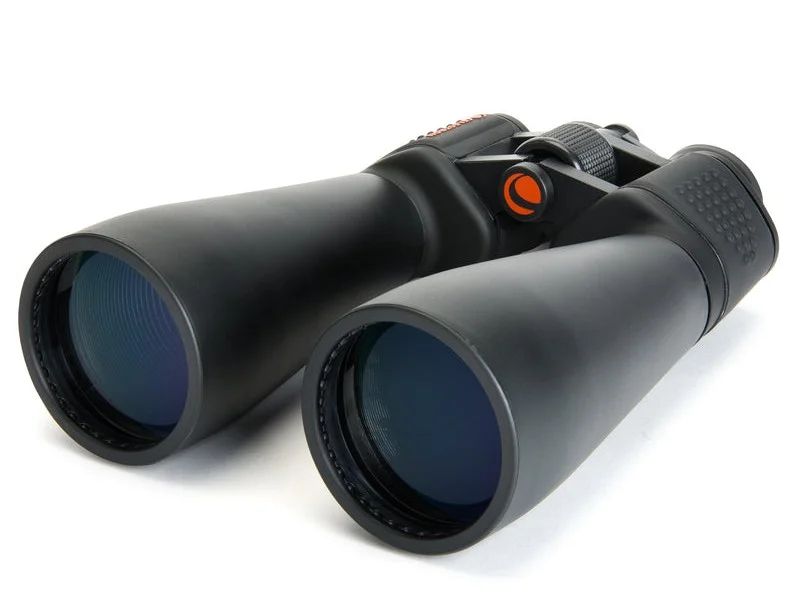
15× pulls a distant light much closer and the 70mm lenses cope with faint objects. You'll want a tripod, but it's the pick for anything low down.
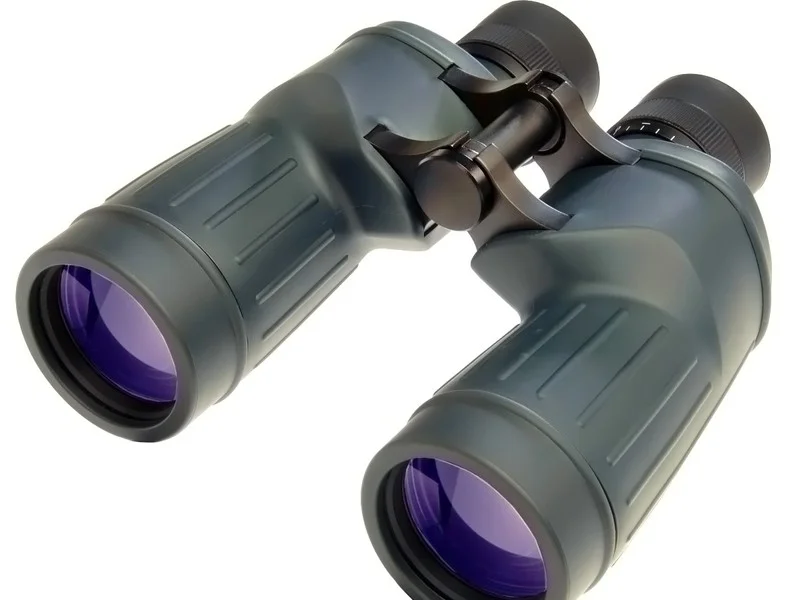
Better contrast and edge sharpness, so points of light stay clean. The one to buy if you want a single pair to last years.
Affiliate links: you pay the same price, we earn a small commission that helps keep WatchTheStars free.
New UFO Videos: Six Spheres Over the Middle East and the Colorado Police Clips
All 15 videos play on our Pentagon UFO file browser, alongside the 119 from earlier releases. The sixth release includes 15 new UFO videos: one minute of infrared showing six spheres over the Middle East in July 2025, two 2022 drone clips from Iraq, six short sensor clips from the Yellow Sea and East China Sea, four Colorado police phone videos, and the 1952 Tremonton film. Most are what we've come to expect from these batches: grainy infrared, a small hot or cold blob crossing the frame, a report that ends with "unresolved". Two cases stand out, and both need reading more carefully than the headlines have.
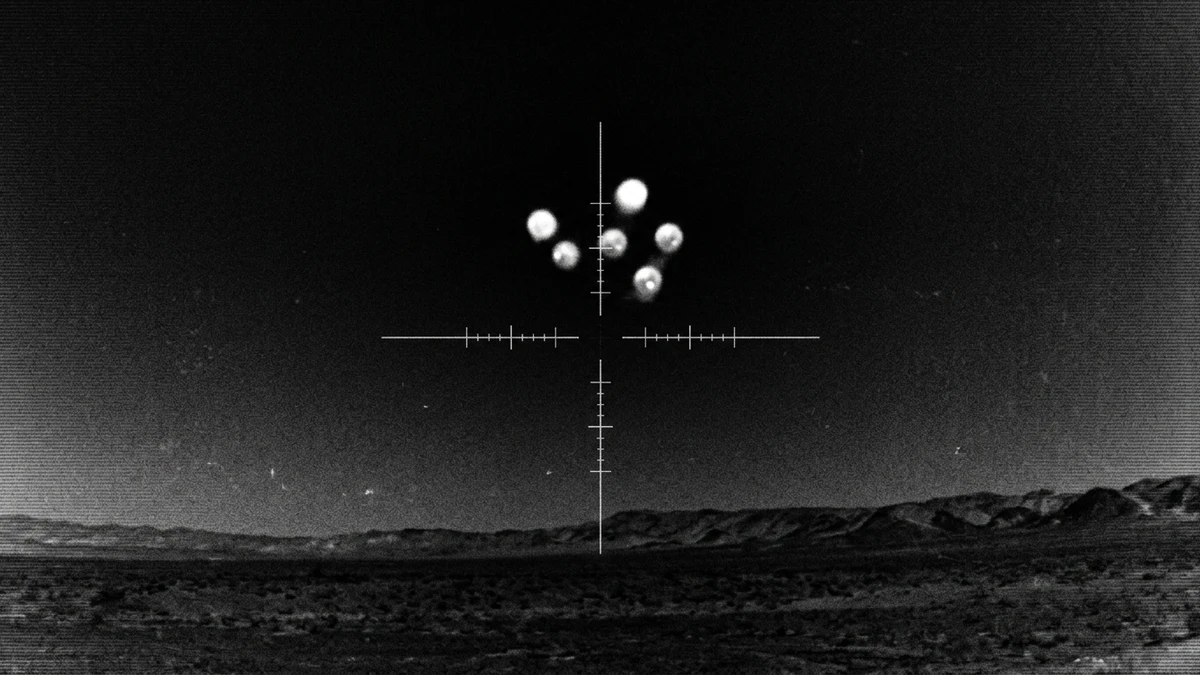
The first is from the Middle East on 29 July 2025. A special operations aircrew, on the way to a routine counter-ISIS surveillance task at 22,000 feet, logged "6X small spherical objects grouped together". The form describes them as "seemed to be agile, frequently changing direction" and "able to change directions quickly and simultaneously", with an estimated speed of 480 mph. That is the crew's after-the-fact description on a standard mission report. On the same form they answered "NO" to the question about advanced capabilities, "NONE" for any reaction to the aircraft, and "UNKNOWN" for propulsion. Nobody tried a radar lock. The one-minute infrared clip shows several small hot specks drifting down the frame over an industrial site, and AARO's own frame-by-frame description of it never counts six of anything, only "areas of contrast". Six objects moving as a group is not what a flock of birds does. It is exactly what a group of small drones does, and that remains the most likely answer. Nobody analysed it either way.
The 2022 material is thinner still. Two drone crews over Iraq, three days apart in May 2022, filed near-identical reports of objects one to two metres across "flying sporadically within the target area" at 80 to 180 mph. One report hedges them as "PROB UAPs" and notes that dust storms affected the footage. Six further clips come from Indo-Pacific Command over the Yellow Sea and East China Sea in 2023, between 19 seconds and a minute and a half long, with no paperwork attached. They sit in exactly the part of the world where the 2023 Chinese spy balloon shifted how the US military reports anything odd in the sky.
The other case is closer to the ground. Five of the 72 files come from a local police force in Colorado: four phone videos and a one-page transcript from October 2023. The Pentagon's notes say "the reporting officer described the phenomenon as 'silent' and as featuring 'red, blue, and green flashing lights'." The transcript adds detail the notes leave out. The officer, parked by a highway, says he is "watching another orb" about 300 feet off the ground, that it "has been flying stationary for about 15 minutes", that he checked radar and "there is no aircraft flying in the area", and then: "the craft is flying closer to me now." The longest clip runs 15 minutes and shows a single coloured point of light drifting above power lines.
Silent, hovering, red, blue and green lights over a residential area is a fair description of a consumer drone, and the best binoculars for stargazing would have settled it in seconds. A star low on the horizon is the single most common thing British police get called about, and it twinkles in colour too, but a star does not sit 300 feet up and then come towards you. Same state, same month as the FBI agents' Colorado Springs reports in the fifth release, and the word "orb" again, though nothing in the files links them. Before you report one yourself, check whether the ISS passes tonight, look at the UK aurora forecast, and see whether a bright planet was low in that direction. Our guide to what you can see in the sky tonight lists them.
What Is on the 1952 Project Blue Book Ruppelt Recording?
The 1952 Ruppelt recording is a 65-minute audio file, with a 19-page transcript, of a talk Captain Edward J. Ruppelt gave in Boston on 26 March 1952. It is the one item in the release I'd listen to first. Ruppelt had just taken over the Air Force UFO investigation as it was renamed Project Blue Book, and he is the man credited with coining the term "unidentified flying object". This is him explaining the job to a room, before it became famous.
The headline number is his own. Of roughly 800 reports the Air Force had investigated to that point, "about 20% are very good reports offered by very reliable people and … just absolutely no conclusions can be drawn." He gives the breakdown twice in the talk with slightly different figures, so treat it as "about a fifth" rather than a precise statistic. Still: one in five, from the man running the programme, in its first year.
He is specific about what puzzled him. "The fact that they're silent is quite interesting because we have no knowledge of any type of power plant that would be completely silent." He describes a radar case at a New York airfield where two unidentified returns turned away the instant the tower warned a landing aircraft it was on a collision course with them. His dry conclusion: "they must speak English." He says airline pilots won't report sightings because "they just say he was crazy and probably ground him". And he confirms the Air Force worked with LIFE magazine on its April 1952 article "Have We Visitors From Space?", adding that the project's classification was being lowered from Confidential to Restricted partly because LIFE was about to print material that had been classified. His summary of the Air Force position: "we try to stay right in the middle of the road. They may be from Mars, but if they are, we don't want to think they are. We don't want to think they're all balloons."
For readers who want the wider history, the Pentagon is also in the middle of buying access to Hynek's own Blue Book archive, which will fill in what happened to that fifth of cases over the following seventeen years.
Tremonton UFO Film: The Blue Book File Behind the Seabird Verdict
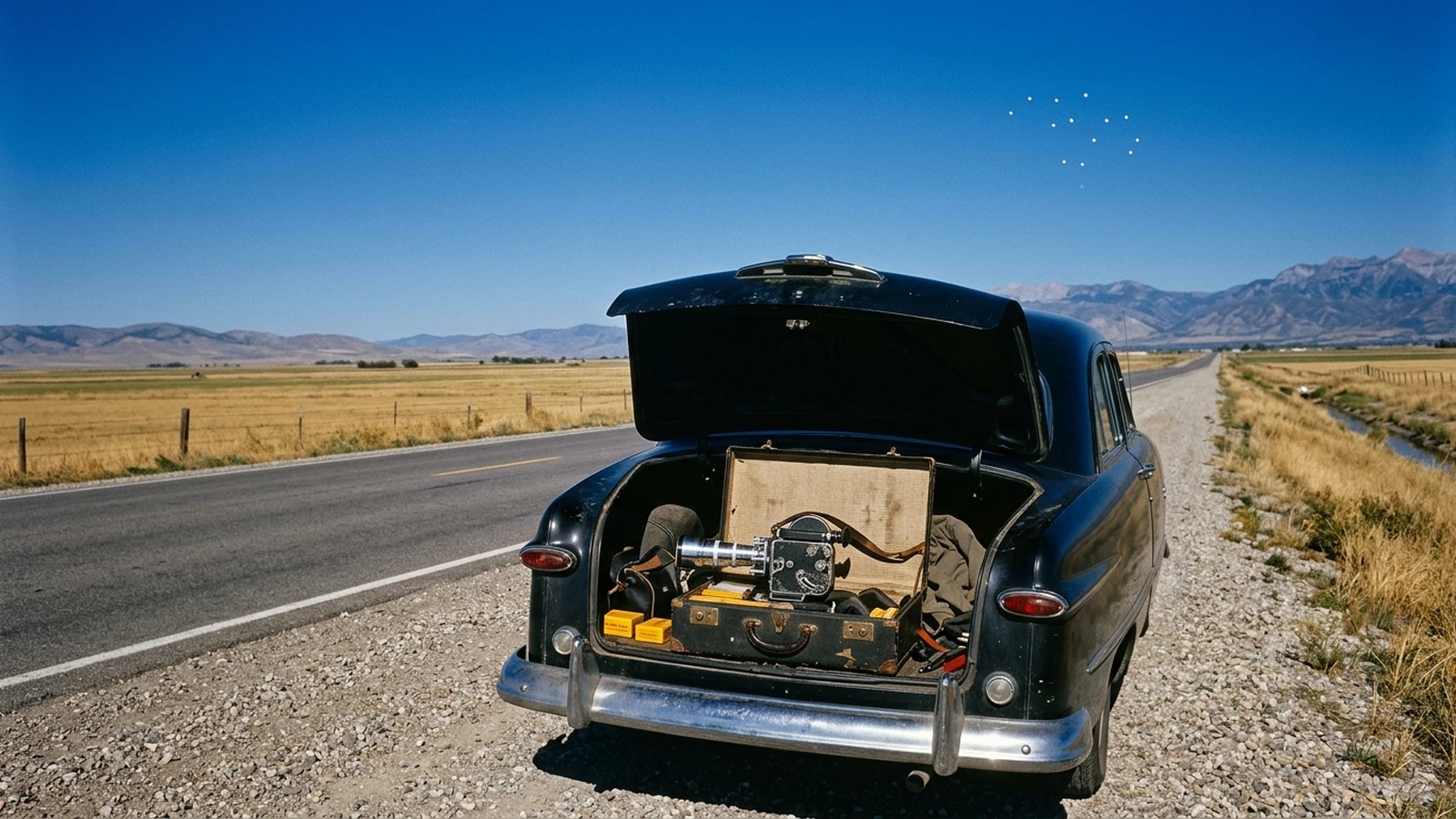
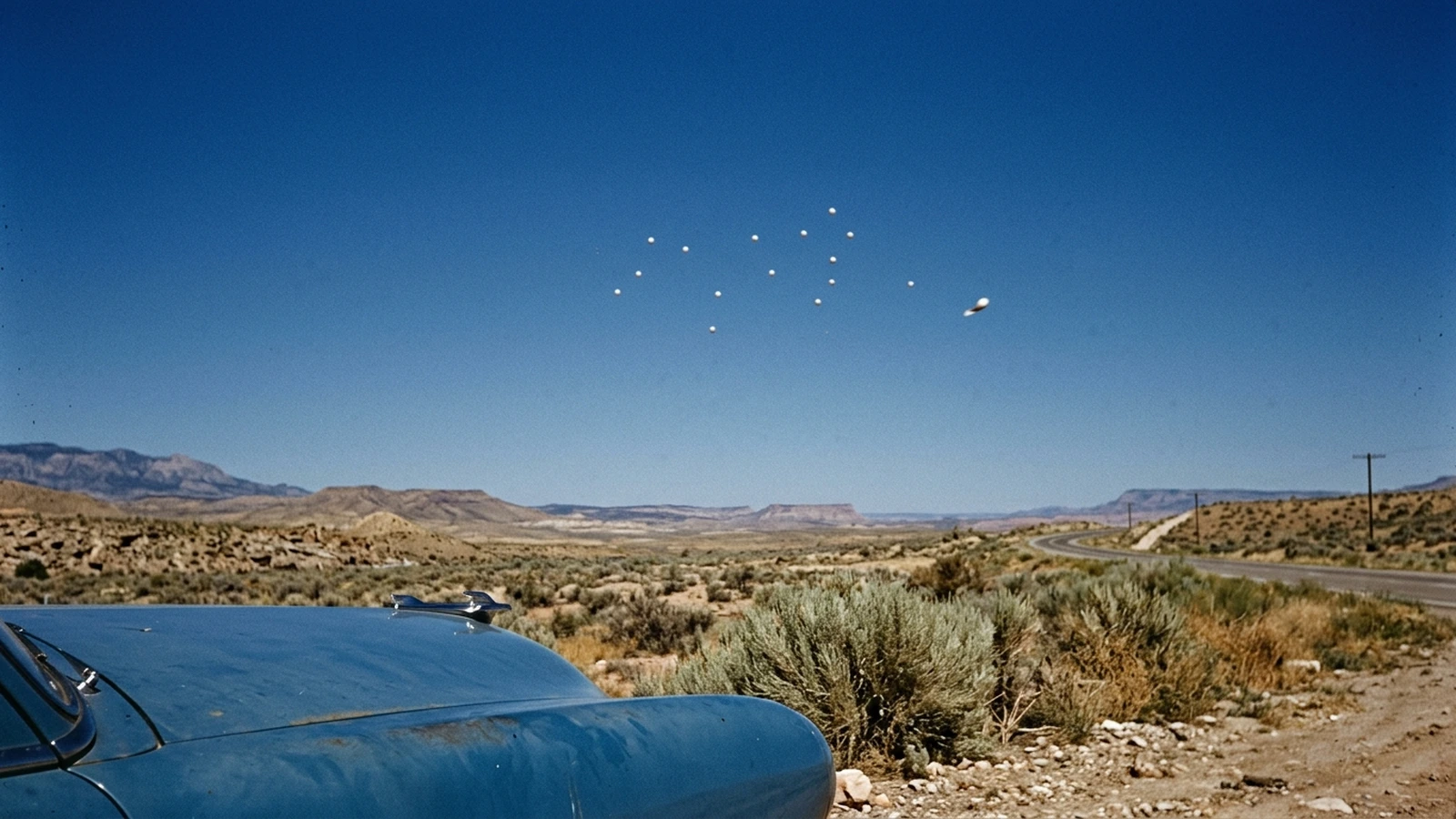
Regular readers will know this one. On 2 July 1952, Navy Warrant Officer Delbert Newhouse filmed "about ten or twelve" bright objects near Tremonton, Utah, on a hand-held 16mm Bell & Howell camera. The Pentagon has now published a digitised print of the film, Newhouse's entire 585-page Navy personnel file, and the 156-page Project Blue Book case file. The press summary is that the Air Force "later assessed" the objects as seabirds. The file shows how that happened, and it is not flattering.
Newhouse comes out of it well. The Air Force interviewed him and his family at home in September 1952 and rated them "extremely honest and reliable". His service record shows a Navy photographer since 1935 with more than 1,000 hours of aerial photography, fitness reports running from "satisfactory" to "excellent", and leave dates from his Oakland posting that bracket 2 July 1952. The personnel file never mentions the film at all.
The seagull idea started early. In October 1952 the Air Force's technical centre suggested showing the film to an ornithologist. In December, an officer went to General Mills in Minneapolis to film "pillow balloons" for comparison; one of the balloon men thought the objects on the film were "a bit too bright and maneuvered a bit too fast". Then the Navy's photo-interpretation lab did its frame-by-frame study, the one we covered in August, and concluded that "birds, aircraft and balloons are ruled out", with decelerations up to 1,479g.
What the file adds is the Air Force's reaction. Two astronomers who heard the Navy briefing said the method used to measure the brightness of the spots "was wrong, therefore, the results of the entire study were wrong". In February 1953 the Air Force's own lab still listed the case as unresolved and recommended the Navy redo its measurements. A memo from the same month fretted about the awkwardness of publicly saying the Navy had got it wrong, and then set out the press plan: "If it is deemed advisable to release the movies quickly, state that the Air Force cannot positively identify the objects but they are reasonably sure that they are balloons or gulls; consequently no further effort is going to be put into the incident. If the Navy and Air Force reports are requested, state that due to the meager data they used, the reports must be discounted."
The verdict hardened in 1956, after Major Donald Keyhoe went public with the Navy's findings. A June 1956 memo from Colonel John Eriksen cites a fresh look by Air Force photo specialists "totally unaware of the previous history of this case" and declares that "the unanimity of opinion present in all evaluations made in this case leaves little reasonable doubt that the UFOs in the Newhouse film were indeed seagulls." The same file contains an independent 1956 study by Douglas Aircraft that tested gulls, balloons, chaff, spiders and mirages one by one and found "no single hypothesis of a natural phenomenon yet suggested seems to completely account for the UFO involved." Unanimity is not the word.
The digitised film itself is a dark, degraded print, and after 55 seconds it cuts to unrelated footage of a sewing machine. The Pentagon's note says the surviving reel may be a composite. Our earlier post, the Tremonton UFO film: the Navy measured 1,479g and ruled out birds, covers the Navy analysis, and our Tremonton and Great Falls film analysis page holds the primary documents. We'll be adding the Blue Book file to it.
When Is the Next UFO File Release?
No date has been given, but the rhythm so far is a batch every four to six weeks, and this one arrived six weeks after the fifth. On the Monday before the release, 14 September, the Department of War announced a legal waiver letting current and former employees bound by non-disclosure agreements share UAP information with the government. That follows the ODNI memo on NDA waivers in August and President Trump's original order in July, and it means the next batch may contain first-hand testimony rather than old paperwork.
On the evidence of this batch, the sceptics and the believers can each take something home. Thirty-seven physics papers everyone had already read, dressed up as new, with a contract file that never mentions UFOs. A police video that probably shows a drone. Six spheres that nobody analysed. But also a DIA-funded medical study arguing people got hurt by something the US couldn't identify, the founder of Project Blue Book on tape admitting one case in five beat him, and a 1953 Air Force memo that planned the "gulls or balloons" line before the science was settled. Unresolved is the Pentagon's word, and it keeps using it.
Every file in this release, and the 375 from the five before it, is searchable and downloadable on our complete PURSUE file browser. We keep our own copy of each document, so they stay available whatever happens to the government's site, and the videos play in the page. Our UAP document archive holds the primary sources on the standout cases from every batch so far, from the black triangle files to the Gulf of Oman gunship. Our write-ups of the first, second, third, fourth and fifth batches tell the story from the start.
Sources:
- Department of War UAP file release (PURSUE), Release 06
- Project Blue Book File on Tremonton Film, Utah, 1952 (DOW-UAP-D102); Final Personnel Record for Newhouse, Delbert C. (DOW-UAP-D104); Transcript of a Presentation by Captain Edward J. Ruppelt, 1952 (DOW-UAP-D154); AAWSAP Statement of Objectives, Solicitation and Modifications (DOW-UAP-D110 to D116); AAWSAP DIRD, Anomalous Acute and Subacute Field Effects on Human Biological Tissues (DOW-UAP-D128); Mission Reports DOW-UAP-D106 to D109; LLE-UAP-D001. All at war.gov/ufo
- Pentagon releases more UFO files, including documents on secretive military program · CBS News
- Pentagon's new UFO file drop includes audio from 1952 Project Blue Book briefing · The Hill
- Pentagon: Military reports recent sightings of UFOs in Mideast · The Washington Times
Frequently Asked Questions
Equipment guides
Related topics

Ian ClaytonAmateur astronomer and founder of WatchTheStars.co.uk, dedicated to helping others explore the wonders of our universe. Full profile →