Finding & Observing
Cygnus · The Swan
The Northern Cross, Flying Down the Summer Milky Way
Jump to section 6 sections
How to Find Cygnus and the Northern Cross
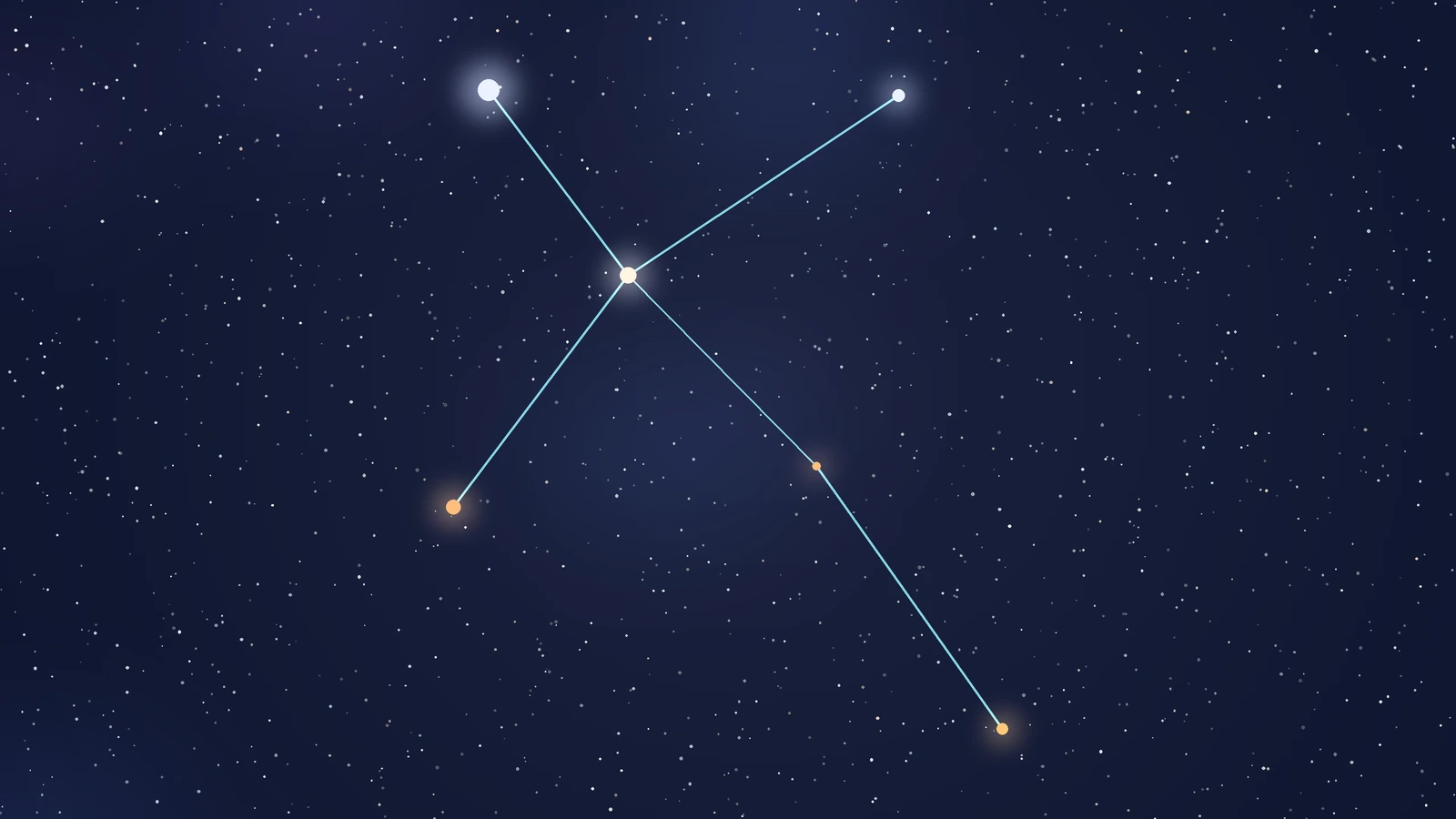
Cygnus is one of the easiest constellations to learn, because you are really looking for a cross rather than a swan. Find the Summer Triangle first, then look for the cross inside its upper corner. From the UK it passes almost directly overhead in late summer, which makes it about as well placed as a constellation can be.
🔺 Start with the Summer Triangle
Three bright stars dominate the summer sky: Vega, Deneb and Altair. Vega is the brightest and almost overhead. Deneb is the faintest of the three and sits at the top of the cross you are looking for.
✝️ Find the cross, not the swan
Six stars form a clear cross about 20° long. The upright runs from Deneb down to Albireo, and the crossbar runs through Sadr in the middle. The swan itself takes some imagination, so most people just use the cross.
🌌 Follow the Milky Way
Cygnus lies right along the Milky Way. From a dark site the pale band leads you straight to it. Look for the dark lane splitting the band in two here: that is the Cygnus Rift, a cloud of dust 300 light-years away.
📅 Best time to look
From the UK, Cygnus is highest around 10pm in early September, when it passes close to the zenith. July and August evenings are almost as good, and it stays usable into November.
Seasonal Visibility from the UK (51°N)
| Season | Evening Position | Altitude | Conditions |
|---|---|---|---|
| Summer (Jun–Aug) | High in the south-east, climbing | 60–85° | ✅ Excellent |
| Autumn (Sep–Nov) | Overhead, then sinking west | 50–88° | ⭐ Best |
| Winter (Dec–Feb) | Low in the north-west, setting | 15–35° | 👍 Fair |
| Spring (Mar–May) | North-east before dawn | 20–45° | 👍 Morning only |
The Main Stars of Cygnus
The six stars of the Northern Cross range from first to third magnitude, so the pattern holds up even from a town garden. Two of them are among the most interesting stars in the sky for very different reasons.
Deneb (α Cygni)
Deneb is the faintest star of the Summer Triangle and, by some distance, the most extreme. It looks moderately bright only because it is so far away. If it sat where Sirius does, it would cast shadows and be visible in daylight. Its distance is genuinely uncertain, because the star saturates Gaia's detectors, but even the low estimate makes it one of the most luminous stars we can see with the naked eye. The name comes from the Arabic for "tail".
Albireo (β Cygni)
The finest double star in the northern sky for a small telescope. At 30x it splits into a warm golden primary and a blue-white companion 35 arcseconds away, and the colour difference is unmistakable. There is a twist: Gaia data suggests the two stars sit at different distances and are not orbiting each other at all. If that holds, this famous pair is a line-of-sight coincidence. The gold star is a real binary in its own right.
Sadr (γ Cygni)
The star at the centre of the cross, where the wings meet the body. Sadr is a supergiant roughly 12 times the Sun's mass, and it sits in front of one of the richest star fields in the northern Milky Way. Point binoculars at it on a dark night and the surrounding area fills with faint stars. The name comes from the Arabic for "chest".
Gienah (ε Cygni)
The eastern wingtip, and a comfortable naked-eye orange. Gienah is much closer to us than the other cross stars, which is why a fairly ordinary orange giant holds its own alongside supergiants. Its name means "wing". Confusingly, a star in Corvus carries the same name, so catalogues usually spell this one out in full.
Fawaris (δ Cygni)
The western wingtip, and a demanding double star. The companion sits only about 2.7 arcseconds away and is far fainter, so you need at least 150mm of aperture and steady air to see it. Fawaris will be the northern pole star around the year 11,250, as the Earth's axis slowly wobbles its way round.
61 Cygni
Historically one of the most important stars in the sky. In 1838 Friedrich Bessel used 61 Cygni to make the first successful measurement of a star's distance by parallax, finally putting a real number on how far away the stars are. It is a wide pair of orange dwarfs, easy to split in any telescope, and one of our closest stellar neighbours.
Mythology and History of Cygnus
Cygnus is one of the 48 constellations listed by Ptolemy in the second century, and the Greeks had several stories to explain why a swan should be flying down the Milky Way.
The Greek myths
The best known version involves Zeus, who took the form of a swan to approach Leda, queen of Sparta. The children of that union included Helen of Troy and the twins Castor and Pollux, who have their own constellation in Gemini.
A gentler story concerns Cygnus and Phaethon, close friends. Phaethon lost control of the Sun chariot and fell into the river Eridanus. Cygnus dived again and again to recover his friend's body from the water. Zeus was moved enough to turn him into a swan and place him in the sky, which is why the constellation lies along the Milky Way, often pictured as a celestial river.
Bessel and the first stellar distance
Cygnus has a solid claim to one of the turning points in astronomy. In 1838 Friedrich Bessel measured the parallax of 61 Cygni and calculated its distance at around 10 light-years, close to the modern value of 11.4. Before that, nobody knew whether the stars were millions of miles away or millions of millions. Bessel's result was the first hard evidence of the true scale of the universe.
🇬🇷 Greek & Roman
Zeus disguised as a swan, or the grieving friend of Phaethon transformed and placed among the stars. Ptolemy catalogued it simply as Ornis, "the bird".
✝️ Christian Europe
Medieval European charts often relabelled the pattern the Cross of Calvary. The name Northern Cross survives from this period and is still the one most people use.
🇨🇳 Chinese
Deneb and its neighbours formed part of Tian Jin (天津), the Celestial Ford: a crossing point over the Silver River, the Chinese name for the Milky Way.
🏝️ Polynesian
Navigators across the Pacific used the cross of Cygnus as a seasonal marker and steering star, one of many bright patterns memorised for open-ocean voyaging.
🇮🇳 Vedic
Some Indian traditions associated this stretch of the Milky Way with the heavenly river Akash Ganga, with the bright stars of Cygnus marking a ford across it.
Deep-Sky Objects in Cygnus
Cygnus sits squarely in the plane of our galaxy, which makes it one of the densest hunting grounds in the northern sky. Some of these targets are easy in binoculars. Others are among the hardest things you will ever try to see.
Veil Nebula (NGC 6960 & 6992) Medium
The shredded remains of a star that exploded somewhere between 10,000 and 20,000 years ago, now a huge circular ribbon of gas three degrees across. Visually it needs an OIII filter, but with one fitted it is astonishing: the eastern section curves across the field like smoke caught in a searchlight. The western section runs through the star 52 Cygni. One of the very few nebulae that looks like the photographs.
M39 (NGC 7092) Easy
A loose, bright scattering of about 30 stars roughly 9° north-east of Deneb. It is large enough that a telescope often shows too little of it at once, so this is a binocular object first and foremost. Under a dark sky it is faintly visible to the naked eye as a small knot in the Milky Way.
North America Nebula (NGC 7000) Medium
A vast cloud of glowing hydrogen just east of Deneb, shaped by a dark dust lane into a striking likeness of the North American continent, complete with a Gulf of Mexico. It covers four times the area of the full Moon. From a genuinely dark site it can be glimpsed with binoculars or even the naked eye as a brighter patch, though from most UK skies it is a photographic target.
Crescent Nebula (NGC 6888) Hard
A bubble of gas blown by a Wolf-Rayet star, one of the most massive and violent types of star known, shedding its outer layers at enormous speed. Visually it is a real challenge and needs 200mm, an OIII filter and a dark sky, when it shows as a faint curved arc near Sadr. It is far easier to photograph than to see.
M29 (NGC 6913) Easy
A small, compact group of about eight brighter stars less than 2° south of Sadr, sometimes called the Cooling Tower for its boxy outline. It is not a rich cluster, and heavy interstellar dust in this direction dims it considerably. Easy to find, and a useful stop while you are in the area.
Cygnus X-1 Notable
In 1971 astronomers traced a powerful X-ray source in Cygnus to a blue supergiant with an invisible companion far too massive to be a normal star. Cygnus X-1 became the first object widely accepted as a black hole, and the subject of a famous bet between Stephen Hawking and Kip Thorne. Hawking conceded in 1990. You can see the supergiant in a small telescope, which is as close as anyone gets to observing a black hole from a back garden.
Observing Cygnus: A Beginner's Guide
Cygnus is a good constellation to learn early, because the pattern is simple and the best targets do not need much equipment. Here is a first session that works from most UK gardens.
- Go out after dark in late summer. Any clear evening from July to October, around an hour after sunset. Face south and look high up. Give your eyes twenty minutes to adjust before you judge how much you can see.
- Pick out the Summer Triangle. Three bright stars in a large triangle, one nearly overhead. Vega is the brightest, Altair the lowest, and Deneb the faintest of the three.
- Trace the cross. From Deneb, follow a line of stars down and to the right towards Albireo. Sadr sits in the middle, with the two wingtips either side. That is the Northern Cross.
- Split Albireo. Point a telescope at the star at the foot of the cross and use around 30x. You should see two stars, one gold and one blue. It is the single best beginner double star in the sky, and worth showing to anyone who thinks stars are all white.
- Sweep with binoculars. Start at Deneb and drift slowly down towards Albireo. The field is never empty. Look for the dark lane splitting the Milky Way, and for the loose cluster M39 up beyond Deneb. Our binocular astronomy guide covers how to hold them steady and what else to hunt for.
Cygnus shares this part of the sky with Perseus and Cassiopeia, both rising in the north-east as Cygnus reaches its highest. If you are planning a session, check what else is up in our UK night sky this week guide, or see whether tonight is worth the effort with the stargazing score.
Equipment Guide
Northern Cross, Milky Way, Cygnus Rift
M39, star clouds, Sadr region
Albireo, 61 Cygni, M29
Veil Nebula, Crescent Nebula
North America Nebula (H-alpha)
Jul–Oct, 10pm–midnight
Recommended equipment for observing Cygnus
Kit we've tested and reviewed in full
Cygnus rewards low magnification and a wide field more than raw aperture. It sits in the densest part of the northern Milky Way, so a slow sweep with binoculars on a dark night shows star clouds, dust lanes and clusters one after another. A small telescope is all you need for Albireo, and an OIII filter transforms the Veil Nebula.
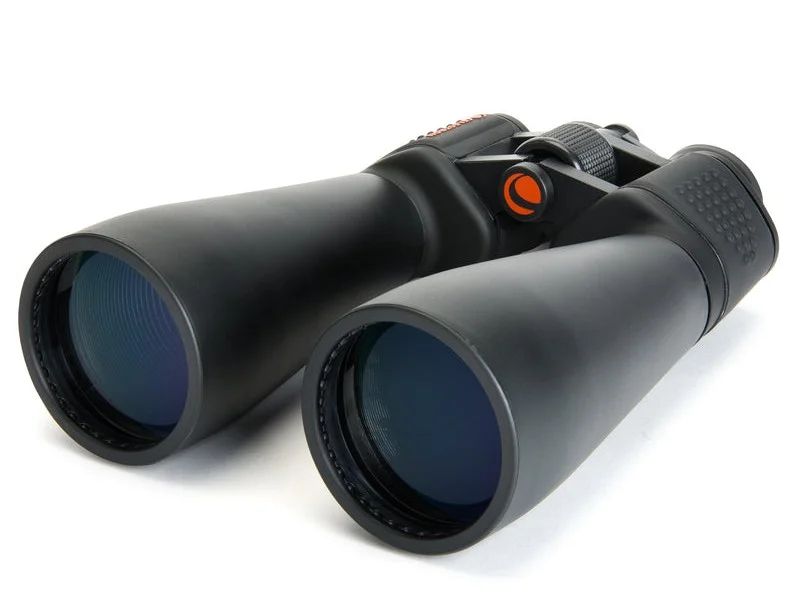
Big binoculars are the right tool for Cygnus. Sweep from Deneb down towards Albireo and the field never empties: star clouds, the dark Cygnus Rift splitting the Milky Way in two, and the open cluster M39 sitting in its own rich field. Use a tripod, because 15x is more than most people can hold steady for long.
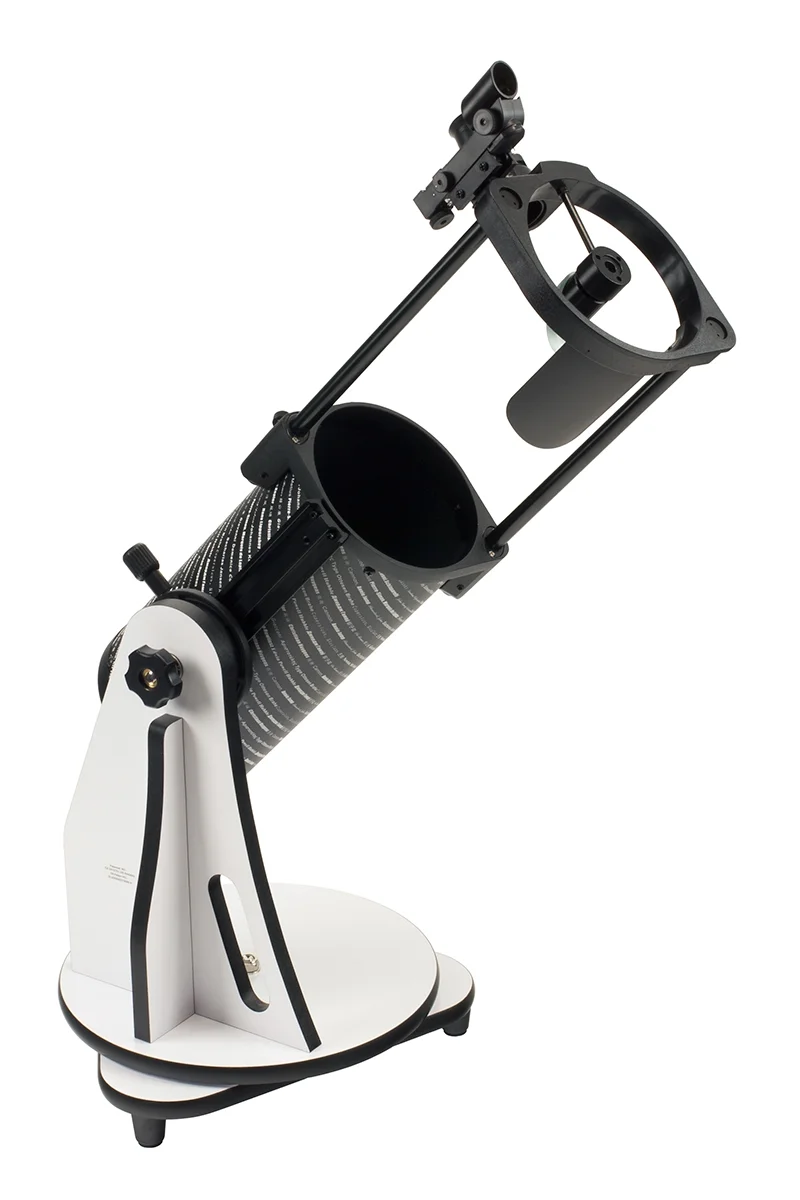
Albireo is the reason to point a first telescope at Cygnus. At 30x the gold and blue pair separates cleanly, and the colour contrast is obvious even from a light-polluted garden. The same scope splits 61 Cygni into two orange dwarfs and shows M29 as a small knot of stars just south of Sadr.
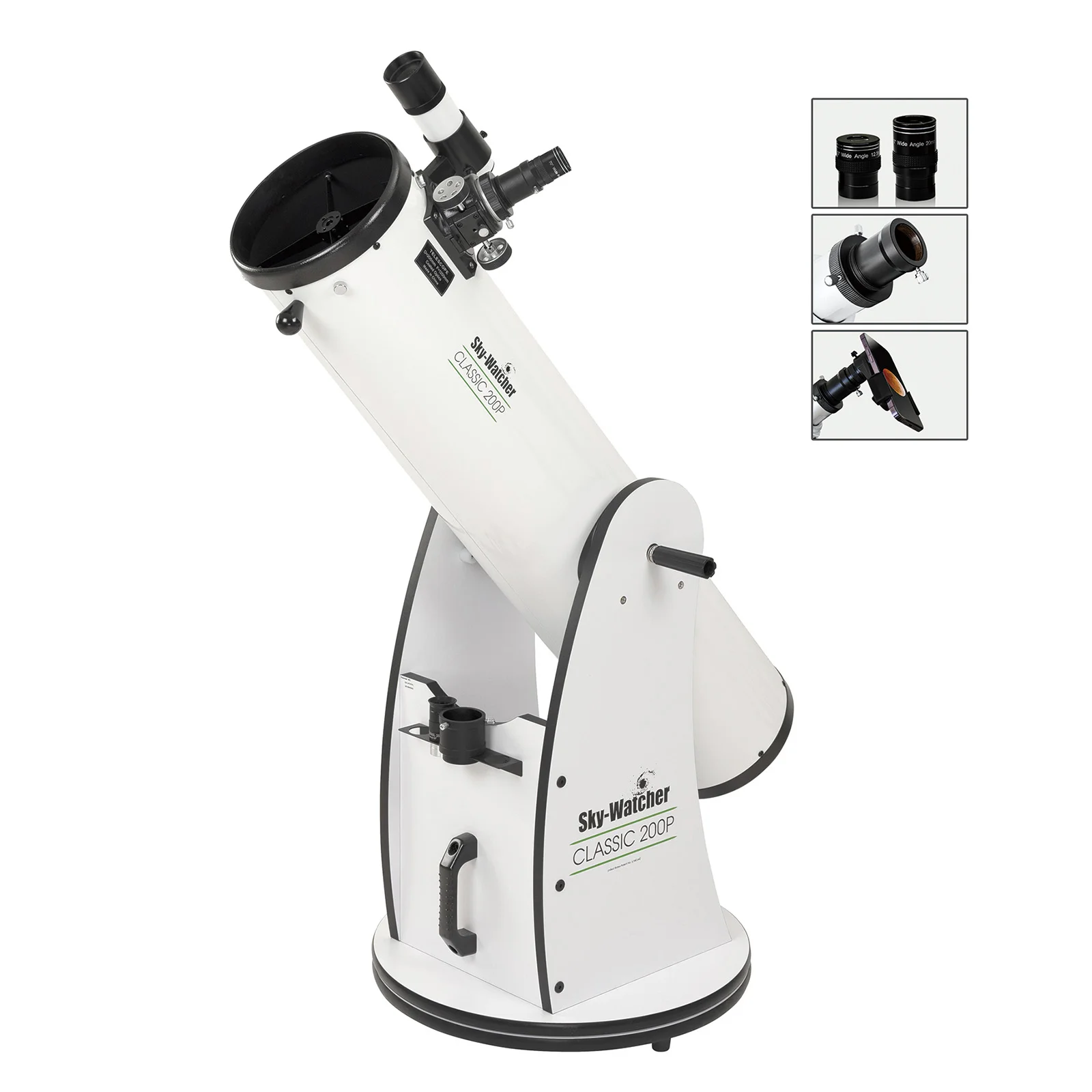
200mm and a dark sky bring the Veil Nebula within reach. Fit an OIII filter, use your lowest power, and the eastern section (NGC 6992) appears as a long curving ribbon of light. It is one of the few nebulae that genuinely looks like its photographs. The Crescent Nebula also becomes detectable on the best nights.
Affiliate links: you pay the same price, we earn a small commission that helps keep WatchTheStars free.
Need help choosing? See our binoculars and telescope guides.
Advanced Observing in Cygnus
Work the whole Veil
Most observers see the eastern arc (NGC 6992) and stop. On a good night, hunt down the western section through 52 Cygni, then look for Pickering's Triangle in between. Use your widest field and an OIII filter, and let your eye wander rather than staring at one spot.
Split Fawaris (δ Cygni)
A genuine test of optics and seeing. The companion sits about 2.7 arcseconds out and is roughly 3 magnitudes fainter, so glare is the enemy. Try 200x or more on a still night with a well collimated scope, and let the telescope cool properly first.
The Kepler field
NASA's Kepler telescope stared at a patch of sky on the Cygnus–Lyra border for four years and found thousands of planets around other stars. You can point binoculars at roughly the same area, just above the line from Deneb towards Vega. Nothing to see, but a good thing to think about while you look.
Chase the Cygnus Rift
The dark lane through the Milky Way here is not empty space. It is a molecular cloud roughly 300 light-years away blocking the light behind it. Under a Bortle 4 sky, trace its edges with the naked eye and you are effectively mapping interstellar dust.