Lunar X and Lunar V: What They Are and When to See Them From the UK
By Ian Clayton · Published 13 September 2026
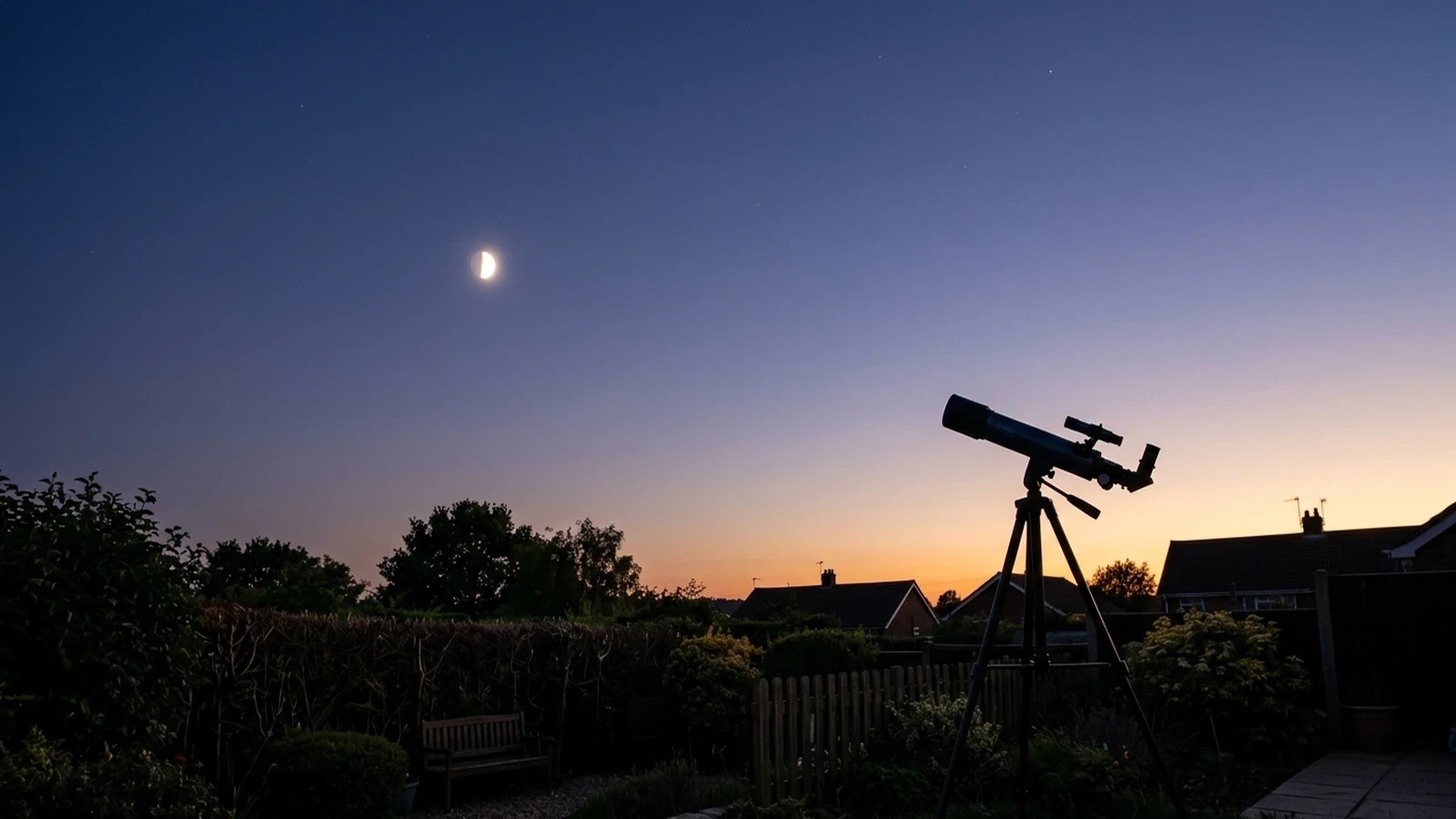
Every few months the astronomy press runs a story about a giant X appearing on the Moon. The Lunar X is real and it is well worth going out for. It is also far smaller and subtler than those headlines suggest. Here is what it is, what you need to see it, and every date it happens over the UK between now and the end of 2027.
What Is the Lunar X on the Moon?
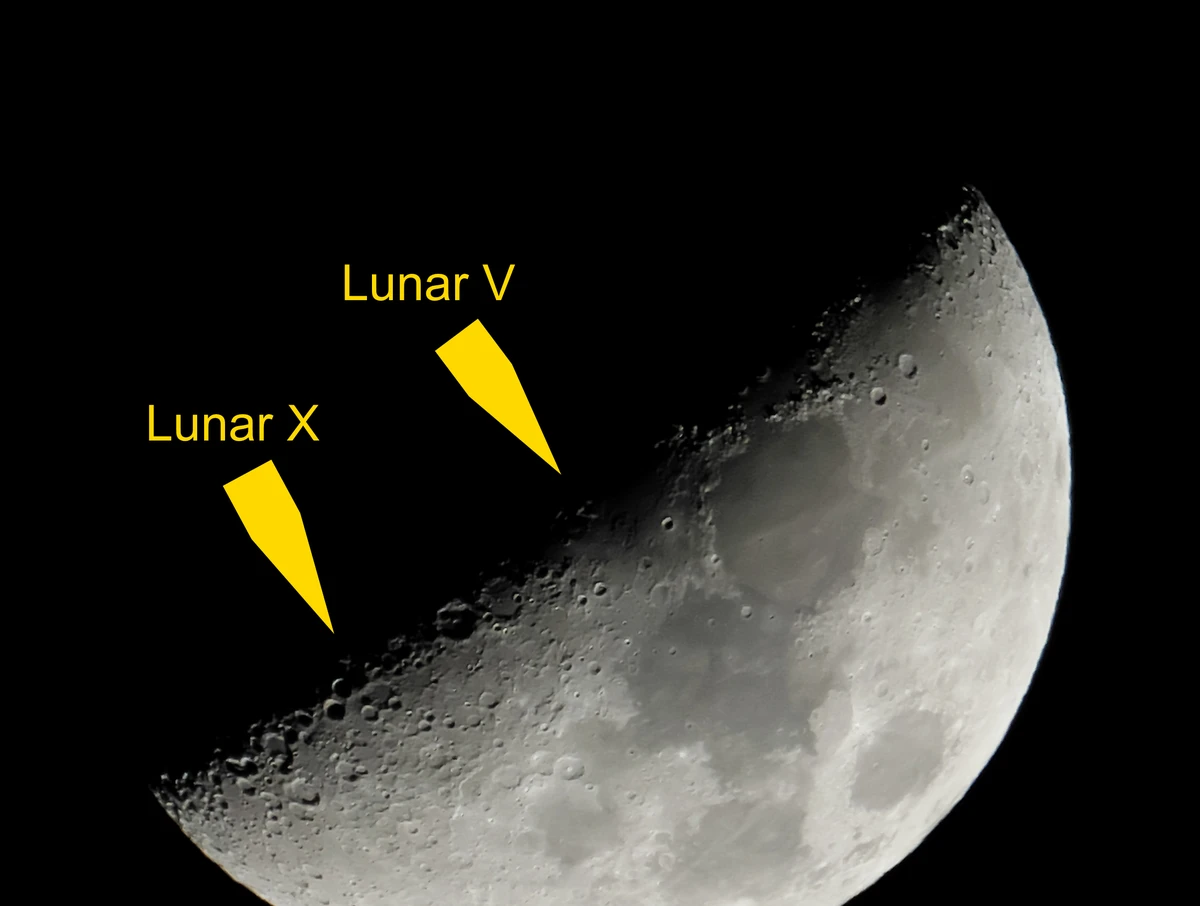
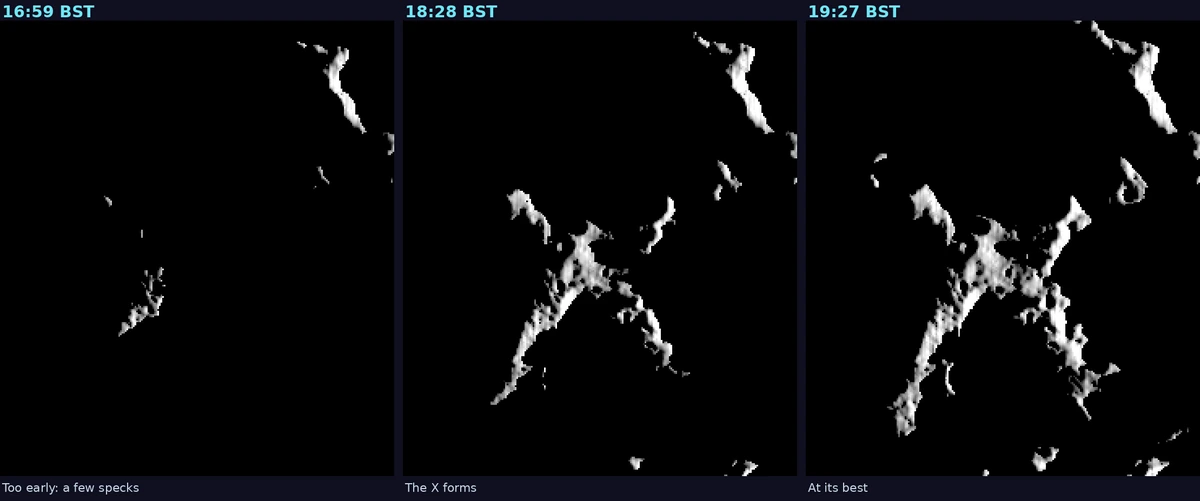
The Lunar X is a shape made of light and shadow that appears on the Moon for about four hours shortly before First Quarter. Low morning sunlight catches the rims of three craters, Blanchinus, La Caille and Purbach, while the ground around them is still in darkness, so the lit rims stand out against black and line up as a rough letter X. Nothing on the surface has changed. It is the angle of the sunlight, and it repeats every lunar month.
The reason it lasts only a few hours comes down to how slowly the Sun moves in the lunar sky. A day on the Moon runs to roughly 29 Earth days, so sunrise at any given crater takes hours rather than minutes. The Sun climbs over the crater walls at a crawl. First the highest rims catch the light while the floors stay dark, which is the moment the X is sharpest, and then the shadows shrink, the surrounding plain lights up, and the shape dissolves back into ordinary lunar landscape.
You will also see it called the Werner X. The crater Werner sits nearby and is bright and easy to identify, so observers use it as a signpost, but Werner contributes nothing to the shape itself.
Set your expectations properly before you go out. The X is a small bright mark south of the centre of the Moon's disc, not a vast letter stamped across the surface, and at low power it looks like an unremarkable bright speck on the dark side of the terminator. Once you push the magnification up and your eye settles, it resolves into a clear X and becomes one of the more satisfying things a small telescope can show you. The gap between the headline and the eyepiece is wide, and knowing that in advance is the difference between being delighted and being disappointed.
What Is the Lunar V?
The Lunar V is a second letter that appears at the same time as the Lunar X, formed by sunlight on the rim of the crater Ukert and several smaller craters around it. It sits well to the north of the X, close to the centre of the Moon's face, and at low magnification the two often fit in the same field of view. Work along the terminator from the X towards the top of the Moon and you should pick it up.
The V shows first. Tracing the sunrise over NASA's LOLA elevation map of this part of the Moon for 18 September 2026 has the V clearly lit by about 16:00 BST, an hour to ninety minutes before the X is recognisable, because the ground around Ukert stands roughly a mile higher than the crater junction that forms the X and catches the Sun sooner. That gap is set by the terrain, so it holds every month. If you get to the eyepiece early and cannot find the X yet, look for the V: it is nearer the centre of the disc, easier to land on, and once you have it the X is on its way. Both fade over the same few hours.
When Can You See the Lunar X? UK Dates for 2026 and 2027
The Lunar X happens once every lunar month, in the few hours before First Quarter, and lasts about four hours. From the UK fewer than half of those windows are any use, because the rest happen while the Moon is below the horizon or lost in daylight. That is why the useful dates are much rarer than the monthly cycle suggests, and why a table like this one is worth keeping.
Times below are the midpoint of the window, taken as the moment the Moon's selenographic colongitude reaches 358°, with Moon altitudes computed for London. Allow two hours either side, and start watching early: the X builds and fades gradually, so you lose nothing by being at the eyepiece before it is due. The times are the same wherever you are in the UK, because this is happening on the Moon, not in your sky. What changes with location is how high the Moon is: a few degrees lower in Scotland, a few higher in Cornwall.
| Date | Midpoint (UK time) | Moon altitude | Worth going out? |
|---|---|---|---|
| Fri 18 Sep 2026 | 18:58 BST | 9° south | Marginal. Best 19:15 to 20:15 as the sky darkens |
| Sun 18 Oct 2026 | 07:37 BST | Below horizon | No |
| Mon 16 Nov 2026 | 20:13 GMT | 20° falling to 7° | Yes, in a fully dark sky. Best of 2026 |
| Wed 16 Dec 2026 | 10:33 GMT | Below horizon | No |
| Fri 15 Jan 2027 | 01:11 GMT | Below horizon | No |
| Sat 13 Feb 2027 | 15:37 GMT | 54°, daylight | Yes, if you can find it. Twilight by 17:30 |
| Mon 15 Mar 2027 | 05:25 GMT | Below horizon | No |
| Tue 13 Apr 2027 | 19:20 BST | 62° south | Yes. The best of the two years, dark from 20:45 |
| Thu 13 May 2027 | 07:21 BST | Below horizon | No |
| Fri 11 Jun 2027 | 18:39 BST | 36°, daylight | Daytime telescope target |
| Sun 11 Jul 2027 | 05:34 BST | Below horizon | No |
| Mon 9 Aug 2027 | 16:33 BST | 8°, daylight | No |
| Wed 8 Sep 2027 | 04:02 BST | Below horizon | No |
| Thu 7 Oct 2027 | 16:21 BST | 5° rising to 13° | Poor, low and in daylight |
| Sat 6 Nov 2027 | 04:37 GMT | Below horizon | No |
| Sun 5 Dec 2027 | 18:44 GMT | 31° in a dark sky | Yes, excellent |
Three of those deserve planning around. Monday 16 November 2026 is the pick of this year: the Moon is 20° up in a fully dark sky at 18:15 and sets at 22:13, so the whole window is usable. Tuesday 13 April 2027 is the best date on the table, the Moon 62° high in the south and well clear of the atmospheric murk that softens a low Moon, with the sky dark from about 20:45. Sunday 5 December 2027 is nearly as good, 31° up and dark throughout. The 18 September 2026 window has now passed, and it was the marginal one it looked: the X peaked at 18:58 BST while the sky was still bright, and by the time it darkened the Moon was sinking. November is the one to put in the diary.
The daytime entries are not a mistake. A half Moon is bright enough to observe in a blue sky, and in February and June 2027 it is up while the Sun is still out. The view is lower in contrast than at night, so the X is harder, but the Moon's altitude more than makes up for it. For any of these, check what you can see in the sky tonight for the cloud outlook first, and see our astronomy events calendar for what else is happening that week.
How to See the Lunar X: Telescope, Magnification and Timing
You need a telescope of about 90mm or more, working at 60x to 100x. Binoculars will not show the Lunar X and neither will the naked eye. Beyond that it is mostly about being in the right place on the Moon at the right hour, which is easier than it sounds.
- Set up early. Be at the eyepiece 30 to 60 minutes before the midpoint in the table. Half the pleasure is watching the shape arrive.
- Find the terminator, the line dividing the lit half of the Moon from the dark half. Everything here happens on or just inside it.
- Work to the middle of the disc. Follow the terminator down from the centre of the disc, a little under halfway to the southern edge. Look for Werner, a sharp bright crater on the lit side.
- Look just into the darkness from Werner. The X appears as a small bright mark apparently floating clear of the lit half, with black all around it.
- Push the magnification up. At 40x it is a speck. At 80x to 100x it is unmistakably an X. Our guide to telescope magnification covers working out what your eyepieces actually give you.
- Come back half an hour later. The change over an hour is obvious, and seeing it change is what makes the target memorable rather than a tick on a list.
Two things spoil the view more than kit does. The first is unsteady air, which matters much more when the Moon is low, as it is for most of the 16 November 2026 window once the Moon drops below about 10°. Give your telescope 20 minutes outside to cool, then wait for the moments when the image settles rather than judging it on the first wobbly glimpse. The second is a badly collimated reflector, which softens exactly the fine detail you are hunting. If you have never checked, our guide to collimating a telescope takes about ten minutes to work through.
You do not need a Moon filter at this phase. A half Moon is only about a tenth as bright as a full one, and the X sits in the dim part of the view, so most people find a filter takes away more than it gives. If you are new to all this, how to use a telescope and stargazing for beginners cover the basics, and is it a full moon tonight will tell you what phase you are looking at on any given evening.
What Are Clair-Obscur Effects on the Moon?
Clair-obscur effects are shapes that appear briefly on the Moon when low sunlight lights some features while leaving their surroundings in shadow. The name is the French form of chiaroscuro, the Baroque Italian art term meaning light-dark, borrowed by lunar observers for the same reason painters used it: the drama is all in the boundary between the two.
The X and the V are the famous pair, but they are not the only ones, and once you know to look for this sort of thing the terminator stops being a line and starts being the most interesting part of the Moon.
- The Golden Handle, sometimes called the Jewelled Handle. Two or three days after First Quarter the Sun rises on the Jura Mountains, which curve around the bay of Sinus Iridum. The mountain tops light up while the bay below is still dark, leaving a bright curved handle apparently attached to nothing. It is larger and easier than the X, and binoculars will show it.
- The Eyes of Clavius. Clavius is a huge crater in the Moon's southern uplands with a curving chain of smaller craters across its floor. As the Sun rises on it, the rims of those craters light up before the floor does, and two of them catch the light as a pair of bright rings looking back at you.
All of them repeat every lunation, because the Sun angle that creates them comes round again every month. That is the useful thing about clair-obscur targets. Miss one and you have not missed it for years, only for a few weeks, which is a rare luxury in astronomy.
How to Photograph the Lunar X
The Lunar X photographs well, and because it visibly changes across the window it rewards taking a frame every 20 minutes and comparing them afterwards. The one thing that catches people out is exposure. Your camera or phone will meter for the bright half of the Moon and underexpose everything near the terminator, which is exactly where the X lives. Expose brighter than feels right, check the result, and take a range.
A phone held over the eyepiece on an adapter is more than good enough for a recognisable shot. If you want the sharpest result, shoot a short video through the telescope and stack the best frames, which averages out the atmospheric wobble. Our guides to photographing the Moon and phone astrophotography cover both routes, and whatever you catch, the current week's sky is always summarised on our UK night sky this week page.
What you need to see the Lunar X
Kit we've reviewed in full
This is a telescope target and nothing else will do. The X is small, it sits in the dark half of the Moon where contrast is lowest, and it is gone in a few hours. Aperture to show it, magnification to resolve it, and something to photograph it with while it lasts.
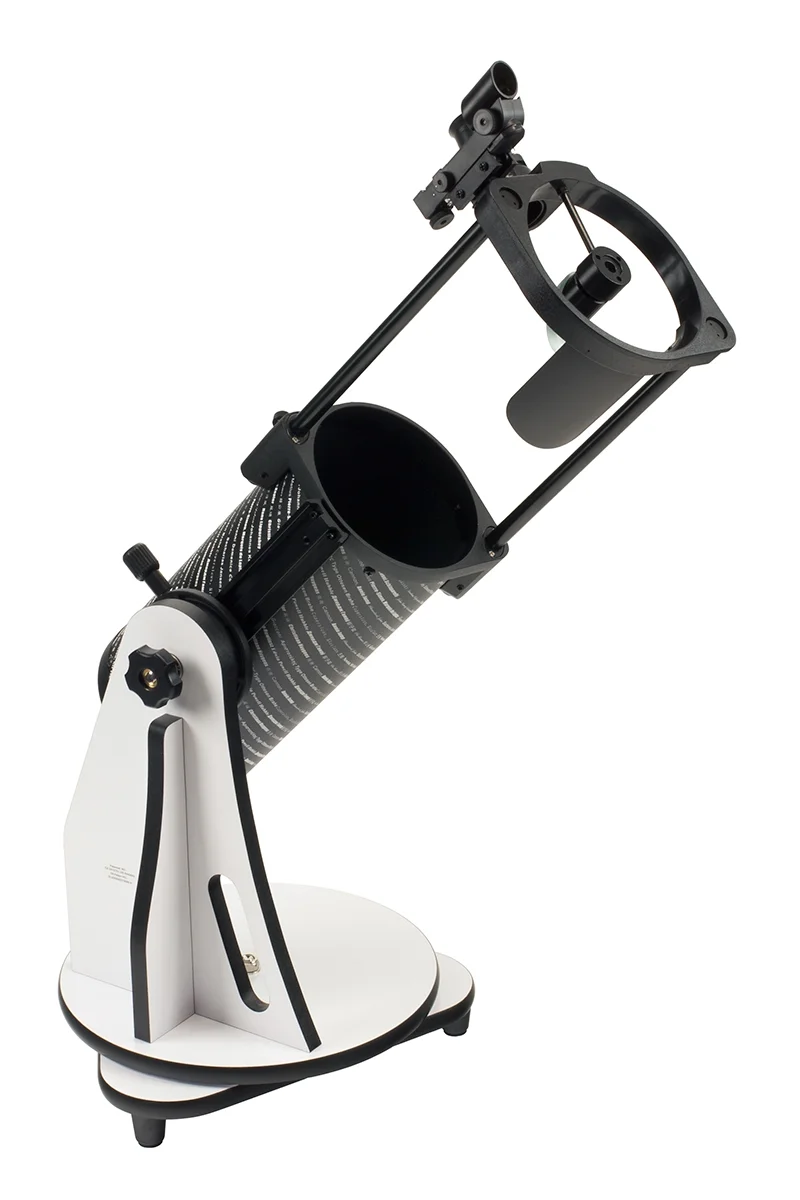
A 130mm tabletop Dobsonian shows the Lunar X comfortably, and because the whole event lasts about four hours you want a telescope you can carry outside and point in two minutes rather than one that needs aligning first. No motors to set up, no polar alignment, just put it on a garden table and push it to the Moon.
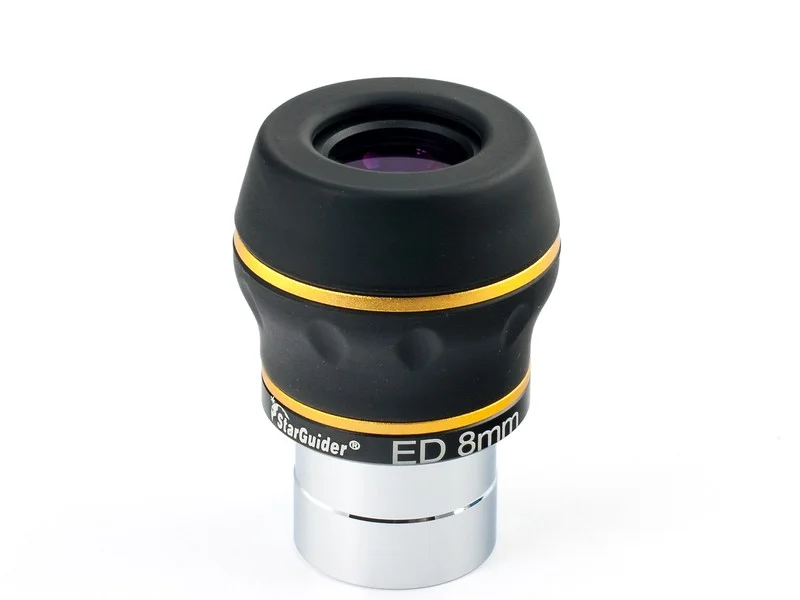
BST StarGuider 60° 8mm ED
Magnification is what turns the X from a smudge into a letter. In the Heritage 130P this 8mm eyepiece gives about 81x, which is the right sort of power for the job, and the long eye relief matters when you are going to spend an hour at the eyepiece watching the shape change.
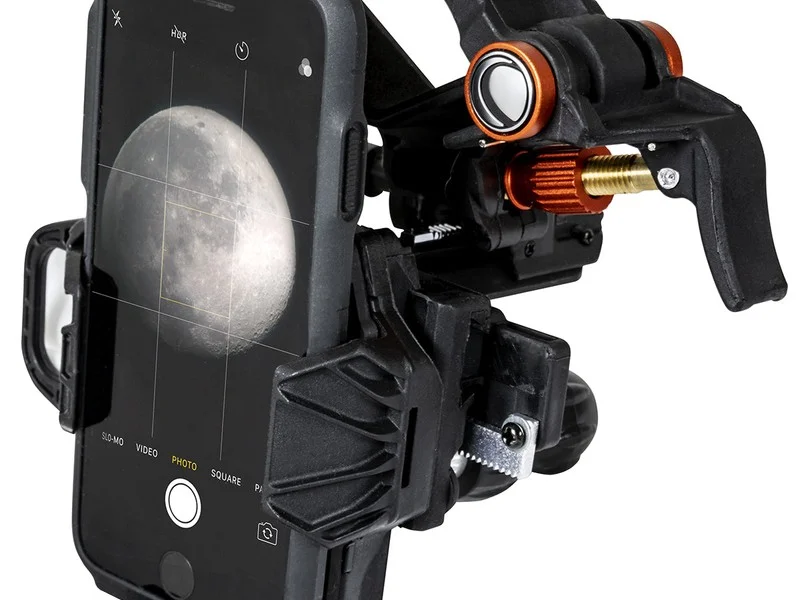
Celestron NexYZ Smartphone Adapter
The Lunar X changes noticeably over an hour, so it is worth recording. This clamps a phone over the eyepiece and holds it steady enough for a sharp frame. Expose for the bright side of the terminator rather than the whole Moon, or the X disappears into the glare.
Browse all equipment
Telescopes, binoculars, mounts, cameras, and accessories: honest, research-based picks for every budget.
Browse all →Affiliate links: you pay the same price, we earn a small commission that helps keep WatchTheStars free.