Key takeaways
- A new telescope in Chile called MOTHRA has found 22 bow shocks in the outer Helix Nebula, published in Nature on 12 August 2026
- Each shock marks an invisible clump of debris from the dying star ploughing through interstellar gas, like the bow wave of a boat
- Shocks near the star are sharp and well defined, while distant ones are fuzzy and breaking apart: a dying star's remains being stripped and mixed back into the galaxy, caught in the act
- The stripped fragments survive only around 10,000 years before dissolving into the gas that will form future stars and planets
- MOTHRA made the discovery using just 190 of its eventual 1,140 telephoto lenses, it wasn't even finished
Jump to section 5 sections
A telescope that isn't even finished yet has caught a dying star being recycled. Pointed at the Helix Nebula, the famous "Eye of God" in the constellation Aquarius, the new MOTHRA telescope in Chile picked up 22 faint shock waves that nobody had ever seen, each one marking a lump of the dead star's remains smashing into the gas between the stars.
The discovery, published in the journal Nature on 12 August 2026, is the first direct look at a process astronomers had long assumed but never witnessed: the moment a star's shed material stops belonging to the star and starts dissolving back into the galaxy, ready to build new stars and planets.
What Did Astronomers Discover in the Helix Nebula?
The team, led by Yale astronomer Pieter van Dokkum with colleague Imad Pasha, imaged the Helix in the red glow of hydrogen and found 22 bow shocks scattered through the nebula's faint outer regions, more than three light-years from the central star.
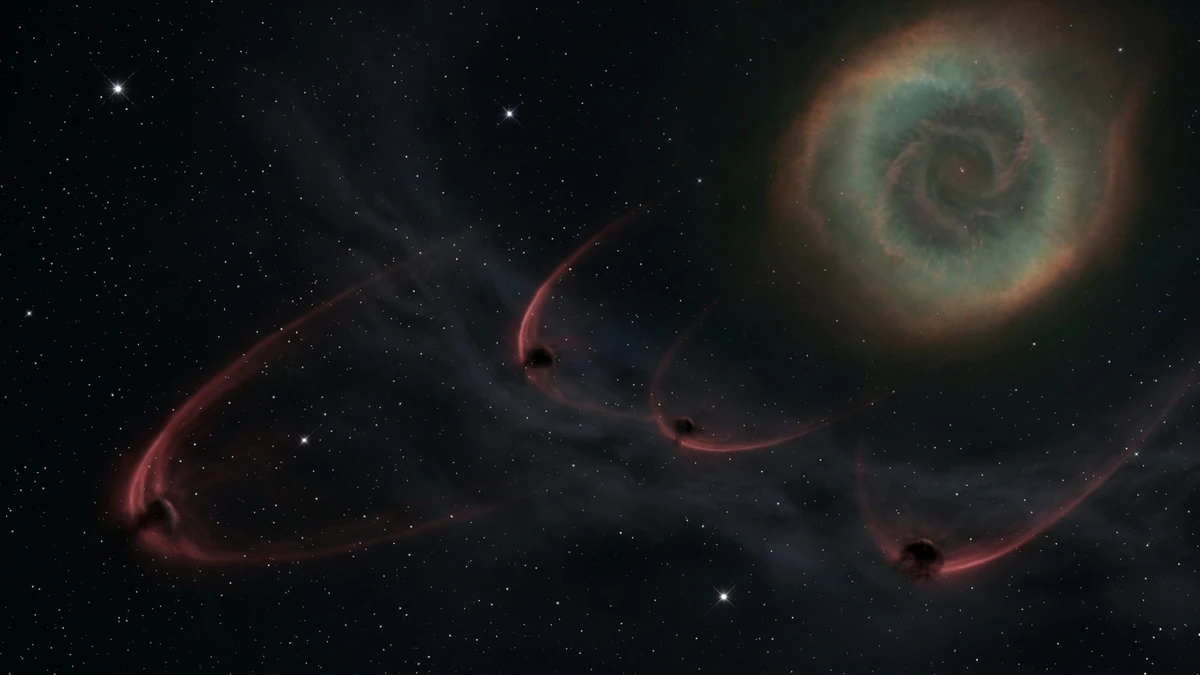
A bow shock is exactly what it sounds like. Picture the V-shaped wave that spreads from the bow of a boat moving through water. Each of the 22 arcs works the same way: a dense clump of gas, thrown off by the dying star thousands of years ago, is ploughing through the thin interstellar gas fast enough to pile it up into a glowing curve. The clumps themselves are mostly invisible, too cold and dark to shine. It's only the wave they push ahead of them that gives them away.
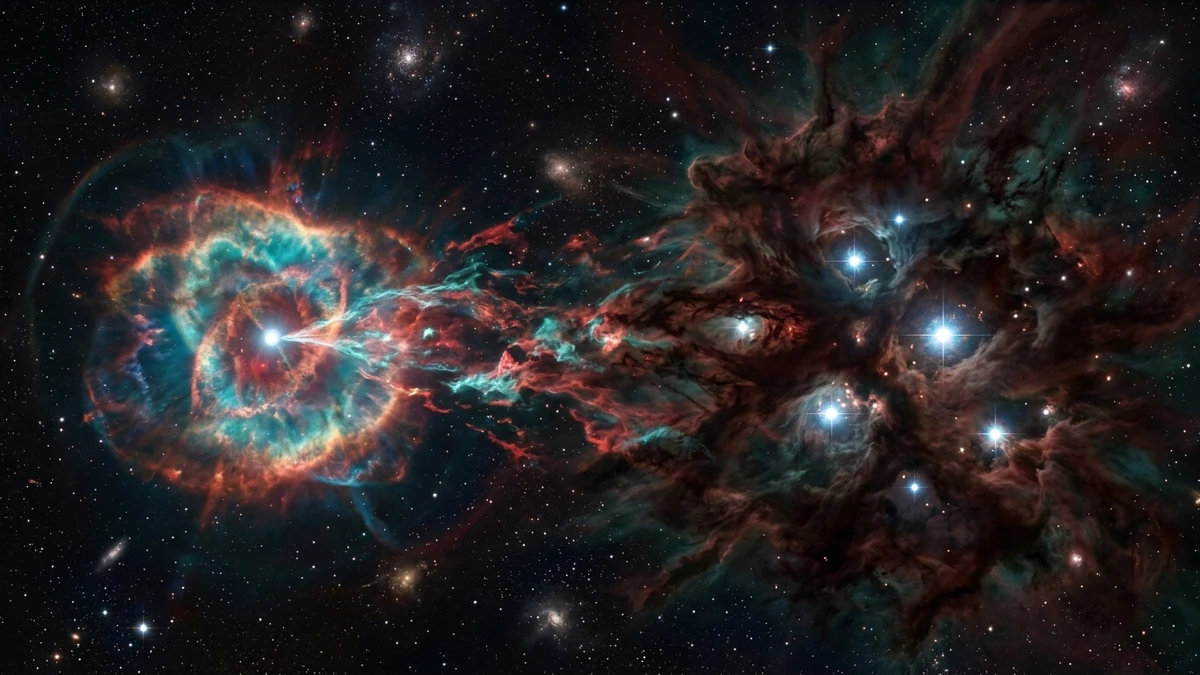
The real story is in how the shocks change with distance. Close to the nebula, they're large, thin and sharply defined. Further out, they get smaller, fuzzier and increasingly ragged, with some visibly breaking into pieces. That's a dying star's remains being stripped apart and stirred into the galaxy, caught mid-process. From the pattern, the team worked out that each fragment survives only around 10,000 years before it loses its identity completely and becomes part of the general soup between the stars.
What Is the MOTHRA Telescope?
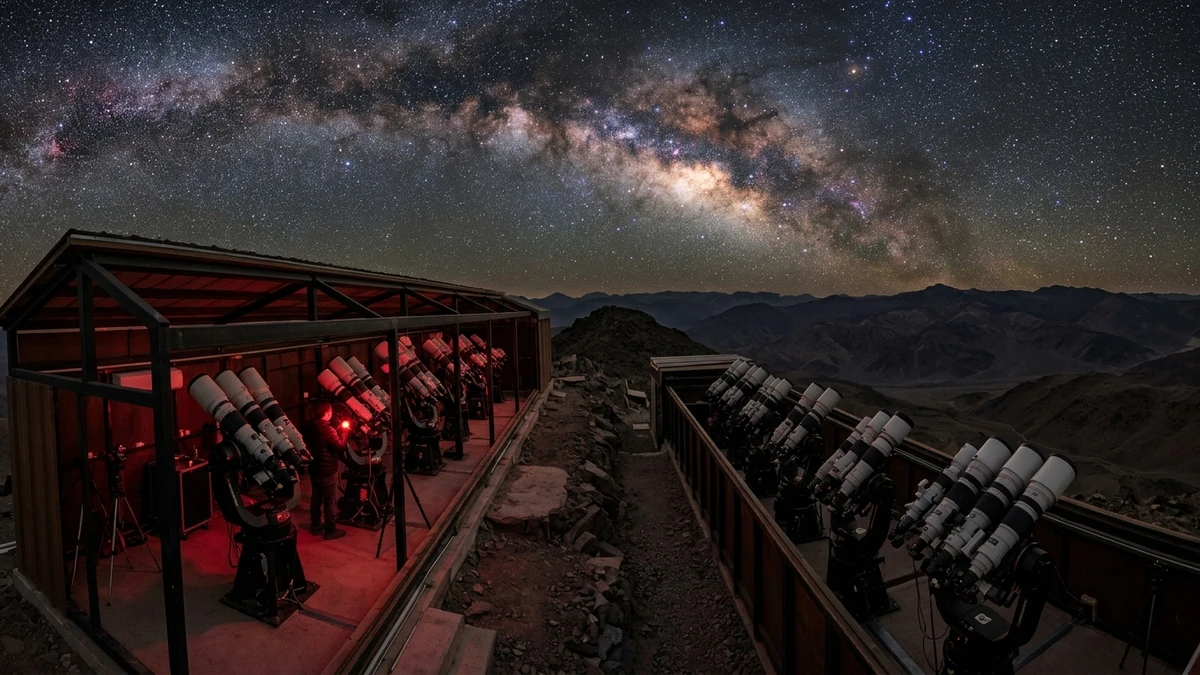
MOTHRA is a new telescope at the El Sauce Observatory in Chile's Coquimbo region, built not around one enormous mirror but from 1,140 high-end Canon telephoto lenses, the same 400mm f/2.8 lenses sports photographers use. Combined, they act like a single 4.8-metre telescope with a huge field of view, purpose-built for detecting extraordinarily faint glowing gas that ordinary telescopes miss.
It grew out of the smaller Dragonfly Telephoto Array, which van Dokkum co-founded, and its main mission is even more ambitious than this: mapping the cosmic web, the vast dim skeleton of gas that links galaxies together. The same faint-structure approach recently helped astronomers trace a stream of stars beyond the Milky Way as a new way to map dark matter.
And MOTHRA wasn't even finished when it took the data. The observations date from November 2025, using roughly 190 of the eventual 1,140 lenses. A sixth of a telescope found something Hubble never did. The full array should be complete by the end of 2026.
What Is the Helix Nebula? The 'Eye of God' Explained
The Helix Nebula, catalogued as NGC 7293, is a planetary nebula, which is a confusing name because it has nothing to do with planets. Early astronomers thought these round glowing shells looked planet-like through small telescopes, and the label stuck.
What you're actually seeing is the death of a star similar to our own Sun. When a Sun-like star runs out of fuel, it swells, becomes unstable and gently puffs its outer layers away into space over thousands of years. The exposed core, a white dwarf, is left behind, and its fierce ultraviolet light sets the cast-off gas glowing. James Webb recently found carbon "buckyballs" floating in exactly this kind of dying-star shell, a reminder of how chemically rich this recycled material is.
The Helix sits around 650 light-years away in Aquarius, making it one of the closest planetary nebulae to Earth, and it's roughly 10,600 years old. It's also enormous on the sky. Its outer ring spans nearly the width of a full Moon, and photographs of its glowing ring around a bright central point earned it the nickname the "Eye of God".
Can You See the Helix Nebula From the UK?
Yes, the Helix Nebula is visible from the UK, and right now is the start of the best season for it. It climbs into the southern sky on late August and autumn evenings, though from UK latitudes it never gets very high, so you'll want a flat southern horizon.
Fair warning: this is a faint target. All that size works against it, because its light is spread over a huge area. From a town, you'll likely see nothing at all. From a genuinely dark site on a moonless night, 10x50 binoculars will show a pale, round glow, and a small telescope at low magnification starts to hint at the ring. An OIII or UHC nebula filter helps enormously. If you're new to this kind of observing, our binocular astronomy guide and telescope basics guide cover the technique, and it's worth checking what else is up tonight while you're out. Beginners might prefer to start with something easier from our stargazing for beginners guide and work up to it.
Gear for hunting the Eye of God
Kit we've tested and reviewed in full
The Helix Nebula is big but faint, a classic dark-sky target for autumn evenings. Here's what will actually show it to you from the UK.

Under a properly dark sky, 10x50s will show the Helix as a pale, round glow in Aquarius. A great test of your sky and your patience.
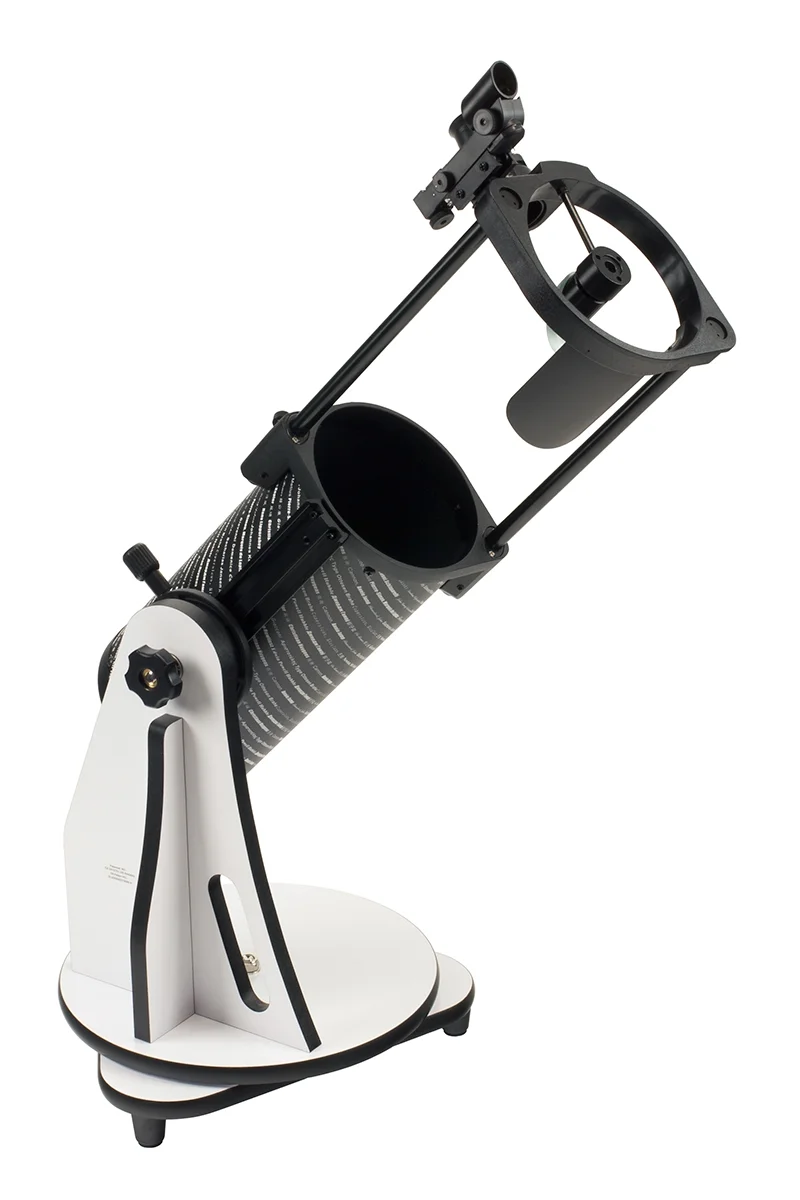
Enough aperture at low power to make out the Helix's ring shape from a dark site, and a brilliant all-round first telescope.
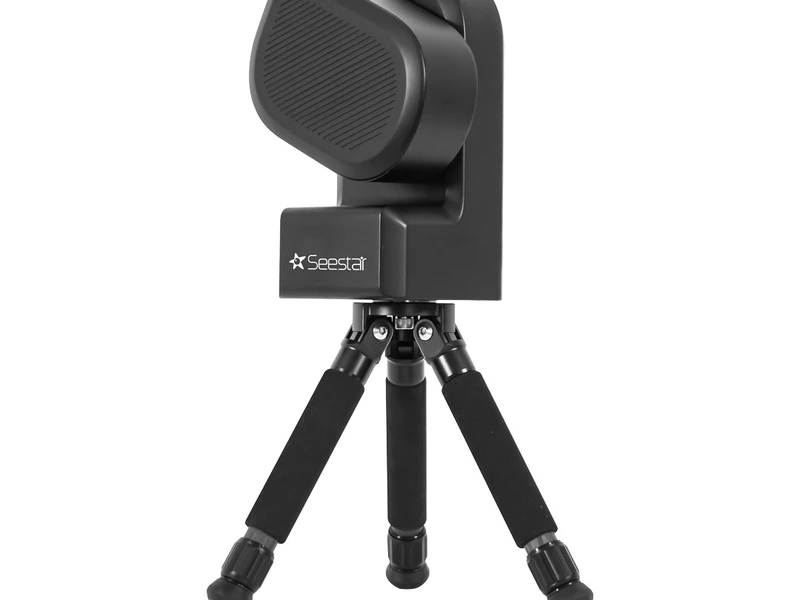
A smart telescope that stacks exposures automatically, pulling out the Helix's colour and structure that eyes alone can't see.
Affiliate links: you pay the same price, we earn a small commission that helps keep WatchTheStars free.
How Dying Stars Recycle Their Material Into New Stars and Planets
Astronomers have understood the broad strokes of stellar recycling for decades. Stars forge new elements in their cores, dying stars shed that enriched material, and somehow it ends up in the clouds that collapse into the next generation of stars and planets. The carbon in your body and the oxygen you're breathing went through this loop before the Sun existed.
The missing piece was the "somehow". Nobody had directly seen the step where a dead star's cast-off material actually breaks down and blends into the interstellar medium. That's what the 22 bow shocks show: fragment by fragment, the Helix's dying star is being broken down and folded back into the galaxy's raw material.
"Far in the future, the Sun will go through a similar process, and its material will enter the same cycle," van Dokkum said. And because the Helix is a fairly ordinary planetary nebula, the same thing should be happening around dying stars all over the galaxy. We just needed a telescope sensitive enough to catch it.
In five or six billion years, some of the atoms that make up the Earth will be riding bow shocks of their own into interstellar space. If you do track down that faint glow in Aquarius this autumn, you're looking at a preview of home.
Sources:
- MOTHRA Shows Us A Star Being Recycled in the Helix Nebula · Universe Today
- Numerous bow shocks in the outer Helix Nebula · Nature, van Dokkum & Pasha, 12 August 2026
- Astronomers witness cosmic recycling system in action · Northwestern Now
- MOTHRA Telescope Array · official project site
- Helix Nebula (NGC 7293) · Constellation Guide
Hero image: NGC 7293, the Helix Nebula · NASA/JPL-Caltech (GALEX/Spitzer), public domain.
Frequently Asked Questions
Equipment guides
Related topics

Ian ClaytonAmateur astronomer and founder of WatchTheStars.co.uk, dedicated to helping others explore the wonders of our universe. Full profile →