Key takeaways
- Edward Ruppelt's 1952 UFO talk was given in Boston on 26 March 1952 and released by the Pentagon on 18 September 2026 as a 65-minute recording (PR160) and a 19-page transcript (D154)
- Ruppelt told the room the Air Force had about 800 UFO cases on record, and that about 20% were very good reports from reliable people where 'absolutely no conclusions can be drawn'
- The talk gives two different breakdowns of the 800 cases, so 'about a fifth unexplained' is the fair summary, not a precise figure
- Ruppelt said the Air Force had worked closely with Life magazine on a coming article, and was pushing the project's classification down from confidential to restricted because of it
- The 1952 Ruppelt talk predates the Tremonton UFO film by over three months and never mentions it
Jump to section 9 sections
- What Is the 1952 Edward Ruppelt UFO Recording?
- How Many UFO Reports Did Blue Book Say Were Unexplained?
- 'They Must Speak English': The Radar Case Ruppelt Joked About
- Why Airline Pilots Wouldn't Report UFOs in 1952
- Did the Air Force Work With Life Magazine on UFOs?
- What Did Ruppelt Say About the Mantell Case?
- What Did Ruppelt Say About the Green Fireballs and Lubbock Lights?
- Is This the MIT Lincoln Lab 'Flying Saucer Talk' Tape?
- How to Listen to the Ruppelt Recording Yourself
In March 1952 a young Air Force officer stood up in front of a room in Boston and talked for about an hour about flying saucers. Someone recorded it. Seventy-four years later the Pentagon has published the tape and a transcript, and it's one of the most human documents in the Pentagon's sixth UFO file release.
The speaker is Edward J. Ruppelt, who had just been put in charge of the Air Force UFO investigation that became Project Blue Book. What follows is what he said, checked line by line against the transcript.
What Is the 1952 Edward Ruppelt UFO Recording?
The 1952 Ruppelt recording is a talk Captain Edward J. Ruppelt gave in Boston on 26 March 1952, explaining how the Air Force was reorganising its study of UFO reports. It was released on 18 September 2026 as a 65-minute audio file (DOW-UAP-PR160) with a 19-page transcript (DOW-UAP-D154).
The Department of War calls him Captain, but in the recording a colleague calls him "Lieutenant Ruppelt", which fits a man early in the job. He describes his role plainly: the year before, "we decided there possibly was enough material now to reopen this case," and the Air Technical Intelligence Center "appointed a permanent project engineer, which I'm the project engineer."
The tape opens with someone testing the microphone ("Now is the time for all good men to come to the aid of their country") before Ruppelt starts mid-sentence. His first rule for the subject is a good one: "I'll refer to them as 'these things' because we have no idea what we're dealing with."
This talk is three months older than the Tremonton UFO film, shot on 2 July 1952. It never mentions Tremonton. It's a picture of Blue Book's thinking just before that case landed on its desk.
How Many UFO Reports Did Blue Book Say Were Unexplained?
About a fifth. Ruppelt said the Air Force had "approximately 800 cases now on record", that only about 2% were hoaxes or "psychopathological people", and that "about 20% are very good reports offered by very reliable people and are just absolutely no conclusions can be drawn."
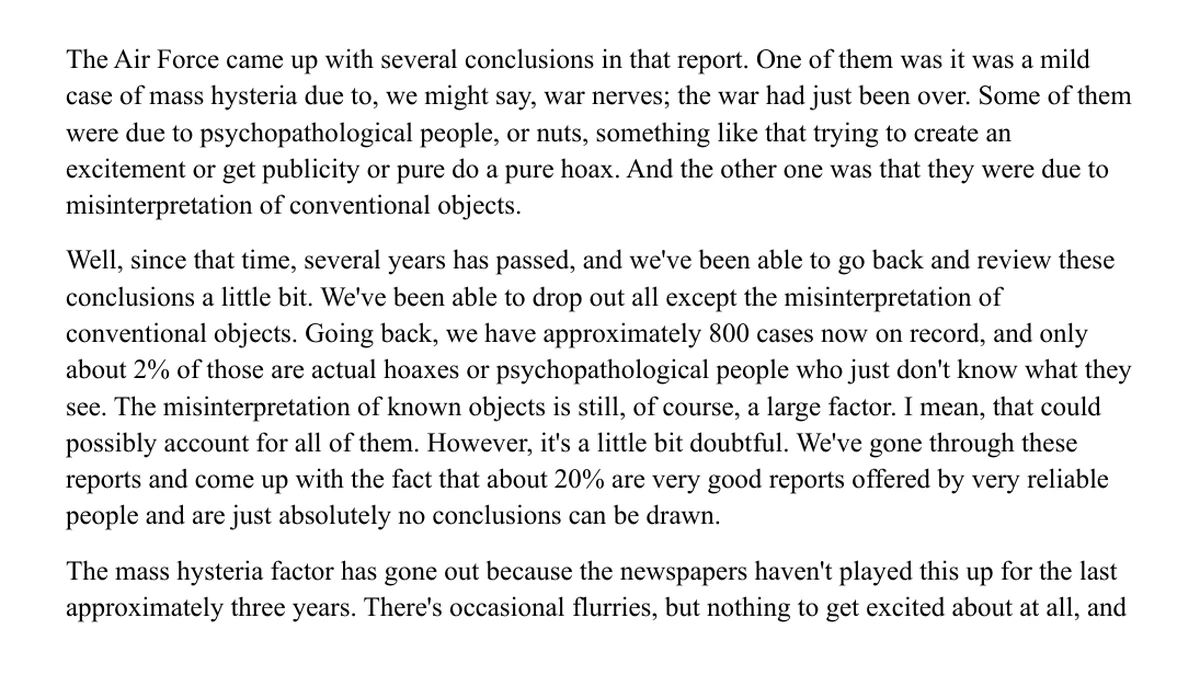
He also said the Air Force had dropped most of the conclusions in its 1949 report. Mass hysteria and hoaxers were out; "we've been able to drop out all except the misinterpretation of conventional objects." Misidentification, he added, "could possibly account for all of them. However, it's a little bit doubtful." If you want the earlier history he was revising, our post on the 1948 Project Sign report covers the first hundred cases.
The trouble is the figures move. Near the end, in the question time, the breakdown is given again: "80% of these, roughly, are known objects, or possibly", then "not 80% definitely proved, but say 60 definitely", "say 20% that maybe could have been a plane, a balloon, or a meteor", and "that 20% like the green fireballs and the lights that we just do not have an answer for." The speaker calls them "rough figures" himself. So "about a fifth unexplained" is fair. A precise percentage isn't.
| Ruppelt's 1952 figures (about 800 cases) | First breakdown (page 2) | Second breakdown (page 15) |
|---|---|---|
| Hoaxes or "psychopathological people" | about 2% | not given |
| Definitely explained | not given | "say 60 definitely" |
| Possibly a plane, balloon or meteor | not given | about 20% |
| No answer | "about 20%" | "that 20%" |
'They Must Speak English': The Radar Case Ruppelt Joked About
The line in the title comes from a radar case. A ground-controlled approach (GCA) operator saw two objects coming in at "about 4 or 500 miles an hour" on a collision course with a landing C-47. The tower said there were no other aircraft out there. The radar man said there were, so the tower called "in the blind" to warn the two unknowns.
"And just as they said that, these two returns made a turn." Ruppelt's verdict: "Do they speak English? ... So, that's about the only conclusion we can draw, they must speak English." The transcript garbles the airfield's name, so we won't guess at it.
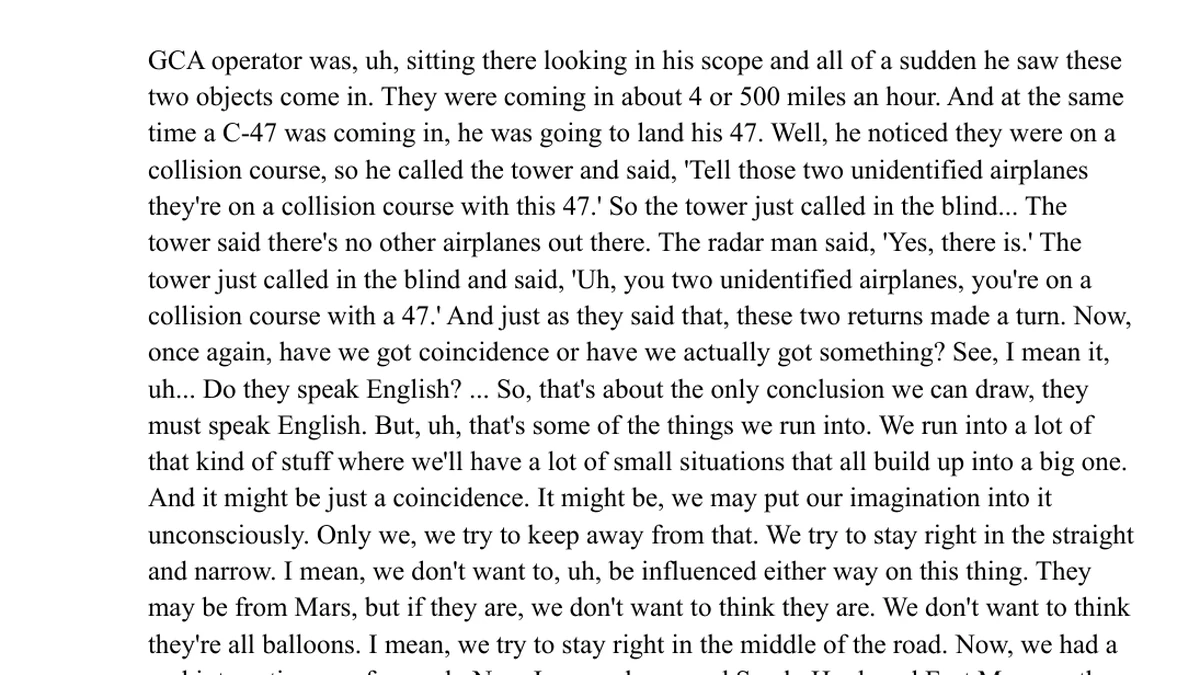
He doesn't oversell it: "it might be just a coincidence. It might be, we may put our imagination into it unconsciously." Then the line that sums up his whole approach: "They may be from Mars, but if they are, we don't want to think they are. We don't want to think they're all balloons. I mean, we try to stay right in the middle of the road."
He follows it with a case that fell apart. Two T-33 pilots chased a "great big disc-shaped thing" near Fort Monmouth, New Jersey, and radar stations clocked "speeds up to 3,500 miles an hour". It turned out to be a large balloon launched at Fort Monmouth, and flustered student radar operators who couldn't lock on. "Well, what at first appeared to be a very good sighting just all broke down when we get enough facts."
Why Airline Pilots Wouldn't Report UFOs in 1952
Airline pilots kept quiet because they feared ridicule and losing their jobs. Ruppelt said they "absolutely refuse to give us reports unless they're completely sold that they saw something", after "very unfavorable publicity" in 1947 and 1948.
One pilot told him that if he saw "a V-2 rocket or something like that flying wingtip to wingtip with him over Spokane, he wouldn't tell anybody about it", because "they just say he was crazy and probably ground him." Ruppelt rated pilots, tower operators, balloon crews and scientists as the reports he was "very much interested in".
He was just as frank about the evidence: "Up till the present time, we've got no real proof that anything even exists. The only thing we've got are reports from very reliable people."
Did the Air Force Work With Life Magazine on UFOs?
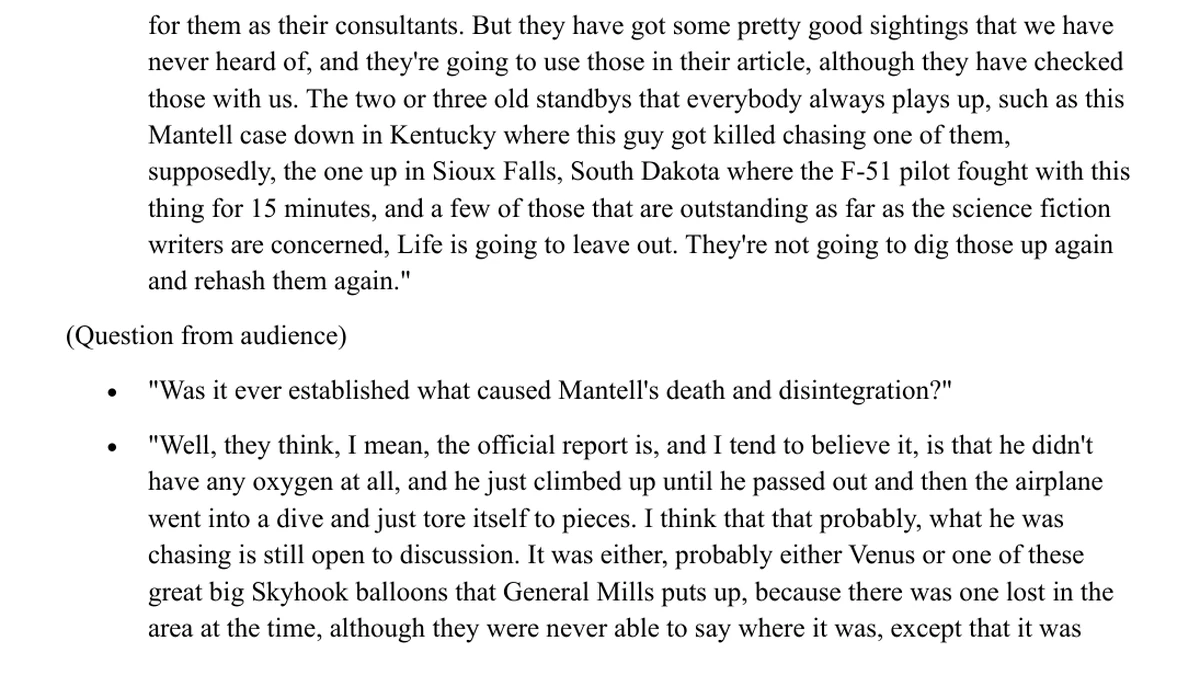
Yes. In the 1952 talk Ruppelt said the Air Force had worked closely with Life magazine on its coming UFO article: "we've been working closely with Life, and they're supposedly are going to print what we told them to. I hope they do." He expected it to be "on a factual basis... just about like this briefing."
He also said Life would leave out "the two or three old standbys", naming the Mantell case and a Sioux Falls F-51 case, and that a True magazine piece would be "slanted the other way" and "written by one of these science fiction writers".
The most striking admission is about secrecy. Asked whether the subject was still top secret, he said the project was carried as confidential, and "We're trying to get it dropped down to restricted now because Life is going to come out with a lot of material we've given them that is classified, or was classified at one time." In other words, the classification was being lowered to fit a planned magazine story. He gave a second reason too: when the Air Force told reporters a sighting was classified, the next headline was that it had "picked up a spaceship somewhere and they won't tell us about it."
What Did Ruppelt Say About the Mantell Case?
Ruppelt backed the official explanation of Mantell's death but left the object open. The official report, "and I tend to believe it", was that Mantell "didn't have any oxygen at all, and he just climbed up until he passed out" before the aircraft broke up in a dive.
On what Mantell was chasing, he said it "is still open to discussion. It was either, probably either Venus or one of these great big Skyhook balloons that General Mills puts up". Venus turns up again and again in UFO files for a simple reason: it's the brightest thing in the sky after the Sun and Moon, and in daylight people don't expect to see it.
What Did Ruppelt Say About the Green Fireballs and Lubbock Lights?
Ruppelt said the green fireballs "definitely exist" and that the Lubbock Lights were the most interesting case Blue Book had, but he had no answer for either. He talked at length on the green fireball incidents over New Mexico. He described them as "a brilliant, uh, greenish-blue color" with "a definite flat trajectory", and said "they don't explode". Dr Lincoln LaPaz's idea that they came from Russia was "a good story", he said, while another scientist, Dr Kaplan, thought they were a new kind of meteor or something to do with the aurora. Our post on James Tuck and the Los Alamos green fireballs picks up that thread.
There's a nice astronomy detail in it. Ruppelt said the fireballs tended to appear "in December and January" and "coincide with a meteor shower that occurs at that time", though he couldn't remember its name. The two big showers either side of New Year are the Geminids meteor shower in December and the Quadrantid meteor shower in early January. He added that the link had weakened, as reports had begun to come in all year round.
He called the Lubbock case of August 1951 "the most interesting one we've ever had". OSI offered the student photographer a quiet way to back out, and he refused and signed a sworn statement. The Air Force checked the negatives and found the images were about as dense as "a bright planet at night". It still couldn't say what the lights were. The professors who saw them wouldn't accept the photos or the duck theory, and Ruppelt said about half the people who saw the lights insisted they weren't ducks.
Is This the MIT Lincoln Lab 'Flying Saucer Talk' Tape?
Nobody can yet say whether the Pentagon's 1952 Ruppelt recording is the MIT Lincoln Lab tape. In June we covered Congressman Eric Burlison's push to get the MIT Lincoln Lab 1952 flying saucer tape, catalogued as a March 1952 Ruppelt "flying saucer talk". The Pentagon's recording is also Ruppelt, also March 1952. But its catalogue entry gives Boston as the place and says nothing about MIT or Burlison's request, so we're not going to claim they're the same reel.
How to Listen to the Ruppelt Recording Yourself
The audio is public domain and plays below, straight from DVIDS. The transcript is DOW-UAP-D154; open it in our PURSUE files browser under D154, and find the rest of our case work on the UAP research hub.
Check a strange light the way Blue Book wished it could
Kit we've tested and reviewed in full
Ruppelt's team had no way to get a closer look at what people saw. You do. A decent pair of binoculars tells you in seconds whether a light is a planet, a satellite or an aircraft. Our guide to the best binoculars for stargazing has the full comparison.
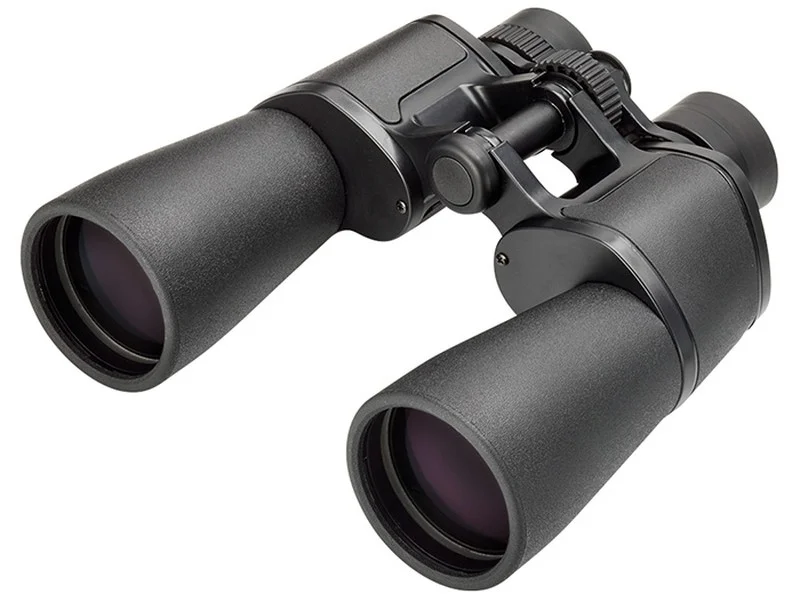
Bright and quick to aim, so you can get onto a moving light before it's gone.
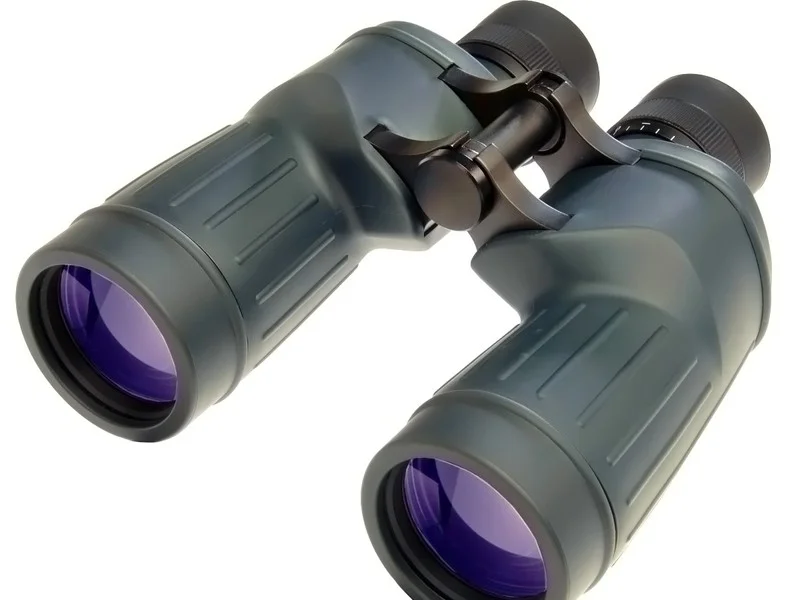
Built for long, damp nights outdoors, which is when most sightings happen.
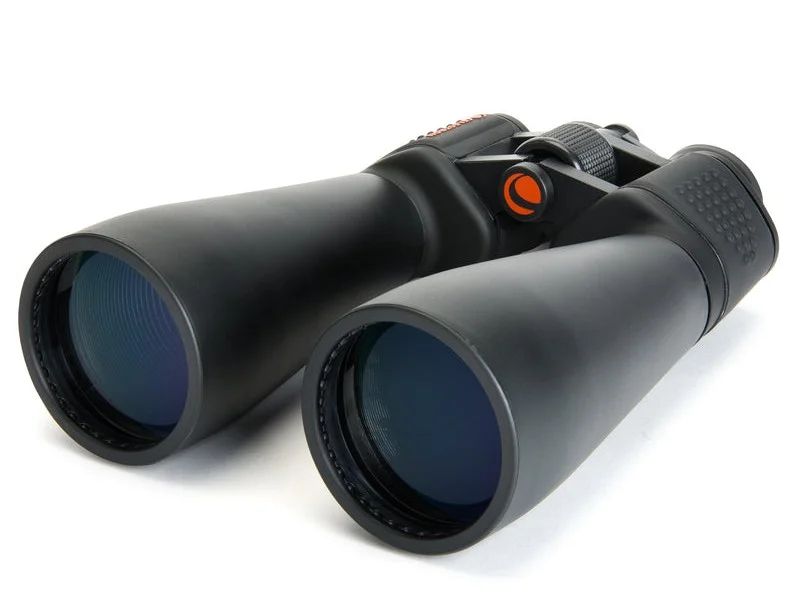
The extra aperture picks out navigation lights on a far-off aircraft. Best on a tripod.
Affiliate links: you pay the same price, we earn a small commission that helps keep WatchTheStars free.
Ruppelt's best cases were lights nobody could get a closer look at. If you see one yourself, start with the ordinary answers. Check ISS passes tonight for your area, and see what you can see in the sky tonight for the bright planets. Fireballs are more likely around the peak of a shower, so it's worth knowing the next meteor shower in the UK.
Sources:
- DOW-UAP-D154, "Transcript of a Presentation by Captain Edward J. Ruppelt, 1952", US Department of War, PURSUE Release 06, 18 September 2026
- DOW-UAP-PR160, "Presentation by Captain Edward J. Ruppelt, 1952" (audio, DVIDS 1023407), US Department of War, PURSUE Release 06
- Department of War records catalogue entries for DOW-UAP-D154 and DOW-UAP-PR160
Header image: an illustration generated with Google Gemini, not a photograph of the 1952 talk. Transcript pages: DOW-UAP-D154, US Department of War, public domain.
Frequently Asked Questions
Equipment guides
Related topics

Ian ClaytonAmateur astronomer and founder of WatchTheStars.co.uk, dedicated to helping others explore the wonders of our universe. Full profile →