Key takeaways
- The Pentagon's warp-drive paper is AAWSAP DIRD D138, 'Warp Drive, Dark Energy, and the Manipulation of Extra Dimensions', dated 2 April 2010 and published in the sixth PURSUE release on 18 September 2026
- Its own Table 2 says a 50-metre warp bubble at light speed needs −3.03 × 10⁵⁰ joules of negative energy. Set against the Sun's rest energy, which the paper gives as 1.79 × 10⁴⁷ J, that's about 1,700 Suns
- At 3 km/s the bubble needs −3.03 × 10⁴⁰ J. That is a tiny fraction of the Sun, not a hundred Suns, but it is still a mass-equivalent of roughly 6% of the Earth, and all of it negative
- For a 1,000-tonne ship the paper works out a top speed of 5.16 × 10⁻⁶ metres per second and adds: 'Garden snails can crawl faster than this.'
- The companion wormhole paper (D139) needs 0.71 Jupiter masses of negative mass per metre of throat. The Department of War's own summary says the warp-drive idea 'offers no viable engineering pathway'
Jump to section 10 sections
- What Is the Pentagon Warp Drive Paper?
- How Much Energy Does a Warp Drive Need? The Paper's Table 2
- How Many Suns Would a Warp Drive Need?
- Could a Slow Warp Drive Work? The 'Garden Snails' Line
- Warp Drive and Extra Dimensions: The Paper's Way Out
- What Does the Pentagon Wormhole Paper Say?
- Pentagon Antigravity and Negative Mass Papers: What They Conclude
- Who Wrote the Pentagon Warp Drive Paper?
- Is Warp Drive Possible? What the Pentagon Itself Says
- How to Read the Warp Drive Paper Yourself
The Pentagon warp drive paper made the headlines when the sixth batch of UFO files came out last month. Read it through, though, and it spends most of its pages arguing against its own idea. It runs the numbers for a warp bubble, finds they are hopeless, and says so in plain words, including a line about garden snails.
This post goes through those numbers, because they've been misquoted, including once by us. The short version: a warp drive at light speed needs negative energy worth about 1,700 Suns, and even a very slow one needs more than anyone could make.
What Is the Pentagon Warp Drive Paper?
The Pentagon warp drive paper is a 33-page Defense Intelligence Agency research paper called "Warp Drive, Dark Energy, and the Manipulation of Extra Dimensions", dated 2 April 2010. It's catalogued as DOW-UAP-D138 and was published in full on 18 September 2026 in the Pentagon's sixth UFO file release.
It was written for AAWSAP, the DIA's Advanced Aerospace Weapon System Applications Program, as one of its Defense Intelligence Reference Documents (DIRDs). The release contains 37 of them, and our AAWSAP programme guide rates every one. The paper never mentions UFOs. It is a survey of theoretical physics, built on Miguel Alcubierre's 1994 idea of a "warp bubble": a ship sits still inside a pocket of spacetime that shrinks in front and stretches out behind, so nothing inside the bubble ever moves faster than light. The DIA paid $21,948,810 for the programme as a whole, as the AAWSAP contract file shows.
The paper opens with a fair point: "If one is to realistically entertain the notion of interstellar exploration in timeframes of a human lifespan, a dramatic shift in the traditional approach to spacecraft propulsion is necessary." Its Table 1 shows why the idea appeals. At 100 times light speed, it says, a ship would reach Mars in 193 seconds, Neptune in 4 hours and Alpha Centauri in 15 days.
How Much Energy Does a Warp Drive Need? The Paper's Table 2
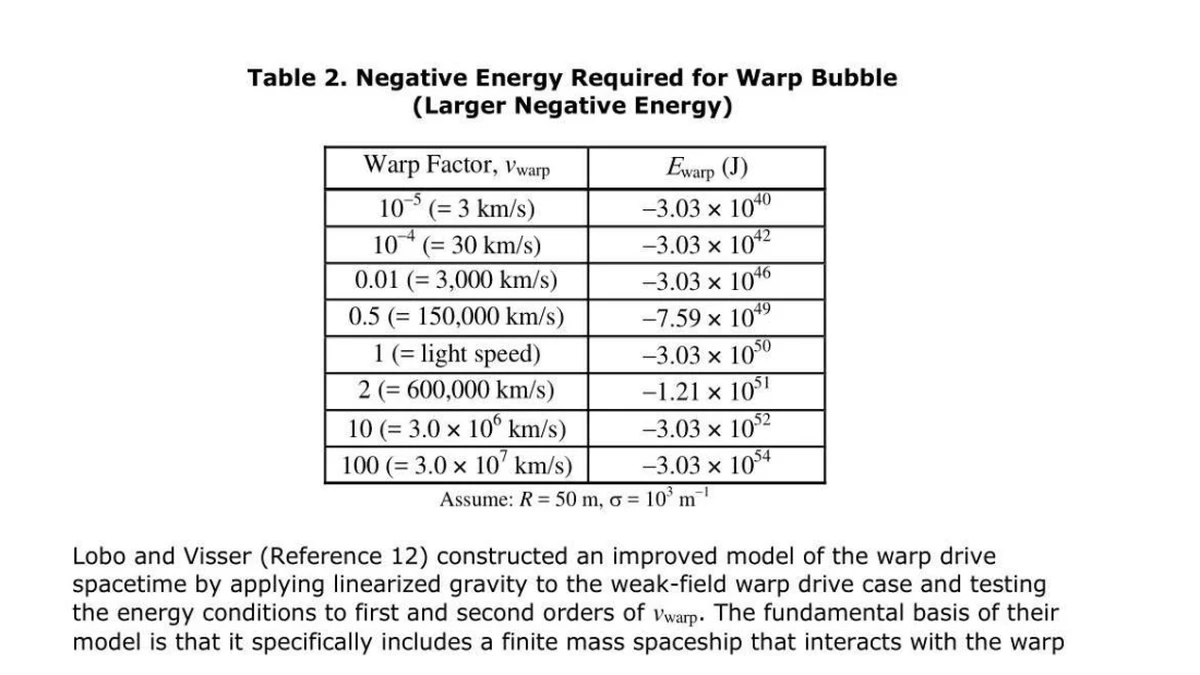
A warp drive needs negative energy, and the Pentagon paper says the amount is enormous at every speed. Its Table 2 assumes a bubble 50 metres in radius and lists the negative energy required, in joules:
| Bubble speed | Negative energy needed (Table 2) |
|---|---|
| 3 km/s | −3.03 × 10⁴⁰ J |
| 30 km/s | −3.03 × 10⁴² J |
| 3,000 km/s | −3.03 × 10⁴⁶ J |
| 150,000 km/s (half light speed) | −7.59 × 10⁴⁹ J |
| Light speed | −3.03 × 10⁵⁰ J |
| Twice light speed | −1.21 × 10⁵¹ J |
| 10 times light speed | −3.03 × 10⁵² J |
| 100 times light speed | −3.03 × 10⁵⁴ J |
The minus sign is the problem. Negative energy means an energy density below that of empty space. Physics allows it in tiny, short-lived amounts, such as between two metal plates in the Casimir effect, but nobody has ever made it in bulk. The paper says as much: "Engineering a warp drive bubble is quite daunting given these results."
How Many Suns Would a Warp Drive Need?
At light speed, a warp drive would need negative energy equal to about 1,700 Suns. That comes from the paper's own comparison. Straight after Table 2, it suggests comparing the figures "with the (positive) rest-energy contained in the Sun (1.79 x 10 47 J)", meaning all the energy locked up in the Sun's mass.
Do the division and you get this:
- 3 km/s: about one ten-millionth of the Sun
- 3,000 km/s: about a sixth of the Sun
- Half light speed: about 420 Suns
- Light speed: about 1,700 Suns
- 100 times light speed: about 17 million Suns
A note on a number you may have seen. Our own sixth release round-up said the slowest bubble needs "roughly a hundred times" the Sun's energy. That was wrong, and we've corrected it. At 3 km/s the figure is far smaller than the Sun. It isn't small, though. Turn −3.03 × 10⁴⁰ J into mass and it comes to about 3.4 × 10²³ kilograms, around 6% of the Earth's mass, and it would all have to be negative.
Could a Slow Warp Drive Work? The "Garden Snails" Line
No. A slow warp drive fails too, and the Pentagon paper makes this point itself. It cites work by Lobo and Visser showing that a warp bubble breaks the usual energy rules even at very low speeds, and concludes that for any lab that can only make negative energy "in minute amounts, the warp bubble speed will be absurdly low".
It then works an example. Take the Table 2 bubble and put a ship of 10⁶ kilograms (1,000 tonnes) inside it. The top speed comes out at 5.16 × 10⁻⁶ metres per second, which is about 2 centimetres an hour. The next sentence in the paper is: "Garden snails can crawl faster than this."
To get that same ship up to light speed, it adds, the bubble wall would need to be 3.57 × 10⁸ light-years thick, which it calls "an unrealistic requirement".
Warp Drive and Extra Dimensions: The Paper's Way Out
The second half of the paper offers a way round the numbers, and it's where the speculation comes in. It proposes that dark energy might come from extra dimensions of space, and that a technology able to change the size of those dimensions could make space expand and contract on demand. Its Table 3 recalculates the energy under this idea and gets figures about 10⁸ times smaller. At 100 times light speed, that's −3.03 × 10⁴⁶ J, roughly a sixth of the Sun.
Even here the paper hedges. It calls the results order-of-magnitude, and says "the energies are still far in excess of those available in the foreseeable future." The section on experiments opens: "At this point we take a diversion into pure speculation". Its summary calls control of higher dimensions "a tantalizing possibility, and one that is most certainly worthy of deeper investigation". Nobody has found extra dimensions of that kind yet.
Jupiter is a real sight, no warp drive needed
Kit we've tested and reviewed in full
The wormhole paper measures its numbers in Jupiters. The real one is well up in the south-east before dawn this autumn, and a small telescope shows its cloud belts and four big moons. Our guide to the best beginner telescopes UK has the full comparison.
Sets up in a minute on a table or wall and shows Jupiter's belts and moons clearly.
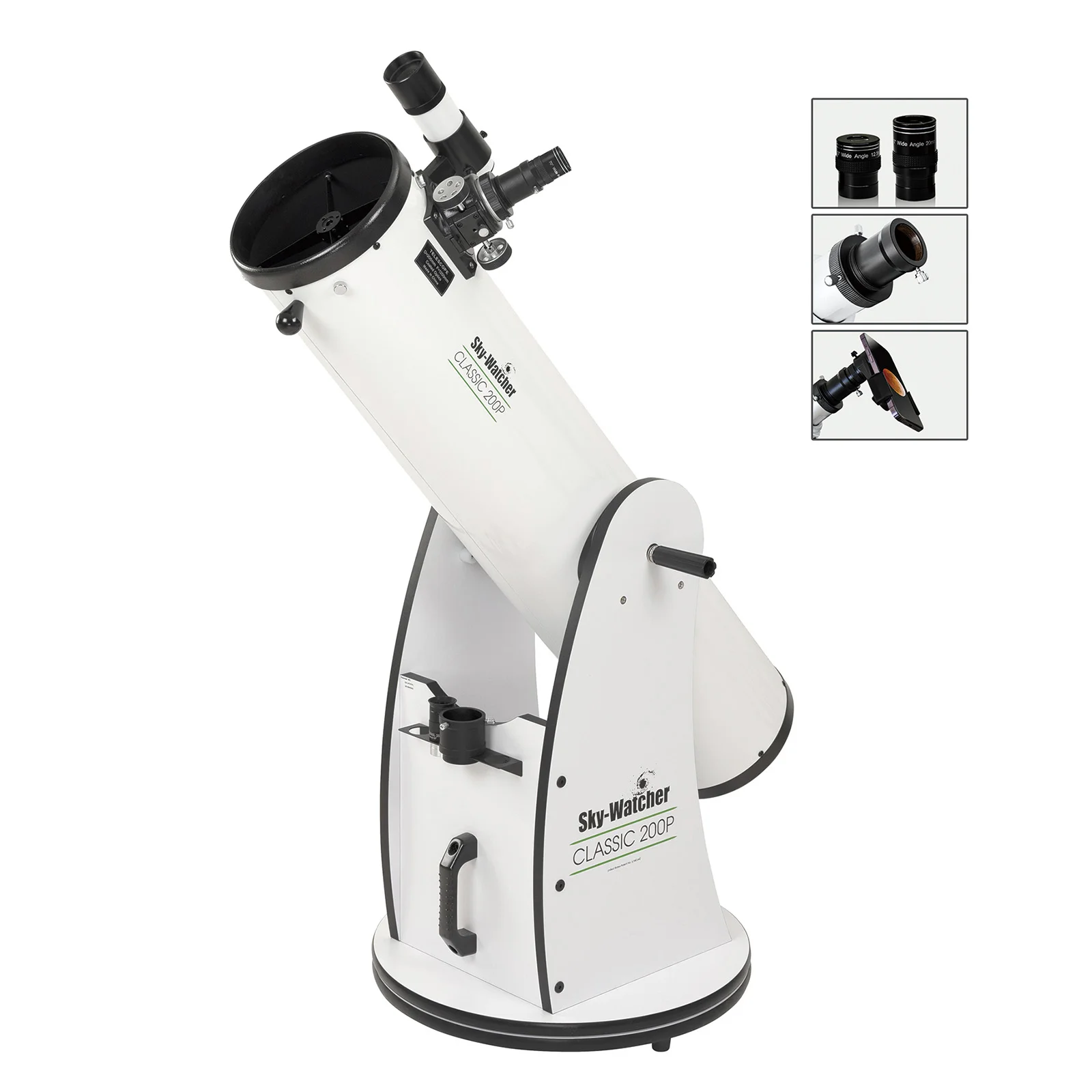
Twice the light grasp for the Great Red Spot, Saturn's Cassini Division and faint galaxies.
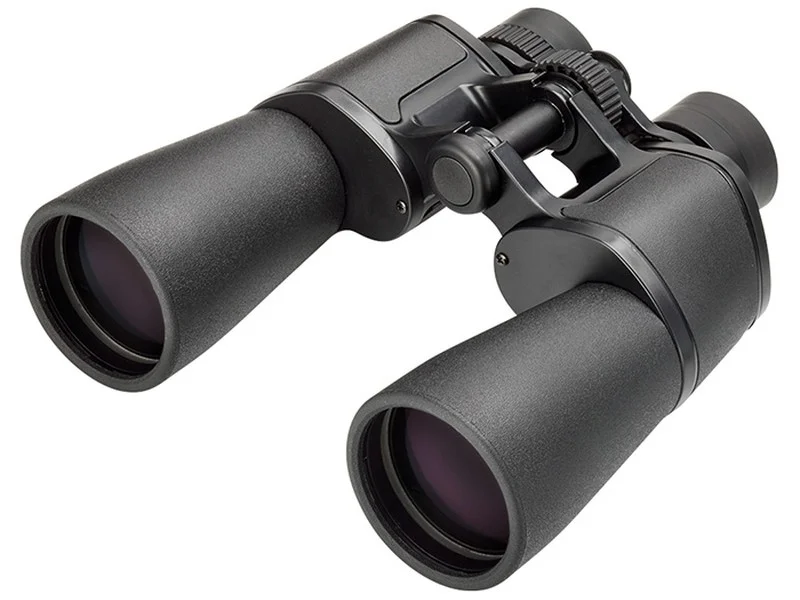
Enough to pick out Jupiter's moons as tiny points of light, and handy for anything odd in the sky.
Affiliate links: you pay the same price, we earn a small commission that helps keep WatchTheStars free.
What Does the Pentagon Wormhole Paper Say?
The Pentagon wormhole paper, "Traversable Wormholes, Stargates, and Negative Energy" (D139, dated 6 April 2010), reaches a similar answer by a different route. To hold a wormhole open, its Equation (9) says you need negative mass equal to 0.71 times the mass of Jupiter for every metre of throat width. A 1-kilometre wormhole needs about 710 Jupiters' worth.
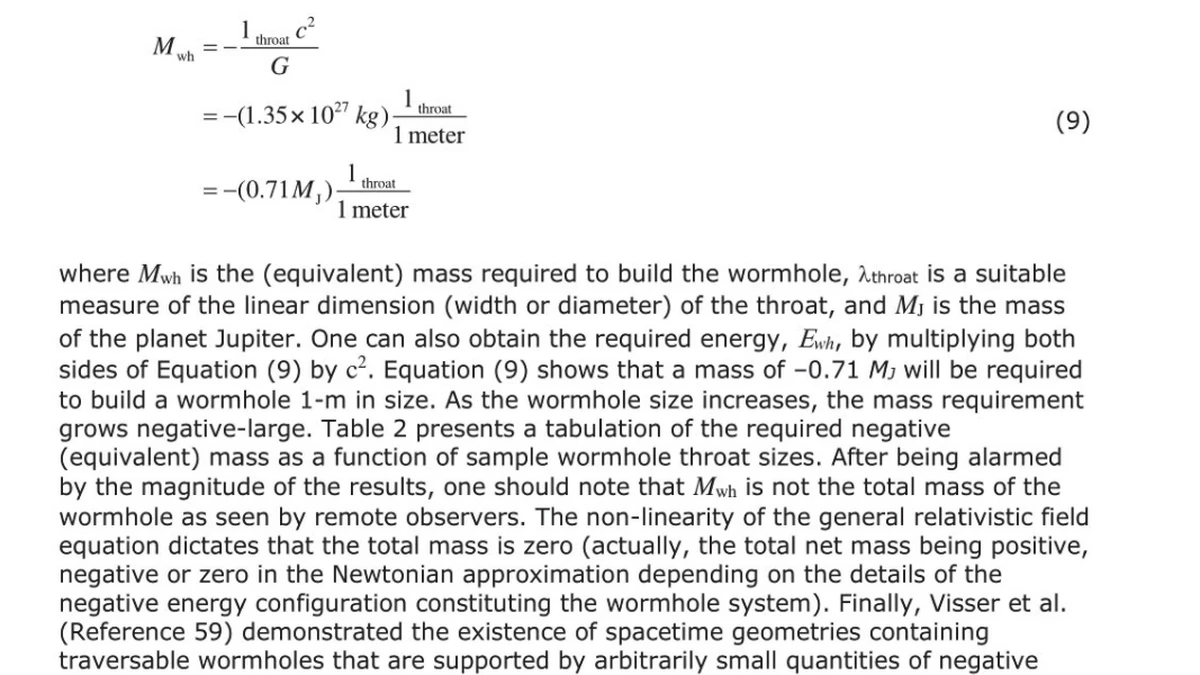
The paper is more upbeat than the warp-drive one. It says the objection that exotic matter breaks the energy rules "is a spurious issue", and points to work by Visser and colleagues showing that some wormhole shapes need only very small amounts of negative energy. It also has a figure titled "A Stargate in Times Square", and notes that the 1980s wormhole research behind it was done "at the request of Carl Sagan, who had completed the draft of his novel Contact."
Pentagon Antigravity and Negative Mass Papers: What They Conclude
The Pentagon antigravity and negative-mass papers land in much the same place as the warp-drive paper: neither offers a workable route. The antigravity paper (D135) concludes it is "highly unlikely, if not impossible" that anyone will soon build a technology that taps enough dark energy for useful antigravity propulsion. It notes that all the dark energy in the solar system adds up to the mass of a small asteroid.
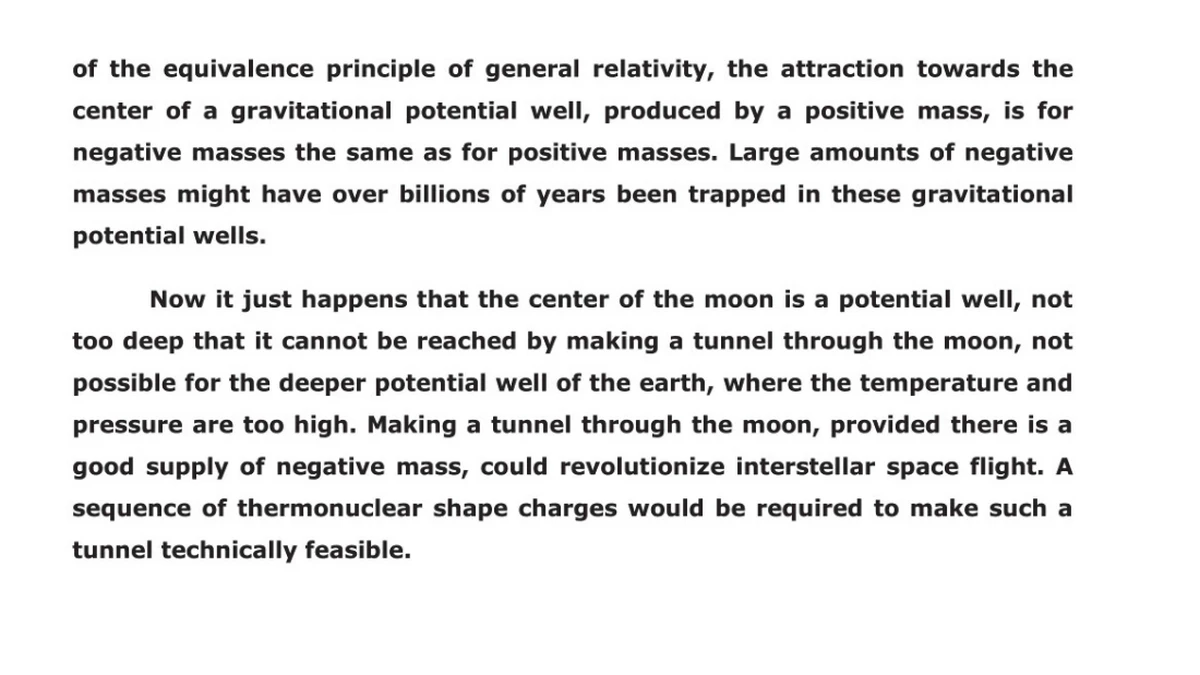
The negative-mass paper (D152, January 2011) goes furthest. It suggests negative mass might be trapped at the centre of the Moon and proposes reaching it with a tunnel: "A sequence of thermonuclear shape charges would be required to make such a tunnel technically feasible."
Who Wrote the Pentagon Warp Drive Paper?
The release doesn't name the authors of the warp-drive paper. Both are redacted, as "AAP Person 74" and "AAP Person 58", and it's the only DIRD in its batch with two.
There are clues. The reference list cites earlier papers by R. Obousy and G. Cleaver, including one called "Warp drive: A new approach", and the paper describes "the novel warp drive concept that we have been developing since 2005". That's consistent with the physicist Richard Obousy being one of the two authors. The code "AAP Person 58" also appears on the antigravity and wormhole papers. None of this confirms a name, so we don't give one.
Is Warp Drive Possible? What the Pentagon Itself Says
Not on the evidence of these papers, and the Department of War says so. Its catalogue entry for D138 says the paper's chain of ideas "lacks empirical support and offers no viable engineering pathway toward a functioning propulsion system". For the wormhole paper, it says "the gap between theoretical models and any realizable technology remains enormous."
The catalogue also describes all the DIRDs as "best understood as reference and synthesis products rather than as original research". That matches what's in them. They are surveys of what physics allows on paper, commissioned by a programme that ran on contract paperwork, and they never claim anyone has built any of this.
How to Read the Warp Drive Paper Yourself
Both papers are public domain. Open the warp-drive paper (D138) or the wormhole paper (D139) in our PURSUE files browser, which links to downloads from our own mirror. The UAP document archive lists every collection we've catalogued, the UAP research hub gathers our case work, and our post on the DIA's UFO injury paper covers the most talked-about paper from the same programme.
And if you'd rather look at the real thing, Jupiter is a morning object this autumn. In early November it rises around midnight from most of the UK, and by 5am it stands 40 to 45 degrees up in the south-east. Check what you can see in the sky tonight, the UK night sky this week for what's coming up, or our guide to stargazing for beginners if you're just starting out.
Sources:
- DOW-UAP-D138, "Warp Drive, Dark Energy, and the Manipulation of Extra Dimensions", AAWSAP DIRD, 2 April 2010, US Department of War, PURSUE Release 06, 18 September 2026
- DOW-UAP-D139, "Traversable Wormholes, Stargates, and Negative Energy", AAWSAP DIRD, 6 April 2010, PURSUE Release 06
- DOW-UAP-D135, "Antigravity for Aerospace Applications", 30 March 2010, and DOW-UAP-D152, "Negative Mass Propulsion", 3 January 2011, both at war.gov/ufo
- Department of War records catalogue entries for DOW-UAP-D138 and DOW-UAP-D139, PURSUE Release 06
Header image: an illustration generated with Google Gemini. Document pages: DOW-UAP-D138, D139 and D152, US Department of War, public domain.
Frequently Asked Questions
Equipment guides
Related topics

Ian ClaytonAmateur astronomer and founder of WatchTheStars.co.uk, dedicated to helping others explore the wonders of our universe. Full profile →