Key takeaways
- CIA-UAP-008 is a two-page CIA Intelligence Information Report, number 00-B-321/07709-72, distributed on 10 April 1972
- CIA-UAP-008 summarises a speculative 1971 paper by Nikolai Kardashev and Andrei Sakharov on charged masses that collapse and 'bounce' into another part of space-time
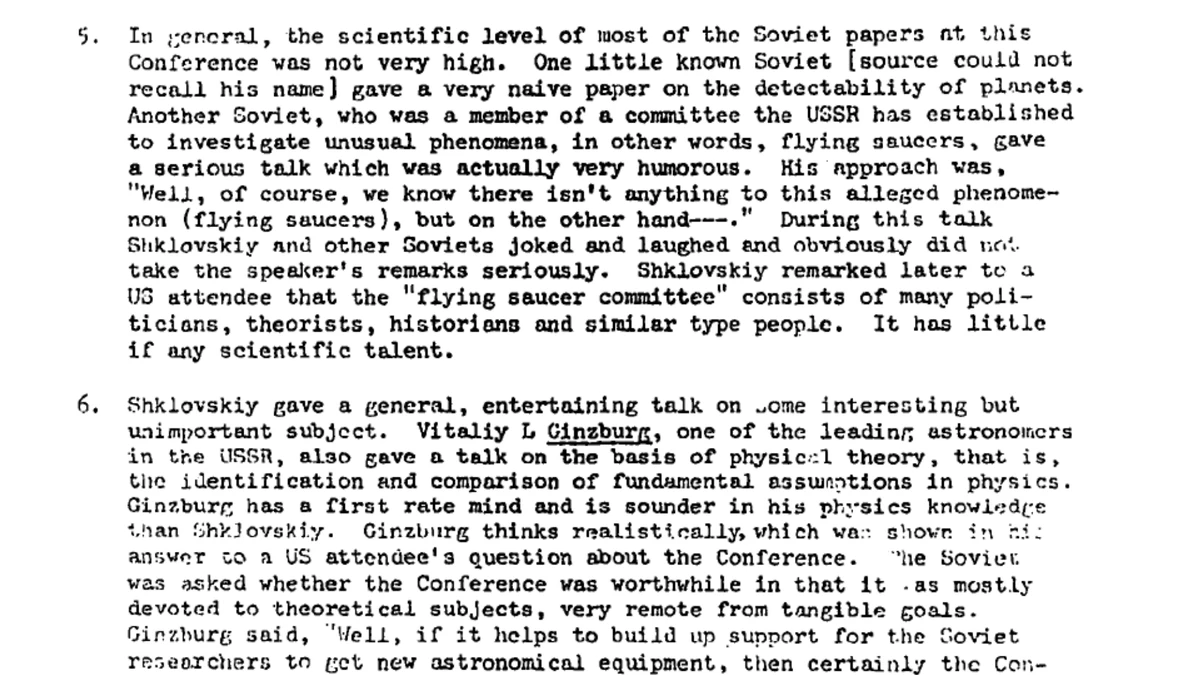
- The only UFO content in CIA-UAP-008 is one paragraph: a Soviet 'flying saucer committee' speaker whose talk made Iosif Shklovsky and other Soviets laugh
- The Yerevan meeting in CIA-UAP-008 matches the dates and cast of the 1971 Soviet-American CETI conference at Byurakan, Armenia
Jump to section 7 sections
- What Is CIA-UAP-008? The CIA Report on Kardashev and Sakharov
- Kardashev and Sakharov's 1971 Paper: Black Holes That Bounce
- Which Conference? Byurakan and the 1971 Soviet-American CETI Meeting
- Did the Soviet Union Have a UFO Committee? Paragraph 5
- Why Is This in the CIA's UFO Files?
- How to Check a UFO Sighting Yourself
- Where to Read CIA-UAP-008
This week's pick from the CIA's UFO files isn't really about UFOs at all, which is what makes it interesting. CIA-UAP-008, report number 00-B-321/07709-72, is a two-page CIA report from April 1972 about a scientific conference in Soviet Armenia. Most of it covers a far-out physics paper by the astronomer Nikolai Kardashev and the H-bomb physicist Andrei Sakharov. Then, in paragraph 5, a Soviet "flying saucer committee" turns up and the room starts laughing.
This is the fifteenth post in our Document of the Week series, where we take one file from our declassified UAP document archive and explain in plain English what it says. Last week's was the CIA's 1952 memo on Britain's flying saucer work. A quick note on the swap: our queue had the 1957 Budapest report (CIA-UAP-009) next, but the released scan of that one is a 134 by 221 pixel thumbnail that nobody can read, so we've moved on to the next file in the queue.
What Is CIA-UAP-008? The CIA Report on Kardashev and Sakharov
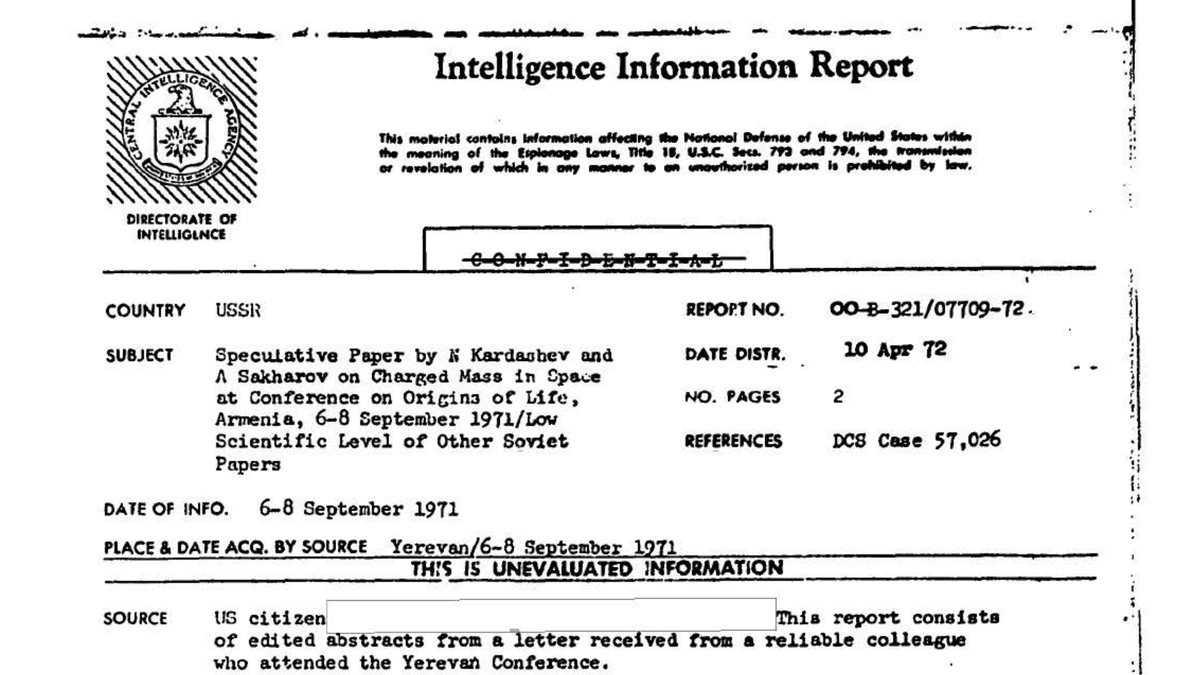
CIA-UAP-008 is a CIA Intelligence Information Report from the Directorate of Intelligence, distributed on 10 April 1972. It runs to two pages and six numbered paragraphs, and the "Confidential" marking has been struck through. The US Department of War released it on 12 June 2026 in the third PURSUE batch.
| CIA-UAP-008 at a glance | |
|---|---|
| Report number | 00-B-321/07709-72 |
| Date distributed | 10 April 1972 |
| Event covered | Conference on the Origins of Life, Yerevan, Armenia, 6 to 8 September 1971 |
| Reference | DCS Case 57,026 |
| Source | A US citizen (name redacted), quoting a letter from a colleague who attended |
| Released | 12 June 2026, PURSUE Release 3 (war.gov) |
The source line tells you how it was gathered. A US citizen, whose details are blacked out, handed over "edited abstracts" from a letter written by a colleague who had been at the meeting. The "DCS" reference points to the CIA's domestic office that debriefed Americans who travelled abroad. In other words, this is a scientist's gossip from a conference, written up by the CIA. The header even warns: "This is unevaluated information."
Kardashev and Sakharov's 1971 Paper: Black Holes That Bounce
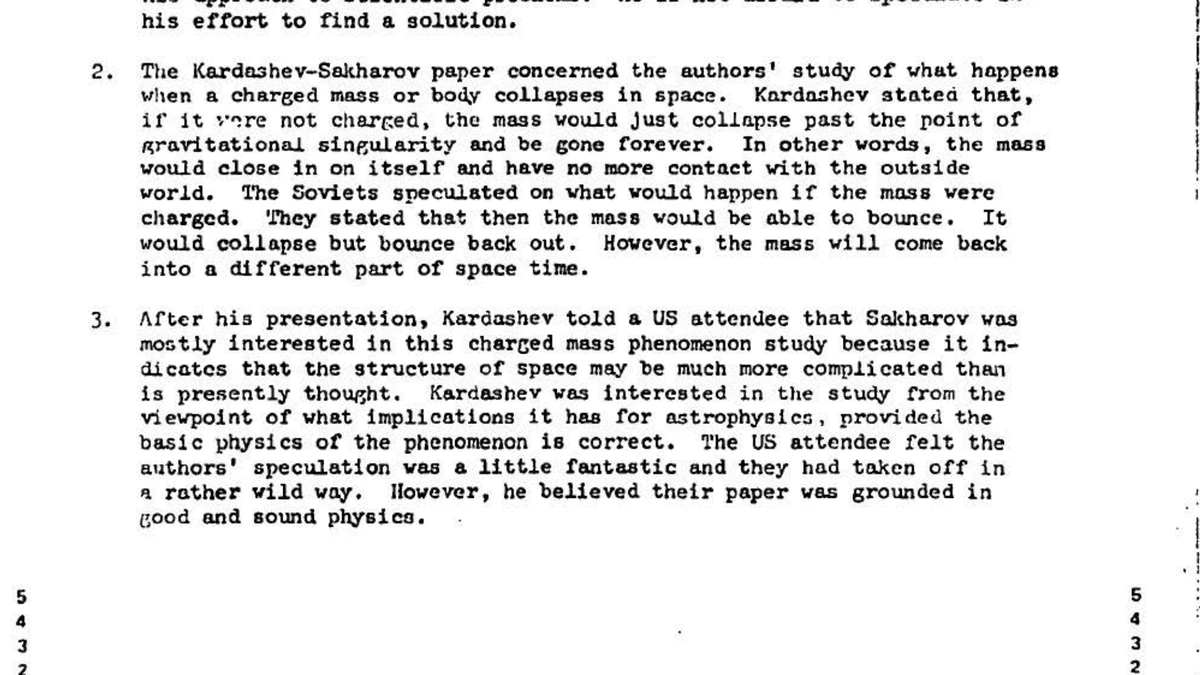
The Kardashev-Sakharov paper asked what happens when a charged body collapses in space. According to the report, an uncharged mass would collapse "past the point of gravitational singularity and be gone forever". A charged one, they argued, could bounce: it "would collapse but bounce back out", except it would come back "into a different part of space time".
That's an early version of an idea physicists still talk about. In the maths of a charged black hole, the inside doesn't have to end in a single crushing point, and a path through it can lead somewhere else entirely. Kardashev kept coming back to it for the rest of his career and later co-wrote papers on how we might spot a wormhole.
Paragraph 3 gives the two authors' reasons. Kardashev told an American that Sakharov liked the idea because it suggested "the structure of space may be much more complicated" than anyone thought, while Kardashev cared about what it meant for astrophysics. The American felt they had "taken off in a rather wild way" but that the paper was built on sound physics. That's a fair review of a lot of good theoretical work.
The names alone explain why the CIA wrote this down. Kardashev, at the Space Research Institute in Moscow, had already published the Kardashev scale in 1964, ranking possible alien civilisations by how much energy they use. Sakharov was the father of the Soviet hydrogen bomb and by 1971 a well-known dissident; four years later he won the Nobel Peace Prize. Paragraph 4 adds a nice human detail: on a visit to the senior academician Lev Artsimovich, a Party man "was almost cringing" while Kardashev stayed "cool and confident".
Which Conference? Byurakan and the 1971 Soviet-American CETI Meeting
The report calls it a "Conference on the Origins of Life in Yerevan", 6 to 8 September 1971. The dates and the cast match a famous meeting: the first Soviet-American conference on Communication with Extraterrestrial Intelligence (CETI), held at the Byurakan Observatory near Yerevan from 5 to 11 September 1971.
Byurakan was a big deal. Carl Sagan, Frank Drake, Philip Morrison, Kardashev and Iosif Shklovsky sat on the organising committee, and the guests included Francis Crick, Freeman Dyson, Marvin Minsky and Vitaly Ginzburg. Shklovsky and Ginzburg both appear in the CIA report by name, and the conference's science overlapped with the origins of life, so the CIA's label isn't far off. We can't prove from the document alone that it's Byurakan, but it would be quite a coincidence otherwise.
Paragraph 5 also mentions "a very naive paper on the detectability of planets". In 1971 nobody had found a planet around another Sun-like star. Today we're picking up radio signals from planets around other stars, so the "naive" speaker may have been ahead of his time.
Did the Soviet Union Have a UFO Committee? Paragraph 5
The Soviet Union had a short-lived official UFO study group in 1967, and CIA-UAP-008 shows a member of a Soviet "flying saucer committee" was still speaking at scientific meetings in 1971. That's the bit that put this file in a UFO release. Another Soviet speaker, described as a member of "a committee the USSR has established to investigate unusual phenomena, in other words, flying saucers", gave what the letter calls "a serious talk which was actually very humorous".
His line, as the American remembered it, was: "Well, of course, we know there isn't anything to this alleged phenomenon (flying saucers), but on the other hand..." Shklovsky and the other Soviets "joked and laughed", and later Shklovsky told an American that the saucer committee was made up of "politicians, theorists, historians and similar type people", with "little if any scientific talent".
The Soviet Union did have an official UFO group, briefly. In 1967 a study group under Major General Pyotr Stolyarov, with the astronomer Felix Ziegel as his deputy, started in Moscow and grew to more than 200 members after a television appeal. It was shut down within months, and at the end of 1967 the Academy of Sciences physics department, led by the same Lev Artsimovich from paragraph 4, condemned UFO study. So by 1971 the "committee" may have been a much smaller, unofficial affair, which fits Shklovsky's sniffy description.
Shklovsky's scorn is worth a moment. He co-wrote Intelligent Life in the Universe with Carl Sagan and spent years taking alien life seriously, but he drew a hard line between searching for signals and chasing saucers. Paragraph 6 ends with Ginzburg, a future Nobel physics laureate, saying the conference made sense if it helped Soviet researchers "get new astronomical equipment". Scientists are the same everywhere.
Look up for yourself
Kit we've tested and reviewed in full
The scientists in this report spent their careers asking what else might be out there. You can start much closer to home. New to it? Our guide to binocular astronomy explains what to look at first.
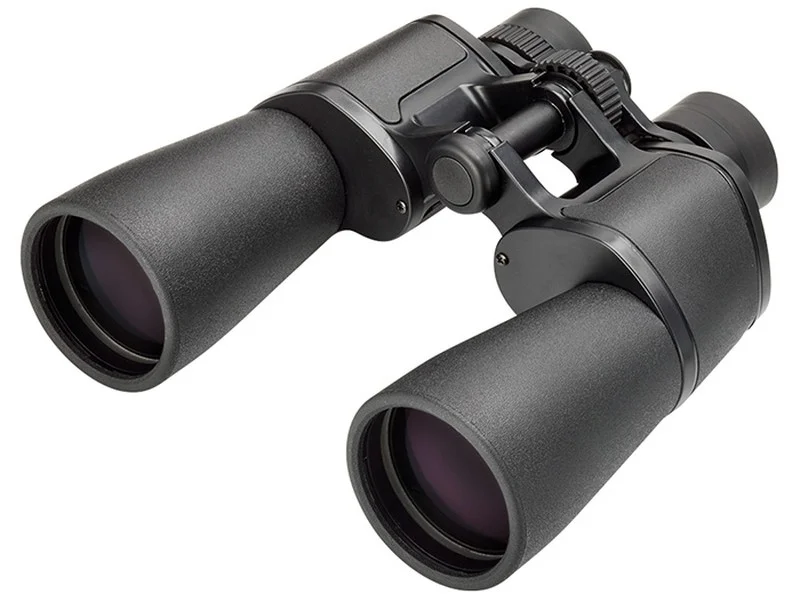
Bright, light and quick to aim. Enough to turn a strange light into a plane, a satellite or a planet within seconds.
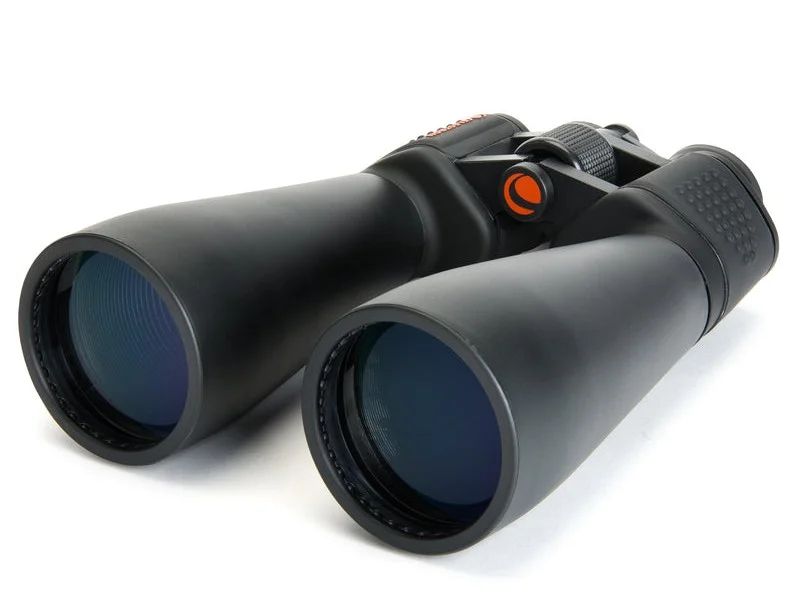
Heavier, but at 15x a slow-moving 'star' shows whether it's a balloon, a satellite flare or a distant aircraft.
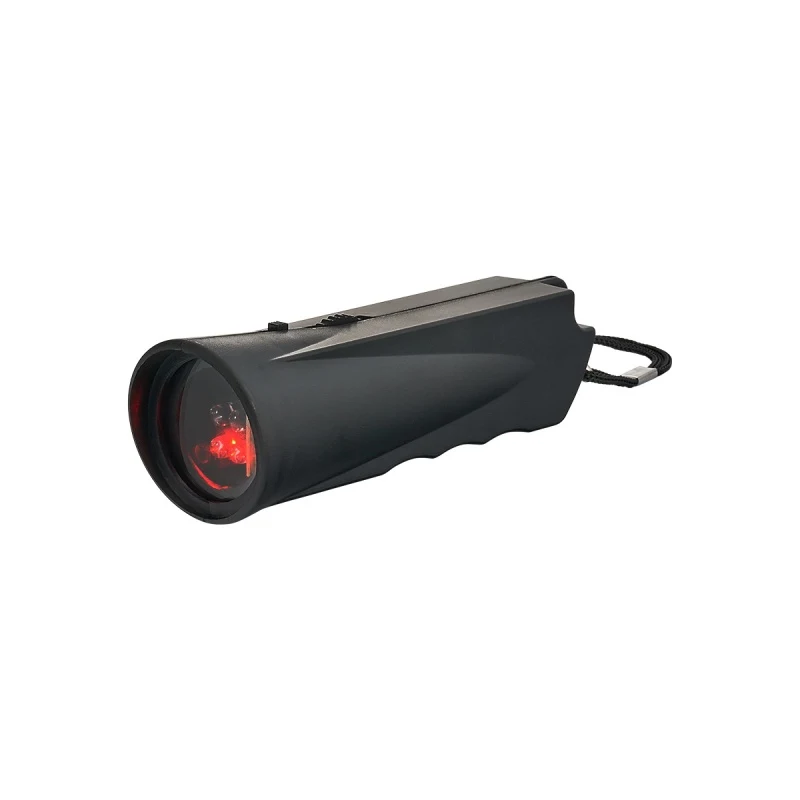
Astro Essentials Red Light Torch
Jot down the time, direction and height of anything odd without wrecking your dark adaptation. Those notes are what every UFO file is missing.
Affiliate links: you pay the same price, we earn a small commission that helps keep WatchTheStars free.
Why Is This in the CIA's UFO Files?
CIA-UAP-008 is in the UFO files because of one paragraph and one word, "saucers". The release catalogue doesn't mention UFOs in its description at all; it calls the file a report on "charged mass behavior in space". It looks as if the CIA's search for UAP material swept up anything that mentioned flying saucers, and this report got caught in the net. According to the catalogue, a more heavily redacted copy had already been on the CIA's own website.
That doesn't make it worthless. Put it next to our earlier Document of the Week on the CIA's report of a green object over a Soviet missile range and the NSA's Cold War UFO intercepts, and a pattern shows. US intelligence watched Soviet UFO interest closely, partly to learn what Soviet scientists really thought. In this case the answer was clear. The serious Soviet scientists in the room were interested in black holes and radio signals from other civilisations, and they found flying saucers funny. The same split runs through today's debate, from the Pentagon's UAP office to the SETI researchers sifting Moon dust for alien technology.
How to Check a UFO Sighting Yourself
The quickest way to check a UFO sighting is to rule out the usual suspects: a bright planet, the International Space Station, a satellite, a balloon or an aircraft catching the light. Most reports that end up in files like these turn out to be one of those.
If you see something odd, note the time, the direction you were facing, how high it was and how long it lasted. Then check what you can see in the sky tonight for bright planets, and our ISS passes tonight page for the space station. If it was a quick streak of light, look up the next meteor shower in the UK. The more of the sky you know, the fewer mysteries you'll have. Our stargazing for beginners guide is the place to start.
Where to Read CIA-UAP-008
The PDF is public on war.gov as CIA-UAP-008_SPECULATIVE_PAPER_BY_N_KARDASHEV_AND_A_SAKHAROV.pdf, part of the third PURSUE release of 12 June 2026. You'll also find it, with a download from our own mirror, in the PURSUE file browser. For the rest of that batch, read our guide to the Pentagon's third UFO file release.
Both pages are clean typescript and easy to read, though the file's text layer is poor, so read the scan rather than copying text out of it.
Sources:
- CIA-UAP-008, Speculative Paper by N Kardashev and A Sakharov on Charged Mass in Space, CIA Intelligence Information Report 00-B-321/07709-72, 10 April 1972, US Department of War, PURSUE Release 3, 12 June 2026, read from our local archive copy
- Release 3 metadata catalogue (release_03_metadata.csv), entry for CIA-UAP-008
- First Soviet-American Conference on Communication with Extraterrestrial Intelligence, Wikipedia
- Communication with Extraterrestrial Intelligence (CETI), 1971, Byurakan Astrophysical Observatory
- Felix Ziegel, Wikipedia, on the 1967 Soviet UFO study group
Frequently Asked Questions
Equipment guides
Related topics

Ian ClaytonAmateur astronomer and founder of WatchTheStars.co.uk, dedicated to helping others explore the wonders of our universe. Full profile →