Key takeaways
- AAWSAP's management plan, DOW-UAP-D168, is the contractor's own deliverable under DIA contract HHM402-08-C-0072
- The AAWSAP plan set nine projects, and only one, the DIA-mandated Project Physics, produced the research papers
- AAWSAP's contractor BAASS planned to seek 'Communication and or Contact' and asked the DIA to lobby for 'biological material of potentially non-human origin'
- Nothing in the AAWSAP release shows the DIA handed BAASS any of the files, film, hardware or samples the plan asked for
Jump to section 6 sections
- Was AAWSAP a UFO Program? What the Contractor's Plan Says
- The Nine AAWSAP Projects in BAASS's Plan
- AAWSAP Project Engagement: 'Communication and or Contact'
- AAWSAP and 'Biological Material of Potentially Non-Human Origin'
- AAWSAP Research Papers: Why the DIRDs Were the Side Project
- What Happened to the AAWSAP Plan?
For years the official line on AAWSAP was that it was a research contract, not a UFO hunt. The contractor's own plan says otherwise. DOW-UAP-D168, the "BAASS Project Management Plan (Overview Paper)" dated 2 December 2008 and released by the US Department of War on 23 October 2026, says it "fulfills the requirement to submit a report as part of" the Defense Intelligence Agency's contract HHM402-08-C-0072 (p.7). Then it lays out nine projects, and most of them are about craft, their operators and the files and material BAASS believed the government was holding.
Our AAWSAP programme page covers the whole contract, money and papers included. This post sticks to the plan: what BAASS said it would do, in its own words, and what the release shows actually happened.
Was AAWSAP a UFO Program? What the Contractor's Plan Says
AAWSAP was a UFO programme in its contractor's plan, though not in the DIA's contract. AAWSAP, the Advanced Aerospace Weapon System Applications Program, was a Defense Intelligence Agency contract awarded on 22 September 2008 to Bigelow Aerospace Advanced Space Studies of Las Vegas, and worth about $22 million. The seven contract documents from the September release never use the words UFO or UAP. The plan BAASS handed in ten weeks after winning the contract is about little else.
Strictly, the plan doesn't say "UFO" in its own voice either. It talks about "advanced aerospace vehicles", "novel spacecraft" and "'paranormal' spacecraft". But it is plain what it means. Its preface opens with "over six decades of intensive activity of advanced aerospace craft in the skies over North America", craft "witnessed, photographed and chased by military pilots" (p.4). Its closing pages say the programme "must necessarily acquire the ability to have a closer look" and get "physical access" to "actual hardware of the anomalous spacecraft" (p.40).
Two years later BAASS described the job the same way. Its November 2010 capability report (DOW-UAP-D175), citing the same contract number, says BAASS "was contracted to the Defense Intelligence Agency (DIA) in 2008 to investigate and analyze the possibility of a credible threat posed by UAPs" (p.12). Both documents are the contractor's account, not the DIA's, and neither proves the DIA agreed with every word.
The Nine AAWSAP Projects in BAASS's Plan
The nine AAWSAP projects were Physics, Engagement, Cooperation, Campus, Database, Oral History, Blue Book Materials, Northern Tier and Colares. The plan lists them on its summary pages (pp.8 to 9) and gives each one objectives, milestones and a team (pp.16 to 39).
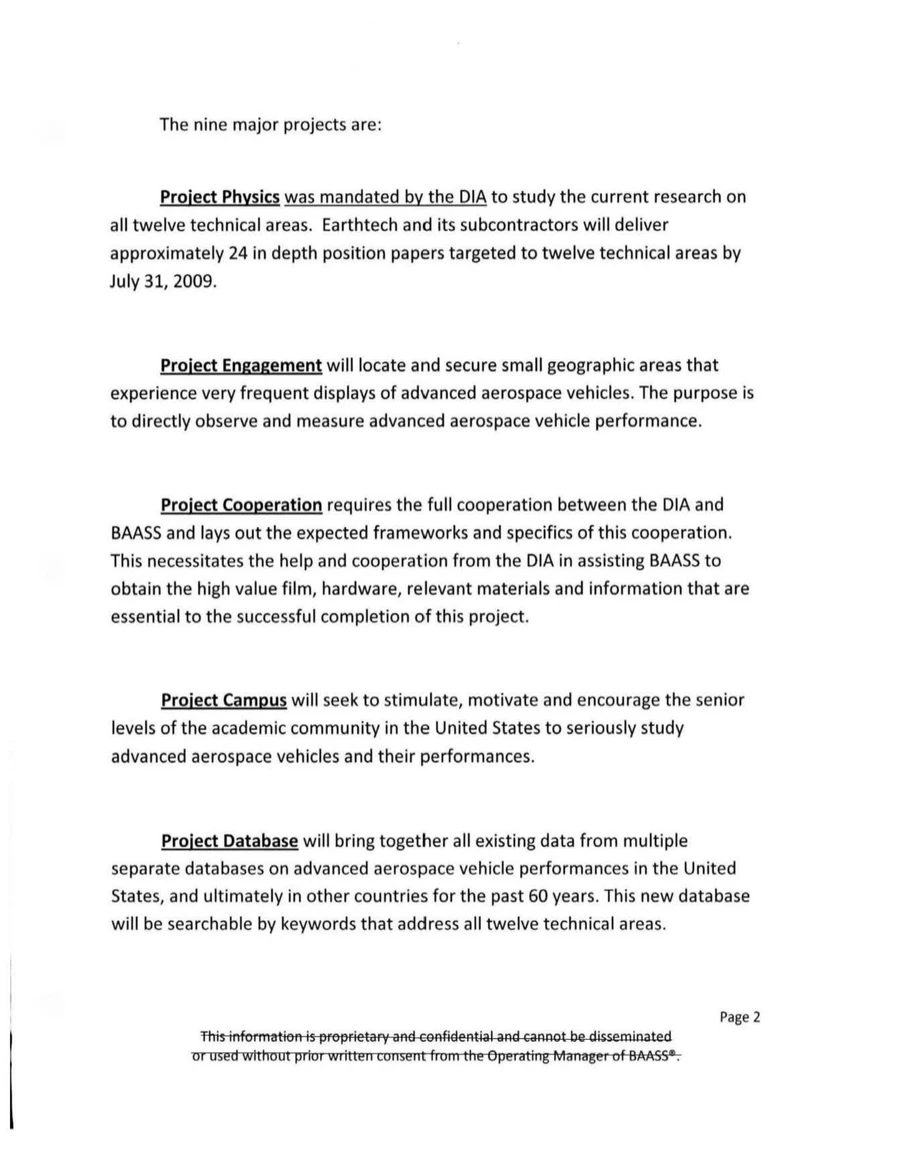
In plain English:
- Physics: about 24 papers from EarthTech International, due by 31 July 2009. These became the research papers known as DIRDs.
- Engagement: find small areas with "very frequent displays of advanced aerospace vehicles", watch them, then seek contact.
- Cooperation: the DIA to help BAASS get "film, hardware, relevant materials and information".
- Campus: grants to get senior academics studying these craft.
- Database: merge US and foreign sighting catalogues. BAASS later built a 234,364-report "data warehouse", 87% of it copied from the UFOCAT catalogue.
- Oral History: recorded interviews with "dozens of highly placed individuals from industry and the military".
- Blue Book Materials: files and "physical trace evidence" that BAASS said sat "in a secure location at Los Alamos National Labs" and had been "excluded from Project Blue Book" (p.33).
- Northern Tier: cases of craft over nuclear bases such as Malmstrom, Minot and Loring in the 1960s and 1970s. Our page on Project Northern Tier follows that one through BAASS's later reports.
- Colares: Brazilian Air Force files and medical records from the 1977 cases on Colares island, the subject of Brazil's secret service file on Colares.
The list of nuclear sites also includes RAF Bentwaters in Suffolk, scene of the 1980 Rendlesham Forest incident. BAASS wanted the DIA to obtain data on "effects upon nuclear facilities" there and at Malmstrom (p.11). Our page on UAP reports at nuclear weapons sites has the background to those cases.
AAWSAP Project Engagement: 'Communication and or Contact'
Project Engagement was BAASS's plan to find places where craft were often reported, observe them and then try to communicate. It is the clearest sign of what the contractor thought it was dealing with.
The plan sets three objectives: locate the sites, observe, and then "Communication and or Contact". It adds, in brackets, that this "is not, by the way, a novel idea", because "select communications and contact between the operators of these spacecraft and interested parties within this country started many years ago" (p.20). The plan offers no evidence for that.
"To successfully gather useful data from observations requires cooperation from the spacecraft."
BAASS Project Management Plan, DOW-UAP-D168 p.20
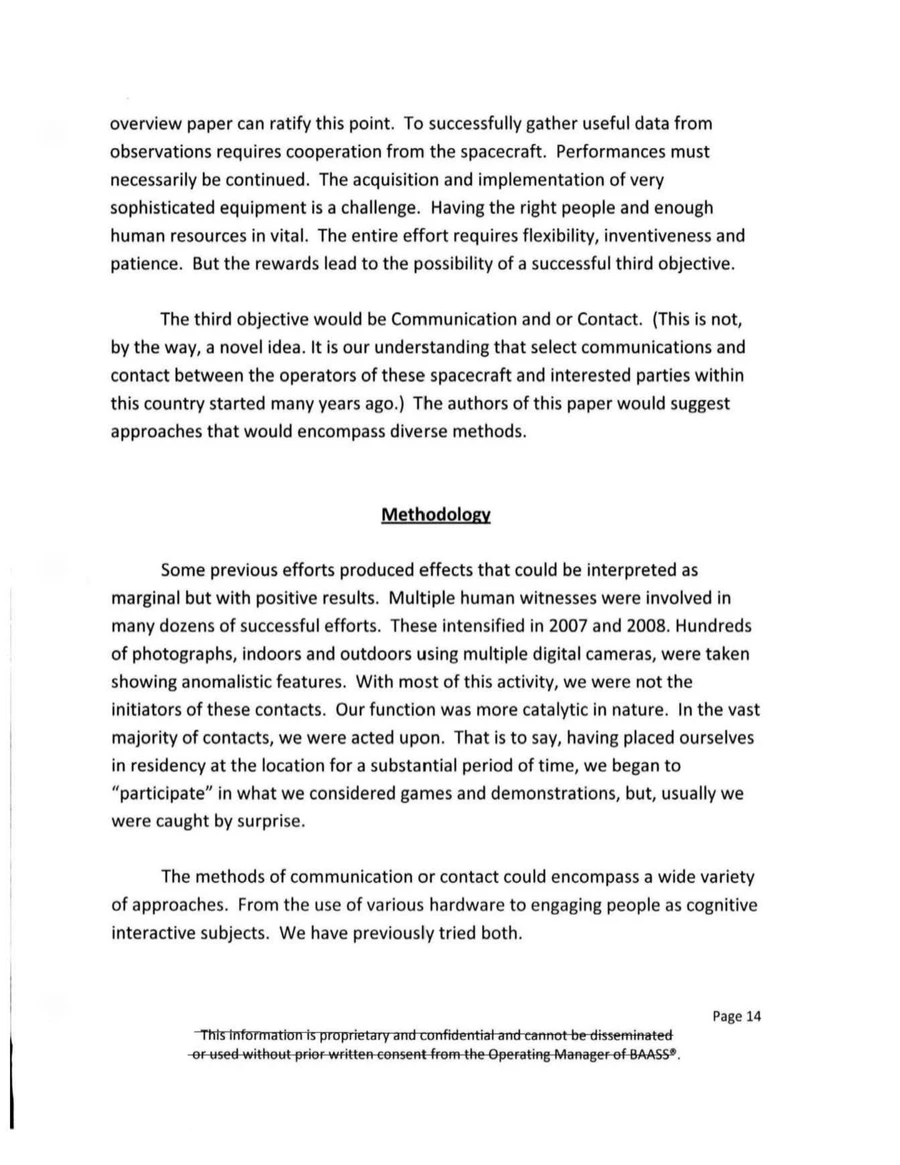
The same page says that, "having placed ourselves in residency at the location for a substantial period of time", the authors had taken part in "what we considered games and demonstrations". The location isn't named. A year and a half later BAASS's Utah ranch report listed "games, puzzles, and other strategies" to establish communication as a project aim, which our post on what the Pentagon's contractor found at Skinwalker Ranch covers. The plan also admits this kind of field work was "very awkward for the Agency to say the least" (p.21).
AAWSAP and 'Biological Material of Potentially Non-Human Origin'
The plan's ninth Key Recommendation asked the DIA to lobby other agencies for samples of recovered "biological material of potentially non-human origin". It is the line most likely to be quoted out of context, so here is the whole of it:
"Under the premise that biological material of potentially non-human origin has been recovered, at the earliest available opportunity DIA will lobby via interagency connections for access to medical samples for evaluation by BAASS affiliated forensic personnel"
BAASS Project Management Plan, DOW-UAP-D168 p.13
The laboratories it names are the Armed Forces Institute of Pathology, the commands at Fort Detrick and Dugway Proving Ground. Note the opening words: "Under the premise". BAASS was assuming such material existed, not reporting that it had seen any.
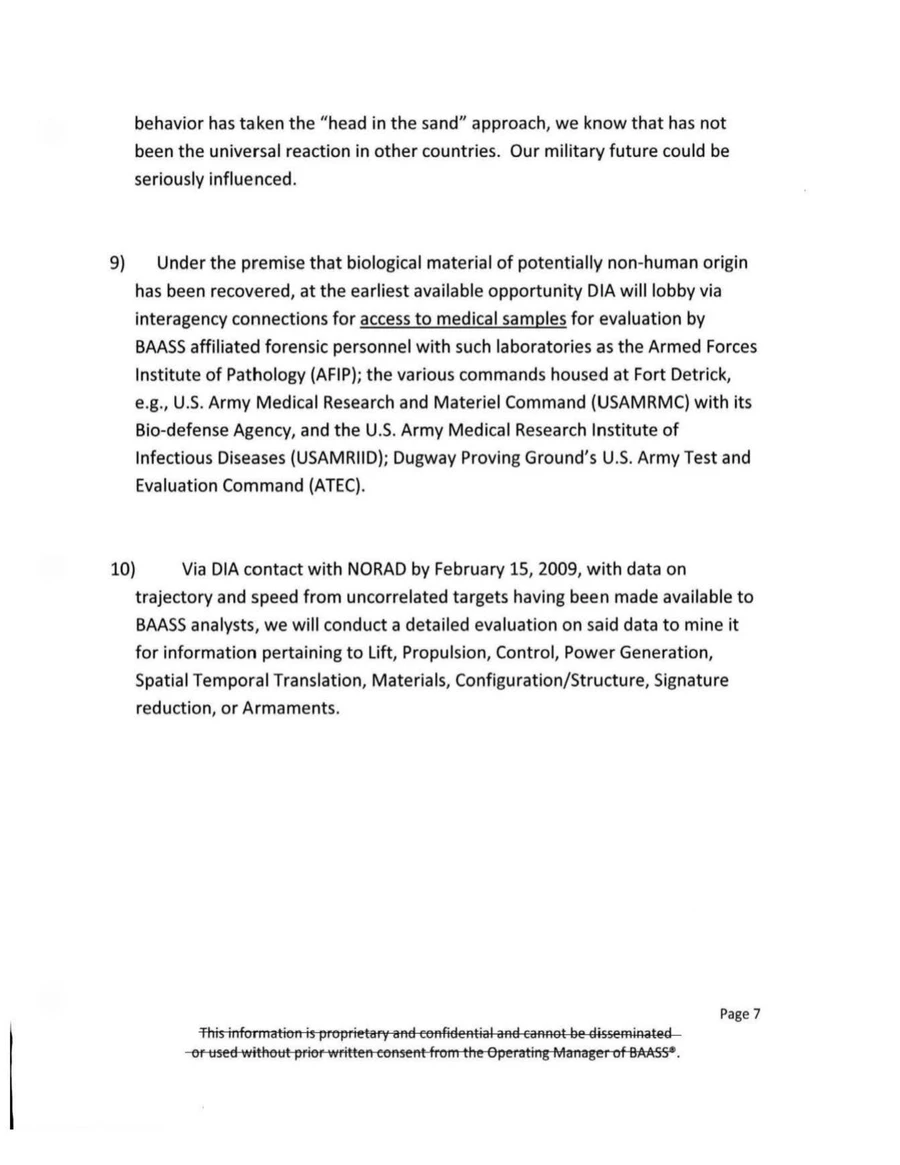
The neighbouring recommendations are in the same vein. BAASS said it had "a list of about ten individuals" linked to programmes "involving retrieval of advanced aerospace hardware or of associated biological material" (p.12). It said "several 'crashes' of novel spacecraft have occurred outside of the United States" (p.12). Among the plan's exhibits is a 2002 sealed affidavit from the 1947 public information officer at Roswell, with his name redacted, describing a craft and bodies in a hangar (pp.45 to 46). Our Roswell incident page covers what that affidavit does and doesn't establish.
All of this is BAASS's claim or hope. None of it is a government finding, and nothing in the 2026 releases shows a sample, a crash file or a Los Alamos folder ever reached BAASS.
AAWSAP Research Papers: Why the DIRDs Were the Side Project
The 38 research papers everyone associates with AAWSAP were one project of nine, and the one BAASS didn't choose. The plan says "Very recently, DIA has mandated the creation of a ninth project, that we call Project Physics" (p.15).
BAASS was frank about how little it expected from it. It said its "resources will not be devoted to studying the current 'state of the art'", apart from "the DIA mandated Project Physics", because the "most productive way" to learn was "to study craft that are already displaying novel behavior" (p.15). It went ahead with the papers "on the remote chance a six month exploratory effort may reveal significant progress" (p.16).
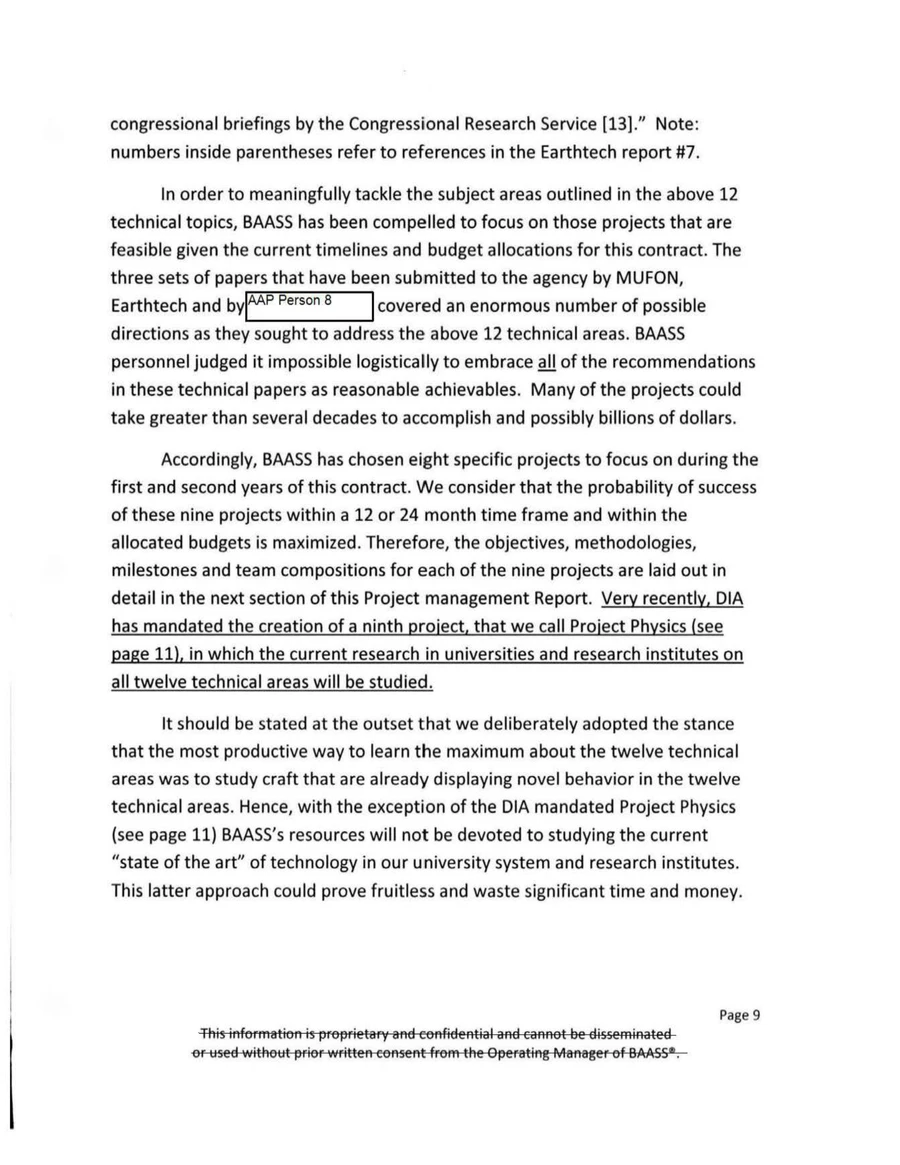
That turns the usual story upside down. The papers on warp drives, wormholes and invisibility cloaks, including the one behind our AAWSAP UFO injury study page, were the part the DIA asked for. The UFO work was what the contractor wanted to do. That fits a programme officially about "advanced aerospace weapon system applications" that was run, day to day, by a contractor that wrote of "novel spacecraft already known to exist" (p.16).
What Happened to the AAWSAP Plan?
Some of the plan happened and much of it stalled. BAASS hired fast: its March 2009 report lists 33 full-time and 7 part-time staff, including investigators with law-enforcement and AFOSI backgrounds (D169 p.4). It bought a sighting feed from the Mutual UFO Network, built its data warehouse and sent teams to Brazil.
The parts that depended on the government did not get far. The plan expected the DIA to locate the Northern Tier files "by March 10, 2009" (p.36). By April BAASS was working from a county deputy's logs and planning public freedom-of-information requests (D170 p.47). By November 2009, Northern Tier, "entry into classified archives" and Project Oral History were "on hold because BAASS currently does not have the Need to Know" (D173 p.155). The contract ended in December 2010, and BAASS's own summary dates its work "Between 2008 and 2010" (D175 p.11).
So the answer to "was AAWSAP a UFO programme?" has two halves. On paper, the DIA bought research on future aerospace threats. In practice its contractor set out to study UFOs, talk to whatever was flying them and get hold of the government's files and samples, and the government never gave it the clearances to see most of them.
If you want to do your own looking, start with the ordinary explanations, because the 2009 reports show BAASS's investigators ran into them too. Check what you can see in the sky tonight and the ISS passes tonight, and scan the UK night sky this week for bright planets. If you're new to it, stargazing for beginners will get you finding your way round the sky in an evening.
Watch the sky the plan wanted watched
Kit we've reviewed in full
BAASS wanted to find places where odd things turn up in the sky often. You can do a cheaper version from your own garden: a pair of binoculars turns most strange lights into an aircraft, a satellite or a planet within seconds.
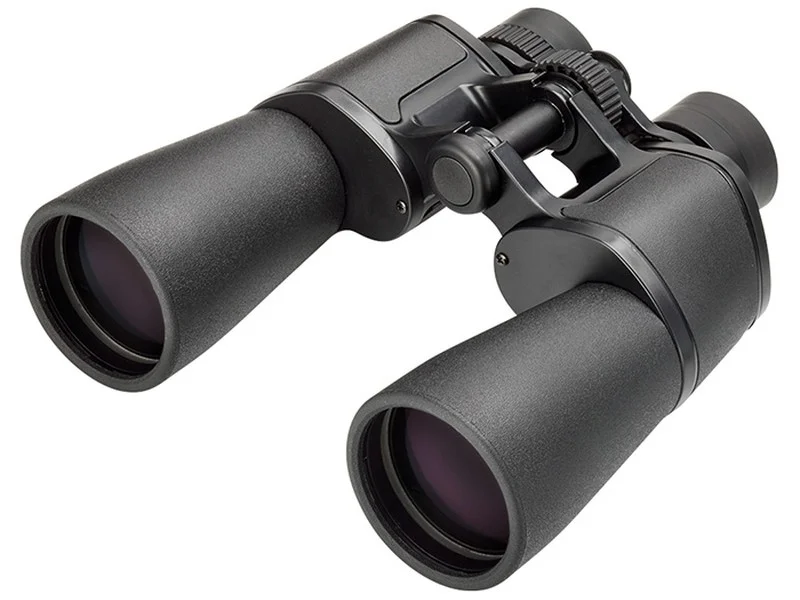
Bright and wide, so you can get onto a moving light before it has gone.
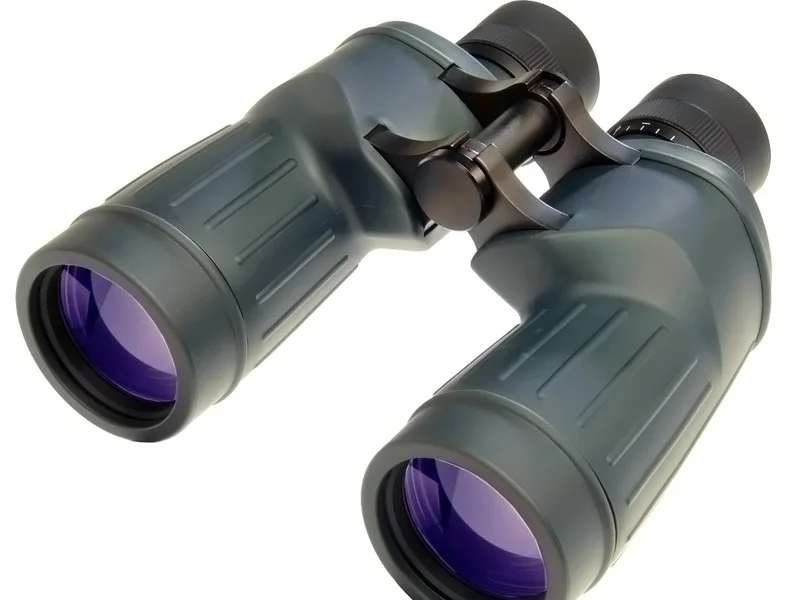
Built for long, cold nights outdoors, which is when most odd lights get reported.
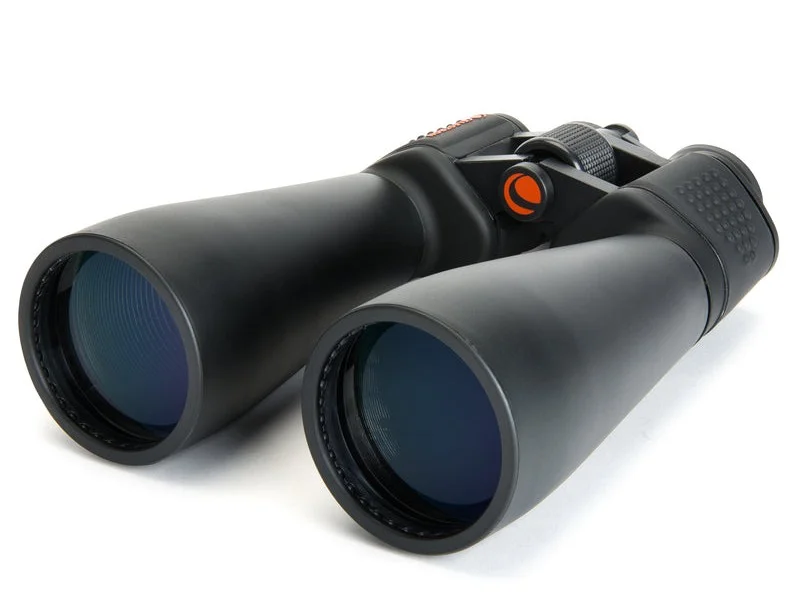
More power to pick out the navigation lights on a far-off aircraft. Best on a tripod.
Affiliate links: you pay the same price, we earn a small commission that helps keep WatchTheStars free.
You can read the plan yourself in our Pentagon UFO file browser, along with BAASS's November 2010 summary. Our round-up of the Pentagon's seventh UFO file release covers the rest of the batch, our line-by-line look at the AAWSAP contract shows what the $22 million bought on paper, and the UAP document archive shows how all seven releases fit together.
Sources:
- DOW-UAP-D168, BAASS Project Management Plan (Overview Paper), 2 December 2008: US Department of War, PURSUE Release 7
- DOW-UAP-D175, Summary Report on BAASS UAP Analysis Capabilities, 23 November 2010: US Department of War, PURSUE Release 7
- DOW-UAP-D169, D170 and D173, BAASS monthly reports for March, April and November 2009: US Department of War, PURSUE Release 7
Header image: an illustration generated with Google Gemini, not a photograph of any BAASS office or document. Page images: DOW-UAP-D168, released by the US Department of War, PURSUE Release 7. BAASS was a contractor, and its documents are its own account, not government findings. Page numbers are PDF pages.
Frequently Asked Questions
Equipment guides
Related topics

Ian ClaytonAmateur astronomer and founder of WatchTheStars.co.uk, dedicated to helping others explore the wonders of our universe. Full profile →