Key takeaways
- DOW-UAP-D097 is the first progress report of Project Sign, the US Air Force's first UFO investigation, dated 23 April 1948 and released by the Pentagon on 10 July 2026
- The Project Sign report tabulates 100 numbered UFO incidents from 1947 and early 1948, including Kenneth Arnold's sighting and the Godman Field reports of 7 January 1948
- Air Materiel Command's analysts judged the Rhodes photographs of 7 July 1947 to be genuine images of a real object, not a flaw in the film, and estimated it at 44 to 55 feet across
- Nobel laureate Irving Langmuir told Project Sign the data were too thin to identify anything, but the Air Force still thought a disc-shaped aircraft could be built
Jump to section 8 sections
- What Is Project Sign? The 1948 Report in DOW-UAP-D097
- Project Sign's 100 UFO Sightings: What the Table Shows
- Kenneth Arnold, Godman Field and Other 1947 UFO Cases in the File
- Rhodes UFO Photos: Incident #40 and the Horten Flying Wing
- Irving Langmuir and Project Sign: A Nobel Scientist's Verdict
- The Biology of the Flying Saucer: Why a British Magazine Is in the File
- How to Check a UFO Sighting Yourself
- Where to Read the Project Sign Report (DOW-UAP-D097)
Project Sign was the US Air Force's first official UFO investigation, and DOW-UAP-D097 is its very first report. Dated 23 April 1948 and released by the Pentagon on 10 July 2026, it runs to 45 pages: a two-page cover letter, a table of 100 incidents from 1947, photos of one famous sighting, and the opinion of a Nobel Prize-winning scientist. It is the Air Force's first attempt to count and sort the flying saucer reports, written only ten months after they began.
This is the thirteenth post in our Document of the Week series, where we take one item from our declassified UAP document archive and explain in plain English what it says. Last week we covered why Project Blue Book ended. This week goes back to the very start.
What Is Project Sign? The 1948 Report in DOW-UAP-D097
Project Sign was the UFO study run by Air Materiel Command (AMC) at Wright-Patterson Air Force Base, Ohio, from early 1948. DOW-UAP-D097 is its initial report to Air Force headquarters in Washington, signed by Colonel H. M. McCoy, AMC's Chief of Intelligence, and marked Confidential. Project Sign was renamed Project Grudge in early 1949, and Grudge became Project Blue Book in 1952, so this is the first report in a paper trail that ran until 1969.
| DOW-UAP-D097 at a glance | |
|---|---|
| Official title | Project Sign Progress Report, 1948 |
| Released | 10 July 2026, PURSUE Release 4 (war.gov) |
| Date of report | 23 April 1948 |
| From | Headquarters, Air Materiel Command, Wright-Patterson AFB |
| To | Chief of Staff, USAF, attention Director of Intelligence |
| Signed | Col. H. M. McCoy, Chief of Intelligence |
| Length | 45 pages: 2-page letter plus six enclosures |
| Classification | Confidential, since declassified (authority NND 927545) |
The letter opens by setting out where Project Sign came from. A headquarters letter of 30 December 1947, signed by General L. C. Craigie with the subject "Flying Discs", ordered the study. AMC activated it as Project HT-304 on 26 January 1948 and published Technical Instruction 2185 on 11 February. The files merged reports sent straight to AMC with those passed on by the Director of Intelligence, and quarterly reports were promised from 1 July 1948.
One small detail shows how the job started. Paragraph 3 says AMC had got hold of the flying schedules of lighted advertising blimps and cross-checked them against the reports. Mundane explanations were on the list from day one.
We've already written about the other side of Project Sign's first year, the correspondence in which its officers wondered about vehicles from another planet. That file, DOW-UAP-D100, has its own guided tour on our Project Sign file page. D097 is the formal report that went up the chain.
Project Sign's 100 UFO Sightings: What the Table Shows
Project Sign's table lists 100 numbered UFO incidents, almost all from the summer of 1947, with reports up to 1 February 1948. Many are split into lettered sub-reports where more than one witness saw the same thing, so the real number of reports is higher than 100.
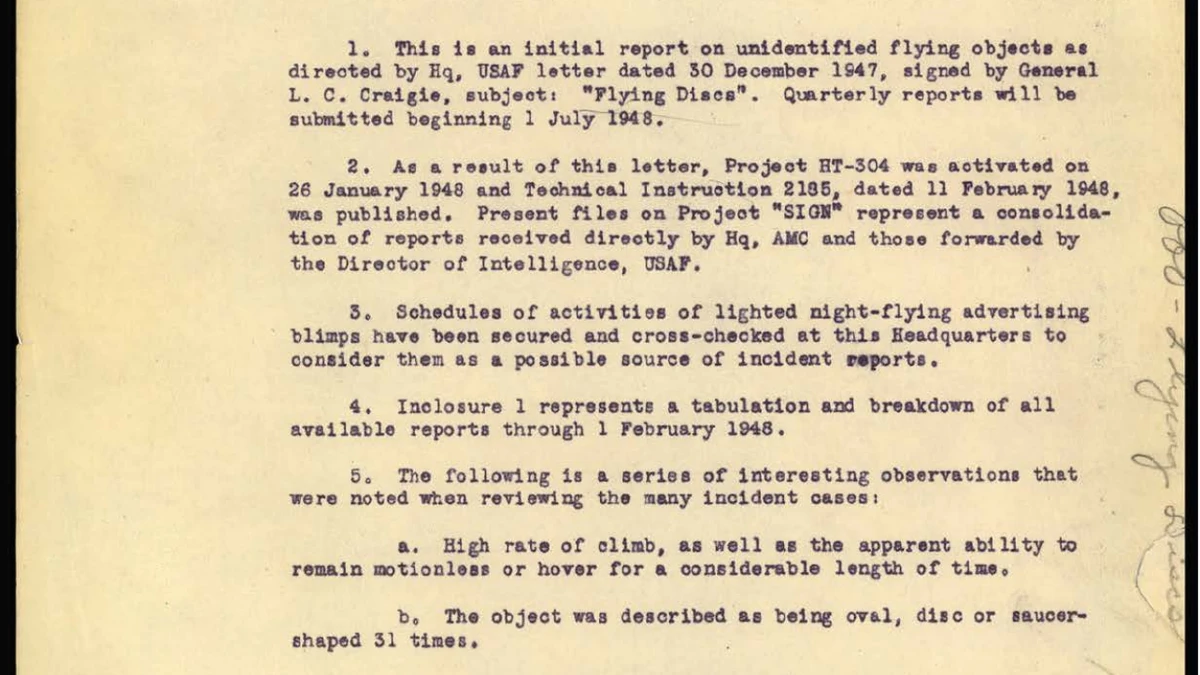
McCoy's letter picks out the patterns his team noticed:
- A high rate of climb, and an apparent ability to hover for a long time
- The object called oval, disc or saucer-shaped 31 times
- Sound reported 11 times, exhaust trails 23 times
- Sizes from a 25-cent coin up to 250 feet across, or from a fighter plane to the bulk of six B-29 bombers
- Speeds from hovering to supersonic
He also broke the sightings down by how many objects were seen: 77 of one object, 21 of two to five, 8 of six to ten and 9 of more than ten.
The table itself has columns for date, time, place, number seen, the witness's job, the manoeuvres, the weather, colour, shape, size, sound, exhaust, heading, height and speed. The phrase that turns up most is "not stated". A diagram of reported directions of flight is the same story: 64 were "direction indefinite" and 61 had no direction at all.
The witness list is the most human part. There are Air Force majors and privates, Portland police patrolmen, airline captains, a judge, a trout farmer, a sign painter, a prospector, an insurance adjuster and, at Incident #77, an astronomer. Most sightings are from the western United States, but the list also includes Newfoundland, Alaska, Germany, a report from "Hungarian peasants" near Budapest, and two from Finland dated January 1946, the year of the Scandinavian ghost rockets.
The table does not take everything at face value either. A note at the end says Incident #18, a photo and story from Toronto, had been found to be a hoax done for publicity and money. Another dismisses the witness in Incident #84 as excitable and very talkative, with an exaggerated imagination.
Kenneth Arnold, Godman Field and Other 1947 UFO Cases in the File
Several of the most famous early UFO cases sit in the table as a single row each. You have to know the date and place to spot them, because hardly anyone is named.
Incident #17 is Kenneth Arnold. The row gives 24 June 1947, 3pm, Mount Rainier, Washington, nine objects seen from the air by a private pilot in weather "clear as crystal". The objects were mirror-bright and roughly circular, each as wide as the gap between a DC-4's outboard engines. Arnold's description of things skipping like saucers on water is where the phrase "flying saucer" came from.
Incidents #1 to #4 are from Muroc Air Field, California (now Edwards Air Force Base), on 7 and 8 July 1947, seen by Air Force men from a private first class up to two majors. One major described an object that dropped in an oscillating way almost to the ground and then climbed to a great height. The same week, on 8 July, the Army put out its Roswell press release. Roswell itself isn't in the table.
Incidents #5 to #15 are a cluster from Portland, Oregon and nearby on 4 July 1947. Several witnesses were Portland police officers, including one former Air Force pilot, who saw discs in a straight line with the last one fluttering sideways.
Incidents #33 to #33g are Godman Field, Kentucky on 7 January 1948, the day Captain Thomas Mantell of the Kentucky Air National Guard died chasing a UFO in his P-51. Mantell was leading a flight called NG869, and one row lists its witness as the flight leader of "869". The table records the sightings but says nothing about the crash. On the same evening there are more reports from Lockbourne air base and Wilmington, both in Ohio.
Rhodes UFO Photos: Incident #40 and the Horten Flying Wing
The Rhodes photos are two pictures taken at Phoenix, Arizona on 7 July 1947. Project Sign logged them as Incident #40 and made them the centrepiece of the report, with two enlargements and an evaluation attached as enclosures 2, 3 and 4.
The evaluation, dated 19 February 1948, looked at the negatives sent in by "Mr. Rhoades" (as it spells his name). It concluded the image was a true photograph, not a flaw in the film or the developing. The blurred "tail" on the object matched what you'd expect from a moving object and the shutter of his camera. Taking his estimate that the object was about 2,000 feet away, and working through the possible film sizes for a 620 camera, AMC put it at about 44 feet across the diagonal with a 4-inch lens, or 55 feet with a 5-inch lens.
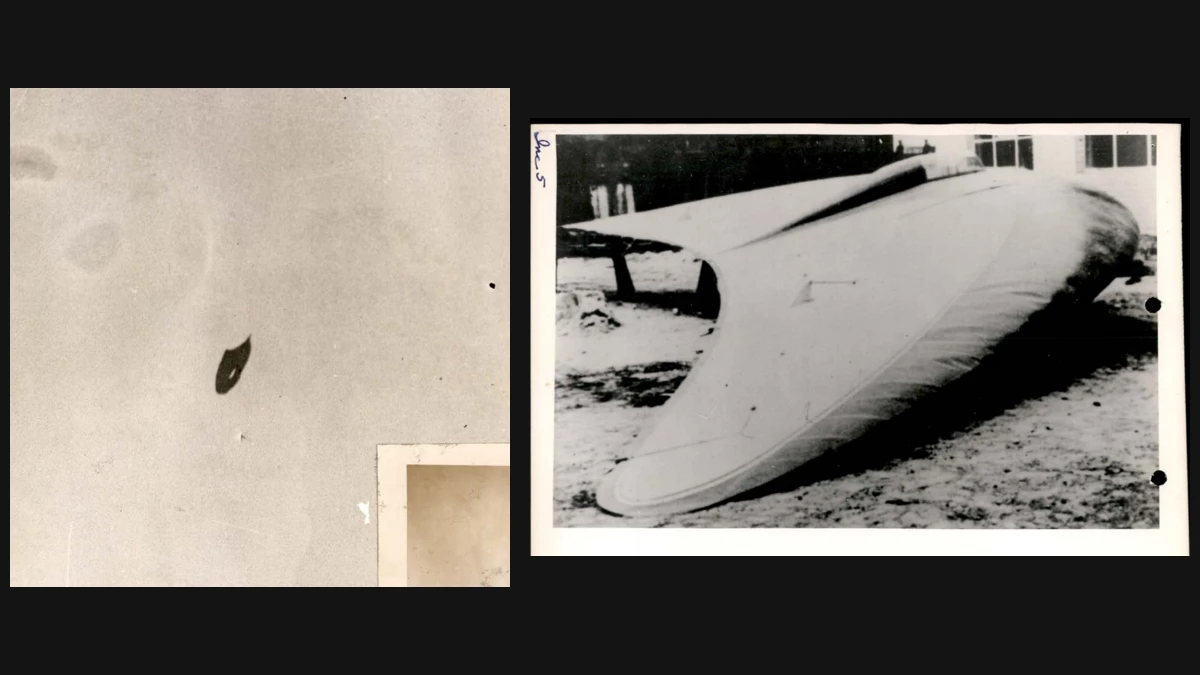
What McCoy put next to them is more revealing. Enclosure 5 is a photo of the Horten "Parabola", a German tailless glider with a crescent-shaped wing, built by the Horten brothers who designed flying wings for the Luftwaffe. The letter invites attention to the "marked similarity" between the Rhodes object and the Horten design.
That tells you where AMC's thinking was in spring 1948. The obvious worry was not visitors from space but a foreign aircraft, perhaps one built from captured German ideas. The heel shape in the Rhodes photo does look a lot like a flying wing seen from below.
Irving Langmuir and Project Sign: A Nobel Scientist's Verdict
Irving Langmuir, who won the 1932 Nobel Prize in Chemistry, was one of the first scientists Project Sign consulted. Paragraph 7 of the letter says AMC representatives visited him at General Electric's Research Laboratory in Schenectady, New York.
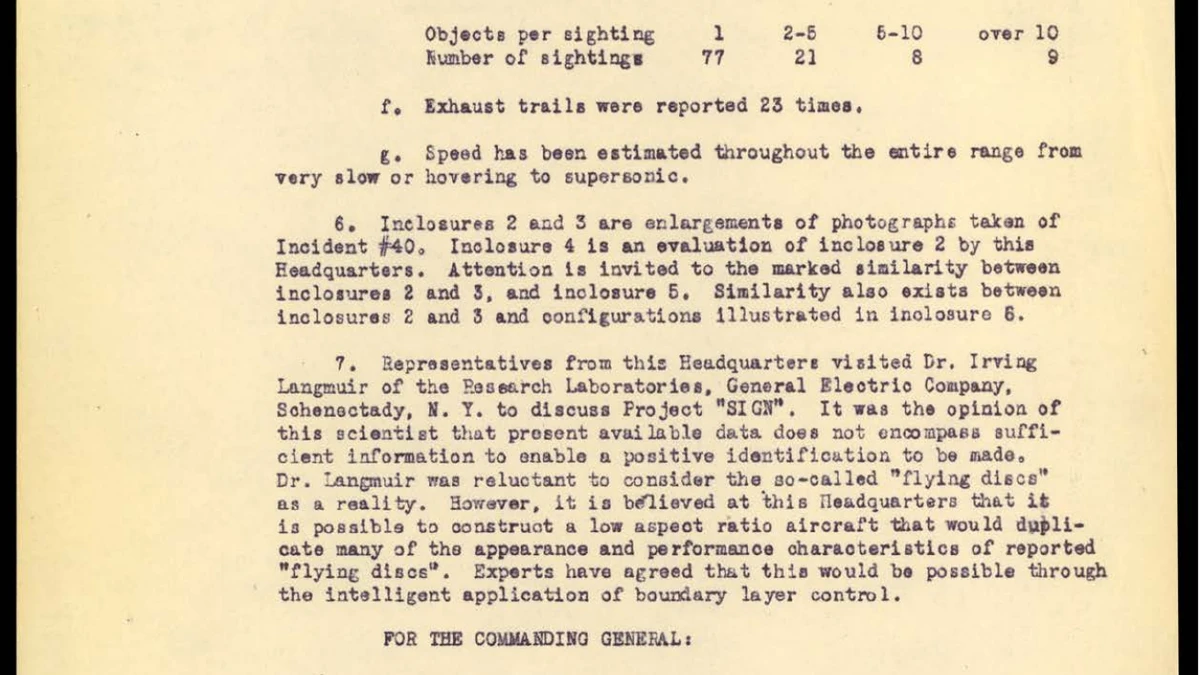
He didn't give them much. The letter says he thought the data weren't enough to identify anything, and records that "Dr. Langmuir was reluctant to consider the so-called 'flying discs' as a reality."
AMC then went its own way in the very next sentence. It said it believed a low aspect ratio aircraft, meaning a short, broad, almost circular wing, could match many of the reported looks and performance of the discs, and that experts agreed this could be done with boundary layer control. That's an engineering answer to a question the scientist had just said wasn't answerable. Langmuir later became famous for a 1953 talk on "pathological science", about researchers fooling themselves, and he used flying saucers as one of his examples.
The Biology of the Flying Saucer: Why a British Magazine Is in the File
The last and longest enclosure, pages 36 to 45, is a three-part series from the British weekly The Aeroplane, published on 13 February, 5 March and 19 March 1948. Its title is "The Biology of the Flying Saucer", and it's by the German-born engineer A. R. Weyl.
Despite the title, it's a serious history of low aspect ratio aircraft. Weyl starts with F. W. Lanchester and Frederick Handley Page, goes through annular and disc-winged designs from before the First World War, and ends with the American engineer Charles Zimmerman's "Flying Pancake", the Vought V-173, and its fighter version, the XF5U-1. Near the end, under the heading "The Real Flying Saucer?", he suggests a disc-winged aircraft with jet engines might explain how the saucers were said to fly fast and high and also hover.
AMC included it for the same reason it included the Horten photo. In April 1948 the leading explanation on paper was that someone, somewhere, had built one.
Check what's really up there
Kit we've tested and reviewed in full
Nearly every entry in the 1947 table was seen with the naked eye. A decent pair of binoculars settles most of these questions in seconds. New to it? Start with our guide to binocular astronomy.
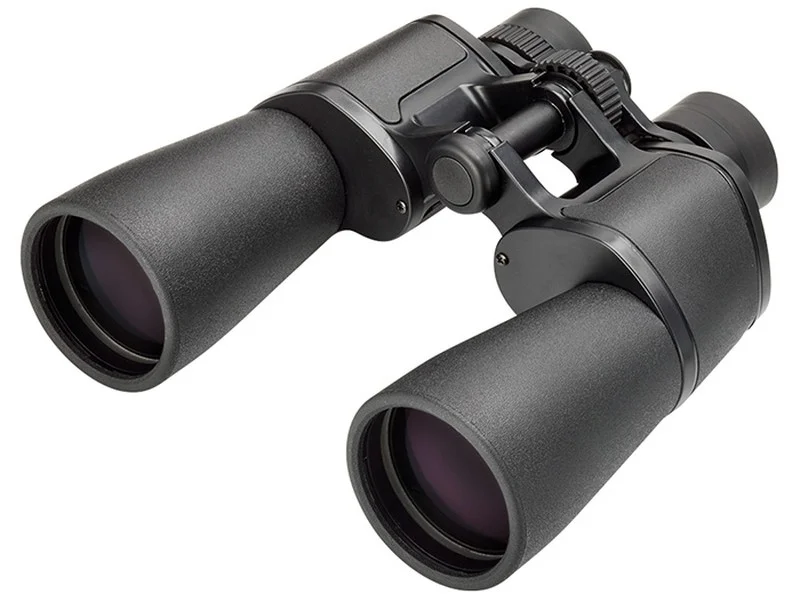
Bright and quick to aim. Enough to turn a 'silver disc' into an aircraft, a balloon or a planet.
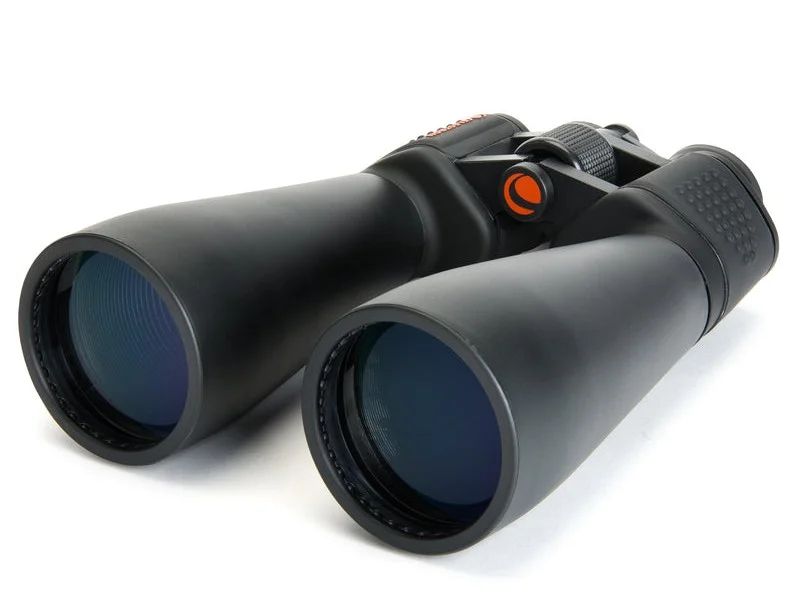
Heavier, but at 15x a distant balloon or a tumbling rocket body shows its real shape.
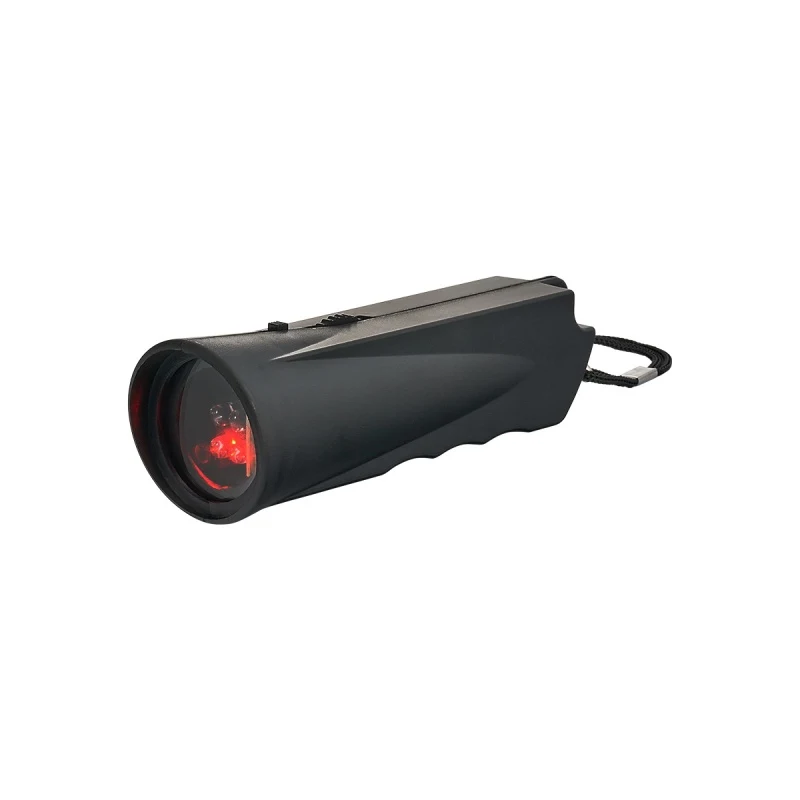
Astro Essentials Red Light Torch
Read a chart or jot down times and directions, the details Project Sign kept asking for, without losing your dark adaptation.
Affiliate links: you pay the same price, we earn a small commission that helps keep WatchTheStars free.
How to Check a UFO Sighting Yourself
The quickest way to check a UFO sighting is to rule out the usual suspects: a bright planet, the International Space Station, a satellite, a balloon or an aircraft catching the sun. Project Sign had to guess at most of its cases because the reports lacked the basics. Nearly every row says "not stated" for heading, height or speed.
If you see something odd, note the time, the direction you were facing, roughly how high it was and how long it lasted. Then check what you can see in the sky tonight for bright planets, and the ISS passes tonight page for the space station. A pair of the best binoculars for stargazing will turn most "discs" into something ordinary within seconds. If it was a quick streak of light, check the next meteor shower in the UK.
The best cure is knowing the sky. Our stargazing for beginners guide covers the first few months, and after that Venus at dusk will never fool you again.
Where to Read the Project Sign Report (DOW-UAP-D097)
The PDF is public on war.gov as part of the fourth PURSUE release of 10 July 2026, filed as DOW-UAP-D097_Project-Sign-Progress-Report_1948.pdf. You can also find it, with a download from our own mirror, in the PURSUE file browser. Our guide to the Pentagon's fourth UFO file release puts it alongside the other files released that day.
The typed pages are clear, but the table is a 1948 carbon copy and some rows are hard to read. The PDF text layer garbles much of it, so zoom into the images instead. Pages 31 to 35 are the photos and the evaluation, and a couple of pages in between are near-blank scans.
Sources:
- DOW-UAP-D097, Project Sign Progress Report, 1948, US Department of War, PURSUE Release 4, 10 July 2026, read from our local archive copy
- Release 4 metadata catalogue (release_04_metadata.csv), entry for DOW-UAP-D097
- Project Sign, background on the programme and its successors
- Rhodes UFO photographs, background on Incident #40
Frequently Asked Questions
Equipment guides
Related topics

Ian ClaytonAmateur astronomer and founder of WatchTheStars.co.uk, dedicated to helping others explore the wonders of our universe. Full profile →