Project Northern Tier: AAWSAP and the Nuclear-Base UFO Cases
How the Pentagon's UFO contractor tried to reopen the missile-base sightings of the 1960s and 70s, and why it stopped
Project Northern Tier was BAASS's attempt, under the DIA's AAWSAP contract, to reopen reported UFO incidents at US nuclear-weapons bases in the 1960s and 1970s. The contractor's own plan, monthly reports and a June 2009 memo were released in October 2026. They show what it set out to do, how far it got with Freedom of Information requests and people-search databases, and why it stopped.
What Was Project Northern Tier?
Project Northern Tier was a project run by Bigelow Aerospace Advanced Space Studies (BAASS) under the Defense Intelligence Agency's AAWSAP contract (2008–2010) to re-investigate reported UFO incidents at US nuclear-weapons bases in the 1960s and 1970s. It took its name from the "Northern Tier", the Strategic Air Command bomber and missile bases in the states along the Canadian border. BAASS's paperwork on it was published on 23 October 2026 in the Department of War's seventh PURSUE release.
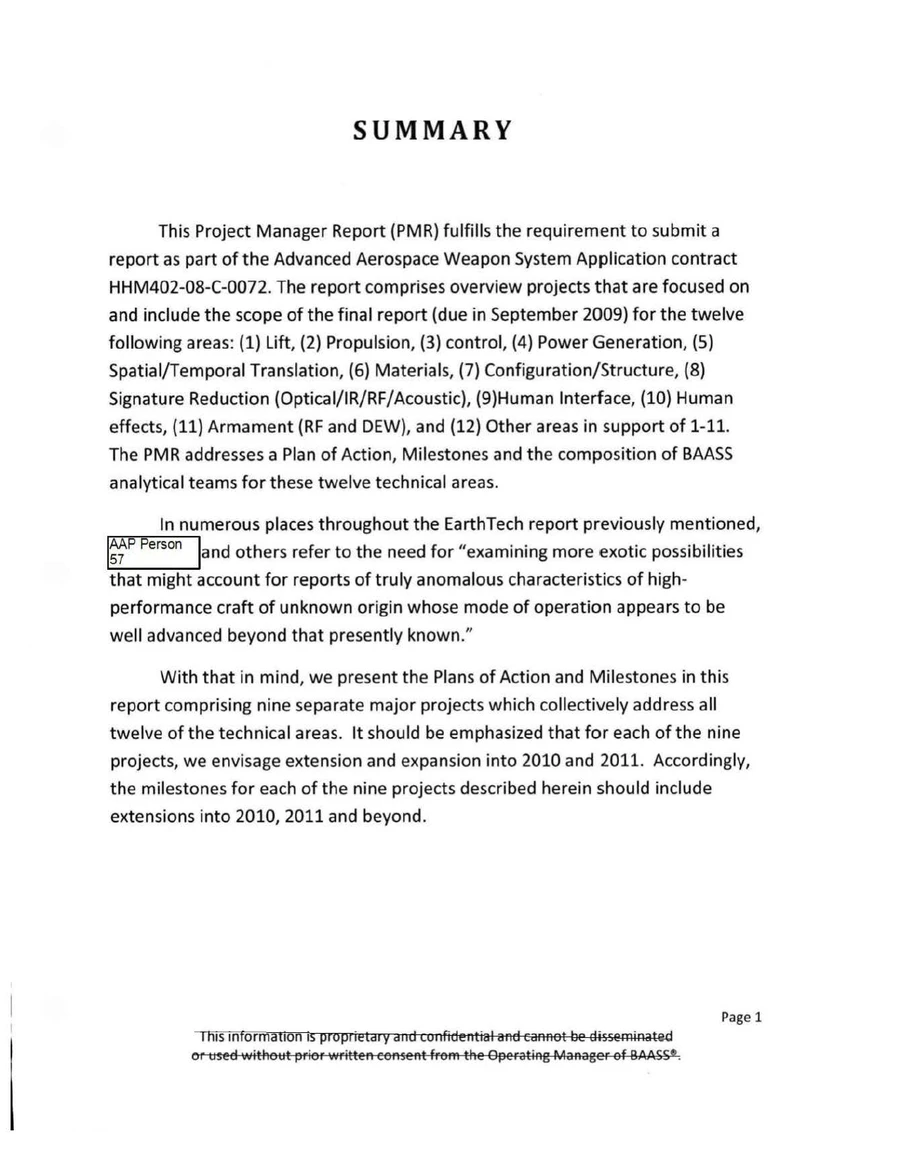
It was one of nine projects in BAASS's December 2008 management plan, alongside the research papers the DIA had mandated, a hunt for files said to be held at Los Alamos and the 1977 Colares injury cases in Brazil. Our AAWSAP programme page covers the contract and its money. The plan's summary of Northern Tier states its aim plainly:
"Project Northern Tier will obtain all the information and case files pertaining to dozens of cases in which advanced aerospace vehicles flew over restricted air force bases containing nuclear weapons, hovered over weapon storage depots and interfered with functional integrity of ICBM missile systems during the 1960s and 1970s."· BAASS Project Management Plan, 2 December 2008 (DOW-UAP-D168, p.9)
That is BAASS's own description of the cases, written before the project began. It is the starting assumption, not a finding.
| Contractor | Bigelow Aerospace Advanced Space Studies (BAASS), Las Vegas |
| Customer | "The sponsor" in the monthly reports; DIA contract HHM402-08-C-0072 in the plan |
| Planned | 2 December 2008, one of nine projects (technical area 11, Armament) |
| Team formed | Late April 2009 |
| Last status | November 2009: on hold, no "Need to Know" |
| Files | DOW-UAP-D168, D170, D171, D173, D175 (PURSUE Release 7, 23 October 2026) |
Which Nuclear Bases Did Project Northern Tier Cover?
Project Northern Tier covered five US Air Force bases in BAASS's December 2008 plan, plus RAF Bentwaters in England, and added a Canadian base in April 2009. These are the dates BAASS gave.
| Base | Where | Dates in BAASS's files | Source |
|---|---|---|---|
| Malmstrom AFB | Montana | 1960s–70s; August 1975 to December 1977 | D168 p.35; D170 pp.35–36 |
| Loring AFB | Maine | 1960s–70s; 27–31 October 1975 | D168 p.35; D171 p.128 |
| Wurtsmith AFB | Michigan | 1960s–70s; 30 October 1975 | D168 p.35; D170 p.36 |
| Minot AFB | North Dakota | 1966 or 1967; 5 March 1967; 6 June 1968; 24 October 1968; 10 November 1975 | D171 pp.123–125 |
| Kirtland AFB | New Mexico | "1960's and 1970s", no single date | D168 p.35 |
| RAF Bentwaters | Suffolk, England | December 1980 | D168 pp.11, 35 |
| CFB Falconbridge | Ontario, Canada | September to November 1975 | D170 p.34 |
Kirtland, in New Mexico, stretches the name. Bentwaters appears twice: the plan's fifth Key Recommendation asked the DIA for data on "effects upon nuclear facilities where anomalous spacecraft were in close proximity", naming "RAF Bentwaters, England, Malmstrom AFB in Montana and several others" (D168 p.11). That is the Rendlesham Forest incident, where the plan says "allegedly trace radioactivity was measured".
How Did BAASS Investigate the Nuclear-Base UFO Cases?
BAASS planned in December 2008 for the DIA to hand over the Air Force's own records. By April to June 2009 it was instead working from a county deputy sheriff's logs, filing Freedom of Information Act (FOIA) requests and tracing old witnesses through commercial people-search databases.
The plan said "DIA will obtain the full set of Strategic Air Command (SAC)/other organization records" and that the files would be located "By March 10, 2009" (D168 pp.35–36). The March monthly report doesn't mention the project.
The April report's "Initial Analysis" picked 1975–76 for "the likelihood of being able to contact witnesses for re-interview" (D170 p.34). Most of the Malmstrom data came from a Cascade County deputy sheriff who logged over 250 events from August 1975 to December 1977. At Wurtsmith on 30 October 1975, Security Police reported an object along the perimeter, ground radar picked up a target, and a KC-135 tanker sent over Lake Huron lost the object and then, in BAASS's summary, saw it reappear, "appearing to follow the 135" (p.37). At Loring, an Air National Guard helicopter "was unable to observe the object" (p.38). The analyst also argued that SAC's move "to a higher alert level is itself an apparent acknowledgement of the events" (p.38). That is his interpretation, not a SAC statement.
The plan lists FOIA requests to AFOSI, SAC, HQ USAF and NORAD (p.47) and warns of "the uncertainty of tracking down witnesses 30 years after the fact" (p.45). By late June the Wurtsmith and Malmstrom requests were "Accepted by the agencies and pending their response" (D171 p.120). Nothing in the release shows the DIA delivered SAC or NORAD records, and the reports don't say why the route changed.
Was Project Northern Tier a Pentagon Priority? The June 2009 Memo
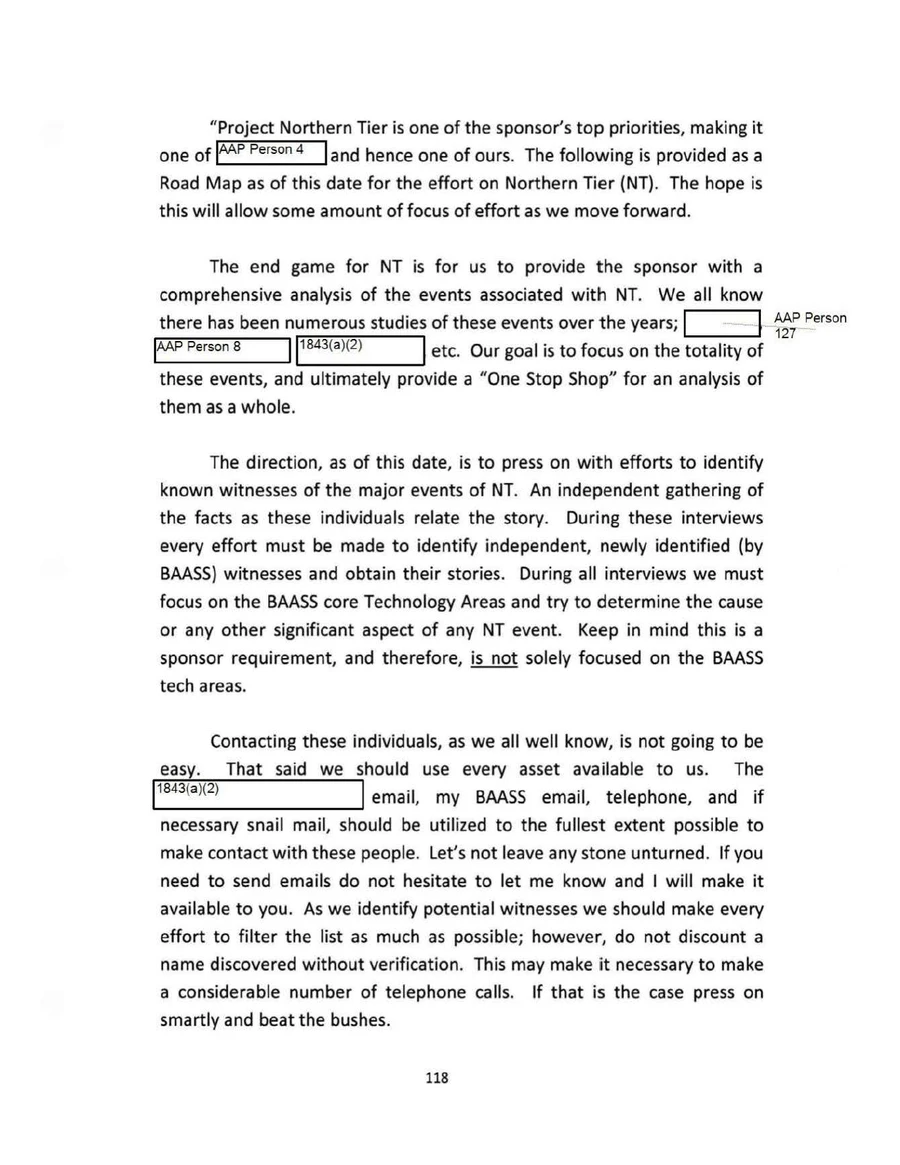
A BAASS memo of 11 June 2009 calls Project Northern Tier "one of the sponsor's top priorities". The words are those of BAASS's senior investigator, writing to his own team, and "sponsor" is BAASS's term for its customer.
"Project Northern Tier is one of the sponsor's top priorities, making it one of [AAP Person 4] and hence one of ours."· BAASS senior investigator's guidance to the Northern Tier team, 11 June 2009 (DOW-UAP-D171, p.121)
AAP Person 4 is the release's code for the BAASS administrator. The monthly reports never name the DIA. The management plan and BAASS's 2010 report cite DIA contract HHM402-08-C-0072, which is why the sponsor is read as the DIA. So the memo shows how BAASS understood its customer's wishes. It is not a DIA statement.
The memo sets the "end game" as a "One Stop Shop" analysis of the events "as a whole", and adds: "Keep in mind this is a sponsor requirement, and therefore, is not solely focused on the BAASS tech areas." Even failed calls had to be logged, because "We must demonstrate the level of effort to accomplish this task" (p.122).
Loring AFB UFO Witnesses: How Cold Is a 34-Year-Old Case?
The Loring AFB sightings of 27–31 October 1975 were 34 years old by 2009, and the witness trail had almost gone. BAASS's investigator started with 15 named witnesses and, after 71,428 database hits, reached two people. One had nothing to add and the other hung up.
One "did not have any additional information he could remember from an incident he encountered nearly 34-years ago". The other heard why BAASS was calling, said it was the wrong person "and purposefully terminated the call" (D171 pp.128–129). At Wurtsmith, 12 known witnesses produced two interviews, and one man recalled that "small planes would often 'buzz' the Base" (p.126).
The project's research assistant ran 29 witness searches for Wurtsmith and Loring through a commercial people-search database: "The cost of the searches came to a total of $31.50. It took me approximately 16 hours" (p.130). At Malmstrom, six names from 1975 were still to be traced, and "It is not known if these people are still living" (p.131).
Were There 300 UFO Witnesses at Minot? What the Number Means
The "three hundred plus unidentified witnesses" at Minot is one BAASS investigator's estimate of how many missile officers could have heard a report relayed over an open line in 1966 or 1967. It is not 300 people who saw anything.
The case is a UFO over several silos, reported to SAC headquarters on the Primary Alerting System, "basically an open line". Taking a website's count of at least 150 Minuteman sites and assuming "Each silo had two officers assigned", the investigator reached "at least 300 unidentified witnesses listening to the event" (D171 pp.123–124). The only person in his tally recorded as watching the object is "one unidentified security officer". The premise is wrong too: Minuteman silos weren't crewed. Two-officer launch crews sat in underground control centres, each in charge of ten missiles, so 150 missiles meant about 30 launch officers on duty at a time.
Why Was Project Northern Tier Put on Hold? "Need to Know"
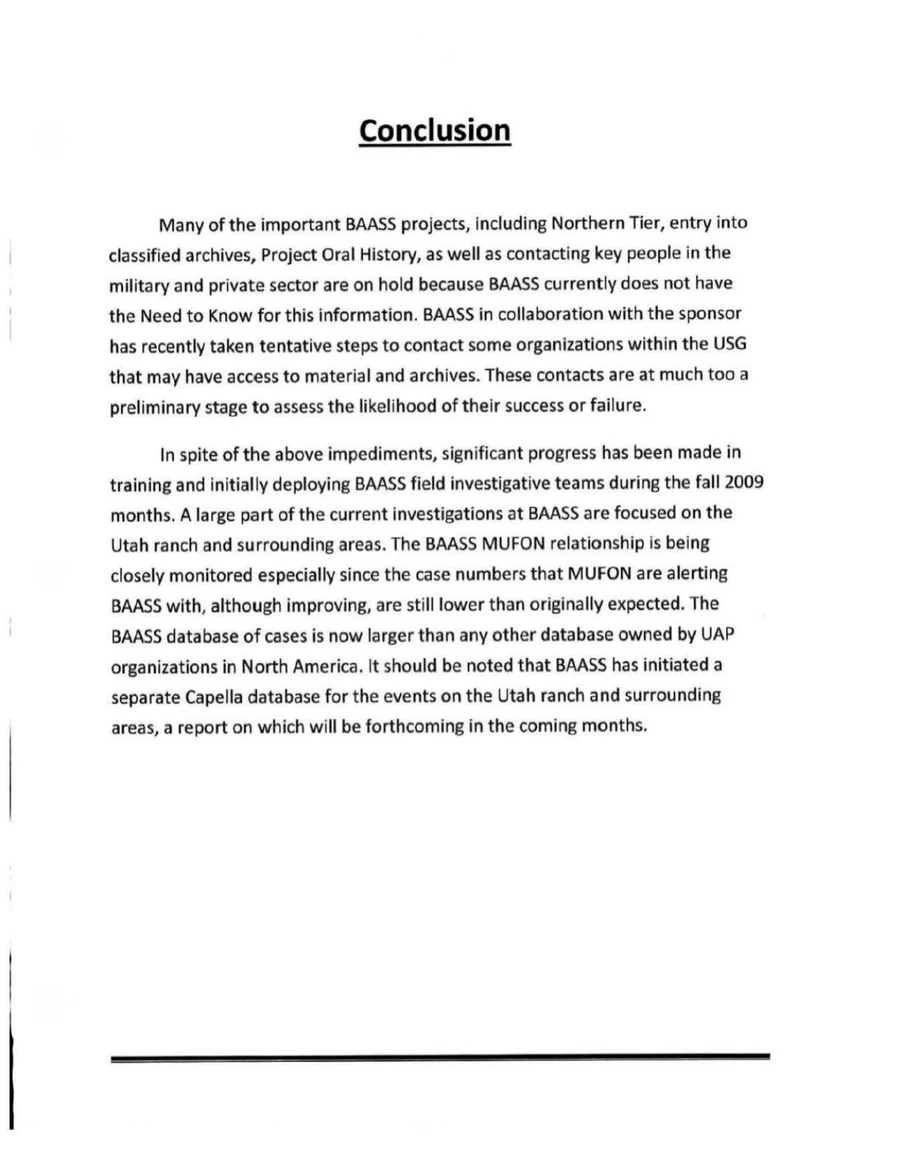
BAASS's November 2009 report says Project Northern Tier was on hold because the company did not have the "Need to Know" for the information. That means its staff were not authorised to see the government's own files on these cases.
"Many of the important BAASS projects, including Northern Tier, entry into classified archives, Project Oral History, as well as contacting key people in the military and private sector are on hold because BAASS currently does not have the Need to Know for this information."· BAASS Monthly Report, November 2009, Conclusion (DOW-UAP-D173, p.155)
A clearance is only half of access: whoever holds classified material must also agree that you need it. BAASS's first recommendation in December 2008 had warned: "Without these clearances, BAASS will not be able to access this vital information relevant to very advanced spacecraft" (D168 p.10). The November report adds that, with the sponsor, BAASS had taken "tentative steps" to approach government organisations that might hold the archives.
A year later, BAASS's capability report of 23 November 2010 still hedged. Without naming a base, it mentions a March 1967 report of missiles disabled "while a UAP allegedly hovered nearby", which matches the Malmstrom story, and says: "The 1967 incident, if true, as well as other Northern Tier incidents, arguably had national security implications" (D175 p.10). "If true", after two years, suggests BAASS never saw records that would settle it.
Project Northern Tier Timeline, 2008 to 2010
2 December: the management plan
Northern Tier is one of nine projects. The DIA is to obtain SAC records, with files located by 10 March 2009 (D168).
March: no mention
The March monthly report says nothing about the project (D169).
Late April: the team forms
Investigators for Minot, Loring and Malmstrom. The April report adds the 1975–76 analysis and FOIA plans (D170).
11 June: 'top priorities' memo
The senior investigator's guidance to the team (D171 p.121).
25 June: Malmstrom changes hands
Wurtsmith and Malmstrom FOIA requests accepted and pending (D171 pp.120, 130).
November: on hold
No 'Need to Know' for Northern Tier, classified archives or oral history (D173 p.155).
23 November: 'if true'
BAASS's capability report still hedges the 1967 case. The contract ends on 21 December 2010 (D175).
Does Project Northern Tier Add New Evidence on Nuclear-Base UFOs?
No. Project Northern Tier's lists match the nuclear-base UFO cases already in the public record: Malmstrom in 1967, Minot in 1968, the 1975 sightings at Loring, Wurtsmith and Malmstrom, and Bentwaters in 1980. The released files add no new evidence about any of them. What they add is paperwork about an investigation.
Our page on UFOs and nuclear weapons covers Malmstrom's Echo Flight in March 1967, with the Air Force's explanation and the dispute over it, and the Minot B-52 radar case of October 1968. BAASS's 2009 work barely touches 1967. It concentrates on 1975, and even there it worked from a deputy's logs and from Air Force and Defense Department documents already "received via Freedom of Information Act (FOIA) requests" (D171 p.128). The new part is the paper trail: a DIA-funded contractor made these cases a named project, believed its customer rated them highly, and couldn't reach the government's own files.
What Did Project Northern Tier Find?
Project Northern Tier found nothing that the released files report. Its last appearance in the monthly reports is the November 2009 "on hold", and no findings, "One Stop Shop" analysis or FOIA replies appear anywhere in the release.
Only four BAASS monthly reports are in the release: March, April, June and November 2009. The rest, including July to October 2009 and every 2010 report, are not in the release, and there is no D172 in the numbering. If the project restarted or the FOIA replies came back, it isn't in anything published so far. The Department of War's notes say AAWSAP was "active from 2008 to 2012"; BAASS's own 2010 report says "Between 2008 and 2010" (D175 p.10). Our guide to the seventh UFO file release covers the rest of the batch.
Seen a Light Hovering Over a Base? Check the Sky First
Check the sky first. BAASS noted that many 1975 base reports were logged as "helicopter sightings" because the objects seemed to hover, and a bright planet or star low on the horizon can seem to hang in one place for an hour. That doesn't explain the 1975 cases, some of which had radar returns and an aircrew, but it is the first thing to rule out for your own sighting.
See what you can see in the sky tonight for the bright planets, check for ISS passes tonight, and our UK night sky this week lists what rises when. Our guide to binocular astronomy shows how to hold a pair steady enough to tell a planet from an aircraft.
What the guards had: their eyes
Kit we've reviewed in full
Most of the nuclear-base reports in these files begin with guards or security police watching something in the dark with no optics at all. A steady pair of binoculars will usually show you an aircraft's navigation lights, a helicopter's shape or a planet's disc within seconds.
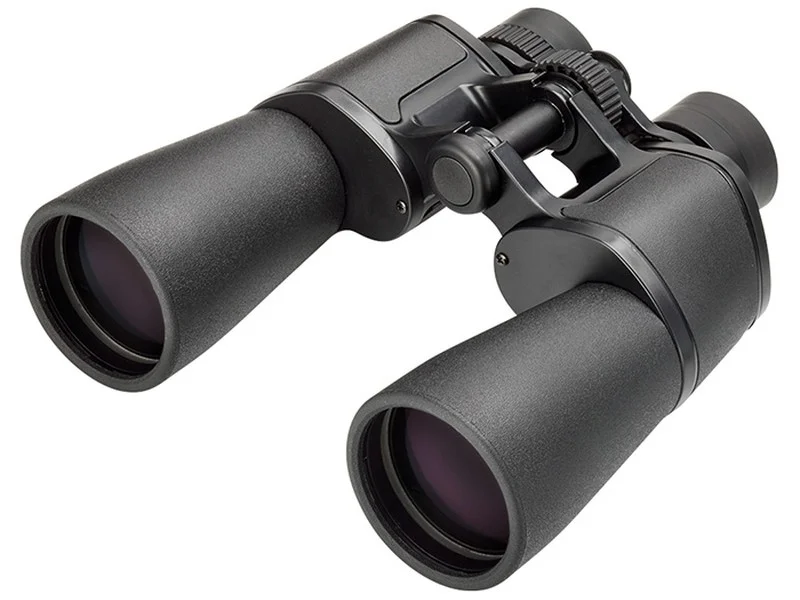
Bright and quick to aim, so you can get onto a light before it moves off.
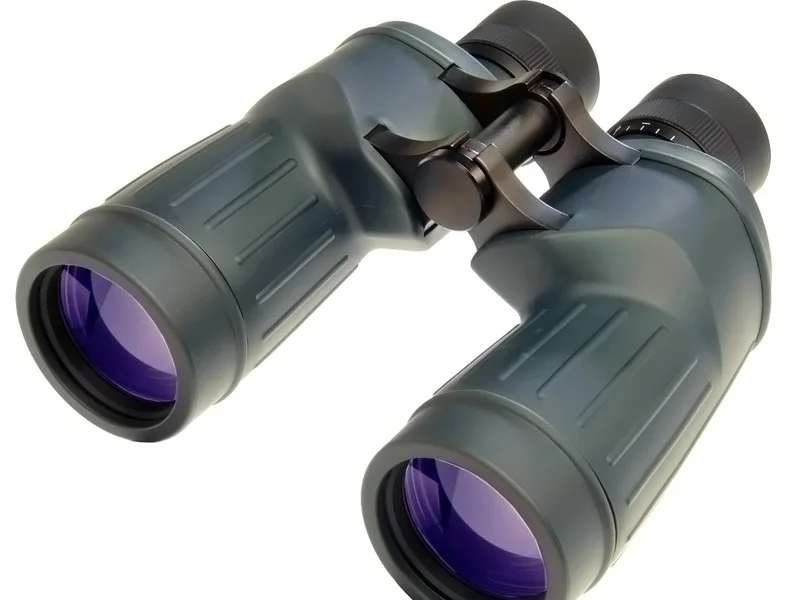
Built for long, cold nights outdoors, the kind a perimeter patrol knows well.
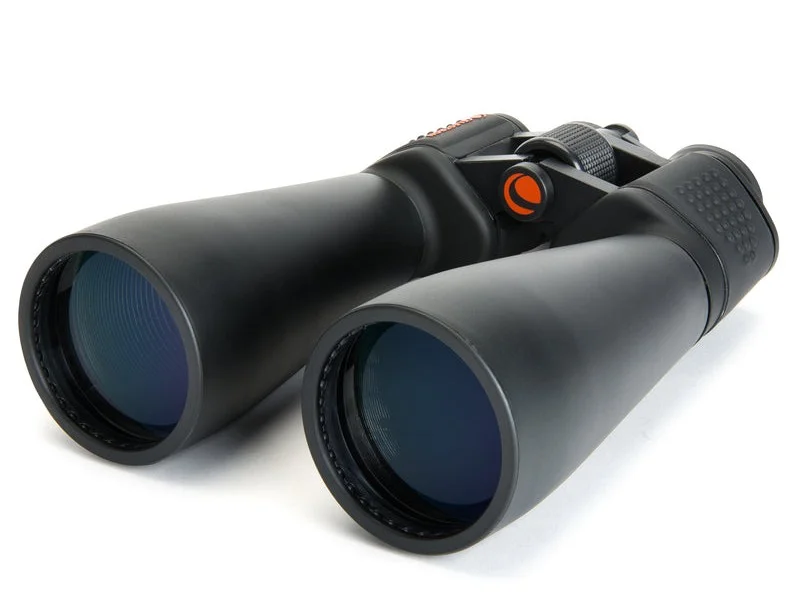
Extra power for a light hanging far off over the horizon. Best on a tripod.
Browse all our binocular reviews
Honest, research-based recommendations for every budget.
Browse all →Affiliate links: you pay the same price, we earn a small commission that helps keep WatchTheStars free.
Project Northern Tier Primary Sources: Read the Files
Every quote on this page comes from five BAASS documents in PURSUE Release 7. Page numbers are PDF pages, except D175, where we give the printed page.
| DOW-UAP-D168 | Project Management Plan, 2 December 2008: p.9 (summary), pp.10–11 (Key Recommendations), pp.35–36 (Northern Tier) |
| DOW-UAP-D170 | Monthly Report, April 2009: pp.34–38 (Initial Analysis), pp.45–47 (Investigative Plan) |
| DOW-UAP-D171 | Monthly Report, June 2009: pp.119–131 (memo p.121, Minot pp.123–125, Wurtsmith p.126, Loring pp.128–129, searches p.130) |
| DOW-UAP-D173 | Monthly Report, November 2009: p.155 (Conclusion) |
| DOW-UAP-D175 | Summary Report on BAASS UAP Analysis Capabilities, 23 November 2010: p.10 (executive summary; PDF p.11) |
You can open each one in our PURSUE files browser, which links a download from our own mirror. Our guide to the US PURSUE releases explains the designations, and the UAP research hub lists every case we've written up from the primary documents.
// Page Update Log //
Related Reading
Header image: an illustration generated with Google Gemini, not a photograph of any real base. Document pages: DOW-UAP-D168 (p.7), DOW-UAP-D171 (p.121) and DOW-UAP-D173 (p.155), BAASS documents released by the US Department of War, PURSUE Release 7.
More UAP cases
- Grey AliensBetty & Barney Hill · 1961 · the abduction template
- Project SIGN: The 1947–48 FileSEPTEMBER 1947 – NOVEMBER 1948 · 245 PAGES · RELEASED 7 AUGUST 2026
- Browse Every Pentagon UFO FileRELEASES 01–07 · 8 MAY TO 23 OCTOBER 2026 · MIRRORED ON OUR OWN SERVERS
- Reptilian AliensSerpent men · Officer Schirmer · David Icke
- AAWSAP: What the DIA Actually Paid ForCONTRACT 2008–2010 · $21,948,810 OBLIGATED · RELEASED SEPTEMBER AND OCTOBER 2026
- Skinwalker Ranch in the Pentagon's UFO Files: What BAASS Actually FoundAUGUST 2009 TO MAY 2010 · FORT DUCHESNE, UTAH · RELEASED 23 OCTOBER 2026