Key takeaways
- The Pentagon's seventh UFO file release, published on 23 October 2026, contains 28 documents and no video, taking the PURSUE archive to 478 records
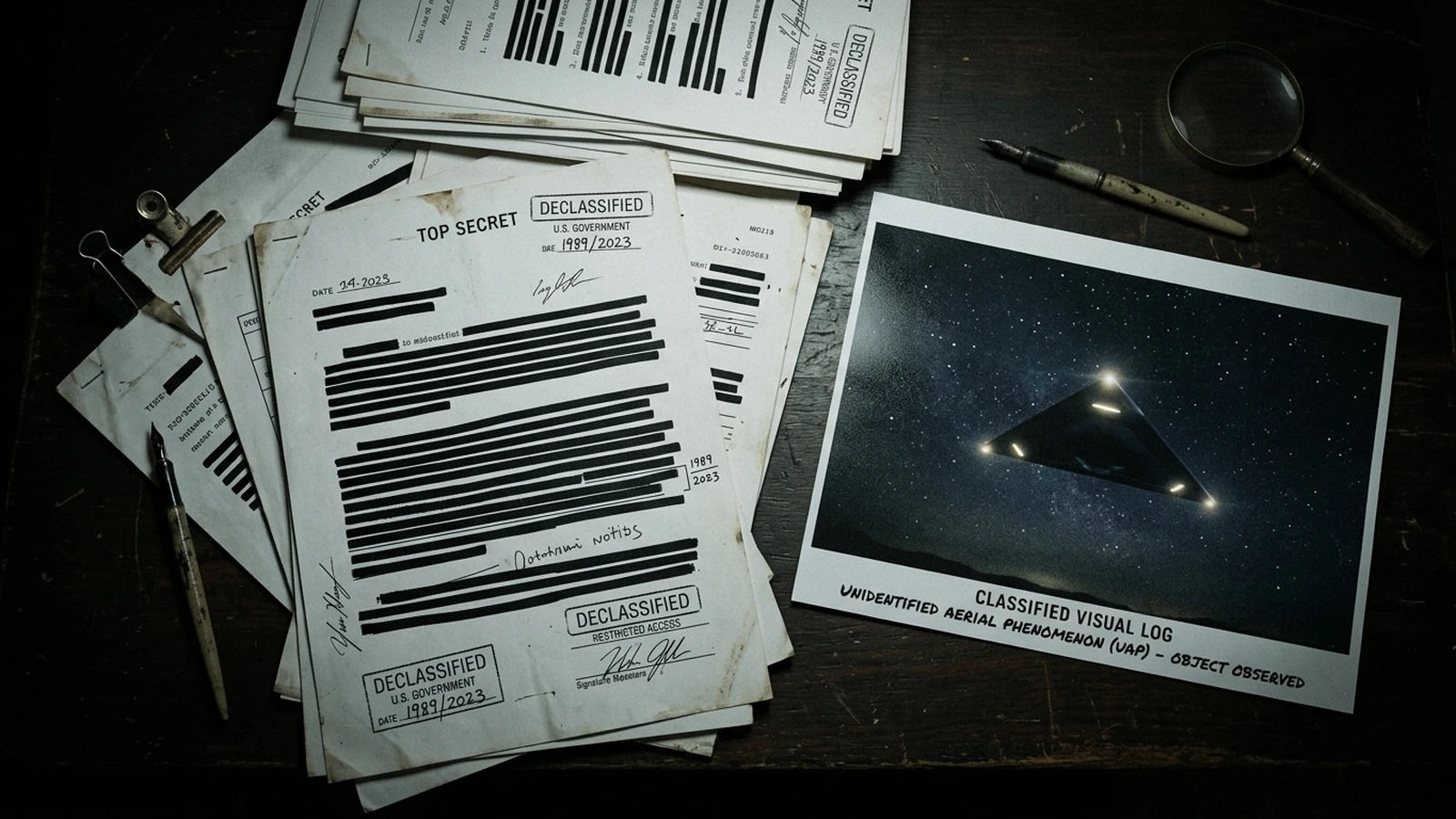
- The lead file is an AARO debrief of federal agents who watched a matte black triangle climb over a ridge, hover for about 20 seconds and dive into a canyon in June 2026
- The widely reported speed of 1,800 mph is not in either 2026 file. It comes from misreading 1.5 miles, the distance at which the agents lost sight of the object
- The Pentagon-funded team's 2010 Utah ranch report had mystery hairs DNA-tested: three came from a dog and one from a raccoon
- A 1953 Air Force card in the release says a 'saucer' over Catalina was Jupiter, and our ephemeris check puts Jupiter 45° up in the west at that moment, exactly where the witness looked
Jump to section 7 sections
- What's in the Seventh UFO File Release
- Black Triangle UFO: What the Federal Agents Actually Reported
- Skinwalker Ranch Files: What the Pentagon-Funded Team Found in Utah
- AAWSAP and MUFON: Where the UFO Programme's Money Went
- 1950s UFO Reports: Jupiter Over Catalina and Red Lights Over Berlin
- Space Debris and Colonel McCoy: The Other Files
- When Is the Next UFO File Release?
The Pentagon's seventh batch of UFO files went up at war.gov/ufo on Friday 23 October 2026. It's a quieter release than the last one: 28 documents, no video, and most of it old paper. But it opens with the most detailed modern sighting the programme has put out so far, a black triangle watched by federal agents in June this year, and it comes with the field reports from the Pentagon-funded team that spent 2009 and 2010 investigating a ranch in Utah.
We've read all 28 files, more than 1,100 pages. Several of the headlines don't match what the documents say, so this is what's actually in them. If you'd rather go straight to the source, our Pentagon UFO file browser now holds all 478 records from the seven releases, with every Release 7 document mirrored on our own servers.
What's in the Seventh UFO File Release
The seventh Pentagon UFO file release contains 28 documents. They fall into five groups:
- Two 2026 accounts of a black triangle: an AARO debrief memo and an FBI interview record, both from a "sensitive national security site in the western United States".
- Nine AAWSAP contractor files: the 2008 project plan, monthly reports from 2009, a 2010 self-assessment and the April 2010 Utah ranch report, all written by Bigelow Aerospace Advanced Space Studies (BAASS).
- Fourteen sighting files from 1949 to 1957: Air Force intelligence reports from Saudi Arabia, Guam, Sardinia, Canada, Germany, Morocco, Alaska, Sweden and Indiana, plus four record cards filed under Catalina Island, California.
- One personnel file: the 298-page career record of Colonel Howard McCoy.
- Two files on fallen space hardware from 1962 to 1964.
It's the seventh batch under PURSUE, the programme set up after President Trump's directive in February. Our guide to the earlier releases covers what each batch contained. Release 7 carries straight on from the sixth release, which published the AAWSAP contract and its 37 research papers. This time we get the contractor's own working files.
Black Triangle UFO: What the Federal Agents Actually Reported
The black triangle UFO at the top of this release comes from two documents. The fuller one is a memorandum for record from AARO, the Pentagon's All-domain Anomaly Resolution Office, recording a debrief of two federal law enforcement agents, with a third person named as a corroborating witness. The date is blacked out. The Pentagon's catalogue entry gives June 2026 and says the debrief covers observations "over two days".
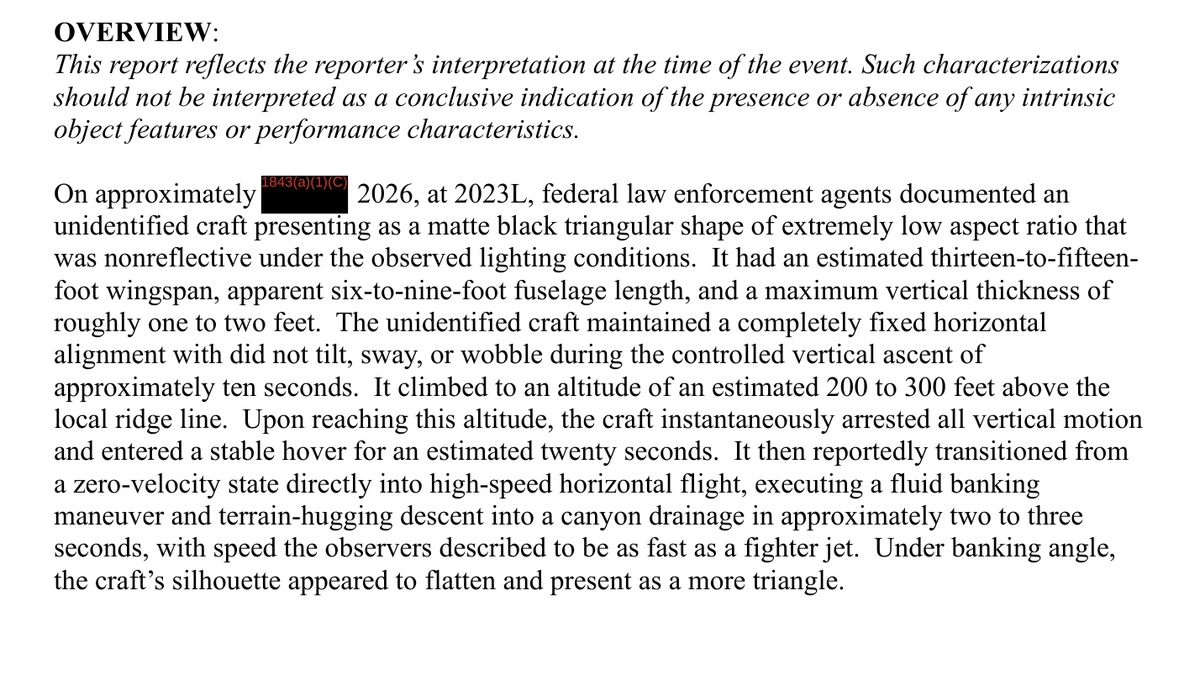
The memo is careful to say it records "the reporter's interpretation at the time of the event". Here's what they reported. At 20:23 local time, just after sunset, the third witness was scanning west with long-range thermal equipment and called out a contact over a ridge line. The two agents ran across the hilltop to look. Against the leftover glow of the sunset they saw "a matte black triangular shape of extremely low aspect ratio", with an estimated wingspan of 13 to 15 feet and a thickness of only one to two feet.
The memo splits what happened into three phases:
- A climb of about ten seconds, perfectly level and silent, to 200 to 300 feet above the ridge.
- A hover of about 20 seconds with "no observable drift or oscillation".
- A banking dive into a canyon lasting two to three seconds, at a speed the agents compared to a fighter jet.
The range was 1.4 to 3.2 miles, worked out from the terrain. A ground search of the canyon the next morning found "no wreckage, ground scarring, or vegetation damage".
Two details in the coverage need correcting. Several outlets said thermal cameras couldn't detect the object. The memo says the opposite: through the handheld thermal viewer it "displayed a spatially uniform thermal signature across the entire airframe", meaning it showed up evenly warm with no hot exhaust. The other is the speed. The figure of 1,800 mph is everywhere, but neither 2026 file gives one. The memo says plainly that "no instrumented speed measurement was obtained". The FBI statement says the agents lost sight of the object "at an estimated range of about 1.5 miles" and that the whole sighting lasted about three seconds. Someone seems to have turned that range into a distance flown, and 1.5 miles in three seconds is 1,800 mph.
The two accounts also don't match each other. The FBI version has a nine-to-15-foot wingspan, no hover, and the object "approaching our position" before it dropped to the south-east. It's three seconds of sighting against more than 30 in the memo. With the catalogue saying "over two days", these may well be two different evenings. The agents in the FBI statement call it "a delta wing drone" and an "unmanned aerial system". They were describing what it looked like, not saying whose it was, but it's a reminder that a quiet, flat drone at dusk is the first thing to rule out. AARO's notes say the incident warrants further investigation. Black triangles have turned up in these releases before, notably the Bagram triangle from 2002, and our black triangle sightings page covers the longer history.
Skinwalker Ranch Files: What the Pentagon-Funded Team Found in Utah
The Skinwalker Ranch files are the part of the release getting the most attention online. The documents themselves never use the name. They call it "the Utah ranch", and it's the property in the Uinta Basin that BAASS investigated while it held the Defense Intelligence Agency's AAWSAP contract.
The April 2010 investigation report is mostly witness interviews. More than 25 people were spoken to, and eleven of them describe a bipedal "dog-like" creature or orbs. Others mention a "pterodactyl", "little people" and a maggot "about 8-feet long". Those are what people told the investigators, and the report presents them that way.
The physical tests are the more interesting part, because they came back ordinary. Hairs were found on a fence and on a red-stained rock on the mesa and sent for mitochondrial DNA analysis. Three were identical canine sequences, most likely from one of the ranch's own dogs, which "run at will on the property". The fourth was a raccoon. An electromagnetic sweep picked up two strong signals on the mesa, at 1,210 to 1,216 MHz and 1,232 to 1,239 MHz, that hadn't been there the day before. The report itself notes that those bands are allocated to satellite navigation and says satellite transmissions would have to be checked before calling them unexplained. Sensors fixed to plants were too new to say anything.
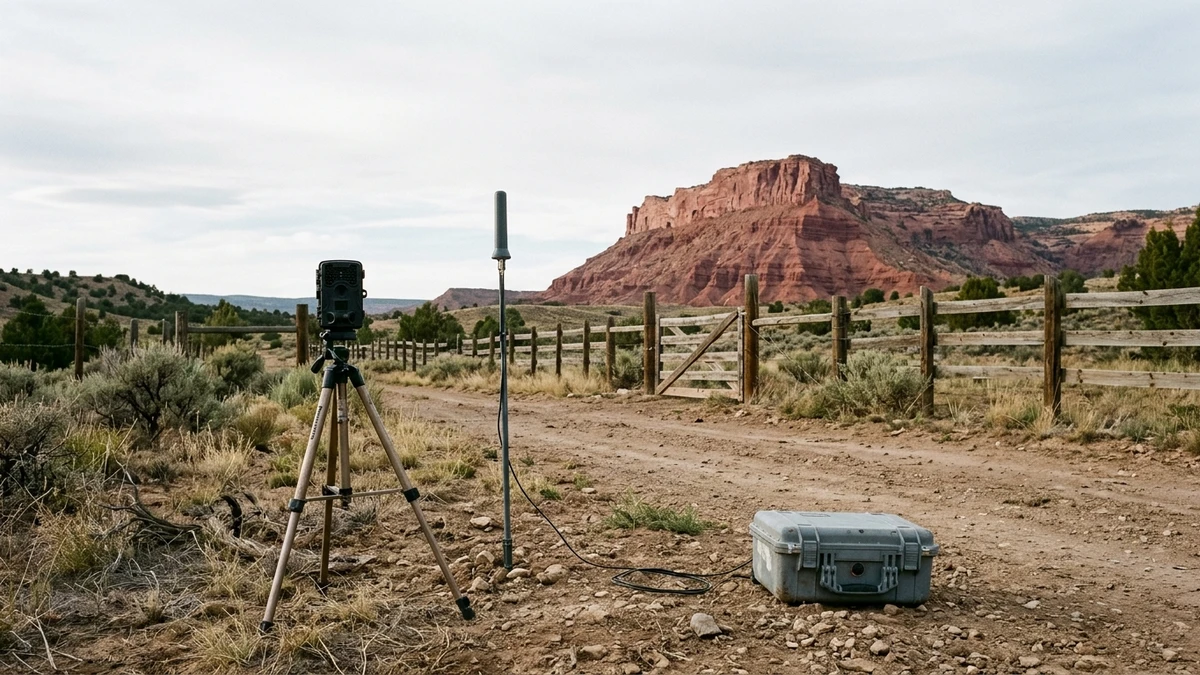
The November 2009 monthly report adds the guards' logs from when round-the-clock security started that August: a stereo switching itself on, pennies moving, an "orb" on a photo. To its credit, BAASS wrote that the penny reports "can be easily explained by (a) fraud perpetrated by the officers, (b) trespassers, (c) animals". It then set up locked-briefcase tests to rule those out.
That caution sits oddly next to the project plan from December 2008, which talks about "having confirmation that a significant menu of very novel spacecraft have existed for over 60 years". Nothing in the nine files backs that up, and the team's own 2010 self-assessment admits that "since there was little hard data, most analyses" relied on assumptions or "eye witness testimony". It also concedes that "possibly a majority" of reports can be explained as simple misidentification.
Seen something odd yourself?
Kit we've reviewed in full
Most lights reported as UFOs turn out to be satellites, planets or aircraft, and a pair of binoculars settles it in seconds.
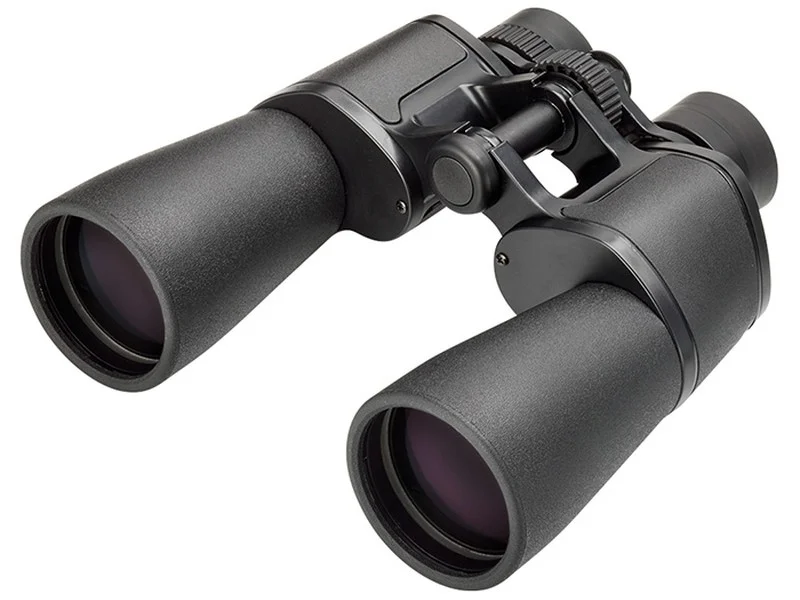
Wide field, 50mm lenses and light enough to hold steady by hand, so you can get onto a moving light before it's gone. The pair we point most UK beginners to first.
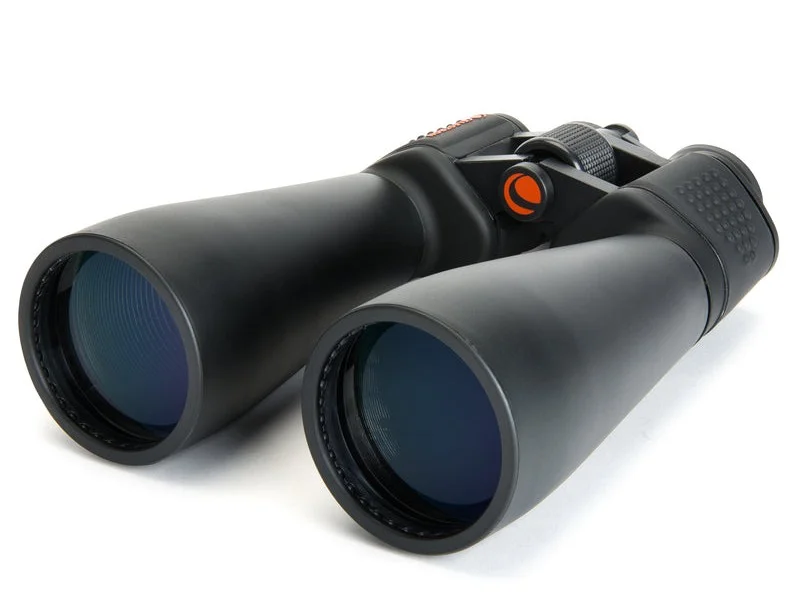
15× brings a distant light much closer and the 70mm lenses pick up faint objects. You'll want a tripod, but it's the pick for anything low over the horizon.
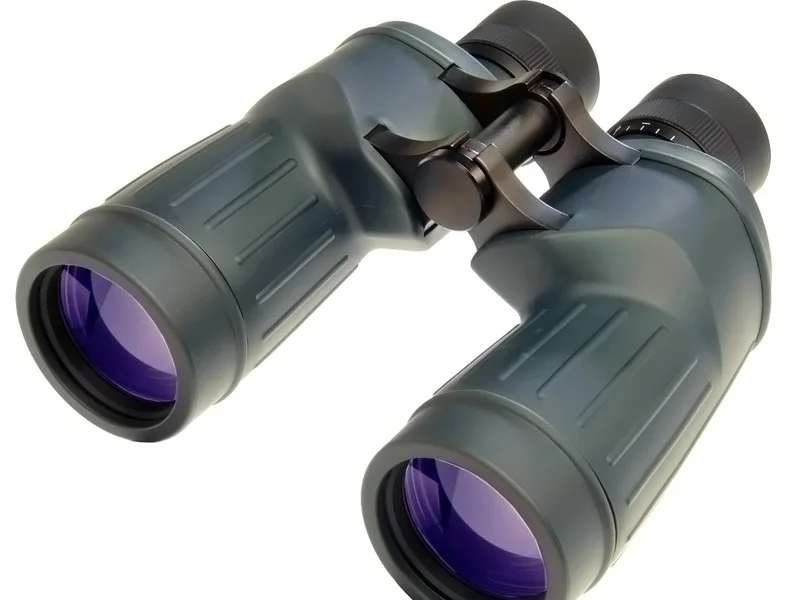
Better contrast and sharper edges, so points of light stay clean. The one to buy if you want a single pair to last years.
Affiliate links: you pay the same price, we earn a small commission that helps keep WatchTheStars free.
AAWSAP and MUFON: Where the UFO Programme's Money Went
We've already been through the $21.9 million AAWSAP contract line by line. Release 7 shows where some of that money went day to day, and the most surprising part is the deal with MUFON, the American volunteer UFO group. From February 2009 BAASS paid MUFON to send it sighting alerts "within hours", along with full investigation reports and physical samples.
MUFON couldn't spend the money fast enough. A BAASS letter of 25 June 2009 sets out the figures:
- February and March: $11,014.37 spent out of $74,666.67 allocated.
- April: $23,803.95 out of $56,000.
- May: $23,812.00 out of $51,000.
BAASS cut the monthly payment to $25,500. By November it was complaining about MUFON's "tendency to warehouse significant sums of money" and cut it by another $10,000 a month. One MUFON case BAASS paid for was solved as radio-controlled gliders carrying blue lights.
The files also show how much British material the programme was reading:
- RAF Bentwaters: the December 2008 plan asks for data on the 1980 case, which we know as the Rendlesham Forest incident, and plans contact with the Ministry of Defence.
- The MoD files: in March 2009 analysts were working through about 7,297 pages already released, plus 1,200 more cases put out on 21 March 2009.
- One big database: BAASS's combined catalogue held 234,364 reports "from 593 B.C. to present time".
The 2010 self-assessment includes its own analysis of the 2004 Nimitz "Tic Tac" encounter, but the "Mach 10.7" headline number it produces is a "what if" calculation, not a measurement. It assumes the object fell 60,000 feet in five seconds.
1950s UFO Reports: Jupiter Over Catalina and Red Lights Over Berlin
The fourteen 1950s files are short and mostly unsolved, but one of them we could check ourselves. At about 05:10 Pacific time on 16 November 1953, an Air Force sergeant in San Pedro, California, watched a "round purplish white object" that seemed to hang over Catalina Island at 45° elevation before drifting north-west and fading after ten minutes. The Air Force record card says "Astronomical (JUPITER)" and notes Jupiter at "45 deg elevation in West".
We ran it through the same ephemeris software we use for our UK night sky this week guide. At 05:10 PST that morning, Jupiter stood 44.9° up from San Pedro, due west. Planets drift towards the west-north-west as they set, and the sky was brightening towards dawn, which explains both the drift and the fading. The Air Force got that one right. Jupiter is still the most common "UFO" in the night sky. If something bright is hanging in the same spot for ten minutes, check what you can see in the sky tonight first.
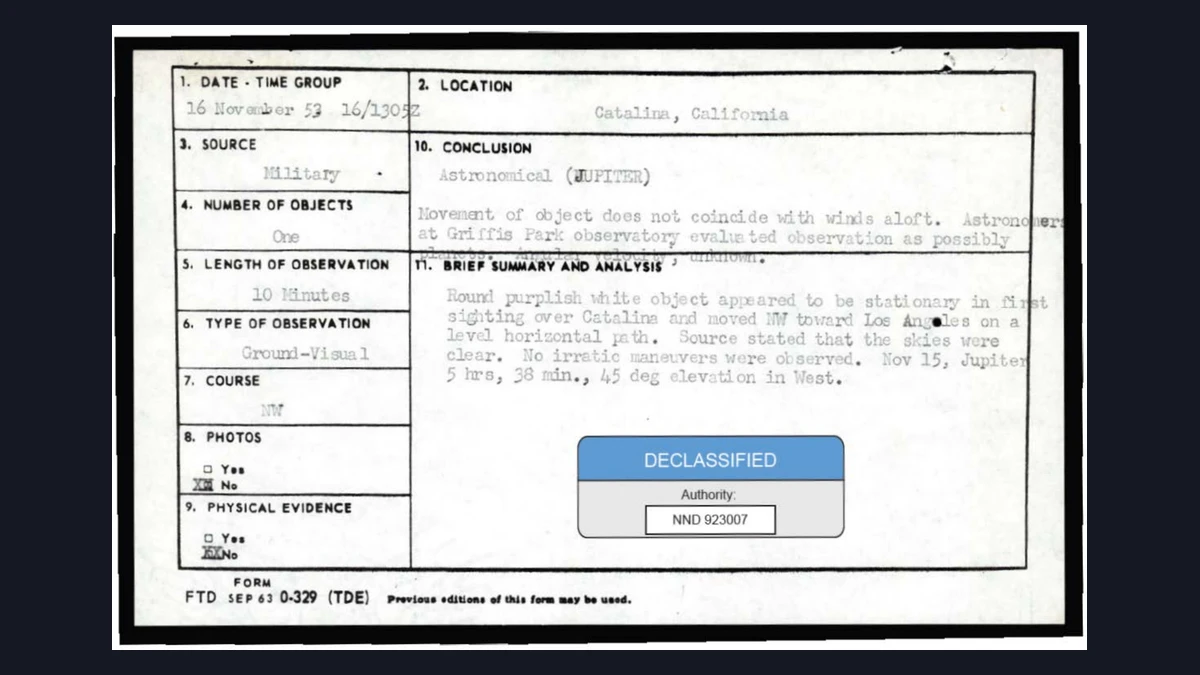
The rest are a mixed bag. The other three Catalina files are a 1955 light that the Air Force put down as a meteor, Boy Scouts watching a silver object in 1952, and a 1949 letter to the pilot Kenneth Arnold about ten objects over Avalon. On 10 August 1953, two British European Airways DC-3 crews flying the Berlin corridor reported red lights over East Germany, and the British air safety centre in Berlin said the Soviets "could not account for it". In December 1953 a Swedish DC-3 captain reported a "shining metal spherical elliptical object" below his aircraft near Hässleholm. He had flown about 30 Mosquito raids with the RAF, though a Swedish source told the Americans he was "most untrustworthy". A Guam fighter pilot's blinking light in 1956 may have been a lighted weather balloon launched earlier that night. Lights like that, and satellites, are why we always suggest checking ISS passes tonight before reporting anything.
Space Debris and Colonel McCoy: The Other Files
The last three files are the strangest fit for a UFO release. Two are early-1960s White House and NASA papers on who should collect space-vehicle fragments when they fall to Earth. The agreed guidelines say NASA and other agencies "will deliver to the DoD... on a priority basis" any fragments "suspect as coming from vehicles launched from foreign countries". That means Soviet hardware went to the military for intelligence analysis first. A NASA telex insists the agency never guesses "on the origin of an object", and a 1963 memo has a NASA official complaining that the Defense Department wanted to use NASA "for a 'cover'". Nothing in either file describes an object that wasn't man-made.
The 298-page personnel file of Colonel Howard McCoy contains no UFO material at all. We searched every page. It's in the release because of the job it records: from December 1946 to August 1949 McCoy ran Air Force technical intelligence at Wright Field, the office behind Project Sign, the first official US UFO study, which we covered in our post on the 1948 Project Sign report. One appraisal says his "enthusiasms for broadening the horizons of his job have to be continually checked".
When Is the Next UFO File Release?
The Department of War hasn't given a date for the next UFO file release. Its spokesman, Sean Parnell, said more files will follow "on a rolling basis". The seven batches so far have arrived four to six weeks apart, so late November or early December would fit the pattern.
Release 7 shows what PURSUE does well. It puts out the raw paperwork, redactions and all, including the notes that undercut the excitement. The triangle file is the one to watch. AARO has flagged it for more work, and two sets of trained witnesses, a thermal viewer and a terrain-based range estimate are more than most cases ever get. Whether it turns out to be someone's very quiet drone or something harder to explain, the next step is AARO's.
Sources:
- Pentagon UFO files, Release 7: US Department of War (documents DOW-UAP-D155 to D181, EOP-UAP-D002, FBI-UAP-D043, USG-UAP-D002; our mirror copies are in the PURSUE file browser)
- 'Triangular object rose, descended into canyon': The Washington Times, 23 October 2026
- Pentagon releases 7th batch of UFO files: Anadolu Agency, 23 October 2026
- Jupiter's position on 16 November 1953 computed with Skyfield and the JPL DE421 ephemeris for San Pedro, California (33.74°N, 118.29°W)
Header image: AI-generated illustration based on the description in the AARO memo, not a photograph of the object.
Frequently Asked Questions
Equipment guides
Related topics

Ian ClaytonAmateur astronomer and founder of WatchTheStars.co.uk, dedicated to helping others explore the wonders of our universe. Full profile →