AAWSAP: What the DIA Actually Paid For
The contract, the money and all 37 released research papers, read from the primary documents
AAWSAP, the Advanced Aerospace Weapon System Applications Program, has been described as the Pentagon's secret UFO programme for nearly a decade. The sixth PURSUE release in September 2026 put its own paperwork in public: the statement of objectives, the contract and every modification, plus 37 of the 38 research papers it commissioned. Read in full, the file is mostly dry acquisition paperwork and literature reviews. That is the reason to read it properly.
| Programme | Advanced Aerospace Weapon System Applications Program (AAWSAP) |
| Customer | Defense Intelligence Agency, Acquisition Support Division (DWO-3) |
| Contractor | Bigelow Aerospace Advanced Space Studies, LLC (BAASS), Las Vegas |
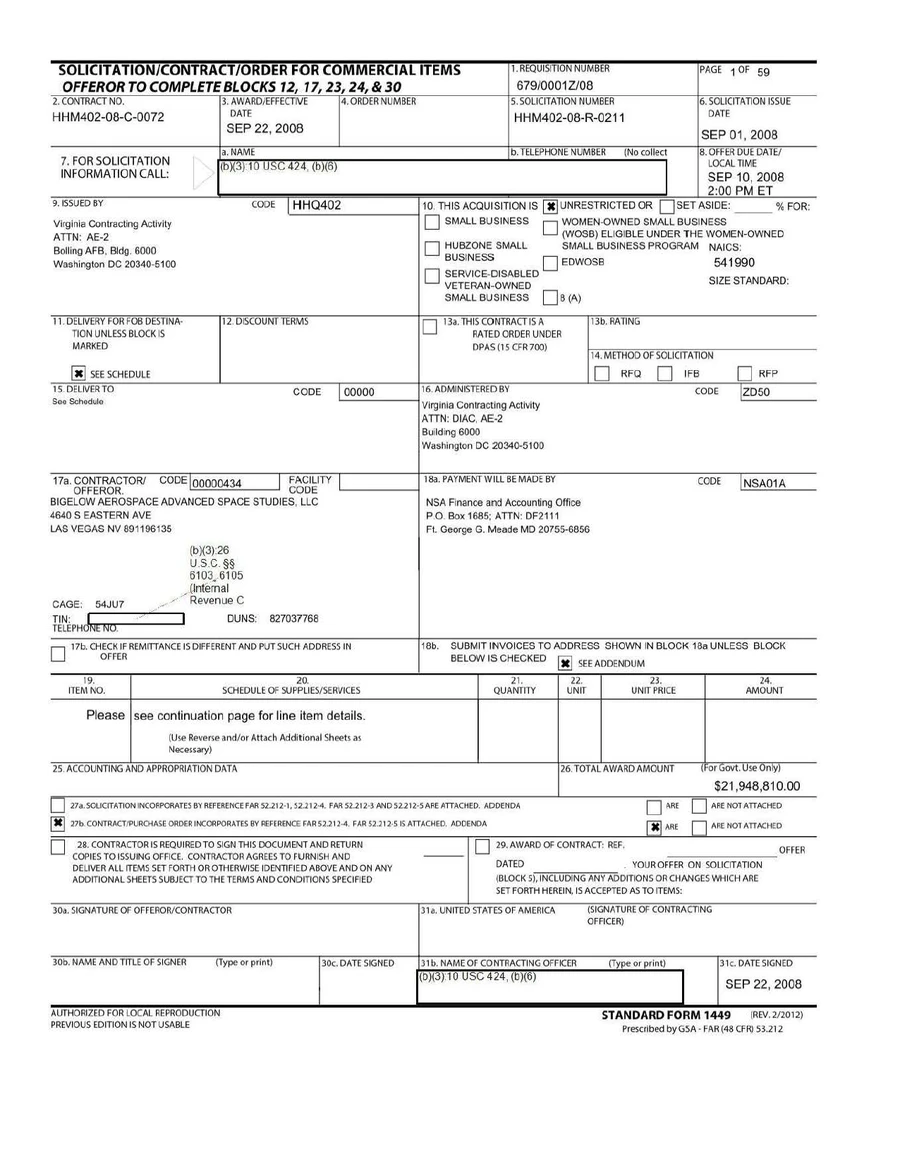
| Contract number | HHM402-08-C-0072 (solicitation HHM402-08-R-0211) |
| Awarded | 22 September 2008, firm fixed price |
| Total obligated | $21,948,810.00 |
| Last action | No-cost extension to 21 December 2010 |
| Research papers | 37 of 38 DIRDs released, D117 to D153 |
| Released | 18 September 2026, sixth PURSUE release |
What Was AAWSAP?
AAWSAP was a Defense Intelligence Agency contract, awarded in September 2008 to Robert Bigelow's company BAASS, to study where breakthrough aerospace technology might go over the next forty years and what that would mean as a foreign threat. It ran on paper from September 2008 to December 2010 and cost $21,948,810. Its best-known products are 38 research papers, of which 37 are now public.
The programme's reputation runs well ahead of its paperwork. It is usually described as a secret UFO programme, and the research papers include warp drives and wormholes. But the documents the DIA itself wrote are about deliverables, invoices and contracting officers. We read all 44 AAWSAP documents in the release, and this page sets out what they actually contain. If you are new to this collection, our UAP research hub explains how we work with primary sources, and the news story on the sixth UFO file release covers the rest of the September batch.
"The objective of this program is to understand the physics and engineering of these applications as they apply to the foreign threat out to the far term, i.e., from now through the year 2050."· DIA Statement of Objectives, 18 July 2008 (DOW-UAP-D110)
How Much Did AAWSAP Cost? The $22 Million, Line by Line
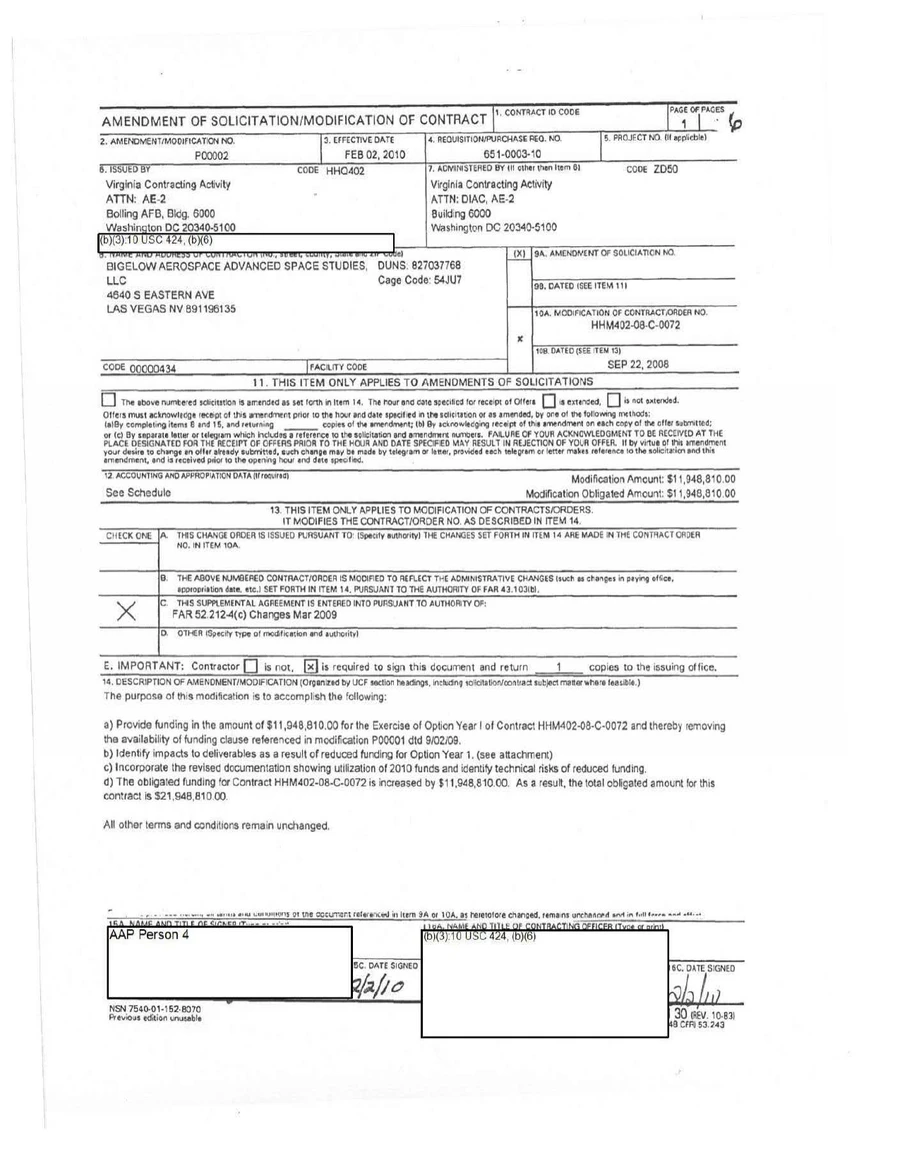
AAWSAP cost $21,948,810.00. That figure is printed in the "total award amount" box of the contract's first page and repeated in Modification P00002, so the "$22 million" in news coverage is not a rounding guess. It is the government's own number, accurate to the dollar.
The base year was priced at exactly $10,000,000. In September 2009 the DIA priced the first option year at $25,000,000, but when it was funded in February 2010 the money came to $11,948,810, under half. The same modification asks the contractor to "identify impacts to deliverables as a result of reduced funding". On this evidence the programme was scaled back long before it stopped.
| Line item | Base year (2008–09) | Option Year 1 as priced | Option Year 1 as funded |
|---|---|---|---|
| Monthly status reports | $2,887,000 | $3,241,200 | $1,549,100 |
| Project management plan | $3,600,000 | $9,957,600 | $4,759,300 |
| Research report | $2,100,000 | $6,006,000 | $2,870,600 |
| Integrated threat assessment | $240,000 | $460,800 | $220,200 |
| Travel | $50,000 | $115,000 | $36,700 |
| Other direct costs | $1,123,000 | $5,219,400 | $2,494,610 |
| Additional travel (added Feb 2010) | none | none | $18,300 |
| Total | $10,000,000 | $25,000,000 | $11,948,810 |
Sources: base year from the contract (D111), the priced option from Modification P00001 (D112), the funded option from Modification P00002 (D113). The six priced lines add up to exactly $25,000,000 and the funded lines to exactly $11,948,810.
AAWSAP Timeline: From Solicitation to Wind-Down
The whole contract life fits in seven documents. The striking part is the start: three weeks from solicitation to award, with nine days for bids.
18 July: statement of objectives
The DIA's Acquisition Support Division sets out the work: 12 technical areas, a five-year term (one base year plus four option years), firm fixed price, TS/SCI clearances.
1 September: solicitation issued
Solicitation HHM402-08-R-0211 goes out, marked 'unrestricted' (no small-business set-aside).
10 September: offers due
Bids close at 2:00 PM Eastern, nine days after issue.
22 September: contract awarded
HHM402-08-C-0072 goes to BAASS. The base year runs to 21 September 2009 at $10,000,000.
2 September: Modification P00001
Extends the base year to 30 September, prices Option Year 1 at $25,000,000 and 'exercises' it subject to funds becoming available. No money moves.
2 February: Modification P00002
Funds Option Year 1 at $11,948,810 and asks for the impact of the reduced funding on deliverables. Total obligated: $21,948,810.
18 May: Modifications P00003 and P00004
P00003 changes the contracting officer's representative, at no cost. Only the cover page of P00004 is in the release, so its content is unknown.
28 September: Modification P00005
A no-cost extension by mutual agreement, moving the end date to 21 December 2010.
21 December: last documented date
Option years 2 to 4 are never exercised. Nothing later appears in the contract file.
What Was AAWSAP Asked to Study? The 12 Technical Areas
The statement of objectives lists twelve areas, in this order. Read cold, it looks like the contents page of an aerospace engineering textbook with a couple of odd entries.
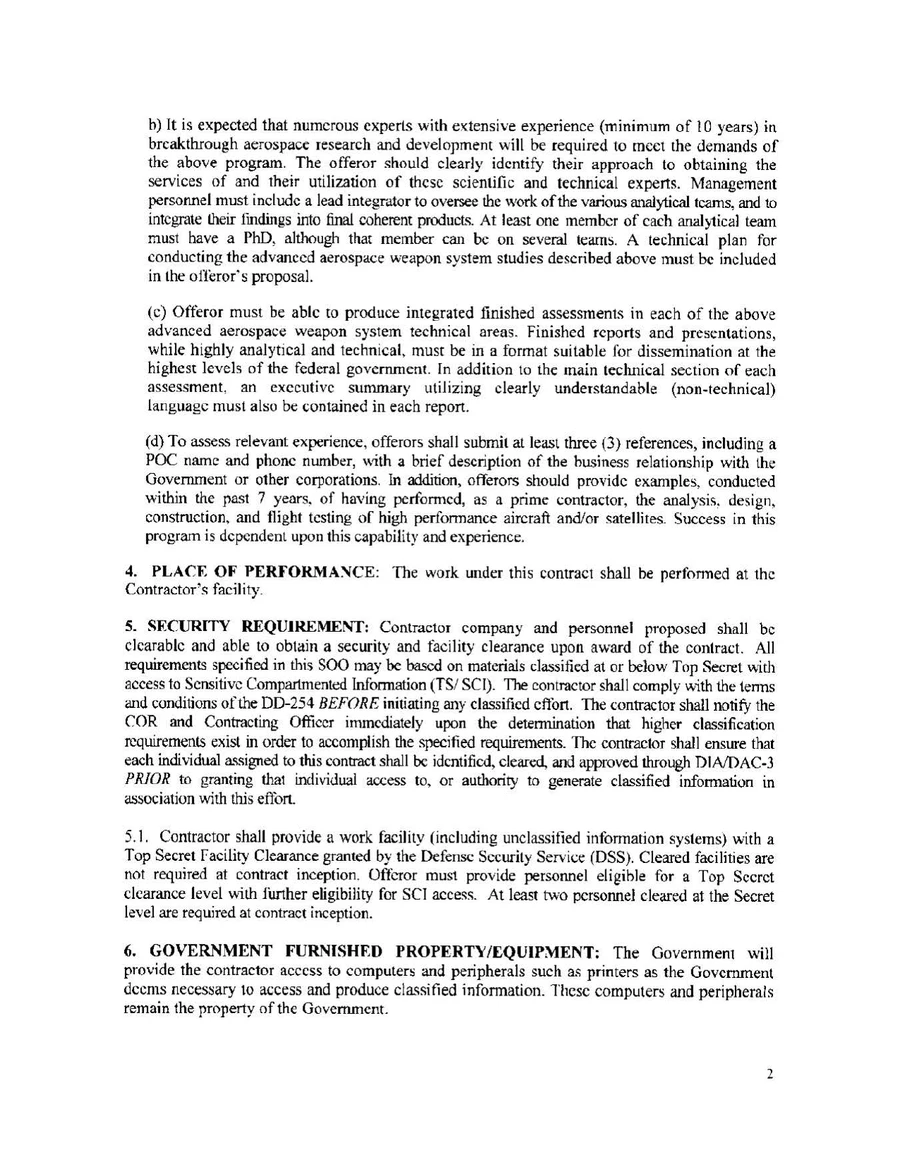
It also asks for teams of experts with at least ten years in breakthrough aerospace research, with at least one PhD on each analytical team, and for work cleared up to Top Secret with access to compartmented information. The deliverables are monthly status reports, a management plan, research reports and a final integrated threat assessment.
The AAWSAP DIRD List: All 37 Papers in the Release
The release contains 37 of the 38 Defense Intelligence Reference Documents (DIRDs) the programme produced, dated December 2009 to January 2011. The Department of War's own notes call them "reference and synthesis products" rather than original research, and that is how most of them read. The speculation rating is ours, from reading each paper in full: 1 is a mainstream literature review, 5 is fringe. Page counts are the PDFs as released, covers included.
| DIRD | Title | Dated | Pages | Rating | In one line | Mentions anomalous craft? |
|---|---|---|---|---|---|---|
| D117 | Metallic Glasses: Status and Prospects for Aerospace Applications | 14 Dec 2009 | 30 | 1 | Strong but brittle amorphous metals; composites might replace high-strength steel in small parts | No |
| D118 | Aerospace Applications of Programmable Matter | 14 Dec 2009 | 20 | 4 | Real smart materials stretched into a self-cloaking space station | No |
| D119 | Biomaterials | 7 Jan 2010 | 32 | 1 | A textbook survey of implants, scaffolds and medical materials | No |
| D120 | Materials for Advanced Aerospace Platforms | 12 Jan 2010 | 27 | 1 | Alloys, composites and ceramics for launch vehicles and spacecraft | No |
| D121 | Pulsed High-Power Microwave Source Technology | 28 Jan 2010 | 37 | 2 | Microwave weapons engineering; the physics companion to D128 | No |
| D122 | Invisibility Cloaking: Theory and Experiments | 2 Mar 2010 | 29 | 2 | Metamaterial cloaking, which it says can never be perfect | No |
| D123 | Positron Aerospace Propulsion | 2 Mar 2010 | 35 | 4 | Antimatter-fuelled aircraft and Mars vehicles; storing the fuel is the unsolved problem | No |
| D124 | Space Access: Where We've Been and Where We Could Go | 8 Mar 2010 | 56 | 2 | A polemical history of US launchers, blaming institutions rather than technology | No |
| D125 | Inertial Electrostatic Confinement Fusion | 10 Mar 2010 | 72 | 3 | Real lab fusion devices, extrapolated to spacecraft power | No |
| D126 | Advanced Nuclear Propulsion for Manned Deep Space Missions | 11 Mar 2010 | 37 | 4 | Project Orion-style pulse propulsion using fusion micro-explosions | No |
| D127 | An Introduction to the Statistical Drake Equation | 11 Mar 2010 | 55 | 2 | Rigorous maths on the Drake equation; the only paper with an author's name in it | No |
| D128 | Anomalous Acute and Subacute Field Effects on Human Biological Tissues | 11 Mar 2010 | 38 | 5 | Argues injuries near unknown craft could reveal how they are propelled | Yes |
| D129 | Metallic Spintronics | 23 Mar 2010 | 27 | 1 | Giant magnetoresistance and spin-transfer torque, the physics in hard drives | No |
| D130 | Technological Approaches to Controlling External Devices in the Absence of Limb-Operated Interfaces | 23 Mar 2010 | 36 | 1 | A survey of brain–machine interfaces | No |
| D131 | The Role of Superconductors in Gravity Research | 23 Mar 2010 | 16 | 2 | A sceptical first-person history of failed "gravity shielding" replications | No |
| D132 | Advanced Space Propulsion Based on Vacuum (Spacetime Metric) Engineering | 29 Mar 2010 | 17 | 4 | General relativity treated as an engineering toolkit for propulsion | No |
| D133 | The Space-Communication Implications of Quantum Entanglement and Nonlocality | 30 Mar 2010 | 32 | 4 | Asks whether entanglement could carry faster-than-light messages | No |
| D134 | Maverick Inventor Versus Corporate Inventor | 30 Mar 2010 | 19 | 2 | Not physics: who invents breakthroughs, and how to filter out free-energy cranks | No |
| D135 | Antigravity for Aerospace Applications | 30 Mar 2010 | 44 | 4 | Every theoretical route to antigravity; none usable any time soon | No |
| D136 | Biosensors and BioMEMS: A Survey of the Present Field | 31 Mar 2010 | 45 | 1 | Implants, micropumps and biosensors | No |
| D137 | State of the Art and Evolution of High-Energy Lasers | 31 Mar 2010 | 31 | 1 | Laser weapons and how they damage spacecraft | No |
| D138 | Warp Drive, Dark Energy, and the Manipulation of Extra Dimensions | 2 Apr 2010 | 33 | 5 | The Alcubierre warp drive, with energy figures that rule it out in practice | No |
| D139 | Traversable Wormholes, Stargates, and Negative Energy | 6 Apr 2010 | 42 | 5 | Wormhole physics, including a figure titled "A Stargate in Times Square" | No |
| D140 | High-Frequency Gravitational Wave Communications | 6 Apr 2010 | 57 | 4 | Messages sent through the Earth on a disputed, unconfirmed effect | No |
| D141 | Metamaterials for Aerospace Applications | 6 Apr 2010 | 38 | 1 | Negative-index materials and super-lenses | No |
| D142 | Concepts for Extracting Energy From the Quantum Vacuum | 6 Apr 2010 | 57 | 2 | Zero-point energy reviewed; mainstream physics does not support extracting it | No |
| D143 | Laser Lightcraft Nanosatellites | 1 Nov 2010 | 77 | 2 | Launching small satellites on ground-based laser beams | No |
| D144 | Cockpits in the Era of Breakthrough Flight | 1 Nov 2010 | 57 | 4 | What a cockpit would need if gravity or inertia could be controlled | No |
| D145 | Aneutronic Fusion Propulsion I | 1 Nov 2010 | 50 | 2 | Neutron-free fusion and antimatter rockets compared | No |
| D146 | Aneutronic Fusion Propulsion II | 1 Nov 2010 | 36 | 2 | Terrestrial fusion reactor designs adapted for space | No |
| D147 | Ultracapacitors as Energy and Power Storage Devices | 1 Nov 2010 | 34 | 1 | Supercapacitors against lithium-ion batteries | No |
| D148 | Detection and High Resolution Tracking of Vehicles at Hypersonic Velocities | 20 Nov 2010 | 46 | 1 | Radar, infrared and acoustic tracking of Mach 5+ objects | No |
| D149 | MHD Air Breathing Propulsion and Power for Aerospace Applications | 21 Nov 2010 | 32 | 2 | Magnetohydrodynamic flow control for hypersonic aircraft | No |
| D150 | Quantum Computing and Utilizing Organic Molecules in Automation Technology | 10 Dec 2010 | 54 | 3 | Quantum and DNA computers for deep-space probes | No |
| D151 | Cognitive Limits on Simultaneous Control of Multiple Unmanned Spacecraft | 15 Dec 2010 | 31 | 2 | How many remote craft one human pilot can handle | No |
| D152 | Negative Mass Propulsion | 3 Jan 2011 | 43 | 5 | Mining negative mass, including tunnelling through the Moon with thermonuclear charges | No |
| D153 | Quantum Tomography of Negative Energy States in the Vacuum | 11 Jan 2011 | 51 | 4 | Measuring negative energy, with a sensor array to detect "anomalous aerospace platforms" | Yes |
Add up the ratings and the shape is clear. Ten papers are straight literature reviews (rated 1) and twelve more are serious science with modest speculation (rated 2). Only four are fringe: the injury paper, the warp drive, the wormholes and negative-mass propulsion. Even those tend to argue against themselves. The warp-drive paper's own table says a 50-metre bubble moving at light speed needs −3.03 × 1050 joules of negative energy, and invites the reader to compare that with the rest energy of the Sun, 1.79 × 1047 joules. That is about 1,700 Suns. Even crawling along at 3 km/s needs −3.03 × 1040 joules of something that has only ever been made in tiny amounts in a laboratory. The wormhole paper needs about 0.71 times the mass of Jupiter, in negative mass, per metre of throat. The antigravity paper concludes it is "highly unlikely, if not impossible" that anyone will soon build a technology that taps enough dark energy for propulsion. And the second fusion paper closes with a line worth framing: "The future needs to be focused more on science and engineering and less on science fiction."
Read the sky, not just the files
Kit we've tested and reviewed in full
None of the AAWSAP papers came from looking up. If you want to judge a strange light for yourself, a decent pair of binoculars settles most cases in seconds: planet, satellite, aircraft or something you really can't explain.
Bright, wide and quick to aim, so you can get onto a moving light before it has gone.
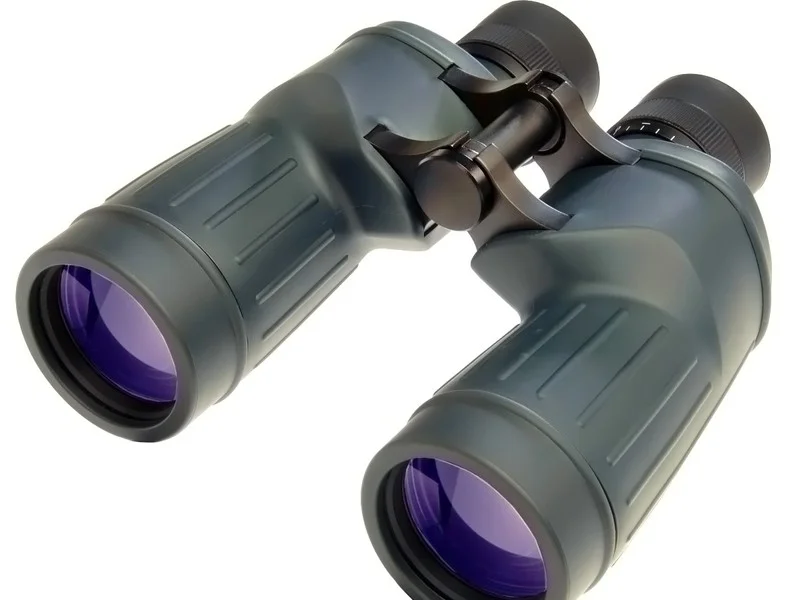
Nitrogen-filled and built for long, damp nights outdoors, which is when most sightings happen.
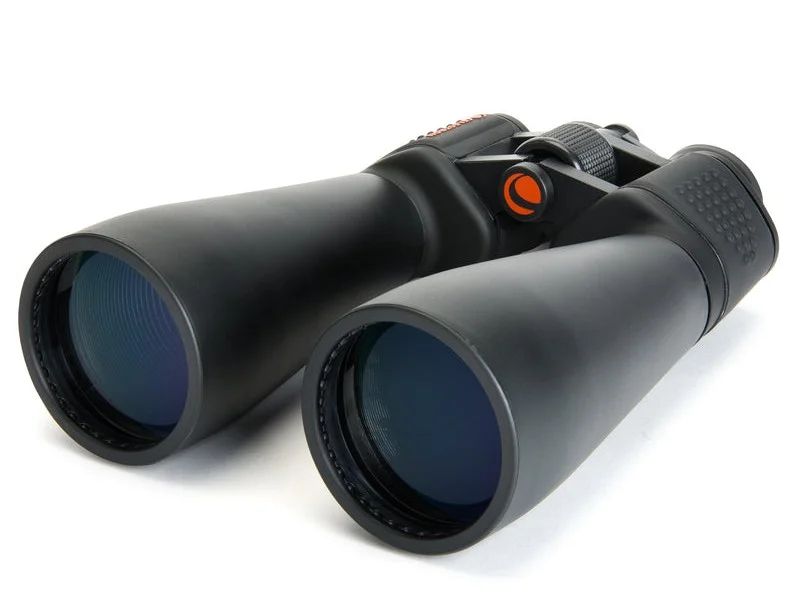
Extra aperture splits close pairs of lights and shows the navigation lights on a far-off aircraft. Use a tripod.
Browse all our binocular reviews
Honest, research-based recommendations for every budget.
Browse all →Affiliate links: you pay the same price, we earn a small commission that helps keep WatchTheStars free.
Which AAWSAP Papers Actually Mention UFOs?
Only two of the 37 released AAWSAP papers, D128 and D153, mention anomalous craft in their own text. Everything else in the set is about materials, propulsion, power, sensors or people, with no reference to unidentified craft at all.
D128, the injury paper, is the one openly about UFO witnesses. It says its purpose is to argue "that data exists to 'reverse engineer' propulsion systems of anomalous aerospace vehicles, independent of origin, based on biology". It compares a real 1997 case of three engineers injured by radio-frequency exposure with reports from people who say they were hurt near unknown objects. The radio-frequency medicine in it is mainstream; the leap from that to UFO case reports is the whole argument. Our full read of the DIA UFO injury study takes it apart section by section.
D153 is mostly a physics review of how negative energy is produced and measured in the laboratory. Twice, near the end, it suggests that the same detectors could be built into "a sensor array for surveillance and detection of any anomalous aerospace platforms that might use engineered spacetime effects for propulsion". That is the closest any of the propulsion papers comes to naming what the programme was interested in.
D144, on cockpits for "breakthrough flight", describes vehicles that shrug off inertia, which is how people describe UAP behaviour, but it never makes that link itself. We have left it marked "no" on the same rule as the rest: what the paper says, not what readers bring to it.
"The average energy inventor is not bothered by pesky Laws of Energy Conservation."
· DIRD D134, Maverick Inventor Versus Corporate Inventor, 30 March 2010Does the AAWSAP Contract Mention UFOs?
No. We searched the full text of all seven contract documents for UFO, UAP, anomalous, paranormal and Skinwalker, and none of those words appears even once. The statement of objectives talks about "advanced aerospace weapon system applications" and the "foreign threat". The modifications deal with funding, dates and who the contracting officer's representative is.
That does not settle what the programme was really for. It does mean that anyone who says "the contract shows" a UFO purpose is wrong about the contract. The UFO link comes from D128, from D153's one sentence, and from reporting and testimony outside this release.
Who Wrote the AAWSAP DIRDs?
The authors of the AAWSAP DIRDs are officially anonymous: every byline is redacted to a code like "AAP Person 58". The one exception is D127, the statistical Drake equation paper, which reproduces its author's signed 2008 conference paper as an appendix: Claudio Maccone.
The codes recur, which tells you something. Person 58 appears on antigravity, warp drive (as co-author), wormholes, vacuum energy, laser lightcraft and negative-energy tomography. Person 73 wrote the brain–machine interface, quantum computing and pilot-workload papers. Person 75 wrote both the superconductor-gravity history and the maverick-inventor essay. Several papers cite their own author's earlier work heavily, and names have been attached to them elsewhere on that basis. Those identifications are inference from the text, not something the release confirms, so we do not repeat them here.
Robert Bigelow's own name does appear in the paperwork: he is listed as the BAASS contact on the distribution list for Modification P00002. Elsewhere in the contract file the company contact is redacted to "AAP Person 4".
When Did AAWSAP End: 2010 or 2012?
The AAWSAP contract ends on 21 December 2010. That is the date set by Modification P00005, a no-cost extension "by mutual agreement", and it is the last action in the file. Option years 2, 3 and 4 were never exercised.
The Department of War's release notes describe AAWSAP as "active from 2008 to 2012". Nothing in the 44 released documents supports the 2012 date. Some DIRDs are dated January 2011, a few weeks after the contract's end, which fits papers being finished and delivered during wind-down rather than a programme still running. If the 2012 date comes from records outside this release, they have not been published.
How to Read the AAWSAP Files Yourself
All 44 documents are public domain. You can open the contract file in our PURSUE files browser (search for D110 to D116 for the contract, D117 to D153 for the papers), where every record links to a download from our own mirror. Our guide to the six US PURSUE releases explains how the designations work, and the wider UAP document archive lists every collection we have catalogued.
The same release carries the Air Force's file on the 1952 Tremonton film, which makes an instructive contrast: a case where the paperwork is far more interesting than the headline. Our Tremonton film analysis and the post on how the Air Force settled on "balloons or gulls" cover it.
Seen Something Odd? Check the Sky First
AAWSAP spent its money on theory. If you have seen a strange light yourself, the quickest answers are free. Many reports turn out to be the International Space Station, a bright planet or a string of satellites, and you can check ISS passes tonight or see what you can see in the sky tonight in a few seconds. Our UK night sky this week lists the bright planets and when they rise, and if you want to learn the sky well enough to spot the odd one out, start with stargazing for beginners.
Related Reading
More UAP cases
- The Hellfire Missile & The OrbINCIDENT DATE: 2024-10-30 | LOCATION: GULF OF ADEN / RED SEA COAST | STATUS: UNDER INVESTIGATION
- Browse Every Pentagon UFO FileRELEASES 01–06 · 8 MAY TO 18 SEPTEMBER 2026 · MIRRORED ON OUR OWN SERVERS
- The Western U.S. Event: Orbs Launching OrbsINCIDENT DATE: OCTOBER 2023 (TWO NIGHTS) | LOCATION: WESTERN UNITED STATES (REDACTED) | STATUS: UNRESOLVED
- Grey AliensBetty & Barney Hill · 1961 · the abduction template
- The Cheyenne Mountain IncidentINCIDENT DATE: FEBRUARY 2022 | LOCATION: COLORADO SPRINGS, COLORADO | STATUS: UNRESOLVED
- Project SIGN: The 1947–48 FileSEPTEMBER 1947 – NOVEMBER 1948 · 245 PAGES · RELEASED 7 AUGUST 2026