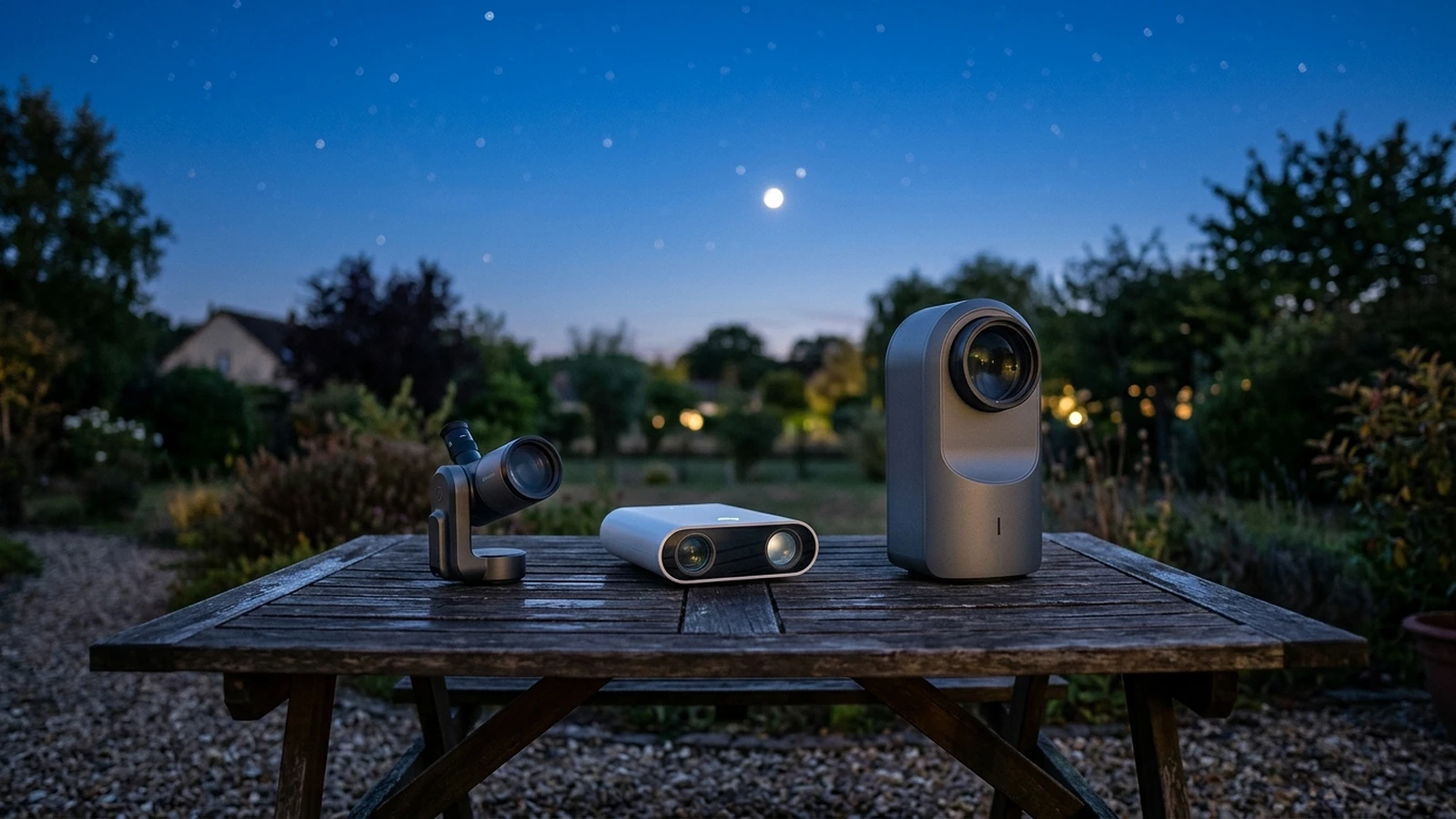
Seestar S50 Pro vs Dwarf Draco vs Vespera II: Which Smart Telescope Should You Buy?
Short answer: buy the Seestar S50 Pro if you want the most capable smart telescope you can actually buy today, at £999 with a filter, a tripod and a case in the box. Buy the Vaonis Vespera II if automatic mosaics, the best app in the category and a telescope that looks like furniture are worth £400 more to you. Pre-order the DwarfLab Draco only if 90mm of aperture and five-minute guided exposures are what you've been waiting for, you can live with 5.5kg, and you're comfortable being an early adopter. Nobody has tested a Draco yet, so every Draco figure below is DwarfLab's own. We'll update this page when review units arrive; First Light Optics expect deliveries in November or December 2026.
Updated 18 September 2026. Prices and specifications from First Light Optics, ZWO, DwarfLab and Vaonis on that date.
Available from First Light Optics today
Kit we've tested and reviewed in full
All four are sold by First Light Optics with UK warranty and returns; the Draco is pre-order with deliveries expected in November or December. Prices are kept current from our product data.
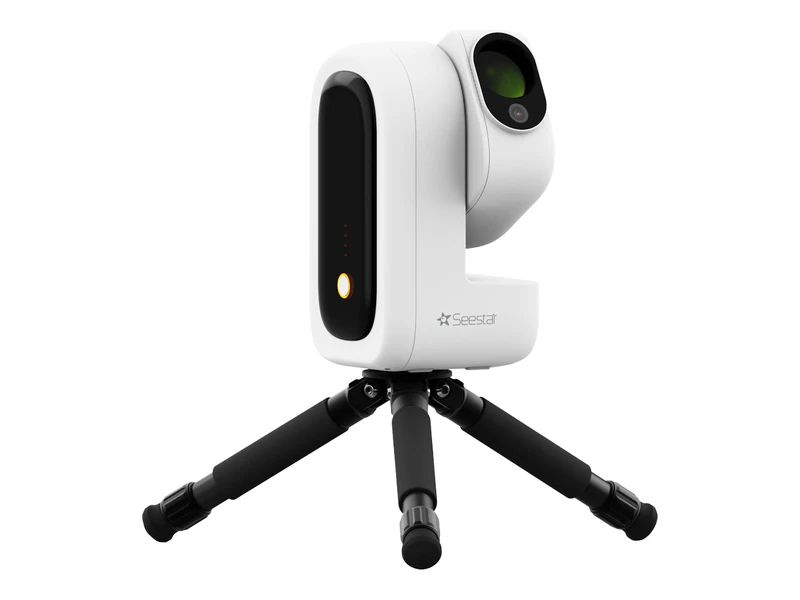
50mm quadruplet APO, dual 8.3MP 4K cameras, built-in dual-band filter, 10,000mAh battery, tripod and hard case in the box.
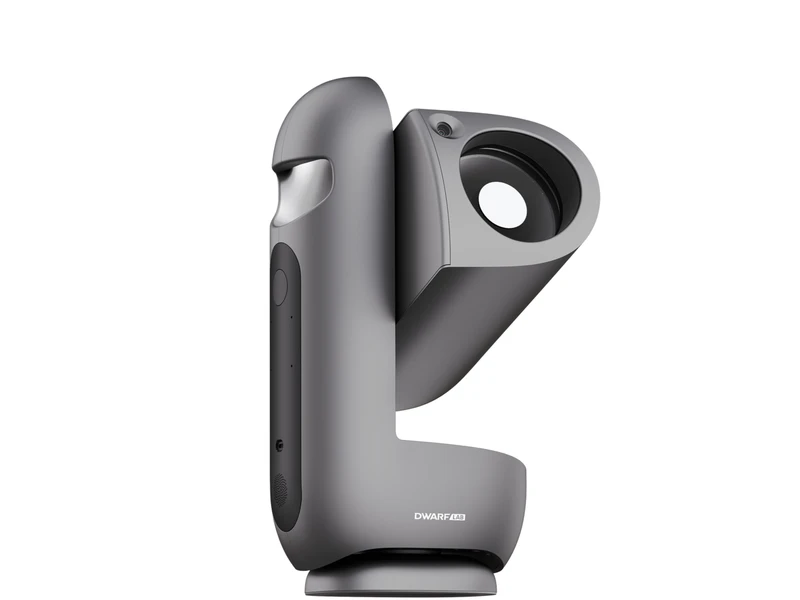
90mm f/3.8 folded optics, 50MP sensor, 300-second guided exposures, tripod included. Nobody has tested one yet.
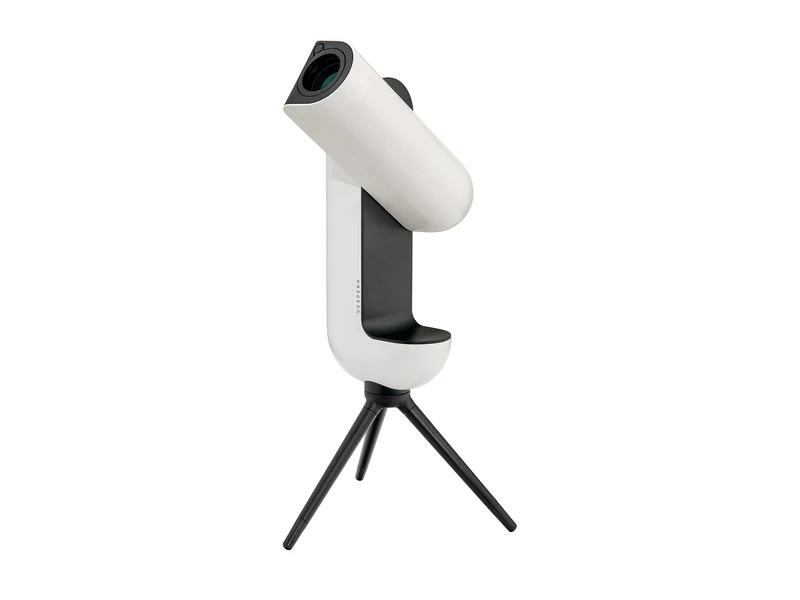
50mm f/5, Sony IMX585 8.3MP, CovalENS mosaics to 4.3 degrees, Plan My Night scheduling. Tripod and filters extra.
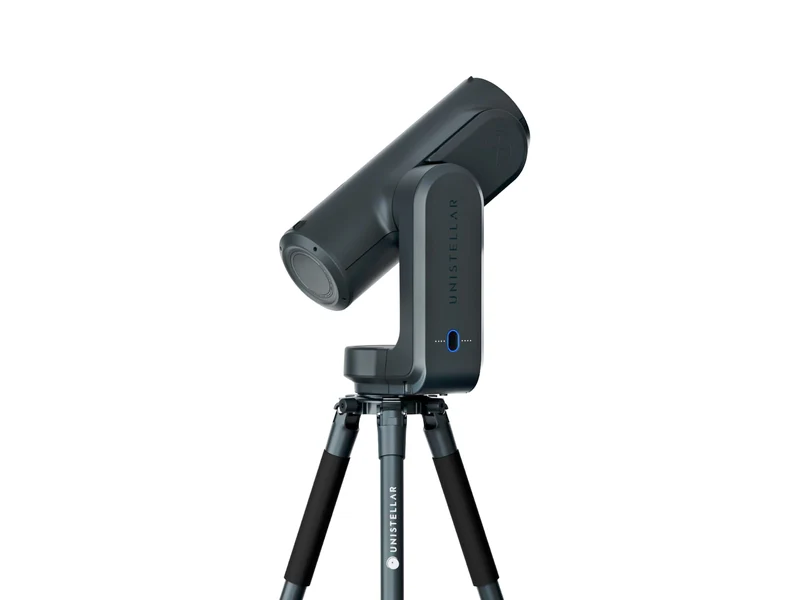
85mm f/3.9 Nikon-developed mirror optics, tripod included. The only shipping smart telescope with Draco-class aperture.
Affiliate links: you pay the same price, we earn a small commission that helps keep WatchTheStars free.
| Spec | ZWO Seestar S50 Pro | DwarfLab Draco | Vaonis Vespera II |
|---|---|---|---|
| Aperture | 50mm quadruplet APO, f/5.2 | 90mm folded, f/3.8 | 50mm refractor, f/5 |
| Focal length | 260mm | 340mm | 250mm |
| Main sensor | 1/1.2", 8.3MP 4K | 1/1.3", 50MP, binned to ~12MP | Sony IMX585, 8.3MP |
| Field of view | 2.8° (portrait) | Not yet stated | 2.5° × 1.4°; up to 4.3° × 2.4° with CovalENS mosaics |
| Mosaic mode | Yes, panels stitched in the app, output up to 8K | Astro Mosaic, up to 1.8× frame width and height; CoMosaic with other Dracos | CovalENS, automatic, up to 4.33° × 2.43° at about 24MP |
| Wide-angle camera | 1/2", 8.3MP 4K, 63° field | 1/1.55", 23mm equiv., 86° field | None |
| Longest exposure | 60s (EQ mode), unguided | 300s, guided (EQ mode) | 10s subs, live stacked |
| Light pollution filter | Hα + OIII dual-band, built in | Hα + OIII, 13nm, built in; ND or SII + OIII by edition | None built in; clip-on dual-band and light pollution filters extra |
| Equatorial mode | Yes, via tilt | Yes, built into the base | No, alt-az only |
| Battery | 10,000mAh, up to 9 hours (ZWO) | 10,000mAh, about 5 hours | About 4 hours |
| Storage | 128GB | Not yet stated | 25GB |
| Scheduling and remote use | Plan mode, Telescope Network sharing | USB Ethernet, PhotonLink, motorised filters and cover, scheduling | Plan My Night scheduling, Wi-Fi only |
| Weight | 2.8kg | 5.5kg | 5kg |
| In the box | Tripod, hard case, solar filter | Tripod, carrying case, cable, cloth | Telescope only; tripod, charger, cable and filters extra |
| UK price | Around £999 | £1,349; SHO £1,499 | Around £1,398, telescope only |
| Availability | In stock at FLO | Pre-order at FLO; deliveries expected November or December 2026 | In stock at FLO |
Seestar S50 Pro vs Vespera II: what does £400 more buy?
This is the odd one, because on the spec sheet the two are the same telescope. Both have 50mm of aperture, both have an 8.3MP sensor, and both stack short exposures live and hand you a finished image on your phone. The Seestar S50 Pro is around £999 at First Light Optics. The Vespera II is around £1,398, and that's before a tripod and a dual-band filter, both of which the Seestar includes and Vaonis sell separately. Kitted out like for like, the gap is nearer £600.
What Vaonis charge for is three things. CovalENS, their automatic mosaic mode, nudges the telescope between exposures and stitches the frames, so a finished image can cover 4.3 by 2.4 degrees at around 24 megapixels. Andromeda fits with room to spare and the whole North America Nebula goes in one frame. The Seestar has a mosaic mode too, and it works, but you set up a panel grid in the app and it shoots the panels in turn; CovalENS is one tap and stitches as it goes. The Singularity app is the most refined in the category, with target suggestions ranked for your sky and a Plan My Night scheduler that runs a list of objects unattended. And the Vespera is a sealed, sculpted object that you'd happily leave on the patio table, where the Seestar looks like a security camera on a stick.
What the Seestar gives you for less: a built-in dual-band filter, a second 8.3MP wide-angle camera, an equatorial mode that allows 60-second subs, more than twice the battery, five times the storage, and a tripod and hard case. On a like-for-like image of the Orion Nebula from a UK garden, most people would struggle to tell them apart. Sky at Night's 4.5-star review of the Vespera II noted some softness and the occasional need to refocus twice, which is what a 50mm f/5 lens does.
Verdict: Seestar S50 Pro for image per pound, and it isn't close. Vespera II if mosaics, the app and the design are what you're paying for.
Dwarf Draco vs Seestar S50 Pro: is 90mm worth £350 more?
The Seestar S50 Pro launched two weeks before the Draco and is the best smart telescope you can buy for under £1,000 today. ZWO kept the original S50's 50mm aperture, upgraded the optics to a four-element APO, fitted two 8.3MP 4K cameras (one telephoto, one 63° wide-angle), doubled the battery to 10,000mAh, added NFC and a 128GB store, and put a tripod and hard case in the box.
The Draco's case against it is aperture and exposure. Ninety millimetres against fifty is 3.2 times the light, and 300-second guided subs against the Seestar's 60-second unguided maximum is a big deal for faint targets, because long subs lift faint signal above the sensor's read noise in a way that stacking short ones never quite does. The Draco's remote features, Ethernet, a motorised dark cover and filters, and the PhotonLink relay, make it usable as a remote observatory in a way the Seestar isn't. And the Draco's 13nm dual-band filter is narrower than the one in the Seestar range.
The Seestar's case is everything you can verify. It's £350 cheaper. It's 2.8kg against 5.5kg, so it goes to a dark site without a second thought. ZWO's app is the most polished in the business bar Vaonis's, and the Seestar community on Stargazers Lounge and Facebook is enormous, which is where you go at 11pm when something won't connect. Its plan mode does overnight scheduling and its mosaic mode outputs images up to 8K. It exists, it's been reviewed, and it works. The Draco's folded optics are hard to make well at f/3.8, its 1.2-micron phone-class pixels are an unusual choice for deep sky, and its guiding, scheduling and Hubble-palette workflow are all new code.
Verdict: Seestar S50 Pro if you want to image this autumn. Draco if aperture is the reason you're upgrading and you can wait for the first proper reviews in November.
Dwarf Draco vs Vespera II: more aperture for less money?
This is the comparison the Draco was built to win. At £1,349 it undercuts the Vespera II (£1,398) by about £50 and offers 90mm of aperture against 50mm, which is 3.2 times the light-gathering area. It has five-minute guided exposures against the Vespera's short live-stacked subs, a dual-band filter, a tripod and a carrying case in the box against a telescope that ships alone, and an equatorial mode the Vespera doesn't have at all. On paper it makes the Vespera II look expensive.
The Vespera's answer is that it exists, and has since 2024. Vaonis have shipped several generations of product, the Singularity app is mature, CovalENS mosaics have two years of results behind them where the Draco's Astro Mosaic is a launch-day promise, and First Light Optics stock it with UK returns and a two-year warranty. DwarfLab's reputation has been built on value at the bottom of the market, and the Draco is their first attempt at a premium instrument. If the first reviews find clean stars to the corners and quiet 300-second subs, the Vespera II becomes hard to justify. If they find soft corners or noisy frames, Vaonis keep their premium.
Verdict: Draco on paper. Vespera II if you need a known quantity today and mosaics matter more than aperture.
Which is best for nebulae from a UK garden?
The Seestar S50 Pro and the Draco both have a built-in dual-band filter that passes hydrogen-alpha and oxygen-III light and blocks most of the orange sky glow over a British town, which is why either will show you the Orion Nebula from a Bortle 7 garden. The Vespera II ships without one; Vaonis's clip-on dual-band filter does the same job but is an extra cost, and without it the Vespera struggles under streetlights. The Seestar gets a satisfying Orion or North America Nebula in half an hour of stacking. The Draco, with 3.2 times the Seestar's light and five-minute guided subs, should make the Rosette, Heart and Veil Nebulae routine rather than a project, and the SHO Edition adds Hubble-palette versions automatically. All three can mosaic the big targets. The Vespera's CovalENS is the least effort for getting the whole North America and Pelican complex in one frame, and the only mosaic mode of the three with two years of owner results behind it. Whatever you buy, our UK dark sky sites map will do more for your nebula images than any spec on this page.
Verdict: Seestar S50 Pro today. Draco on paper. Vespera II if one-tap mosaics of the biggest nebulae matter most, once you've bought the filter.
Which is best for galaxies, star clusters and the Milky Way?
Galaxies are where aperture stops being a spec and becomes the picture. At 50mm the Seestar S50 Pro and Vespera II show Andromeda well and turn M81, M51 and the Leo Triplet into small ovals with a hint of shape. The Draco's 90mm and finer resolution should give them structure: spiral arms on M51, the dust lane in M82, the tidal bridge between M81 and M82 from a dark site. This is the one area where we'd say the Draco's advantage is close to certain, because aperture and resolution are physics rather than firmware. Andromeda needs a mosaic on all three, and all three have one; the Vespera's takes the least effort.
For the Milky Way it's a different order. The Draco's wide-angle camera is a 1/1.55-inch sensor at 23mm equivalent, close to what a phone's main camera offers, and the Seestar S50 Pro's is an 8.3MP 4K unit with autofocus and live stacking. The Vespera II has no wide camera at all. If you've read our guide to seeing the Milky Way from the UK and want to photograph the arch properly, the Draco and S50 Pro are the two that can.
Verdict: Draco for galaxies; Draco or Seestar S50 Pro for the Milky Way.
The Moon, the Sun and the planets
The Moon is the Draco's showcase. Its 340mm focal length and full-resolution 50MP readout should give a lunar disc with crater detail beyond the Seestar's 260mm or the Vespera's 250mm, both of which give a pleasant full disc with the mare and the major craters. Our is it a full Moon tonight tool tells you when the terminator is best placed. For the Sun, all three have a solar filter (built-in ND on the Standard Draco, a magnetic clip-on in the Seestar's box, a separate purchase from Vaonis) and a mode that finds and tracks it; read our guide to observing the Sun safely first, because a smart telescope's sensor is as easy to burn as an eye.
Planets are the honest weak spot of every smart telescope here. At 250mm to 340mm of focal length Jupiter and Saturn are small discs; the Draco's finer pixels and 90mm lens will show the belts and rings more clearly than the others, and DwarfLab's samples include the Great Red Spot, but a Sky-Watcher Heritage 130P with a phone adapter will beat all three on Jupiter for £200. If planets are the goal, read our planetary imaging for beginners guide before buying any smart telescope.
Verdict: Draco for the Moon; none of them for planets.
Portability, battery and apps
The Seestar S50 Pro (2.8kg) goes in its hard case and then a rucksack, and it's the one that gets taken to a dark site on a whim. The Vespera II (5kg) and Draco (5.5kg) are a one-hand carry from the car to the garden and a two-hand carry across a field, so they tend to get set up somewhere and left. DwarfLab clearly know this, which is why the Draco has Ethernet, a motorised dark cover, remote filter switching and PhotonLink: it's designed to be run from indoors. Vaonis's Plan My Night does the same job over Wi-Fi from the sofa.
Batteries: the Seestar S50 Pro's seven to nine hours will see out a UK winter night. The Draco's five will not, and the Vespera II's four is the shortest of the three, so plan on a USB-C power bank or mains for anything long with either. None of the three has a built-in dew heater (the Seestar S30 Pro is the only smart telescope that does), so a heater band is a sensible £20 add-on for all of them. Apps: Vaonis's Singularity is the most polished, ZWO's is close behind with the biggest community and the fastest feature updates, and DwarfLab's has improved fast and is now good rather than frustrating. The Draco's guiding, scheduling and SHO features are the parts to watch in early reviews.
Verdict: Seestar S50 Pro for anyone who travels with their telescope; Draco or Vespera II for a garden or remote setup.
Price and value in the UK
Like for like, ready to image nebulae from a town garden: Seestar S50 Pro around £999 with its own tripod, case and filter; Draco £1,349 with its own tripod and filter (the SHO Edition is £1,499); Vespera II around £1,398 plus a tripod and Vaonis's dual-band filter, which takes it towards £1,600. So the real ladder is £999, £1,349, £1,600, and the middle rung is the one with the most aperture. That's the Draco's whole pitch.
First Light Optics are taking pre-orders for the Draco now, at £1,349, with deliveries expected in November or December 2026. Buying from a UK dealer gives you UK returns and warranty handling, which matters on a first-generation product. If you can spend more, the Unistellar Odyssey (£2,099) is the only shipping smart telescope with Draco-class aperture, an 85mm f/3.9 with Nikon optics and a tripod in the box. Vaonis's Vespera III (£2,199) and Vespera Pro II (£2,599) add quadruplet optics and an 11-hour battery but stay at 50mm. If £999 is too much, our Seestar S50 vs Dwarf 3 comparison covers the budget end of the market.
Which should you buy?
Buy the Seestar S50 Pro if you want the most capable smart telescope you can hold today, with a filter, a case, a tripod, a great app and a huge community behind it, for around £999. It's the default choice this autumn.
Buy the Vespera II if CovalENS mosaics, the Singularity app and the design are what you want and you're happy to pay around £1,398 plus a tripod and filter for them. Buy it because you want it, not because it out-images the Seestar.
Pre-order the Draco if you already own a Seestar or Dwarf 3 and have run out of aperture, you want galaxies with structure and five-minute subs, you're happy with 5.5kg in a fixed spot, and you accept that you'll be among the first to find out whether it lives up to the spec sheet. Standard Edition unless Hubble-palette nebulae are the whole point.
Wait if you're torn between the S50 Pro and the Draco. First Light Optics expect deliveries in November or December 2026, so review units should land around then; we'll update this page and our Draco guide the week they do.