Key takeaways
- MUFON was hired by BAASS, the DIA's AAWSAP contractor, under a February 2009 purchase order for UFO reports 'within hours'
- MUFON's first month of dispatch for BAASS logged 319 reports, nine category-two cases and four investigator call-outs
- MUFON spent $58,630.32 of the $181,666.67 BAASS allocated for February to May 2009, so BAASS halved the stipend
- In late 2009 BAASS cut MUFON's monthly stipend by another $10,000 over its 'tendency to warehouse significant sums of money'
Jump to section 6 sections
- Why the Pentagon's UFO Contractor Hired MUFON
- How the MUFON Hotline Worked: Skype, Shiftboard and Visa Cards
- MUFON's First Month for BAASS: 319 Reports, Four Call-Outs
- MUFON's Kansas Case: Chinese Lanterns or 'UAV Unknown'?
- How Much Did BAASS Pay MUFON? The 2009 Ledger
- What the MUFON Deal Tells Us About AAWSAP
In February 2009 the company running the Pentagon's secret UFO study signed up America's biggest volunteer UFO group. BAASS (Bigelow Aerospace Advanced Space Studies), which held the Defense Intelligence Agency's AAWSAP contract (HHM402-08-C-0072), bought the Mutual UFO Network's sighting reports and field work. Four BAASS monthly reports released by the US Department of War on 23 October 2026, DOW-UAP-D169, D170, D171 and D173, show how the deal worked, what it produced and how the money ran.
There are no crashed saucers in it. There are home dispatchers on Skype, investigators with reloadable Visa cards, a sheriff who blamed Chinese lanterns, and a contractor complaining that its supplier couldn't spend the money fast enough. Our AAWSAP programme page covers the contract as a whole; this post sticks to MUFON.
Why the Pentagon's UFO Contractor Hired MUFON
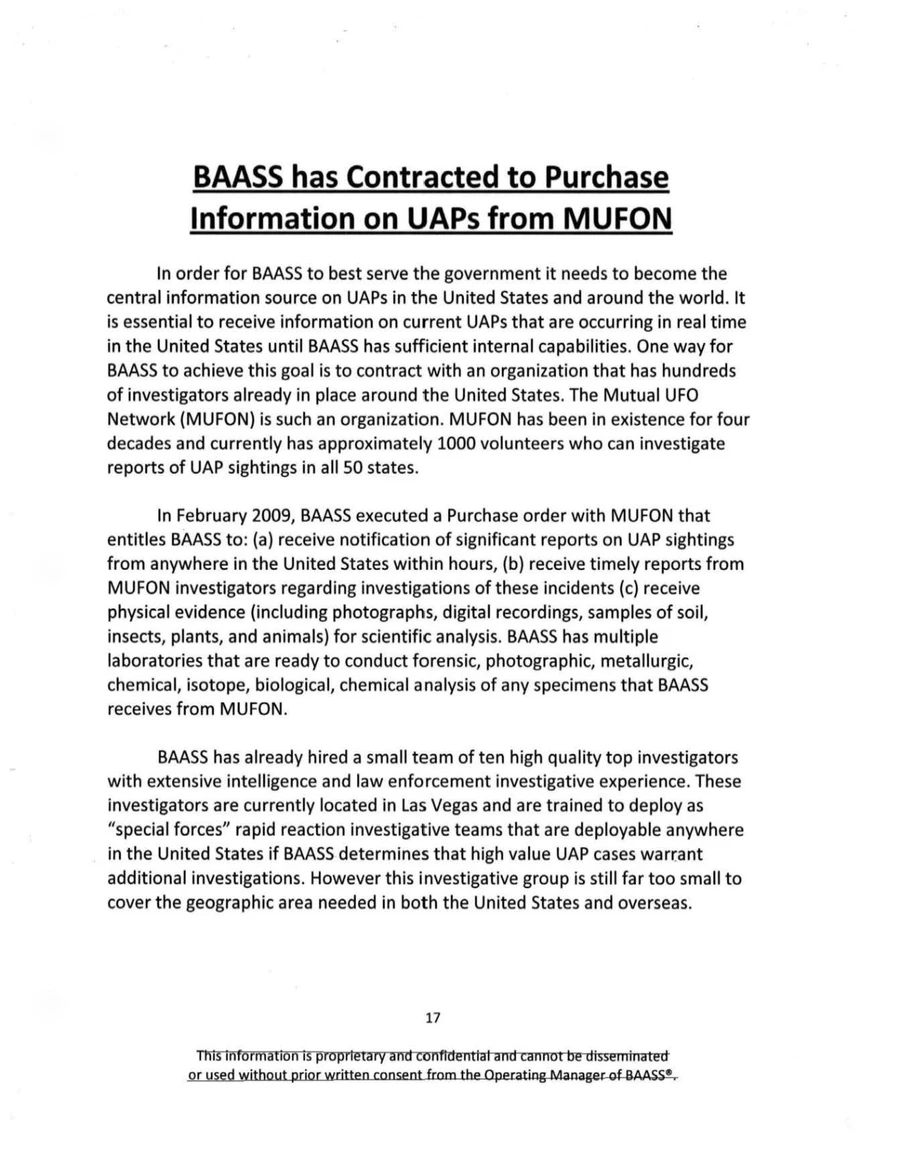
BAASS hired MUFON because it wanted live UFO reports from across the United States and had only a handful of its own investigators. Its March 2009 report says that "to best serve the government" it needed "to become the central information source on UAPs in the United States and around the world" (D169 p.19), and MUFON had about 1,000 volunteer investigators in all 50 states.
The purchase order, executed in February 2009, entitled BAASS to notice of significant sightings "within hours", to MUFON's investigation reports, and to physical evidence "including photographs, digital recordings, samples of soil, insects, plants, and animals" (D169 p.19). BAASS said it had laboratories ready to analyse whatever came in. Its own ten investigators, based in Las Vegas, were described as "special forces" rapid-reaction teams, but still "far too small" to cover the country.
The deal fed the sighting database and field work that BAASS had promised in its December 2008 plan, which our post on AAWSAP's own plan and its nine projects walks through. MUFON had been named in that plan too, as the author of concept papers under a separate contract.
How the MUFON Hotline Worked: Skype, Shiftboard and Visa Cards
The MUFON hotline was a virtual call centre run from volunteers' homes. MUFON's own report for February and March 2009, reproduced in BAASS's April report, says it bought services on Shiftboard.com and Skype so its "Dispatch" would "appear to be a centralized operation" (D170 p.12).
Dispatch operators booked four-hour shifts on Shiftboard. When a report landed in MUFON's online case system, the operator on duty phoned the witness through a shared Skype number, checked the details and gave the case a category. A recent category-two or category-three case went to the coordinator of the STAR team, MUFON's group of field investigators sent out on fresh, high-priority reports under the BAASS deal, and BAASS was told on its duty phone when a team went out (D170 pp.14 to 15).
Field investigators carried their own basic kit, with a rapid-deployment box of heavier equipment shipped to the scene. MUFON issued each of them a reloadable Visa card so headquarters could load their expenses for a trip, and kept the project money in a separate bank account (D170 p.16). The project wasn't secret, either: MUFON did one interview about it on the late-night radio show Coast to Coast AM on 15 March 2009 (D170 p.12).
MUFON's First Month for BAASS: 319 Reports, Four Call-Outs
MUFON's first month for BAASS produced 319 reports and four field deployments. Dispatch opened on 1 April 2009, staffed 16 hours a day, seven days a week. MUFON's April report, dated 6 May, gives the funnel (D170 p.17):
- 319 US reports came into MUFON's case system in April 2009.
- 310 were category one, the lowest grade, and none were category three.
- 9 were category two, and three of those were historical.
- 4 of the remaining six got a STAR team deployment, three of them in April.
Reports were also down by "almost 150-200" on the first three months of the year, and MUFON couldn't explain the drop. BAASS added its own note on top: it had "concerns about the current level of productivity from MUFON" (D170 p.12). Its answer was to let MUFON spend project money on advertising to pull in more cases, and MUFON offered the National UFO Reporting Center a partnership to route its reports through MUFON's system (D170 p.19).
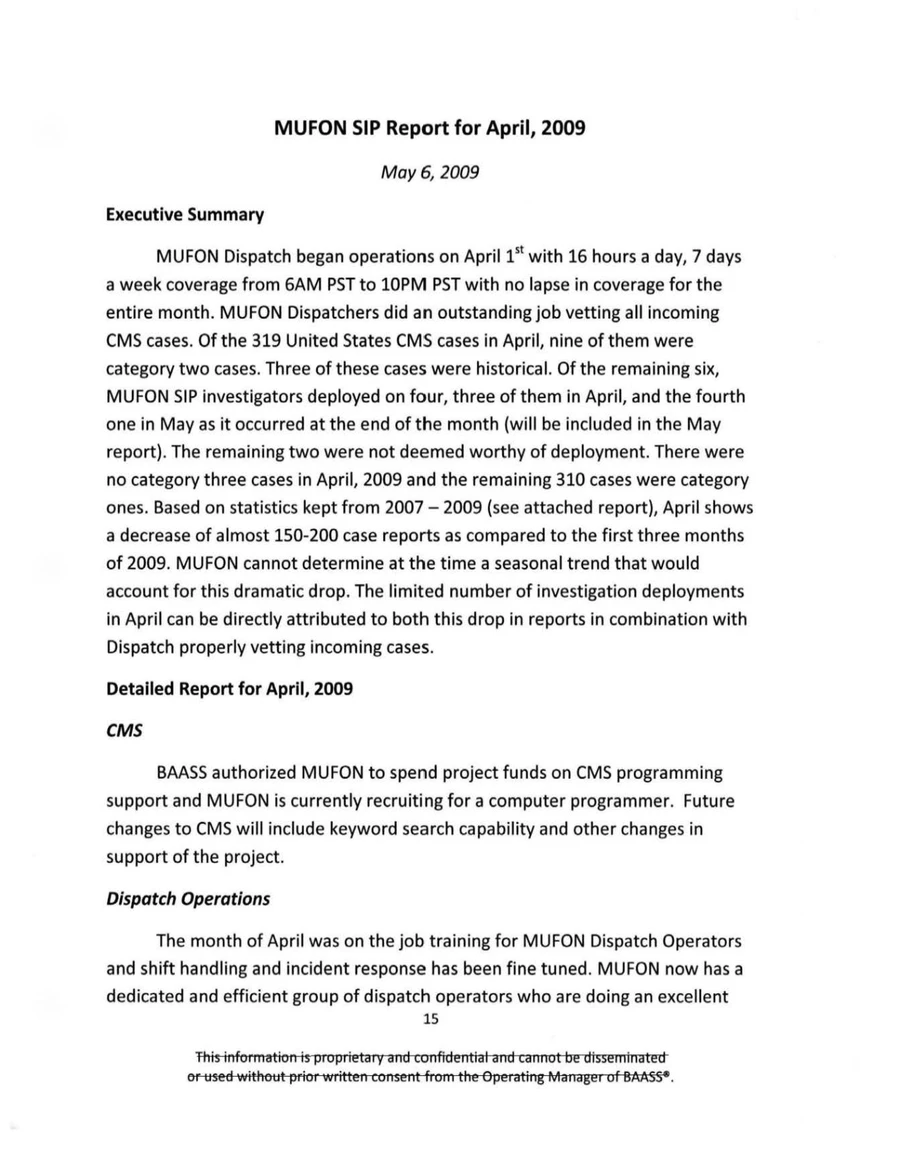
By the April report's conclusion BAASS was still upbeat in places, but blunt about the numbers: "the case numbers are still considerably lower than expected" (D170 p.50).
MUFON's Kansas Case: Chinese Lanterns or 'UAV Unknown'?
The first STAR team deployment went to Scammon, Kansas, where witnesses reported an orange-lit object "as large as a small house" over the trees at about 1:23 am on 4 April 2009. The county sheriff told the MUFON investigator it was fireworks, then said "a guy who set off 3 Chinese lanterns" (D170 p.23). He never passed on the names. The investigator didn't accept it, and closed the preliminary write-up with "Conclusion: UAV unknown" (D170 p.24).
That is MUFON's conclusion, not BAASS's or the government's, and the file holds nothing that settles it. Sky lanterns do drift, hang and then move off quickly when they hit a breeze, and judging the size of a light at night with no reference is hard. Our page on black triangle sightings shows how often distance and size go wrong in night reports.
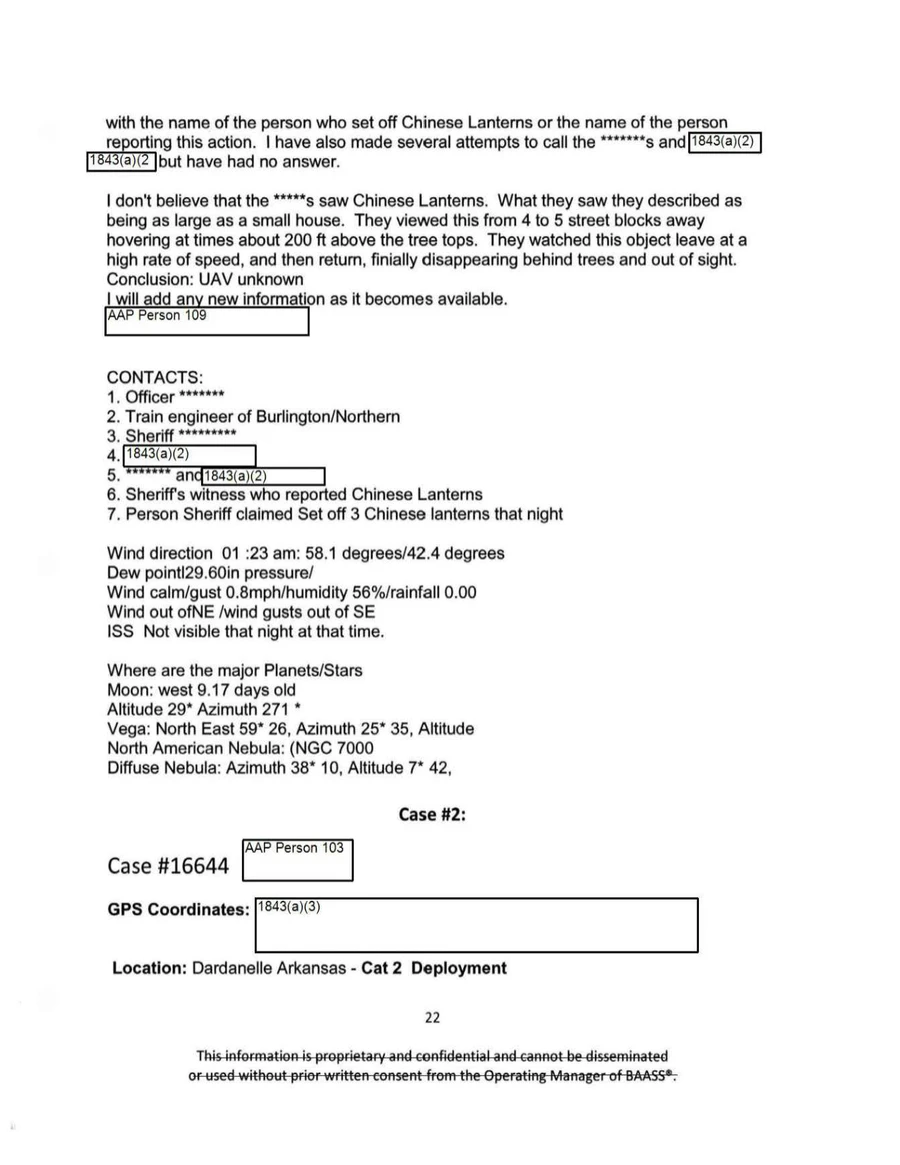
The investigator did check the sky, which is more than many reports manage. The write-up notes "ISS Not visible that night at that time" and put the Moon in the west at altitude 29°, azimuth 271°, "9.17 days old". We reran it with Skyfield. One catch first: the case header gives the time as "1:23 am CST" (D170 p.19), but Kansas was on daylight time (CDT) in April 2009. MUFON's own dispatch hours are written as "6AM PST to 10PM PST" in April too, and a Maryland case is labelled "EST". Read literally, those zone labels put every time an hour out.
Our calculation, for Scammon at 01:23 CDT on 4 April 2009:
- The Moon was 30° up at azimuth 271°, so the investigator's position was right for local clock time. At 01:23 CST (an hour later) it would have been only 18° up. It was 8.6 days past new and 69% lit, not 9.17 days, and it set at about 4:05 am.
- The Space Station couldn't have been seen. The Sun was 47° below the horizon, so the Earth's shadow reached about 2,960 km straight up, far above the ISS at around 350 km. Our guide on how to spot the ISS explains why it only shows up in the hours around dusk and dawn.
A bright Moon low in the west doesn't explain a house-sized light over the trees, and we're not claiming it does. But it is the kind of check worth doing on any odd light: see what you can see in the sky tonight, and whether there are ISS passes tonight, before you decide something is unknown.
How Much Did BAASS Pay MUFON? The 2009 Ledger
BAASS allocated MUFON $181,666.67 for February to May 2009, and MUFON spent $58,630.32 of it (our sum). The figures come from a BAASS letter to MUFON dated 25 June 2009, reproduced in the June report (D171 p.15):
| Period | Allocated | Spent by MUFON |
|---|---|---|
| February and March 2009 | $74,666.67 | $11,014.37 |
| April 2009 | $56,000.00 | $23,803.95 |
| May 2009 | $51,000.00 | $23,812.00 |
| Total | $181,666.67 | $58,630.32 |
"Therefore, it appears that BAASS is sending excessive sums to MUFON on a monthly basis."
BAASS letter to MUFON, 25 June 2009, DOW-UAP-D171 p.15
The letter reminded MUFON that the agreement allowed "Immediate termination effective June 30, 2009". Instead BAASS proposed $25,500 a month from 1 July to 31 October, half the $51,000 May figure, and told MUFON to top it up from roughly $120,000 it hadn't spent (D171 pp.15 to 16). MUFON's reply of 29 June called the new rapid-response process "a HUGE step forward for Ufology" and said "MUFON accepts the reduction in payments for the next four months" (D171 pp.13 to 14).
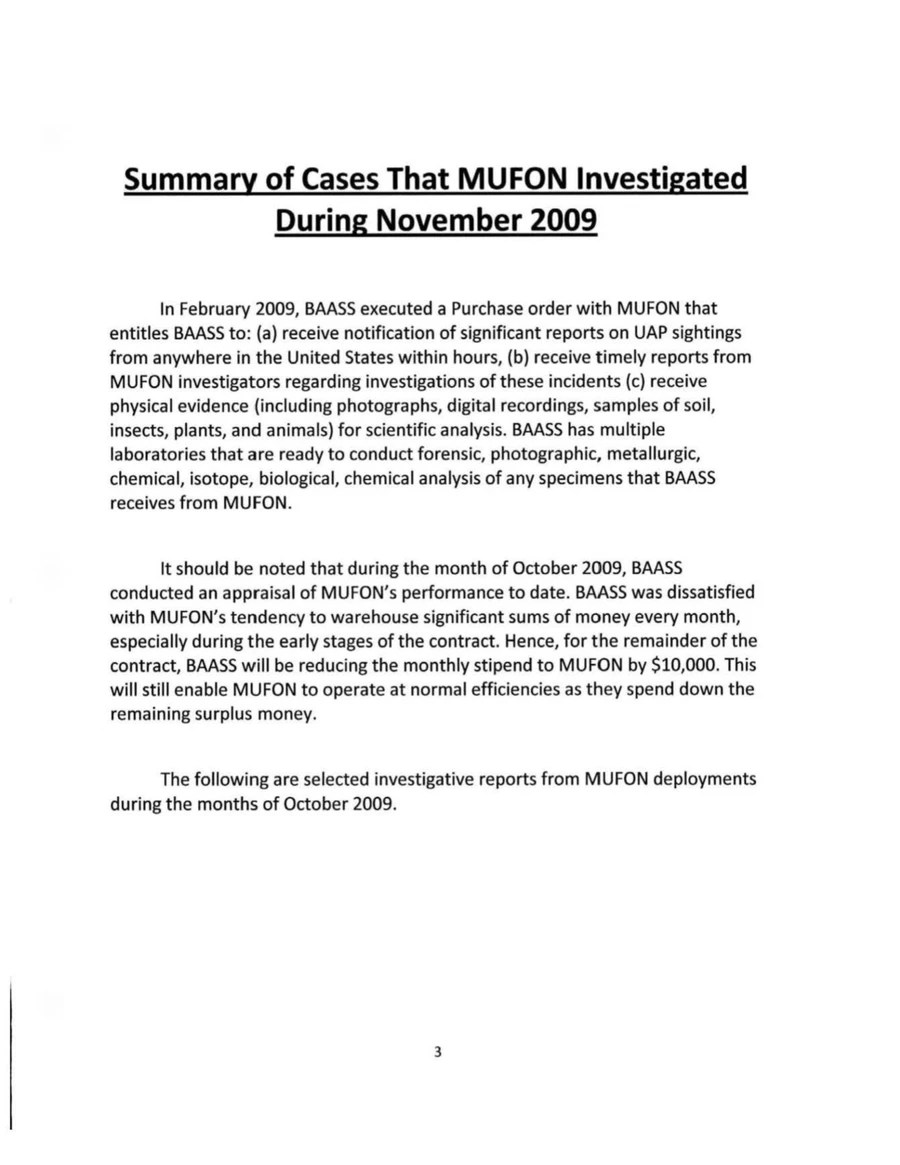
The review in October went the same way. BAASS's November 2009 report says it "was dissatisfied with MUFON's tendency to warehouse significant sums of money every month" and would cut the monthly stipend by another $10,000 "for the remainder of the contract" (D173 p.4). The report doesn't give the new monthly figure.
None of this is new to everyone. A former STAR team manager has written about the project for years, and a BAASS "Ten Month Report" from July 2009 leaked long ago. What Release 7 adds is the money in BAASS's own words, in an official release.
What the MUFON Deal Tells Us About AAWSAP
The MUFON deal shows AAWSAP's contractor running a nationwide UFO reporting operation alongside the physics papers it commissioned. It also shows how thin the results were: hundreds of reports a month, a handful worth a visit, and conclusions like "UAV unknown" that rest on one investigator's judgement.
Keep the attribution straight. The monthly reports are BAASS describing its own work to "the sponsor"; they never name the DIA or AAWSAP. MUFON's case conclusions are MUFON's. And the reports don't say how much of the MUFON money was billed to the government. By November 2009 the parts of BAASS's plan that needed the government's help, such as Project Northern Tier and the oral histories, were "on hold" for lack of a "Need to Know" (D173 p.155), while much of the field effort had moved to the Utah ranch covered in our page on the Pentagon's Skinwalker Ranch files.
If you see something odd yourself, do what the better MUFON investigators did and rule out the sky first. Check the UK night sky this week for bright planets, see is it a full moon tonight, and remember that a bright star near the horizon can seem to follow your plane. If you're new to it, stargazing for beginners will have you finding your way round the sky in an evening.
Check the sky before you call it in
Kit we've reviewed in full
Most of the reports MUFON's dispatchers screened out were ordinary things seen badly. A decent pair of binoculars settles a lot of them in seconds: a lantern flickers, an aircraft shows its navigation lights, a planet stays put.
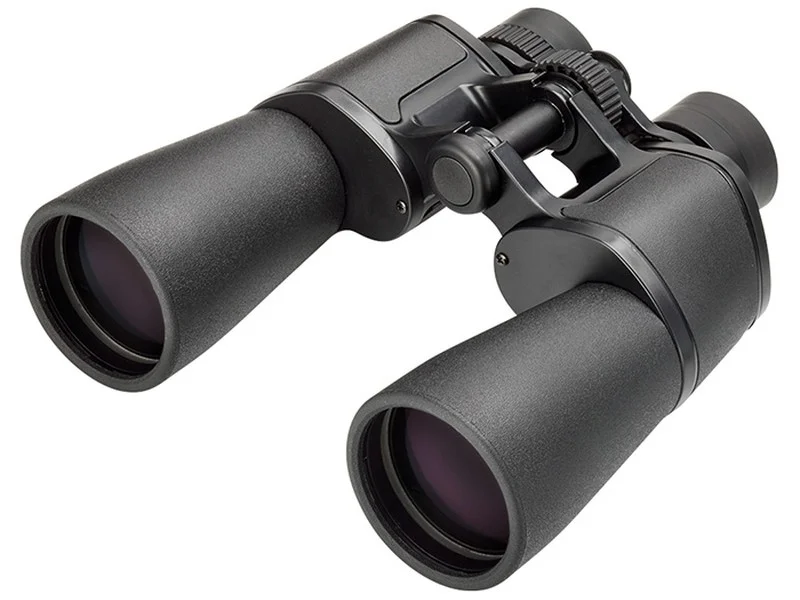
Bright and wide, so you can get onto a moving light before it drifts away.
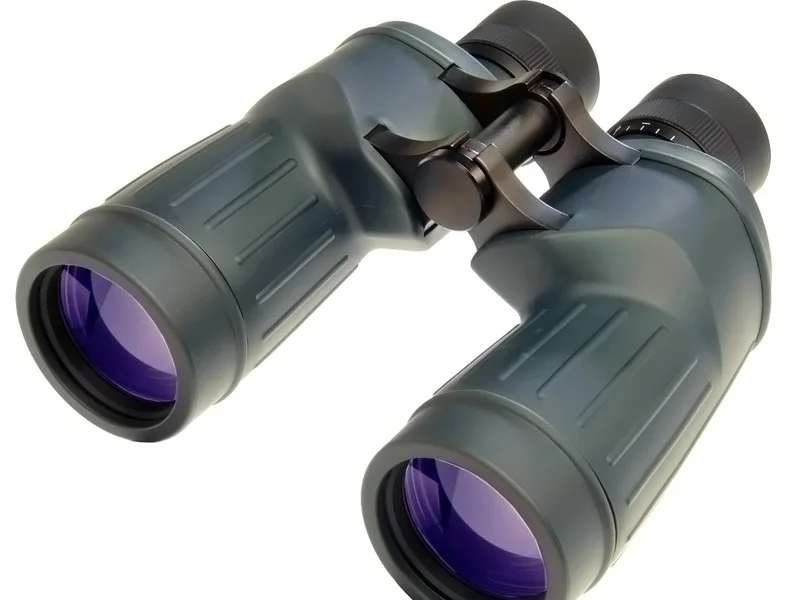
Built for cold, damp nights, which is when most odd lights get reported.
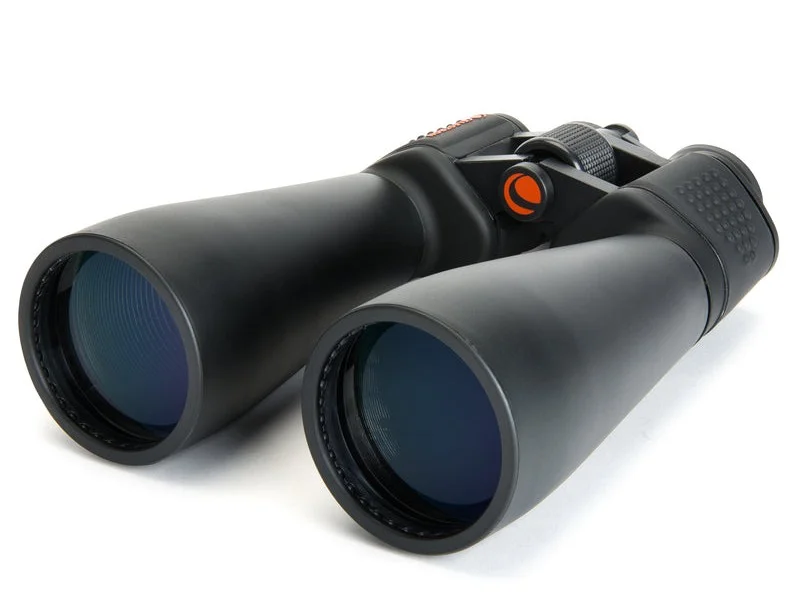
More power for picking out the lights on a far-off aircraft. Best on a tripod.
Affiliate links: you pay the same price, we earn a small commission that helps keep WatchTheStars free.
You can read all four reports in our Pentagon UFO file browser. Our round-up of the Pentagon's seventh UFO file release covers the rest of the batch, our line-by-line look at the AAWSAP contract shows what the $22 million bought on paper, and the UAP document archive shows how all seven releases fit together.
Sources:
- DOW-UAP-D169, BAASS Monthly Report, March 2009: US Department of War, PURSUE Release 7
- DOW-UAP-D170, BAASS Monthly Report, April 2009: US Department of War, PURSUE Release 7
- DOW-UAP-D171, BAASS Monthly Report, June 2009: US Department of War, PURSUE Release 7
- DOW-UAP-D173, BAASS Monthly Report, November 2009: US Department of War, PURSUE Release 7
- Moon and Sun positions for Scammon, Kansas, 4 April 2009: our calculation with Skyfield and the JPL DE421 ephemeris
Header image: an illustration generated with Google Gemini, not a photograph of any MUFON or BAASS office. Page images: DOW-UAP-D169, D170 and D173, released by the US Department of War, PURSUE Release 7. BAASS was a contractor, and its documents are its own account, not government findings. MUFON's case conclusions are MUFON's. Page numbers are PDF pages.
Frequently Asked Questions
Equipment guides
Related topics

Ian ClaytonAmateur astronomer and founder of WatchTheStars.co.uk, dedicated to helping others explore the wonders of our universe. Full profile →