Key takeaways
- Airmiss Report No 2/95 covers a Boeing 737 crew who saw a lit object pass down their right-hand side at 4,000 ft near Manchester on 6 January 1995
- The captain described small white lights 'rather like a Christmas tree'; the first officer described a dark wedge shape and instinctively ducked
- Manchester radar showed no other traffic, and the RT tape recorded the controller saying 'there's nothing seen on radar'
- Investigators ruled out microlights, hang gliders, military aircraft and remotely piloted craft, then closed the case as unresolved with risk and cause both 'unassessable'
- The report survives inside MOD policy file DEFE 24/1958/1, alongside the department's own admission that it does not try to identify what people saw
Jump to section 7 sections
- Manchester UFO Near Miss 1995: What Happened on 6 January
- What the 737 Pilots Saw: Wedge Shape, White Lights, No Sound
- The Air Traffic Control Tape: 'There's Nothing Seen on Radar'
- Was It a Microlight, a Military Jet or a Model Aircraft?
- Why Airmiss Report 2/95 Was Closed as 'Unresolved'
- What Else Is in DEFE 24/1958: DI55, Rudloe Manor and the MOD's Line
- How to Read the MOD UFO Files Yourself
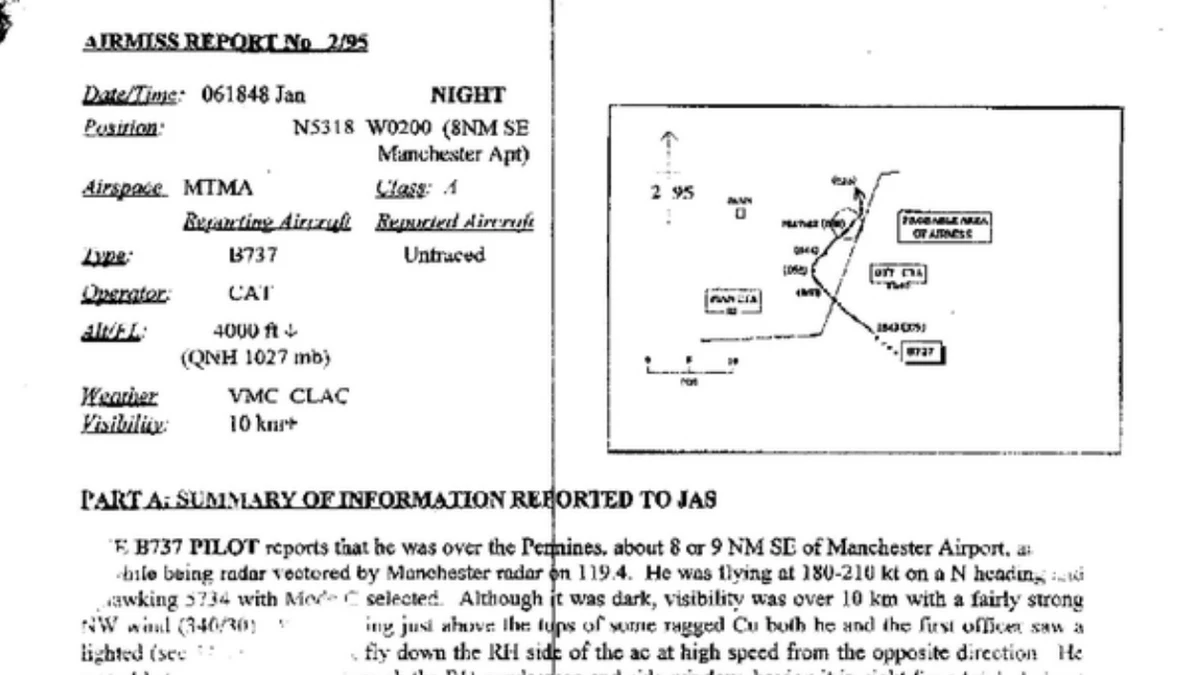
The Manchester Airport UFO near miss of January 1995 is still officially unresolved, and the paperwork that says so is sitting in a Ministry of Defence policy file at the UK National Archives, reference DEFE 24/1958/1. Inside it is a four-page fax from the Civil Aviation Authority's Joint Airmiss Section containing Airmiss Report No 2/95: the official investigation into what a Boeing 737 crew saw as they descended towards Manchester one January evening. The report ends with two words that almost never appear in civil aviation paperwork. Cause: unassessable. Risk: unassessable.
This is the fifth post in our Document of the Week series. Each week we take one file from our declassified UAP document archive and set out, in plain English, what it actually says. This week's is a British file, and unusually for this subject, it is not a story about what somebody claimed. It is a story about what a professional flight crew reported, what a formal investigation could and could not establish, and what happened next.
Manchester UFO Near Miss 1995: What Happened on 6 January
At 1848 on 6 January 1995, a Boeing 737 was descending through 4,000 ft towards Manchester Airport. The report puts it at N5318 W0200, roughly 8 to 9 nautical miles south-east of the airport, over the Pennines. It was being radar vectored by Manchester on 119.4, flying at 180 to 210 knots on a northerly heading, squawking 3734 with Mode C selected.
It was dark. Visibility was over 10 km, the wind was a fairly stiff north-westerly at about 30 knots, and there were ragged cumulus tops below. Weather is logged as VMC, airspace as the Manchester TMA, Class A.
Then something came the other way. Both the captain and the first officer saw a lit object fly down the right-hand side of the aircraft at high speed, travelling in the opposite direction. The captain tracked it through the right windscreen and the side window for a total of about two seconds. There was no apparent sound and no wake.
Under "Reported Aircraft", the report's summary box has one word: Untraced.
| Airmiss Report No 2/95 | |
|---|---|
| Date and time | 6 January 1995, 1848, night |
| Position | N5318 W0200, 8 NM SE of Manchester Airport |
| Airspace | Manchester TMA, Class A |
| Reporting aircraft | Boeing 737, operator listed as "CAT" |
| Reported aircraft | Untraced |
| Altitude | 4,000 ft, descending (QNH 1027 mb) |
| Weather | VMC, visibility 10 km+, NW wind 340/30 |
| Degree of risk | Unassessable |
| Cause | Unassessable |
The press picked the story up within weeks, and some of what got printed drifted from the file. You will still read that the encounter happened at 13,000 ft. The report says 4,000 ft, descending. The flight is usually identified as BA5061, inbound from Milan, and the crew as Captain Roger Wills and First Officer Mark Stuart, but none of that comes from the report: it names neither the airline, the flight number nor the pilots, and lists the operator only as "CAT", the investigators' shorthand for commercial air transport.
What the 737 Pilots Saw: Wedge Shape, White Lights, No Sound
The most useful part of the file is that the two men were interviewed separately by telephone afterwards, and their accounts do not match perfectly. That is what real testimony looks like.
The captain remained convinced the object was itself lit. He could not make out a definite pattern, but described a number of small white lights, "rather like a Christmas tree". He confirmed the high speed. He could not estimate distance, but said it felt very close.
The first officer had been looking at the glare shield in front of him and caught the movement in his peripheral vision. He looked up in time to see a dark object pass down the right-hand side at high speed. He described it as wedge-shaped, with what could have been a black stripe down the side, and put its size somewhere between a light aircraft and a Jetstream, while stressing that this was speculation. He thought the object had been lit by their own landing lights, which were on at that point.
He also, involuntarily, ducked. The report notes that he could not estimate the distance "other than to say that he involuntarily ducked, so it must have appeared to him to be very close".
Afterwards the two men drew what they had seen, independently. They agreed on the shape. They disagreed about the lighting.
Both were certain it was a solid object, and specifically not a bird, a balloon, a kite, a natural phenomenon, or any aircraft they were familiar with. The first officer added one more exclusion: not a Stealth aircraft, which he had seen and felt he would have recognised.
The Air Traffic Control Tape: "There's Nothing Seen on Radar"
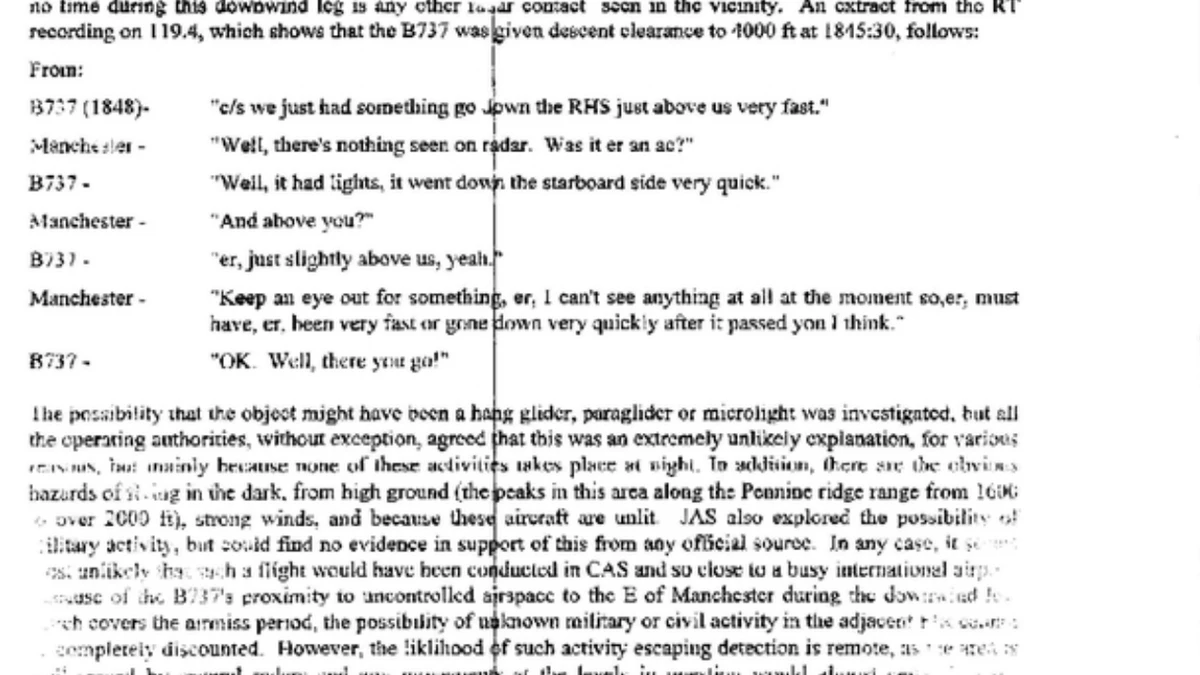
The crew reported it immediately. The investigation transcribed the exchange from the recording of frequency 119.4, and the file reproduces it verbatim:
B737 (1848): "c/s we just had something go down the RHS just above us very fast." Manchester: "Well, there's nothing seen on radar. Was it er an ac?" B737: "Well, it had lights, it went down the starboard side very quick." Manchester: "And above you?" B737: "er, just slightly above us, yeah." Manchester: "Keep an eye out for something, er, I can't see anything at all at the moment so, er, must have, er, been very fast or gone down very quickly after it passed you I think." B737: "OK. Well, there you go!"
The report notes that the same recording shows the 737 being given descent clearance to 4,000 ft at 1845:30, three minutes before the sighting.
Manchester ATC confirmed there was no other traffic in the vicinity and no radar contacts were seen. A replay of the Clee Hill radar showed the 737 itself being vectored through the Manchester TMA and zone, plus a scattering of secondary contacts, but nothing to match what the crew described.
The investigators were careful about what that absence proves. A lack of radar contact, they wrote, is not necessarily unusual if weather suppressors are in use, particularly if the object generates a poor radar response. In those conditions the radar can interpret a non-transponding contact as weather and disregard it. That is a caveat, not a conclusion. There is no radar evidence of the object either way.
Most lights in the sky do have an answer
Kit we've tested and reviewed in full
The Manchester object is one of the rare ones that doesn't. Nearly everything else you'll see overhead is a satellite, a planet or an aircraft, and a pair of binoculars is the quickest way to tell which. Start with our guide to binocular astronomy if you're new to it.
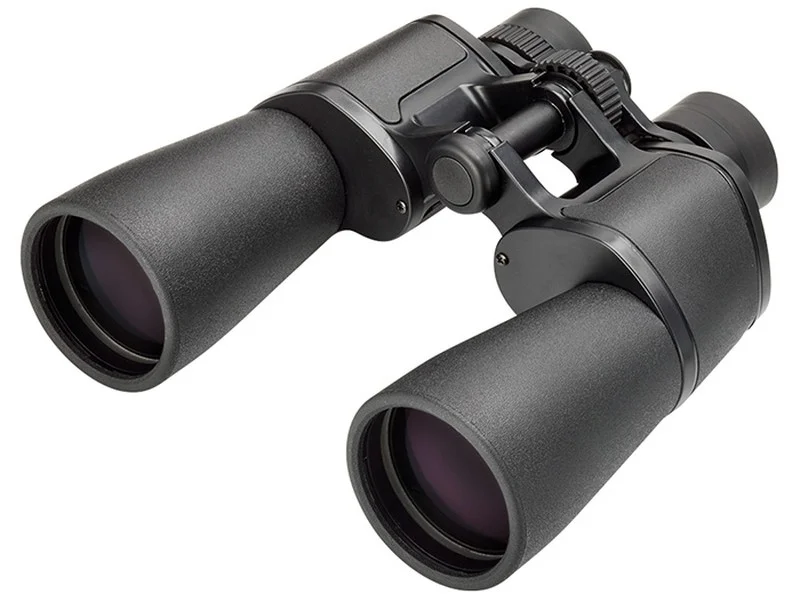
Wide field of view and bright 50mm lenses, so you can find a moving light quickly and follow it. Our usual first pick for UK beginners.
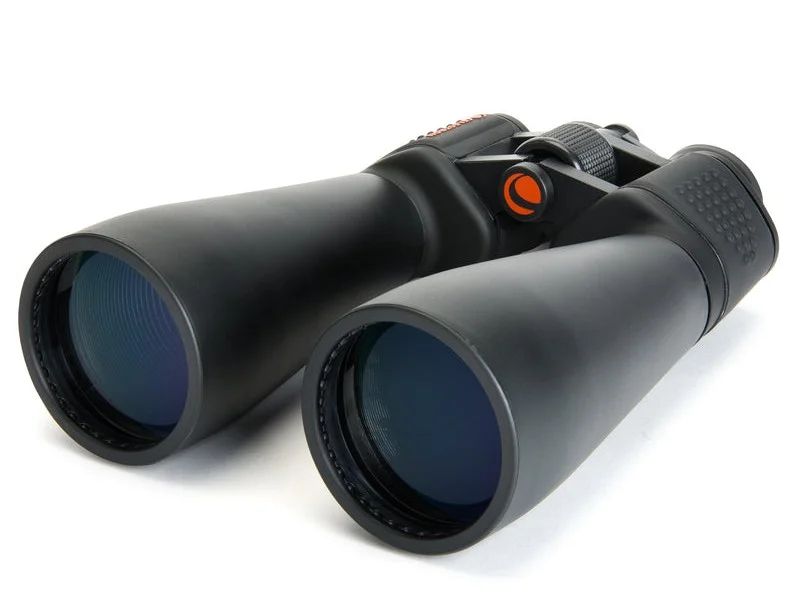
Extra magnification turns a distant point of light into something you can actually identify. Worth a tripod for longer sessions.
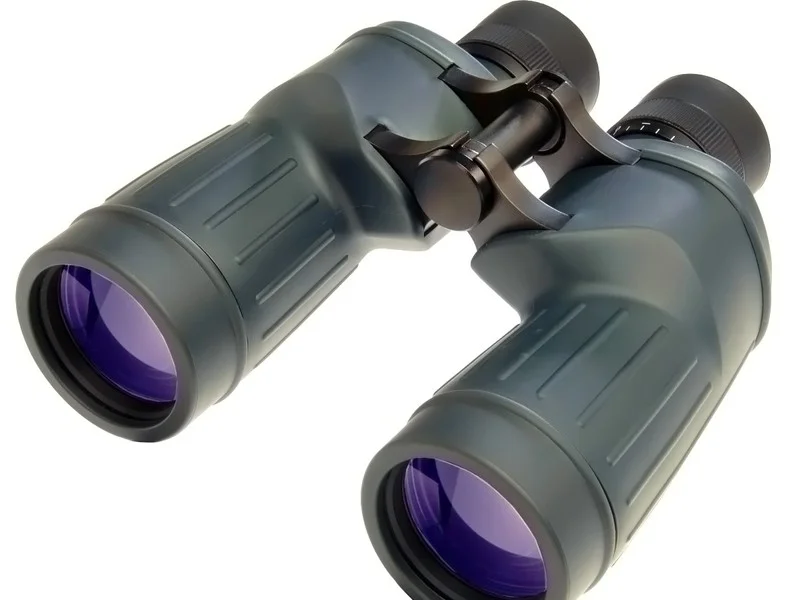
Better contrast and cleaner star points than budget pairs, which matters when you're trying to tell a satellite from an aircraft.
Affiliate links: you pay the same price, we earn a small commission that helps keep WatchTheStars free.
Was It a Microlight, a Military Jet or a Model Aircraft?
All three were considered and all three were rejected. The Joint Airmiss Working Group worked through the ordinary answers first, and the file records each one being closed off.
Hang gliders, paragliders and microlights. Every operating authority they contacted agreed this was extremely unlikely, chiefly because none of those activities take place at night. Add the hazards of flying in the dark from high ground, the Pennine ridge, strong winds, and the fact that such aircraft are unlit. The Group also looked for evidence of an unauthorised night flight and found none from any official source. As they pointed out, it would also have had to happen inside controlled airspace, right next to a busy international airport.
Military activity. Enquiries turned up no aircraft in the area at the time. The Group considered it inconceivable that military activity would take place that close to a busy airport without some sort of prior notification, and noted that anything at those levels would almost certainly have generated a radar response.
Large models and remotely piloted craft. Somebody raised the possibility of a big model aircraft, or a commercially operated remote-controlled craft of the type used for survey or photographic work. Given darkness, high ground, strong north-westerly wind and the proximity of a major international airport, the Group did not regard this as realistic either.
A rogue pilot. One member made the point that the extreme actions of an individual can never be entirely ruled out, so there remained the possibility that someone in a microlight, which most accurately fits the shape described, had defied the conditions and got away with it. Further talks with a microlight expert highlighted how improbable that was. In the words of the report, the wind, terrain and darkness would have made such a flight "almost suicidal".
Why Airmiss Report 2/95 Was Closed as "Unresolved"
The Group debated the options at length and then gave up. There was no firm evidence to identify or explain the object. Without it, they could not assess the cause or the risk using any of the normal criteria for an airmiss. Part C of the report, headed "Assessment of Risk and Cause", records two entries:
- Degree of Risk: Unassessable
- Cause: Unassessable
The closing line of Part B is plainer still: "The incident therefore remains unresolved."
Two other things in that section say a lot about how the case was handled. The Group were, in their words, anxious to emphasise that the report came from two responsible pilots. They commended the crew for their courage in filing it, and the airline for the attitude that made it possible. Reports like these, the file notes, "are often the object of derision". The Group hoped this one would encourage other pilots to come forward without fear of ridicule.
They also drew a firm line around the interesting part. To speculate about extra-terrestrial activity, the report says, fascinating though it may be, is not within the Group's remit and must be left to specialists in that field. They added, reasonably, that almost all unusual sightings can be explained by well-known natural phenomena. And that a few defy explanation.
A newspaper clipping filed a few pages away notes that this was one of four UFO reports investigated by the CAA's Joint Airmiss Working Group since 1987 that remained unexplained, and that three of the objects had been described as triangular or lozenge-shaped. That is a much older pattern than the one running through today's Pentagon UAP reporting, and it turned up in British airspace first.
What Else Is in DEFE 24/1958: DI55, Rudloe Manor and the MOD's Line
DEFE 24/1958/1 is not a case file. It is a working policy file, MOD reference D/Sec(AS)12/1, kept by Secretariat (Air Staff) 2a in Room 8245 of Main Building, Whitehall, and it runs from roughly 1993 to 1995. The airmiss report is in there because someone sent it over. Most of the rest is the machinery around the subject rather than the subject itself: press cuttings, parliamentary questions, television requests, and a lot of internal minutes about what the department should say.
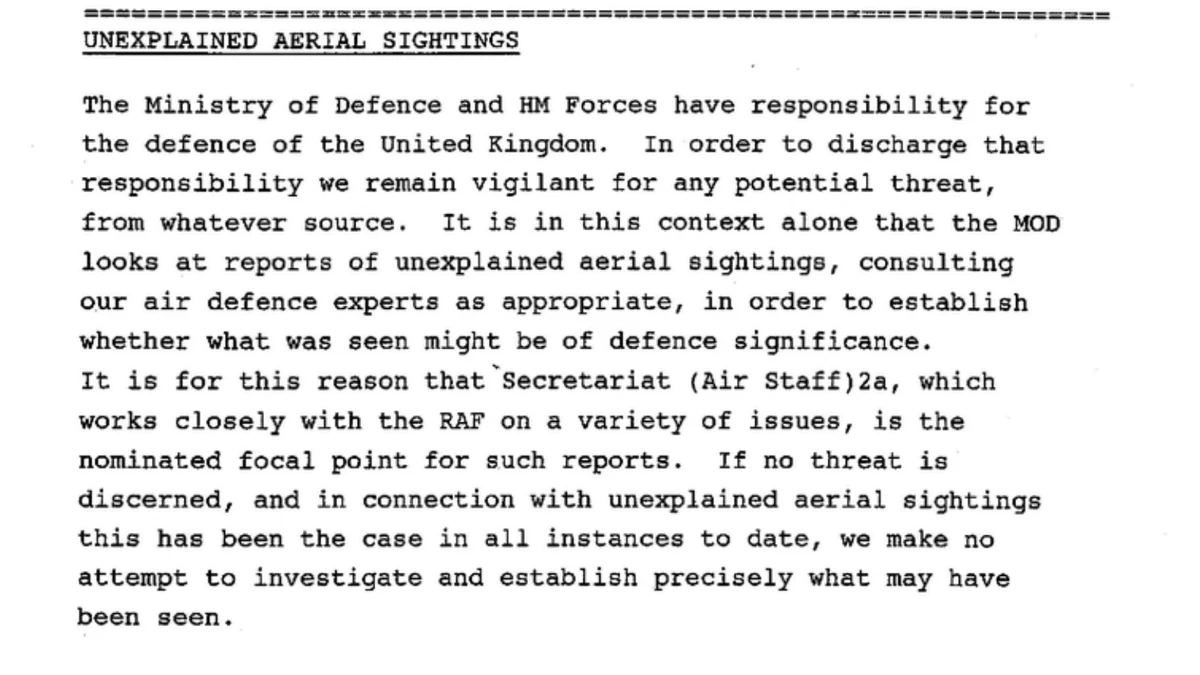
The single most quotable page is a set of agreed lines drafted in June 1995 for a writer working on an X-Files companion book. It sets out the MOD's position on unexplained aerial sightings with unusual candour:
"If no threat is discerned, and in connection with unexplained aerial sightings this has been the case in all instances to date, we make no attempt to investigate and establish precisely what may have been seen."
The same page adds that because it is outside the department's remit to spend resources identifying every inexplicable sight in the sky, "it is quite normal for a sighting to remain 'unexplained' but not require further official action". People often read the MOD's pile of unexplained cases as a mystery being suppressed. The file points at something duller. Nobody was assigned to solve them.
There is more in the same vein. An August 1995 note on public access to the UFO files records that the intelligence branch DI55, which received copies of sighting reports, was under a general remit to advise on unidentified aerial phenomena but lacked the resources to study them. The reports, it says, "were merely glanced at and placed on file". Another minute from the same month deals with the belief that RAF Rudloe Manor ran a secret UFO investigation unit. It states flatly that Rudloe Manor had only ever been a coordination point for forwarding reports, and "does not, nor has it done in the past, carried out any research into 'UFOs'".
That context is what makes the airmiss report stand out. The MOD never investigated the Manchester case. It was handled by civil aviation safety people whose job is working out why two aircraft nearly hit each other, using pilot statements, radar replays and RT tapes. They ran that process to the end and it produced nothing. The file then went to Whitehall, where it was filed by a branch that had already written down, in the same folder, that it does not try to identify things.
How to Read the MOD UFO Files Yourself
The DEFE 24 series at the UK National Archives is the main MOD UFO holding, and it is public. Search the Discovery catalogue for the series and you will find hundreds of pieces, many downloadable, covering sighting reports, policy correspondence and the department's dealings with researchers and the press. DEFE 31 and AIR 2 hold related material. Our own archive holds scans from all three, and our earlier piece on what the Pentagon's UFO files mean for Britain explains how the UK material differs from the American releases.
A few habits make these files much easier to read. Note both references, not just the archival one: DEFE 24/1958/1 is what the National Archives calls this file, D/Sec(AS)12/1 is what the MOD called it, and the second is what you will see quoted inside the paperwork. Read the routing as well as the content, because who copied whom, and how fast, tells you how seriously something was taken. And be suspicious of any document that arrives without that machinery. That is the test the alleged JFK UFO memo fails, and the one that files like the Sandia Base sightings log and the CIA's Sary Shagan report pass easily.
And if you want to do the practical version of this, learn what normal looks like overhead. Most reports that reach any authority turn out to be aircraft, satellites or Venus, which is bright enough to have triggered thousands of sightings on its own. Our guide to spotting the ISS is a good place to start, and what's in the sky tonight will tell you what should be up there before you decide something shouldn't.
Next week: another file, in plain English.
Sources:
- Airmiss Report No 2/95, Civil Aviation Authority Joint Airmiss Section · facsimile dated 3 August 1995, filed in Ministry of Defence file D/Sec(AS)12/1
- "Unexplained Aerial Sightings", MOD Secretariat (Air Staff) 2a agreed lines, loose minute D/Sec(AS)/12/1, June 1995
- File note "Public Access to 'UFO' Files", MOD Secretariat (Air Staff) 2a, August 1995
- Loose minute on RAF Rudloe Manor, MOD Secretariat (Air Staff) 2a, 25 August 1995
- All of the above: The National Archives, DEFE 24/1958/1 · scans held in the WatchTheStars document archive (UK National Archives collection)
- Unidentified Flying Objects (UFOs) research guide · The National Archives
Frequently Asked Questions
Equipment guides
Related topics

Ian ClaytonAmateur astronomer and founder of WatchTheStars.co.uk, dedicated to helping others explore the wonders of our universe. Full profile →