Key takeaways
- The Pentagon's fifth UFO file release includes a 1963 Brazilian radio report of a metal sphere crashing at Conde, Bahia, with a dead crewman inside
- The same files show the US embassy checked within six days and found the story was 'apparently fabricated in Rio': reporters who rushed to Conde found nothing
- A Bahia newspaper closed the case on 11 November 1963 with the headline 'The Airship that wasn't there'
- Several 2026 news reports are repeating the sphere story without the resolution that sits in the very same files
- The three documents are a complete misinformation life-cycle on paper, filed in Washington days before JFK's assassination
Jump to section 7 sections
- What Do the New Pentagon UFO Files Say About the 1963 Brazil Sphere?
- The Radio Tupi Broadcast: A Sphere, a Crater and a Dead Crewman
- How the Story Reached the White House
- 'Apparently Fabricated in Rio': How the Story Fell Apart
- The Airship That Wasn't There
- Is the 1963 Brazil Sphere Being Reported Wrong in 2026?
- What the Conde Case Teaches About Reading UFO Files
November 1963: a large metal sphere falls on a small town in Brazil. It gouges a crater four metres deep. Through thick glass windows, onlookers can see a dead crewman in strange clothing, marked with inscriptions nobody can read. That story is doing the rounds again right now, lifted from the Pentagon's fifth UFO file release, and some of the coverage stops exactly there. The documents don't. They follow the story for twelve more days, watch it collapse, and preserve the best headline any Brazilian newspaper ever wrote: "The Airship that wasn't there."
This is the fifth post in our Document of the Week series, where we take one file from our declassified UAP document archive and set out, in plain English, what it actually says. After last week's JFK memo fact-check, which asked whether a famous document should be believed, this week's three pages ask something more useful: what does it look like, on paper, when officials check a sensational story properly?
What Do the New Pentagon UFO Files Say About the 1963 Brazil Sphere?
Three documents in the fifth release tell the Conde story from start to finish: a CIA radio-monitoring transcript filed with the White House's space council, and two State Department cables from the US embassy in Rio de Janeiro. Together they record a spectacular claim entering official channels on 8 November 1963 and being declared dead by 20 November. Twelve days, no sphere.
That makes them unusual among the files released under the PURSUE programme so far. Most of the collection, which we've been through file by file, records sightings that were never resolved. This one is the opposite: a complete misinformation life-cycle in three declassified pages, from radio sensation to newspaper punchline.
The Radio Tupi Broadcast: A Sphere, a Crater and a Dead Crewman
It started with a late-night radio bulletin. At 11:30pm on 8 November 1963, Radio Tupi in Rio de Janeiro reported news from the municipality of Conde, in Bahia state on Brazil's north-east coast. A large metal sphere, the station said, had fallen in the centre of the town.
The details were vivid. The sphere had gouged a hole four metres deep. It had "window shaped openings covered with thick glass". And inside was a human body, "dressed in heavy clothing bearing inscriptions which cannot be deciphered". The population of Conde was intrigued, the bulletin finished, and the authorities had been informed.
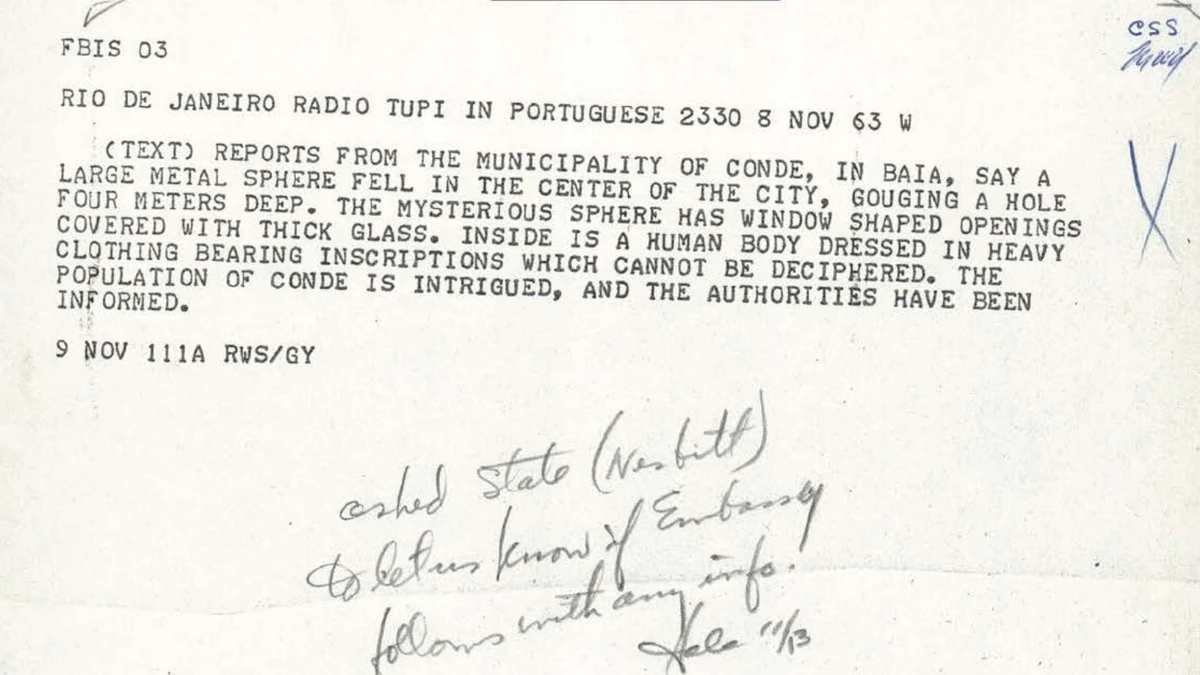
Read that transcript again and notice what's missing: no witness names, no official source, no reporter on the scene. One paragraph of secondhand detail, broadcast at half past eleven at night. Everything that happened over the next twelve days flowed from those few sentences.
How the Story Reached the White House
The CIA's Foreign Broadcast Information Service, the arm of the agency that monitored the world's radio stations, picked up the bulletin and transcribed it the next morning. In the new release, that transcript sits in a file from the Executive Office of the President: it was pulled into an inquiry by the National Aeronautics and Space Council, the White House's space policy body, dated 13 November 1963. Five days from a late-night radio claim to questions being asked at the White House.
The State Department moved the same week. On 14 November, the US embassy in Rio cabled the consulate in Salvador, the nearest post to Conde, asking it to confirm its "unqualified negative" on the report. The cable, sent under Ambassador Lincoln Gordon's name, spells out the claim being checked: a "large metal manned balloon" found around 8 November, a "dead crewman aboard wearing uniform or spacesuit with strange markings", and a four-metre-deep crater. A note at the bottom records that copies went to the Defense Department and NASA at 2:20 that afternoon.
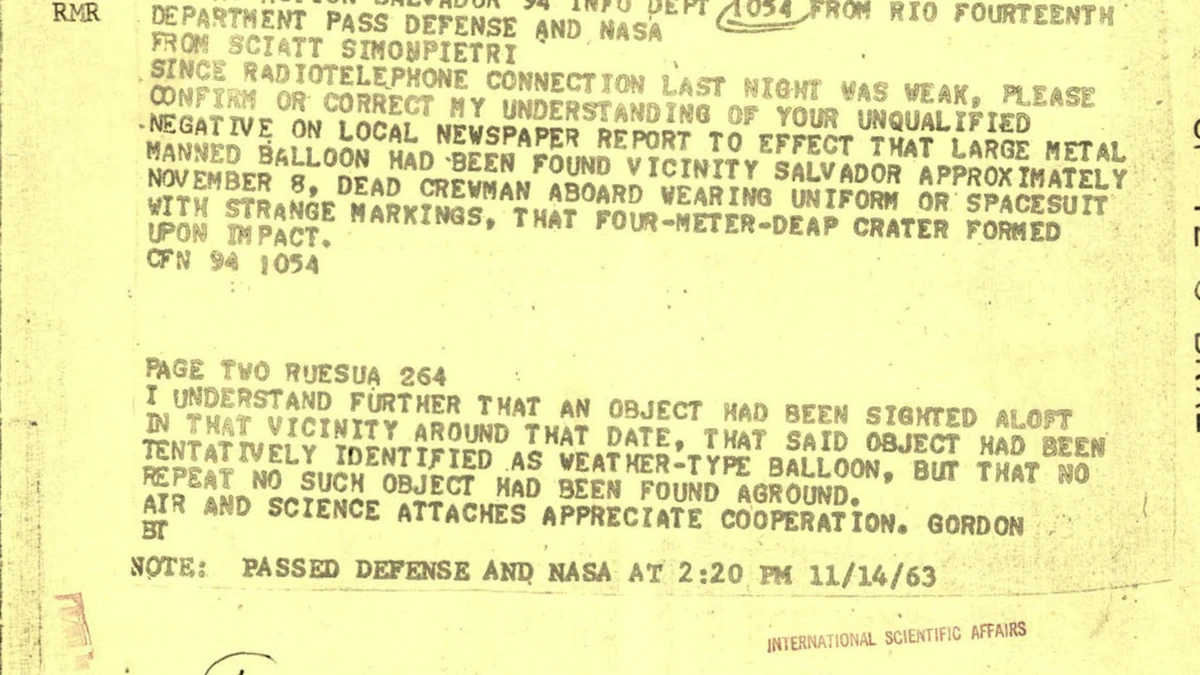
One detail in that cable matters more than it looks. The embassy notes that an object genuinely had been seen in the air near Salvador around that date, tentatively identified as a weather-type balloon. But "no repeat no such object had been found aground". Something in the sky was real. The crash, the crater and the crewman were the invention.
'Apparently Fabricated in Rio': How the Story Fell Apart
The consul in Salvador, Harold Midkiff, had already done the checking, and his reply, quoted in the embassy's wrap-up report, is a small masterpiece of cable-ese:
"Story of strange object descending in region of Conde Bahia apparently fabricated in Rio no such objects seen by anyone in the area according to newspaper reporters and others who rushed there before investigation reports were received Secretary Public Security speculated object might be weather balloon but no such sighting verified."
Unpack that and the case is over. Reporters and other curious souls had rushed to Conde as soon as the story broke, before any official investigation reached town. They found nothing. Nobody in the area had seen anything come down. Bahia's Secretary of Public Security could only offer the weather balloon as a guess, and even that couldn't be verified on the ground. And the story hadn't grown in Conde at all: in Midkiff's judgement it was "apparently fabricated in Rio", the same city whose radio station had broadcast it.
Brazilian officialdom agreed. The Diario de Noticias reported on 9 November, the morning after the broadcast, that the Ministry of Aeronautics "categorically denies" any strange object at Conde.
Check the sky yourself
Kit we've tested and reviewed in full
Sixty-three years on, the best cure for a second-hand story is still first-hand looking. A decent pair of binoculars turns a strange light into something you can actually examine.
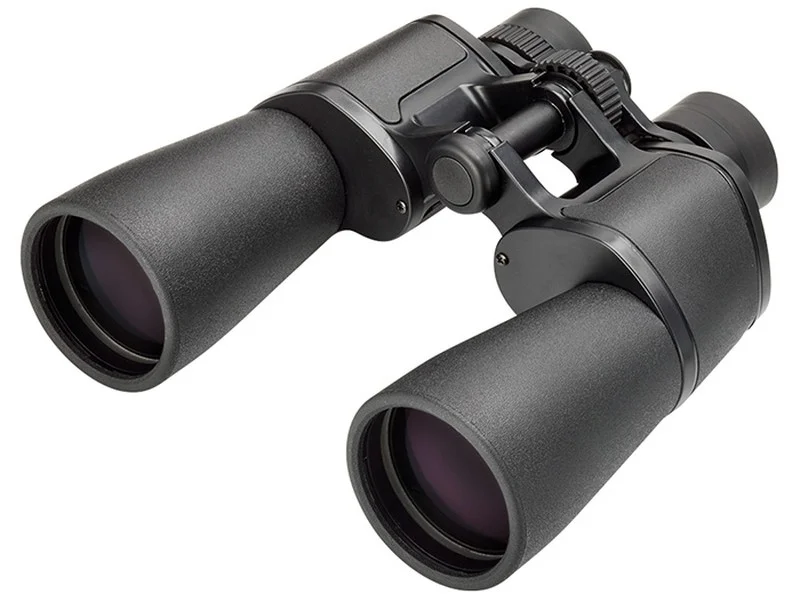
Bright 50mm lenses and a wide field of view, quick enough to get onto a moving light before it's gone. Our usual first pick for UK beginners.
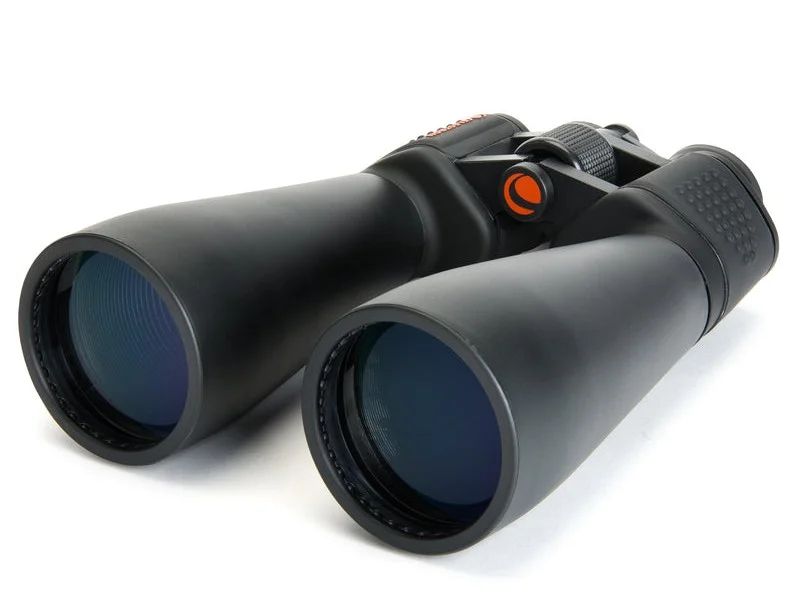
15x magnification pulls a distant object much closer, which is how most 'mystery spheres' become balloons, planets or satellites. Best on a tripod.
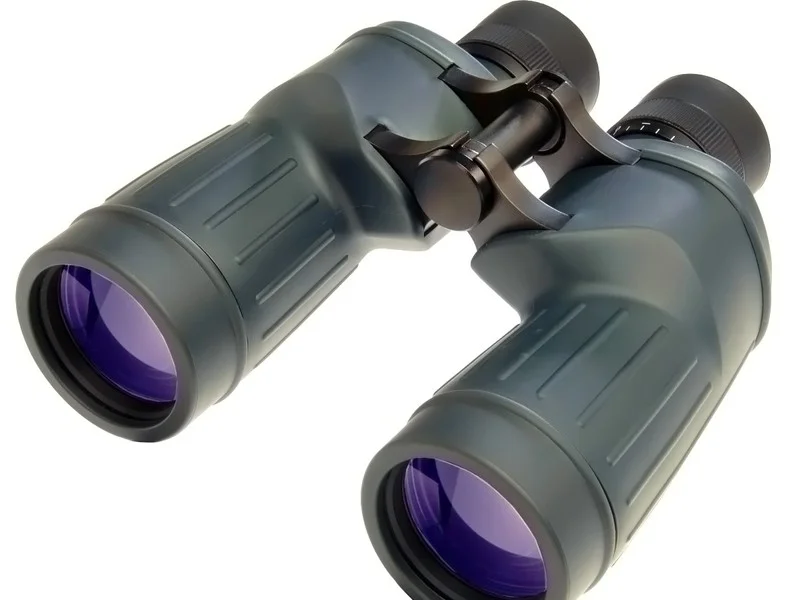
Better contrast and cleaner star points than budget pairs, so what you're looking at stays crisp instead of smearing into something spooky.
Affiliate links: you pay the same price, we earn a small commission that helps keep WatchTheStars free.
The Airship That Wasn't There
The embassy closed the file on 20 November 1963 with an airgram to Washington, attaching two newspaper clippings as the final word. One was the Ministry of Aeronautics denial. The other was from the Jornal da Bahia of 11 November, whose reporter had made the trip to Conde himself. His headline: "The Airship that wasn't there".
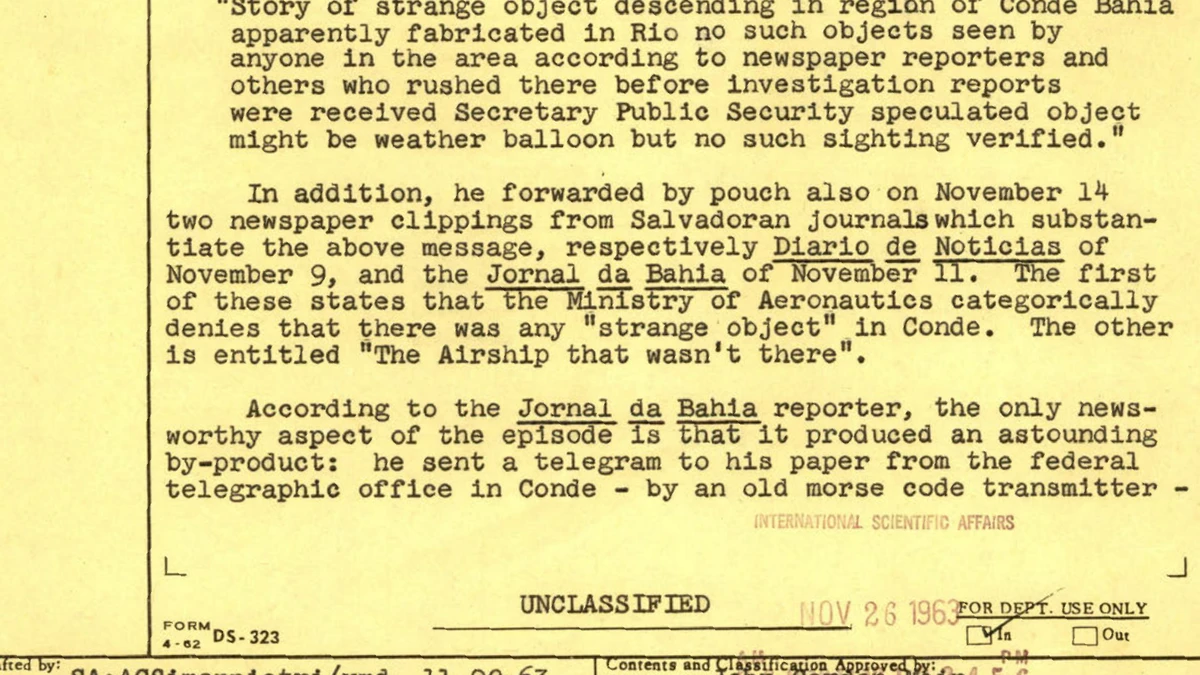
The airgram preserves one last detail with a wink. According to the Jornal da Bahia man, the only newsworthy thing the episode produced was a by-product of covering it: he filed his story from Conde's federal telegraph office using an old morse code transmitter. The most exotic technology in Conde that week, in other words, was a Victorian telegraph key.
Two days after the airgram was typed, President Kennedy was shot in Dallas, and Washington stopped thinking about Brazilian radio stories. The timing is pure coincidence, but it does put these cables in the same strange month as the disputed JFK UFO memo we examined last week. The difference between the two is the whole lesson of this series: the Conde papers have file numbers, named officials and an unbroken archival trail. The JFK memo has none of those things.
Is the 1963 Brazil Sphere Being Reported Wrong in 2026?
Here's the part that would have made the Jornal da Bahia reporter smile. When the fifth release came out in August 2026, a run of news sites and aggregators picked out the sphere story and ran it more or less as Radio Tupi told it: Pentagon files reveal a metal sphere with a body inside fell on Brazil in 1963. Some noted the Pentagon "declined to comment on the object's origin". Few mentioned Midkiff's cable, the Aeronautics Ministry denial or the newspaper that went and looked, even though all of it sits in the same three-document file.
So a story knocked down in twelve days in 1963 is enjoying a second life 63 years later, powered by the very documents that debunk it. That's worth remembering whenever a headline says "declassified files reveal". Files record claims as well as facts, and a claim doesn't become true by being declassified. We've seen the same pattern before with viral objects like Colombia's Buga sphere: the first dramatic version of a story travels much further than the check that follows it.
What the Conde Case Teaches About Reading UFO Files
None of this makes Brazil a country of UFO fairy tales. The opposite, in fact. Brazil produced some of the best-documented cases in the world: the Air Force's Operação Prato investigation generated 130 official records in 1977, complete with theodolite logs and photographs, and the 1978 Amazon pilot encounters come with signed reports from both pilots. Congress in Washington is still demanding Brazil's Varginha files today. Those cases survive scrutiny because they're built from named witnesses and primary paperwork.
Conde is the control sample. It shows what a fabricated story looks like in the same official channels: one anonymous source, zero witnesses on the ground, and a paper trail that ends in a denial rather than a mystery. Genuine intelligence files, like the CIA's Cold War UFO reporting from Sary-Shagan, are messy and inconclusive. Fabrications are tidy and dramatic, and they fall over the moment someone drives to the town and asks.
The people of Conde, for the record, had a perfectly good sky above them all along. If a strange light ever does drift over your own town, the odds are heavily on a satellite, a balloon or a bright planet, and our guide to spotting the ISS is a good place to start telling them apart. Next week: another file, in plain English.
Sources:
- FBIS transcript, Radio Tupi (Rio de Janeiro) broadcast of 8 November 1963, filed under National Aeronautics and Space Council inquiry of 13 November 1963 · US National Archives, PURSUE Release 05, EOP-UAP-D001
- Embassy Rio de Janeiro telegram 94 to Amconsul Salvador (SecState 1054), 14 November 1963 · US National Archives, PURSUE Release 05, DOS-UAP-D001
- Airgram A-628, Amembassy Rio de Janeiro to Department of State, 20 November 1963, quoting Consulate Salvador telegram 157 and Jornal da Bahia of 11 November 1963 · US National Archives, PURSUE Release 05, DOS-UAP-D002
- Pentagon releases new batch of UFO files · CBS News, August 2026
Frequently Asked Questions
Equipment guides
Related topics
Ian ClaytonAmateur astronomer and founder of WatchTheStars.co.uk, dedicated to helping others explore the wonders of our universe. Full profile →