Key Takeaways
- Dew forms when glass cools below the air's dew point by radiating heat to the sky; it's a physics problem, not bad luck, and it's worst on clear still nights
- A dew shield delays it, a heater strap prevents it, and the two together beat almost any UK night; never wipe a dewed lens
- Refractors, Maksutovs and Schmidt-Cassegrains dew up first; Newtonians last longest but their secondary and eyepieces still fog
- Cool the telescope for an hour, keep batteries warm, dress for standing still, and pack up before you get cold rather than after
📑 Table of Contents
- Why Does Dew Form on a Telescope?
- Which Telescopes Dew Up First?
- Dew Shield vs Dew Heater: What Actually Works
- How to Stop Dew on Eyepieces, Finders and Binoculars
- What to Do When Your Telescope Has Dewed Up
- Telescope Cool-Down Time in Winter
- Winter Observing Tips: Batteries, Frost and Staying Warm
- What to Look at on a Winter Night
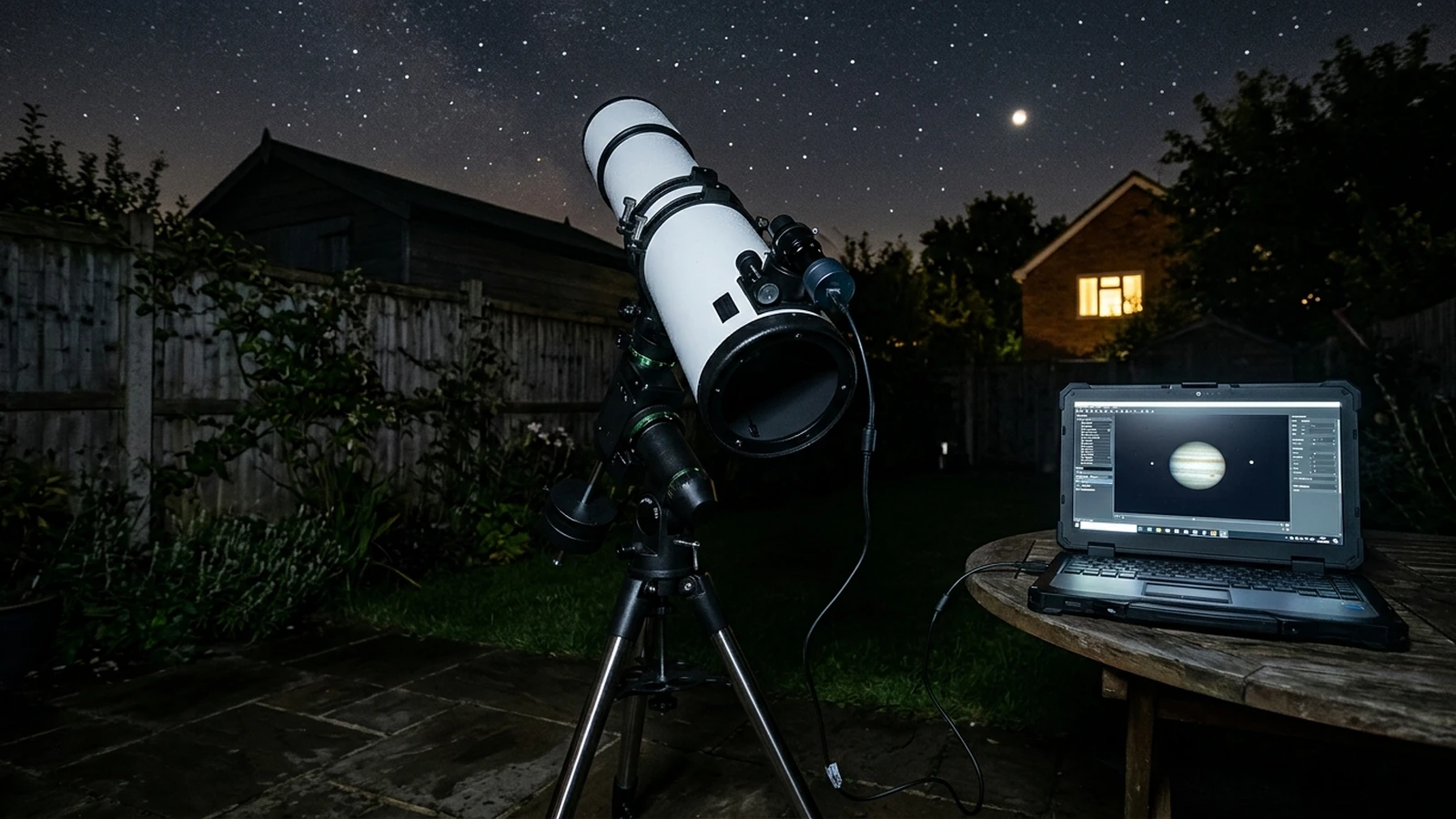
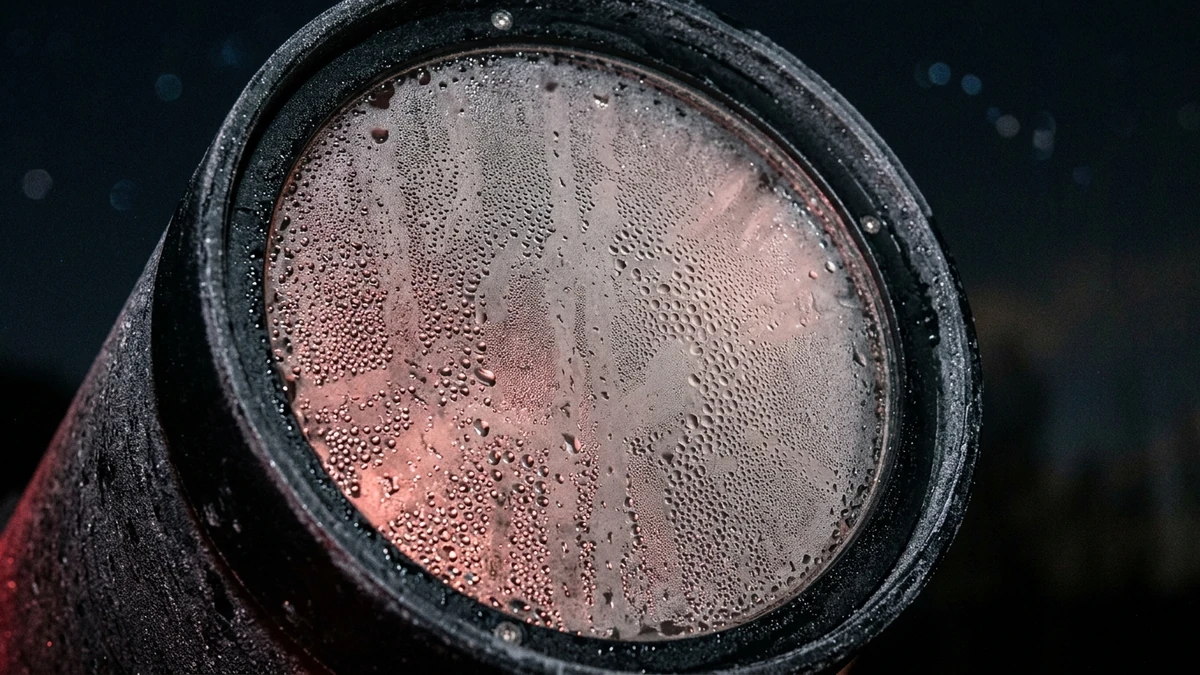
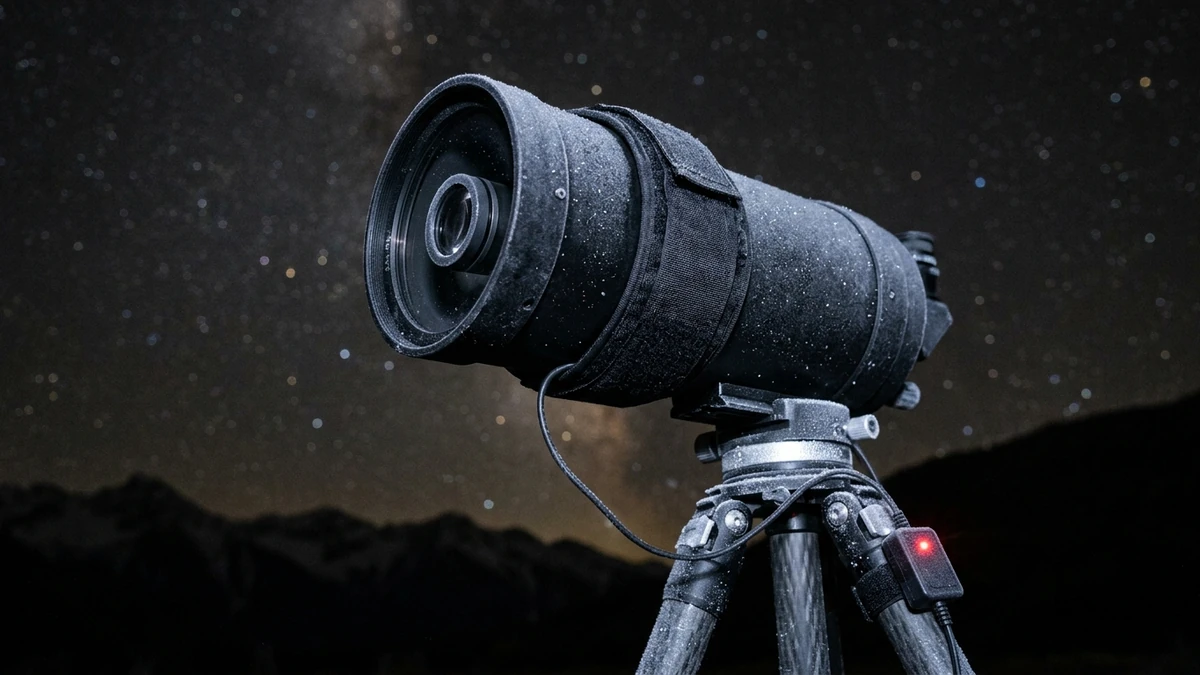
Every UK stargazer has the same story. The forecast was clear, the telescope was out, Jupiter looked wonderful for half an hour, and then the view went soft, then milky, then vanished. A red torch on the front of the scope showed a lens covered in a film of water. Session over.
Dew is the single biggest thing that ends observing sessions in Britain, and it is more common than cloud in the seasons when the sky is at its best. The good news is that it's a physics problem with cheap, well-understood fixes. This guide explains why it happens, which telescopes suffer most, what a dew shield and a dew heater actually do, and how to run a winter session so the cold ends it on your terms rather than the dew's.
Why Does Dew Form on a Telescope?
The air always holds some water vapour. Cool a surface below the air's dew point and vapour condenses onto it as liquid, which is why a cold drink sweats in summer. What surprises people is that your telescope can get colder than the air around it.
Anything with a clear view of the night sky radiates heat away to space, and the sky on a clear night is very cold indeed. A lens or corrector plate pointed upwards is losing heat in exactly the direction it can't get it back from, so it drops a few degrees below the surrounding air. On a still, clear, humid night, which describes most good British observing nights, that is enough to cross the dew point. Water condenses, first as an invisible film that softens the image, then as a visible fog.
Three things make it worse. Clear skies, because cloud acts as a blanket and reflects heat back. Still air, because a breeze keeps replacing the cold air next to the glass. And high humidity, which in the UK is most of the time. Frost is just dew that formed below freezing, and it's harder to shift.
This is why dew is worst on the nights you most want to be out, and why a plan for it matters more than the weather app.
Which Telescopes Dew Up First?
The design of your telescope decides how much of a problem you have.
Refractors have their objective lens right at the front of the tube, exposed to the sky. Most come with a built-in dew shield that helps, but on a bad night a refractor will fog within the hour.
Schmidt-Cassegrains and Maksutovs are the worst affected. The corrector plate is a large, thin sheet of glass at the very front of a short tube, with nothing shielding it. It cools quickly and dews quickly, sometimes in twenty minutes. If you own one of these, a dew shield is not optional.
Newtonians and Dobsonians are the lucky ones. The main mirror sits at the bottom of a long tube, shielded from the sky by the tube itself, and it rarely dews. The secondary mirror near the open end can fog on a damp night, and the Sky-Watcher Heritage style collapsible tubes are more exposed than solid ones, but a Newtonian will usually outlast everything else in the garden.
Binoculars dew on both objectives and both eyepieces, and they're often warm from your hands and face, which makes their own fog. The binocular astronomy guide has more on managing them in the cold.
Whatever the telescope, eyepieces, finderscopes and red-dot finders fog on every design, and the eyepiece is the one you'll notice first because your breath lands on it.
Dew Shield vs Dew Heater: What Actually Works
There are two tools, and they do different jobs.
A dew shield delays dew. It's a tube that extends forward from the front of the telescope, usually two to three times the aperture in length. It doesn't warm anything; it simply narrows the lens's view of the cold sky, so the glass radiates less heat and cools more slowly. On many nights that's enough to double or triple your dew-free time. A shield also blocks stray light from streetlamps and neighbours' windows, which improves contrast, so it's worth having even in summer. You can buy one for about £50 for a common Schmidt-Cassegrain size, or make one from a camping mat and Velcro for a few pounds. A homemade one works just as well, provided it's black inside and doesn't sag.
A dew heater prevents dew. It's a flexible strap with a resistive element inside, wrapped around the tube just behind the lens or corrector, and powered from 12V or USB. It warms the glass by a degree or two, enough to hold it above the dew point. Very little heat is needed; too much creates its own air currents and ruins the view. A controller lets you turn the power down to the minimum that works, which on a typical night is a quarter to half of full. Straps cost from about £20 for a small one to £60 for an 8-inch, plus a controller and a power source.
Together they win. A shield reduces the heat loss, the strap replaces what's left. Most experienced UK observers run both on catadioptric scopes and on refractors, and a small strap on the secondary of a Newtonian if it fogs. First Light Optics' dew prevention range has straps and controllers for every size; the Celestron dew shield for the C6 and C8 is the one we'd start with for those scopes.
Kit that keeps you observing when the dew comes down
Kit we've tested and reviewed in full
Dew is the reason most winter sessions end early. These three bits of kit, in this order, fix that for less than the price of an eyepiece.
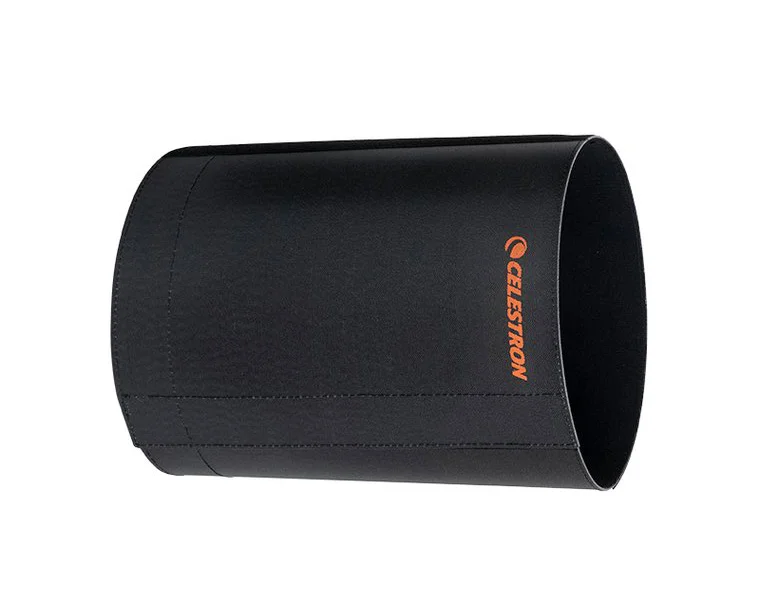
Celestron Dew Shield for C6/C8
Slides over the front of a 6 or 8-inch Schmidt-Cassegrain and blocks the corrector's view of the cold sky. On a typical night it turns 20 dew-free minutes into an hour or two, and it cuts stray light too.
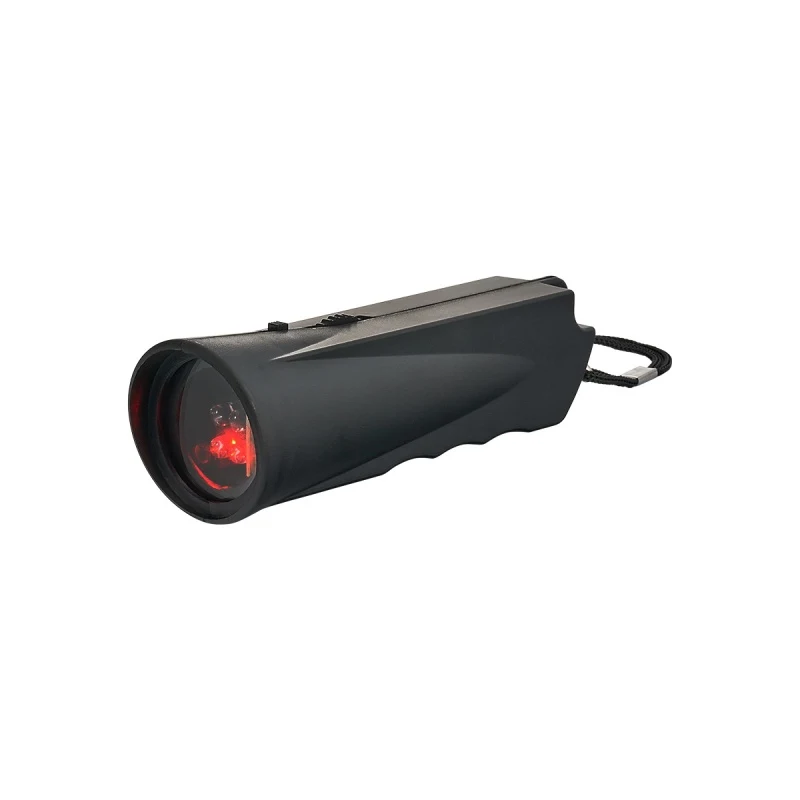
Astro Essentials Red Light Torch
Checking a lens for dew by phone torch wrecks your night vision for twenty minutes. A dim red torch shows the tell-tale fog without costing you the faint stuff.
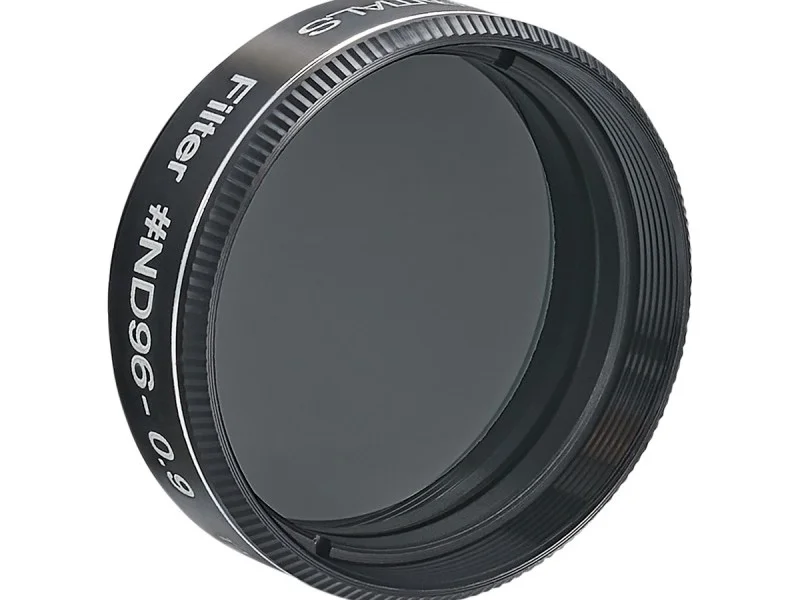
Astro Essentials ND96 Moon Filter
The winter Moon rides high and blindingly bright on frosty nights. A neutral density filter takes the glare off so you can pick out crater detail and keep some dark adaptation.
Affiliate links: you pay the same price — we earn a small commission that helps keep WatchTheStars free.
How to Stop Dew on Eyepieces, Finders and Binoculars
Eyepieces fog from two directions: the sky side, like the main lens, and the eye side, from your breath and the warmth of your face. Habits fix most of it.
Keep the eyepieces you're not using in a closed case or a jacket pocket rather than lying on a table where they'll cool and dew. Hold your breath, or breathe out to one side, as you lean in to look. If an eyepiece fogs on the eye lens, don't blow on it; the extra moisture makes it worse. Swap to a spare from your pocket and let the first one dry in the case.
Finderscopes get dew shields too, and a short cardboard tube taped on works fine. Red-dot finders fog on the little window; a strip of Velcro and a scrap of foam make a cap you can flip up when you need it. For binoculars, keep them under your coat between looks, and use a tripod so they're not always warm from your hands. Small stick-on heater bands exist for both if it's a constant problem.
If you're imaging planets with a camera in the focuser, the camera's own window can dew too. Our planetary imaging for beginners guide has more on running a camera through a cold session.
What to Do When Your Telescope Has Dewed Up
Don't wipe it. Dew sits on top of whatever dust is on the glass, and a cloth drags the grit across the coatings. Warming the glass is the only safe way to clear it.
A 12V hairdryer sold for cars is the classic tool, held a foot away on low. A mains hairdryer on its lowest setting works if you're in the garden. A hand warmer held close to the glass without touching it clears a small lens in a few minutes. Once the dew has gone, put the dew shield or heater on before it comes back, because it will.
At the end of the night, leave the caps off until the optics are dry. Capping a wet lens seals the water in, and a damp case grows fungus over the summer. Bring the scope indoors uncapped, stand it somewhere with airflow, and cap it in the morning.
Telescope Cool-Down Time in Winter
Dew is one cold-weather problem; the other is the opposite. A telescope carried straight from a warm house into a frosty garden is a heat source, and warm air rising off the mirror or lens shimmers the view like a road on a hot day. At low power you won't notice; at the magnifications you'd use on Saturn or a double star, the image boils.
Give it time. A small refractor or a 130mm reflector settles in about 45 minutes. A 200mm Dobsonian wants an hour or more, and a Schmidt-Cassegrain with its thick corrector and closed tube can take 90 minutes. Put the scope outside before you eat, capped so it doesn't dew while it cools, and it'll be ready when you are. A small fan on the back of a Dobsonian mirror halves the time. Once you've waited, the winter sky's steadier air rewards you: the stiller, colder nights of January are often the best of the year for planets and the Moon.
Collimation shifts slightly as a Newtonian's tube contracts in the cold, so check it once the scope has settled. Our collimation guide takes five minutes and makes more difference than any accessory.
Winter Observing Tips: Batteries, Frost and Staying Warm
Batteries. Cold halves the capacity of lithium cells and can shut a phone down outright. Keep phones and power banks in an inside pocket, run mount batteries from a bag off the frozen ground, and carry spare AAs for anything that takes them. A GoTo mount that suddenly loses alignment at 1am has often just browned out.
Frost on the tube and tripod. It does no harm, but it makes metal painfully cold to touch and tripod legs slippery to grip. Foam pipe insulation from a DIY shop, slit and wrapped around the legs, is a two-pound fix.
Frost on charts and laptops. Paper goes limp and laptops slow to a crawl. A clear plastic sleeve for charts, and a laptop kept closed on a towel rather than the frozen table, both help. Dim the screen and use a red-screen mode, and check the Tonight page before you go out so you're not squinting at a phone in the garden.
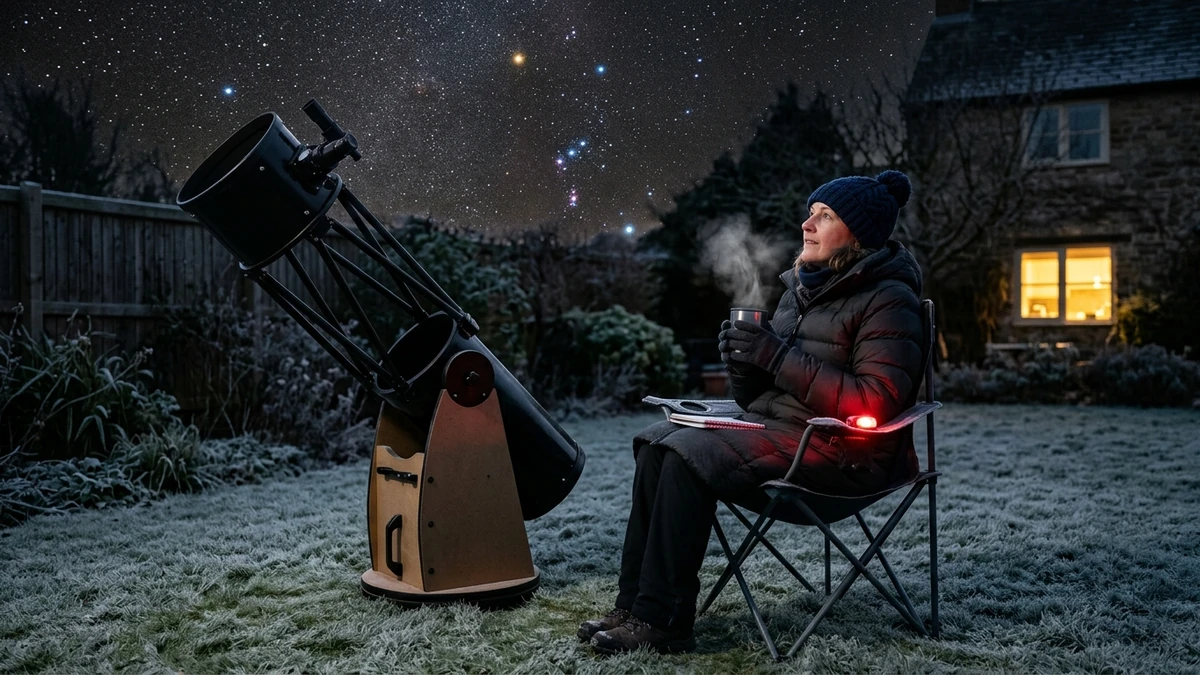
Your own heat. Stargazing is standing still in the cold for two hours, which is harder than a winter walk. Layers, with a windproof shell on top and something insulating under your feet. Feet and hands go first, so insulated boots on a foam mat, thin liner gloves under mittens you can pull off to focus. A hat, because you lose a surprising amount through your head. Chemical hand warmers in the pockets, a flask of something hot, and a chair; sitting keeps you warmer than standing and steadies your view.
Know when to stop. Shivering wrecks your ability to see faint detail long before it becomes dangerous, and packing up with numb fingers is when eyepieces get dropped. Decide in advance how long you're staying and go in five minutes before you'd naturally want to. The kit will still be there tomorrow, and so will Orion.
What to Look at on a Winter Night
All this effort is for a sky that repays it. Winter evenings bring Orion and its nebula, the Pleiades and Hyades in Taurus, the twin stars of Gemini, and Sirius, the brightest star in the sky, flashing colours low in the south. The Moon rides high in winter, which puts it above the murk for the best lunar views of the year; our guide to photographing the Moon is a good frosty-night project.
The 2026–27 winter adds planets. Jupiter reaches opposition on 11 February 2027 and Mars on 19 February, both well placed for the UK, and Saturn is still around in the early evening through the autumn. The Geminids peak around 13–14 December, and they're the one meteor shower that's better before midnight, so the cold doesn't have to be an all-night affair.
If you're just starting out, the stargazing for beginners page covers what to look for season by season and the basics of finding your way around. Get the dew sorted and the winter sky is the best sky Britain has.
Sources:
- Met Office: dew point and humidity explained — how condensation forms
- First Light Optics dew prevention — current heater strap and controller range
- Stargazers Lounge — UK observer discussion on dew control and winter sessions
- In-The-Sky.org — 2027 opposition dates
Frequently Asked Questions