James Webb Telescope Discoveries: The Biggest Findings So Far
Webb has shown that the young universe built galaxies, stars and black holes far faster than anyone expected. It has also found a new kind of planet and mapped the cosmic web in more detail than ever. Here are its biggest discoveries, what each one means, and the one Webb galaxy you can find from a British garden.
What Has James Webb Found? The Short Answer
James Webb has found that the early universe grew up much faster than the textbooks said. Within a few hundred million years of the Big Bang there were already massive, dusty galaxies, swarms of strange "little red dots" and black holes far too big for their age. Closer to home it has found a planet covered in a permanent ocean of molten rock, spotted a hidden giant planet by the chemistry of its air, and mapped the cosmic web across most of the universe's history.
Webb is the most powerful infrared observatory ever built. Infrared light lets it see further back in time and through dust that blocks ordinary light. Since its first deep field images in the summer of 2022, nearly every survey it has made has turned up something that doesn't fit. The sections below group its biggest results by theme, with a link to our full write-up wherever one is still live.
James Webb Early Universe Discoveries: First Stars, Hidden Stars and Little Red Dots
Webb's biggest surprise is how crowded and grown-up the young universe already looked.
The "little red dots" are the clearest example. They are hundreds of compact, intensely red objects that turn up in nearly every Webb deep survey. We see them as they were between 600 million and 1.5 billion years after the Big Bang, and there are roughly 700 of them in every square degree of sky, far more than models predicted for any rare, extreme object. They look almost like single stars, yet each one puts out as much energy as a whole galaxy. For three years nobody could say what they were. The next section covers the answer that is now emerging.
Webb has also found the strongest evidence yet for Population III stars, the very first generation, made of nothing but hydrogen and helium. Two independent teams picked up the signal from Hebe, a small companion of the galaxy GN-z11, seen just 400 million years after the Big Bang. Neither team found any trace of heavier elements, which is exactly what truly primordial stars should look like. Our full story on how Webb may have found the first stars explains how the two teams reached the same result by different methods.
A third result made the puzzle worse. Studying nine early galaxies with Webb spectra and older Very Large Telescope data, astronomers found that the biggest of them hold far more small, faint stars than expected. One, formed less than 1.5 billion years after the Big Bang, may be four times more massive than earlier estimates. Read more in Webb's hidden stars in early galaxies.
James Webb Black Hole Discoveries: Black Hole Stars and Monster Stars
Webb keeps finding supermassive black holes that are too big for their age, and the little red dots may show how they got that way.
The problem is simple to state. Webb sees galaxies just a few hundred million years after the Big Bang that already hold black holes of hundreds of millions of solar masses. For comparison, Sagittarius A*, at the centre of our own galaxy, is about four million solar masses. Growing from small stellar seeds, those early black holes shouldn't have had time to get so large. Astronomers call it the "too big, too soon" problem.
In 2026 a team led by Russet Hviding at the Harvard-Smithsonian Center for Astrophysics used NASA's Chandra X-ray Observatory to detect X-rays from a little red dot for the first time. Growing black holes almost always shine in X-rays, so the signal points to a supermassive black hole hidden inside. The leading idea is a "black hole star": a dense gas cloud up to 500 light-years across, with a black hole that formed at its centre and is now eating it from the inside. The heated cloud glows like a whole galaxy, and from far away it looks like one small, very red, very bright point. Each one might only last a few million years.
A separate Webb study backs this up. The galaxy GS-3073, seen about one billion years after the Big Bang, has a nitrogen-to-oxygen ratio of 0.46. A team led by Devesh Nandal found that only stars of 1,000 to 10,000 times the Sun's mass can produce that mix. Stars that big are thought to collapse straight into black holes without exploding, giving a black hole a large head start. One X-ray detection is strong evidence rather than proof, and both results still need confirming with more objects.
James Webb Images of Galaxies: M77 and the Red Monster
Webb's galaxy results run from a dusty giant at the dawn of time to a blazing spiral 45 million light-years away.
The red monster galaxy EGS-z11-R0 is the most distant of its kind ever confirmed. It sits at a redshift of 11.45, so we see it as it was barely 400 million years after the Big Bang, yet it already holds between one and four billion solar masses of stars, plenty of dust and clear signs of carbon. Carbon and dust are made inside stars and spread when they die, so at least one full generation of massive stars must have lived and died there in a very short window. A team led by Giulia Rodighiero at the University of Padua found it in public data from Webb's NIRSpec instrument, and posted the paper as a preprint in March 2026, ahead of peer review. It doesn't overturn the Big Bang model. It does suggest that some assumptions about how fast early galaxies made stars and dust need revisiting.
Much closer, Webb's NIRCam and MIRI instruments have given us one of the most detailed infrared views ever taken of an active galaxy. Messier 77 (NGC 1068) is a barred spiral 45 million light-years away in Cetus, and the archetypal Seyfert type 2 galaxy: its central black hole, about 8 million times the Sun's mass, is feeding hard behind a thick ring of dust. Infrared light gets through that dust. Webb's image shows a starburst ring more than 6,000 light-years across, where gas funnelled in by the spiral arms is turning into stars at a furious rate.
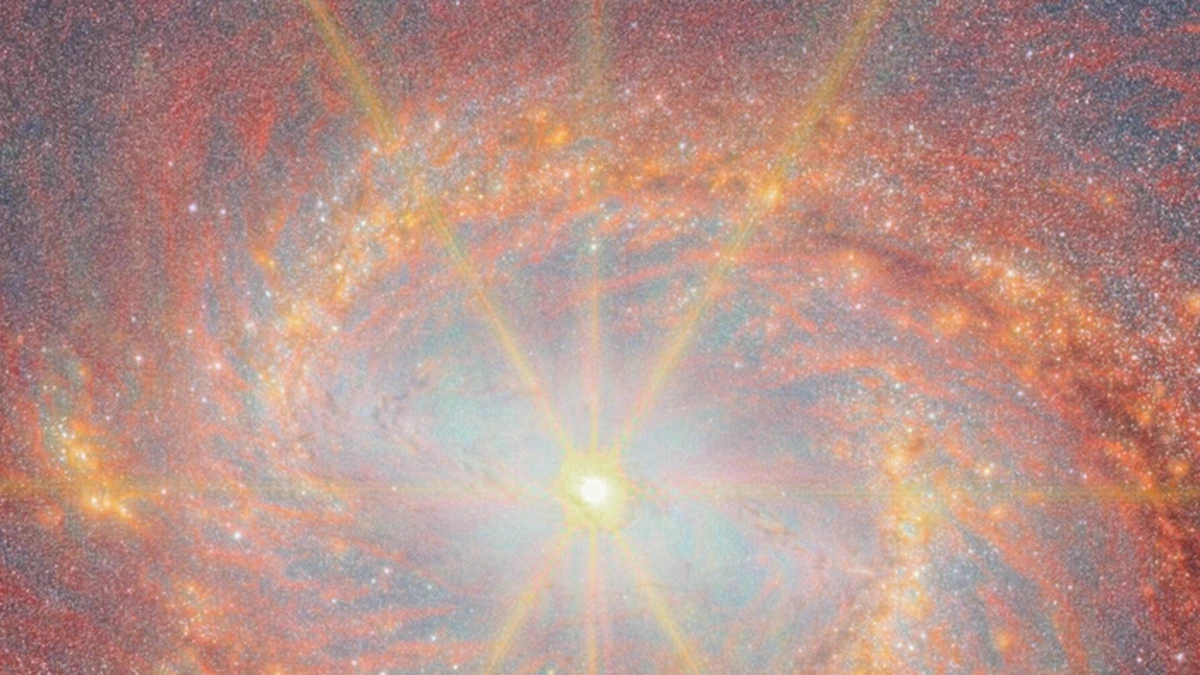
The data also hint at a second, quieter black hole near the nucleus, which would mean M77 is the product of an old galaxy merger. That isn't confirmed yet. It is also the one Webb galaxy you can see for yourself, and our Cetus constellation guide shows where it sits among the Sea Monster's stars.
James Webb Exoplanet Discoveries: A Magma Ocean World and a Hidden Planet
Webb has found a whole new class of rocky planet, and a giant planet nobody knew was there.
L 98-59 d is the first known "sulphurous magma ocean world". It is a super-Earth, 1.64 times Earth's mass and about 1.63 times its width, orbiting a small red dwarf 35 light-years away in the constellation Volans. It goes round its star every 7.5 days, so close that its whole surface is a sea of molten rock thousands of kilometres deep. Using transmission spectroscopy, reading starlight that filters through the planet's air as it crosses its star, Webb's NIRSpec and MIRI instruments picked up hydrogen sulphide and sulphur dioxide. The gas comes out of the magma and acts as a blanket that stops the atmosphere escaping, so the magma and the air keep each other going. It would smell of rotten eggs.
The result was published in Nature Astronomy on 16 March 2026 by a team led by Dr Harrison Nicholls at the University of Oxford. The planet is not habitable: there is no water and the surface is thousands of degrees. What it does is add a fourth type of rocky planet to the three scientists already knew about, and Venus may have passed through a stage like it early in its history.
In July 2026 Webb found a new planet, Beta Pictoris d, by accident. Astronomers studying another planet in the same system spotted the chemical fingerprint of its atmosphere. It is at least twice Jupiter's mass, orbits about as far out as Neptune and hides inside one of the brightest dust discs known. See how Webb found Beta Pictoris d for the full story.

Webb has turned up surprises within our own galaxy too. Its NIRSpec data suggest the interstellar comet 3I/ATLAS formed 10 to 12 billion years ago, long before the Sun, with about 30 times more heavy hydrogen in its water than any comet from our solar system (read why 3I/ATLAS may be 12 billion years old). And its MIRI camera has mapped buckyballs, footballs of 60 carbon atoms, in a thin shell around a dying star in the planetary nebula Tc 1. Our post on Webb's buckyballs around a dying star includes the odd upside-down question mark in the image.

James Webb Cosmic Web Map: The Universe's Hidden Skeleton
In May 2026 Webb produced the most detailed map of the cosmic web ever made.
The cosmic web is the large-scale shape of the universe. Galaxies and galaxy clusters sit along vast threads of dark matter and gas, hundreds of millions of light-years long, with huge near-empty voids in between. Dark matter makes up roughly 27% of the universe and gives off no light, so astronomers map the web by plotting where the galaxies are. The galaxies are like flags stuck into a landscape we can't photograph directly.
The new map comes from COSMOS-Web, the largest survey Webb has carried out so far. It used more than 164,000 galaxies and traces the web back to when the universe was about one billion years old. Webb's advantage is depth and distance: it picks up far fainter galaxies than ground-based telescopes, and it measures how far away they are much more precisely, which you need to build a map in three dimensions. Seeing the web at different ages lets cosmologists test how it grew, and with it the roles of dark matter and dark energy. The full dataset is being made public.
James Webb Discoveries at a Glance
| Discovery | What was found | Why it matters | Announced |
|---|---|---|---|
| L 98-59 d | A super-Earth with a permanent magma ocean and a sulphurous atmosphere | The first of a new class of rocky planet | 16 March 2026 |
| Red monster EGS-z11-R0 | A massive, dusty galaxy 400 million years after the Big Bang | Galaxies formed stars and dust faster than models allow | March 2026 (preprint) |
| Buckyballs in Tc 1 | Carbon-60 molecules in a thin shell round a dying star | Helps explain why they glow so brightly there | April 2026 |
| Population III stars | Signs of hydrogen-and-helium stars in Hebe, near galaxy GN-z11 | Strongest evidence yet for the first stars | April 2026 |
| Little red dots | First X-rays from one, detected by Chandra | Points to "black hole stars" growing early black holes | May 2026 |
| Cosmic web map | The web traced through more than 164,000 galaxies | Tests how dark matter and dark energy shaped the universe | May 2026 |
| M77 (NGC 1068) | A starburst ring over 6,000 light-years across round an active black hole | A preview of a Milky Way with a feeding black hole | May 2026 |
| 3I/ATLAS | Interstellar comet with about 30 times our comets' heavy hydrogen | May have formed 10 to 12 billion years ago | 22 June 2026 |
| Beta Pictoris d | A hidden planet at least twice Jupiter's mass | Found by its atmosphere's chemistry, not its light | 15 July 2026 |
| Hidden stars | Far more small, faint stars in nine early galaxies | One galaxy may be four times heavier than thought | August 2026 |
Other Space Telescope Discoveries: Euclid's Milky Way Map and a Black Hole That Woke Up
Webb isn't working alone, and two recent results from other telescopes fit the same story.
Europe's Euclid telescope, launched in July 2023 to map dark matter and dark energy, turned to the crowded heart of our own galaxy for its second quick data release, Q2, on 24 June 2026. It imaged 4.8 square degrees of the galactic bulge, about the area of 24 full Moons, across nine fields with its VIS camera, which was built by a UK-led consortium at University College London's Mullard Space Science Laboratory. At 0.16 arcseconds the images are sharp enough to separate individual stars, and the release includes catalogues of their positions and brightness. The aim is planet hunting: the region holds dozens of old microlensing planet signals that Euclid can now help confirm, and it gives NASA's Roman Space Telescope a "before" map for its own bulge survey. Euclid has also turned up some of the oldest quasars ever found.
The second result came from radio telescopes, not Webb. LOFAR in the Netherlands and India's upgraded Giant Metrewave Radio Telescope caught the supermassive black hole in galaxy J1007+3540 firing new jets after roughly 100 million years of silence. The jets and the faded lobes from earlier outbursts stretch nearly a million light-years, about ten times the width of the Milky Way. It is one of the clearest signs yet that black holes switch on and off over and over, heating the gas around them and stopping it from forming stars.
Can You See What James Webb Sees From the UK?
Mostly no, but one of Webb's galaxies is within reach of a modest telescope.
The little red dots, the red monster and the cosmic web are billions of light-years away and far beyond any amateur telescope. L 98-59 d is a planet no amateur will ever see. Webb works in infrared from space for good reason.
M77 is the exception. At magnitude 9.6 it needs at least a 10cm telescope, where it looks like a bright, almost star-like point. A 15 to 20cm scope under a dark sky shows the nucleus with a faint oval halo around it. To find it, locate the 4th-magnitude star Delta Ceti and move just over one degree south-south-east. We worked out its height for the UK: M77 is highest in the south at about 11pm in mid-November, 9pm in mid-December and 7pm in mid-January (GMT), standing about 34° up from Edinburgh, 37° from Birmingham and nearly 40° from Plymouth. You won't see the starburst ring, but knowing what Webb found there makes that small glow a lot more interesting. For a dark enough sky, try one of the spots on our UK dark sky sites map.
Other targets give you a feel for what Webb studies. The Orion Nebula (M42), a cloud where new stars are forming, is a glowing patch in binoculars on winter evenings, and our Orion constellation guide shows how to find it. On summer nights the Milky Way's core, the region Euclid surveyed, sits low in the south in Sagittarius: see how to see the Milky Way from the UK. The Andromeda Galaxy is a naked-eye smudge from a dark site. For more targets, browse all our constellation guides or check what you can see in the sky tonight.
If you're choosing a first scope for galaxies, aperture matters more than anything else. Our guide to the best beginner telescopes UK explains why, and if you'd rather take pictures than sketch, the best smart telescopes do the finding and the image stacking for you.
Which telescope shows the galaxies James Webb studies?
Kit we've reviewed in full
No garden telescope will ever show a little red dot or a red monster galaxy. M77, the Webb galaxy you can find for yourself, starts to show at about 10cm of aperture and improves with every extra centimetre, so these are the scopes we'd point at it.
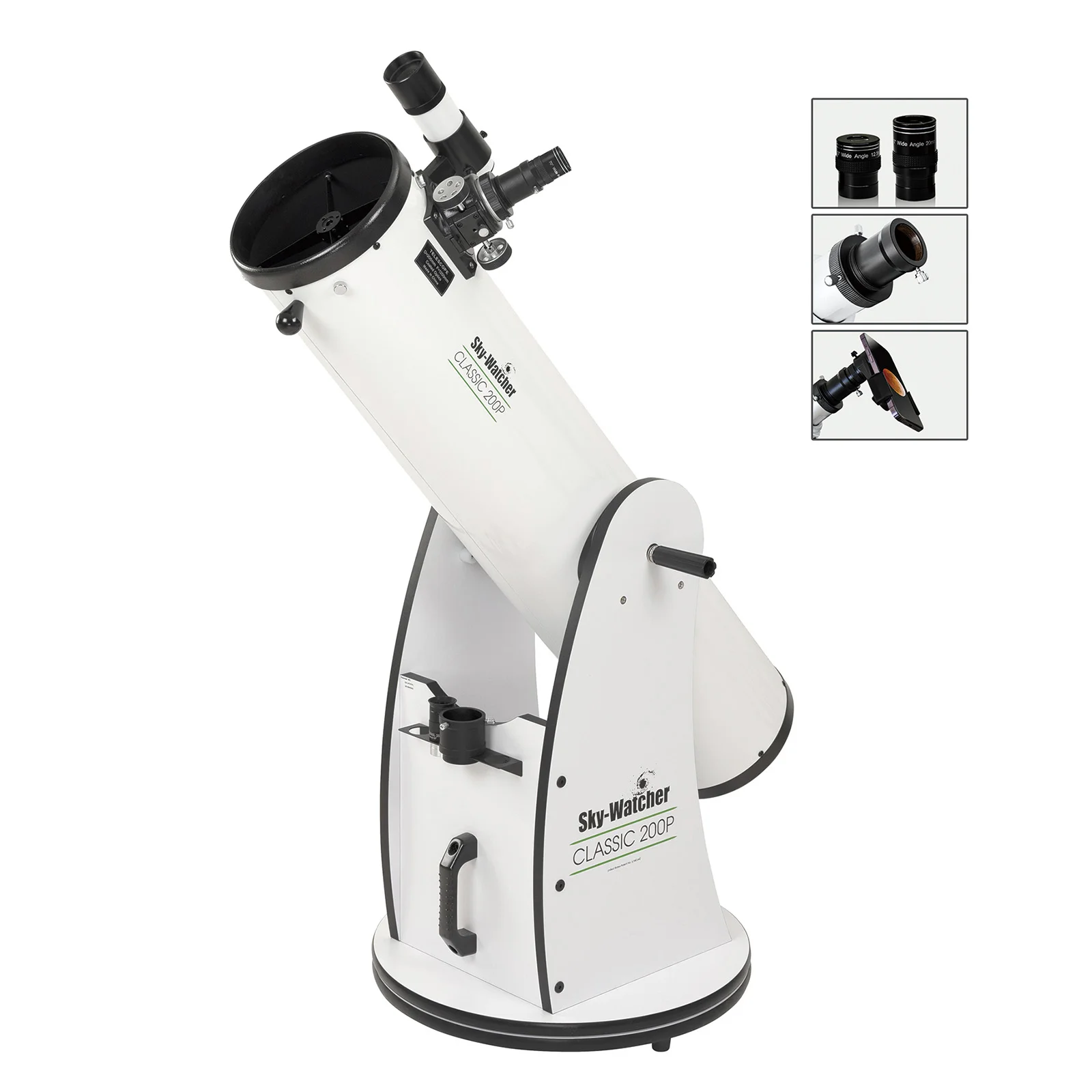
200mm of aperture is what turns M77 from a bright dot into a core with a faint oval halo, and it brings in hundreds of other galaxies under a dark sky.
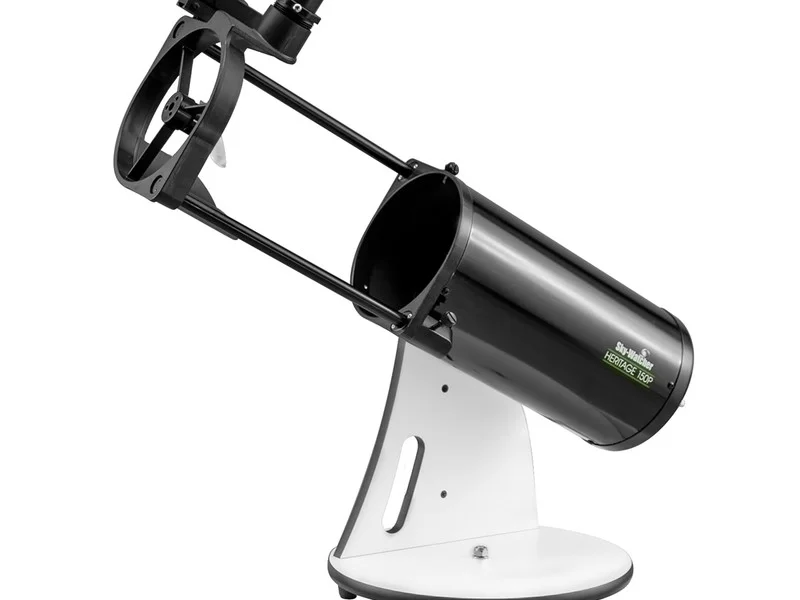
A 150mm tabletop Dobsonian is inside the 15 to 20cm range that shows M77's nucleus and halo, and it is small enough to take to a dark site.
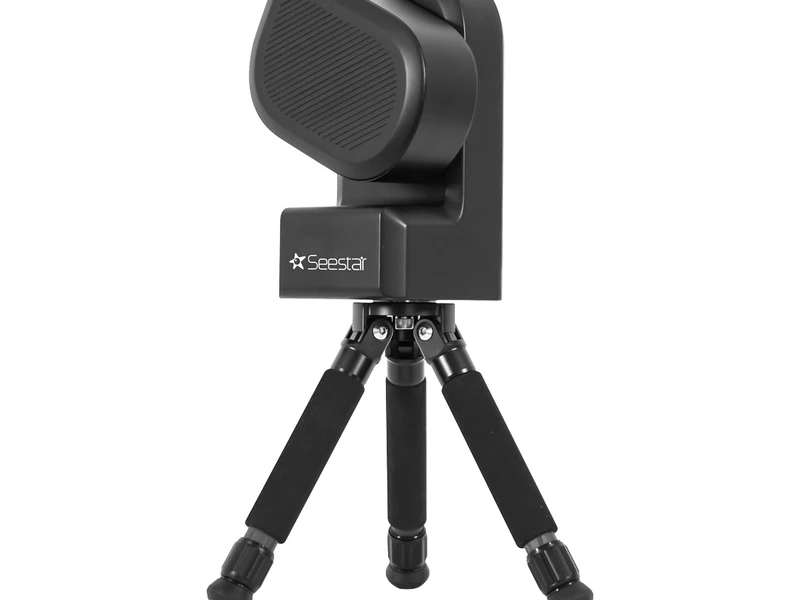
A smart telescope that finds targets from your phone and stacks live images of galaxies, nebulae and clusters, so you can try for your own picture of M77 in Cetus.
Browse all our telescope reviews
Honest, research-based recommendations for every budget.
Browse all →Affiliate links: you pay the same price, we earn a small commission that helps keep WatchTheStars free.
New to finding faint objects? Our stargazing for beginners guide covers star-hopping and reading a chart.
Header image: Messier 77 in Webb's NIRCam view. Credit: ESA/Webb, NASA & CSA, A. Leroy.