AATIP vs AAWSAP
What the Pentagon's Own Files Say About the Two Names
For nine years people have argued over whether AATIP and AAWSAP were one programme or two. The Pentagon's eighth UFO file release put the government's own paperwork in public: the job advert, Senator Harry Reid's letter asking for a secret programme, the Defense Intelligence Agency's answer and its director's later memo. Here is what those pages say, and what they don't.
| AAWSAP | Advanced Aerospace Weapon System Applications Program: the DIA contract with BAASS, HHM402-08-C-0072, awarded 22 September 2008 |
| AATIP | Advanced Aerospace Threat Identification Program: first in Senator Harry Reid's letter of 24 June 2009, as the nickname for a proposed secret programme |
| Reid's request | A restricted special access program (SAP) for 'specific portions' of the work |
| DIA's answer | 13 November 2009: 'DIA cannot find adequate justification to establish a restricted SAP' |
| Contract ended | 21 December 2010 (no-cost extension, Release 6 contract file) |
| Pentagon files | DOW-UAP-D182 to D188, PURSUE Release 8, 20 November 2026 |
AATIP vs AAWSAP is one of the longest-running arguments in UFO research. AATIP became famous in December 2017, when The New York Times reported on a secret Pentagon UFO programme by that name (outside context, not from these files). AAWSAP surfaced later as the name of the Defense Intelligence Agency contract behind it. Ever since, people have argued over whether they were the same thing, two stages of one thing, or two different programmes.
The Pentagon's eighth UFO file release on 20 November 2026 added seven short government documents, 27 pages in all, that speak directly to it. Several, including Reid's letter, had already surfaced: the letter was first reported in July 2018, and copies of it and related DIA memos were later released under Freedom of Information requests. This is the first time the set has been published together by the Department of War. We read every page against the scans. Our AAWSAP programme guide covers the contract, the money and the research papers; this page is about the names, the secret programme request and the DIA's answer.
What Is the Difference Between AATIP and AAWSAP?
AAWSAP is the name of the DIA's contract with Bigelow Aerospace Advanced Space Studies (BAASS), and AATIP is the name Senator Harry Reid used for the same effort in a June 2009 letter asking for part of it to be made a secret programme. That is what the documents show. On paper, AAWSAP comes first and AATIP is Reid's word.
The detail is a little more interesting than "two names for one thing". Reid didn't simply rename the contract. He proposed "Advanced Aerospace Threat Identification Program (AATIP)" as the "Unclassified Nickname" of a new restricted special access program (SAP) covering "specific portions" of the work. The DIA then read his letter as being about the AAWSAP contract, and the DIA's director later wrote about the whole effort under the AATIP name, without once saying AAWSAP.
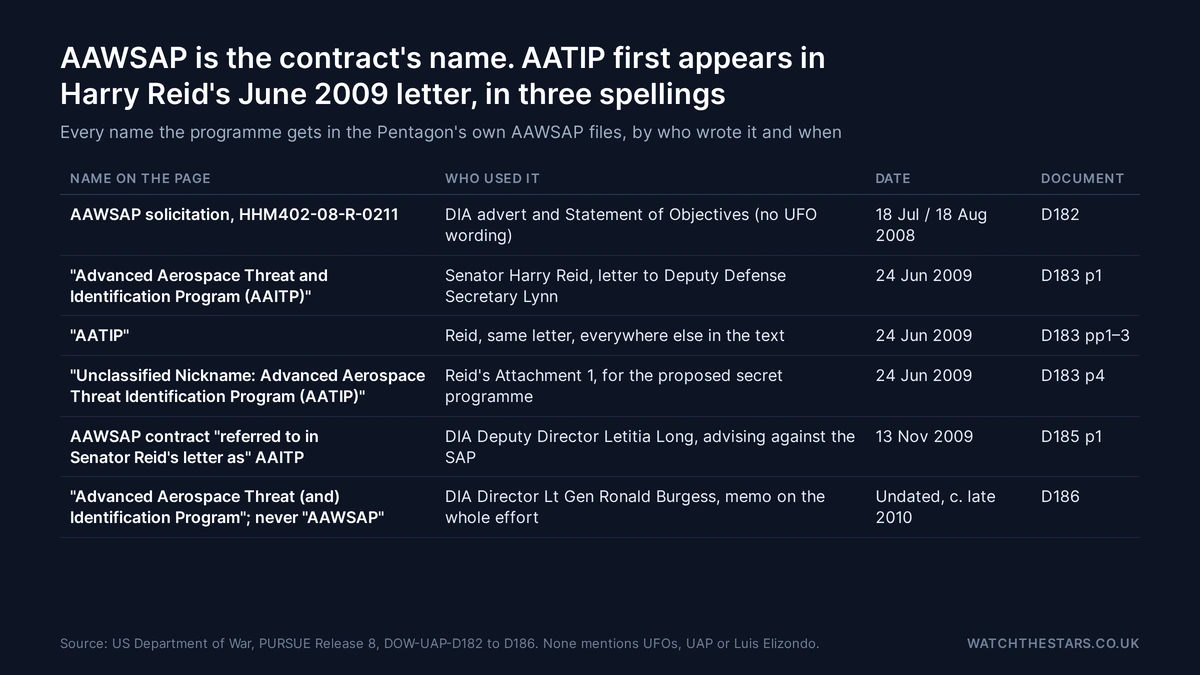
| Name as written | Who used it | Date | Document |
|---|---|---|---|
| Advanced Aerospace Weapon System Applications Program (solicitation HHM402-08-R-0211) | DIA job advert and Statement of Objectives | 18 July and 18 August 2008 | D182 |
| "Advanced Aerospace Threat and Identification Program (AAITP)" | Senator Harry Reid, letter to Deputy Secretary of Defense William Lynn | 24 June 2009 | D183, p1 |
| "AATIP" | Reid, everywhere else in the same letter | 24 June 2009 | D183, pp1–3 |
| "Unclassified Nickname: Advanced Aerospace Threat Identification Program (AATIP)" | Reid's Attachment 1, setting out the proposed SAP | 24 June 2009 | D183, p4 |
| "Advanced Aerospace Weapon System Application Program Contract, referred to in Senator Reid's letter as" AAITP | DIA Deputy Director Letitia Long | 13 November 2009 | D185, p1 |
| "Advanced Aerospace Threat and Identification Program" (subject line); "Advanced Aerospace Threat Identification Program" (text); never AAWSAP | DIA Director Lieutenant General Ronald Burgess | Undated; the release dates it December 2010 | D186 |
BAASS used the contract name too. Its July 2009 Ten-Month Report quotes the solicitation, "Advanced Aerospace Weapon System Applications Program, Solicitation No. HHM40208R0211" (DOW-UAP-D172, p175).
Where Did the Name AATIP Come From? Harry Reid's 2009 Letter
The name AATIP first appears in the Pentagon's released files in Harry Reid's signed letter of 24 June 2009 to Deputy Secretary of Defense William Lynn III. Reid, then Senate Majority Leader, wrote that since "the Advanced Aerospace Threat and Identification Program (AAITP) and study were first commissioned, much progress has been made with the identification of several highly sensitive, unconventional aerospace-related findings."
"Due to the sensitivities of the information surrounding aspects of this program, I require your assistance in establishing a Restricted Special-Access-Program (SAP) with a Bigoted Access List for specific portions of the AATIP."· Senator Harry Reid to Deputy Secretary of Defense William Lynn, 24 June 2009 (DOW-UAP-D183, p1)
So the letter itself has three versions of the name. Page one opens with "AAITP", a different acronym from the one that became famous. The body then switches to "AATIP" throughout. The attachment gives the formal "Unclassified Nickname: Advanced Aerospace Threat Identification Program (AATIP)". The letter never uses "AAWSAP" or "Advanced Aerospace Weapon System Applications".
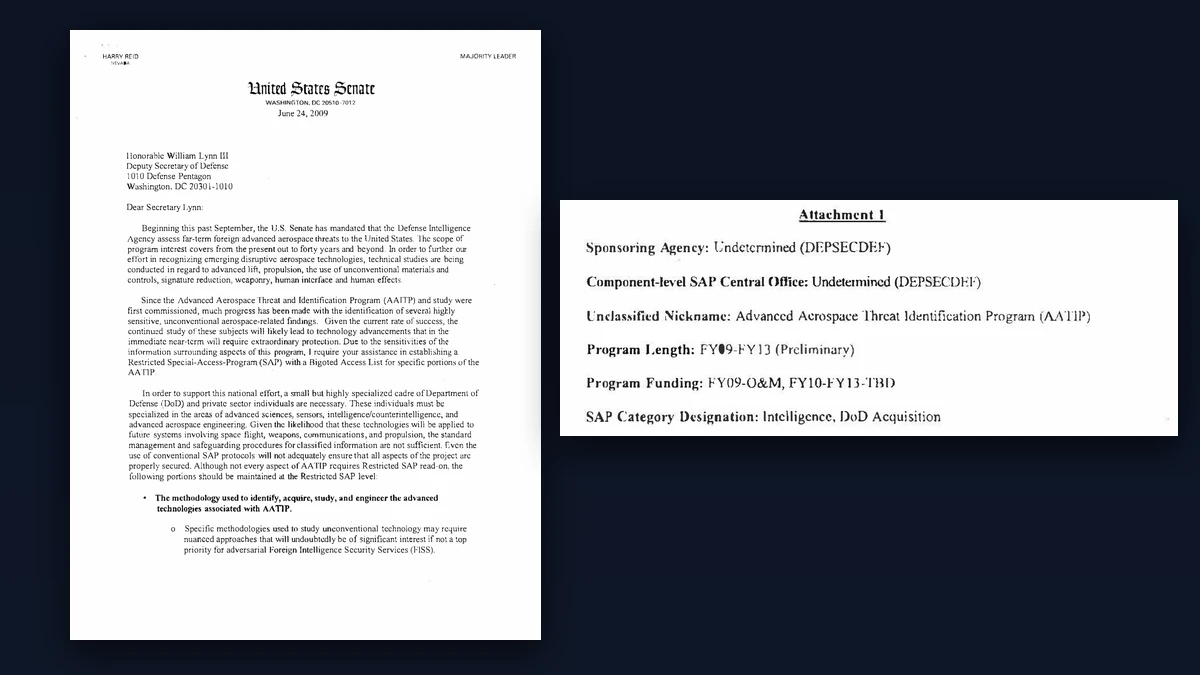
Reid asked for protection of "the methodology used to identify, acquire, study, and engineer the advanced technologies associated with AATIP", the identities of the specialists and industry partners involved, and "the nuanced manner in which some of these technologies will be collected, engineered and applied". He wrote that "even the use of conventional SAP protocols will not adequately ensure that all aspects of the project are properly secured". He doesn't say what the technologies were or where they came from, and he doesn't use the words UFO or UAP.
The attachment lists the sponsoring agency as "Undetermined (DEPSECDEF)", a programme length of "FY09-FY13 (Preliminary)" and an access list headed by Lynn, Reid and Senator Daniel Inouye, then a Senate staffer and seven redacted government names, followed by three redacted BAASS staff. A footer says the letter is exempt from FOIA disclosure. The Department of War's own catalogue calls it "public correspondence"; it was a private letter.
Did the Pentagon Make AATIP a Special Access Program?
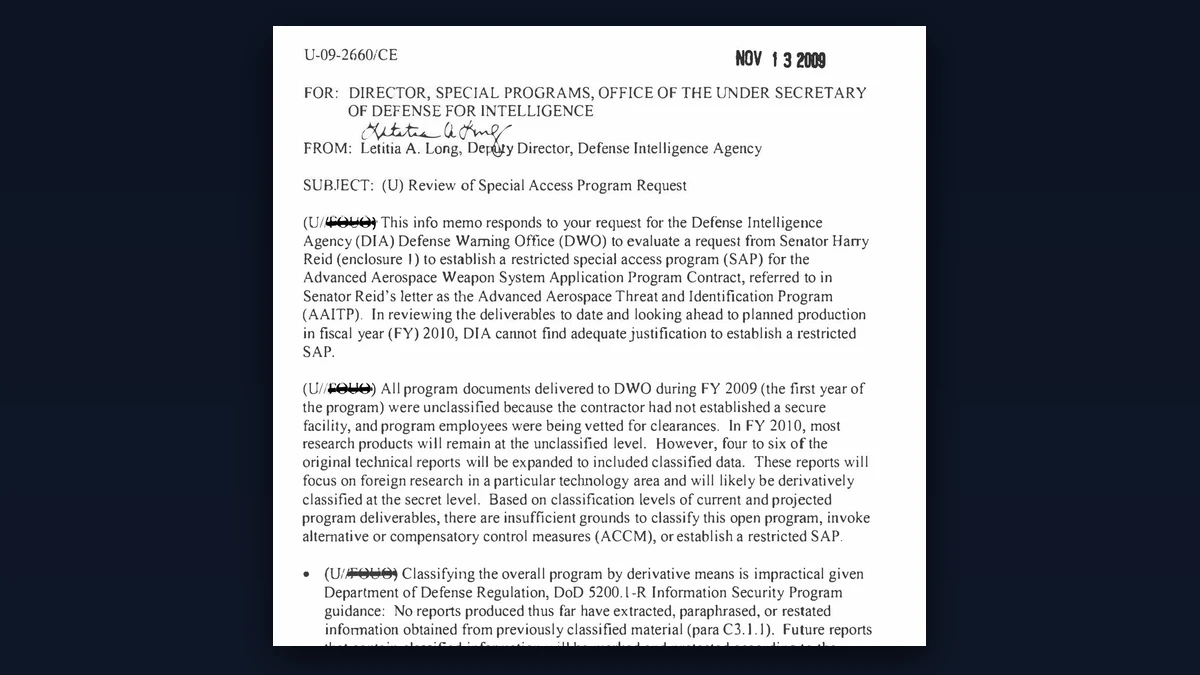
The DIA advised against making AATIP a special access program, and nothing in the released files shows one was created. The answer came in an information memo stamped 13 November 2009, signed by the DIA's Deputy Director, Letitia A. Long, and sent to the Director of Special Programs in the Office of the Under Secretary of Defense for Intelligence, who had asked the DIA's Defense Warning Office to evaluate Reid's request.
"In reviewing the deliverables to date and looking ahead to planned production in fiscal year (FY) 2010, DIA cannot find adequate justification to establish a restricted SAP."· DIA Deputy Director Letitia A. Long, 13 November 2009 (DOW-UAP-D185, p1)
The memo gives four reasons, and they are mundane:
- Nothing was classified. Everything delivered in the first year was unclassified "because the contractor had not established a secure facility, and program employees were being vetted for clearances." Four to six reports might reach Secret in 2010.
- Nothing came from secret material. No report had "extracted, paraphrased, or restated information obtained from previously classified material", so it couldn't be classified by derivation.
- It was public science. The information was "not owned by, produced by or for, or under control of the U.S. government", and the DIA could not "identify any damage" from disclosing publicly available information. Basic research can't be classified unless it clearly relates to national security, and "This requirement has not been met."
- No sensitive findings had reached the DIA. "Although most of the unclassified reports discuss unconventional aerospace technologies, DIA is unaware of any report containing information sufficiently sensitive and vulnerable to require extra protection". The DIA assumed Reid was talking about "future phases of this program".
Two points of precision matter here. First, this memo is an evaluation, written because the Under Secretary's office asked for one. It isn't a ruling by the Deputy Secretary of Defense, and no such ruling is in the release. Second, the phrase often quoted alongside it, that the programme wanted "deeper cover to pursue the projects that are deemed more sensitive", isn't from Reid or the DIA. It's from the contractor. BAASS's own Ten-Month Report, dated 30 July 2009, says "it will be necessary to alter the official programmatic status of the BAASS operation. This change is already underway and will afford the BAASS organization deeper cover" (DOW-UAP-D172, p191). The same report's plan for 2010 looks ahead to the day BAASS "accomplishes the transition to Special Access Program (SAP) status" (p494). Our post on AAWSAP's 2010 wish list covers what BAASS hoped that status would unlock.
Why did BAASS want it? Its own report explains part of it. When it went looking for the government's old UFO records, it found very little: the DIA said it had destroyed "thousands, perhaps millions" of paper files in the early 1990s, and NORAD said it held no pilot reports of the kind BAASS asked for (D172, pp192–194). Our story on the Pentagon UFO contractor's empty archive hunt tells it in full.
Check the sky before the files
Kit we've reviewed in full
AAWSAP's contractor paid investigators to chase reports, and many ended with satellites, aircraft or bright planets. A good pair of binoculars settles most strange lights in seconds.
Bright, wide and quick to aim, so you can get onto a moving light before it has gone.
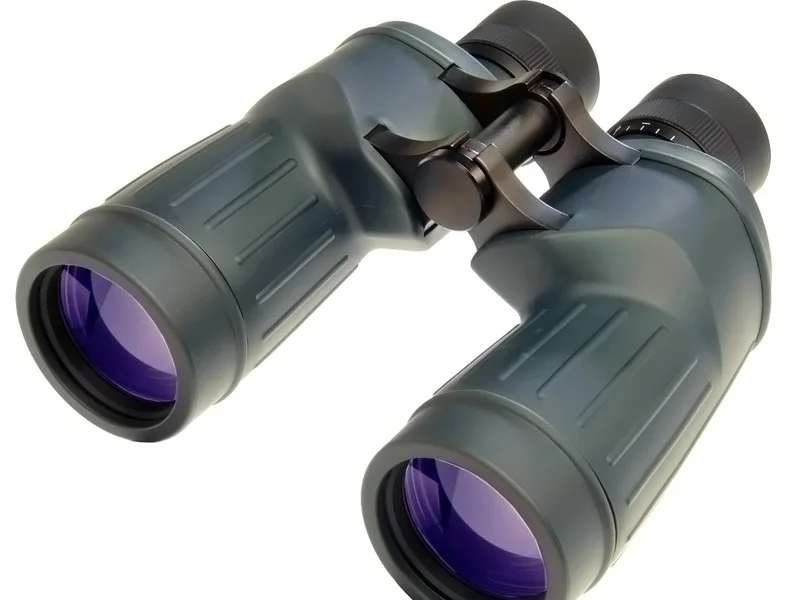
Built for long, damp nights outdoors, which is when most sightings happen.
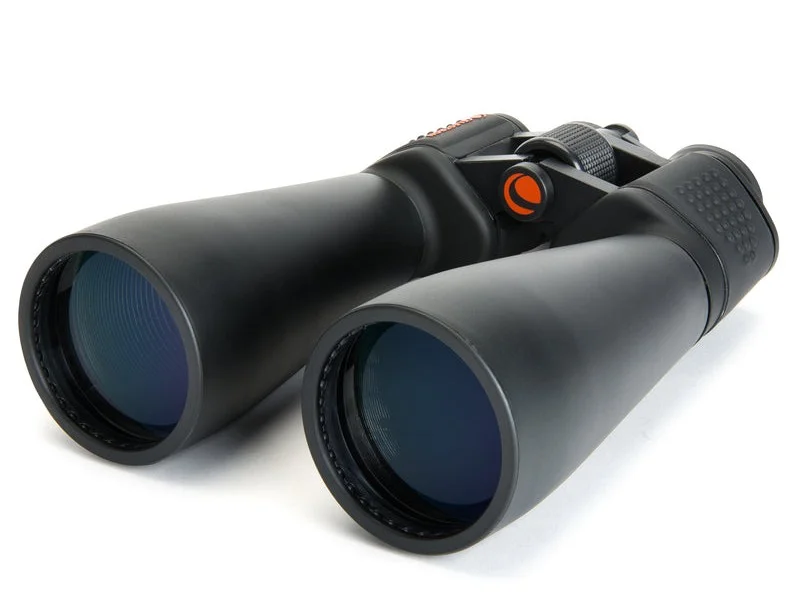
Extra aperture shows the navigation lights on a far-off aircraft. Use a tripod.
Browse all our binocular reviews
Honest, research-based recommendations for every budget.
Browse all →Affiliate links: you pay the same price, we earn a small commission that helps keep WatchTheStars free.
Why Did the DIA Say the AATIP Reports Were of "Limited Value"?
The "limited value" line comes from a memo by DIA Director Lieutenant General Ronald Burgess, recalling a November 2009 meeting with Senator Reid. The memo has no date on either page; the release's catalogue calls it December 2010, which fits its references to the 2010 budget. It was prepared in the DIA's Office of Congressional and Public Affairs and is addressed to the Under Secretary of Defense for Acquisition, Technology and Logistics.
"In November, 2009, Deputy Secretary of Defense Lynn and I met with Senator Reid to discuss this program. At that time, we determined the reports were of limited value to DIA. However, I did suggest they could be of merit to other organizations and, that upon the completion of the DIA contract; the project could be transitioned to another agency or component better suited to oversee the project."· DIA Director Lt Gen Ronald L. Burgess, Jr., undated memo (DOW-UAP-D186, p2)
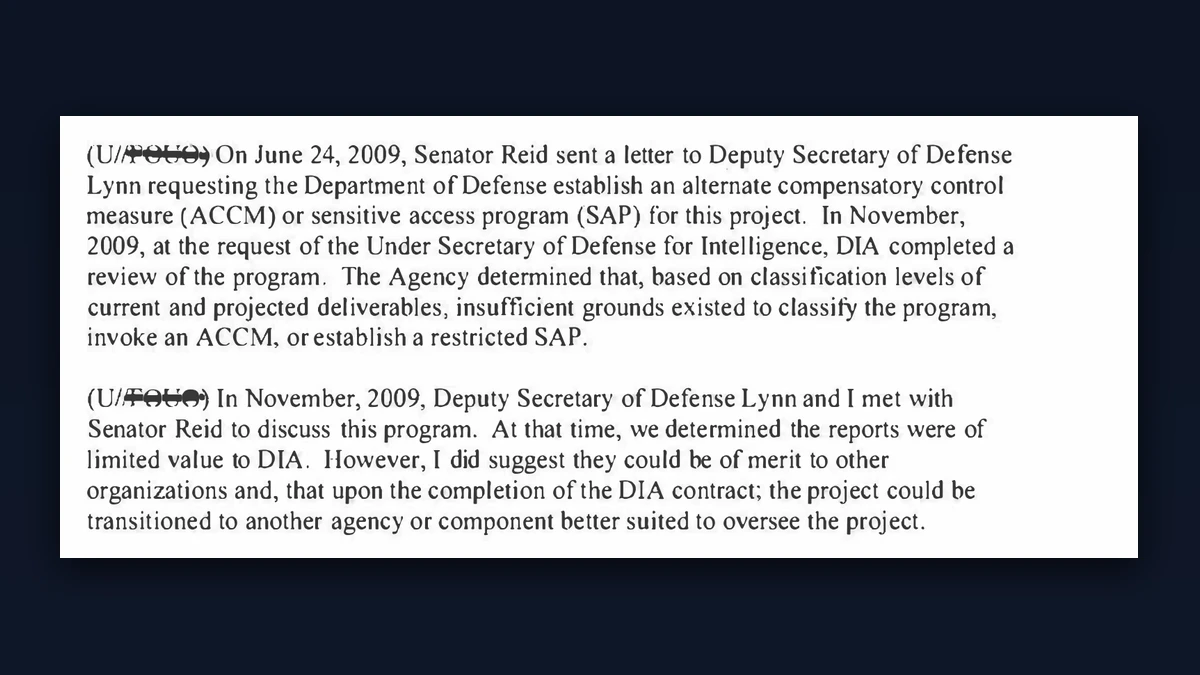
This is the memo that matters most for the naming question. Its subject line reads "Advanced Aerospace Threat and Identification Program", and its first sentence says "The Advanced Aerospace Threat Identification Program was first sponsored in the Fiscal Year (FY) 2008 Defense Supplemental Appropriation Act by Senators Reid and Inouye with a $10 million add." It then describes only the DIA's contract: the request for proposals, BAASS "the only bid", 26 technical reports by June 2009, a $12 million add in 2010 and twelve more reports. So the DIA's own director applied the AATIP name to the whole AAWSAP effort.
Two cautions. Burgess's summary of Reid's letter is loose: he says Reid asked for "an alternate compensatory control measure (ACCM) or sensitive access program (SAP)", but the letter asked for a restricted special access program and said even ordinary SAP rules weren't enough. And "limited value" is a judgment made at a meeting, not the result of a review. It sits oddly beside the warmer words in the DIA's own papers from earlier in 2009, which is the next part of the story.
Was AAWSAP a Sole-Source Contract? The Advert and the One Bid
AAWSAP was not formally sole-source: the DIA advertised it publicly, but only BAASS bid. The release includes a printout of the original FedBizOpps notice for solicitation HHM402-08-R-0211, first posted on 18 August 2008 as a "Total Small Business" set-aside, with responses due at 4pm Eastern on 5 September 2008 (DOW-UAP-D182, p1). That's 18 days. Three DIA papers say the same thing about the result: "DIA received only one bid, from Bigelow Aerospace Advanced Space Studies (BAASS)" (D184 and D187), and BAASS was "the only bid" (D186).
The Statement of Objectives pasted into that advert is about foreign threat technology "from now through the year 2050", with twelve areas from lift and propulsion to "spatial/temporal translation" and "armament (RF and DEW)". It has no UFO wording at all. The DIA's talking paper for Burgess, dated 4 May 2009, ahead of a visit from Reid, reported that "BAASS performance has been excellent" (D184, p2). An earlier one, prepared for the then Director, Lieutenant General Michael Maples, before Reid's visit on 5 January 2009, said the contract was "proceeding on schedule and within cost" (D187).
One correction for readers of the Department of War's catalogue: its summary of D187 says that paper records the "limited value" verdict and a transfer to another agency. It doesn't. Those words are in D186. In January 2009 no reports had yet been delivered.
How Good Were the AAWSAP Reports? The DIA's Own Review
The DIA's own review of the AAWSAP reports, dated 30 October 2009, told Burgess that "all of the reviews were positive, some exceptionally so". He had asked for it on 15 May 2009, after meeting Reid. The memo (DOW-UAP-D188) lists all 26 first-year reports and quotes 13 reviews. Read closely, it has clear limits:
LIMIT
Run by the programme's own managerThe review was prepared in the Defense Warning Office by the DIA's programme manager for the contract, who 'concurs with the reviews'.
LIMIT
11 of 26 papers reviewedEight papers went to other reviewers and three to Sandia National Laboratories staff. Fifteen weren't reviewed at all.
LIMIT
Mostly fellow authorsEight of the 13 reviews were by other authors on the same contract, and some pairs reviewed each other's papers.
LIMIT
The boldest papers skippedWormholes, warp drives and vacuum energy were among the 15 papers not reviewed.
FAIR
Good surveys of real scienceThe Sandia reviews read as 'a good general introduction' and 'a good starting point', which is a fair judgment of a literature review.
Both statements can stand. The reviewers judged the papers as surveys of science, and many are perfectly decent ones. "Limited value to DIA" is a judgment about intelligence usefulness, made the following month. The papers themselves were later issued as Defense Intelligence Reference Documents; our read of the AAWSAP warp drive paper shows why even the wildest of them argue against themselves.
Was AATIP a UFO Program? What the Government Files Say
None of the seven government files on AATIP and AAWSAP mentions UFOs or UAP. We searched every text extract and read every page: the words UFO, UAP, unidentified, anomalous and flying don't appear. The closest language is "unconventional aerospace technologies", "'leap' aerospace vehicles", and one reviewer's remark about trying "to reverse engineer materials and components possibly of interest" from "observed performance...or even claimed performance" (D188, p7).
The contractor's paperwork is a different matter. BAASS's own December 2008 plan set out nine projects, most aimed at UFO reports, and its Ten-Month Report of July 2009 describes field investigations, a 237,331-record sighting database and a team at a Utah ranch, covered on our Skinwalker Ranch Pentagon files page. The same report includes a 2009 memo about the 2004 Nimitz "Tic Tac" encounter. So the honest answer is that the government documents are silent and the contractor's documents are explicit.
Was Luis Elizondo Part of AATIP? What the Files Don't Say
Luis Elizondo isn't mentioned in any of the seven government files on AAWSAP and AATIP in the November 2026 release. Nor are any Pentagon intelligence staff outside the DIA's contract office, any later UAP study, or any work after the DIA contract. Burgess's memo names no one as running the programme at all.
Elizondo, a former Pentagon intelligence officer, has said publicly that he led AATIP and that it studied UAP. That is his account, and the Pentagon's public statements about his role have varied over the years. These seven files can't settle it either way, because they stop at the DIA contract. The contract itself ran until 21 December 2010, after a no-cost extension. The Department of War's catalogue says AAWSAP was "active from 2008 to 2012", but nothing in the released AAWSAP documents supports the 2012 date, and BAASS's own November 2010 summary says "Between 2008 and 2010". Burgess's suggestion that the project "could be transitioned to another agency or component" is the last forward-looking line in the government's file, and nothing released so far shows whether it was.
The contract
18 July: Statement of Objectives. 18 August: advert posted, 18 days to respond. 22 September: contract signed with BAASS, the only bidder (D182, D187).
Talking papers
5 January: Reid's scheduled visit to DIA Director Maples. By 15 May: Reid meets the new Director, Burgess. 'BAASS performance has been excellent' (D184, D187, D188).
Reid names AATIP
24 June: letter to Deputy Secretary Lynn asking for a restricted SAP, with 'AATIP' as its unclassified nickname (D183).
BAASS wants 'deeper cover'
30 July: the contractor's Ten-Month Report says a change of programme status is 'already underway' (D172, p191).
The review and the refusal
30 October: internal review, 'all of the reviews were positive' (D188). 13 November: 'DIA cannot find adequate justification' (D185). November: Burgess and Lynn meet Reid, 'limited value to DIA' (D186).
Contract ends
21 December: end of the period of performance after a no-cost extension (Release 6 contract file).
AATIP vs AAWSAP: Our Verdict
On the documents, the argument is mostly settled. AAWSAP was the DIA contract. AATIP was Senator Reid's name for it, or for a protected slice of it, first written down in his June 2009 letter, and the DIA's own director later used it for the whole thing. Reid's request for a secret programme went to the DIA for evaluation, and the DIA said it couldn't justify one because everything it had received was unclassified public science.
What the documents can't do is tell you what happened after 2010, or who did what at the Pentagon beyond the DIA contract office. Anyone claiming these files prove or disprove a later AATIP is going beyond them. For the wider picture, start at our UAP research hub, and if you want the contractor's side of 2009, our Project Northern Tier page follows BAASS's hunt for nuclear-base UFO records.
Seen Something Odd? Check the Sky First
AAWSAP's contractor sent investigators to chase reports in 2009, and its own staff put several down to satellites and airliners. Most strange lights still have ordinary answers. Check what you can see in the sky tonight for bright planets such as Venus, look up ISS passes tonight, and see our UK night sky this week for what's rising when. If you're new to it, stargazing for beginners is the place to start.
Primary Source Documents
Reid's AATIP letter, 2009
DOW-UAP-D183 · 4 pages · PURSUE Release 8
The letter to Deputy Secretary Lynn asking for a restricted SAP, with its attachment.
Download PDFDIA's SAP review, 2009
DOW-UAP-D185 · 3 pages · PURSUE Release 8
Deputy Director Long's evaluation: "cannot find adequate justification", and why.
Download PDFBurgess's AATIP memo
DOW-UAP-D186 · 2 pages · PURSUE Release 8
The DIA Director's history of the programme and the "limited value" meeting.
Download PDFAdvert, talking papers, review
DOW-UAP-D182, D184, D187, D188 · PURSUE Release 8
The 2008 job advert, the DIA's notes for Reid's visits, and the October 2009 deliverables review.
Open in the file browserNote: Official US Department of War records released through PURSUE (Release 8, 20 November 2026, war.gov/ufo), mirrored on our own servers. Every record is in our Pentagon UFO file browser. Page numbers are PDF pages. Senior officials who signed or received these papers are named as on the page; staff are described by role. BAASS's Ten-Month Report is DOW-UAP-D172 in the same release.
Related Reading
Header image: DIA Director Burgess's memo (DOW-UAP-D186), Senator Reid's letter of 24 June 2009 (D183) and the DIA's review of 13 November 2009 (D185), US Department of War, PURSUE Release 8.
More UAP cases
- The Hellfire Missile & The OrbINCIDENT DATE: 2024-10-30 | LOCATION: GULF OF ADEN / RED SEA COAST | STATUS: UNDER INVESTIGATION
- AAWSAP: What the DIA Actually Paid ForCONTRACT 2008–2010 · $21,948,810 OBLIGATED · RELEASED SEPTEMBER AND OCTOBER 2026
- The Western U.S. Event: Orbs Launching OrbsINCIDENT DATE: OCTOBER 2023 (TWO NIGHTS) | LOCATION: WESTERN UNITED STATES (REDACTED) | STATUS: UNRESOLVED
- Browse Every Pentagon UFO FileRELEASES 01–07 · 8 MAY TO 23 OCTOBER 2026 · MIRRORED ON OUR OWN SERVERS
- The Cheyenne Mountain IncidentINCIDENT DATE: FEBRUARY 2022 | LOCATION: COLORADO SPRINGS, COLORADO | STATUS: UNRESOLVED
- Grey AliensBetty & Barney Hill · 1961 · the abduction template