Key takeaways
- Astronomers have found the first globular cluster stellar stream outside the Milky Way, in a faint galaxy 115 million light-years away
- The stream is nicknamed Oyashio, after a cold Pacific Ocean current, and measures about 72 parsecs wide and 2,000 parsecs long
- It was hiding in Hubble images taken back in September 2022 for a completely different study, and was spotted by eye
- The shape of the stream let the team weigh the galaxy's dark matter halo at roughly 150 billion times the mass of the Sun
- The Roman Space Telescope sees an area 100 times larger than Hubble and should find many more of these streams after launch
Jump to section 7 sections
- Stellar Stream Beyond the Milky Way: What Hubble Found
- What Is a Stellar Stream?
- How Do Stellar Streams Reveal Dark Matter?
- What Is an Ultra-Diffuse Galaxy? Inside UGC 9050-Dw1
- Why Nobody Had Found One Outside Our Galaxy Before
- What the Roman Space Telescope Will Find Next
- Can You See a Globular Cluster From the UK?
Astronomers have found a faint ribbon of stars trailing around a dim galaxy 115 million light-years away. It is the first stream from a globular cluster ever confirmed outside the Milky Way, and it hands scientists a new tool for measuring dark matter, the invisible material that makes up about 85% of all the matter in the universe.
The stream has been nicknamed Oyashio, after a cold ocean current in the Pacific. The discovery was published in Nature on 12 August 2026 by a team led by Julie Kiel Holm of the Niels Bohr Institute in Copenhagen and Sarah Pearson of DTU Space in Denmark.
Stellar Stream Beyond the Milky Way: What Hubble Found
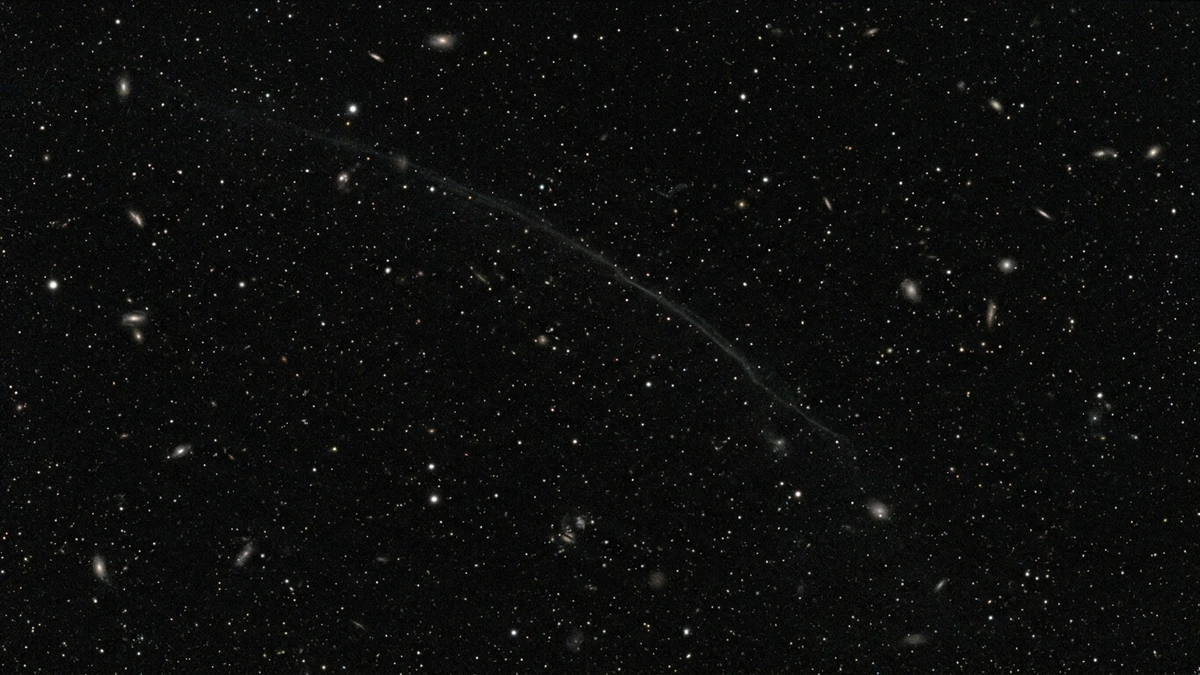
Oyashio is a thin arc of stars about 72 parsecs across and roughly 2,000 parsecs long. In more familiar units, that is a ribbon around 230 light-years wide and 6,500 light-years from end to end, stretched out around a galaxy called UGC 9050-Dw1.
The odd part is where it was found. Nobody went looking for it. The Hubble Space Telescope took the images back in September 2022 for an entirely different study about how faint galaxies form. Co-author David Hendel was going through those archived pictures when he noticed a thin, curved smudge that did not belong.
"We have discovered a globular cluster stellar stream in another galaxy," said Holm. "This is the first time such a stream has been observed outside our own galaxy, the Milky Way, which makes the discovery particularly exciting."
The team then did the sensible thing and tried to prove themselves wrong. A computer algorithm was run over the images independently and picked out the same curved feature. Older ground-based photographs from the Canada-France-Hawaii Telescope in Hawaii showed it too, in three separate colour filters, which ruled out a smudge on Hubble's detector. The stream and the small compact object at one end share almost identical colours, which is what you would expect if the stars in the ribbon had been pulled off that object.
Even after all that, the signal only sits about seven times above the background noise. This is faint work.
What Is a Stellar Stream?
A stellar stream is a long, thin trail of stars stripped off a star cluster by the gravity of a larger galaxy.
Picture a globular cluster, one of those tight balls of a few hundred thousand ancient stars, orbiting a galaxy. The galaxy's gravity pulls harder on the near side of the cluster than the far side. Over hundreds of millions of years that difference peels stars off the cluster's outer edges, a few at a time. Those escaped stars keep travelling along nearly the same orbital path, so they gradually spread out ahead of and behind the cluster into a ribbon.
Given enough time, the cluster can be shredded entirely and all that survives is the stream.
We have plenty of them at home. Dozens are known inside the Milky Way, including the Sagittarius stream, a huge loop of debris from a dwarf galaxy currently being torn apart, and the neat narrow trail behind the cluster Palomar 5, which has become the textbook example. Our own galaxy has been mapped in growing detail in recent years, right down to the discovery that the Milky Way's spiral arms reach further out than anyone realised.
What nobody had managed until now was to see the same thing happening around somebody else's galaxy.
How Do Stellar Streams Reveal Dark Matter?
Every star in a stream follows almost the same orbit, and that orbit is bent by the total gravity of the galaxy it moves through. Measure the shape of the ribbon and you can work backwards to the mass doing the bending.
"The stars in a stellar stream all travel along nearly the same orbit, and that orbit is shaped by the galaxy's gravity," explained Tjitske Starkenburg, an astrophysicist at Northwestern University and one of the paper's co-authors. "By modeling that gravity, we can estimate the galaxy's total mass. We already know roughly how much of that mass comes from visible matter like stars, so the rest must be dark matter."
That is the whole trick. It is the same logic that lets you weigh the Sun by watching Earth go round it, applied to something you cannot see at all.
To do it, the team generated thousands of simulated streams under different assumptions about how much dark matter UGC 9050-Dw1 holds and how it is spread out, then asked which version reproduced the real thing. The answer came back as a halo weighing around 150 billion times the mass of the Sun, which puts it in the same broad range as published estimates for the Large Magellanic Cloud. Within the small region the stream actually crosses, about 2.5 kiloparsecs from the galaxy's centre, the enclosed mass works out at around 13.6 billion solar masses.
Here is why that number matters more than it looks. Somebody had already estimated this galaxy's mass by a completely different method, counting its globular clusters, and got between 150 and 180 billion solar masses. The two answers agree.
"Our results are consistent with previous studies and what they have shown about dark matter in this ultra-diffuse galaxy," said Holm. "We are measuring it with a completely new tool for this type of galaxy, demonstrating that this method also works beyond our own galaxy."
A new measuring technique that agrees with an old one on its first outing is a technique you can start trusting.
See a globular cluster for yourself
Kit we've tested and reviewed in full
Oyashio is a Hubble-only target, but the kind of object it was stripped from is well within reach. Globular clusters are among the best things a small scope will show you, and late August evenings from the UK put two of the finest ones high in the south. Our binocular astronomy guide is a good place to start if you are new to hunting them down.
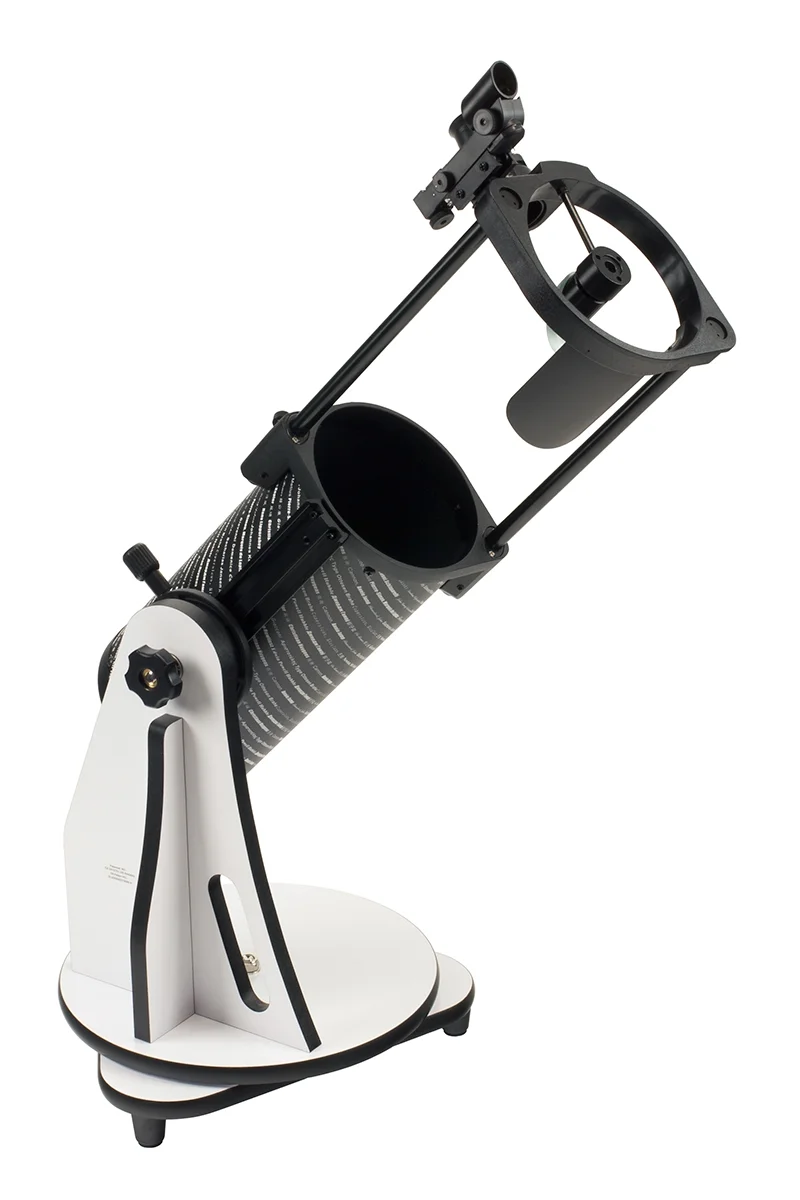
130mm of aperture is the point where M13 stops being a fuzzy blob and starts breaking into individual stars around the edges. That moment is worth the price on its own.

Big 70mm lenses show the brighter globulars as soft round glows, and sweeping the summer Milky Way for them is a fine way to spend an evening.
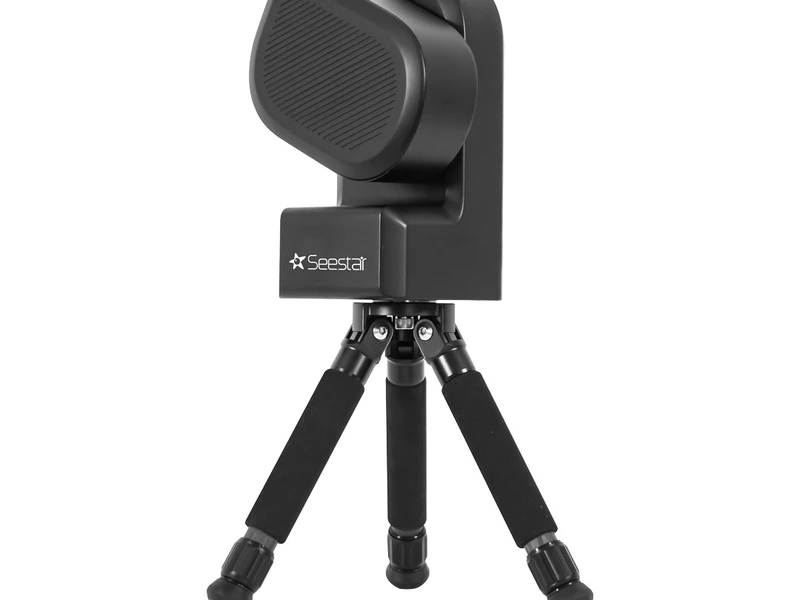
A few minutes of stacked exposure on a smart telescope will resolve a globular cluster into thousands of stars, which is closer to the Hubble view than anything an eyepiece gives you.
Affiliate links: you pay the same price, we earn a small commission that helps keep WatchTheStars free.
What Is an Ultra-Diffuse Galaxy? Inside UGC 9050-Dw1
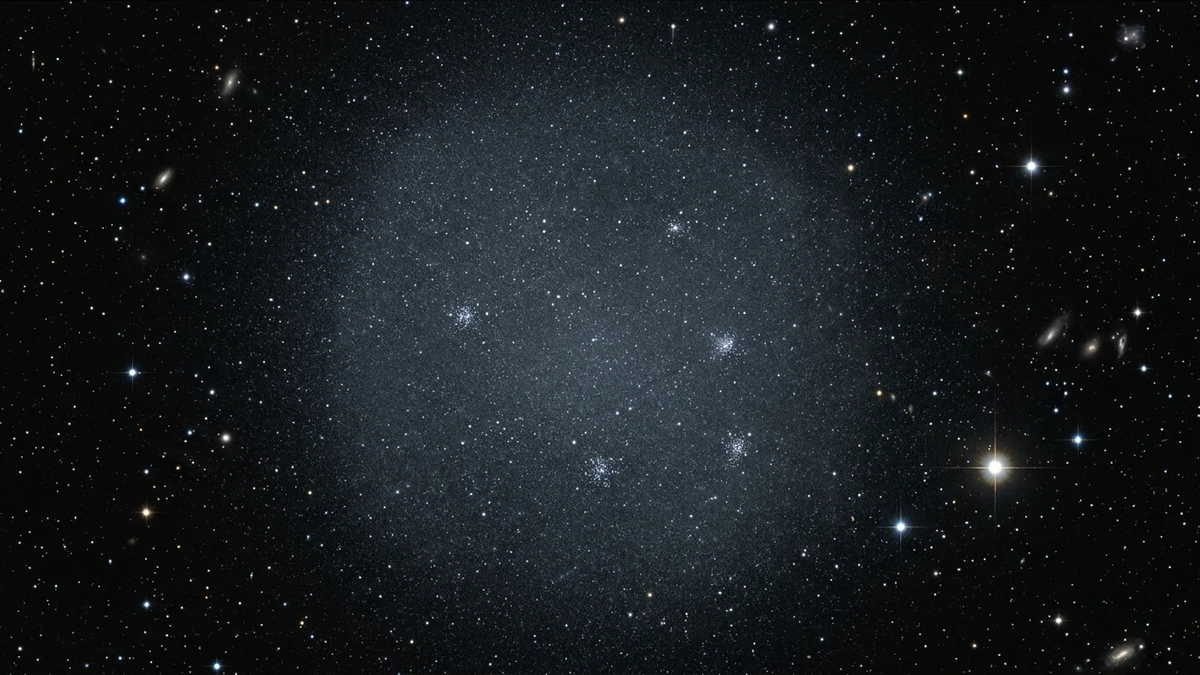
An ultra-diffuse galaxy holds as few stars as a small dwarf galaxy but spreads them across an area as wide as the Milky Way. UGC 9050-Dw1 is a textbook example: roughly ten million Suns' worth of stars smeared over a Milky Way-sized patch of space.
The result is a galaxy so faint it barely registers. Ultra-diffuse galaxies were only recognised as a proper class about a decade ago, and they are awkward objects: too big to be ordinary dwarfs, far too dim to be spirals. Most of what holds them together appears to be dark matter.
That emptiness turned out to be the reason Oyashio was visible at all. In a normal galaxy, the diffuse glow of billions of halo stars washes over a faint stream completely. In an ultra-diffuse galaxy there is almost no background glow to hide behind, so a thin ribbon of stripped stars can stand out. Finding the first extragalactic stream in the emptiest possible galaxy was not luck so much as the only place it was ever going to work.
Why Nobody Had Found One Outside Our Galaxy Before
Theorists have expected extragalactic streams for years. Finding one was another matter.
The problem is brightness, or the lack of it. Globular cluster streams are among the faintest structures in astronomy. Inside the Milky Way we can pick out individual stars and spot them by their shared motion, but at 115 million light-years all you get is a smear of unresolved light that has to beat the glow of everything around it.
There have been near misses. A candidate stream around the galaxy NGC 1052-DF2 got the nickname the "Maybe Stream" in 2018, and later work concluded it probably was not one. Andromeda, our nearest big neighbour, has been searched with dedicated software and produced nothing that passed the statistical bar. Watching astronomers pull faint things out of noise is a recurring theme at the moment, whether that is Hubble catching a tiny galaxy burning off the cosmic fog or James Webb mapping the cosmic web.
It took a galaxy dim enough to act as a dark backdrop, deep Hubble exposures already sitting in the archive, and someone willing to look closely at them.
What the Roman Space Telescope Will Find Next
If one stream can be found in archived images of a galaxy nobody was studying for streams, there should be many more waiting.
Two telescopes are about to make that search far easier. NASA's Roman Space Telescope, launching on 30 August 2026, photographs an area of sky about 100 times larger than Hubble at similar sharpness. Europe's Euclid, already mapping the crowded heart of our own galaxy, covers huge areas too.
"It's exciting that we discovered a thin stellar stream around a galaxy other than our own with already-existing Hubble Space Telescope data and confirmed it with ground-based telescope data," said Starkenburg. "That makes it very promising for the new telescopes becoming available, including the Roman Space Telescope, which can see an area 100-times larger than that of the Hubble."
There is a bigger prize beyond simply counting streams. Our best theory of dark matter predicts that galaxies should be surrounded by thousands of small, completely starless clumps of the stuff. If one of those clumps passes through a stellar stream, its gravity should punch a gap in the ribbon. Astronomers have argued for a decade about whether gaps seen in Milky Way streams are really caused by dark matter or by ordinary things like giant gas clouds and spiral arms, which our galaxy has in abundance.
"Thin stellar streams can develop gaps or clumps when small concentrations of dark matter pass through them," Starkenburg said. "Astronomers have long debated whether we've seen this happen in streams within the Milky Way. If we can confirm that's what's causing these features, that will give us an entirely new way to test how dark matter is distributed, and ultimately learn more about its fundamental nature."
An ultra-diffuse galaxy has almost none of that clutter. A gap found in a stream out there would be much harder to explain away, which is exactly what makes these distant, difficult targets worth the effort. It is the same appetite for the invisible that drove the recent work on the wind around the Milky Way's central black hole.

Can You See a Globular Cluster From the UK?
You cannot see Oyashio. Nobody can, without a space telescope and a long exposure. But you can go outside tonight and look at the kind of object it came from, which is the next best thing.
Globular clusters are ancient, densely packed balls of hundreds of thousands of stars, most of them around 12 billion years old. The Milky Way has roughly 150 of them orbiting in its halo, and a few are easy targets. M13 in Hercules is the classic: a hazy round patch in binoculars that starts to break into individual stars through a 130mm telescope. M5 is arguably prettier and often overlooked. Both are well placed high in the southern sky on August evenings from the UK.
Late August also brings darker skies as the long summer twilight finally fades, which is the point in the year when the Milky Way itself becomes worth chasing. Our guide to seeing the Milky Way from the UK covers where to go and when. If you want to know what else is up before you commit to a cold field, this week's night sky has the rundown, and complete beginners might prefer to start with our stargazing for beginners guide.
When you find M13, it is worth a moment's thought that a galaxy 115 million light-years away has been slowly pulling one of its own star clusters apart, and the trail it left behind has just told us how much dark matter that galaxy is hiding.
Sources:
- Evidence for the first globular cluster stellar stream beyond the Milky Way · Holm et al., Nature, 12 August 2026
- Cosmic breadcrumb trail reveals hidden dark matter · Northwestern University
- A Rare Extragalactic Stellar Stream Reveals Hidden Dark Matter · Universe Today
- Stellar stream beyond Milky Way offers new tool to map dark matter · Phys.org
- Preprint: Evidence for the First Globular Cluster Stellar Stream beyond the Milky Way · arXiv
Frequently Asked Questions
Equipment guides
Related topics
Ian ClaytonAmateur astronomer and founder of WatchTheStars.co.uk, dedicated to helping others explore the wonders of our universe. Full profile →