Key takeaways
- DOE-UAP-D003 is a single typed page dated Tuesday 20 May 1986: a meeting notice sent to members of the Pajarito Astronomers, an amateur astronomy club in Los Alamos, New Mexico
- The Pajarito Astronomers letter announces a talk on Thursday 29 May 1986 at Fuller Lodge by Dr John Warren of Los Alamos group AT-6, titled 'Why Should a Scientist be Concerned about UFO's?'
- The Pajarito Astronomers letter contains no sighting, no lights, no green fireballs and no request for the Laboratory to investigate anything, despite how it has been described, including by us
- The Department of Energy says the talk was not officially hosted by Los Alamos and the Laboratory has no record of what Dr Warren said
- The club's officers gave Los Alamos mail-stop codes as their addresses, which is why a newsletter ended up in a national laboratory's records and, forty years later, in a Pentagon UFO release
Jump to section 7 sections
- Los Alamos UFO Files: What DOE-UAP-D003 Is
- Pajarito Astronomers Letter: Read Line by Line
- Why Should a Scientist Be Concerned About UFOs? The Talk and the Speaker
- Los Alamos UFO Letter: What It Does Not Say (and Where We Got It Wrong)
- Why a Club Newsletter Is in the Pentagon UFO Files
- Astronomy Clubs and UFO Reports: Why Amateur Astronomers See Fewer UFOs
- Where to Read DOE-UAP-D003
Three of the six documents in the Pentagon's second UFO release came from the Department of Energy, and the smallest of them is a single typed page filed as DOE-UAP-D003, titled by the Department "Pajarito Astronomers Invitation, 1986". It is dated Tuesday, May 20, 1986, it comes from the Pajarito Astronomers of P.O. Box 1092, Los Alamos, New Mexico, and it has been described in more than one place as a letter from local astronomers warning the Laboratory about strange lights in the sky. It is nothing of the sort. It is a club meeting notice. This week's Document of the Week is about what the page really says, why it exists at all, and why we, along with several others, got it wrong first time round.
This is the eleventh post in our Document of the Week series, where we take one item from our declassified UAP document archive and explain in plain English what it says. Last week we read the NSA's spiral-of-light cable line by line. This week's document is much shorter, and much easier to misdescribe.
Los Alamos UFO Files: What DOE-UAP-D003 Is
DOE-UAP-D003 is a one-page members' notice from an amateur astronomy club, released by the Department of Energy on 22 May 2026 as part of the second PURSUE batch. The Department's own catalogue entry describes it as "a letter to the members of the Pajarito Astronomers club regarding an upcoming meeting featuring a presentation from a Los Alamos National Laboratory-affiliated physicist, Dr. John Warren". The thumbnail summary on war.gov is even shorter: "A letter announcing an upcoming talk on UFOs."
| DOE-UAP-D003 at a glance | |
|---|---|
| Official title | Pajarito Astronomers Invitation, 1986 |
| Released | 22 May 2026, PURSUE Release 2 (war.gov) |
| Originating agency | US Department of Energy (Los Alamos National Laboratory records) |
| Length | 1 page, typed, photocopied |
| Document date | Tuesday 20 May 1986 |
| From | Pajarito Astronomers, P.O. Box 1092, Los Alamos NM 87544 |
| To | "Dear Members" (the club's own membership) |
| Event announced | Club meeting, Thursday 29 May 1986, 7:30pm, Ranch Room, Fuller Lodge |
| Speaker and title | Dr John Warren of AT-6, "Why Should a Scientist be Concerned about UFO's?" |
| Redactions | President, Vice President, Treasurer names; signatory's signature and typed name |
| Sightings described | None |
That is the whole document. There is no attachment, no covering memo, no second page. It is the smallest file in the batch by a wide margin, sitting next to the James Tuck green fireball correspondence and the 116-page Sandia file that gave us the 209 sightings logged at Sandia Base. Those two are serious Cold War records. This one is a photocopied newsletter, and it deserves to be read as one.
Pajarito Astronomers Letter: Read Line by Line
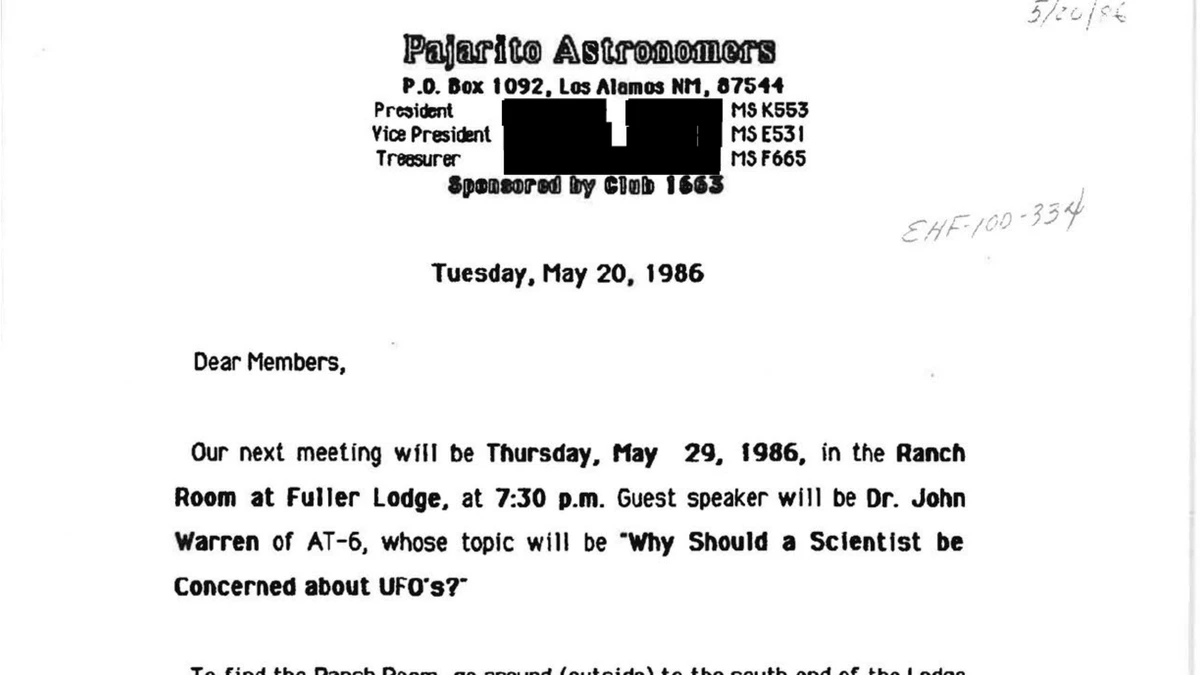
The letter announces a club meeting on Thursday 29 May 1986 at 7:30pm in the Ranch Room at Fuller Lodge, with a guest speaker and a talk title, and that is all it announces. Read from the top, here is everything on the page.
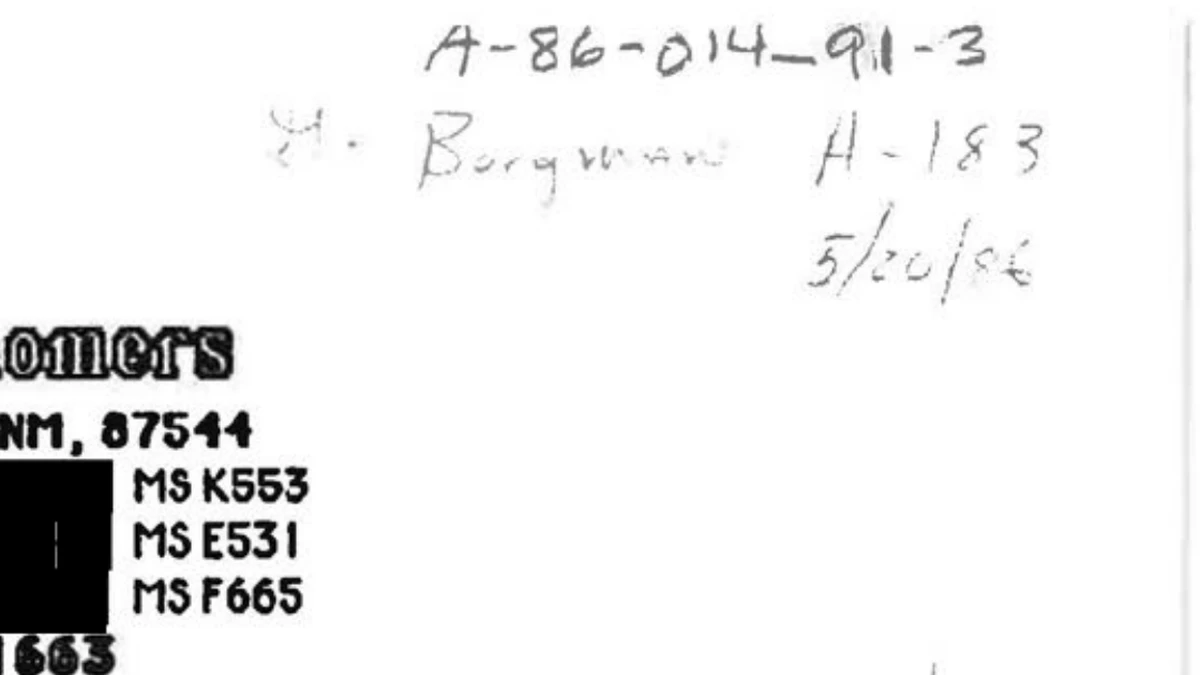
The letterhead reads "Pajarito Astronomers, P.O. Box 1092, Los Alamos NM, 87544". Beneath it are three officer lines, President, Vice President and Treasurer. The names are blacked out, but the contact codes next to them are not: MS K553, MS E531 and MS F665. "MS" is a mail stop, the Laboratory's internal postal address. These three people gave their work pigeonholes as the way to reach them, which tells you the club's committee were Los Alamos staff. Below that, a line reads "Sponsored by Club 1663", presumably a nod to P.O. Box 1663, the Santa Fe postbox that served as the mailing address for the whole wartime Los Alamos project.
Then the date, "Tuesday, May 20, 1986", and the body, which is three sentences long. In the letter's own words: "Our next meeting will be Thursday, May 29, 1986, in the Ranch Room at Fuller Lodge, at 7:30 p.m. Guest speaker will be Dr. John Warren of AT-6, whose topic will be 'Why Should a Scientist be Concerned about UFO's?'"
The second paragraph is directions. To find the Ranch Room, go around the outside to the south end of the Lodge, facing Central Avenue, and go upstairs. "See you there." Then "Sincerely," and a redacted signature and typed name.
Fuller Lodge, for readers who have not been to Los Alamos, is the big log building on Central Avenue that was the dining hall of the Los Alamos Ranch School before the Army took the mesa in 1943. It is a community hall today, and it was one in 1986. An astronomy club meeting in an upstairs room there on a Thursday evening is about as ordinary as small-town life gets.
Why Should a Scientist Be Concerned About UFOs? The Talk and the Speaker
The speaker was Dr John Warren of AT-6, a group in the Laboratory's Accelerator Technology Division, and nobody now knows what he said. The Department of Energy's release notes say, in full: "The referenced event was not officially hosted by Los Alamos. The laboratory has no record of the subject matter discussed at the meeting."
So we have a title and a division code. In 1986 the AT Division ran the Laboratory's accelerator work, the big proton machine at LAMPF among other things, and a group numbered AT-6 would have been a team of physicists and engineers inside it. That is consistent with the Department calling him a "Laboratory-affiliated physicist". We searched for a published version of the talk, a newsletter write-up, or a later paper by Dr Warren on the subject and found nothing. If a club member kept notes, they have not surfaced.
The title itself is worth a moment, because it is a question rather than a claim. "Why should a scientist be concerned about UFOs?" is the sort of title a working physicist picks when he wants to talk about evidence, instrumentation and how to think about odd reports, not the sort a believer picks. It could equally have been a sceptical talk. Given the audience, a room of people who spend their evenings looking up through telescopes and know exactly what Venus, a satellite and a meteor look like, a lecture on how to sort real anomalies from misidentifications would have gone down well. But that is our guess, and the document does not settle it.
Los Alamos UFO Letter: What It Does Not Say (and Where We Got It Wrong)
The letter does not describe a sighting, a light, a fireball, a colour, a direction of travel or a date on which anything was seen, and it was not addressed to Laboratory officials. It was addressed "Dear Members".
When the second release landed in May we wrote, in our overview of the 2026 government UFO files, that this document "describes observations of unusual aerial phenomena in the region" and that its writers "clearly believed the laboratory should know about what was being seen in their skies". Our green fireballs deep-dive repeated the idea that trained observers were still reporting the phenomenon to the Laboratory in 1986. Neither claim survives contact with the page. We were working from the release headlines at the time rather than from the scan, and we have now corrected both articles.
We were not alone. The document's title in the metadata, "Pajarito Astronomers Invitation", is accurate, but the fact that it sat in a folder next to the Tuck letters and the green fireball file made it very easy to assume it was more of the same. It is a lesson this series keeps teaching: the Department of Energy's one-line summary was right, and the excited retellings were wrong. The same thing happened with the spiral's diameter on page 322 of the NSA files and with the JFK "UFO memo". Read the document, not the write-up.
The kit that turns a UFO into a satellite
Kit we've reviewed in full
Dr Warren's audience were people who already knew the sky. Most UFO reports come from people who don't, and a decent pair of binoculars closes that gap faster than anything else. New to them? Start with our guide to binocular astronomy.
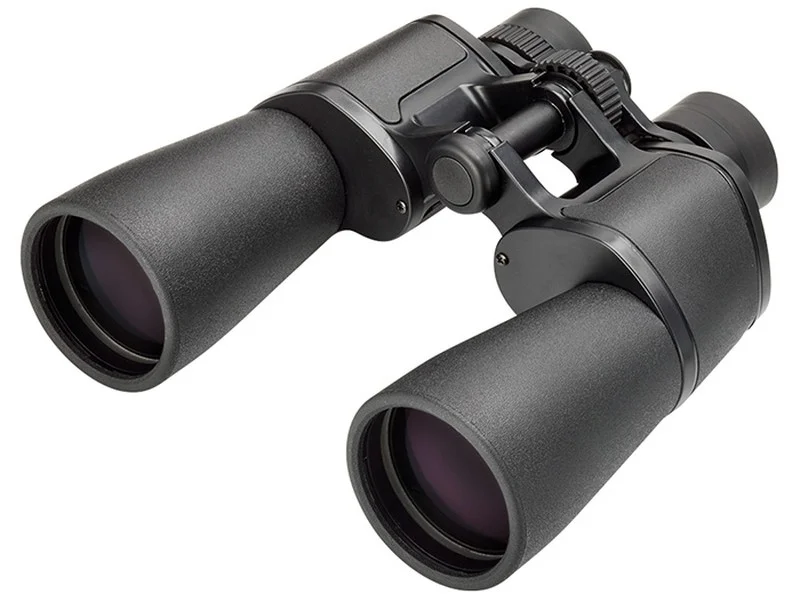
Bright, wide and quick to point at something odd overhead. Enough to tell a planet from a plane from a tumbling rocket body.
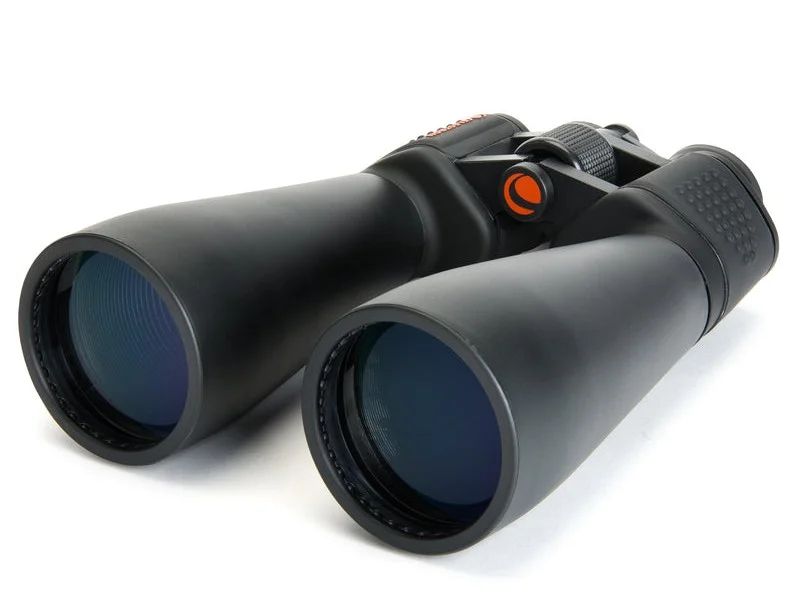
Bigger and heavier, but a high-altitude balloon or a satellite flare shows shape and motion at 15x.
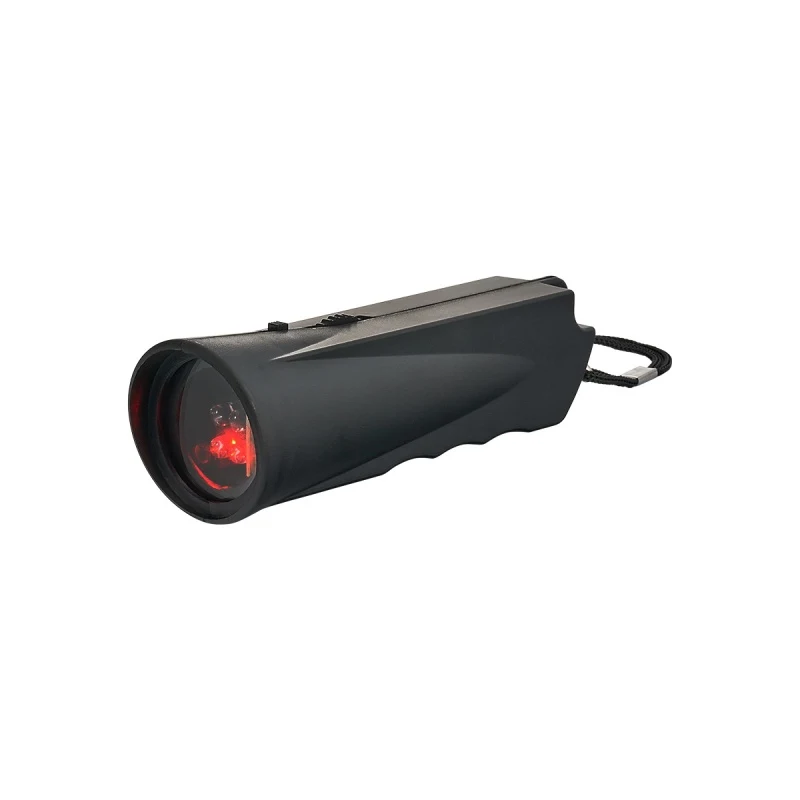
Astro Essentials Red Light Torch
Check a sky app or a star chart without wrecking your dark adaptation.
Affiliate links: you pay the same price, we earn a small commission that helps keep WatchTheStars free.
Why a Club Newsletter Is in the Pentagon UFO Files
The page is in the release because it was in Los Alamos National Laboratory's records and it contains the word UFO. Under the 2026 declassification order, each department searched its holdings for material about unidentified aerial phenomena and published whatever it found, and the Department of Energy's contribution was overwhelmingly Los Alamos and Sandia material. A keyword search does not know the difference between a physicist's letter about green fireballs and a club notice about a talk.
How it got into the records in the first place is visible on the page. The officers used Laboratory mail stops, so the newsletter travelled through the internal mail. Someone then wrote on it. Top right, in pen, there is a code, A-86-014-91-3, a name, a second code, and the date 5/20/86, plus another handwritten reference lower down. We cannot say for certain what filing system those belong to, but the "A-86" prefix follows the pattern the Laboratory's archives use for accession numbers, and the year matches. In other words, an archivist or records clerk logged a copy of the club's mailing in 1986, and forty years later a records search for "UFO" turned it up.
That is a useful reminder about how these releases work. The PURSUE programme is not a curated selection of the government's best evidence. It is what a set of searches returned, good and trivial together, and part of reading it properly is being willing to say when a document is trivial. This one is. Its real value is as a footnote to the bigger Los Alamos story: the town where James Tuck and Edward Teller argued about green fireballs in 1949 still had a room full of scientists turning up on a Thursday night to hear a colleague talk about UFOs in 1986. That interest never went away, and our page on UFOs over nuclear sites explains why the Pajarito Plateau in particular kept producing reports.
Astronomy Clubs and UFO Reports: Why Amateur Astronomers See Fewer UFOs
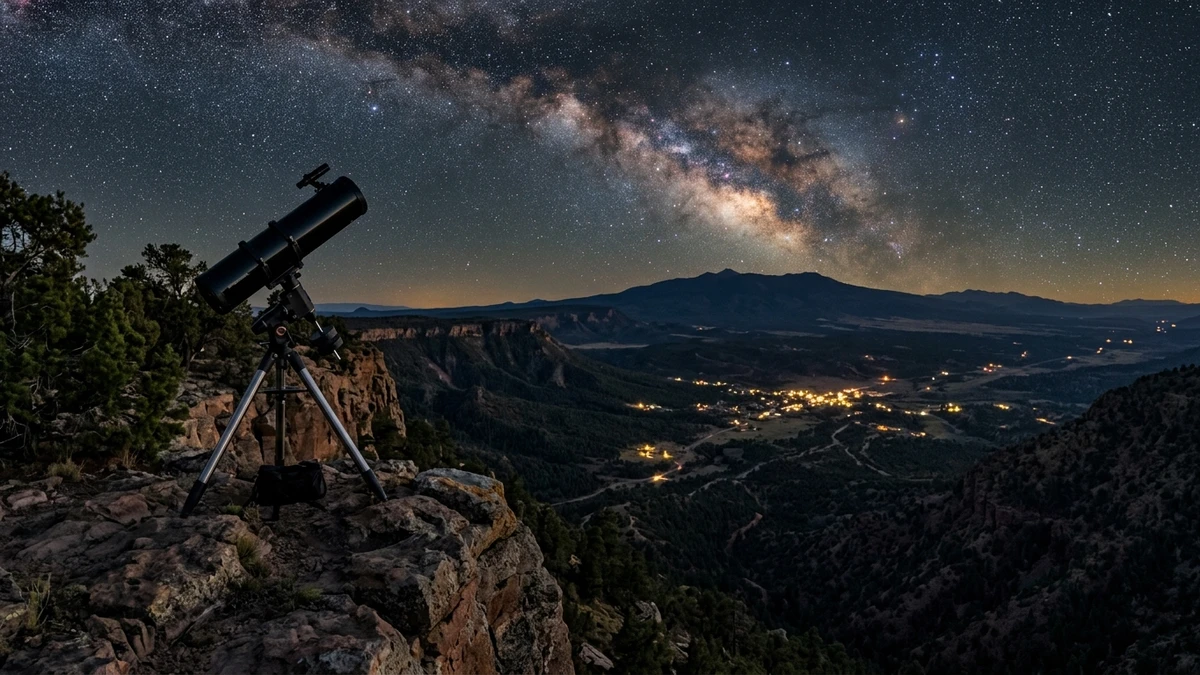
Amateur astronomers report far fewer UFOs than the general public because they spend more time looking at the sky and know what is normally in it. That is the quiet joke in this document. The one group of people in Los Alamos least likely to be fooled by a bright light over the mesa were the ones who booked a UFO talk, and they booked it, we suspect, out of curiosity rather than alarm.
It is also the single most useful thing a reader can take from it. Most of the "UFO" messages we get each year are Venus low in the west, Jupiter, the International Space Station, a Starlink train, a tumbling rocket body or a very bright meteor. A club will teach you all of those in a season, and there is almost certainly one near you: our directory of astronomy clubs in the UK and Ireland lists 288 of them with meeting details. Before you go, check what you can see in the sky tonight and the ISS passes tonight page, because those two answer most sightings on their own. If you are starting from scratch, our stargazing for beginners guide covers the first few months, and a trip to one of the UK dark sky sites will show you far stranger things than any file on war.gov, every one of which has a name.
Where to Read DOE-UAP-D003
The PDF is public on war.gov under the second release of 22 May 2026, filed as DOE-UAP-D003_Pajarito_Astronomers.pdf, and it is one page. We hold a copy in our UAP document archive with the rest of the Department of Energy material from that batch, and our guide to the second PURSUE batch puts it in context with the other five documents released the same day.
If you know more about Dr Warren's 1986 talk, or you were in the Ranch Room that Thursday evening, we would very much like to hear from you. It would be nice, for once, to finish one of these posts with the answer.
Sources:
- DOE-UAP-D003, Pajarito Astronomers Invitation, 1986 — US Department of War, PURSUE Release 2, 22 May 2026, read from our local archive copy
- Release 2 metadata catalogue (release_02_metadata.csv), entry for DOE-UAP-D003 — Department of Energy description and release notes
- Pajarito Astronomers — Sky & Telescope club directory listing
- Pajarito Astronomers Club: Dark Night observing at Overlook Park — Los Alamos Reporter, for the club's history with Los Alamos County
Frequently Asked Questions
Equipment guides
Related topics

Ian ClaytonAmateur astronomer and founder of WatchTheStars.co.uk, dedicated to helping others explore the wonders of our universe. Full profile →