Key takeaways
- The 1950s UFO files in Pentagon Release 7 (DOW-UAP-D156 to D164, D177 to D179 and D181) are mostly explainable
- The 1953 Catalina UFO (DOW-UAP-D178) was filed as 'Jupiter', but our sky check puts Sirius right over the island
- Two of the Catalina UFO files labelled 'Unresolved' were closed by the Air Force as a meteor and as Jupiter
- The Sardinia green fireball file (DOW-UAP-D157) shows a Vatican astronomer got the Sun's position right to within 0.6 degrees
Jump to section 9 sections
- 1950s UFO Files in Release 7: What the Pentagon Published
- Catalina Island UFO, 1953: Jupiter or Sirius?
- Catalina UFO Files, 1949 to 1955: A Meteor, Scouts and a Letter to Kenneth Arnold
- Green Fireball Over Sardinia, 1952: The Vatican Astronomer's Sums
- Guam UFO Chase, 1957: Sirius, Jupiter and a Weather Balloon
- Alaska UFO Lights, 1953: Little Diomede and Gambell
- Berlin, Prince George, Morocco and Sweden: 1953 UFO Reports With No Star to Blame
- Seymour, Indiana UFO, 1953: Rings of Light and a Missing Date
- 1950s UFO Sightings Explained: Our Sky Check in One Table
The Pentagon's seventh UFO file release, published on 23 October 2026, ends with a tray of 1950s UFO files from the US Air Force: thirteen sighting reports numbered DOW-UAP-D156 to D164, D177, D178, D179 and D181, plus the B-52 radar file D155 that we covered on its own. Four are filed under the name "Unresolved UAP Report". We ran the sky for every case that gave a time and place.
The short version: most of these 1950s UFO files have plain answers, and in one case the Air Force picked the wrong bright object. Our round-up of the Pentagon's seventh UFO file release covers the rest of the batch. Every sky position below is our calculation, made with Skyfield and NASA JPL's DE421 ephemeris for the exact place and time in each report.
1950s UFO Files in Release 7: What the Pentagon Published
Release 7 holds fourteen Air Force sighting files from 1949 to 1957. Most are AF Form 112 Air Intelligence Information Reports sent in from bases and embassies abroad, plus four items from Catalina Island, off Los Angeles. They are raw field reports, not investigations: one witness, a guess at size ("a nickel at arm's length"), and sometimes a verdict typed on a record card years later.
The label matters. The Department of War filed D177, D178 and D181 (and D179, by its file name) as "Unresolved UAP Report". The Air Force's own cards inside those files say otherwise: D177 was a meteor, D178 was "Astronomical (JUPITER)", and D179 and D181 were "Insufficient Data". None was left as an unknown. The files also carry witnesses' names, addresses and phone numbers, and one witness was a 14-year-old boy. We leave all of that out.
Catalina Island UFO, 1953: Jupiter or Sirius?
The Air Force said Jupiter. Our sky check says it was more likely Sirius, the brightest star in the sky.
Between 05:05 and 05:15 Pacific time on 16 November 1953, an Air Force sergeant in San Pedro, California watched a round light that seemed to hang over Catalina Island at 45 degrees elevation, then drift north-west toward Los Angeles and fade (file DOW-UAP-D178). He called it "purplish white" at first, then white. The local teletype passed on the view of astronomers at Griffith Observatory that such objects are "POSSIBLY PLANETS". A later Project 10073 record card, typed on a form edition dated September 1963, gives the verdict.
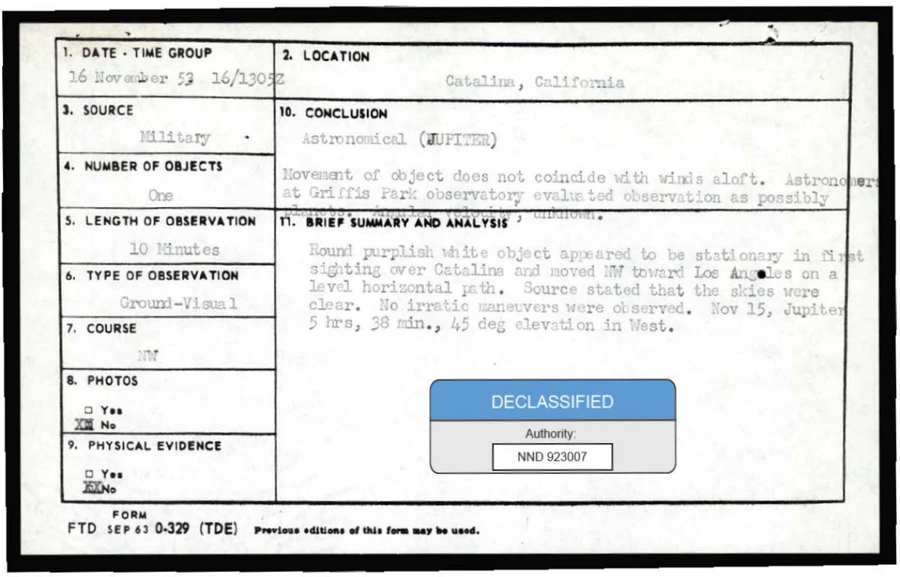
We ran the sky from San Pedro for those ten minutes. Jupiter was 46 degrees up, falling to 44, which matches the reported height almost exactly. But it was due west (azimuth 269 to 270 degrees), over the Palos Verdes hills and open sea, not over Catalina. Sirius was 31 degrees up in the south-west (azimuth 217 to 219 degrees), sitting right above the island (our calculation).
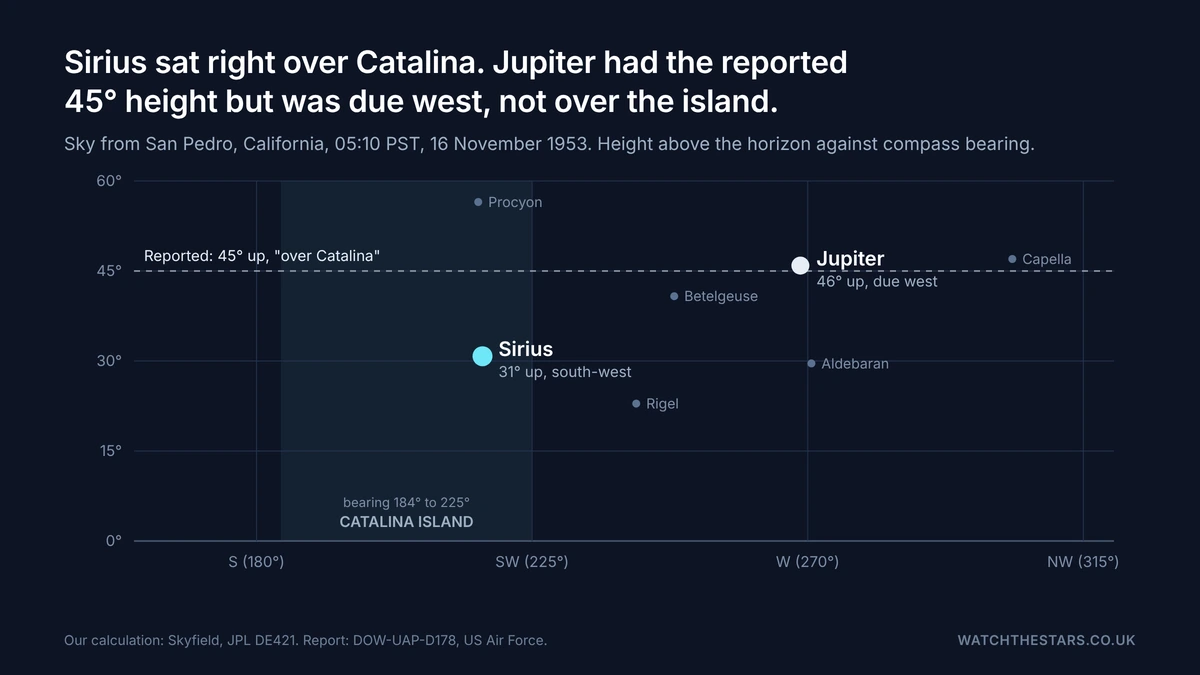
Colour tips it further. Low in the sky, Sirius flashes white, blue and violet as the air bends its light, while Jupiter shines a steady cream. "Purplish white" fading to white sounds like Sirius. Neither one could have drifted toward Los Angeles: each moved only about 2 degrees in ten minutes. That drift was probably the autokinetic effect, where a lone light in a dark sky seems to wander because your eyes can't hold it still. Our guide to why a star seems to follow your plane explains both effects.
One more catch. The card's line "Nov 15, Jupiter 5 hrs, 38 min." is not a clock time. It is Jupiter's right ascension, its position on the sky like a longitude. Our calculation puts it at 5h 38m on 15 November 1953, a match to the minute. So the person who filled in the card did look Jupiter up. They just didn't check the direction.
Catalina UFO Files, 1949 to 1955: A Meteor, Scouts and a Letter to Kenneth Arnold
The other three Catalina files are a meteor, a daytime sighting and a letter, and the Air Force said as much at the time.
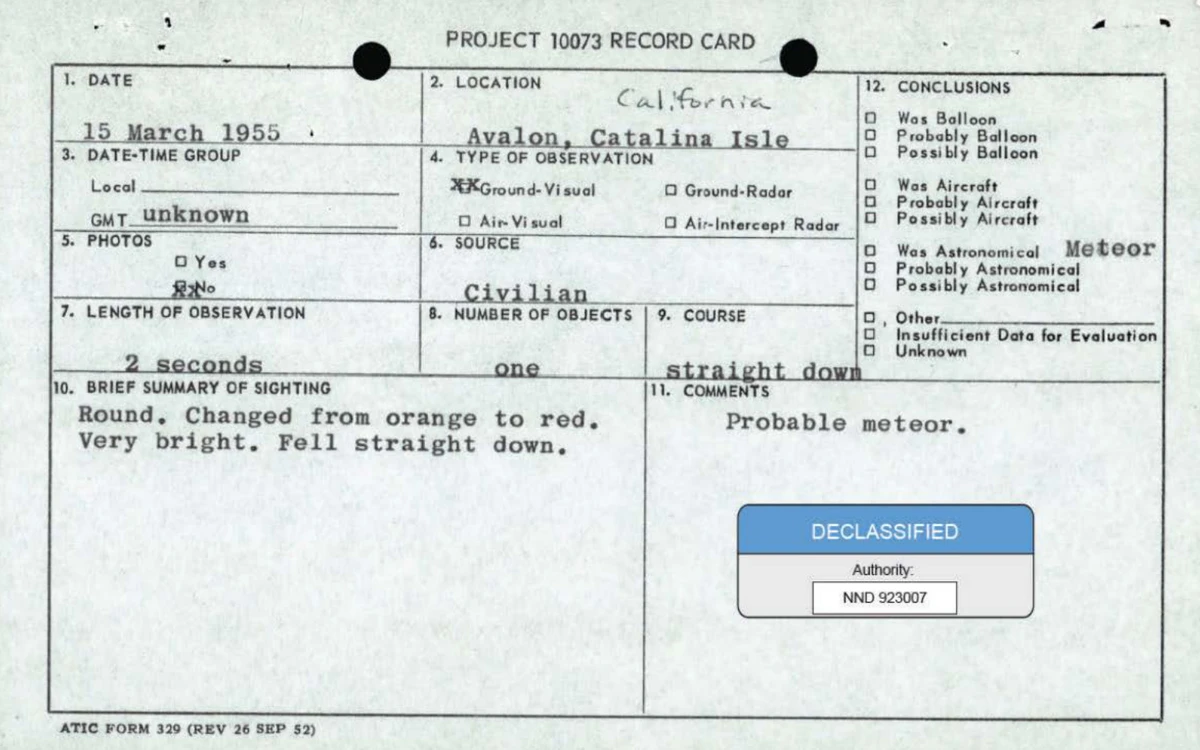
March 1955 (D177). A resident of Avalon saw a very bright round light, orange turning red, fall straight down in the north-north-west for two seconds. The radar squadron's officer called it probably a meteor, an index card said "Possibly Astronomical", and the final record card says "Was Astronomical" with "Meteor" typed beside it. The time on the index card, 2231Z, is when the teletype was sent, not when the sighting happened, so we can't run the sky. We don't need to: a bright light that falls 35 degrees in two seconds and fades is a fireball, a meteor big enough to glow orange and red.
June 1952 (D179). Three Boy Scouts at summer camp reported a silver object at noon, faster than a jet, that made one climbing turn and "disintegrated". The Sun was 74 degrees up, so this was daylight and nothing astronomical. The reporting officer noted that "The experience of the observers is probably meager at best", and the scouts' own letters and sketch aren't in the file. Insufficient data is fair.
April 1949 (D181). This is a handwritten letter to Kenneth Arnold, the pilot whose 1947 sighting gave us the phrase "flying saucer". An Avalon resident wrote that at about 8pm on 28 April his wife and a schoolteacher saw six objects, "not in a group, but singly", and family on the next street saw four more, all heading the same way. That makes ten, not the six on the record card. Somehow the letter reached Air Force intelligence in May 1949, where someone pencilled that it was never acknowledged. Saturn was 69 degrees up in the south that night with no Moon (our calculation), but ten lights passing one at a time are not planets. Aircraft from the Long Beach area or birds lit from below are likelier. The 1948 Project Sign report covers how the Air Force handled reports like this in that era.
Green Fireball Over Sardinia, 1952: The Vatican Astronomer's Sums
The Sardinia file is a textbook fireball, and the astronomy inside it holds up. At 21:45 on 27 August 1952, a professor in Sassari saw a green-blue sphere "slightly larger than the full moon" race east to west across the southern sky for three to five seconds, leaving a glowing trail (file DOW-UAP-D157). His first thought was a meteorite. The US Air Attaché in Rome forwarded his statement in December 1953.
The professor took his notes to Father Junkes, a Jesuit astronomer at the Vatican Observatory in Castel Gandolfo, who worked out where the Sun was at that moment: 27° 41' below the horizon, at azimuth 133° 36' measured from south through west. Our calculation gives 27.1 degrees below and 134 degrees, agreeing to within 0.6 degrees. That also confirms the time was Central European Time. (The professor calls Junkes the observatory's director; we couldn't confirm that.)
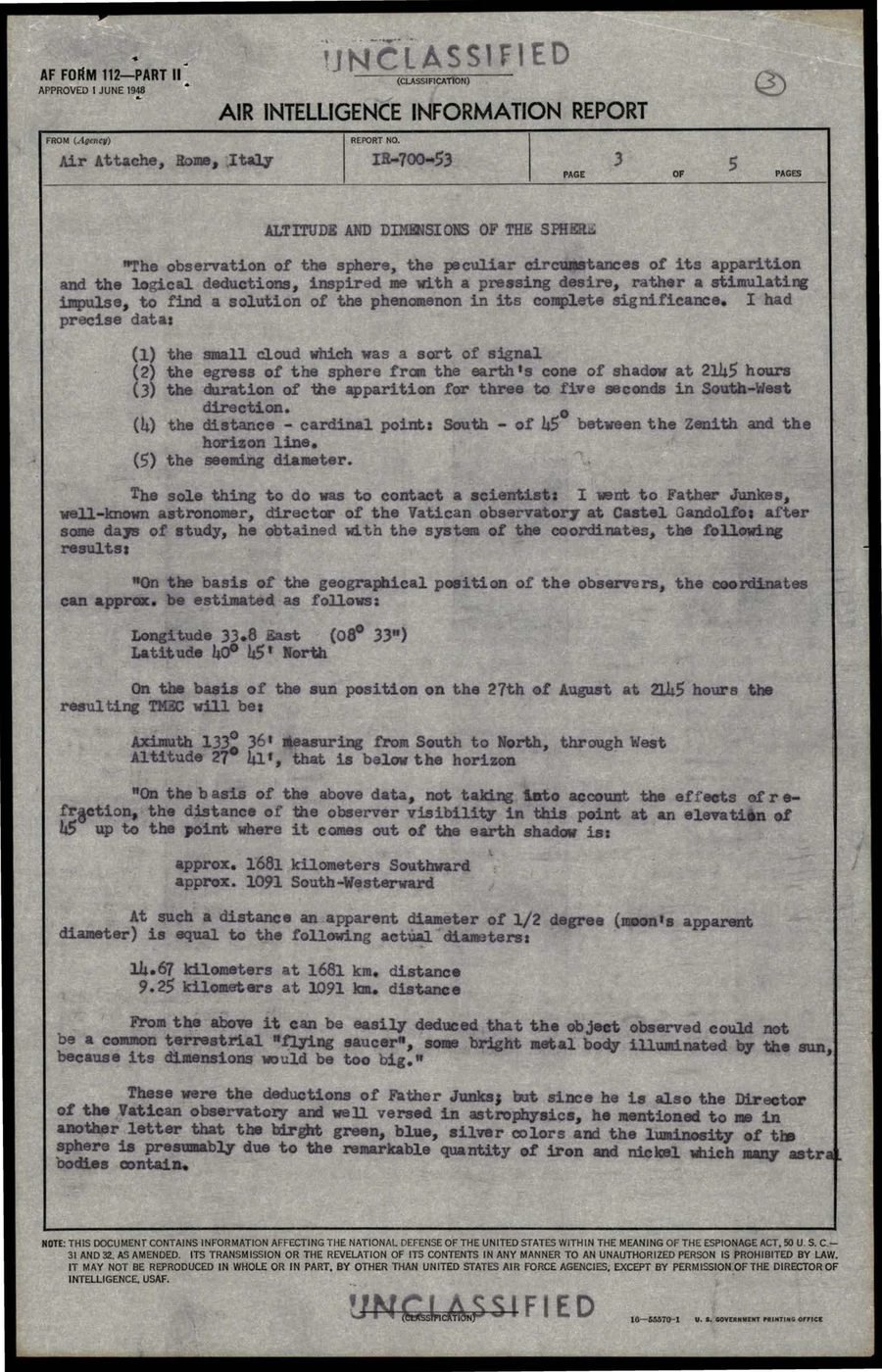
Where the sums go wrong is the model. The astronomer treated the sphere as a sunlit body high enough to sit outside Earth's shadow, which made it 9 to 15 km across. A fireball isn't lit by the Sun; it glows as it burns up in the air, so the size calculation falls away. (His 9.25 km figure is also an arithmetic slip for about 9.5.) He did add that the green, blue and silver colours were probably down to "iron and nickel", which is close to right: green is one of the commonest colours in bright meteors. The Air Force's own green fireball incidents over New Mexico ran from 1948 into the 1950s. If you want to see a bright meteor yourself, the Geminids meteor shower next month is the year's richest, and our page on the next meteor shower in the UK has the rest.
Guam UFO Chase, 1957: Sirius, Jupiter and a Weather Balloon
The 1957 Guam UFO chase was probably a bright star for at least part of the ten minutes, though a weather balloon was the Air Force's only lead. The file gets its own post soon, so here is the short version. At 02:10 local time on 1 January 1957, an F-86D pilot over Guam chased a blinking white light for about ten minutes (file DOW-UAP-D156). It turned with him, and once it "started circling him" he put the jet in afterburner but "was unable to gain on it or close with it". The Air Force found a lighted weather balloon launched earlier that night, and the reporting officer wrote that, unless that balloon malfunctioned, the object "can not be readily explained".
Our calculation: no Moon, Sirius 50 degrees up in the south-west and Jupiter 35 degrees up in the east. The circling phase fits a bright star seen from a hard-turning jet very well. The first phase, when the light passed under the aircraft, doesn't: no star sits below a plane at 20,000 feet. The account may blend two different things.
Alaska UFO Lights, 1953: Little Diomede and Gambell
Both Alaska files describe a light on the horizon toward Soviet territory, and in neither case was a star or planet anywhere near it. That is the useful result: we ruled astronomy out, not in.
Little Diomede, early October 1953 (D161). A 14-year-old Alaska Native boy, who had been keeping his own nightly watch on Soviet Big Diomede 2.5 miles away, saw a light on its southern tip for a few seconds. He thought it came from "a large flashlight or spotlight". The report's dates conflict (it gives both 6 and 8 October), so we checked all three nights at the reported time: dark, no Moon, and nothing bright low in that direction (our calculation). The light was on the island itself, well under a degree above the sea. The Air Force noted it only because nobody had been seen there before.
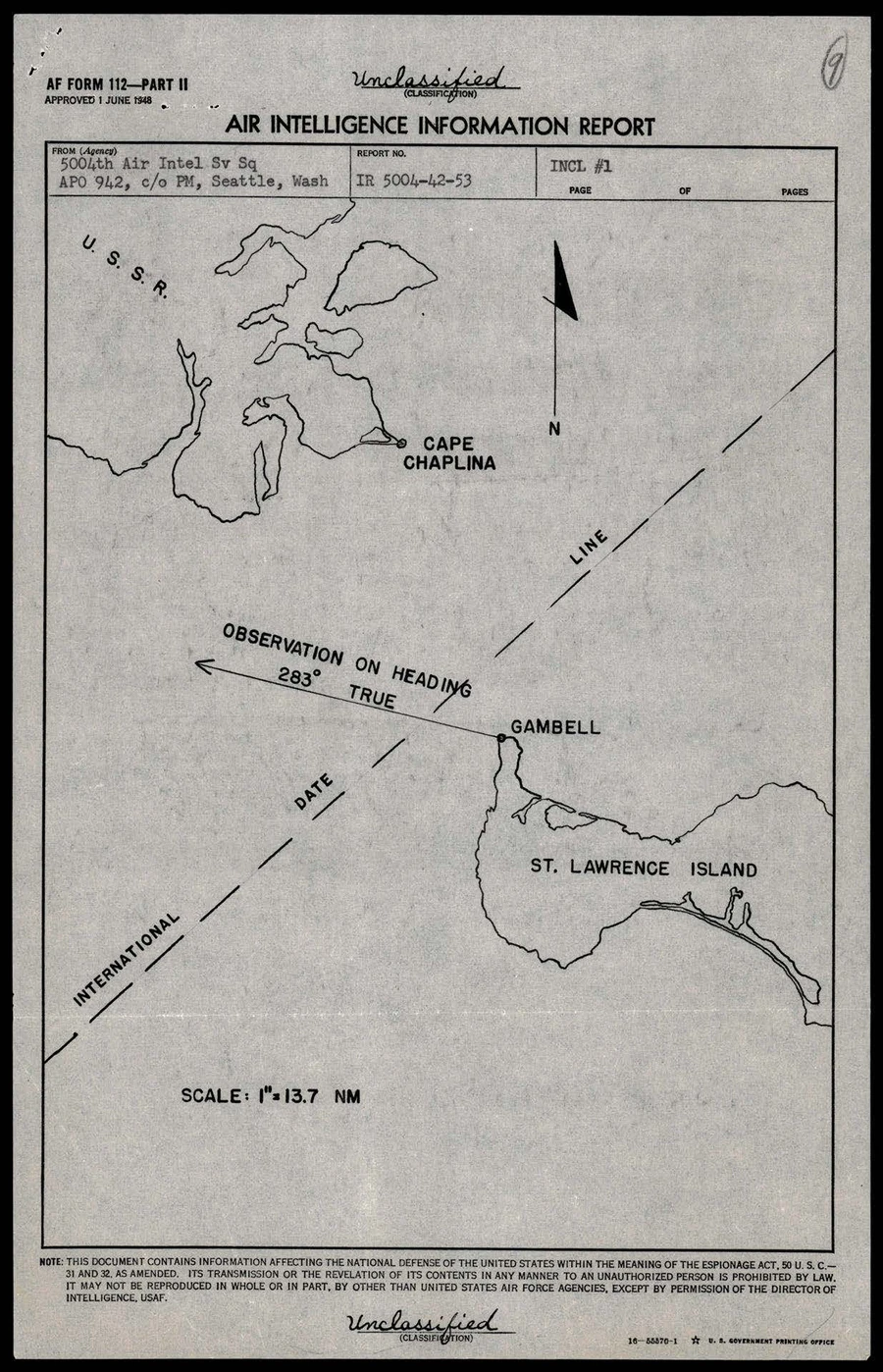
Gambell, St Lawrence Island, 1 December 1953 (D162). A National Guard sergeant watched a steady light on the western horizon, bearing 283 degrees true, for about five minutes until it "disappeared as though someone had turned it off". A setting star was our first suspect, because that is exactly how one vanishes. But at 00:10 local time nothing bright was low in the west; the only bright object near any horizon was Sirius, 5 degrees up in the south-south-east (our calculation). The Air Force's "ship at sea" stands. Our Alaska UFO history puts these two files in context.
Berlin, Prince George, Morocco and Sweden: 1953 UFO Reports With No Star to Blame
These four 1953 reports have no good astronomical candidate. Each has a more down-to-earth answer, or none.
The Berlin air corridor, 10 August 1953 (D159). A British European Airways DC-3 reported "red colored rockets" fired about a mile ahead, and three hours later another reported a steady red light at about 5,000 feet west of Genthin, in the Soviet Zone. The British air safety centre said the Soviets "could not account for it". Low in the west at 23:45 local time, Arcturus was 10 degrees up and can look reddish (our calculation), but a pilot placing a light at a set height over the ground isn't describing a star. A Pan Am pilot said he had seen ground-to-air firing in the same area three nights earlier. Flares or ground fire fit better.
Prince George, British Columbia, 7 November 1953 (D158). Two airmen guarding a B-29 saw what "Appeared at first to be a falling star" come down to about 150 feet, hang there, rise and leave westward with a two-second hum. The sky was moonless; Jupiter was just 6 degrees up in the east-north-east (our calculation). No star stops at 150 feet. The intelligence officer wrote "Cause unknown."
Saïdia, Morocco, 16 December 1953 (D160). A radar-only report: a line of up to twelve returns over the Mediterranean, shifting between V, W and M shapes, under thick cloud. The division's electronics staff suggested "Anomalous propagation", jamming from a ship, or "Geese or storks". Nothing to check in the sky.
Hässleholm, Sweden, 17 December 1953 (D163). In daylight, the crew of a Transair DC-3 saw a shining sphere pass beneath them, which the newspaper account says "could definitely not have been a meteor". Sweden's Defence Staff opened an investigation. The Sun was only 3.9 degrees up in the south-west (our calculation), in the direction the object came from, and low sunlight glinting off another aircraft can look exactly like polished metal. Sweden was still chasing objects seven years after its 1946 ghost rockets.
Check the sky yourself
Kit we've reviewed in full
Most of these 1950s reports come down to a bright star, a planet or a meteor. A pair of binoculars settles that in seconds: a star stays a point, a planet shows a tiny disc, and an aircraft shows its lights.
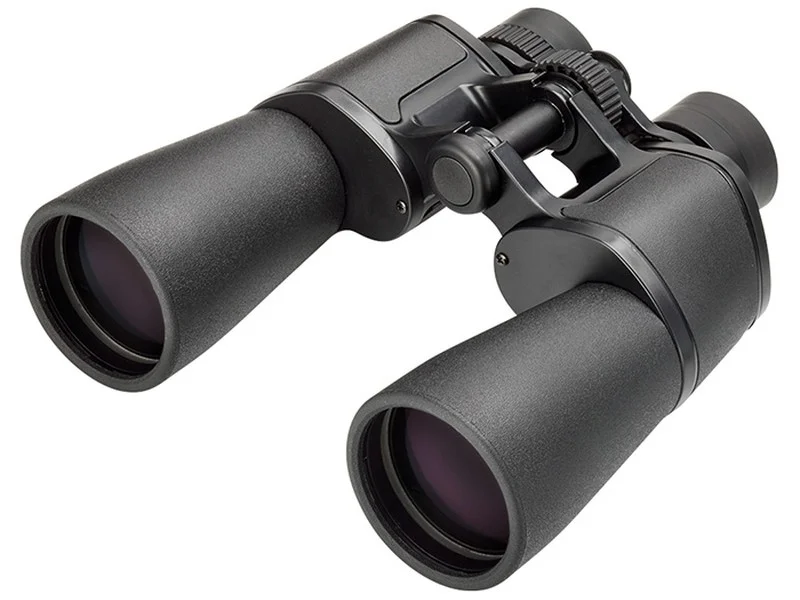
Bright and wide, so you can find Sirius or Jupiter fast and see it isn't moving.
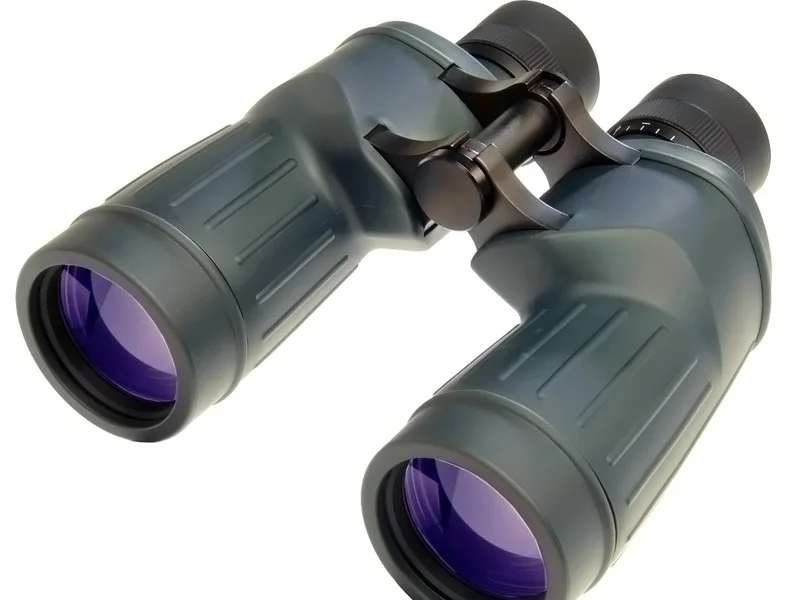
Built for cold, damp winter nights, when Sirius is up and the reports come in.
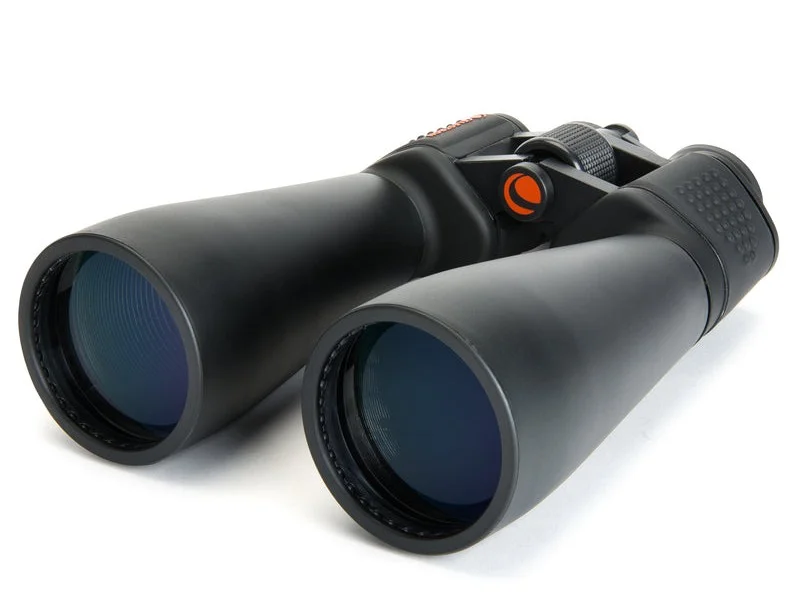
Enough power to show Jupiter's four big moons, the quickest proof a light is a planet. Best on a tripod.
Affiliate links: you pay the same price, we earn a small commission that helps keep WatchTheStars free.
Seymour, Indiana UFO, 1953: Rings of Light and a Missing Date
The Seymour file can't be pinned to a night, and what it describes isn't a star. A pharmacist and his wife, driving east one December evening, saw two white, cloudy rings, each with four bright points "rotating slowly clockwise", come down, hover and leave fast to the south-west (file DOW-UAP-D164). They told only three friends, "desiring to avoid ridicule", and the story reached the Air Force through a hospital doctor a month later.
The couple couldn't remember the date. The form's own weather notes give clear evenings only on 10 to 12 December, so it was most likely one of those. Checking those evenings, the brightest thing in the sky was Jupiter, about 18 degrees up in the east-north-east, and nothing bright sat in the north where they were looking (our calculation). The form also says "between dusk and night", but at 18:05 local time the Sun was nearly 20 degrees down, full darkness. Two lights in formation that hover and leave are not planets. A pair of aircraft with landing lights in haze is the obvious ordinary candidate, but without a date the Air Force couldn't check traffic, and neither can we.
1950s UFO Sightings Explained: Our Sky Check in One Table
Of the thirteen sighting files, the sky explains two outright (Catalina 1953 and Guam's circling phase), meteors explain two more (Sardinia and Catalina 1955), and the rest are ruled out as astronomy. All positions are our calculation.
| File | Place and local time | What was in the sky | Our verdict |
|---|---|---|---|
| D178 | San Pedro, 05:05–05:15, 16 Nov 1953 | Sirius 31° SW over Catalina; Jupiter 46° due W | Star or planet; Sirius fits best |
| D177 | Avalon, night, Mar 1955 | Time unknown | Fireball, as the Air Force said |
| D157 | Sassari, 21:45, 27 Aug 1952 | Moon setting; Sun position matches to 0.6° | Fireball |
| D156 | Guam, 02:10, 1 Jan 1957 | Sirius 50° SW; Jupiter 35° E; no Moon | Circling phase fits a star |
| D161 | Little Diomede, early Oct 1953 | Nothing bright near the horizon | Not astronomical |
| D162 | Gambell, 00:10, 1 Dec 1953 | Nothing bright near 283° | Not astronomical; ship light likely |
| D159 | Berlin corridor, 10 Aug 1953 | Saturn 11° WSW, then Arcturus 10° WNW | Weak star case; ground fire likelier |
| D158 | Prince George, 19:15, 7 Nov 1953 | Jupiter 6° ENE; no Moon | Not astronomical |
| D160 | Saïdia, 17:54, 16 Dec 1953 | Overcast; radar only | Not astronomical |
| D163 | Hässleholm, 14:37, 17 Dec 1953 | Sun 3.9° SW | Daylight; not astronomical |
| D164 | Seymour, ~18:05, 10–12 Dec 1953 | Jupiter 18° ENE | Not astronomical |
| D179 | Catalina, noon, 25 Jun 1952 | Sun 74° up | Daylight; insufficient data |
| D181 | Avalon, 20:00, 28 Apr 1949 | Saturn 69° S; no Moon | Not astronomical |
The pattern is one the Air Force knew well, and its later reasoning is covered in why Project Blue Book ended. Bright stars, planets and meteors account for a big share of reports, and the rest needed data nobody collected. The Project Sign file shows the same mix six years earlier.
You can see the culprit from the UK this winter. Sirius rises in the south-east in the late evening and is highest, due south, at about 3am: around 23 degrees up from Plymouth, 21 from Birmingham and 17 from Edinburgh. Jupiter rises around 22:40 to 23:00 and is highest, about 50 degrees up in the south, before dawn (our calculation for 20 to 21 November 2026). Sirius sits so low from Britain that it always twinkles hard, which is why it turns up in winter UFO reports. Check what you can see in the sky tonight, and whether there are ISS passes tonight, before you decide a light is strange. New to all this? Stargazing for beginners will get you round the sky in an evening.
Every file here can be opened on our Pentagon UFO file browser, and the UAP document archive shows how all seven releases fit together.
Sources:
- PURSUE Release 7 documents: US Department of War, 23 October 2026 (files DOW-UAP-D156 to D164, D177, D178, D179 and D181)
- Sky positions for every case and the UK figures for November 2026: our calculation with Skyfield and the JPL DE421 ephemeris, for the place and time given in each report
Header image: an illustration generated with Google Gemini, not a photograph of Catalina Island or the 1953 sky. Document pages: US Air Force, public domain, released by the US Department of War in PURSUE Release 7. Page numbers are PDF pages.
Frequently Asked Questions
Equipment guides
Related topics

Ian ClaytonAmateur astronomer and founder of WatchTheStars.co.uk, dedicated to helping others explore the wonders of our universe. Full profile →