Why a Star Seems to Follow Your Plane (or Your Car)
It isn't chasing you. It's so far away that nothing you do can change where it sits
A star or planet that seems to follow your plane or car isn't moving with you at all: it is staying exactly where it is. It's so far away that travelling a few miles doesn't change its direction, so it keeps the same place in your window while trees, houses and ground lights slide past. Your brain reads "it isn't moving relative to me" as "it is moving with me", and a bright light that keeps pace with you soon feels like it's following.
It's one of the commonest reasons people say a UFO followed their plane or car, and it fooled US Air Force pilots in the 1950s. Below are the numbers, two Air Force files where it happened, and a 30-second check you can do from a window seat.
Why Does the Moon or a Star Seem to Follow You?
The Moon and the stars seem to follow you because they are too far away for your movement to change their direction. They stay fixed in the window while everything nearer slides backwards.
The effect is called parallax: the shift in an object's direction when you see it from a different place, which is large for nearby things and tiny for distant ones. Drive at 60 mph for one minute and you cover a mile. A house 200 metres from the road swings through about 150 degrees in that minute, from well ahead of you to well behind. The Moon, 384,000 km away, shifts by less than one arcsecond, under a thousandth of a degree (our calculation).
Now put yourself in an airliner at 500 mph. In one minute you travel about 8 miles, and the Moon's direction changes by 0.002 degrees, roughly a third of the width of a human hair held at arm's length (our calculation). Sirius, the brightest star in the night sky, is 8.6 light years away, about six trillion times further than those 8 miles. However far you fly, its direction doesn't change by any amount you could measure.
Why Does a Star Turn With the Plane When You Turn?
A star seems to turn with a turning plane because the cabin around you rotates and the star doesn't. From your seat the light slides round the windows, which looks exactly like a light flying a circle around the aircraft.
Picture it from the cockpit. A bright light sits 30 degrees to your right and you bank towards it. As the nose comes round, the light drifts across the windscreen, sits dead ahead, then slides off to the left. Keep turning and it goes all the way round you, which from the seat feels like being circled.
You can't close on it either. Full power makes no difference to a distance measured in light years, so the light never grows bigger or brighter. That is the giveaway: a real aircraft or balloon gets bigger as you approach, and sooner or later you pass it.
On a winding road the Moon does the same, flipping from one side of the windscreen to the other at every bend.
Why Does a Star Flash Red and Blue Like a UFO?
A bright star flashes red, blue and white because Earth's atmosphere bends its light unevenly, an effect called scintillation, or twinkling. It is strongest near the horizon, where the light passes through the most air, and Sirius is the worst offender.
Pockets of warm and cool air act like weak, drifting prisms. Low down, a star's colours separate and you see a fast run of red, green, blue and white, sometimes with the star seeming to blink off. From the UK, Sirius never climbs higher than about 23 degrees above the southern horizon from Plymouth, or 17 degrees from Edinburgh (our calculation), so you always see it through a thick layer of air. On a cold winter night it is the classic "red, blue and white flashing UFO".
Planets twinkle much less, because they show a tiny disc rather than a point and the wobbles average out. That makes Venus and Jupiter the usual "bright hovering light": brighter than any star, steady, and parked in the same patch of sky for an hour or more. Venus is the brightest thing in the night sky after the Moon, and our UK night sky this week says where both planets are.
Seen a bright light you can't place?
Our Tonight tool shows which planets and bright stars are up from your location, and where to look.
Check Tonight's Sky →Did Air Force Pilots Really Chase Stars? Two 1950s UFO Files
Air Force pilots did chase lights that behaved exactly like stars. Two 1950s reports made public in the Pentagon's seventh UFO file release in October 2026 show it: a Guam fighter pilot whose light "circled" his jet, and a light over Catalina Island that the Air Force put down to Jupiter.
Guam, 1 January 1957: the light that circled an F-86D
At 02:10 local time on 1 January 1957 (31 December 1956 GMT), an F-86D alert pilot holding over Guam saw a blinking white light (file DOW-UAP-D156). He took it for a B-47 bomber and turned towards it. The report says the object "proceeded to turn with the aircraft", and he grew suspicious "when he was unable to close with it and it continued to turn with him on the turn."
Later the light climbed above him. He turned to keep it in sight "and it started circling him". He lit the afterburner and turned into it, but "It continued to turn around aircraft and he was unable to gain on it or close with it." After about ten minutes, low fuel sent him back to Andersen Air Force Base.
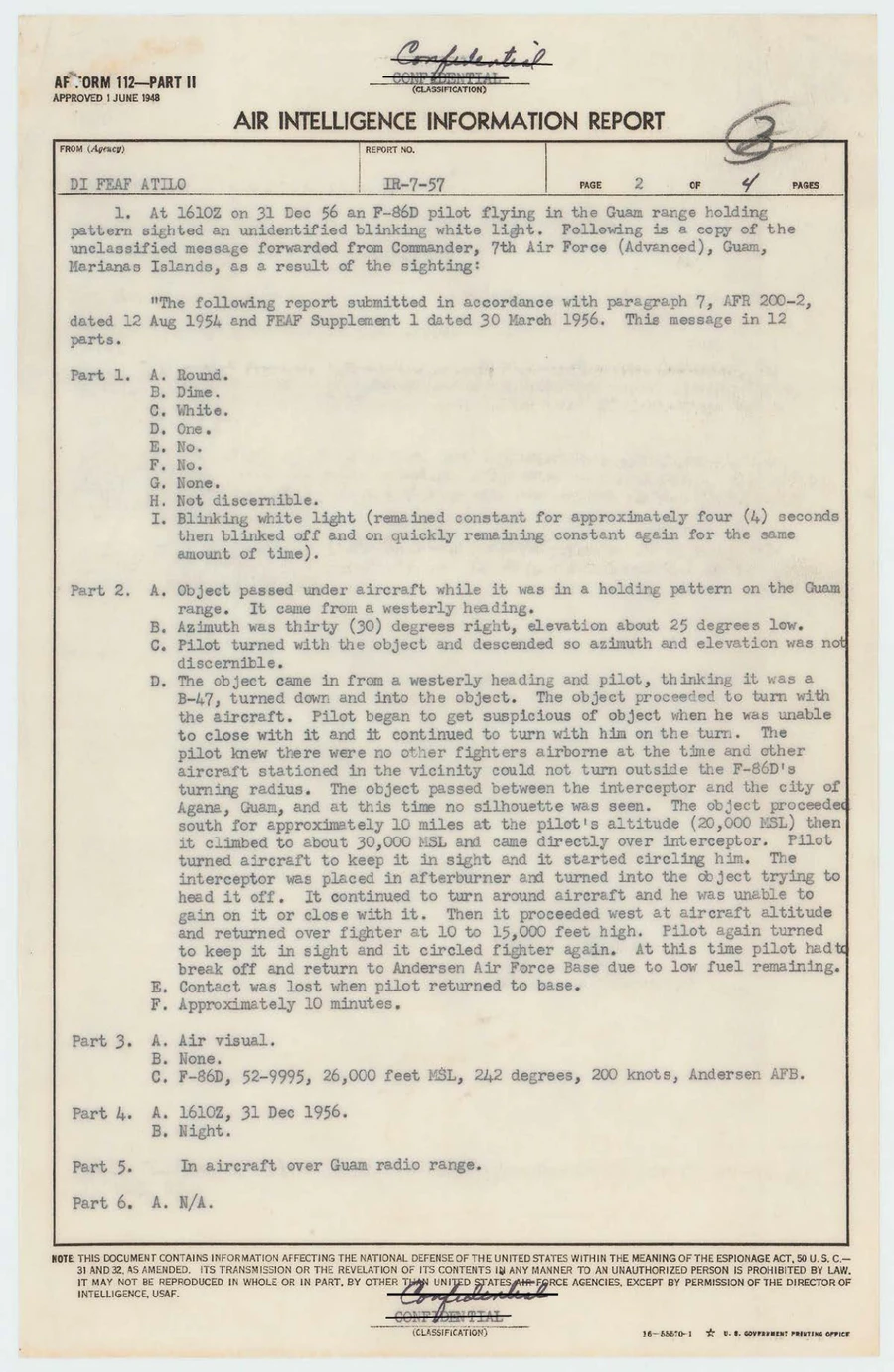
The Air Force looked for a lighted weather balloon and found one, launched by the US Weather Bureau on the island 1 hour 38 minutes before the sighting. The pilot rejected it, saying the light had manoeuvred with his jet. The reporting officer concluded that unless the balloon had malfunctioned and stayed low, the object "can not be readily explained."
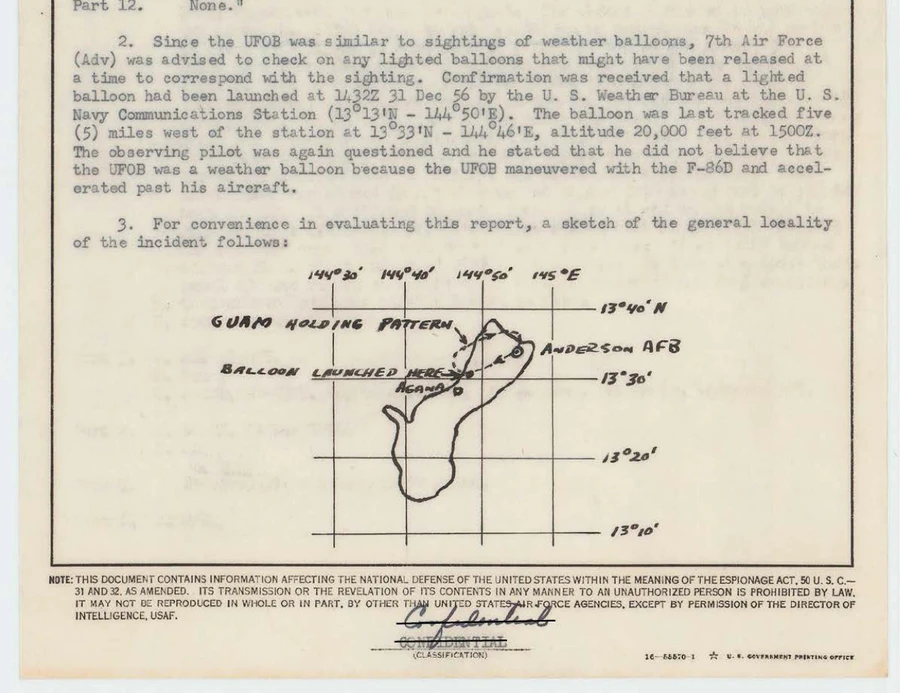
We ran the sky for that time and place. Sirius was 50 degrees up in the south-west (azimuth 222°), Jupiter 35 degrees up in the east (azimuth 99°), and there was no Moon (our calculation). The circling phase fits a bright star or planet very well: a light high above that turned with a hard-turning fighter and could never be closed on. The first part doesn't fit. The light passed under the aircraft, about 25 degrees below it, and from 20,000 feet the horizon is only about 2.5 degrees below level (our calculation), so that light was against the sea or the island. The report may blend two different things.
Catalina Island, 16 November 1953: "Astronomical (JUPITER)"
Before dawn on 16 November 1953, between 05:05 and 05:15 Pacific time, an Air Force sergeant in San Pedro, California saw a "round purplish white object" that seemed to hang over Catalina Island at 45 degrees elevation, then drift north-west towards Los Angeles and fade (file DOW-UAP-D178). The local report passed on the view of Griffith Observatory astronomers that such objects are "possibly planets". A later Air Force record card gave the verdict: "Astronomical (JUPITER)".
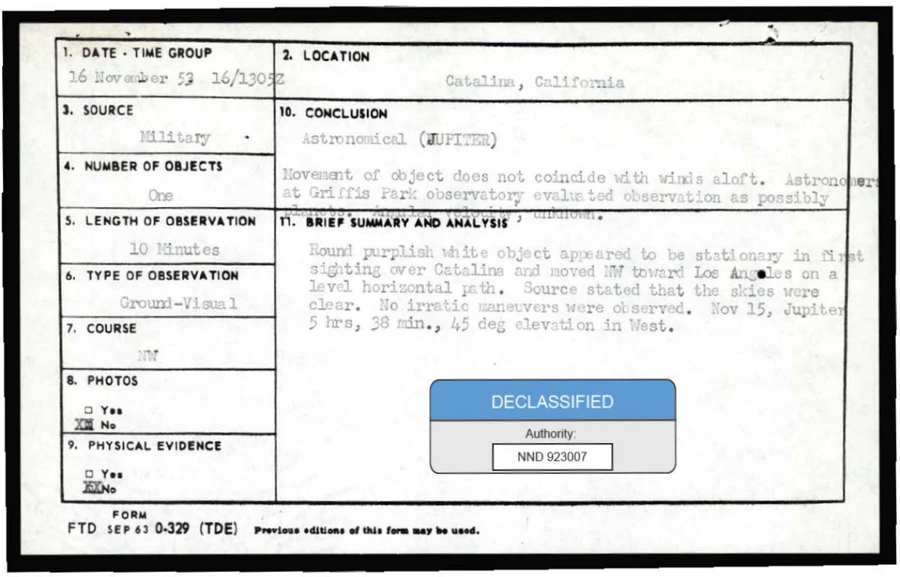
Our check agrees it was astronomical but points at a different object. Jupiter matched the height (45.9 falling to 43.8 degrees) but sat due west at azimuth 269–270°, over the Palos Verdes hills and open sea. Sirius, about 30 degrees up at azimuth 217–219°, sat right over the island (our calculation). Low Sirius flashing white and violet fits "purplish white" fading to white far better than steady Jupiter, so in our view it was more likely Sirius than Jupiter.
Neither Jupiter nor Sirius could have moved north-west towards Los Angeles: each shifted only about 2 degrees in those ten minutes (our calculation). The drift was probably the autokinetic effect, where a lone bright light in a dark sky seems to wander because your eyes can't hold it still. And the card's "Nov 15, Jupiter 5 hrs, 38 min." isn't a time. It is Jupiter's right ascension, its position on the sky, which our calculation puts at 5h 38m on 15 November 1953.
| Case | Bright object | Height and direction | How it fits |
|---|---|---|---|
| Guam, 02:10, 1 Jan 1957 | Sirius | 50°, south-west (222°) | Fits the circling phase |
| Guam, 02:10, 1 Jan 1957 | Jupiter | 35°, east (99°) | Also well placed |
| Catalina, 05:05–05:15, 16 Nov 1953 | Jupiter | 45.9° to 43.8°, due west (269–270°) | Right height, wrong direction |
| Catalina, 05:05–05:15, 16 Nov 1953 | Sirius | 30.8° to 29.5°, south-west (217–219°) | Over the island; fits the colour |
All positions are our calculation with Skyfield and NASA JPL's DE421 ephemeris, for the place and local time in each report.
The aviation writer Philip Klass gave the famous 1986 Japan Air Lines 1628 sighting over Alaska the same reading, arguing the crew were watching Jupiter and Mars. Both 1950s reports are in our PURSUE files browser, and the UAP research hub lists other cases we've checked against the sky.
How to Check a Bright Light Following Your Plane or Car
To check a bright light that seems to follow your plane or car, note the time, which way you're heading and where the light sits, then compare with a planetarium app set to that time. If a bright planet or star is in that spot, you've found your light. It takes about 30 seconds.
- Note the time and your heading. The seat-back map or your phone's map app will show which way you're travelling.
- Note where the light is. Left or right, ahead or behind, and how high. A fist held at arm's length covers about 10 degrees.
- Open a planetarium app. Stellarium, SkySafari or Sky Guide all work. Set the clock to when you saw the light. Phone GPS usually works in flight mode.
- Look for the usual suspects. Venus, Jupiter, Sirius, Capella and Arcturus, then Mars and Saturn. If one sits at the light's direction and height, that's your light. Our page on what you can see in the sky tonight lists which are up from the UK.
- Rule out the ISS. The space station does move visibly, crossing from horizon to horizon in two to six minutes, then fading. Check ISS passes tonight for your location, and our guide to spotting the ISS explains what a pass looks like.
- Use binoculars if you have them. A star stays a single point and a planet a tiny steady disc, while an aircraft splits into separate lights. Our guide to stargazing with binoculars covers holding them steady.
When Is a Light Following You Not a Star?
A light following you is not a star if it crosses the background stars, shows a fixed pattern of coloured lights, drifts across the ground while you travel straight, or appears below the horizon. Any one of those means it is much closer.
- It crosses the stars. Stars and planets keep their places among the other stars. A light sliding through a constellation is an aircraft, a satellite or the ISS.
- It has a pattern of coloured lights. Aircraft carry a red light on the left wingtip, green on the right, and white strobes. A red-green-white pattern that keeps its shape is a plane. Sirius changes colour at random, many times a second.
- It drifts against the ground while you go straight. On a straight road or a steady flight path, the Moon and stars hold their place above the same fields and hills. A light that slides across the hills while your heading stays the same is close, moving, or both.
- It sits below the horizon. A light against the sea, a hillside or the ground is not a star. From an airliner at 35,000 feet the horizon is only about 3.3 degrees below level (our calculation).
- It comes as a string of dots. A neat line of lights moving together is usually a Starlink train, the explanation offered for the orbs a singer filmed following her plane for 45 minutes.
Which Binoculars Help You Check a Light in the Sky?
Kit we've reviewed in full
Binoculars are the fastest way to turn "a light" into an answer. A star stays a single point of light, a planet becomes a small steady disc, and an aircraft breaks up into a cluster of separate lights. A 10x50 pair is the standard stargazing choice and small enough to keep in the car.
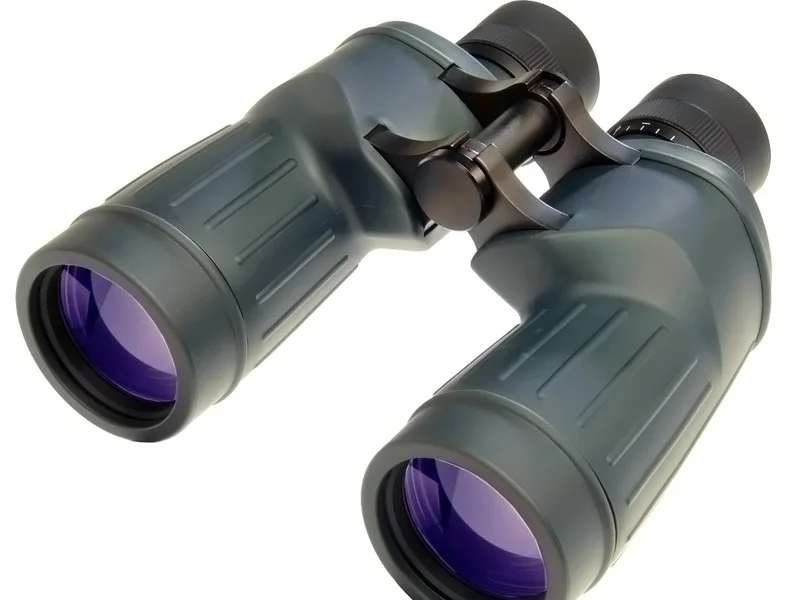
Bright, sharp 10x50s that are easy to hold by hand. Point them at a puzzling light and you'll know within seconds whether it's one point or a set of aircraft lights.
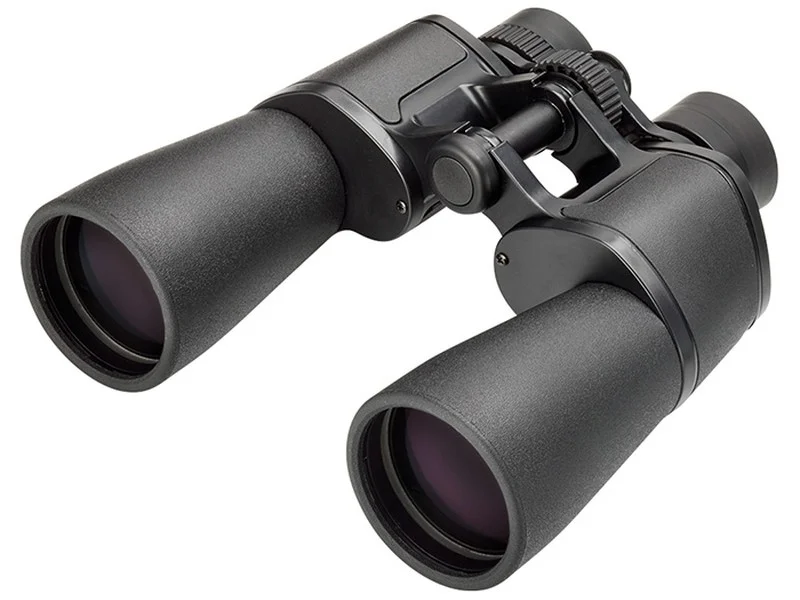
A light, capable pair at a modest price. Good enough to keep by the back door or in the glovebox for the next time something bright seems to be following you.
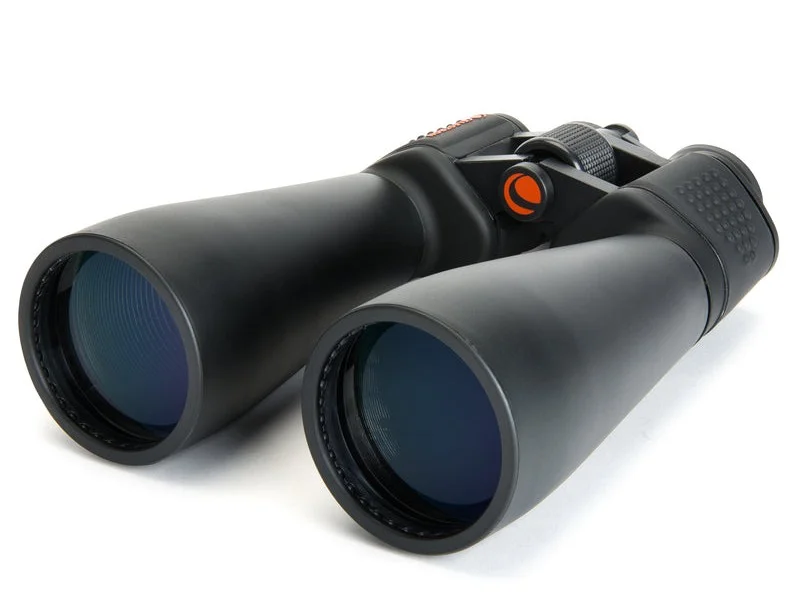
Bigger lenses and more power for the garden. Jupiter's four bright moons show clearly, which settles any argument about whether that light is a planet. Best on a tripod.
Affiliate links: you pay the same price, we earn a small commission that helps keep WatchTheStars free.
Frequently Asked Questions
Why does the Moon follow my car?
The Moon seems to follow your car because it is 384,000 km away, so driving a few miles doesn't change its direction by any amount you could see. Hedges, houses and lamp posts swing past while the Moon stays in the same spot in the window, and your brain reads that as the Moon keeping pace with you. Driving for a minute at 60 mph shifts it by less than one arcsecond.
Can a star follow a plane?
No, but a star can look exactly as if it is following a plane. A star is so far away that the aircraft's movement doesn't change its direction, so it stays fixed in the window while the ground slides past. When the plane turns, the star swings round the cabin and seems to circle the aircraft, and no amount of speed brings it any closer.
What is the bright light following my plane?
A bright light that seems to follow your plane is most often Venus or Jupiter, or a bright star such as Sirius, Capella or Arcturus. Note the time and where the light sits, then check a planetarium app set to that time. If the light moves across the stars it is another aircraft, a satellite or the ISS, and a neat line of moving dots is usually a Starlink train.
Why does Sirius flash red and blue?
Sirius flashes red, blue and white because moving pockets of air bend its light unevenly and split it into colours that change many times a second. Sirius is the brightest star in the night sky and, from the UK, never climbs higher than about 23 degrees, so its light always crosses a thick layer of air. It is one of the commonest causes of winter UFO reports.
How do I tell a planet from a plane?
A planet keeps its place among the stars, shines steadily and stays in the same part of the sky for hours. A plane crosses the stars within seconds, carries red, green and white lights in a fixed pattern, and usually flashes a strobe. Through binoculars a planet is a single steady point or tiny disc, while a plane splits into separate lights.
Did pilots really chase stars?
Pilots have chased lights that behaved just like stars. A 1957 US Air Force report from Guam, released in 2026, describes a fighter pilot whose light "started circling him" and who "was unable to gain on it or close with it". Our sky check puts Sirius and Jupiter both well up at the time, and that circling phase fits a bright star seen from a turning jet. A 1953 Catalina report was closed by the Air Force as "Astronomical (JUPITER)".
Explore More
Header image: an illustration generated with Google Gemini, not a photograph of the Guam aircraft or any real flight. Document pages: DOW-UAP-D156 / D178, US Air Force, released by the US Department of War, PURSUE Release 7, public domain. Sky positions: our calculation with Skyfield and NASA JPL's DE421 ephemeris.