Key takeaways
- Venus explains the 1957 Larson Air Force Base UFO to within three minutes: the object set at 18:50 at 240°, Venus at 18:47 at 233°
- At White Sands in 1957 the Air Force blamed Venus for a light at 20:00, but Venus had set at 19:50 by our calculation
- The Air Force's 'ASTRO (MARS)' verdict for Catalina in 1965 is probably the wrong object: Antares sat over the island, Mars 30° west
- The NORAD log's Malmstrom 'UFOs' that faded at sunrise on 7 November 1975 match Venus rising in the east and swinging south-east
Jump to section 7 sections
- Venus Mistaken for a UFO: Six Air Force Files at a Glance
- Larson AFB 1957: The UFO That Set With Venus
- White Sands 1957: The Air Force Blamed Venus After It Had Set
- Catalina 1965: Did the Air Force Pick the Wrong Planet?
- Upland and Fontana: Sirius, Mars and a Contrail at Midnight
- Malmstrom 1975: The UFOs That Vanished at Sunrise
- How to Check Whether a UFO Was Venus
Venus mistaken for a UFO is one of the oldest stories in UFO research, and the Pentagon's eighth file release has some fine examples. But it also has the opposite: an Air Force officer blaming Venus for a light that Venus can't have been. We took six cases from the release, five 1950s and 1960s Air Force files plus a 1975 NORAD log quoted in a Pentagon contractor's report, and ran the sky for each one with Skyfield.
Every position below is our calculation, for the place and the local time zone of the day, using the JPL DE421 ephemeris. Sometimes the Air Force got it right, sometimes it picked the wrong object, and in one case Venus was the answer and nobody in the file said so.
Venus Mistaken for a UFO: Six Air Force Files at a Glance
Venus, the Moon, Mars and Sirius between them explain most of these six reports. Here's the summary; the detail for each case follows.
| Case | Local time | Air Force's answer | Our sky check | Does it hold? |
|---|---|---|---|---|
| Larson AFB, Washington (D196) | 19 Oct 1957, 17:10–18:50 | None. A radar site said "PLUTO" | Venus set 18:47 at 233°; Saturn 4° away | Venus, within 3 minutes |
| White Sands, patrol 1 (D193) | 3 Nov 1957, 02:30 | Moonset | Moon 3.5° up in the west, set 02:50 | A fair fit |
| White Sands, patrol 2 (D193) | 3 Nov 1957, 20:00 | Venus | Venus had set at 19:50 | No |
| Catalina, California (D208) | 8 Aug 1965, 21:15–21:30 | "ASTRO (MARS)" | Mars 30° west of the island; Antares over it | Astronomical, probably Antares |
| Upland, California (D203) | about 5–6 Sep 1957, 05:15–05:30 | Too little information | Sirius 20–23° up in the south-east | Sirius likely |
| Fontana, California (D211) | 21 Aug 1956, 23:45 | Jet contrail | Mars, bright and red, 32° up in the south-east | Mars fits better |
| Malmstrom AFB, Montana (D172) | 7 Nov 1975, 03:35–07:29 | None in the log | Venus rose in the east, swung south-east | Venus, for the morning object |
Larson AFB 1957: The UFO That Set With Venus
The Larson AFB UFO of 19 October 1957 was Venus, setting in the south-west. A Moses Lake resident rang the base about "a bright spot, silvery, circular in shape, like the sun, SSW of Moses Lake". The airdrome officer, a C-124 aircraft commander, watched it from the roof of base operations and then the control tower, by eye and through field glasses, for 1 hour 40 minutes.
He reported it moving from a bearing of 200°, 30° up, at 17:10 Pacific time, to "240° from Larson where it dropped below the horizon" at 18:50. Near the end it changed colour "from silver to blue, to pink, then a reddish orange, like the sun does prior to its setting". And "a small object, just a speck, appeared just to the west" of it. The radar site couldn't paint it, saw it by eye, and said "they believed object to be PLUTO, no interception deemed necessary."
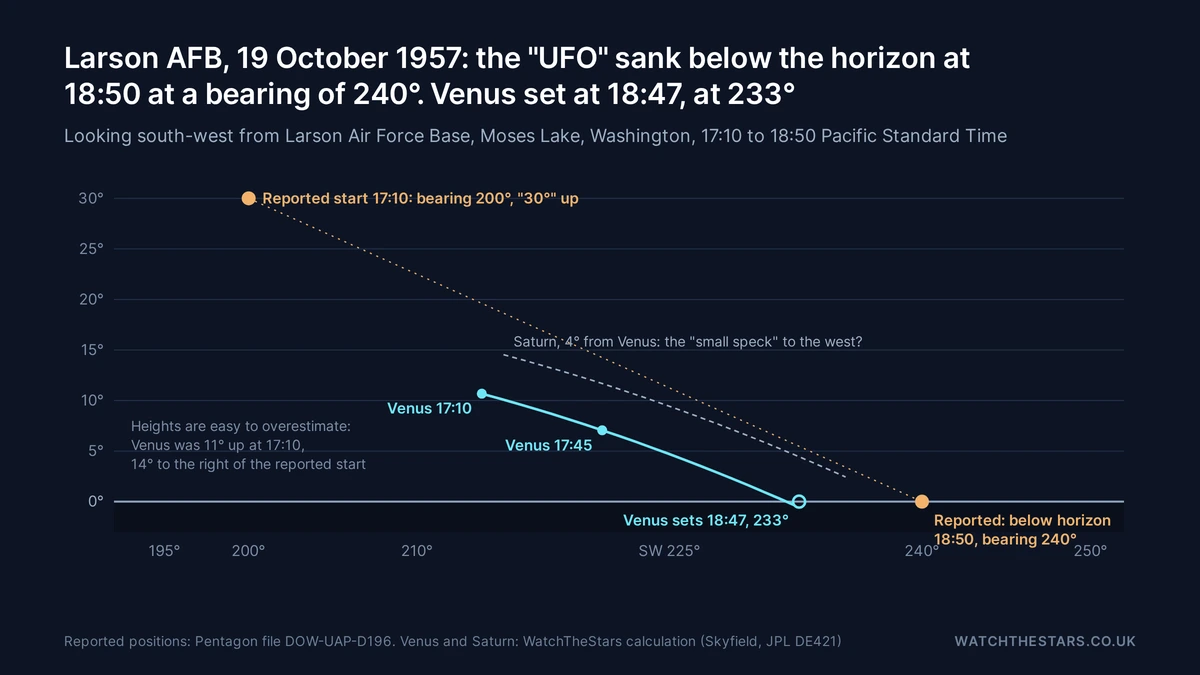
Our check: Venus was 11° up at a bearing of 214° at 17:10, and set at 18:47 at 233°. That's three minutes and 7° from the report. Saturn sat 4° from Venus, slightly higher and to the west, and would have appeared only once the sky darkened: the "speck". The 30° starting height is too high, but heights are the measurement witnesses most often overestimate. The officer's own hunch was right. He wrote that once it grew dark "I assumed it to be part of the solar system, however, it appeared to move too fast for this." The steady westward slide was simply a planet setting.
As for "PLUTO", Pluto is far too faint to see without a big telescope, and we can't tell what the radar site meant. The object doesn't need it.
White Sands 1957: The Air Force Blamed Venus After It Had Set
The White Sands file blames Venus for a light that Venus can't have been. On 3 November 1957, in the week of the famous Levelland sightings, two Army military police patrols at the White Sands Proving Grounds in New Mexico reported lights. The investigating officer concluded "that the first patrol mistook moonset for an unidentified flying object, and that the second patrol merely witnessed the planet Venus."
The second patrol, driving west near the Trinity site at about 20:00 Mountain Standard Time, saw "a bright light" that "slowly climbed to approximately forty-five (45) degrees from the horizon", pulsing red then white, for about 25 minutes. To support Venus, the file says "Weather records reveal that the planet Venus was at first magnitude at 2000 hours MST, and at 15 degrees elevation, with an azimuth of 225 degrees."
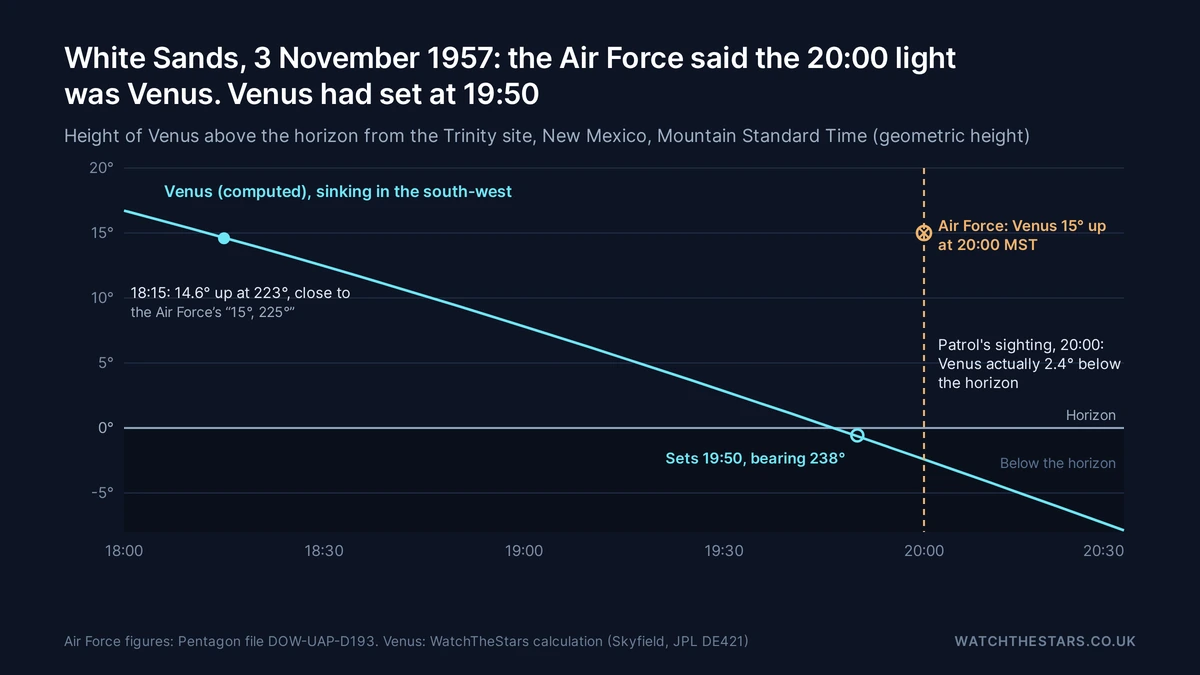
Those numbers are real, but for the wrong time. Venus was 14.6° up at a bearing of 223° at 18:15, which is the Air Force's position almost exactly. It then sank, and set at 19:50 at a bearing of 238°. At 20:00 it was 2.4° below the horizon. Venus was also sinking all evening, while the patrol's light climbed. If the patrol's time is right, Venus is ruled out.
The first patrol's moonset holds up better. At 02:30 that morning the Moon, 84% lit, was 3.5° up in the west and set at about 02:50. The Air Force put moonset at 02:29, about 20 minutes early by our reckoning, but at the right bearing. One caveat: that patrol was driving north and their statements don't say the light was in the west, so moonset is a reasonable guess, not a proven one.
Catalina 1965: Did the Air Force Pick the Wrong Planet?
The Catalina UFO of 8 August 1965 was probably a bright star, but probably not the planet the Air Force chose. Two boys, aged 14 and 15, watched a round object with "red, white and blue flashing lights" through a telescope from the Palos Verdes Peninsula. It seemed to move "back and forth across Catalina" for 10 to 15 minutes, at about 21:15 to 21:30 Pacific Daylight Time.
The Project Blue Book card's typed verdict, "Insufficient Data for Evaluation", is crossed out and replaced by hand with "ASTRO (MARS)", with the note "Position to west. Mars at 260° az on horizon in process of setting." The release's own summary still gives the crossed-out verdict.
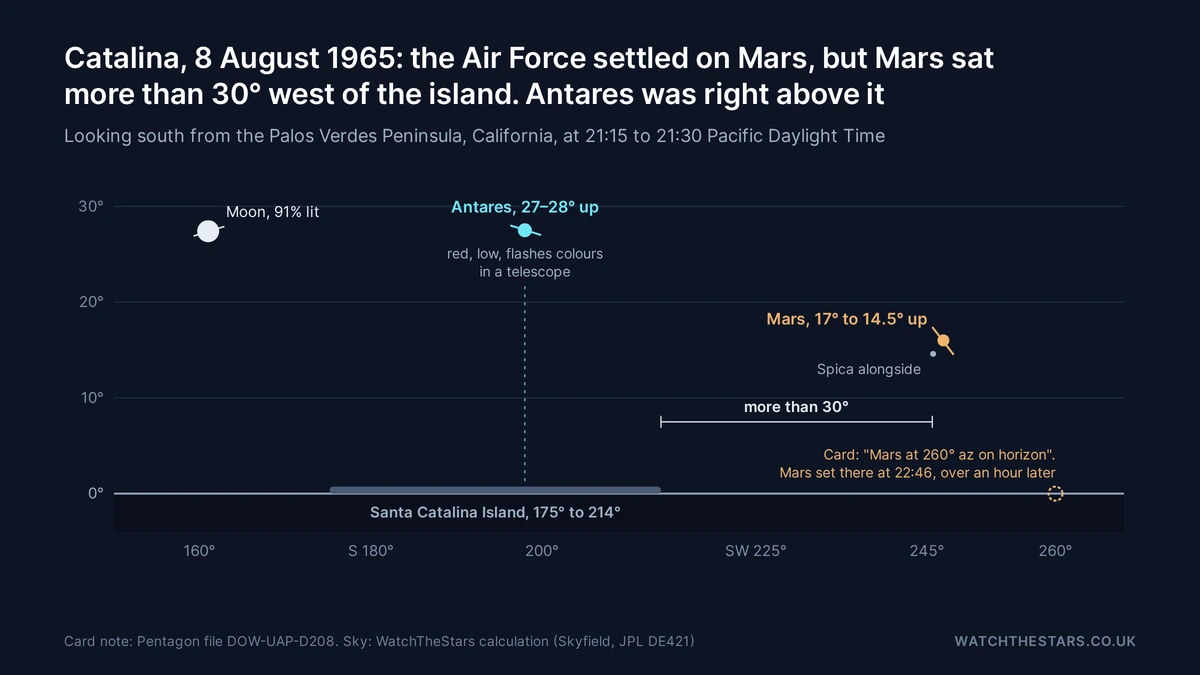
From Palos Verdes, Catalina spans bearings of about 175° to 214°. At 21:15 to 21:30, Mars was 17° falling to 14.5° up at 246° to 248°, with Spica beside it, more than 30° west of the island. It set at 22:46, at 259°, which is where the Air Force's "260° on horizon" came from, more than an hour after the sighting. Antares, the red star in Scorpius, was 27° to 28° up at 196° to 200°, directly over the middle of the island.
A low star seen through a small telescope flashes colours as the air bends its light, so "red, blue, white, green" and "blinked off and then came on a different colour" fit Antares well. The "back and forth" motion fits neither, and probably came from a wobbly telescope or the eye's own drift. The boy also said it was as bright as a car headlight, which no star is, so the file isn't fully explained. But if it was over Catalina, Antares fits far better than Mars.
Settle a bright light in seconds
Kit we've reviewed in full
Binoculars are the quickest way to sort a planet from an aircraft. Venus shows as a single steady point or a tiny disc, while a plane splits into separate red, green and white lights.
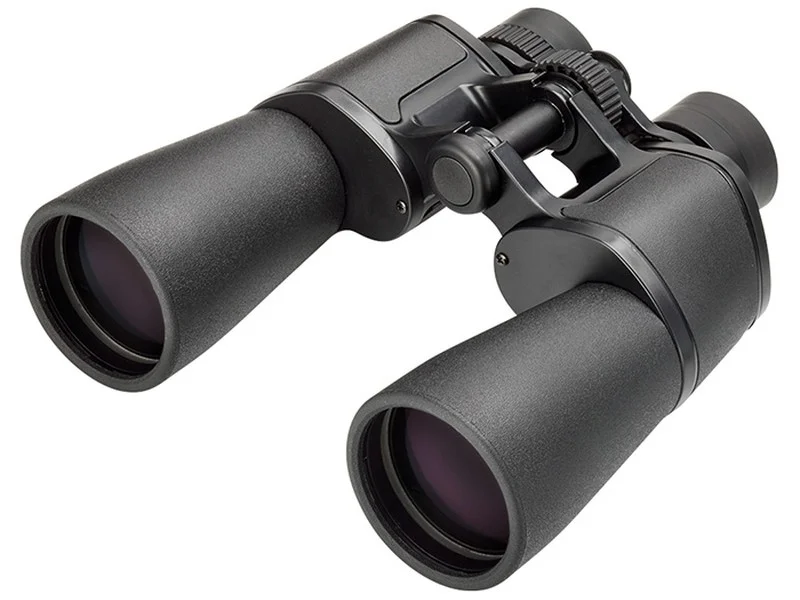
Easy to aim and hold, so you can get on a puzzling light before it drops into the haze.
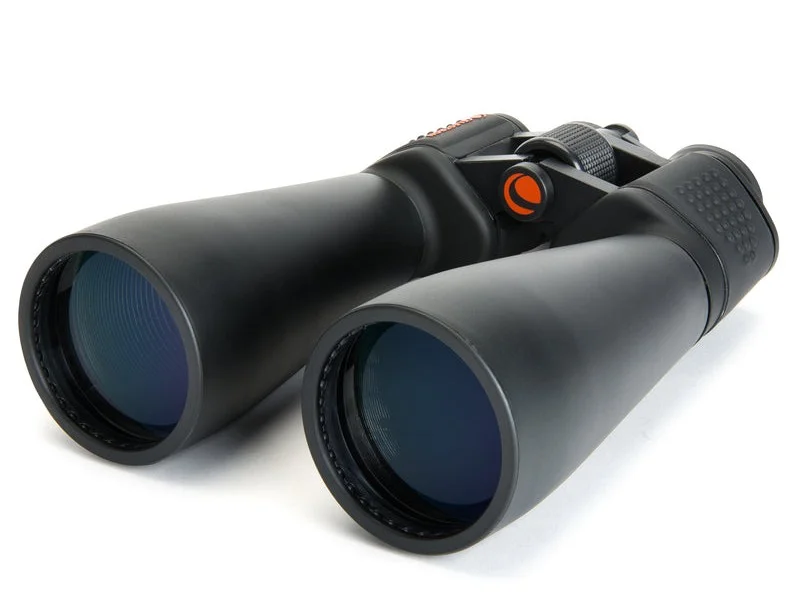
Enough power to show Venus as a small disc and Jupiter's moons. Best on a tripod.
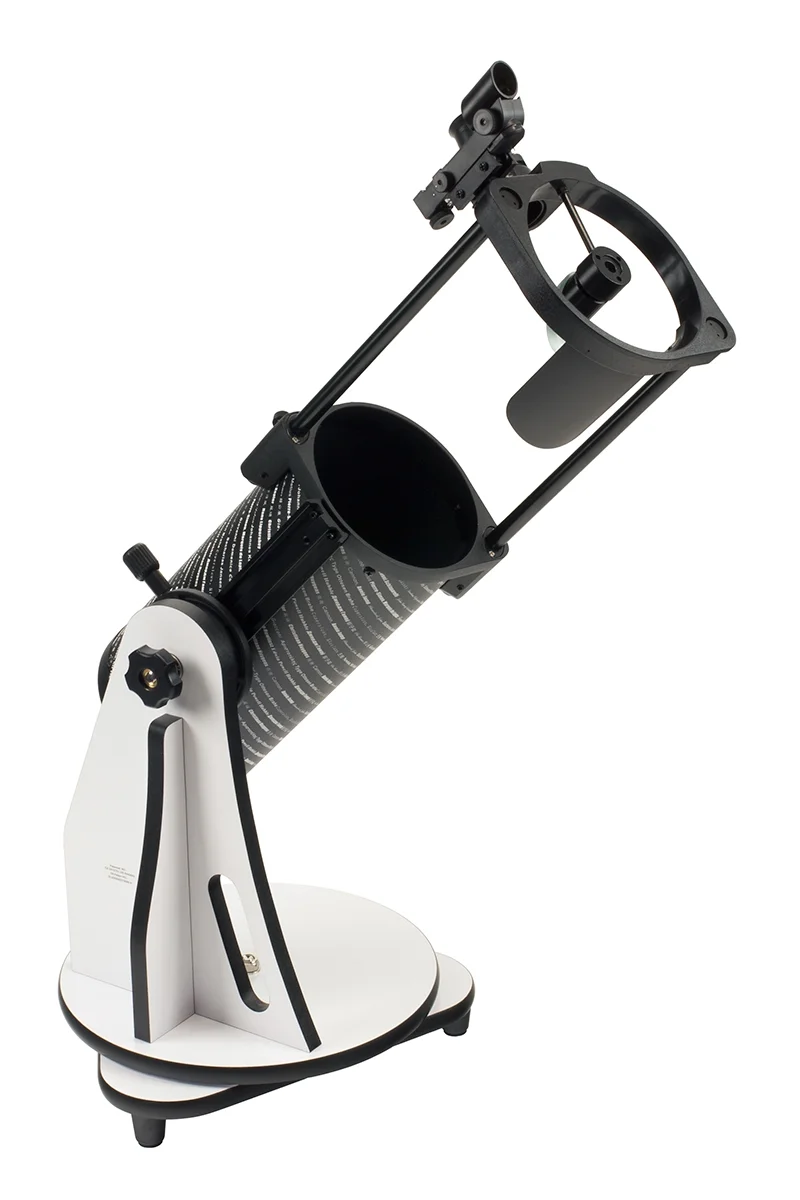
Shows Venus's phase and the red disc of Mars, which ends any argument about what you're looking at.
Affiliate links: you pay the same price, we earn a small commission that helps keep WatchTheStars free.
Upland and Fontana: Sirius, Mars and a Contrail at Midnight
Two shorter California files show the same thing: a bright star or planet in the right place, and a report that never checked. At Upland, on two mornings around 5 and 6 September 1957, a civilian reported a "green flash with red tails", "one (each day)", between 05:15 and 05:30 Pacific Daylight Time. The Air Force officer wrote that the information was "not adequate, either in quantity or detail, to permit any analysis." Our check puts Sirius 20° to 23° up in the south-east at that time each morning, low enough to flash green and red as it twinkles, in the same place on both days. The report gives no direction, so we can't confirm it, but Sirius is a strong candidate.
At Fontana, at 23:45 on 21 August 1956, a Ground Observer Corps couple saw "one round red object, with a tail", the size of a basketball at arm's length, moving east and fading "into a fog" after two minutes. The record card says "Probably Aircraft", "the tail being the contrail of the jet". But at 23:45 the Sun was 41° below the horizon, so no contrail would have been lit red. Mars was 32° up in the south-east at magnitude −2.5, distinctly red, and weeks from a very close approach to Earth. A bright red point drifting in and out of haze is a good description of Mars that night.
Malmstrom 1975: The UFOs That Vanished at Sunrise
The Malmstrom UFOs of 7 November 1975 that "disappeared" at sunrise were most likely Venus. This case isn't an Air Force file but a log quoted in the 2009 report by BAASS, the Pentagon's contractor for its AAWSAP programme, in its Project Northern Tier section. BAASS took the entries from the 1984 book Clear Intent, which quotes the 24th NORAD Region senior director's log.
The log reads, at 6:19am Mountain Standard Time: "K-1 saw a very bright object to their east is now southeast of them and they are looking at it with 10 x 50 binoculars." At 6:55: "as the sun rises, so do the objects they have visual." At 7:29: "As the sun rose, the UFOs disappeared."
Venus rose in the east at about 3am that morning (our calculation for Malmstrom). At 3:35, when several missile sites reported "a large red to orange to yellow object", it was 5° to 6° up in the east, where low planets often look orange. By 6:19 it was about 31° up in the south-east, and it went on climbing towards the south-south-east as the Sun came up at 7:17. Venus was at magnitude −4.5, close to its greatest distance from the Sun, and would have faded into the daylight for anyone not tracking it.
Venus doesn't explain everything in the log. The same 6:19 entry mentions an "orange/gold object overhead", and the radar tracks later that night are a separate matter. Our page on UFOs at nuclear weapons sites has the wider story. But the bright object that moved from east to south-east and faded at sunrise is exactly what Venus did.
How to Check Whether a UFO Was Venus
To check whether a UFO was Venus, you need just two things: the time and the direction. Every case above could be tested because someone wrote down a clock time and a bearing. Where they didn't, as at Upland, the best we can say is "likely".
- Note the time and where the light is. Use a compass app for the bearing, and your fist at arm's length (about 10°) for the height.
- Check the sky for that moment. Our page on what you can see in the sky tonight shows the planets up from your location, and the UK night sky this week says where Venus, Jupiter and the bright stars are.
- Remember where Venus can be. After dark, Venus is only ever in the west after sunset or the east before sunrise, because it never strays far from the Sun. A light high in the south at midnight isn't Venus.
- Watch it for a few minutes. A planet keeps its place among the stars and creeps slowly west. A plane crosses the stars in seconds, and the space station crosses the whole sky in a few minutes: check ISS passes tonight.
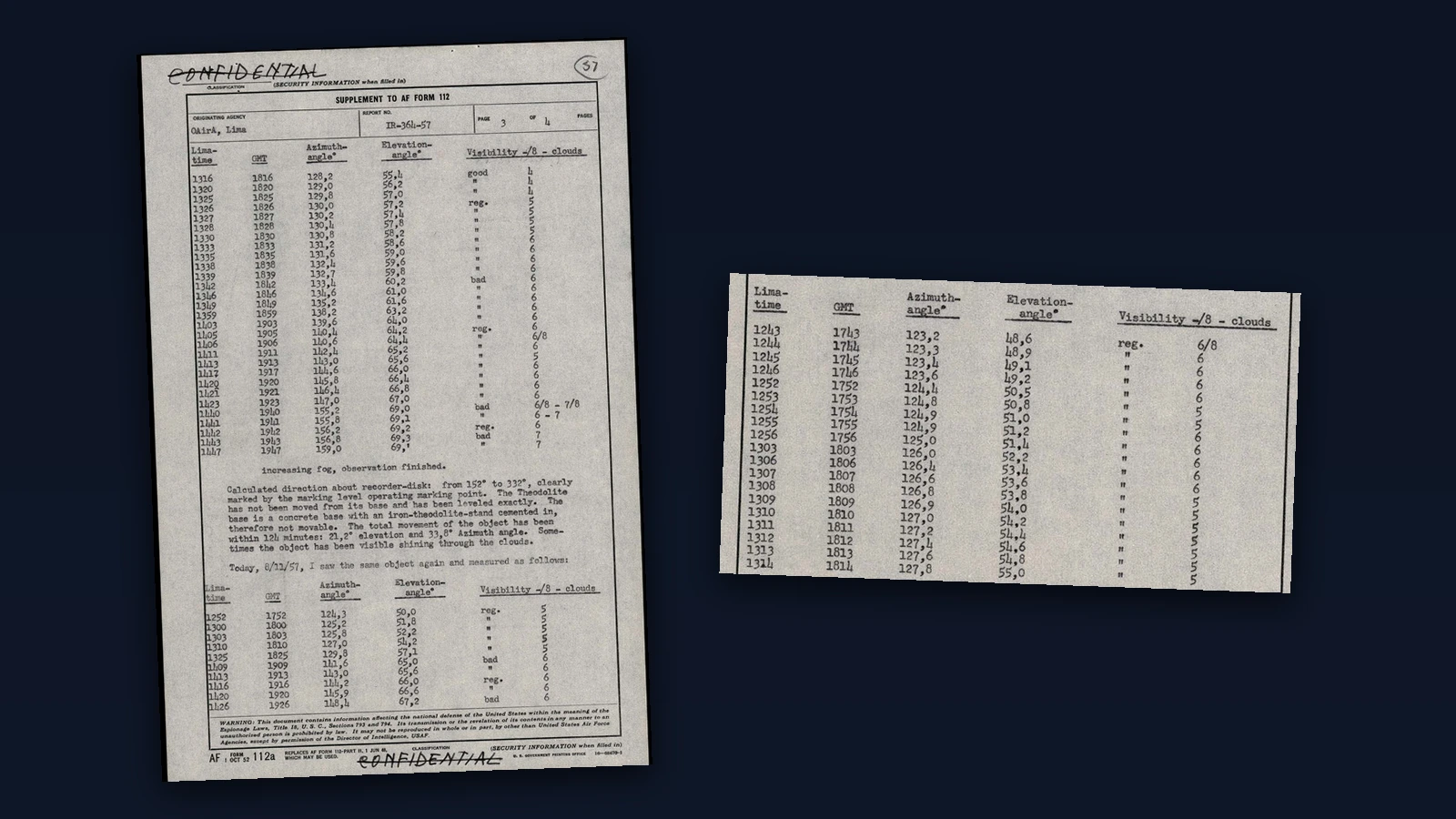
If a light seems to follow your car or plane, our guide to why a star seems to follow your plane explains it. For the best single example of all, a weather observer who measured Venus 58 times with a theodolite and still called it a UFO, read our post on the 1957 Peru UFO that was Venus. More 1950s files from the previous batch are in our Release 7 sky checks, and the rest of this release is in our round-up of the eighth Pentagon UFO file release. Every file is downloadable from our Pentagon UFO file browser.
Sources:
- US Department of War, PURSUE Release 8 (20 November 2026): DOW-UAP-D196 (Larson AFB), DOW-UAP-D193 (White Sands), DOW-UAP-D208 (Catalina), DOW-UAP-D203 (Upland), DOW-UAP-D211 (Fontana) and DOW-UAP-D172 (BAASS Ten-Month Report, Malmstrom log at pp333–335), originals at war.gov/ufo
- Sun, Moon, planet and star positions computed with Skyfield and the JPL DE421 ephemeris for Larson AFB (47.20°N 119.32°W, PST), the Trinity site and Stallion area (MST), Palos Verdes (33.77°N 118.37°W, PDT), Upland (34.10°N 117.65°W, PDT), Fontana (34.09°N 117.44°W, PDT) and central Montana (47.0–47.5°N, 109.7–111.2°W, MST)
Header image: the White Sands report's Venus figures and verdict (DOW-UAP-D193) and the Catalina record card with its "ASTRO (MARS)" correction (DOW-UAP-D208).
Frequently Asked Questions
Equipment guides
Related topics
Ian ClaytonAmateur astronomer and founder of WatchTheStars.co.uk, dedicated to helping others explore the wonders of our universe. Full profile →