Key takeaways
- The 1957 Peru UFO in Pentagon file DOW-UAP-D202 was Venus, seen in daylight from a mountain weather observatory
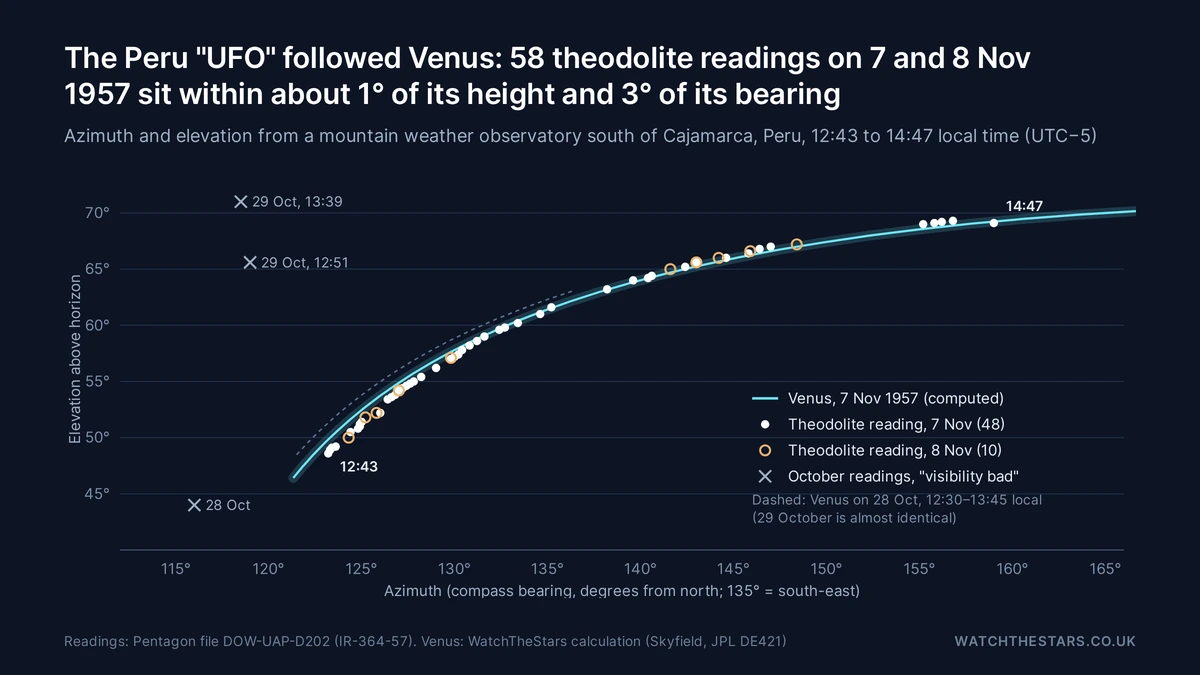
- All 58 theodolite readings taken on 7 and 8 November 1957 sit within about 1° of Venus on the sky, by our Skyfield calculation
- Venus was magnitude −4.4 and 47° from the Sun, near greatest elongation, the best time to see it in a blue sky
- Venus is bright enough to find in daylight from the UK this winter, about 26° up in the south-south-east after sunrise in early December 2026
Jump to section 6 sections
The Peru UFO of 1957 is the neatest Venus case we've found in eight batches of Pentagon UFO files. A professional weather observer, working at a mountain observatory in the Peruvian Andes, saw a "white-steel-gleaming" object in the midday sky. He did what almost no UFO witness can do: he measured it, 58 times over two days, with a precision instrument, and wrote down the time of every reading.
His numbers are in file DOW-UAP-D202, released on 20 November 2026 in the eighth PURSUE batch (our round-up of the eighth Pentagon UFO file release covers the rest). We ran every reading through Skyfield, the astronomy software behind our UK night sky this week guide. The object was Venus, and the readings prove it.
What the Peru UFO File Says
The Peru UFO file is a six-page Air Intelligence Information Report, IR-364-57, sent by the US Air Attaché in Lima on 29 November 1957. It follows up an earlier report (IR-350-57, file D200) about a bright object over a hacienda near Cajamarca that a US mining employee said was "visible 24 hours a day" and "definitely not a star, being much too low".
The new report quotes a weather observer at an observatory run by the Compañía Peruana de Servicios Meteorológicos, "on the continental divide about 35 miles S of Cajamarca at an altitude of 3750 meters". He first saw the object at noon on 26 October from the hacienda's lake, where it "could be observed easily without binoculars" for more than 15 minutes. Back at work he used the observatory's automatic Zeiss recording theodolite, an instrument for tracking weather balloons, fixed on a concrete base, which measures bearing (azimuth) and height (elevation). He gave his readings to a tenth of a degree.
On 7 November, after the hacienda rang to say the object was back, he took 48 readings over 124 minutes, from 12:43 to 14:47 Lima time, until "increasing fog, observation finished." On 8 November he took ten more. He summed up the first run as "21,2° elevation and 33,8° Azimuth angle" of movement. The Air Attaché rated the report C-3 (fairly reliable source, possibly true).
Peru UFO vs Venus: Checking 58 Theodolite Readings
The Peru UFO readings match Venus to within about a degree. We set Skyfield up for the observatory's own coordinates, 7°25'30"S 78°20'30"W at 3,750 metres, used Lima time as UTC−5 (the same conversion the observer used), and worked out where Venus was at every minute he logged. These are our calculations, with the JPL DE421 ephemeris:
| Date (1957) | Lima time | Theodolite (azimuth / elevation) | Venus (azimuth / elevation) |
|---|---|---|---|
| 7 Nov | 12:43 | 123.2° / 48.6° | 122.8° / 49.1° |
| 7 Nov | 13:30 | 130.8° / 58.2° | 130.9° / 58.5° |
| 7 Nov | 14:03 | 139.6° / 64.0° | 140.5° / 64.3° |
| 7 Nov | 14:47 | 159.0° / 69.1° | 161.8° / 69.6° |
| 8 Nov | 12:52 | 124.3° / 50.0° | 123.8° / 50.8° |
| 8 Nov | 14:26 | 148.4° / 67.2° | 149.9° / 67.4° |
Across all 58 readings the elevation never differs from Venus by more than 1.1°. The bearing drifts by up to 2.8° late on 7 November, but that's when Venus was nearly 70° up, and close to the overhead point a few degrees of bearing is a very small distance on the sky. Measured as a straight angle, the largest gap between any reading and Venus is 1.1°, and most are within about half a degree.
The movement matches too. Over his 124-minute run Venus climbed 20.5° and swung 39° round in bearing; he measured 21.2° and 33.8°. A small, slowly growing bearing error as the planet nears its highest point is what you'd expect from a theodolite very slightly off level, or a clock a minute or so out. It isn't what you'd expect from a balloon or an aircraft, which would drift with the wind and never retrace a planet's path on two days running.
The first sighting fits as well. At noon on 26 October, our calculation puts Venus 42° up in the east-south-east, at a bearing of 118°, with the Sun almost overhead and far away from it. That's an easy place to spot a bright point if someone shows you where to look, which is exactly what happened.
The October Readings That Don't Fit as Well
The three October readings in the Peru UFO file are about 11° to 13° away from Venus, and the observer warned about them himself. On 28 October he wrote "I could not identify the direction exactly", and of 28 and 29 October together, "On all these days the visibility has been bad."
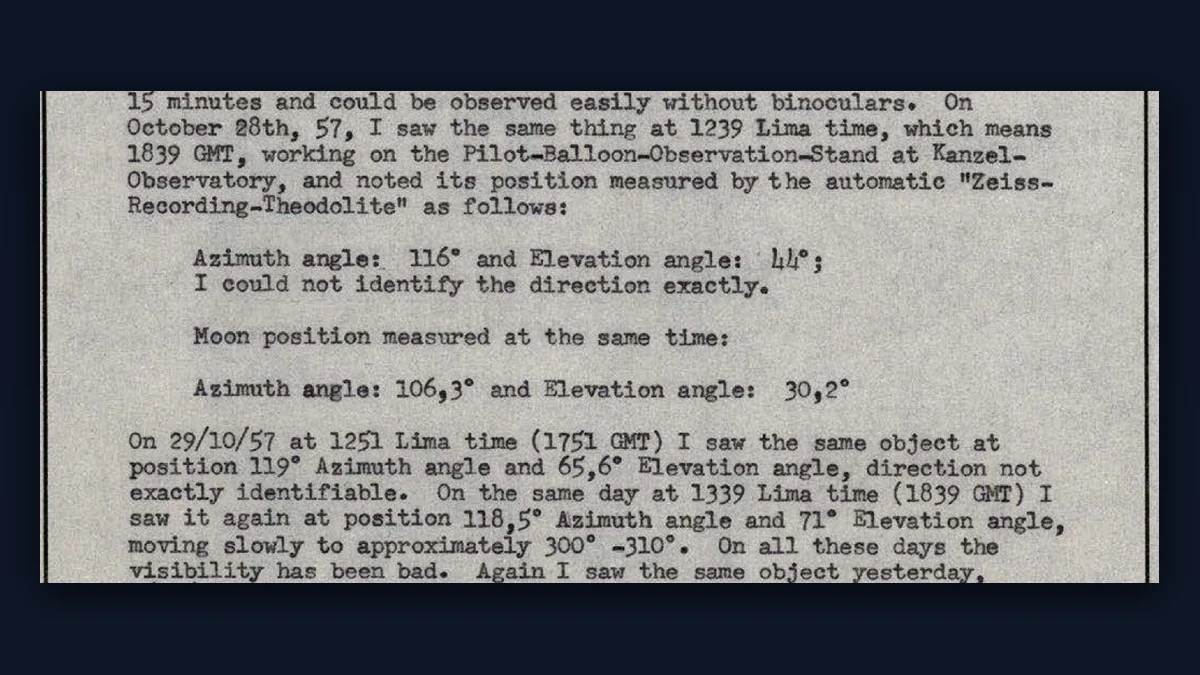
On 28 October he also measured the Moon, which makes a handy calibration. He wrote the time as "1239 Lima time, which means 1839 GMT". That conversion is wrong: Lima was five hours behind GMT, so 12:39 is 17:39 GMT, and his other conversions all use five hours. Our Moon sits at his azimuth of 106.3° throughout, and reaches his elevation of 30.2° at about 17:52 to 17:53 GMT (12:52 Lima time). At 18:39 GMT it would have been 41° up. So his azimuths are true compass bearings, "1839" is a slip, and his clock or note was about 13 minutes adrift that day.
Even allowing for that, his object on 28 October (116°, 44°) was about 11° from Venus, and his two readings on 29 October (119° by 65.6°, and 118.5° by 71°) were 11° to 13° higher and further east than Venus. We can't tell whether those were Venus misread through cloud or something else. What we can say is that the object he called "the same" on 7 and 8 November, when he measured it carefully in better conditions, was Venus beyond reasonable doubt.
Can You See Venus in the Daytime?
Yes, you can see Venus in the daytime, and late 1957 was a very good time to do it. Venus shines by reflected sunlight from thick white cloud, and when it's bright and well away from the Sun it can outshine the blue sky around it. Two things matter most.
Brightness. On 7 November 1957 Venus was magnitude −4.4 (our calculation), about 15 times brighter than Sirius, the brightest star in the night sky. Nothing else in the sky except the Sun and Moon gets close.
Distance from the Sun. Venus orbits inside Earth's orbit, so from here it never strays far from the Sun. Most of the time it's lost in the glare. But at greatest elongation it stands as far out as it gets, about 45° to 47°. In 1957 that came on 18 November, at 47.2°, so on the 7th Venus was already 47° from the Sun (both our calculation).
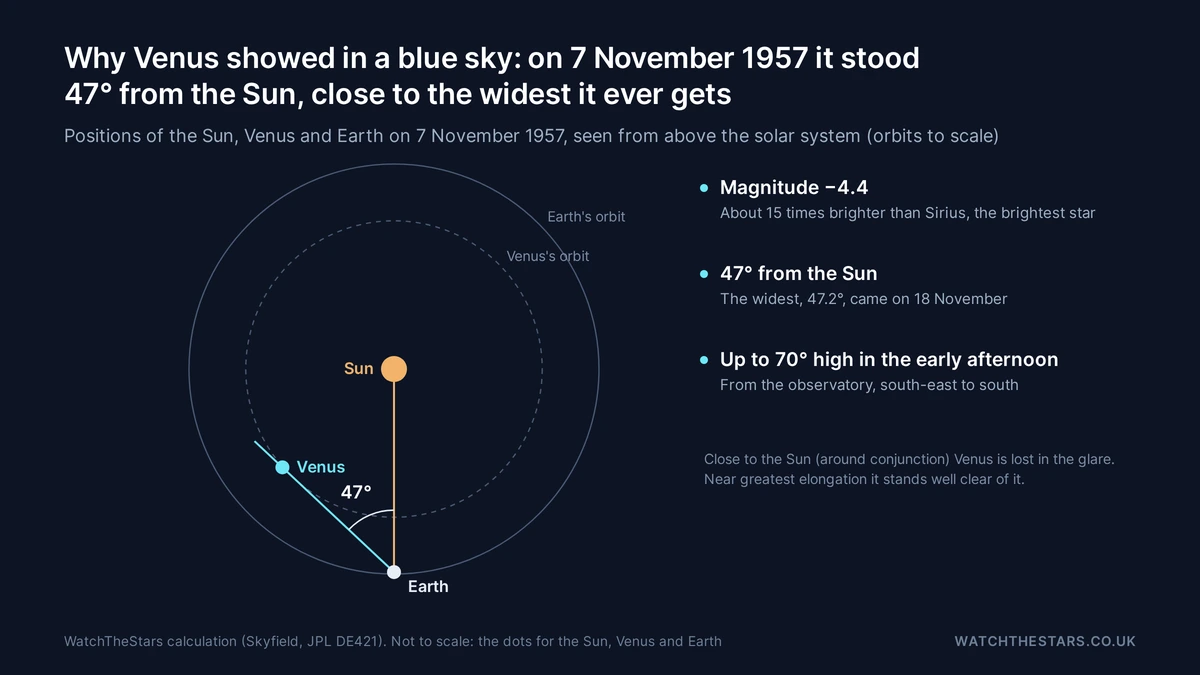
Add a high, clear mountain site and an observer who knew where to point a theodolite, and a "white-steel-gleaming" point at midday is just what you'd expect. The hard part with daylight Venus isn't seeing it. It's finding it, because a point of light in a featureless blue sky is easy to lose. Once someone points it out, as the hacienda's administrator did on 26 October, it's suddenly obvious. That's also why it can look so strange: people don't expect to see a "star" at lunchtime.
How to See Venus in Daylight from the UK This Winter
Venus is in a good place to try this right now. It's a brilliant morning planet, at magnitude −4.9 in early December 2026, and it reaches greatest western elongation, 47° from the Sun, on 4 January 2027 (our calculation). Here's what we computed for UK sites:
- 1 December 2026, Birmingham: Venus is 26° up in the south-south-east at sunrise (7:55am), and stays 24° to 28° high until about 11am, drifting round to the south and south-south-west.
- Plymouth sees it a little higher (27° at sunrise), Edinburgh a little lower (23°), so everyone in the UK gets a go.
- Mid-December: about 25° up between 8am and 10am from Birmingham. Early January: about 20° up over the same hours.
The easiest method is to find Venus before sunrise, when it's dazzling, and keep watching as the sky brightens. Line it up with a chimney, tree or lamp post so you can find it again. If you start after sunrise, stand in the shadow of a building so the Sun is completely hidden, then look about 40° from the Sun, up and to its right. Never sweep binoculars across the sky near the Sun. Our stargazing for beginners guide covers judging distances on the sky with your hand, and you can check what you can see in the sky tonight to find Venus before dawn.
Find Venus in daylight with binoculars
Kit we've reviewed in full
Binoculars turn a hunt for a faint white dot into a quick find, as long as you keep the Sun well out of the view. Read our guide to observing the Sun safely first, and stand in the shadow of a building.
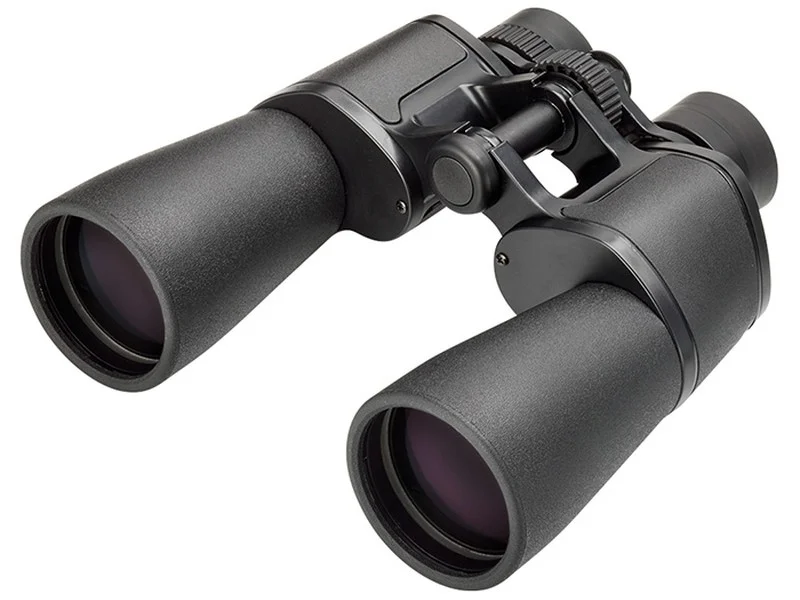
Wide, bright and easy to aim. Once you've found Venus by eye against a rooftop, these show it as a tiny white disc in the blue.
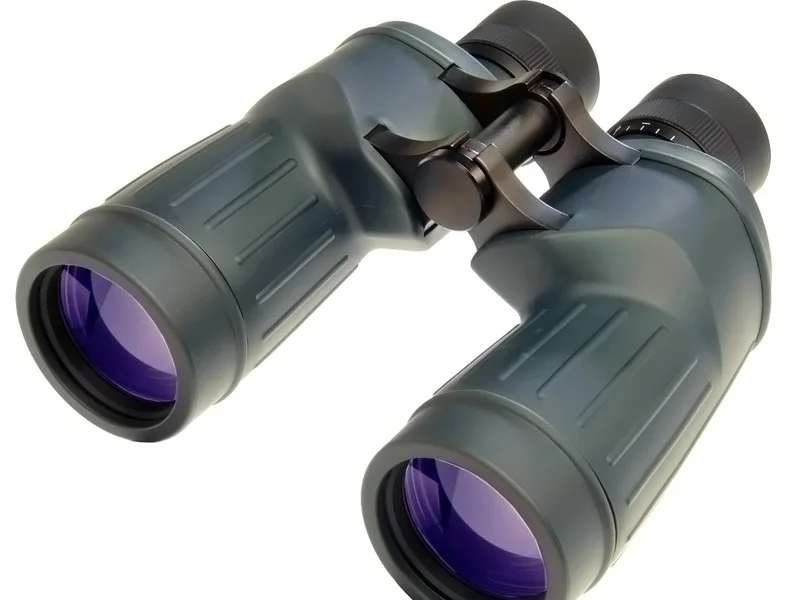
Crisp optics help a small point stand out against a bright sky, which is exactly the daylight Venus problem.
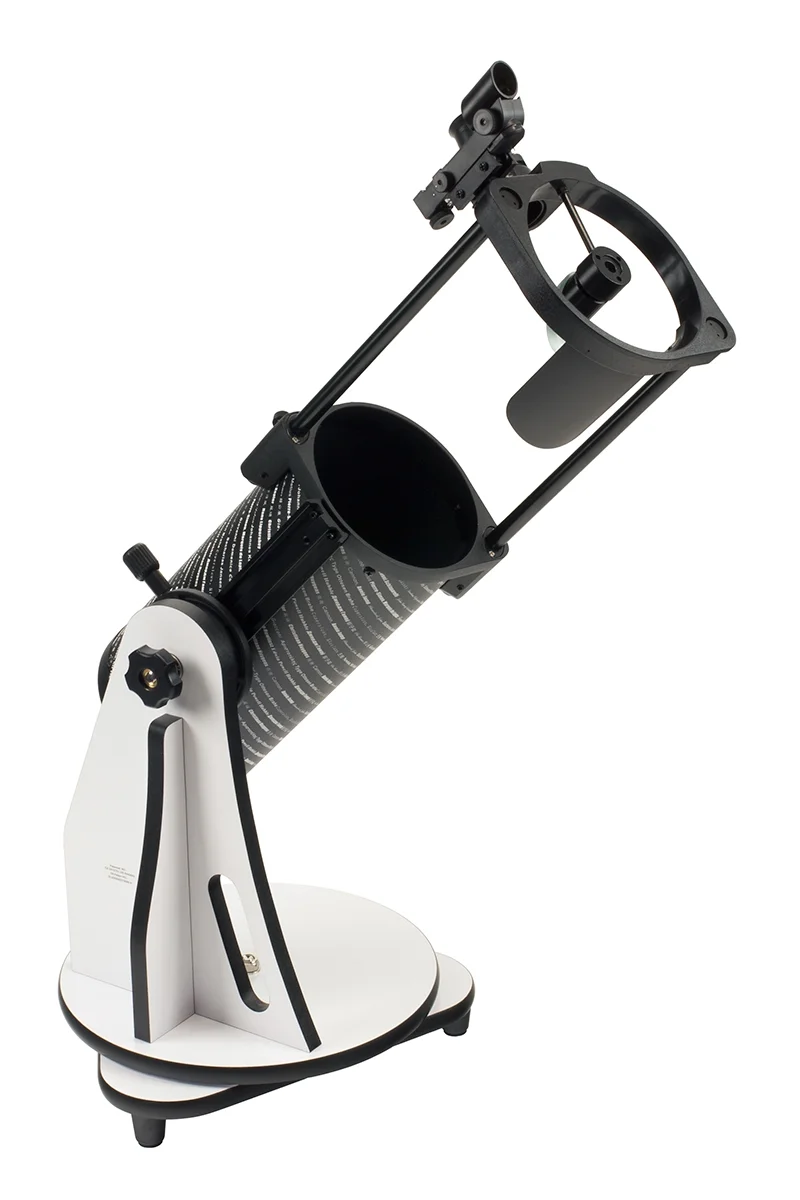
In a small telescope Venus shows a phase like a little Moon. It's a crescent through December 2026, reaching half-lit in early January.
Affiliate links: you pay the same price, we earn a small commission that helps keep WatchTheStars free.
Through a small telescope Venus shows a phase, like a tiny Moon, which Galileo first noticed in 1610. Our guide on how to use a telescope explains how to find and focus on it.
Why This 1957 UFO Report Still Matters
The Peru UFO report matters because it shows that even a skilled observer with a good instrument can measure Venus and not recognise it. Nobody in the file seems to have compared the readings with an almanac, and the Air Attaché's summary even leaves out the 7 November run, the longest one.
It's the same story in several other files in this release. At Larson Air Force Base in Washington, less than three weeks earlier, an aircraft commander watched Venus set for 100 minutes. At White Sands, the Air Force blamed Venus for a light seen after Venus had set. We've checked those and four more in our post on when the Air Force's UFO answer was in the sky, and when it wasn't.
If a bright light seems to hang over the horizon for hours, or follows your car, Venus is usually the first suspect. Our guide to why a star seems to follow your plane explains why, and Kelly Johnson's 1953 sunset sighting shows a case where we ran the same check and Venus was ruled out. You can read and download the Peru reports, D200 and D202, in our Pentagon UFO file browser.
Sources:
- US Department of War, PURSUE Release 8 (20 November 2026): DOW-UAP-D202 (IR-364-57, Lima, 29 November 1957) and DOW-UAP-D200 (IR-350-57, Lima, 14 November 1957), originals at war.gov/ufo
- Venus, Sun and Moon positions for the observatory (7°25'30"S, 78°20'30"W, 3,750 m), Lima time UTC−5, and UK positions for December 2026 and January 2027, computed with Skyfield and the JPL DE421 ephemeris
Header image: the observer's theodolite tables for 7 and 8 November 1957, from DOW-UAP-D202.
Frequently Asked Questions
Equipment guides
Related topics
Ian ClaytonAmateur astronomer and founder of WatchTheStars.co.uk, dedicated to helping others explore the wonders of our universe. Full profile →