Key takeaways
- Delbert C. Newhouse was a US Navy Chief Photographer who enlisted at Portland, Oregon, in January 1933, so he had 19 years' service when he filmed the Tremonton objects on 2 July 1952
- Air Force interviewers in September 1952 called Newhouse and his wife 'extremely honest and reliable persons' and said he 'could be classified as an expert photographer'
- His 585-page Navy personnel file (DOW-UAP-D104), released on 18 September 2026, shows leave from his Oakland posting from 19 June to 7 July 1952, the dates of his drive
- Fitness reports praise his photography throughout; the one 'unfavorable' report, in 1948, was about staff administration, not his camera work
- The personnel file never mentions the Tremonton film, UFOs or any Air Force investigation. He retired on 1 April 1960
Jump to section 9 sections
- Who Was Delbert Newhouse? The Tremonton UFO Film's Photographer
- What Did Delbert Newhouse See? His Own 1952 Statement
- Did the Air Force Believe Delbert Newhouse?
- Was Delbert Newhouse a Real Navy Photographer? His Career From 1933
- What Did Newhouse's Navy Fitness Reports Say?
- Where Was Newhouse on 2 July 1952? The Leave Records
- Does Newhouse's Personnel File Mention the Tremonton UFO Film?
- Why Delbert Newhouse Matters to the Tremonton Argument
- Where to Read the Delbert Newhouse Files
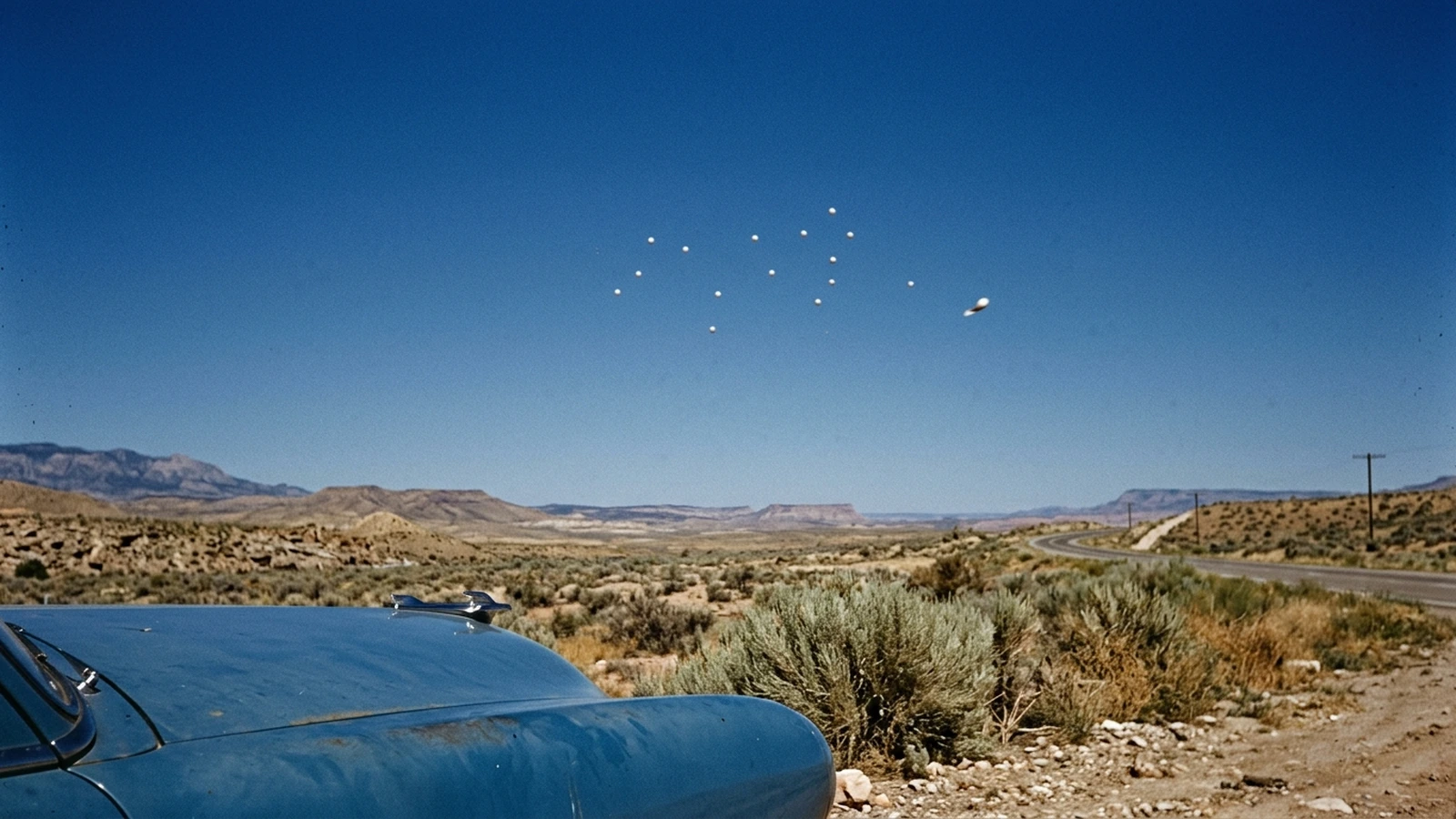
Every account of the Tremonton UFO film starts the same way: a Navy photographer, driving across Utah with his family, pulls over and films a dozen bright objects in a clear sky. Most accounts then move straight on to the film. The man behind the camera usually gets one line, "a Navy cameraman", and that's it.
The Pentagon's sixth UFO file release on 18 September 2026 changed that. Alongside the Blue Book case file I wrote about in how the Air Force settled on "balloons or gulls", it included Delbert Newhouse's own Navy personnel file: 585 pages, catalogued as DOW-UAP-D104. The companion Air Force flying discs file, D105, has his signed statement and the Air Force's notes on him. Between them, we can finally answer the question properly.
One note before we start. The personnel file includes private details such as a service number, home addresses and family information. I've left all of that out, and so should anyone else writing about it.
Who Was Delbert Newhouse? The Tremonton UFO Film's Photographer
Delbert C. Newhouse was a US Navy Chief Photographer, a warrant officer with 19 years' service, who filmed the Tremonton objects on 2 July 1952. He enlisted at Portland, Oregon, on 23 January 1933, trained as a naval photographer, served as a commissioned photographic officer from the Second World War until 1949, and retired on 1 April 1960.
At the time of the sighting he was posted to the Aviation Supply Depot at the Naval Supply Center in Oakland, California. That's the address on the covering letter he sent with the film to Hill Air Force Base in Utah, dated 11 August 1952.
What Did Delbert Newhouse See? His Own 1952 Statement
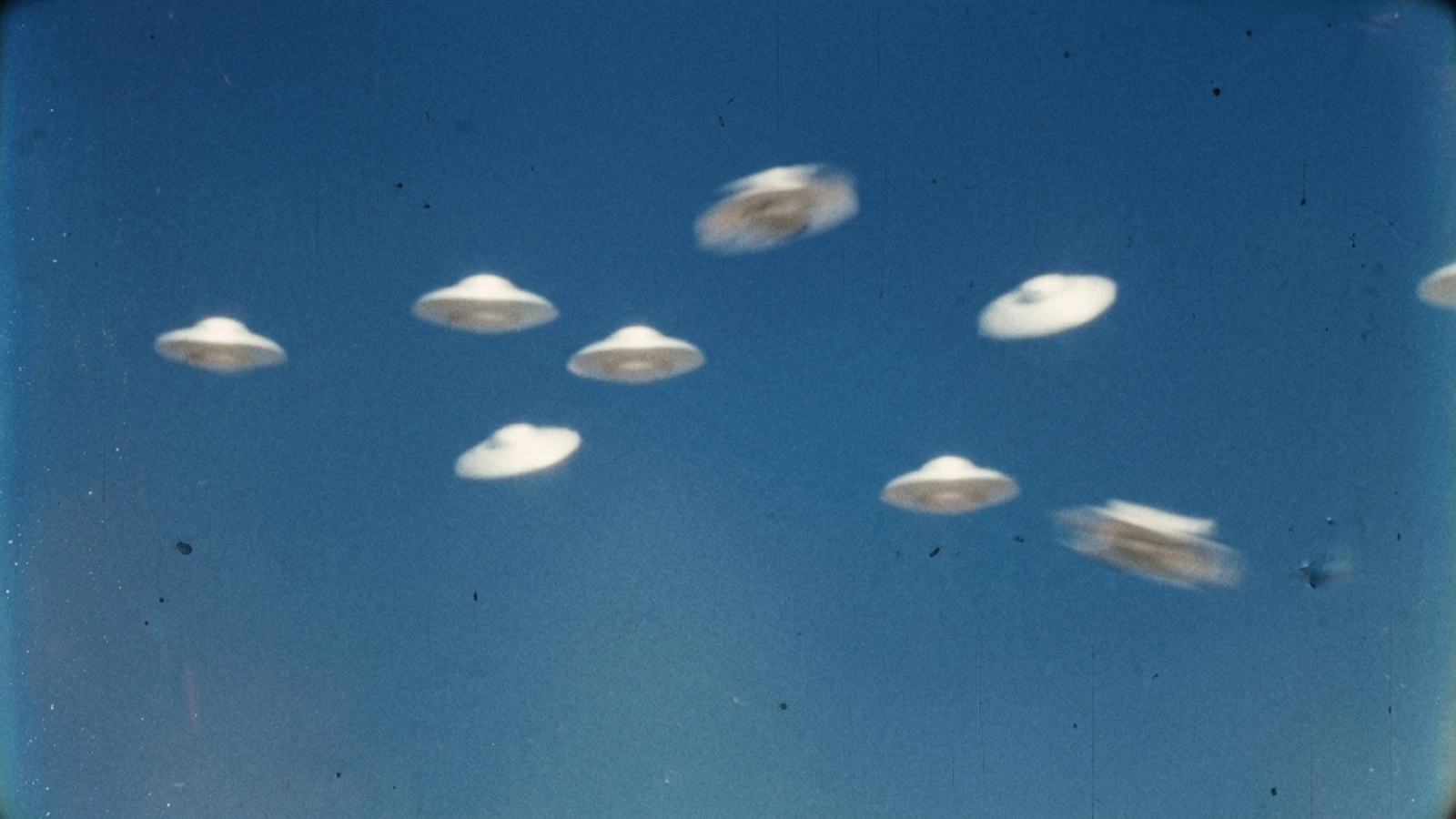
Newhouse saw "a group of about ten or twelve objects" moving roughly westward, and filmed them with a hand-held 16mm camera. His signed statement, sent with the film on 11 August 1952, is short and matter-of-fact. He was driving from Washington, D.C. to Portland, Oregon, when his wife spotted them.
In his words, the objects "bore no relation to anything I had seen before" and were "milling about in a rought formation and proceeding in a westerly direction" (the typo is in the original). He got the camera out of a suitcase in the boot, loaded it in a hurry and shot about thirty feet of film. Then comes the sentence that sums up the whole case: "There was no reference point in the sky and it was impossible for me to make any estimate of speed, size, altitude or distance."
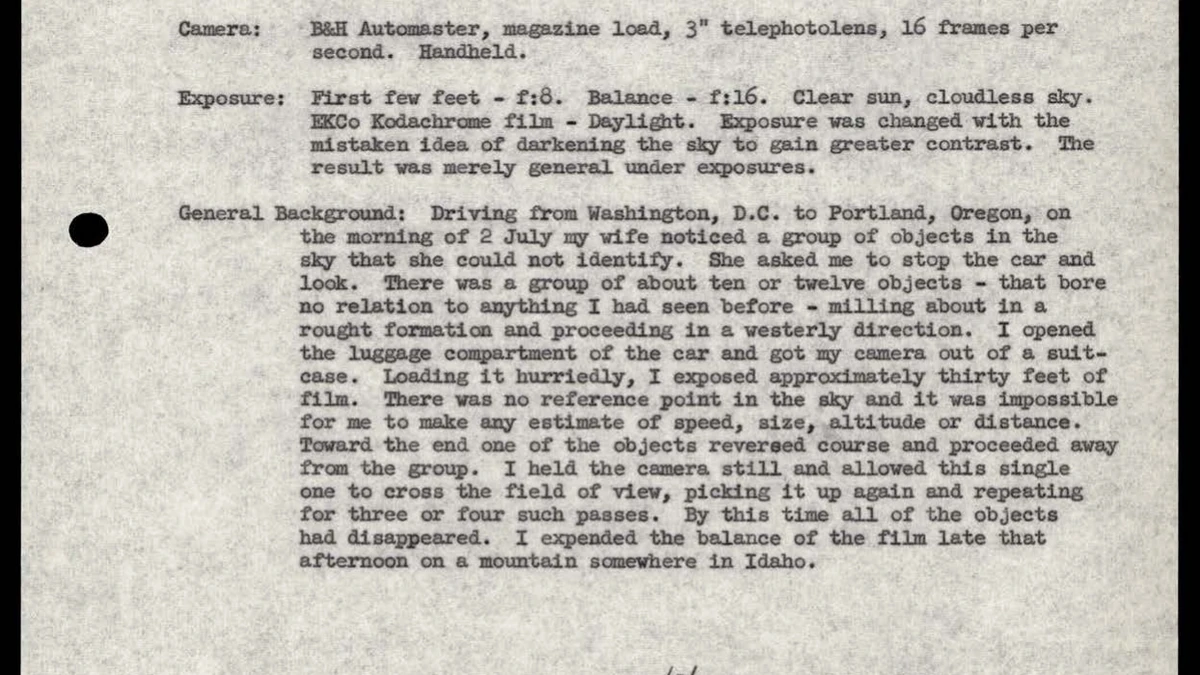
The statement also gives the technical detail that later analysts relied on. He used a "B&H Automaster" with a 3-inch telephoto lens at 16 frames per second, hand-held, on daylight Kodachrome. He shot the first few feet at f/8 and the rest at f/16, "with the mistaken idea of darkening the sky to gain greater contrast", and admits the result was "merely general under exposures". He was a professional, and he still owned up to his own mistake in writing to the Air Force.
Did the Air Force Believe Delbert Newhouse?
Yes. The Air Force rated Delbert Newhouse as honest, reliable and highly skilled. Its officers interviewed the whole family at home in September 1952, and a 28th Air Division message in D105 summarises what they found.
The key line reads: "CPO Newhouse and Mrs. Newhouse appeared to be extremely honest and reliable persons." The message adds that he had been in the Navy for over 19 years, including service as a commissioned officer in the war, that he was a graduate of the Naval Photographic School in 1935, and that he claimed "over 1000 hours in the air as a photographer on actual aerial photograph missions". Its verdict: "It is believed Newhouse could be classified as an expert photographer."
The same message adds that Newhouse "never believed he would join ranks of those reporting such objects" before that day. He wasn't a UFO enthusiast looking for something to film.
Was Delbert Newhouse a Real Navy Photographer? His Career From 1933
Yes. Delbert Newhouse was a trained Navy photographer from the 1930s onwards, and his newly released personnel file shows it in detail. A career summary in the file lists his enlistment at Portland in January 1933, a temporary appointment to the warrant rank of Photographer on 25 June 1942, then temporary commissions as Ensign (1943), Lieutenant (junior grade) in 1944 and Lieutenant on 1 April 1946. He went back to his permanent warrant rank on 31 December 1949, when the Navy cut back its wartime temporary officers.
| Date | Delbert Newhouse's career, from D104 and D105 |
|---|---|
| 23 January 1933 | Enlists in the US Navy at Portland, Oregon |
| 1935 | Graduates from the Naval Photographic School (his statement to the Air Force, 1952) |
| 25 June 1942 | Temporary appointment to the warrant rank of Photographer |
| 1943 to 1946 | Temporary commissions: Ensign, Lieutenant (junior grade), then Lieutenant from 1 April 1946 |
| 1948 to 1949 | Navy photographic liaison officer at Wright-Patterson Air Force Base |
| 31 December 1949 | Reverts to permanent warrant rank, Chief Photographer |
| 2 July 1952 | Films the Tremonton objects while on leave from the Naval Supply Center, Oakland |
| 1 April 1960 | Retires as Chief Photographer, W-4, advanced to lieutenant on the retired list |
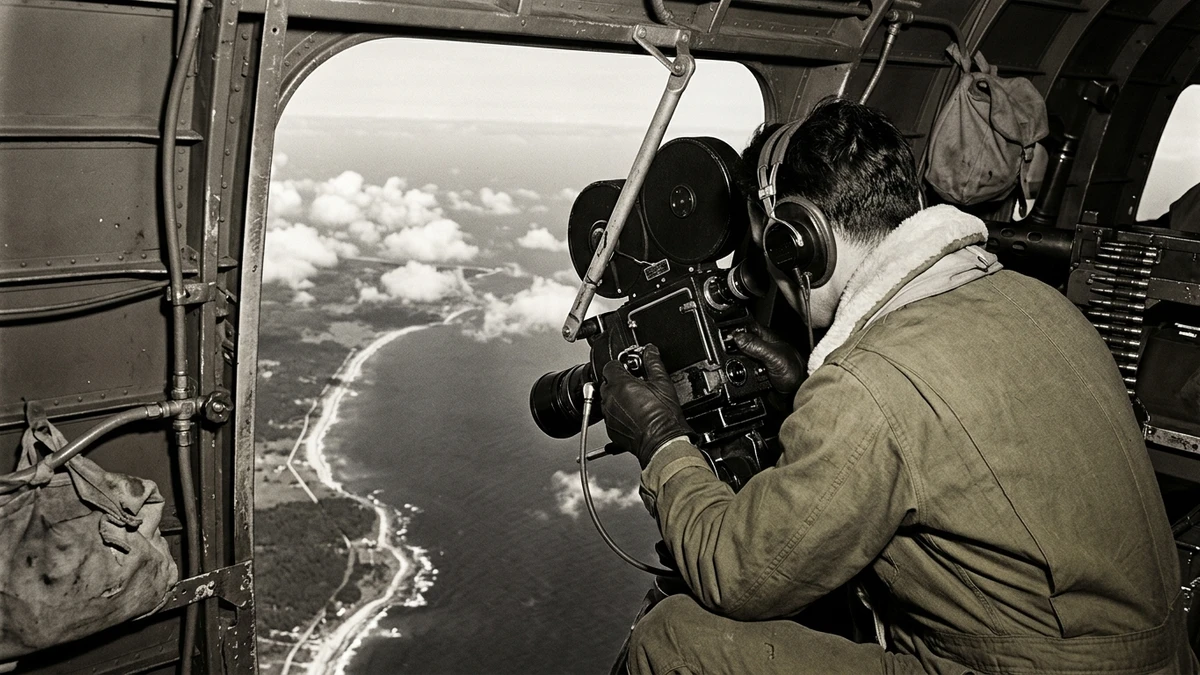
In a 1949 letter appealing against that reversion, Newhouse set out his own career. He had been "consistently ordered to duty of ever increasing responsibility", from Photographic Officer of naval air stations, through Photographic Liaison Officer of naval aviation supply depots and Staff Photographic Officer for Commander Utility Wings, Pacific, to Staff Photographic Liaison Officer with the Bureau of Aeronautics at Wright-Patterson Air Force Base, and then Head of the Material Procurement Branch in the Bureau's Photographic Division.
That Wright-Patterson posting will catch the eye of anyone who knows Project Blue Book was based there. In Newhouse's case it was a Navy liaison job on buying photographic equipment, in 1948 and 1949. Nothing in the file links it to the Air Force's UFO work.
What Did Newhouse's Navy Fitness Reports Say?
Delbert Newhouse's Navy fitness reports praise his photography almost without exception. The one poor report, from 1948, was about office administration, not camera work. Newhouse attached transcripts of seven reports to his 1949 appeal, and they read as a fair picture of him.
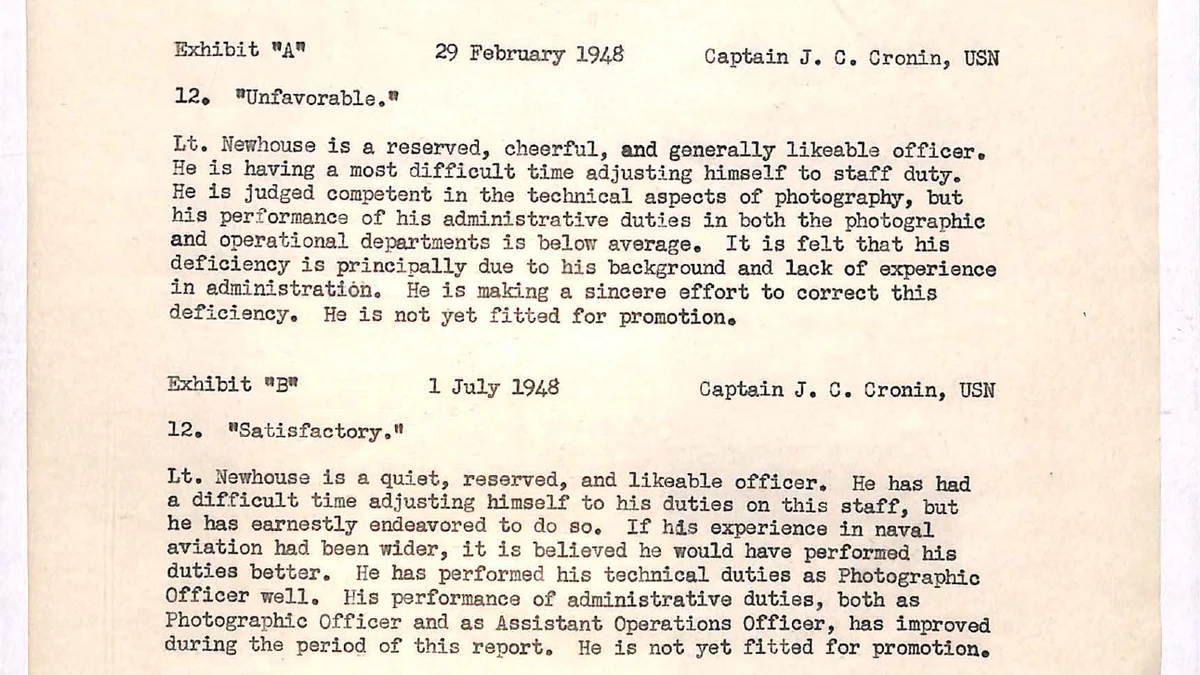
From 1946, Admiral E. D. Foster praised his "initiative and thoroughness". In March 1947, Commander K. A. Grahn wrote that he "has shown a superior grasp of photographic supply details, sound judgment, foresight, devotion to duty and thoroughness", and that "his personal and military characteristics are the highest". An October 1947 report called his performance "excellent and outstanding". His last report as a lieutenant, in September 1949 from Rear Admiral L. M. Grant, begins: "Lt. Newhouse is a loyal, capable officer."
For balance, here's the exception. On 29 February 1948, Captain J. C. Cronin marked a report "unfavorable". He called Newhouse "a reserved, cheerful, and generally likeable officer" who was having "a most difficult time adjusting himself to staff duty". Cronin judged him "competent in the technical aspects of photography" but below average at administration, and "not yet fitted for promotion". Cronin's next report, four months later, was satisfactory and said Newhouse had performed his technical duties as Photographic Officer well. Newhouse himself wrote that the rest of his reports "ranged from above average to superior".
What Newhouse didn't have: magnification
Kit we've tested and reviewed in full
Newhouse said himself there was no reference point and no way to judge size or distance. A pair of binoculars on the back seat would have told him in seconds whether those were birds. Our guide to the best binoculars for stargazing has the full comparison.
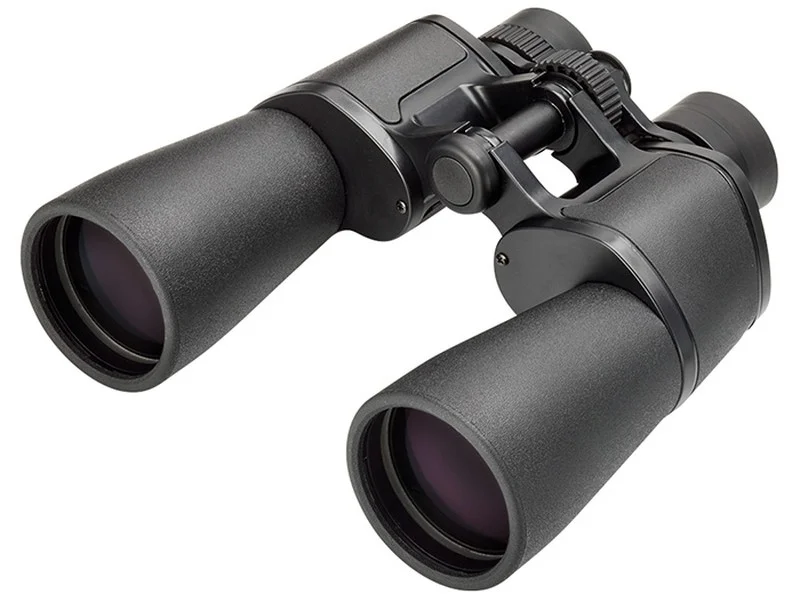
Bright, wide and quick to swing on to anything odd overhead. At 10x a soaring gull shows its wings straight away.
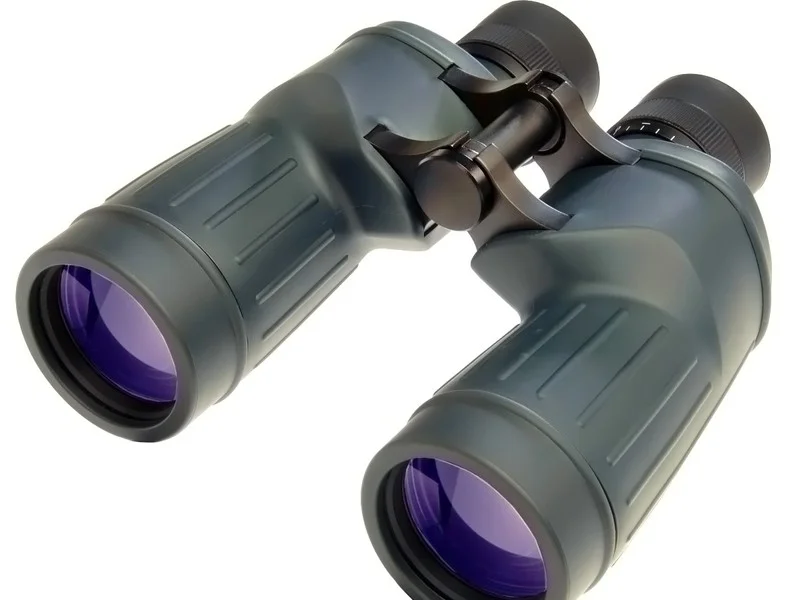
Waterproof, nitrogen-filled 10x50s that live happily in a car boot, which is where Newhouse's camera was.
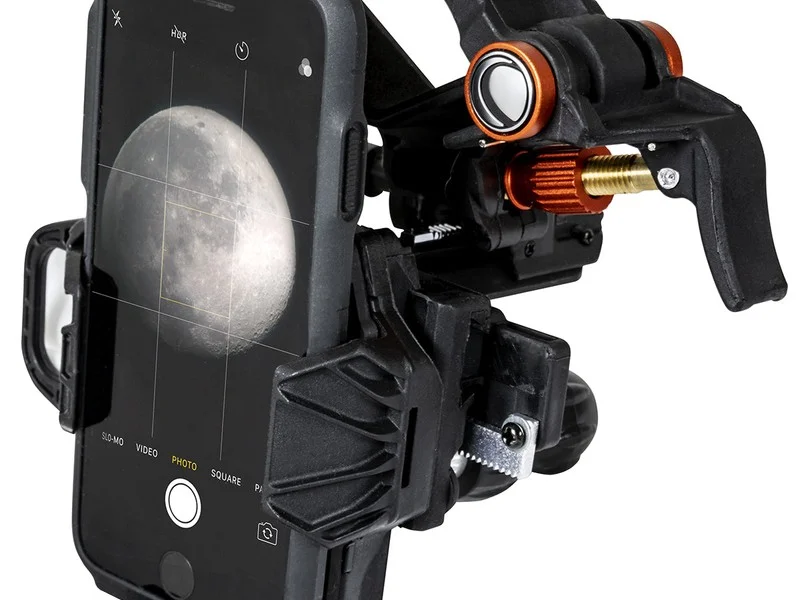
Celestron NexYZ Smartphone Adapter
Clamps your phone to binoculars or a telescope, so your footage has magnification and a steady view behind it.
Affiliate links: you pay the same price, we earn a small commission that helps keep WatchTheStars free.
Where Was Newhouse on 2 July 1952? The Leave Records
Delbert Newhouse was on leave from his Navy posting. His personnel file records two blocks of leave from the Naval Supply Center in Oakland: 19 to 30 June 1952 and 1 to 7 July 1952. The Tremonton sighting on 2 July falls inside the second block.
That fits his account of a family drive from Washington, D.C. to Oregon. The leave records only prove so much, though. They say where he wasn't (at his desk in Oakland). They say nothing about a sighting, and nobody at the time wrote them with Tremonton in mind. It's a small piece of corroboration, not confirmation.
Does Newhouse's Personnel File Mention the Tremonton UFO Film?
No. Delbert Newhouse's 585-page Navy personnel file never mentions the Tremonton film. Search it for Tremonton, flying saucers or anything unidentified and you get nothing. The file holds exactly what a Navy career file should: orders, pay and leave forms, fitness reports, medical checks and retirement papers.
His 1960 retirement orders transfer him to the retired list as Chief Photographer, W-4, from 1 April 1960, under the rule for voluntary retirement after twenty years' service, and advance him to lieutenant on the retired list. The most famous thing he ever filmed left no trace on his service record at all.
Why Delbert Newhouse Matters to the Tremonton Argument
Newhouse matters because every explanation of the Tremonton film has to fit the man who shot it. The Navy's 1953 study, covered in our post on the Navy's Tremonton analysis, ruled out birds on brightness. The Air Force later settled on seagulls. A common sceptical point is that an experienced photographer would have got a better film.
The file lets us weigh that properly. Newhouse was a trained, experienced naval photographer, but he was on a family holiday with a hand-held camera loaded in a hurry, pointing at a featureless sky, and he got the exposure wrong and said so. Skill doesn't give you a reference point, and without one nobody could judge how far away those specks were. His honesty was never in doubt, and the files don't settle what he filmed. Our Tremonton and Great Falls film analysis page covers the full story, including the Air Force's decision to have the Navy study the Tremonton and Great Falls films "in conjunction".
It's also a lesson for anyone who sees something odd today. Before you assume anything, check what you can see in the sky tonight and whether there are ISS passes tonight over your area, because the space station and bright planets are behind a lot of modern reports. If you're new to all this, our stargazing for beginners guide covers the usual suspects.
Where to Read the Delbert Newhouse Files
Newhouse's personnel file is DOW-UAP-D104 and the Air Force flying discs file with his statement is DOW-UAP-D105, both in the Pentagon's sixth PURSUE release, free at war.gov/ufo. You can open them from our PURSUE files browser, next to the Blue Book case file D102 and the digitised film. The wider collection is on our UAP document archive, and the rest of our research is on the UAP research hub.
For the mood inside the Air Force in the months before Newhouse pulled over, the MIT Lincoln Lab 1952 flying saucer tape is the best companion listen.
Sources:
- DOW-UAP-D104, Final Personnel Record for Newhouse, Delbert C., US Navy, US Department of War, PURSUE Release 06, 18 September 2026
- DOW-UAP-D105, US Air Force Flying Discs File, September to December 1952, US Department of War, PURSUE Release 06
- DOW-UAP-D102, Project Blue Book File on Tremonton Film, Utah, 1952, US Department of War, PURSUE Release 06
Frequently Asked Questions
Equipment guides
Related topics
Ian ClaytonAmateur astronomer and founder of WatchTheStars.co.uk, dedicated to helping others explore the wonders of our universe. Full profile →