Key takeaways
- USG-UAP-D001 is an 86-page NASA Headquarters file of 1998 replies to UFO letters sent via Congress and the White House
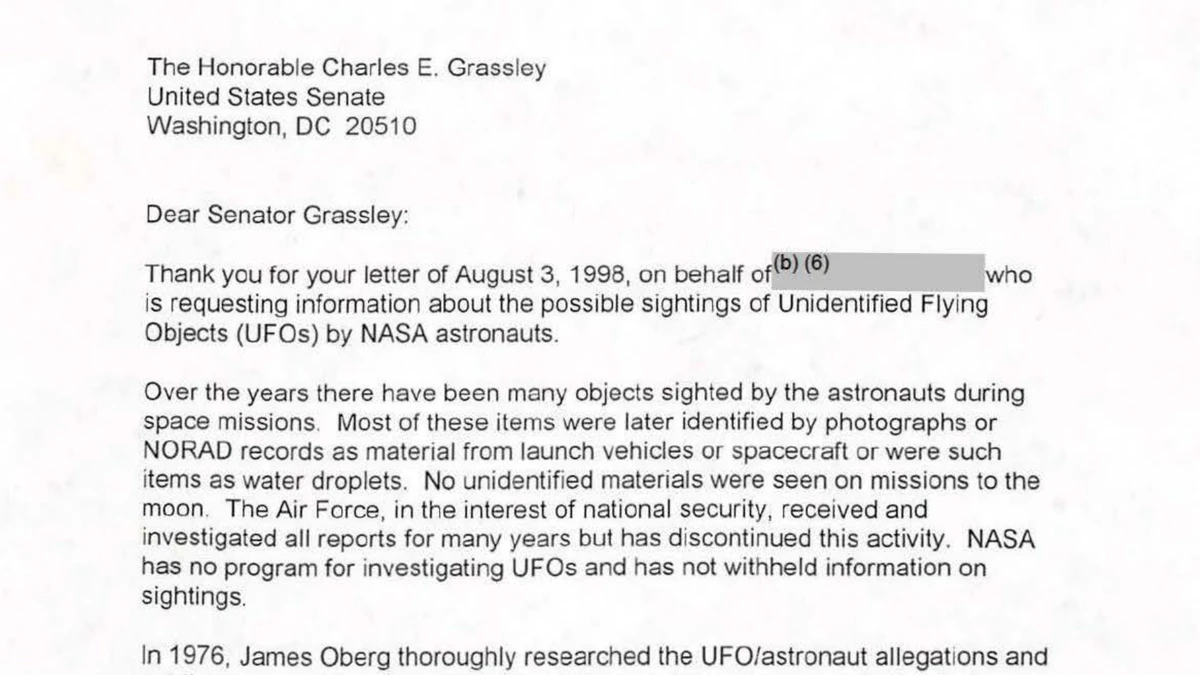
- NASA's 4 September 1998 letter to Senator Chuck Grassley said objects seen by astronauts were mostly rocket debris or water droplets
- NASA answered the Grassley query by enclosing James Oberg's 1976 article debunking the famous astronaut UFO cases, written 22 years earlier
- The Oberg article in USG-UAP-D001 traces the McDivitt Gemini 4 'UFO' to the mission's own booster, missing from NORAD's list because nobody asked
Jump to section 8 sections
- What Is USG-UAP-D001? NASA's 1998 UFO Letters to Congress
- Did Astronauts See UFOs? NASA's Answer to Senator Grassley
- The McDivitt UFO: What Gemini 4's Astronaut Really Saw
- Astronaut UFO Photos Explained: Gemini 7, Gemini 11 and Apollo 12
- UFO Hearings, Mars Photos and Area 51: The Other 1998 Letters
- NASA's UFO Fact Sheet: 12,618 Blue Book Sightings, 701 Unidentified
- How to Spot Satellites and the ISS Yourself
- Where to Read USG-UAP-D001
Did astronauts see UFOs? In 1998 that exact question reached NASA through a US senator, and this week's document is NASA's answer. USG-UAP-D001 is an 86-page file from NASA Headquarters, labelled "Aeronautics: UFO", holding a year's worth of replies to UFO letters that came in through Congress and the White House. Its centrepiece is a reply to Senator Chuck Grassley, and what NASA chose to send with it: an article written 22 years earlier.
This is the sixteenth post in our Document of the Week series, where we take one file from our declassified UAP document archive and explain in plain English what it says. Last week's was the CIA's report on Kardashev and Sakharov's 1971 paper.
What Is USG-UAP-D001? NASA's 1998 UFO Letters to Congress
USG-UAP-D001 is NASA's 1998 correspondence file for UFO letters passed on by politicians. Each case has a tracking sheet from NASA's Headquarters Action Tracking System, the letter that came in, a draft reply with handwritten edits, and the final reply signed by Edward Heffernan, NASA's (acting) Associate Administrator for Legislative Affairs. The US Department of War released it on 12 June 2026 in the third PURSUE batch.
| USG-UAP-D001 at a glance | |
|---|---|
| File plan | 1320.4, "Aeronautics: UFO" |
| Pages | 86 |
| Main reply | NASA to Senator Charles E. Grassley, 4 September 1998 (tracking no. L/1998-00729) |
| Other cases | Senator Olympia Snowe (two letters), Congressman Bart Gordon, two White House referrals |
| Enclosures | James Oberg's 1976 "astronaut UFOs" article; NASA fact sheet FS-1997-01-017-HQ |
| Released | 12 June 2026, PURSUE Release 3 (war.gov) |
The names of the people who wrote in are blacked out under the privacy exemption (b)(6). The politicians, NASA staff and the letters themselves are all left in.
Did Astronauts See UFOs? NASA's Answer to Senator Grassley
NASA's answer was no. On 3 August 1998 Senator Grassley's office forwarded emails from a constituent asking about UFO sightings by astronauts. NASA replied on 4 September. Most objects astronauts had seen, the letter said, were later identified from photos or NORAD tracking as bits of launch vehicles or spacecraft, or as water droplets. Then came the line that sums up the whole file: "No unidentified materials were seen on missions to the moon."
The letter adds that NASA had no programme for investigating UFOs and had not withheld anything. For the detail, it pointed to the space writer James Oberg, who had "thoroughly researched" the astronaut stories in 1976 for SEARCH magazine, and enclosed his article in full. It takes up 26 pages of the file.
What the constituent had sent is just as telling. The emails, also in the file, ask whether there are aliens at Area 51, then paste in a list of internet stories: a supposed Apollo 11 exchange in which Neil Armstrong describes huge alien ships watching the landing, an X-15 pilot filming UFOs, and a shuttle crew talking about an "alien spacecraft" over amateur radio. NASA didn't answer these one by one. It sent the Oberg article and a fact sheet, and left it there.
The McDivitt UFO: What Gemini 4's Astronaut Really Saw
The Gemini 4 "UFO" was almost certainly the mission's own discarded rocket stage, according to the article NASA enclosed. It's the most famous astronaut sighting of all, and Oberg's account of how it became a mystery is the best part of the file.
On 4 June 1965, about 30 hours into the flight and with Ed White asleep, James McDivitt reported a cylindrical object with an arm sticking out, apparently close by. Houston asked NORAD which satellites were near Gemini 4. NORAD's list had about a dozen objects, mostly small debris, plus the Pegasus satellite, which NASA announced as the answer. But Pegasus was more than a thousand miles away, and McDivitt had seen something much closer.
Oberg's explanation is simple. NASA had asked NORAD to compare Gemini 4 with other satellites, so the computer was never asked about the spent upper stage that had been launched with it. McDivitt had flown near that booster on the first day, had once failed to recognise it in the Sun's glare, and had described it with straps hanging off it. A week after landing he told a press conference the object looked a lot like the upper stage of a booster. Oberg also notes McDivitt's eyes were red and watering at the time, from a reaction to the cabin air.
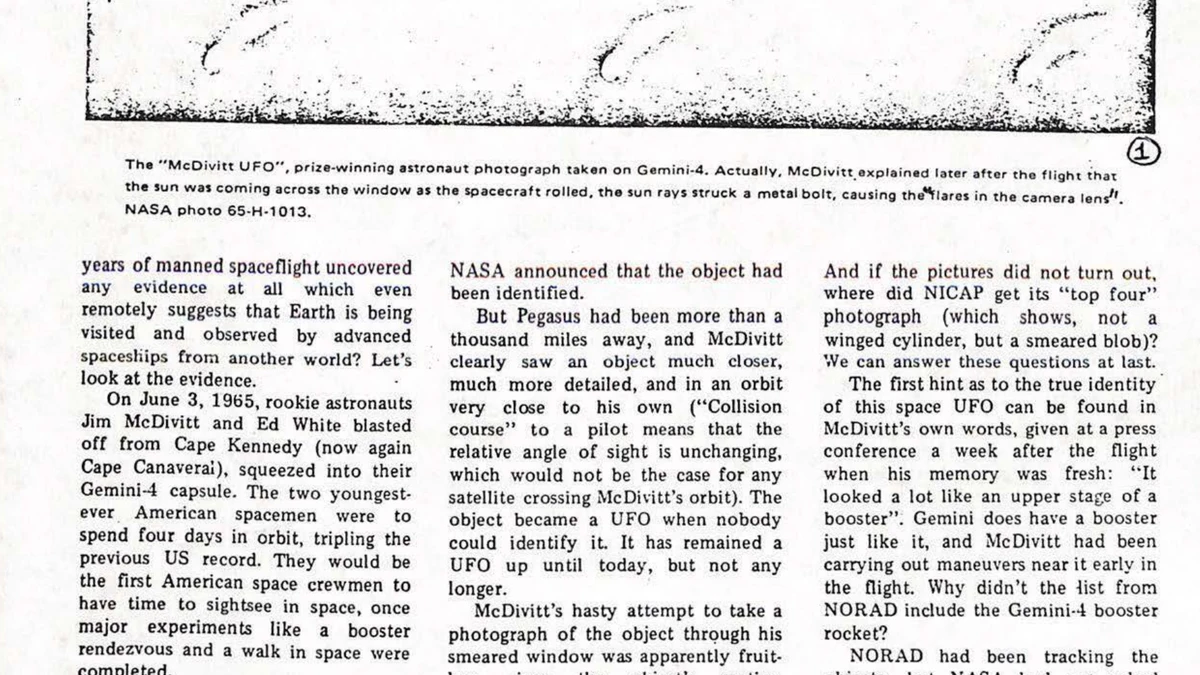
What about the famous photo? The caption in the file says NASA photo 65-H-1013 shows sunlight striking a bolt on the dirty window as the capsule rolled, and that McDivitt agreed. McDivitt found no picture of the object he saw. He never claimed it was alien, only that he didn't know what it was. He died in 2022.
Astronaut UFO Photos Explained: Gemini 7, Gemini 11 and Apollo 12
Several of the best-known astronaut UFO sightings and photos turn out to be misidentified or doctored, according to the Oberg article. Three cases stand out.
- Gemini 7, December 1965. A widely shared photo of two glowing lights in space was, Oberg says, an ordinary NASA picture (S65-63722) of two thrusters on the capsule's nose catching the Sun. Someone retouched out the edge of the spacecraft so the lights seemed to float in space. Oberg says he examined the original himself.
- Gemini 11, 1966. Pete Conrad and Dick Gordon photographed an object that UFO writers made much of. It was the Soviet Proton-3 satellite, with its large solar panels.
- Apollo 12, 1969. The story that Conrad was "followed by a UFO" to the Moon came from a joke on the radio about panels from his own rocket tumbling alongside. Conrad confirmed this to Oberg in a letter dated 12 April 1976.
The article ends with a line that NASA was clearly happy to pass on: the astronaut UFO stories teach "nothing about UFOs, but a lot about UFO investigators". A photo caption adds that J. Allen Hynek, the Air Force's former UFO consultant, endorsed Oberg's conclusions after seeing the photos in July 1976. Hynek's own papers are now in the news again, with the Pentagon's plan to buy Hynek's Blue Book archive.
NASA's letter says nothing unidentified was seen on the Moon missions. Our page on the Apollo 17 UAP encounter looks at a flashing object that crew tracked in December 1972, which the 1998 reply doesn't mention. And the space shuttle era had its own puzzle, covered on our STS-80 UFO incident page.
UFO Hearings, Mars Photos and Area 51: The Other 1998 Letters
The rest of the file shows what ordinary people were asking about UFOs in 1998, and how NASA brushed each request off politely.
- Mars photos. In May 1998 Senator Olympia Snowe passed on a letter from a Maine constituent worried about the "authenticity" of recent Mariner photos of Mars. NASA's 24 June reply points out there were no recent Mariner photos and guesses he meant the Mars Global Surveyor, which had re-imaged the "Face on Mars" region in April 1998. NASA said it didn't tamper with the images and that they'd all go into a public archive within six months. You can read more about the planet itself on our Mars facts page.
- UFO hearings. Two emails to President Clinton, sent to the White House website, asked for open hearings on alien evidence. One, from a member of Steven Greer's CSETI group in March 1998, suggested it would change the headlines away from the scandal of the day. The White House sent both to NASA, which replied that it knew of no hearings planned.
- Taxpayers' money. A constituent of Congressman Bart Gordon sent in an article about Congress funding the search for aliens. NASA replied that Congress had cancelled its search in 1993.
- A young researcher. A 12-year-old from Portland, Maine, wrote to Senator Snowe asking for the Roswell files, with a list of 15 sightings and a firm belief that aliens were kept in Hangar 18. NASA faxed the fact sheet over to Snowe's office.
Every reply ends the same way: the fact sheet, and a polite line hoping the information helps.
NASA's UFO Fact Sheet: 12,618 Blue Book Sightings, 701 Unidentified
NASA's standard UFO answer in 1998 was fact sheet FS-1997-01-017-HQ, "The US Government and Unidentified Flying Objects", last revised on 14 February 1997. It went out with almost every reply in this file.
Its main points: no part of the US government was investigating UFOs; the Air Force's Project Blue Book ended on 17 December 1969 after 12,618 reports, of which 701 stayed "unidentified"; NASA was asked to look at resuming UFO work in 1977 and decided there was nothing to gain; and Congress paid for a NASA radio search for alien signals, the High Resolution Microwave Survey, in October 1992, then cancelled it a year later. The SETI Institute in California carried on the work with NASA's borrowed equipment.
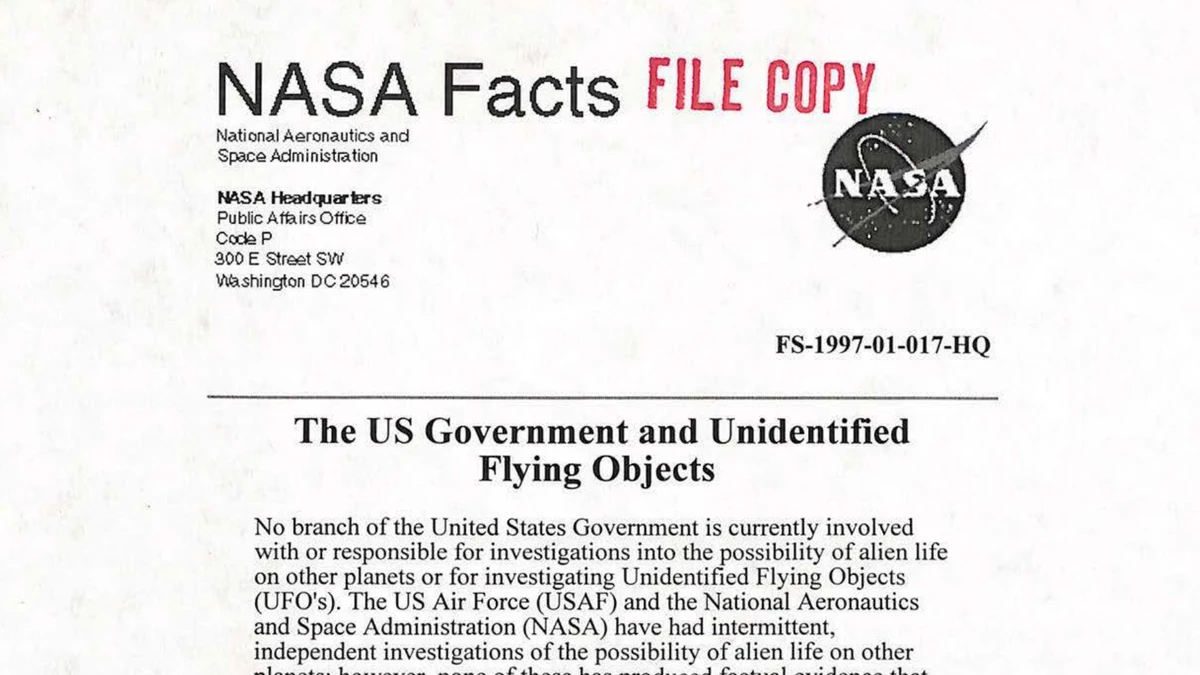
The last line of advice is the one that dates it most. Anyone wanting to report a UFO, it says, should contact the police. For how Blue Book came to be shut down in the first place, see our earlier Document of the Week on why Project Blue Book ended. NASA's view has since moved on: in 2022 it set up an independent study team on unidentified anomalous phenomena, which reported in 2023.
Catch your own 'space UFO'
Kit we've tested and reviewed in full
Most of the astronaut cases in this file came down to rocket stages and debris catching the Sun. From the ground you can watch the same thing happen. New to it? Our guide to binocular astronomy explains where to start.
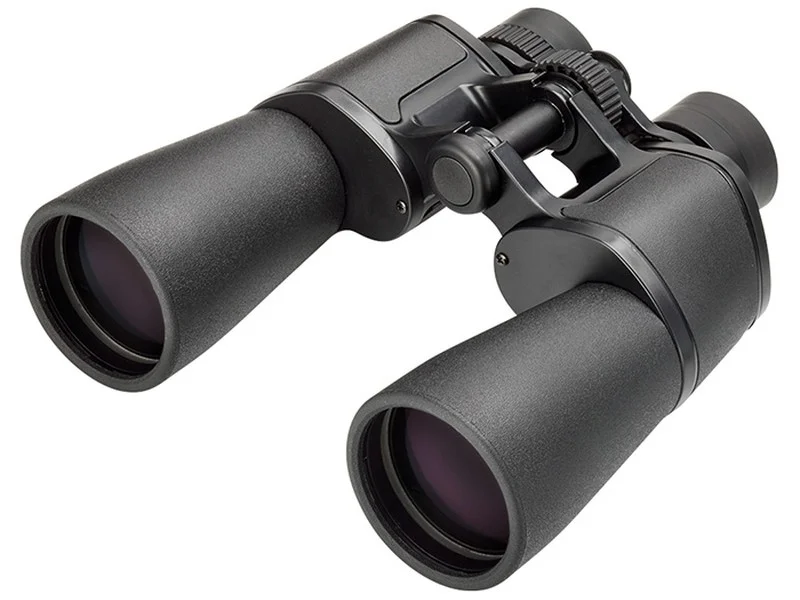
Light and quick to aim. Enough to follow a satellite or the ISS across the sky and see that it's a steady point, not a craft.
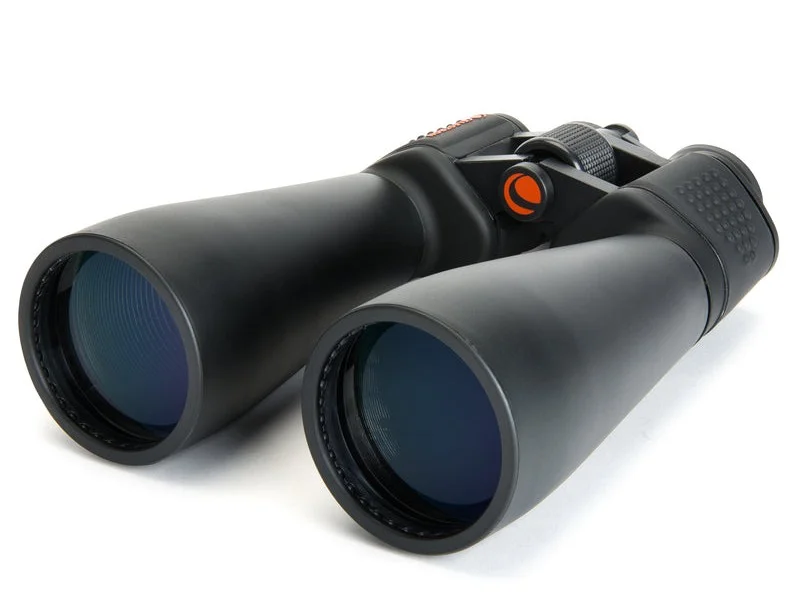
At 15x a slow-moving light shows whether it's a balloon, a distant plane or a tumbling rocket body that flashes as it turns.
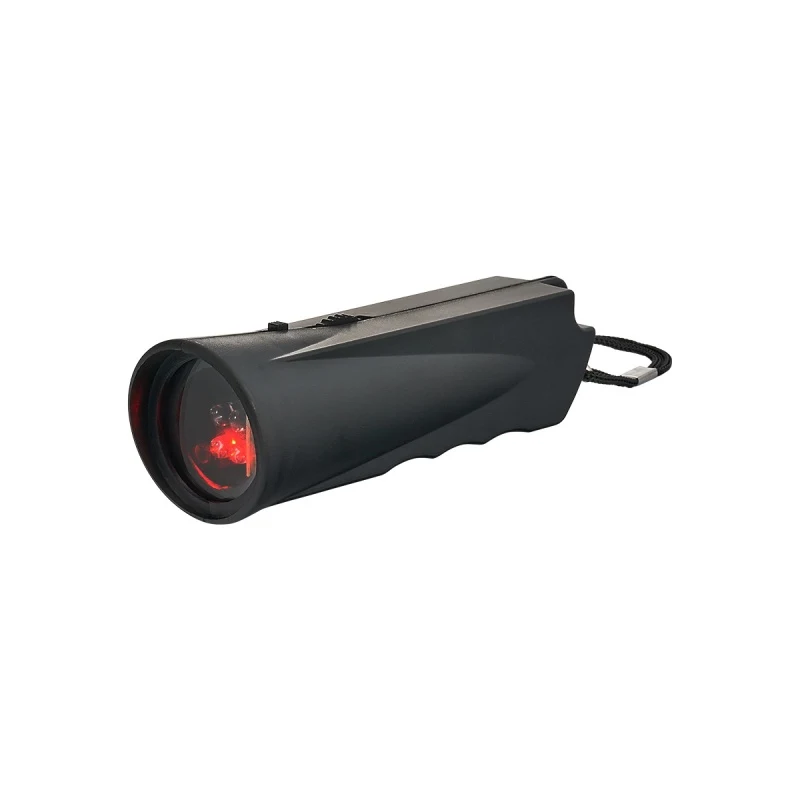
Astro Essentials Red Light Torch
Write down the time, direction and height of anything odd without ruining your dark adaptation. Those three notes solve most sightings.
Affiliate links: you pay the same price, we earn a small commission that helps keep WatchTheStars free.
How to Spot Satellites and the ISS Yourself
You can see the same kind of objects that puzzled the Gemini crews from your own garden. Satellites and spent rocket stages show up as steady points of light gliding across the sky in the hour or two after sunset, lit by a Sun that has already set for you. A tumbling rocket body often flashes as it turns, which is exactly the kind of thing that ends up in UFO reports.
The brightest of all is the space station. Check our ISS passes tonight page for times from your town, and what you can see in the sky tonight for bright planets that also get mistaken for UFOs. A pair of the best binoculars for stargazing, such as the Opticron Adventurer 10x50, turns a mystery light into a satellite, plane or planet in seconds. If you're starting from scratch, our stargazing for beginners guide covers the rest.
Where to Read USG-UAP-D001
The PDF is public on war.gov as USG-UAP-D001_Congress-WhiteHouse-UFO-Correspondence_1998.pdf, part of the third PURSUE release of 12 June 2026. It's also in our PURSUE file browser with a download from our own mirror. For the rest of that batch, read our guide to the Pentagon's third UFO file release.
The letters are clean and easy to read. The Oberg article is a photocopy of a photocopy, so the photos in it are mostly grey smudges, but the text comes through well.
Sources:
- USG-UAP-D001, Congressional, White House, UFO-related Constituent Correspondence, 1998, NASA Headquarters file 1320.4, US Department of War, PURSUE Release 3, 12 June 2026, read from our local archive copy
- Release 3 metadata catalogue (release_03_metadata.csv), entry for USG-UAP-D001
- James E. Oberg, "Astronaut UFOs", SEARCH magazine, 1976 (reproduced in full in USG-UAP-D001)
- UFO sightings in outer space, Wikipedia
- McDivitt's explanation for his Gemini 4 object, James Oberg
Frequently Asked Questions
Equipment guides
Related topics

Ian ClaytonAmateur astronomer and founder of WatchTheStars.co.uk, dedicated to helping others explore the wonders of our universe. Full profile →