Key takeaways
- CIA-UAP-014 is a two-page CIA memo dated 18 December 1952, released in the Pentagon's third PURSUE batch on 12 June 2026
- The CIA memo says Britain's Dr R.V. Jones had inherited a flying saucer committee that judged the sightings were not enemy aircraft
- The memo describes a 'Yorkshire incident' where senior RAF officers and pilots saw a 'perfect flying saucer', usually linked to RAF Topcliffe in September 1952
- The second page of CIA-UAP-014 lists the CIA's real fear: false alarms clogging early warning, not alien visitors
Jump to section 7 sections
- What Is CIA-UAP-014? The CIA's 1952 Memo on British UFOs
- Who Was R.V. Jones? Britain's Flying Saucer Working Party
- The Yorkshire UFO Incident: RAF Topcliffe in 1952
- Ghost Rockets, Chladni and the Tremonton UFO Film
- Why the CIA Worried About UFO Reports: Page Two
- How to Check a UFO Sighting Yourself
- Where to Read the CIA UFO Memo (CIA-UAP-014)
In December 1952 a messenger arrived in Washington from London with news about Britain's flying saucer work, and the CIA wrote it down. That CIA UFO memo, filed as CIA-UAP-014 and titled "British Activity in the Field of 'Unidentified Flying Objects'", was released by the Pentagon on 12 June 2026. It's only two pages long, but it names Britain's top scientific intelligence officer and describes a "perfect flying saucer" seen by senior RAF officers in Yorkshire. The second page shows what the CIA was really worried about.
This is the fourteenth post in our Document of the Week series, where we take one item from our declassified UAP document archive and explain in plain English what it says. Last week's file was Project Sign's first report. This one crosses the Atlantic.
What Is CIA-UAP-014? The CIA's 1952 Memo on British UFOs
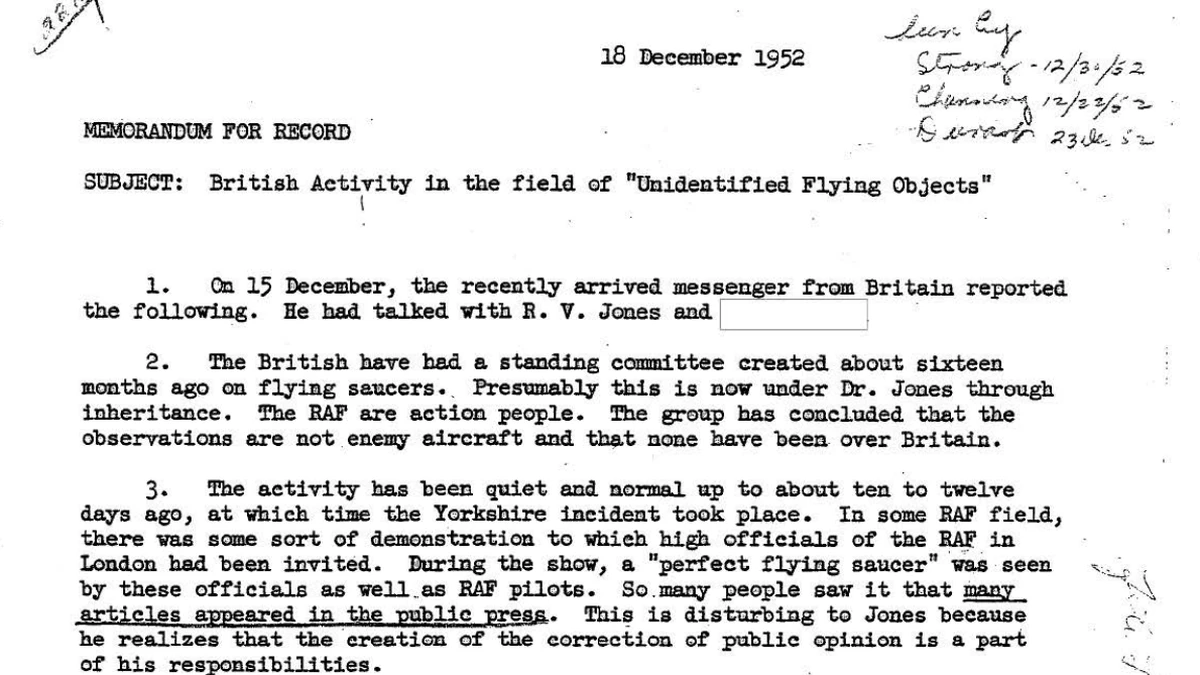
CIA-UAP-014 is a Memorandum for Record dated 18 December 1952, signed by H. Marshall Chadwell, the CIA's Assistant Director for Scientific Intelligence, and stamped Secret. It records what a "recently arrived messenger from Britain" said on 15 December after talking to R.V. Jones and a second person whose name is still blacked out.
| CIA-UAP-014 at a glance | |
|---|---|
| Official title | British Activity in the Field of "Unidentified Flying Objects" |
| Released | 12 June 2026, PURSUE Release 3 (war.gov) |
| Date | 18 December 1952 |
| Signed | H. Marshall Chadwell, Assistant Director, Scientific Intelligence, CIA |
| Length | 2 pages: a five-paragraph memo and a page on "potential dangers" |
| Classification | Secret, Security Information |
Chadwell matters here. In late 1952 he was the CIA officer pushing hardest for a proper scientific look at flying saucers, and within weeks his office had set up the Robertson Panel. That's why notes about Britain were landing on his desk. According to the release catalogue, a more heavily redacted copy of this memo had already been on the CIA's website; this version has fewer black boxes.
Who Was R.V. Jones? Britain's Flying Saucer Working Party
The memo says Britain had a standing committee on flying saucers, created "about sixteen months ago", now presumably run by Dr Jones "through inheritance". Its conclusion was that the objects were not enemy aircraft and that none had been over Britain.
R.V. Jones was a big name to drop. In the Second World War he ran scientific intelligence for the Air Ministry and worked out how German bombers were being steered by radio beams. In 1952 he came back to Whitehall as Director of Scientific Intelligence at the Ministry of Defence, so any saucer work fell to his department.
The committee is almost certainly the MOD's Flying Saucer Working Party, set up in 1950. Its final report in June 1951 put the sightings down to misidentifications, optical illusions and hoaxes, and suggested no more work until there was some material evidence. Sixteen months before December 1952 is roughly the summer of 1951, so the messenger's timing is close. One line in the memo sums up the division of labour neatly: "The RAF are action people." The airmen collected reports, and the scientists explained them away.
The Yorkshire UFO Incident: RAF Topcliffe in 1952
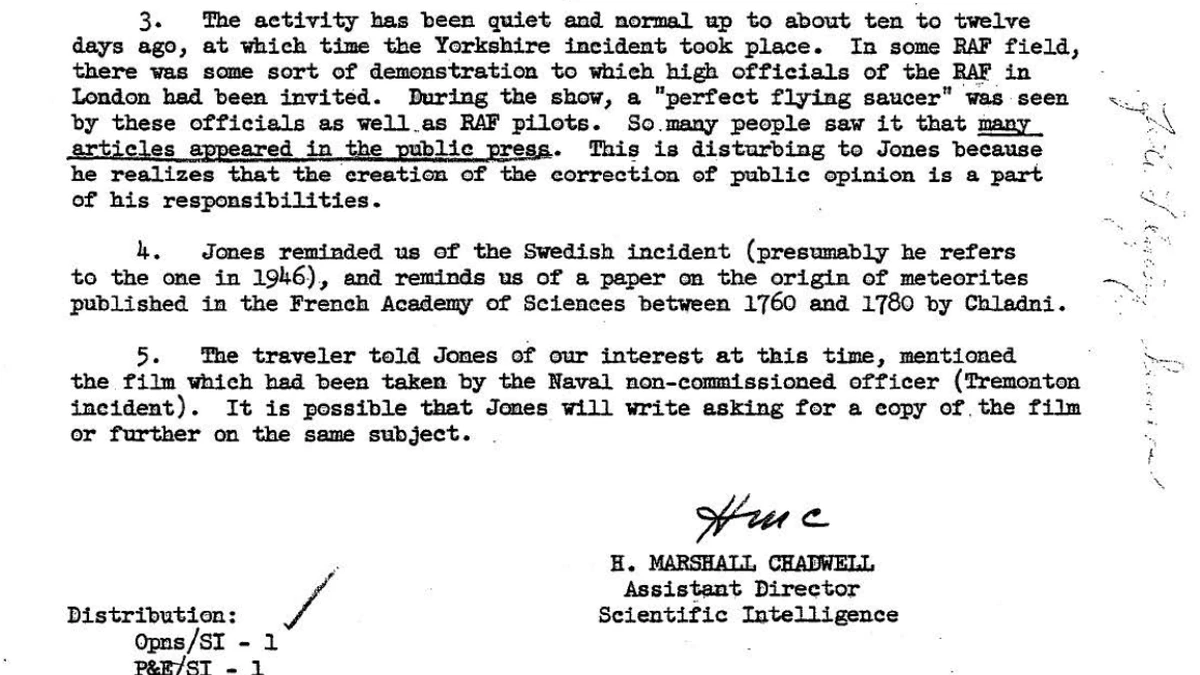
The Yorkshire UFO incident in the CIA memo is usually identified as RAF Topcliffe in North Yorkshire, 19 September 1952, though the memo itself never names the base. Paragraph 3 is the part people will remember. Things had been "quiet and normal", it says, until the Yorkshire incident. At "some RAF field" there had been a demonstration for senior RAF officers from London, and during the show a "perfect flying saucer" was seen by those officials and by RAF pilots. So many people saw it that "many articles appeared in the public press".
Topcliffe is the best-known Yorkshire case of 1952. On 19 September, during the big NATO naval exercise Mainbrace, Flight Lieutenant John Kilburn and other Shackleton aircrew of 269 Squadron were watching a Meteor jet come in when they saw a silver disc behind it. They said it swung down like a falling sycamore leaf, stopped, rotated, then shot off to the west. The story ran in British newspapers, and the RAF report survives at the National Archives in file AIR 16/1199.
There's a catch. The memo puts the Yorkshire incident only ten to twelve days before 15 December, which would be early December, not mid-September. It also describes a demonstration for top brass rather than aircrew watching a jet land. Either the messenger passed on second-hand news with the details blurred, or there was another event we can't now identify. Most historians, including Dr David Clarke, read it as Topcliffe.
The memo says the press coverage was "disturbing to Jones" because he saw correcting public opinion as part of his job. That's a revealing line for a scientist. Britain's MOD files, all the way up to the Manchester Airport near miss of 1995, show the same instinct running for decades, from Topcliffe to the Lakenheath radar case of 1956 and the Rendlesham Forest incident of 1980.
Ghost Rockets, Chladni and the Tremonton UFO Film
Paragraph 4 has Jones reminding the Americans of "the Swedish incident", which the CIA writer guessed meant 1946. That's the summer of the Scandinavian ghost rockets, when Sweden logged hundreds of reports of rocket-like objects and Jones himself looked into them for the British.
He also pointed them to a paper on the origin of meteorites by Ernst Chladni. The memo says it appeared in the French Academy of Sciences between 1760 and 1780, which isn't quite right: Chladni's famous meteorite book came out in German in 1794. The point Jones was making still stands, though. In the 18th century learned men laughed at farmers who said stones fell from the sky, and the farmers were right. He seems to have been warning against dismissing every witness, even while doubting the saucers.
Paragraph 5 brings in an American case. The messenger told Jones about the film "taken by the Naval non-commissioned officer", the Tremonton incident of 2 July 1952, shot in Utah by Navy Chief Photographer Delbert Newhouse. The memo adds that Jones might write asking for a copy. A few weeks later that same film was screened for the Robertson Panel, and you can follow what the experts made of it in our Tremonton and Great Falls film analysis.
Check what's really up there
Kit we've reviewed in full
A shiny dot in the sky at an air show fooled a crowd of RAF officers in 1952. A decent pair of binoculars settles most of these questions in seconds. New to it? Start with our guide to binocular astronomy.
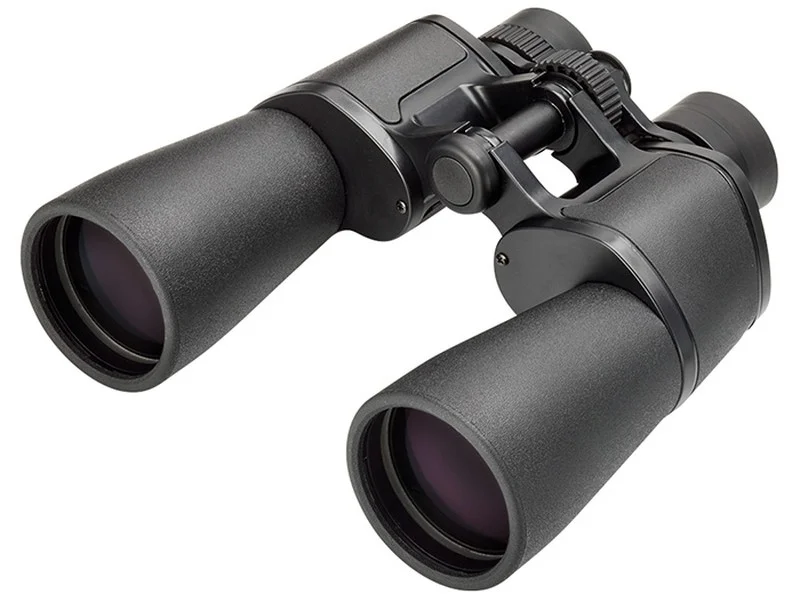
Bright and quick to aim. Enough to turn a 'silver disc' into an aircraft, a balloon or a planet.
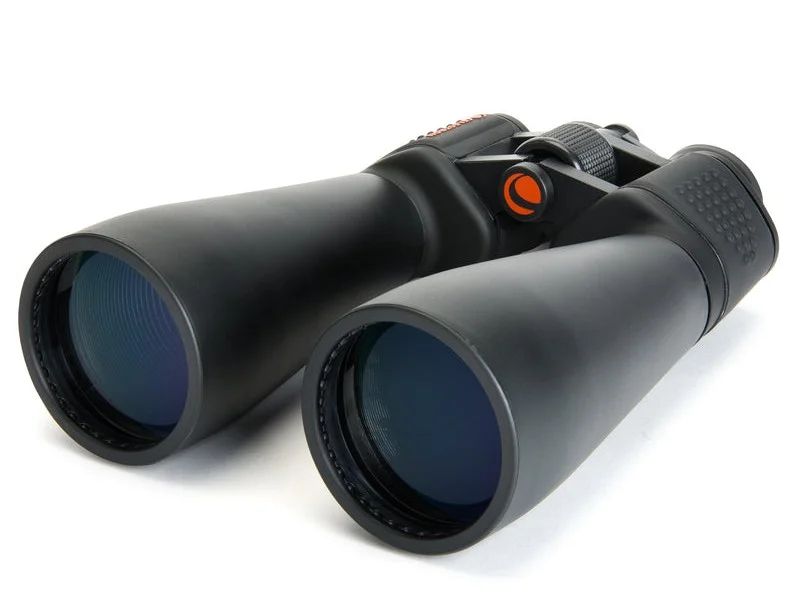
Heavier, but at 15x a distant balloon or a sunlit aircraft shows its real shape.
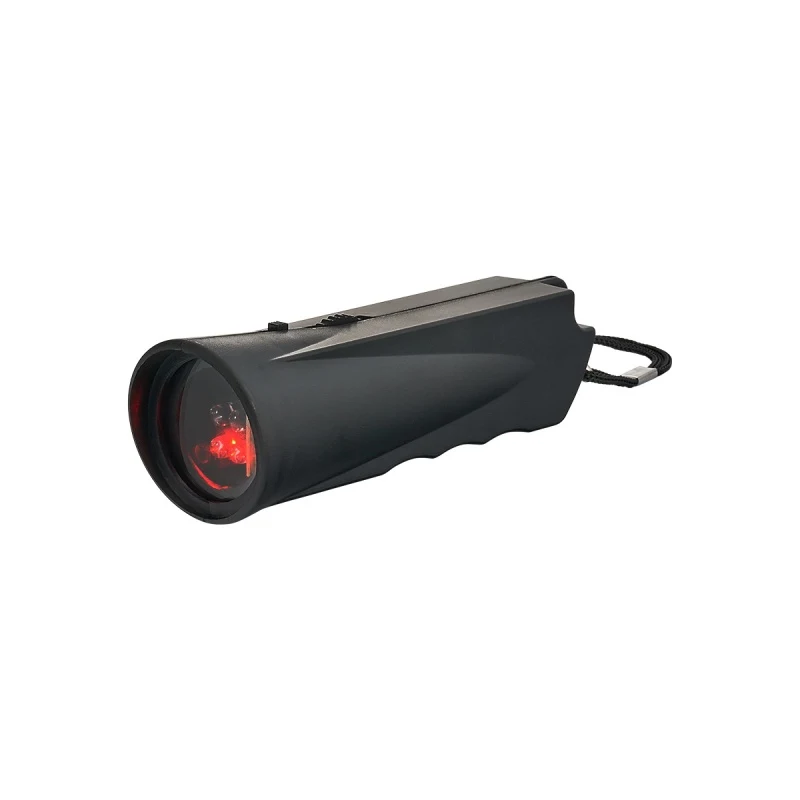
Astro Essentials Red Light Torch
Jot down the time, direction and height of anything odd, the details every UFO file is missing, without losing your dark adaptation.
Affiliate links: you pay the same price, we earn a small commission that helps keep WatchTheStars free.
Why the CIA Worried About UFO Reports: Page Two
The second page is a separate typed sheet, also stamped Secret, and it explains why the CIA was paying attention at all. It opens: "While there is no indication that these objects represent a direct threat to the national defense, there are certain potential dangers which are related to these sightings."
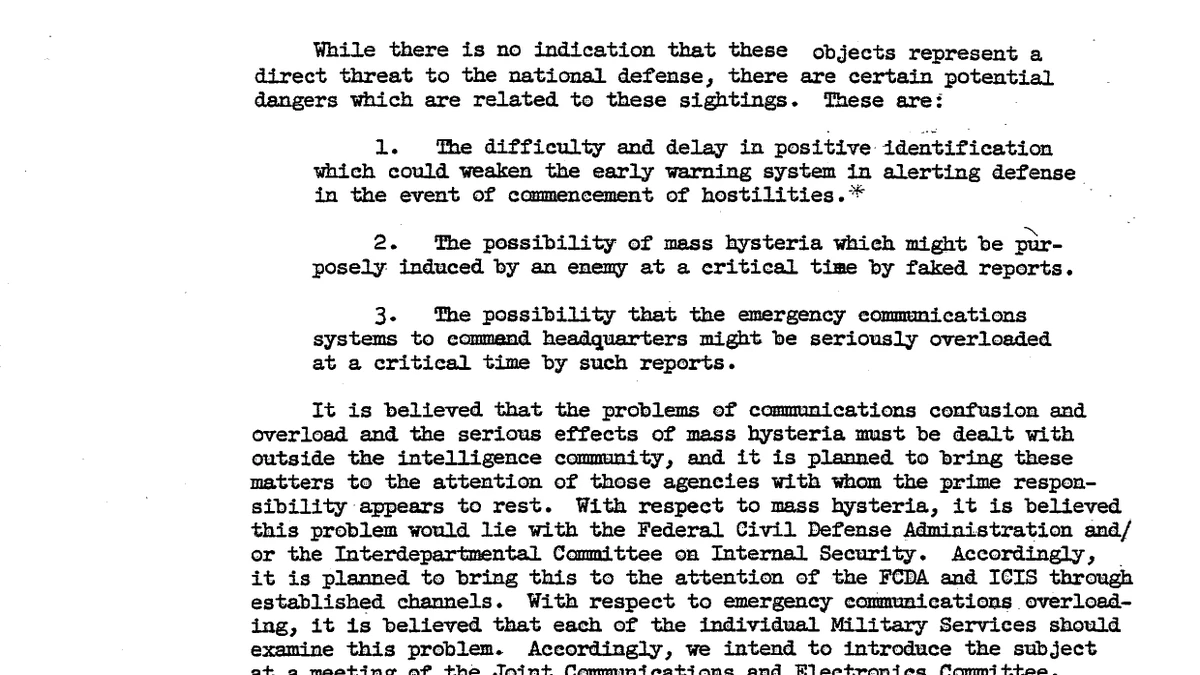
It lists three:
- Slow, uncertain identification could weaken early warning if a war began
- An enemy could fake reports to cause mass hysteria at a critical moment
- A flood of reports could overload emergency communications to military headquarters
The page then passes the problem on. Mass hysteria was a job for the Federal Civil Defense Administration and the Interdepartmental Committee on Internal Security; communications overload was for the military services, through the Joint Communications and Electronics Committee. A pencilled footnote names a US Air Force brigadier general and says Air Defense Command was "cognizant of this potential danger".
Read the two pages together. In December 1952 neither the British nor the CIA thought saucers were enemy aircraft or visitors. What worried them was people: a jumpy public, a crowded radio net, and an enemy who might use both. The Robertson Panel's report in January 1953 said much the same, and that thinking shaped Western UFO policy for twenty years. Our post on what the Pentagon's UFO files mean for the UK picks up the story from there.
How to Check a UFO Sighting Yourself
The quickest way to check a UFO sighting is to rule out the usual suspects: a bright planet, the International Space Station, a satellite, a balloon or an aircraft catching the sun. A shiny disc above an airfield on a bright afternoon is exactly the sort of thing that's hard to judge with the naked eye.
If you see something odd, note the time, the direction you were facing, roughly how high it was and how long it lasted. Then check what you can see in the sky tonight for bright planets, and our ISS passes tonight page for the space station. A pair of the best binoculars for stargazing will turn most "discs" into something ordinary within seconds. If it was a quick streak of light, check the next meteor shower in the UK.
Knowing the sky is the best cure. Our stargazing for beginners guide covers the first few months.
Where to Read the CIA UFO Memo (CIA-UAP-014)
The PDF is public on war.gov as part of the third PURSUE release of 12 June 2026, filed as CIA-UAP-014_British_Activity_in_the_Field_of_Unidentified_Flying_Objects.pdf. You'll also find it, with a download from our own mirror, in the PURSUE file browser. For the rest of that batch, read our guide to the Pentagon's third UFO file release.
Both pages are clean typescript and easy to read. The handwriting is the hard part: the routing notes in the top right corner and the footnote on page 2 are pencil, and the file's text layer misses them, so zoom into the scan.
Sources:
- CIA-UAP-014, British Activity in the Field of "Unidentified Flying Objects", CIA memorandum of 18 December 1952, US Department of War, PURSUE Release 3, 12 June 2026, read from our local archive copy
- Release 3 metadata catalogue (release_03_metadata.csv), entry for CIA-UAP-014
- Operation Mainbrace UFOs and Flying Saucer Working Party, Dr David Clarke
- The Topcliffe sighting, 19 September 1952, Sign Historical Group
Frequently Asked Questions
Equipment guides
Related topics
Ian ClaytonAmateur astronomer and founder of WatchTheStars.co.uk, dedicated to helping others explore the wonders of our universe. Full profile →