Key takeaways
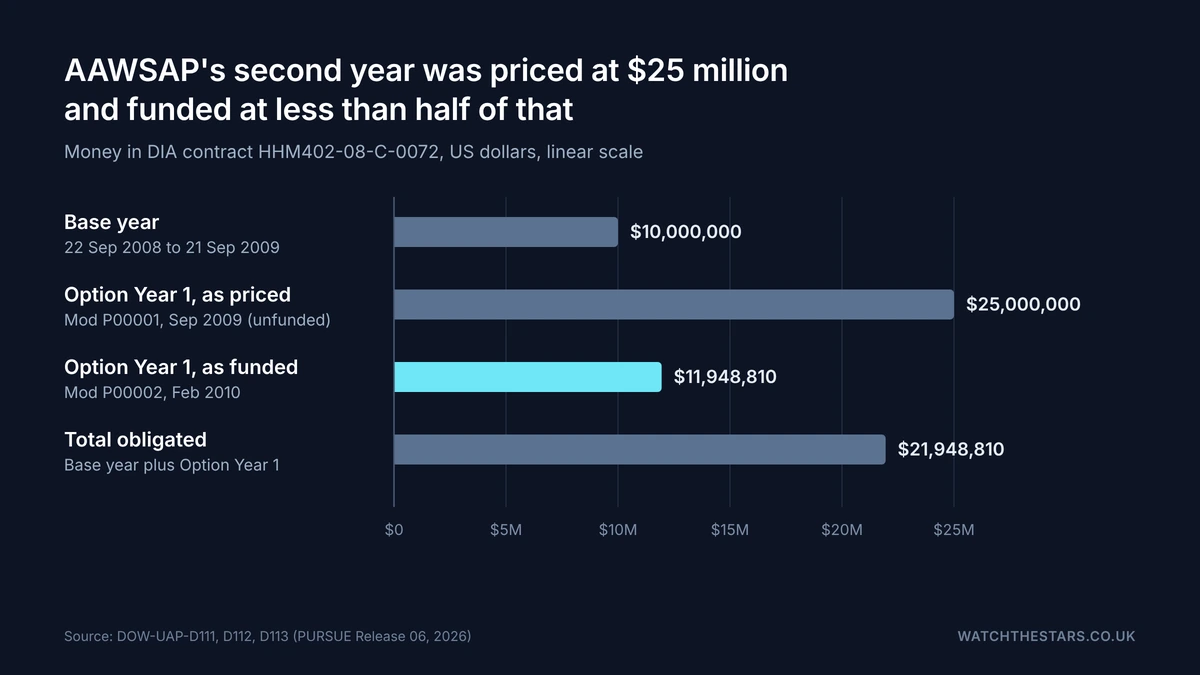
- The AAWSAP contract file records $21,948,810.00 obligated in total: $10,000,000 for the base year and $11,948,810 for Option Year 1. That's where the '$22 million' figure comes from
- The DIA issued the solicitation on 1 September 2008, wanted offers by 10 September and awarded the contract to Bigelow Aerospace Advanced Space Studies (BAASS) on 22 September: 21 days from start to finish
- Option Year 1 was priced at $25,000,000 but funded at $11,948,810, and the funding paperwork lists 'impacts to deliverables as a result of reduced funding'
- The contract was planned for five years. Options 2 to 4 were never used, and the last action is a no-cost extension to 21 December 2010
- None of the seven contract documents uses the words UFO, UAP, anomalous or paranormal. The UFO link comes from the research papers, later reporting and, since October 2026, BAASS's own reports
Jump to section 10 sections
- What Was the AAWSAP Contract?
- How Much Did AAWSAP Cost? $21,948,810 to the Dollar
- How Fast Was the AAWSAP Contract Awarded? 21 Days
- What Did the AAWSAP Contract Pay For?
- Why Was AAWSAP's Second Year Funded at Under Half?
- Is Robert Bigelow Named in the AAWSAP Contract?
- Does the AAWSAP Contract Mention UFOs?
- When Did AAWSAP End? 21 December 2010
- Was AAWSAP a Sole-Source Contract? What the File Doesn't Say
- Where to Read the AAWSAP Contract Documents
For years the Pentagon's "secret UFO programme" has come with a price tag of $22 million and very little paperwork to back it up. That changed on 18 September 2026. The Pentagon's sixth PURSUE release included the full AAWSAP contract file. AAWSAP, the Advanced Aerospace Weapon System Applications Program, was the study the Defense Intelligence Agency ran with Robert Bigelow's company from 2008.
There are seven documents, catalogued DOW-UAP-D110 to D116: a statement of objectives, the solicitation and award, and five modifications. Most of it is government form-filling. Read line by line, though, it answers questions that have been argued about for years, starting with where the money went.
What Was the AAWSAP Contract?
The AAWSAP contract was a firm fixed-price DIA contract, number HHM402-08-C-0072, awarded on 22 September 2008 to Bigelow Aerospace Advanced Space Studies, LLC (BAASS) of Las Vegas. It paid for research reports on breakthrough aerospace technology, planned to run for five years and in practice ran for just over two.
The statement of objectives, dated 18 July 2008 and issued by the DIA's Acquisition Support Division, sets the goal in one sentence: to understand the physics and engineering of these applications "as they apply to the foreign threat out to the far term, i.e., from now through the year 2050". Our AAWSAP programme page has the full picture, including all 37 released research papers. This post sticks to the contract.
How Much Did AAWSAP Cost? $21,948,810 to the Dollar
AAWSAP cost $21,948,810.00 in obligated money, according to the contract file itself. That's exactly $10,000,000 for the base year plus $11,948,810 for Option Year 1. The "$22 million" in news coverage isn't a guess or a rounding of someone's estimate. It's this number, printed in the "Total Award Amount" block of the award form and repeated in the modification that funded the second year.
It also tells you what AAWSAP wasn't. The contract was built as one base year plus four 12-month option years. If every option had been taken up at anything like the $25 million a year priced for the first one, the total would have passed $100 million. The real spend was about a fifth of that.
How Fast Was the AAWSAP Contract Awarded? 21 Days
The AAWSAP contract went from solicitation to award in 21 days. The award form, D111, gives the solicitation issue date as 1 September 2008, the offer due date as "SEP 10, 2008, 2:00 PM ET" and the award date as 22 September 2008. Companies had nine days to put in a bid for a $10 million research contract.
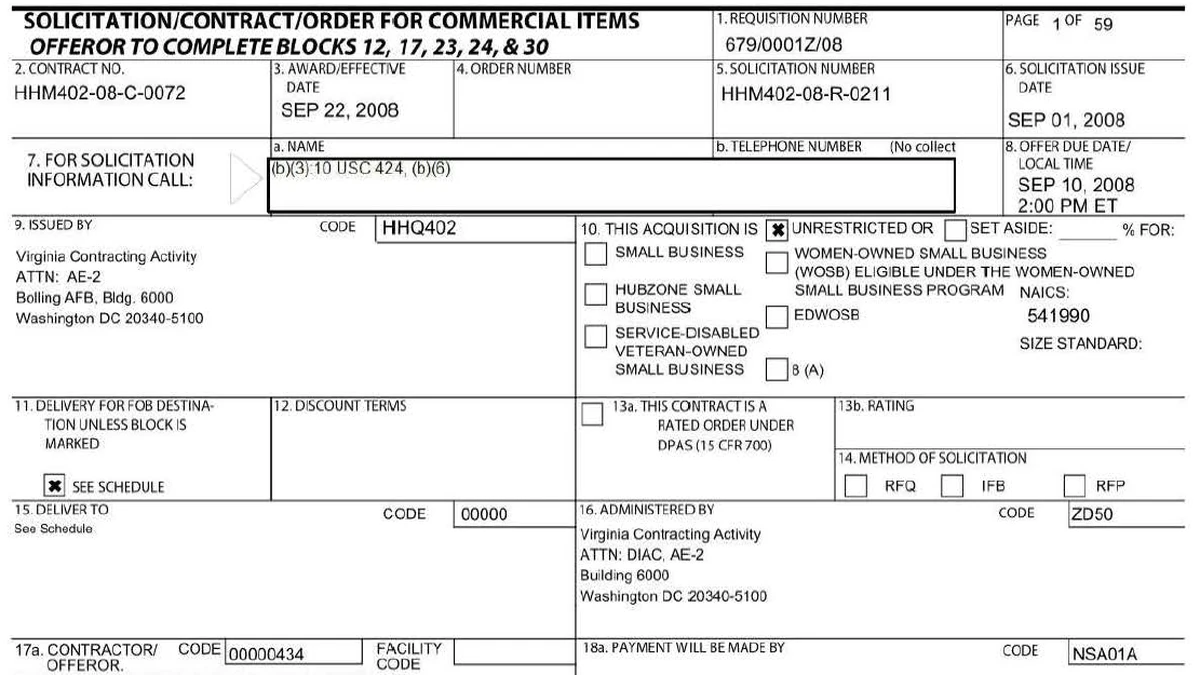
The schedule adds that "BAASS proposal dated 9/3/2008 is incorporated by reference", and that proposal is dated two days after the solicitation went out. The same form ticks "unrestricted", meaning no small-business set-aside. Payments were to go through the NSA Finance and Accounting Office at Fort Meade, Maryland.
What Did the AAWSAP Contract Pay For?
The AAWSAP contract paid for reports. Every line item is paperwork: monthly status reports, a project management plan, research reports, a final threat assessment, travel and "other direct costs". Nothing in the schedule buys hardware, land or test equipment. BAASS's own November 2010 summary (DOW-UAP-D175, page 10), released in October 2026, does say its "data collection, data storage and analysis resources" were "built by BAASS under DIA contract HHM402-08-C-0072". Its list runs from night-vision devices to a 12-core server. The documents don't say which line paid for what.
| Line item | Base year | Option Year 1 (funded) |
|---|---|---|
| Monthly Status Reports | $2,887,000 | $1,549,100 |
| Project Management Plan | $3,600,000 | $4,759,300 |
| Research Report | $2,100,000 | $2,870,600 |
| Comprehensive Integrated Threat Assessment | $240,000 | $220,200 |
| Travel | $50,000 | $36,700 |
| Other Direct Costs | $1,123,000 | $2,494,610 |
| Additional Travel | none | $18,300 |
| Total | $10,000,000 | $11,948,810 |
The research was split into 12 technical areas: lift, propulsion, control, power generation, spatial/temporal translation, materials, configuration and structure, signature reduction, human interface, human effects, armament, and "other peripheral areas". The DIA asked for experts with "minimum of 10 years" in breakthrough aerospace research, at least one PhD on each analytical team, and staff cleared to Top Secret. The research reports were due by the end of the tenth month. Those reports became the Defense Intelligence Reference Documents, or DIRDs, that made AAWSAP famous.
The cheapest UFO research programme: your own eyes
Kit we've reviewed in full
AAWSAP cost nearly $22 million. A good pair of binoculars costs a tiny fraction of that and settles most odd lights in seconds. Our guide to the best binoculars for stargazing has the full comparison.
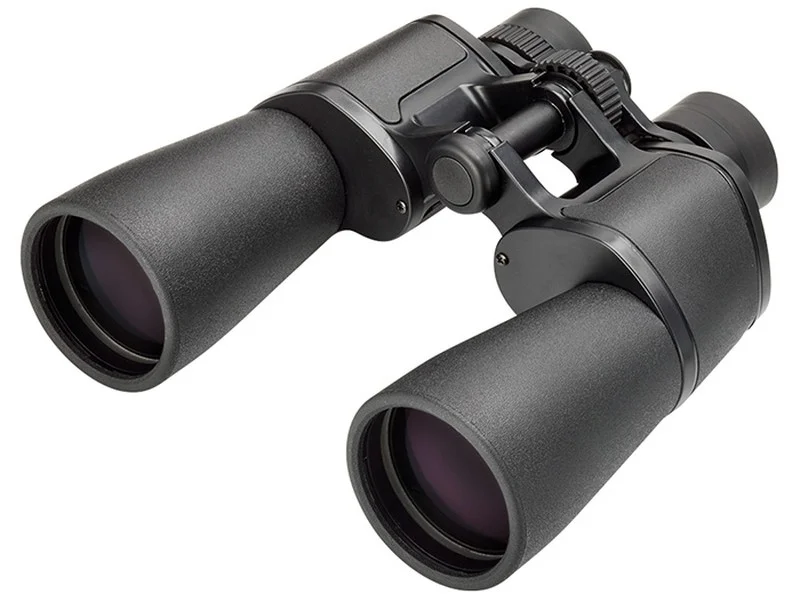
Bright, wide 10x50s that are quick to swing on to anything moving overhead, from a satellite to an aircraft's landing lights.
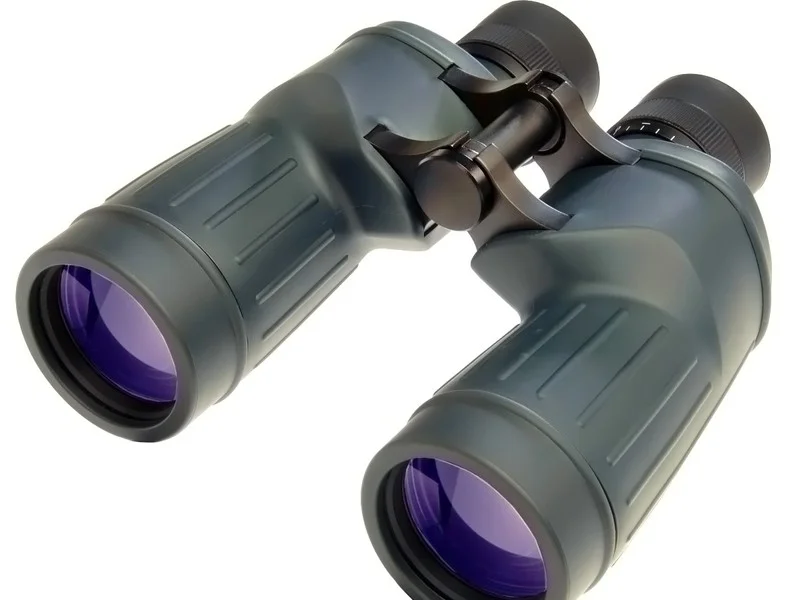
Waterproof and nitrogen-filled, so they can live in the car for the night you need them.
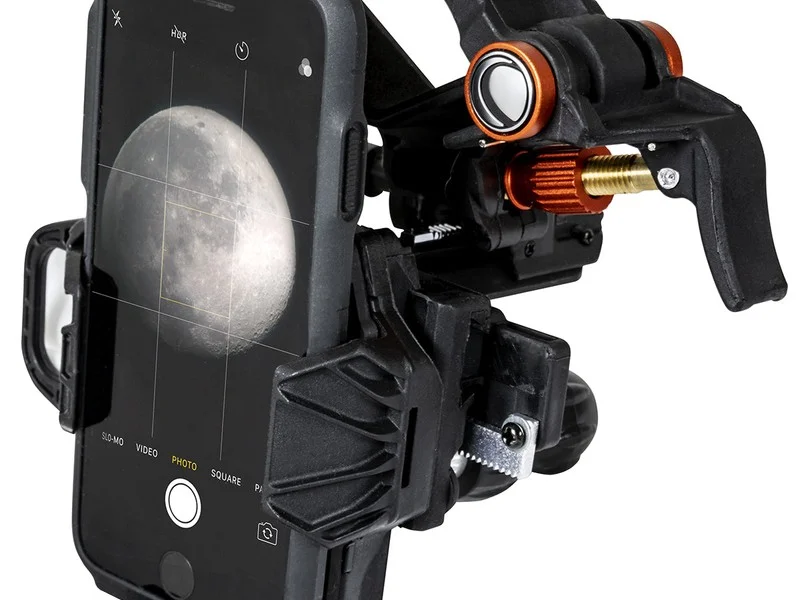
Celestron NexYZ Smartphone Adapter
Clamps your phone to binoculars or a telescope, so your footage has magnification behind it rather than a dot on a dark screen.
Affiliate links: you pay the same price, we earn a small commission that helps keep WatchTheStars free.
Why Was AAWSAP's Second Year Funded at Under Half?
The AAWSAP contract file doesn't give a reason, but it records the cut plainly: Option Year 1 was priced at $25,000,000 and funded at $11,948,810. Modification P00001, in September 2009, exercised Option Year 1 "subject to availability of funds" and priced it at $25,000,000. No money moved: the modification amount was $0.00.
Five months later, on 2 February 2010, modification P00002 put real money in: $11,948,810, under half the priced figure. Its purpose section spells out what that meant. Item (b) is to "Identify impacts to deliverables as a result of reduced funding for Option Year 1", and item (c) to identify "technical risks of reduced funding". Item (d) states that "the total obligated amount for this contract is $21,948,810.00."
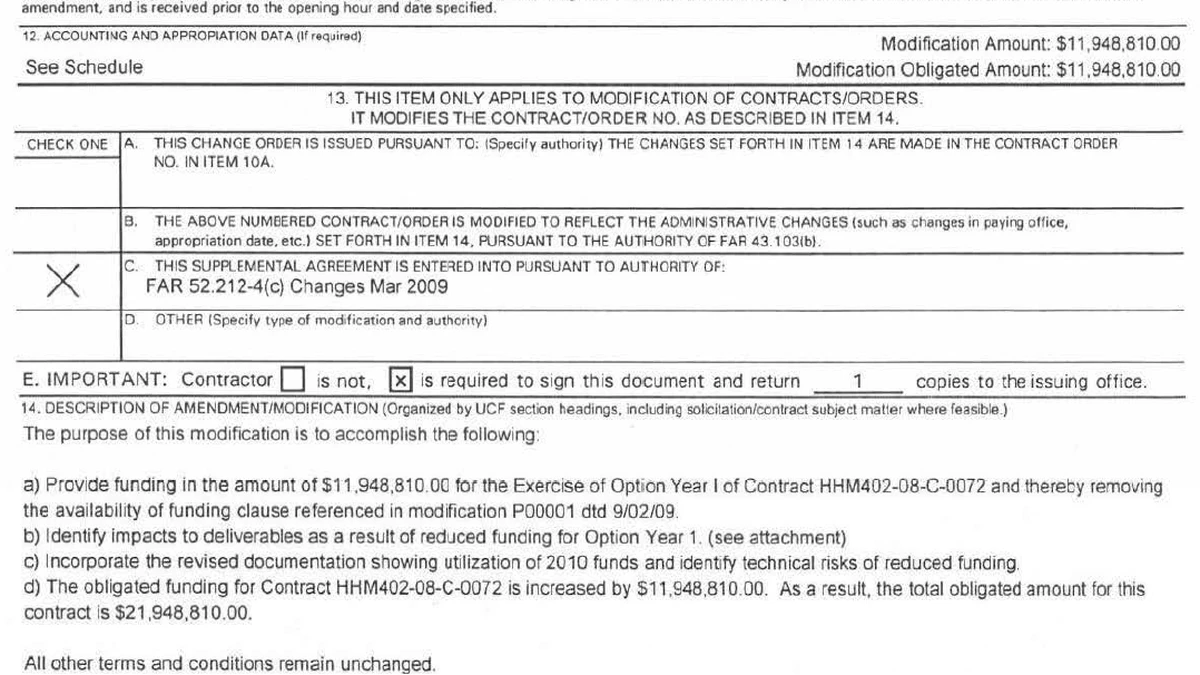
The attachment that lists those impacts isn't in the release. So we know the programme was scaled back in its second year, and that the DIA expected it to deliver less. We don't know what was dropped.
Is Robert Bigelow Named in the AAWSAP Contract?
Yes. Robert T. Bigelow is named as the contractor contact in the AAWSAP contract file. On the distribution list for modification P00002, the contractor copy goes to Bigelow Aerospace Advanced at 4640 S. Eastern Ave, Las Vegas, with "Robert T Bigelow" written as the contact, alongside a phone number we've left out. By the later modifications, P00004 and P00005, the contractor contact is redacted to the code "AAP Person 4".
That puts Bigelow's own name in the government's contract file rather than in later accounts of it.
Does the AAWSAP Contract Mention UFOs?
No. Across all seven contract documents, the words UFO, UAP, anomalous, paranormal and Skinwalker don't appear once, on any page. The file talks about "advanced aerospace weapon system applications", "breakthrough technologies" and the "foreign threat".
That matters, because a lot of coverage blurs the contract and the research it paid for. The UFO connection is real, but it sits in the papers, not the paperwork. Of the 37 DIRDs in the release, only two make it in their own words: D128 on injuries near reported craft, and D153, which proposes sensors to detect "anomalous aerospace platforms". The rest are literature reviews and speculative physics. Our AAWSAP DIRD list rates all of them.
Update, 24 October 2026: That holds for the DIA's contract file, but not for the contractor's. The Pentagon's seventh UFO file release published BAASS's own December 2008 plan and its 2009 monthly reports, and they are about UAP from the first page. The plan sets out nine projects, with the papers as just one, and the reports describe staff investigators, payments to MUFON and round-the-clock security at a Utah ranch widely identified as Skinwalker Ranch. Our guide to what AAWSAP actually did goes through them.
When Did AAWSAP End? 21 December 2010
In the contract file, AAWSAP ended on 21 December 2010. The last document, modification P00005 of 28 September 2010, was a bilateral change, made under the form's "Mutual Agreement" box. It extended Option Year 1 from 22 September to 21 December 2010, and says simply: "No funding is required for this extension."
There was no termination notice and no dramatic shutdown. Options 2, 3 and 4 were never exercised, and the contract ran out. The Department of War's own description of the release dates AAWSAP to 2012. Nothing in the contract papers supports that later date, so treat 2010 as the documented end and 2012 as the Department's claim.
Was AAWSAP a Sole-Source Contract? What the File Doesn't Say
The AAWSAP contract file doesn't say whether the award was sole-source. It doesn't tell us how many companies bid, or what the research actually cost to produce. There's no justification for a single-source award in the release and no count of offers, so anyone saying "no other bidders" needs a source other than these documents.
There are two other gaps. Modification P00004 (D115) survives only as a distribution-list cover sheet, so its purpose is unknown; it shares a date with P00003, which changed the DIA's contracting officer's representative. And the attachment explaining the "reduced funding" impacts is missing. If later releases fill those in, I'll update this post.
The wider fight over what the government knew and who can talk about it carries on. Our post on UFO whistleblowers asking Trump for immunity covers the current state of that, and the AARO deal for Hynek's UFO archive shows the Pentagon still paying for UFO records today. For a 1950s example of a file telling a different story from the headlines, see how the Air Force settled on "balloons or gulls" for the Tremonton film.
Where to Read the AAWSAP Contract Documents
All seven documents are free at war.gov/ufo as DOW-UAP-D110 to D116. The quickest way in is our PURSUE files browser, where you can search by designation and open each scan. The wider collection is on our UAP document archive, and the rest of our research lives on the UAP research hub.
One last thing. AAWSAP was meant to look decades ahead, but most odd lights people report tonight have very ordinary answers. Before you report anything, check what you can see in the sky tonight and whether there were ISS passes tonight over your area. If you're just getting started, our stargazing for beginners guide covers the usual suspects.
Sources:
- DOW-UAP-D110, AAWSAP Statement of Objectives, 18 July 2008, US Department of War, PURSUE Release 06, 18 September 2026
- DOW-UAP-D111, AAWSAP Solicitation and Original Order, 22 September 2008, US Department of War, PURSUE Release 06
- DOW-UAP-D112 to D116, AAWSAP Contract Modifications P00001 to P00005, 2009 to 2010, US Department of War, PURSUE Release 06
Header image: illustration generated with Gemini, not a photo of the AAWSAP file.
Frequently Asked Questions
Equipment guides
Related topics
Ian ClaytonAmateur astronomer and founder of WatchTheStars.co.uk, dedicated to helping others explore the wonders of our universe. Full profile →