The Kelly Johnson UFO Sighting
Lockheed's Chief Engineer, a Dark Ellipse and the Air Force's Lenticular Cloud
At sunset on 16 December 1953, Kelly Johnson, the engineer who went on to design the U-2 and the SR-71, watched a black ellipse hang still in the western sky over California, then leave. A Lockheed test crew flying offshore saw something similar at the same moment. The Air Force filed it as a lenticular cloud. We read the whole file and checked the sky.
| Date and time | 16 December 1953, between 5:00 and 5:05pm Pacific Standard Time |
| Ground witness | Clarence 'Kelly' Johnson, Lockheed's chief engineer, and his wife, at their ranch three miles west of Agoura, California |
| Air witnesses | A Lockheed flight-test crew in a Navy WV-2 Super Constellation, climbing through 16,000 to 18,000 ft off the Los Angeles coast |
| What was seen | A black, sharply outlined ellipse, length 7 to 10 times its depth, stationary for several minutes, then moving off west |
| Where | Johnson: 'roughly over Point Mugu', bearing about 255° from the ranch |
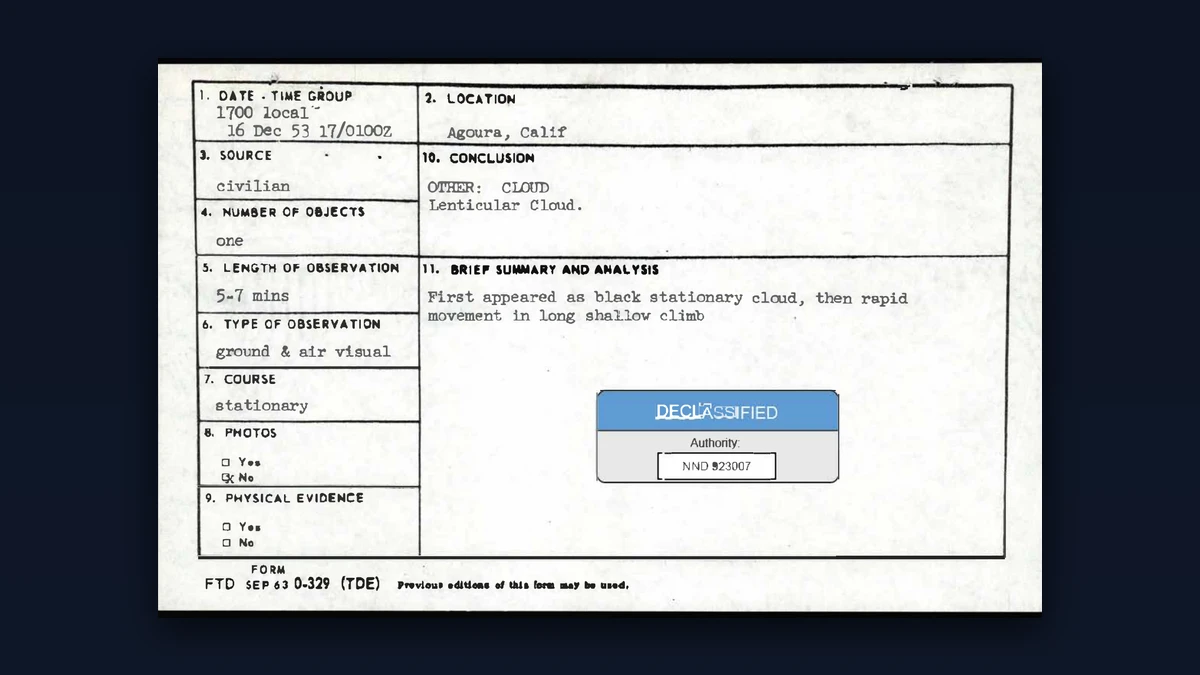
| Air Force verdict | Project Blue Book card: 'OTHER: CLOUD / Lenticular Cloud' (on a 1963 form) |
| Pentagon files | DOW-UAP-D206 (1953) and DOW-UAP-D213 (1949), PURSUE Release 8, 20 November 2026 |
The Kelly Johnson UFO sighting is the 1953 report by Lockheed's chief engineer of a dark, motionless ellipse over the California coast at sunset, seen at the same moment by his own test crew in the air. The Air Force filed it as a lenticular cloud. The full file is now in the Pentagon's eighth PURSUE release, and it's an unusual one: the witness is the man who later designed the U-2 spy plane and the SR-71 Blackbird, writing on company letterhead that he had believed in flying saucers for five years and was now "more firmly convinced than ever".
The case itself isn't new. Researchers have known it from the Project Blue Book archive for decades. What the November 2026 release gives us is the complete paper trail in one place, plus a second file from 1949 that shows Johnson had been passing flying disc reports to the Air Force long before he saw anything himself. We read all of it, then ran the sunset sky for that evening through Skyfield and NASA's JPL ephemeris, the tools we use to verify every sky claim on the site, including our UK night sky this week guide.
What Did Kelly Johnson See on 16 December 1953?
Kelly Johnson saw a black, sharp-edged ellipse hang motionless over the hills west of his ranch near Agoura, California, for at least three minutes at about 5pm, then move off fast to the west and disappear within 90 seconds. Johnson and his wife had driven out to their ranch near Agoura, in the hills north-west of Los Angeles, arriving at about sundown, which he put at "close to 4:45 P.M. PST". The house sat on a hill facing south-west. At about 5 o'clock, looking at the sunset through a large plate-glass window, he noticed "above a mountain to the west what I first thought to be a black cloud."
"The sun had gone down and the whole western sky was gold and red, with several thin layers of clouds or haze at fairly high altitude, I wondered why this one object was so dark, considering that the sun was behind it."· Kelly Johnson, statement of 18 December 1953 (DOW-UAP-D206, p6)
He wondered at first whether an aircraft had laid a smoke trail, then whether it was a lenticular cloud. But its outline didn't change, and it didn't move "at all for three minutes." He asked his wife for his eight-power binoculars and ran outside. By the time he had them focused, the object was moving fast on a heading between 240° and 260°. It stayed black and distinct but showed no detail, because he was looking straight towards the set Sun. Within 90 seconds of starting to move it had gone, "in a long shallow climb". He noted that the clouds were coming onshore, "in a direction of travel opposite to that of the object."
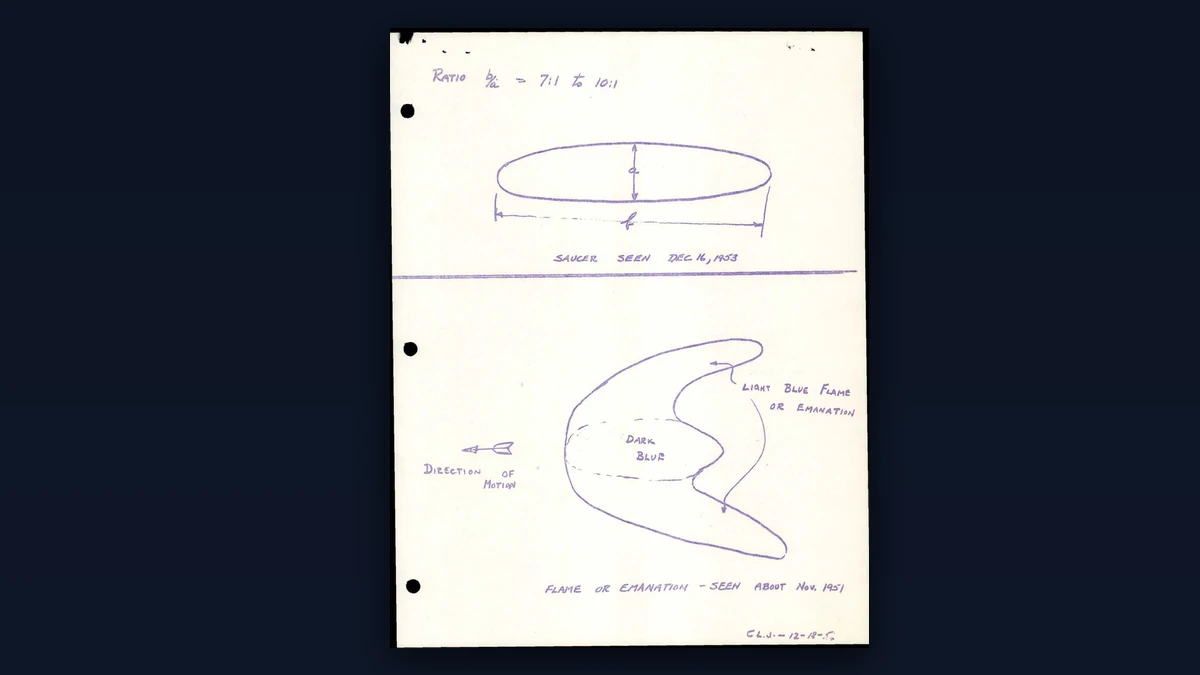
Johnson estimated the object was "roughly over Point Mugu, which lies on a bearing about 255° from my ranch." Without knowing how far away it was, he couldn't size it, but he gave its shape as an ellipse about seven to ten times longer than it was deep. His sketch shows exactly that: a plain, flat lens.
Who Else Saw It? The Lockheed Test Crew Off Point Mugu
A Lockheed flight-test crew in a Navy WV-2 aircraft off the Los Angeles coast saw a dark, wing-like object to the west at the same time as Johnson, flew towards it without closing, and watched it shrink to a speck. The next morning, back at work after a week away, Johnson heard that a Lockheed flight-test crew had seen something the evening before. He cut in before they could say when or where, and described his own sighting first. Their accounts matched closely enough that he collected written statements from four of them.
The crew had taken off at 4:29pm in a Navy WV-2 Super Constellation, the radar-picket version of Lockheed's airliner, and were climbing over the sea off the Los Angeles coast towards 20,000 feet. The co-pilot said it looked as if he was flying "right directly towards, and at about the same elevation as, a very large flying wing airplane." They turned towards it and flew at it for several minutes at some 225mph, but never seemed to close the gap. Then it got smaller. "In probably an elapsed time of somewhere around a minute, the object had reduced in size to a mere speck, and then disappeared. Its direction was almost due west."
The other statements differ in the details, which is what you'd expect from honest witnesses. The aerodynamicist in the cockpit first took it for a B-36 bomber "heading straight toward us and silhouetted against a bright background", thought it hovered for about ten minutes, and said it then "suddenly accelerated due west" and vanished in about ten seconds. The flight-test supervisor thought it was perhaps near Santa Barbara Island and watched it move away "in a generally westward direction". The pilot was certain it kept "its sharp outline and definite shape so I know it was not a cloud that dissolved." Their estimates of their own position range from off Long Beach to off Santa Monica to the Catalina channel, and the map the supervisor marked up with both positions is mentioned in the file but isn't in it.
Kelly Johnson
Watched from his ranch near Agoura with his wife, used eight-power binoculars, gave a bearing and a time to within two minutes, and drew the sketch. Wrote that he had believed flying saucers possible for at least five years.
The co-pilot
Saw what looked like 'a very large flying wing airplane' at about the aircraft's height. Flew towards it without closing, then watched it shrink to 'a mere speck' heading almost due west.
The pilot
Put it at least fifty or sixty miles away and possibly much further. Insisted it kept a sharp outline until it disappeared, so it could not have been a cloud breaking up.
The aerodynamicist
First thought it was a B-36. Argued that the aircraft's own movement relative to the object showed it had depth, ruling out a cloud.
Was Kelly Johnson's UFO a Planet or a Star? Our Sky Check
Kelly Johnson's UFO was not a planet or a star: at 5pm on 16 December 1953 the Sun was 3.2° below the horizon, Venus and Mercury had set, and nothing bright was low in the west. The first question for any sunset sighting is whether a planet or a bright star was sitting where the witness looked. We computed the sky for Johnson's ranch with Skyfield and the JPL DE421 ephemeris. The Sun set at 16:47 Pacific time, so Johnson's "close to 4:45" is right. At 5pm it was 3.2° below the horizon at a bearing of 244°, which is the "gold and red" glow he describes. Venus and Mercury had already set. Jupiter and the Moon were up, but in the east, behind him. No planet or bright star was low in the west. Whatever this was, it wasn't astronomical.
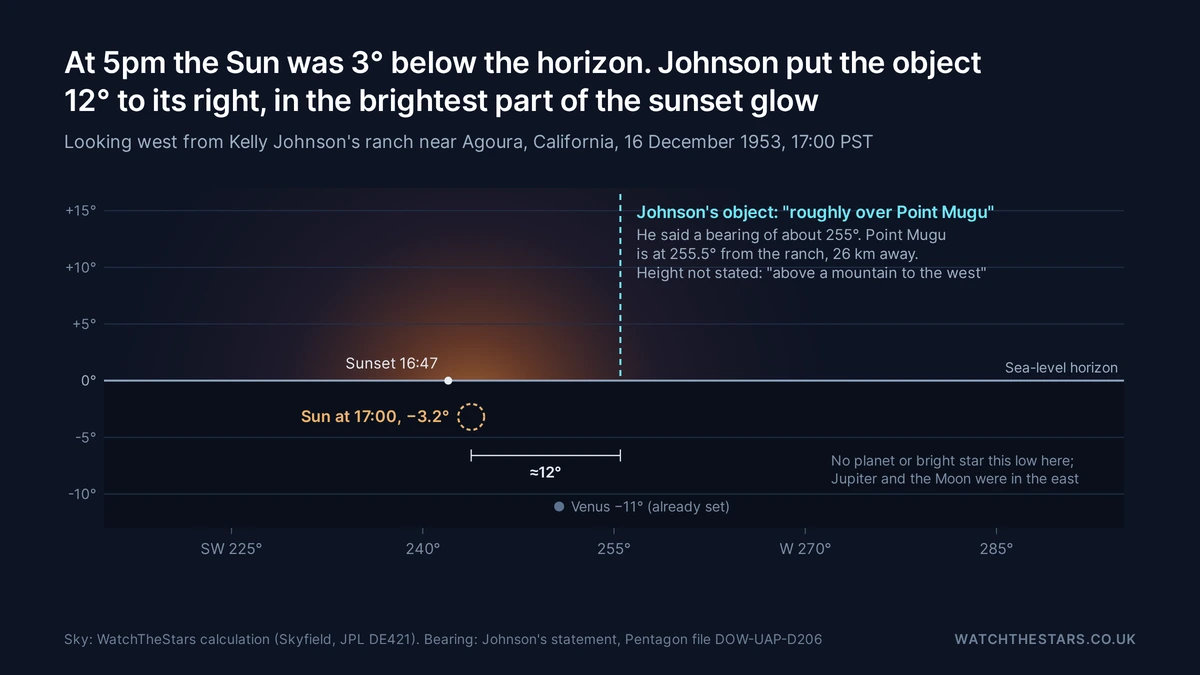
His geometry checks out too. Point Mugu lies at a bearing of 255.5° from a spot three miles west of Agoura, against Johnson's "about 255°". That puts the object about 12° to the right of the Sun's position, in the brightest part of the twilight. A dark object against that background stands out sharply, which is why he noticed it at all. It's also why he couldn't see any detail: like trying to read a sign against a bright Sun, the glare flattens everything into silhouette.
Was Kelly Johnson's UFO a Lenticular Cloud?
Kelly Johnson's UFO may have been a lenticular cloud, as the Air Force decided, but the file never argues the case and the cloud explanation doesn't account for the object leaving. The Project Blue Book record card at the front of the file gives the conclusion in two words: "OTHER: CLOUD / Lenticular Cloud." Its summary reads "First appeared as black stationary cloud, then rapid movement in long shallow climb". There is no reasoning, no weather report and no reply to Johnson anywhere in the file. The card is also printed on a form edition dated September 1963, which means the verdict was typed at least ten years after the sighting.
Lenticular clouds are lens-shaped clouds that form in standing waves of air downwind of hills and mountains. They can sit in the same place for long periods while the wind blows through them, and at sunset, with the light behind them, they can look black and hard-edged. So the cloud explanation fits a lot of this case:
- The shape: a flat lens seven to ten times longer than deep is the classic lenticular profile.
- The darkness: a cloud seen against the bright twilight arch is a silhouette.
- The stillness: several minutes without moving is exactly what a standing-wave cloud does.
- The distance: an aircraft at 225mph that couldn't close on it was looking at something very far away, and therefore very large.
It fits the ending badly. A cloud doesn't fly away. Every witness says the object eventually disappeared, and most describe it moving off to the west and shrinking. Johnson watched it go through binoculars and noted the low clouds moving the other way. The only ordinary ways to read that departure are a change in the light (a cloud losing contrast as the twilight fades) or a change in viewing angle from a climbing, turning aircraft, and neither is argued anywhere in the file. Johnson himself considered the cloud idea first and dropped it.
CONFIRMED
The time and bearing are accurateOur calculation matches Johnson's sunset time to two minutes and his bearing to Point Mugu to half a degree.
CONFIRMED
Not a planet or starVenus and Mercury had set; nothing bright was low in the west. Jupiter and the Moon were in the east.
PLAUSIBLE
Lenticular cloudFits the shape, colour and long stationary phase. The Air Force card asserts it but gives no reasoning or weather data, and was typed a decade later.
UNRESOLVED
The departureEvery witness says it disappeared, most say it moved west and shrank. A cloud can't leave, and the file never explains this.
MISSING
The mapThe flight-test supervisor marked the aircraft's and the object's positions on a map. The file refers to it twice; it isn't there.
Watch the sunset sky properly
Kit we've reviewed in full
Johnson grabbed his binoculars the moment the object didn't behave like a cloud, and even then couldn't make out detail against the glare. A good pair of binoculars, used after the Sun has set, is still the fastest way to tell a cloud, a plane or a planet from something you can't explain.
A similar magnification to Johnson's eight-power pair: bright, light enough to hold steady, and quick to get on target before something moves off.
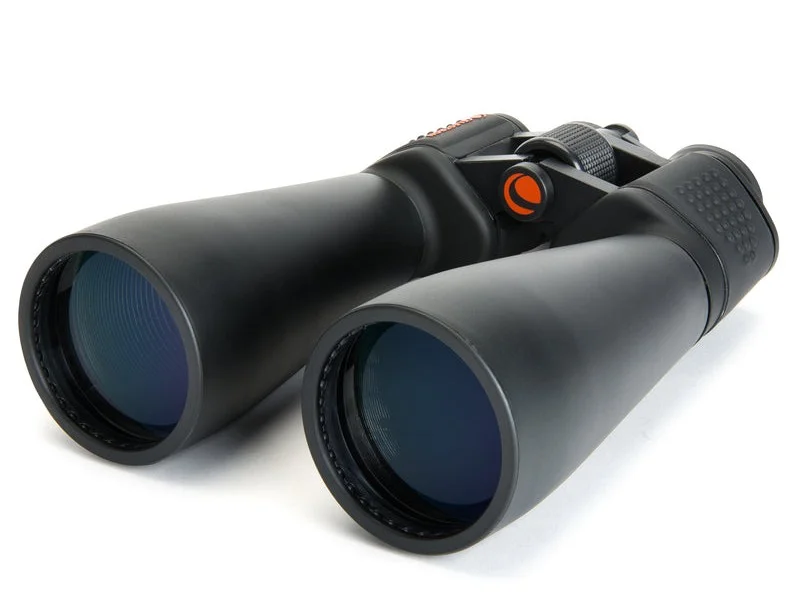
Brings a distant shape much closer and gathers plenty of light at dusk. Use a tripod at 15×.
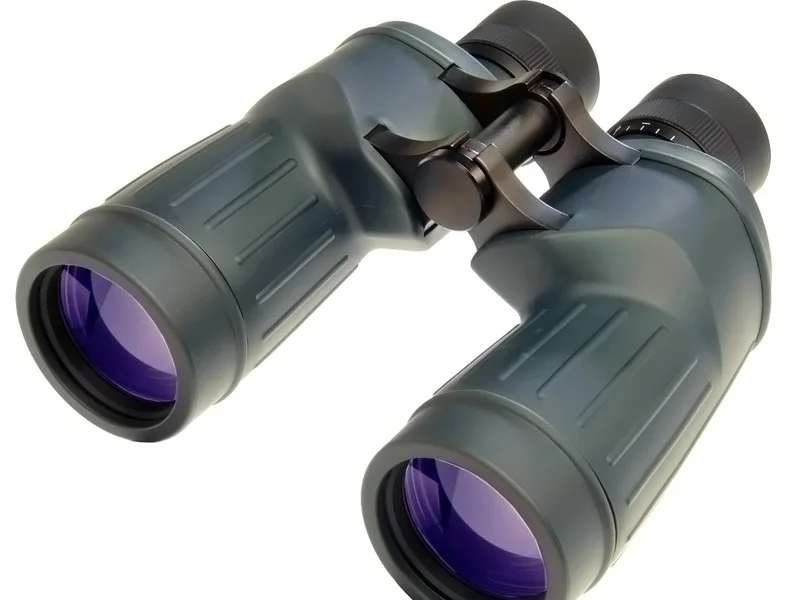
Better contrast against a bright twilight sky, which is what you need to judge whether an edge is solid or soft like a cloud's.
Affiliate links: you pay the same price, we earn a small commission that helps keep WatchTheStars free.
Did Kelly Johnson Believe in Flying Saucers? The 1949 Letter
Yes. Kelly Johnson wrote in 1953 that he had believed flying saucers possible for at least five years, and a 1949 Lockheed memo in the Pentagon files shows him saying there was "something to flying discs". The most surprising line in Johnson's statement isn't about the sighting. "I should state that for at least five years I have definitely believed in the possibility that flying saucers exist," he wrote, adding that he was "now more firmly convinced than ever that such devices exist, and I have some highly technical converts in this belief as of that date."
A second file in the same release shows that wasn't hindsight. In July 1949 Johnson, then Lockheed's chief research engineer, forwarded a colleague's report of two shiny discs over the San Fernando Valley, writing that his "discussions with certain people in the Air Force, as well as late newspaper reports indicate there is something to flying discs." The witness, a former studio animator, offered to animate what he saw if Lockheed gave him the facilities. He also drew it.
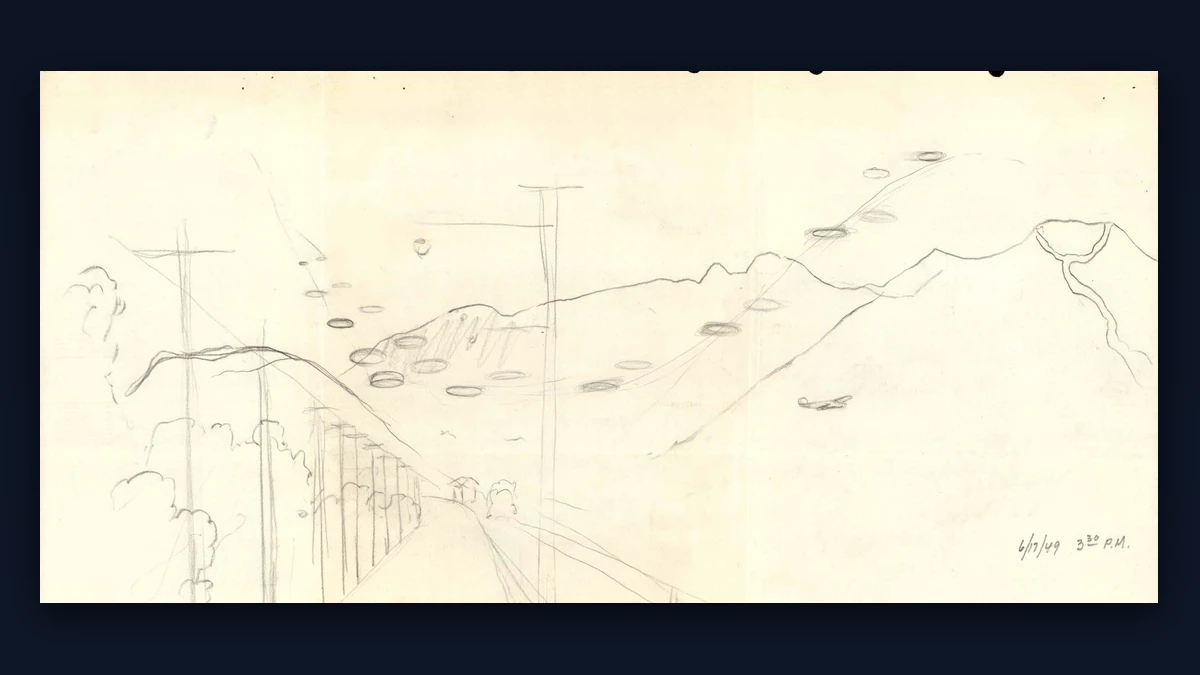
The Air Force's verdict on that one was "AIRCRAFT", and our sky check supports it: at 3:30pm the Sun was 42° up in the west, perfectly placed to flash off anything metallic to the north. The witness was half a mile from Grand Central Air Terminal, with Lockheed's own airfield at Burbank a few miles away in the direction the "discs" left. The 1949 file shows Johnson taking colleagues' reports seriously years before his own sighting, which is worth knowing when you weigh what he wrote in 1953.
Did Kelly Johnson Refuse to Send His Report to the Air Force?
Only according to a second-hand account: Lieutenant General Donald Putt wrote that Lockheed staff told him Johnson "refused to forward" the report, but Johnson's own signed letter to the Air Force is in the same file. Johnson signed a covering letter to the commander of the Air Technical Intelligence Center on 20 January 1954, noting that the information "has not been released to the press" and asking for comments. But the copy in the file arrived by another route. On 15 February 1954 Lieutenant General Donald Putt sent the package to ATIC's commander with a note that it had been "handed to me by Lockheed personnel with the explanation that Mr. Johnson was most reluctant to write the report in the first place and then refused to forward it on to you because of his belief that those who profess to have seen flying saucers are not usually considered to be logical and practical hard-headed engineers."
Both can be true: Johnson may have written and signed the letter, then thought better of sending it. But "refused to forward" is Putt's second-hand account, not Johnson's. Some news reports in November 2026 stated it as fact.
Johnson forwards a disc report
July: passes a colleague's Glendale sighting to the Air Force and writes that 'there is something to flying discs' (DOW-UAP-D213).
A 'light blue flame'
About November: Johnson's own earlier sighting near Brents Junction, drawn on the lower half of his 1953 sketch.
The sighting
16 December, 5:00 to 5:05pm: Johnson at Agoura and the WV-2 crew offshore. Statements written 17 December 1953 to 12 January 1954.
Into the Air Force
20 January: Johnson's letter to ATIC. 15 February: Lt Gen Putt forwards the package.
The verdict
A Blue Book record card on a September 1963 form files it as a lenticular cloud.
Published in full
20 November: the complete file appears in PURSUE Release 8 as DOW-UAP-D206, with the 1949 file as D213.
Kelly Johnson UFO Sighting: Our Verdict
This is a good sighting by any standard. The ground witness was one of the best aircraft engineers alive, he wrote it down within two days, his time and bearing are accurate, and an independent crew in the air saw something consistent with it at the same moment. The Air Force's answer is plausible but unargued, and the one thing it can't easily explain, the departure, is the part every witness describes.
It belongs with the other military and expert-witness cases in our UAP research hub. It's also a reminder of what a trained eye can and can't do. Johnson knew aircraft better than almost anyone, and he still couldn't tell how far away the object was, so he couldn't size it. A distant cloud and a nearby craft look the same in silhouette against a sunset. If you see something odd at dusk, note the time and direction, check what you can see in the sky tonight and whether there are any ISS passes tonight, and get binoculars on it quickly. Our guide to why a star seems to follow your plane covers the most common traps.
Primary Source Documents
The Kelly Johnson file, 1953
DOW-UAP-D206 · 15 pages · PURSUE Release 8
Record card, Putt's cover letter, Johnson's letter to ATIC, his statement and sketch, and the four flight-test statements.
Download PDFThe Glendale and La Jolla discs, 1949
DOW-UAP-D213 · 17 pages · PURSUE Release 8
Two 17 June 1949 reports, including Johnson's July 1949 memo and the animator's sketch.
Download PDFNote: Official US Department of War records released through PURSUE (Release 8, 20 November 2026, war.gov/ufo), mirrored on our own servers. Every record from all eight releases is in our Pentagon UFO file browser, and our guide to the PURSUE releases explains what each batch contains. Sky positions are our own calculation (Skyfield, JPL DE421). Lockheed staff other than Johnson are described by role.
Related Cases
More UAP cases
- The Green Fireball IncidentsDURATION: DEC 1948 – 1952 · LOCATION: LOS ALAMOS / SANDIA / KIRTLAND / WHITE SANDS · STATUS: UNEXPLAINED
- The Newfoundland KC-97 Incident6 JULY 1955 · NEWFOUNDLAND, CANADA · FILE RELEASED 10 JULY 2026
- The Roswell IncidentJuly 1947 · Foster Ranch, New Mexico · Status: Unresolved
- The Senator Russell Sighting4 OCTOBER 1955 · SOVIET TRANSCAUCASUS (PRESENT-DAY AZERBAIJAN) · FULL CIA FILE RELEASED 10 JULY 2026
- UAP Document Archive: Official UFO Files from the US, UK & BrazilUS DoD PURSUE Releases · UK MOD & National Archives Files · Brazilian Air Force Records · NSA UMBRA Files
- RAF Lakenheath: The Night Britain's Air Defences FailedSuffolk, England · 13–14 August 1956 · 2130–0330 hrs