Key takeaways
- Kelly Johnson, Lockheed's chief engineer, reported a dark ellipse at sunset over Agoura, California, on 16 December 1953
- Our Skyfield check matches Johnson's sunset time to two minutes and his bearing to Point Mugu to half a degree
- No planet or bright star was low in the west at 5pm, so the Kelly Johnson UFO was not astronomical
- The Air Force's 'lenticular cloud' verdict sits on a 1963 form with no reasoning, and doesn't explain the object leaving
Jump to section 5 sections
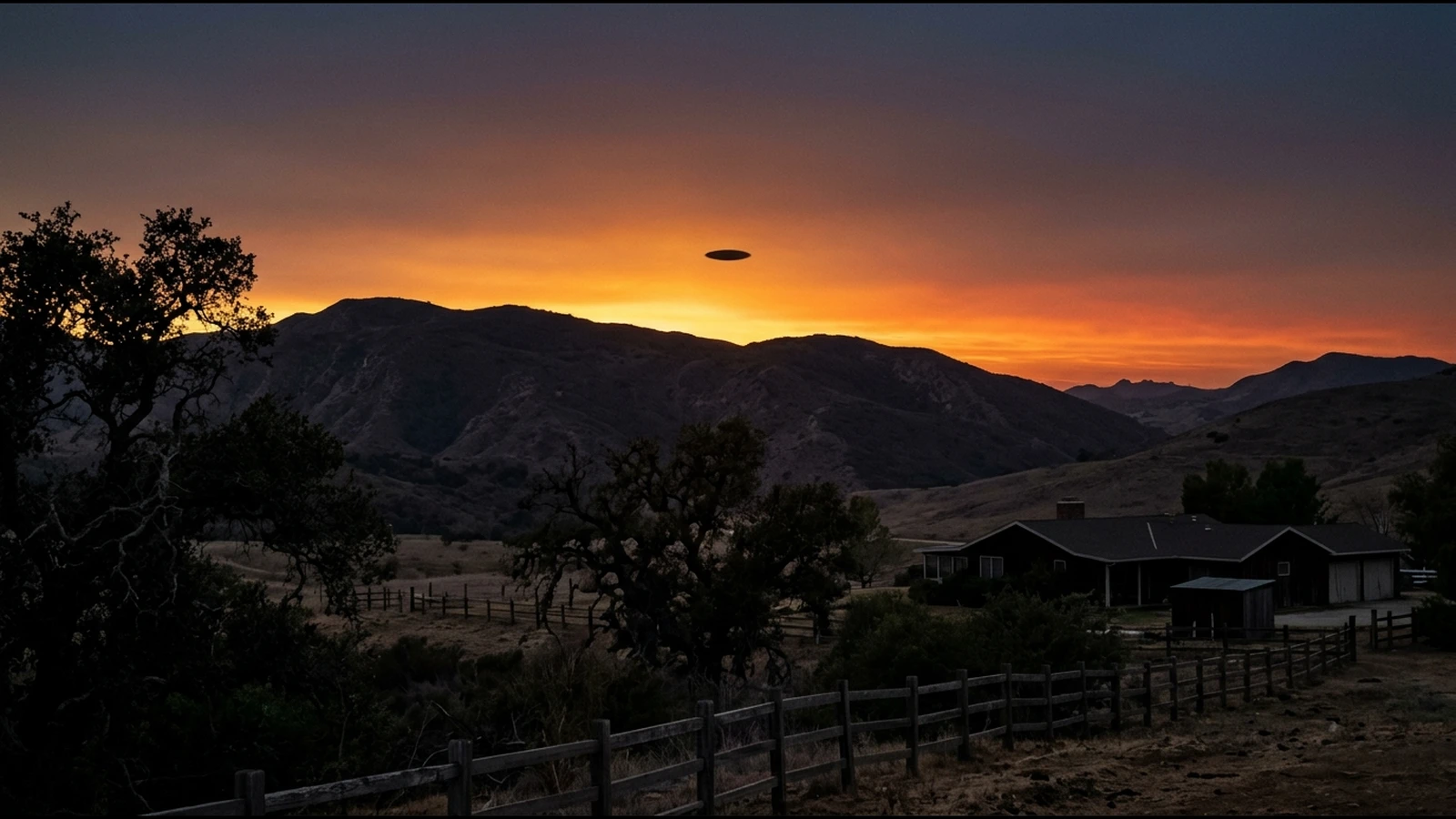
The Kelly Johnson UFO sighting was the lead story of the Pentagon's eighth UFO file release on 20 November 2026, and for good reason. Johnson was Lockheed's chief engineer, the man who went on to design the U-2 spy plane and the SR-71 Blackbird. In December 1953 he reported a dark ellipse hanging still in the sunset over California, then flying off. The Air Force filed it as a lenticular cloud.
We've now read the whole 15-page file, DOW-UAP-D206, and run the sky for that evening through Skyfield and NASA's JPL ephemeris, the tools we use to verify every sky claim on the site, including our UK night sky this week guide. Johnson's numbers hold up remarkably well. The Air Force's verdict holds up less well. The full case, with every witness statement, is on our new Kelly Johnson UFO sighting page. This is the short version.
What Kelly Johnson Saw at Sunset in 1953
Kelly Johnson saw a black, sharply outlined ellipse over the hills west of his ranch near Agoura, California, at about 5pm on 16 December 1953. He and his wife had arrived "at about sundown, which is close to 4:45 P.M. PST". Looking at the sunset through the window, he saw what he took for a black cloud, and wondered "why this one object was so dark, considering that the sun was behind it."
It didn't move for three minutes and its outline didn't change. He fetched his eight-power binoculars and ran outside, by which time it was moving fast on a heading between 240° and 260°. Within 90 seconds it had gone, "in a long shallow climb". He put it "roughly over Point Mugu, which lies on a bearing about 255° from my ranch."
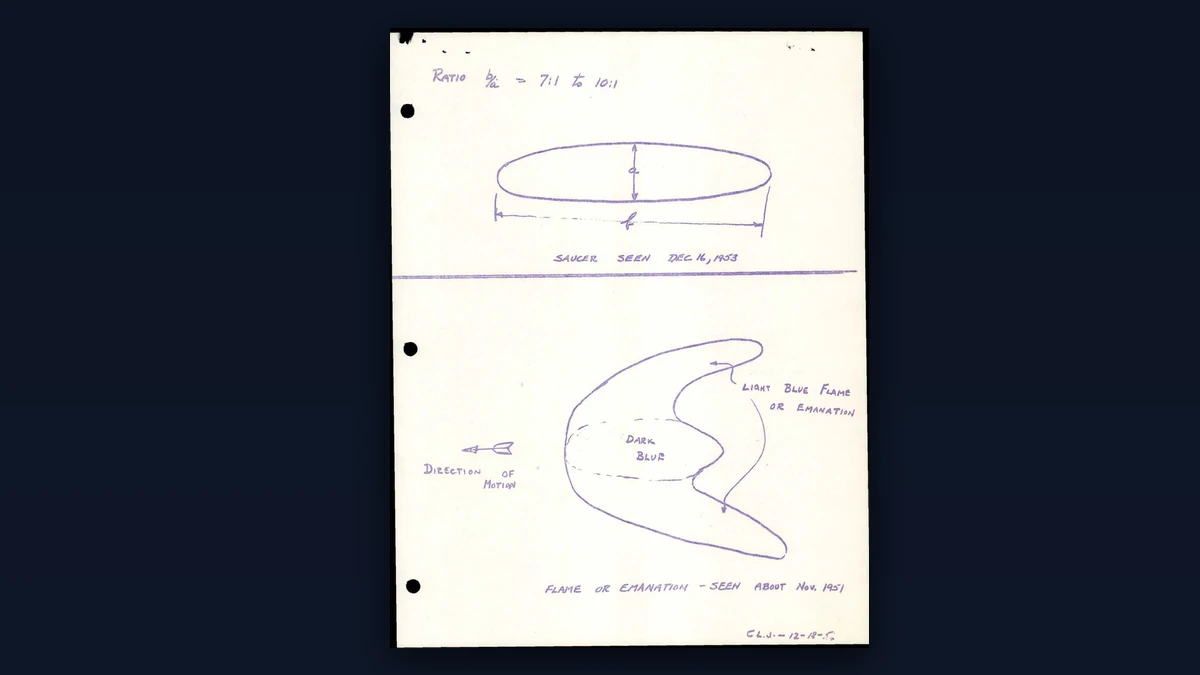
At the same moment, a Lockheed test crew was climbing over the sea off the Los Angeles coast in a Navy WV-2 Super Constellation on a test flight. The co-pilot saw what looked like "a very large flying wing airplane" to the west. They turned towards it at about 225mph but never closed on it. Then it shrank to "a mere speck" and disappeared, "almost due west". When Johnson got to work the next morning he described his sighting before they could tell him theirs, and the stories matched. He collected four of their statements alongside his own and wrote that he was "now more firmly convinced than ever that such devices exist".
Kelly Johnson UFO Sky Check: Sunset Time, Bearing and Planets
The Kelly Johnson UFO was not a planet or a star. Our ephemeris check, using Skyfield and the JPL DE421 ephemeris for a point three miles west of Agoura, gives:
- Sunset at 16:47 Pacific time. Johnson said "close to 4:45".
- At 5pm the Sun was 3.2° below the horizon at a bearing of 244°, the source of the "gold and red" glow.
- Point Mugu lies at 255.5° from the ranch, 26km away. Johnson said "about 255°".
- Venus and Mercury had already set. Jupiter and the Moon were up, but in the east, behind him. Nothing bright was low in the west.
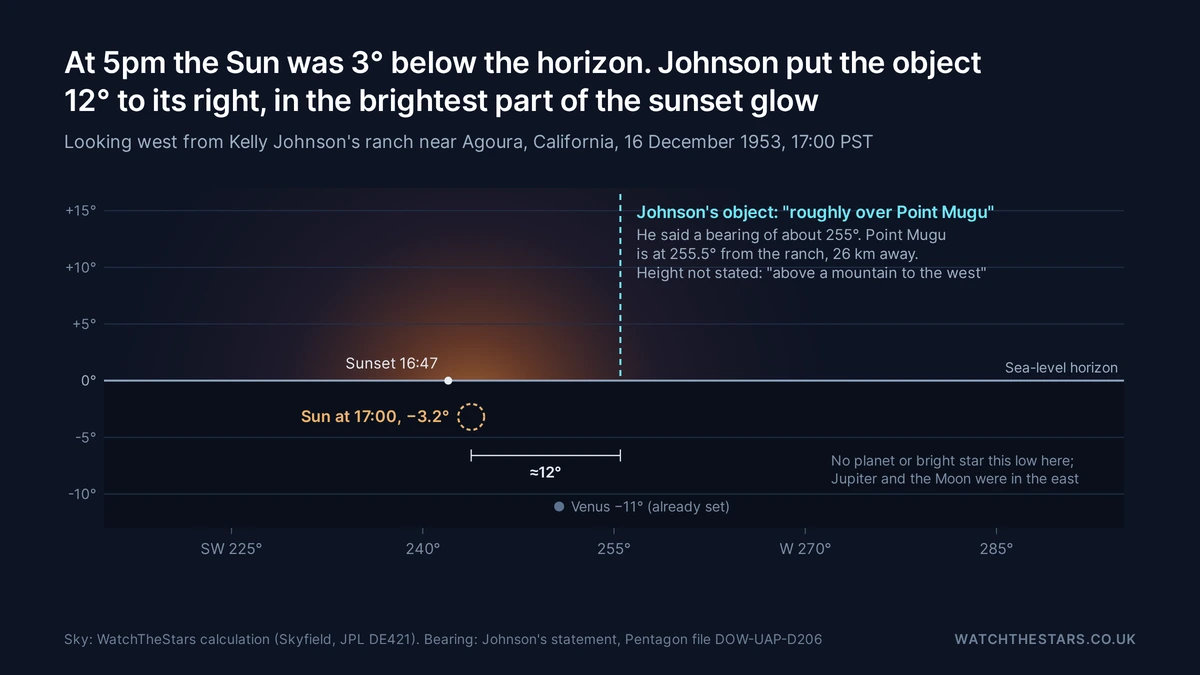
So the object sat about 12° to the right of the set Sun, right in the brightest part of the sky. That's why it looked so black, and why Johnson could see no detail even through binoculars. It's the same problem as looking at anything near a bright Sun: the glare turns it into a silhouette. For a case more than 70 years old, getting a witness's time to two minutes and his bearing to half a degree is unusually good. It tells you Johnson was a careful observer.
Was the Kelly Johnson UFO a Lenticular Cloud?
Maybe, but the file doesn't make the case. The Project Blue Book record card says "OTHER: CLOUD / Lenticular Cloud." It gives no reasoning, cites no weather report, and is printed on a form edition dated September 1963. That's at least ten years after the sighting.
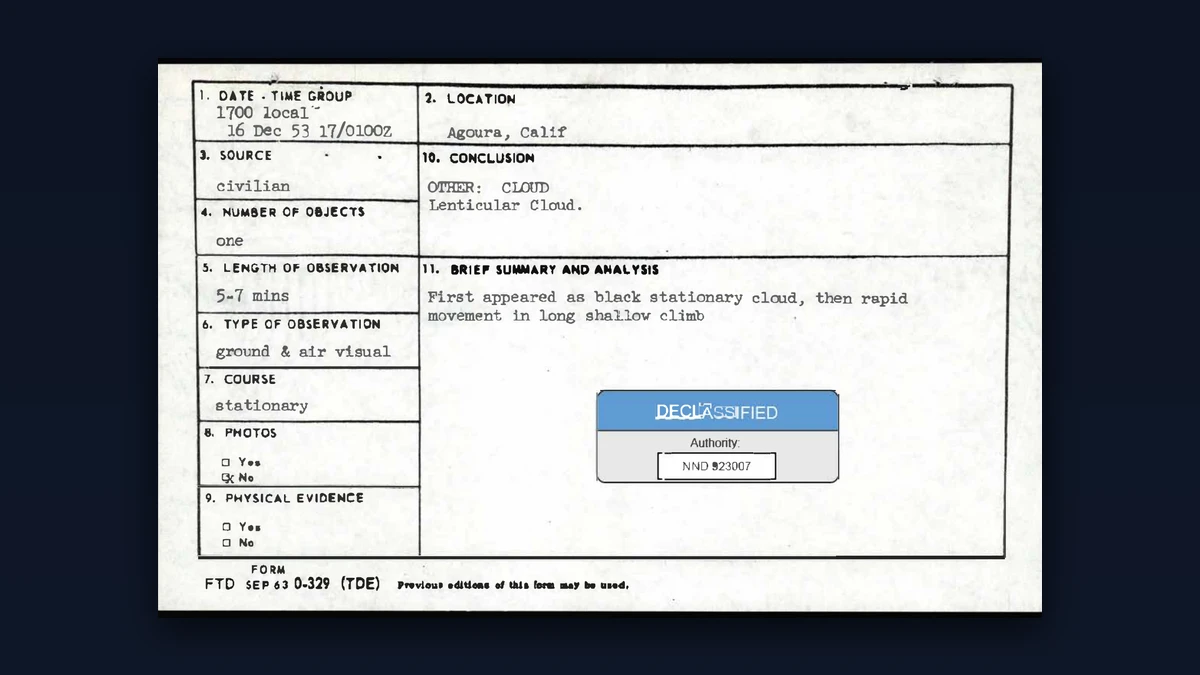
Lenticular clouds form in standing waves of air downwind of hills, can sit in one place for a long time, and look dark and hard-edged against a sunset. That fits the shape, the colour and the long stationary phase. An aircraft at 225mph failing to close on it also fits something very far away and very large.
What it doesn't fit is the ending. Every witness says the object eventually disappeared, and most describe it moving off west and shrinking. A cloud can fade as the light changes, and a climbing, turning aircraft changes its viewing angle, but nobody in the file argues either. Johnson also noted that the low clouds were moving the opposite way to the object. He'd thought of the cloud explanation himself and dropped it when the outline stayed sharp.
Get binoculars on it, fast
Kit we've reviewed in full
Johnson's first move when the 'cloud' didn't behave like one was to grab his binoculars. It's still the right instinct: most strange lights at dusk turn out to be aircraft, planets or clouds within seconds of getting optics on them.
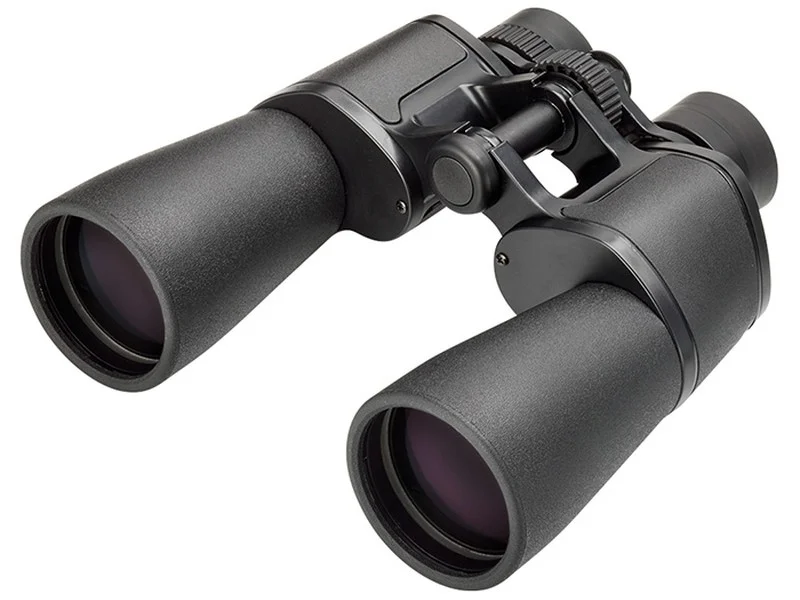
Bright, light enough to hold steady and quick to aim, so you can get on a moving object before it's gone.
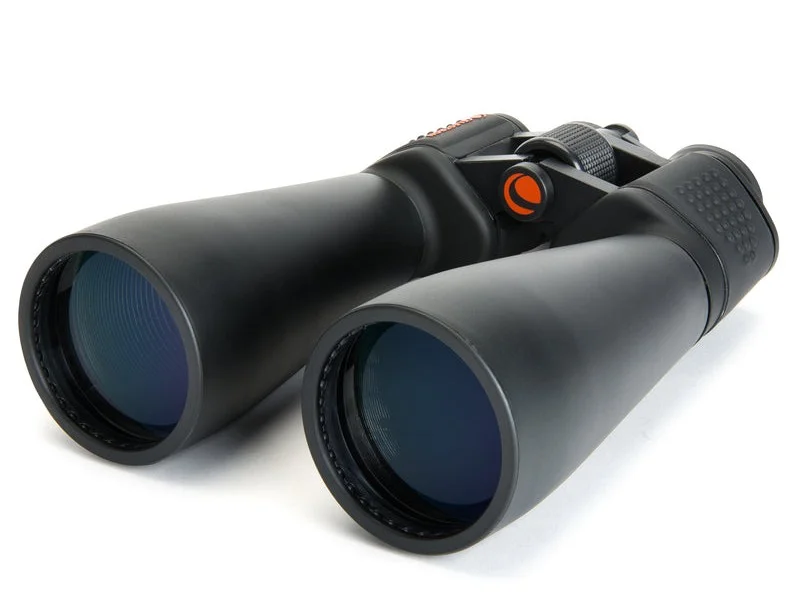
Brings a distant shape much closer at dusk. Best on a tripod at 15×.
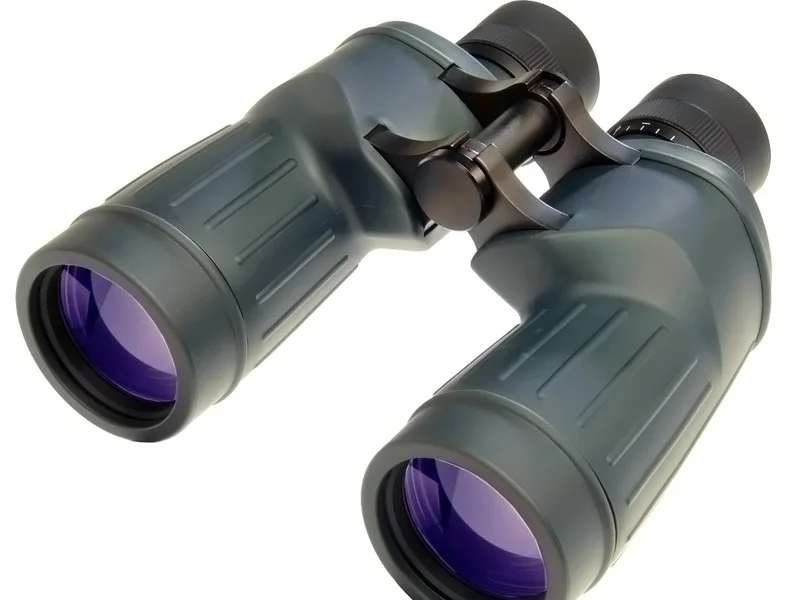
Better contrast against a bright twilight sky, which helps you judge whether an edge is solid or soft like a cloud's.
Affiliate links: you pay the same price, we earn a small commission that helps keep WatchTheStars free.
What the News Coverage Got Right and Wrong
Most of the reporting on Johnson's sighting quotes the file accurately: the "gold and red" sky, the "long shallow climb", the "very large flying wing" and the lenticular-cloud card are all there word for word. Three things need correcting:
- "Johnson refused to forward it." That line comes from Lieutenant General Donald Putt's February 1954 cover letter, which says Lockheed staff told him so. The file also contains Johnson's own signed letter to the Air Technical Intelligence Center, dated 20 January 1954, asking for comments. "Refused" is Putt's second-hand account, not a fact in Johnson's words.
- "ATIC concluded it was a cloud." The only verdict is on the 1963-edition Blue Book card. There's no 1954 reply or analysis in the file.
- "A newly revealed sighting." The case has been known from the Blue Book archive for decades. What's new is the Pentagon publishing the whole file, plus a 1949 memo in which Johnson wrote that there was "something to flying discs".
The rest of the release, from a "Mach 2.5" radar slide to a plan for an underground vault, is in our round-up of the eighth Pentagon UFO file release. You can download every file, including this one, from our Pentagon UFO file browser.
How to Check a Strange Light at Sunset Yourself
Johnson did most things right. He noted the exact time, took a bearing against a landmark, got binoculars on it, and wrote everything down within two days. That's why his report can still be checked more than 70 years later.
If you see something odd at dusk, do the same. Note the time and direction, then check what you can see in the sky tonight: at sunset the usual suspect is Venus, which can be bright enough to look unnatural. After dark, check for ISS passes tonight, since the space station is one of the things most often mistaken for a UFO. If you're on a plane or in a car and the light seems to follow you, our guide to why a star seems to follow your plane explains what's happening. And if you're new to the night sky, our stargazing for beginners guide is the place to start. Plenty of 1950s Air Force reports checked against the sky turn out to be a meteor, a bright star or a planet such as Venus. Johnson's doesn't.
Sources:
- US Department of War, PURSUE Release 8 (20 November 2026): DOW-UAP-D206 (the 1953 Kelly Johnson file) and DOW-UAP-D213 (the 1949 Glendale file), originals at war.gov/ufo
- Sun, Moon and planet positions for Agoura, California (34.145°N, 118.79°W) on 16 December 1953 computed with Skyfield and the JPL DE421 ephemeris
Header image: Lieutenant General Donald Putt's 15 February 1954 cover letter and the Project Blue Book record card, from DOW-UAP-D206.
Frequently Asked Questions
Equipment guides
Related topics

Ian ClaytonAmateur astronomer and founder of WatchTheStars.co.uk, dedicated to helping others explore the wonders of our universe. Full profile →