Key takeaways
- DOW-UAP-D092 is an 85-page US Air Force Scientific Advisory Board file on the 1966 committee set up to review Project Blue Book, released by the Pentagon on 10 July 2026
- The Project Blue Book review committee was chaired by physicist Brian O'Brien and included a young Carl Sagan; it met once, at Wright-Patterson Air Force Base on 3 February 1966
- Air Force press officers asked for the review because UFO criticism was hurting the service's image; one internal memo says they wanted a scientific group to 'help get the Air Force off the hook'
- The committee's idea of university scientific teams became the University of Colorado's Condon study, whose 1969 report led the Air Force to close Project Blue Book in December 1969
Jump to section 7 sections
- Why Did Project Blue Book End? What DOW-UAP-D092 Shows
- Project Blue Book Review Committee 1966: Who Was on It
- Why the Air Force Wanted Blue Book Reviewed: '99% Public Relations'
- Carl Sagan and Project Blue Book: What the Committee Said
- Condon Report: How the O'Brien Committee Led to It
- Amateur Astronomers and UFOs: The Moonwatch Argument
- Where to Read DOW-UAP-D092
Project Blue Book, the US Air Force's UFO investigation, was closed in December 1969. The Pentagon's file DOW-UAP-D092, released on 10 July 2026 and titled "Department of the Air Force Committee to Review Project Bluebook, 1966-1967", shows how that ending began four years earlier: with a small committee of scientists, one of them a 31-year-old Carl Sagan, asked to review the project for an Air Force that was tired of being laughed at. It is 85 pages of memos, meeting notes and letters, and it is much franker than the report the committee published.
This is the twelfth post in our Document of the Week series, where we take one item from our declassified UAP document archive and explain in plain English what it says. Last week's was a one-page Los Alamos astronomy club letter. This one is the paper trail behind one of the biggest decisions in the history of government UFO research.
Why Did Project Blue Book End? What DOW-UAP-D092 Shows
Project Blue Book ended because a university study the Air Force paid for, the Condon Report, concluded in 1969 that more UFO research was not worth doing. DOW-UAP-D092 shows that the study itself came out of a 1966 review by the Air Force's own Scientific Advisory Board, and that the review was requested by the Air Force's press office, not its scientists.
| DOW-UAP-D092 at a glance | |
|---|---|
| Official title | Department of the Air Force Committee to Review Project Bluebook, 1966-1967 |
| Released | 10 July 2026, PURSUE Release 4 (war.gov) |
| Originating office | USAF Scientific Advisory Board (SAB), the Pentagon |
| Length | 85 pages, typed and photocopied, some handwriting |
| Date range | September 1965 to February 1969 (wider than the title says) |
| Main author | Lt Col Harold A. Steiner, the board's assistant secretary, who kept the file |
| Also inside | A copy of the January 1953 Robertson Panel report, used as background (roughly pages 44 to 85) |
| Classification | Mostly "For Official Use Only"; the 1953 report is marked declassified |
The file opens with the request. On 28 September 1965 Major General E. B. LeBailly, the Air Force's Director of Information, wrote to the Scientific Advisory Board. By 30 June 1965, he said, Blue Book had investigated 9,267 reports and 663 could not be explained. He added that many of the unexplained ones came from intelligent, technically qualified witnesses whose honesty was not in doubt, and asked for a panel of physical and social scientists to review the project's resources, methods and findings. J. Allen Hynek, Blue Book's scientific consultant, was willing to help.
The board was not keen. A cover note dated 5 October 1965 says Dr H. Guyford Stever, the board figure it was first put to, was lukewarm and questioned whether a UFO review was worth the board's time. It went ahead anyway.
Project Blue Book Review Committee 1966: Who Was on It
The committee had six members and met for a single day, 3 February 1966, at the Foreign Technology Division at Wright-Patterson Air Force Base in Ohio, where Blue Book was run. The meeting record lists them:
- Dr Brian O'Brien, chairman, a physicist and consultant
- Dr Launor F. Carter, System Development Corporation
- Dr Jesse Orlansky, Institute for Defense Analyses, a psychologist
- Dr Richard Porter, General Electric, a geophysicist
- Dr Carl Sagan, Smithsonian Astrophysical Observatory
- Dr Willis H. Ware, RAND Corporation
The agenda survives too. A welcome at 8am, the "Air Force problem" from the press office at 8:10, then a 90-minute briefing from Major Hector Quintanilla, Blue Book's chief, followed by a review of selected case files, lunch and a writing session. The committee read the 1953 Robertson Panel report, the CIA-convened panel we met in our post on how the Air Force settled the Tremonton film, and a Blue Book compilation of its methods and case histories. That was the whole review: a single day of meetings, and a report finished in March 1966.
Why the Air Force Wanted Blue Book Reviewed: '99% Public Relations'
The Air Force asked for the Project Blue Book review because UFO criticism was damaging its public image, and its press office wanted scientists to back its position. The clearest evidence is a memo from 21 January 1966, two weeks before the meeting. Steiner had visited the Secretary of the Air Force's Office of Information (SAFOI) and he wrote up what they told him.
SAFOI had answered more than 3,300 letters about UFOs the previous year, many of them from the White House and Congress. Every answer made things worse. Steiner compared it to the old trick question "When did you stop beating your wife?": deny UFOs and you look like you are hiding something, blame the witness and you insult them, investigate with Blue Book's three staff at Wright-Patterson and you end up admitting a percentage you cannot explain. His memo says that last approach kept critics such as the journalist John G. Fuller, then writing about the Exeter sightings in the Saturday Review, and Donald Keyhoe of the civilian group NICAP in business.
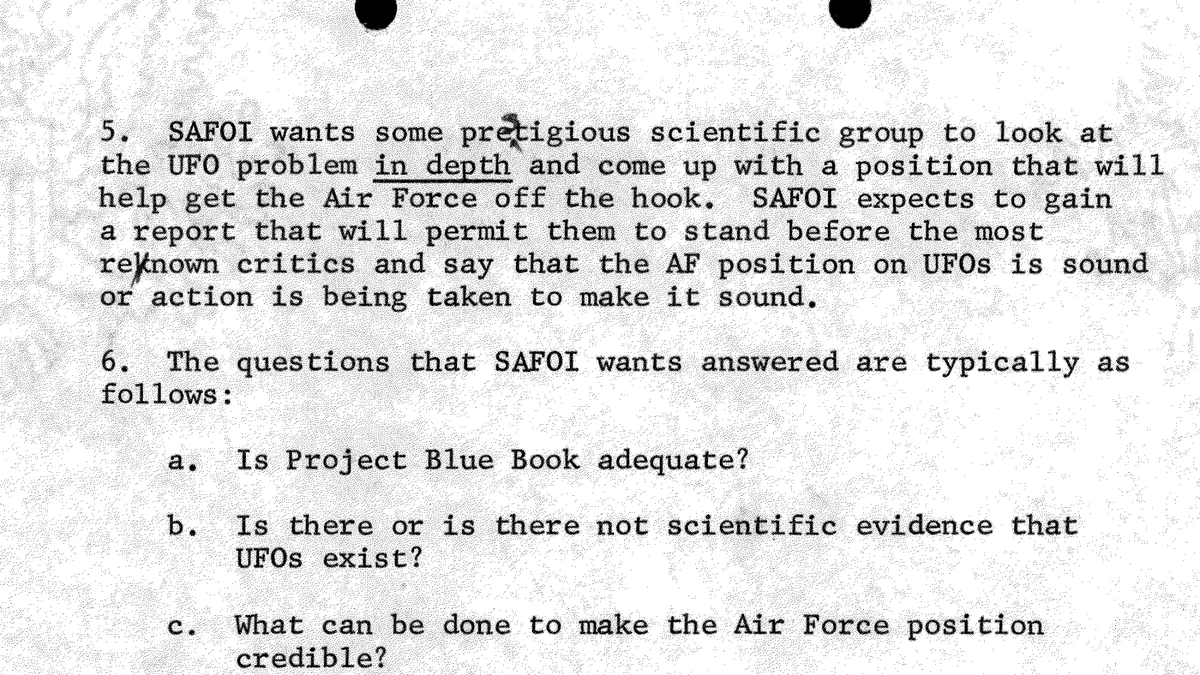
So SAFOI wanted, in the memo's words, a prestigious scientific group whose findings would "help get the Air Force off the hook". It was clear it did not want a bland report. It wanted answers to three questions: is Blue Book adequate, is there scientific evidence that UFOs exist, and what would make the Air Force position credible? The memo ends by saying none of the service's other headaches, the sonic boom, the supersonic transport, racial integration, had damaged its public image as much as UFOs.
The implementation meeting on 19 April 1966 put it even more bluntly. Its notes describe the problem as 99% public relations, and suggest a public information officer, possibly undercover, should go out with the first investigating teams.
Carl Sagan and Project Blue Book: What the Committee Said
Five typed pages, labelled in pen as verbatim comments taken at the meeting, record what the committee members actually said on 3 February 1966. They are the best part of the file, and several comments are credited to named members.
The committee agreed that Blue Book was fine as far as it went but not investigative enough for a scientist. Eighteen years of collected data, the notes say, were no good as a scientific foundation, and the programme could go on forever without settling whether UFOs exist. It was time to move from an operational approach to a scientific one.
Carl Sagan's comments are the most practical. He wanted statistical analysis of the UFO data. He suggested the Air Force run unannounced, controlled experiments, and correlate reports with predictable things such as comets, balloons and air-to-air refuelling by Strategic Air Command, to test how witnesses and investigators behave. And he gave an example of sloppy casework: in a New Hampshire case (almost certainly the 1965 Exeter sightings), Blue Book blamed B-47 bombers but never checked the bombers' navigation logs against the time and place of the sighting. Loose work like that, the note says, gave critics loopholes to attack the Air Force's credibility.
Others added their own points. Carter asked for a short summary of what earlier scientific groups had found, so a new study would not reinvent the wheel. Someone asked how often the SPADATS space-tracking radar picked up unidentified objects, because either answer, lots or almost none, would tell you something. There was a suggestion to brief local police forces, with the honest admission that it would push the number of sightings up. And the Foreign Technology Division's Dr Anthony Cacioppo warned that asking for more money might make the Defense Intelligence Agency recommend cancelling the whole UFO project at its next budget review.
The conclusion, as Steiner recorded it, was to recommend teams at universities around the country, each with at least one psychologist experienced in interviewing and one or more physical scientists such as astronomers or physicists. They would take only the cases Blue Book could not quickly identify, which the committee estimated at 100 to 150 a year.
Condon Report: How the O'Brien Committee Led to It
The Condon Report is the 1969 University of Colorado study, officially the Scientific Study of Unidentified Flying Objects, that the Air Force commissioned in 1966 as a direct result of the O'Brien committee's advice. It is the same study that analysed the Lakenheath radar case and called it one of the most puzzling it had seen. The Air Force Secretary, Harold Brown, accepted the recommendation. His memo to the Chief of Staff says a scientific team should be contracted to investigate selected sightings in depth, and the 20 April 1966 meeting notes say he signed off on 5 April. What followed shows how quickly the plan changed shape.
The April meeting drew up a list of more than 30 universities, grouped East, West and South, and suggested the University of Dayton as lead because it was near Wright-Patterson. Nobody could agree whether to contract universities or individual academics. Hynek and the Harvard astronomer Donald Menzel, who disagreed about almost everything to do with UFOs, were proposed as joint advisers to pick cases. In May, Stever reported back on sounding out other university presidents: some would say no on principle, some had nobody qualified, and some would treat it as a foot in the door for more research money.
In the end there was no network. The Air Force gave the job to a single university, Colorado, under the physicist Edward Condon. A memo of 16 May 1967 records Condon's team briefing the board. They were more interested in how to interpret reports than in chasing new sightings. Their field teams, each a physical scientist and a social scientist with Geiger counters, binoculars and cameras, would be a low priority. They were coding every report since January 1967 onto punch cards, and had asked NICAP to nominate older cases, because without NICAP the report would lack credibility. Steiner concluded the advisory board had nothing more to add.
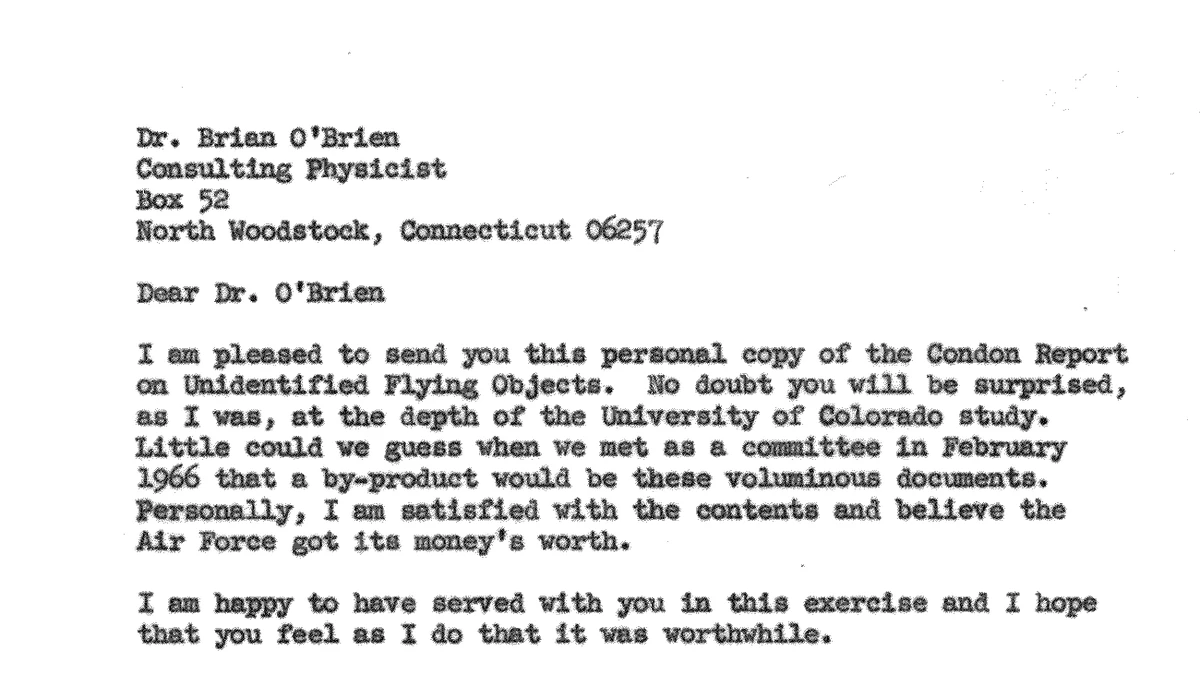
The file closes with the ending. In February 1969 Steiner mailed each committee member the three-volume Condon Report. He told them he was surprised at how deep the Colorado study went, that he believed "the Air Force got its money's worth", and, in his note to Stever, that it put the Air Force in an excellent position to counter criticism. Carter wrote back that the National Academy of Sciences' endorsement should see off any serious criticism. Ten months later, on 17 December 1969, the Air Force announced it was closing Project Blue Book.
A few smaller items fill the gaps. A NICAP investigator dropped into Steiner's office in August 1966 to complain about how Quintanilla had handled the Portage County police chase in Ohio that April; they parted friendly but unconvinced, Steiner wrote. In 1967 Orlansky asked for the committee's report to go to the US Embassy in Thailand, whose staff were dealing with a run of unconfirmed reports of mysterious helicopters near the Laos border. And in 1968 NICAP's Don Berliner paid $5 for copies of the Blue Book material given to the committee, charged at 25 cents a page plus $3 an hour of labour.
Scan the sky like a Moonwatch volunteer
Kit we've tested and reviewed in full
The committee's best argument was that people who watch the sky properly rarely report UFOs. A good pair of binoculars is the fastest way to join them. New to it? Our guide to binocular astronomy gets you started.
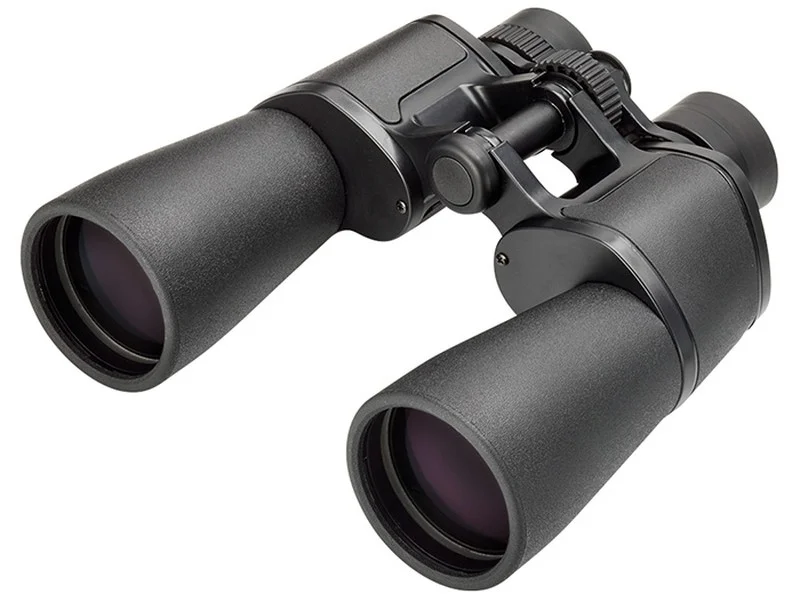
Bright, wide and quick to aim. Enough to tell a satellite from an aircraft from a planet in a few seconds.
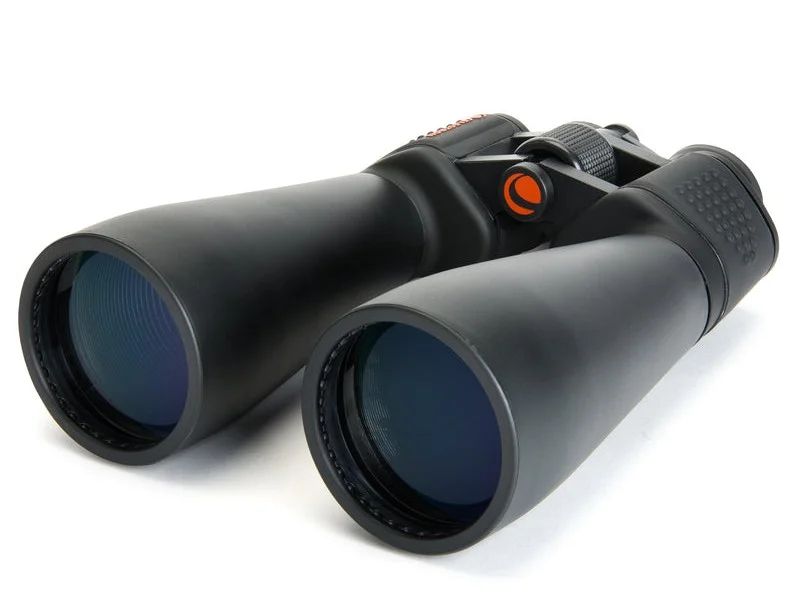
Heavier, but a balloon, a tumbling rocket body or a satellite flare shows its real shape at 15x.
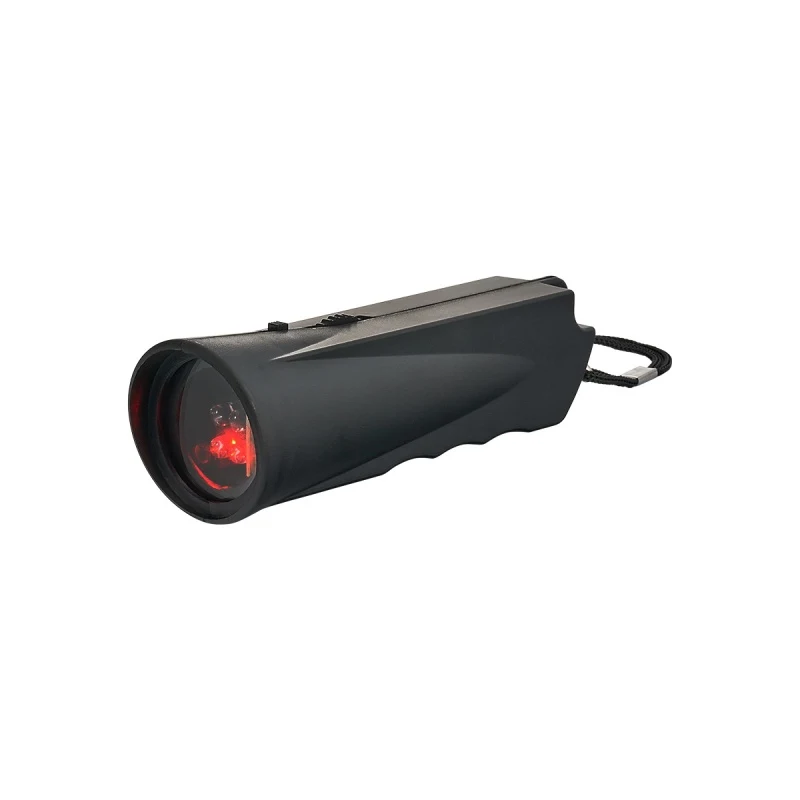
Astro Essentials Red Light Torch
Read a star chart or a sky app without losing your dark adaptation.
Affiliate links: you pay the same price, we earn a small commission that helps keep WatchTheStars free.
Amateur Astronomers and UFOs: The Moonwatch Argument
The 1966 Blue Book committee argued that trained sky-watchers, such as Moonwatch teams and amateur astronomers, almost never reported UFOs. Richard Porter's comment is the one astronomers will like. The committee's notes point out that for as long as the Air Force had been collecting UFO reports, Moonwatch satellite-tracking teams and amateur astronomers running meteor programmes had been scanning large areas of the night sky. As far as the committee knew, none of them had ever seen a UFO. So, the note argues, when trained people watch the sky, UFOs don't show up, and the unexplained cases would probably not stay unexplained under close scientific scrutiny.
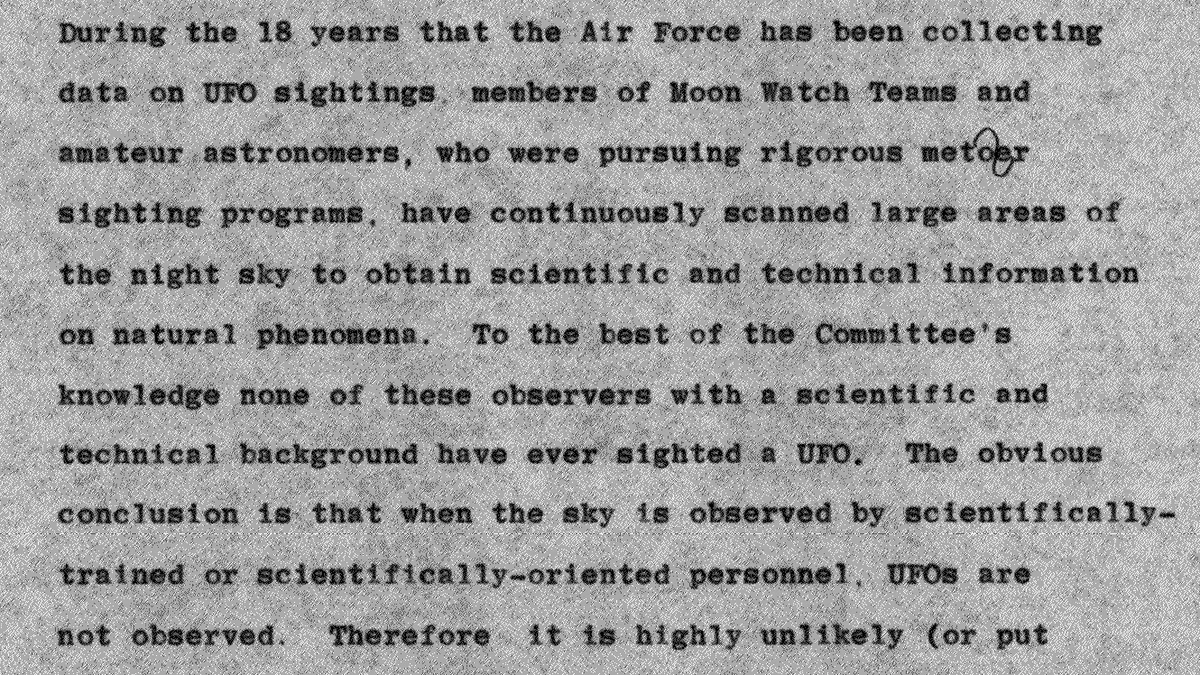
That is an overstatement, and later surveys found some astronomers did report odd things they kept quiet about. But the core of it holds up, and it matches our own experience. People who know the sky report far fewer UFOs because they recognise Venus, a satellite pass or a bright meteor for what it is. Operation Moonwatch was exactly that sort of group: amateurs trained by the Smithsonian to spot and time satellites with small telescopes from 1956 onwards.
You can do the same thing today. Most of the "UFO" messages we get are Venus or Jupiter, the International Space Station, a Starlink train or a meteor. Before you report anything, check what you can see in the sky tonight and the ISS passes tonight page. Meteor programmes like the ones Porter mentioned still run, and our guide to the next meteor shower in the UK is a good place to start. If you want people to learn with, there are 288 societies in our directory of astronomy clubs in the UK and Ireland, and our stargazing for beginners guide covers the first few months on your own.
Where to Read DOW-UAP-D092
The PDF is public on war.gov as part of the fourth PURSUE release of 10 July 2026, filed as DOW-UAP-D092_DAF-Committee-to-Review-Project-Bluebook_1966-1967.pdf. You can find it, with a download from our own mirror, in the PURSUE file browser, and our guide to the Pentagon's fourth UFO file release puts it alongside the other files from that day. The committee's published report is reprinted as Appendix A of the Condon Report.
Some of the photocopies are faint, and pages 37 to 41, the verbatim notes, are images with no text layer, so you will need to zoom in. A few pages are blank or near-blank scans. For the other side of the story, see our piece on AARO buying J. Allen Hynek's Blue Book archive. Hynek was the consultant LeBailly named in the 1965 request, and the scientist who later said the Condon study had missed the point.
Sources:
- DOW-UAP-D092, Department of the Air Force Committee to Review Project Bluebook, 1966-1967, US Department of War, PURSUE Release 4, 10 July 2026, read from our local archive copy
- Release 4 metadata catalogue (release_04_metadata.csv), entry for DOW-UAP-D092
- Condon Report, Appendix A: 1966 Blue Book Review Committee Report, the committee's published report
- Air Force to Terminate Project "Blue Book", press release, 17 December 1969, Department of Defense
- Project Blue Book fact sheet, Air Force Declassification Office
Frequently Asked Questions
Equipment guides
Related topics

Ian ClaytonAmateur astronomer and founder of WatchTheStars.co.uk, dedicated to helping others explore the wonders of our universe. Full profile →