Key takeaways
- Colonel Howard McCoy's 298-page personnel file, DOW-UAP-D180, never mentions flying discs, Project Sign or Project Grudge
- In his own 1954 account, McCoy said he spent his Wright Field years running a classified lab for security and investigative equipment
- Twining and Chidlaw rated McCoy highly but said his enthusiasm needed checking; neither report says what he was enthusiastic about
- McCoy's file shows no demotion or discipline: he left Wright Field in August 1949 for staff college, then served at the CIA
Jump to section 7 sections
- Howard McCoy's Personnel File: What DOW-UAP-D180 Is
- Does the McCoy File Mention Project Sign or UFOs?
- What McCoy Said He Did at Wright Field: The Science Survey Office
- Howard McCoy's Efficiency Reports: How Twining and Chidlaw Rated Him
- Was McCoy Removed Over the Estimate of the Situation?
- McCoy After Wright Field: The CIA and a Security Agency
- Why a Personnel File Is Silent on UFOs
Colonel Howard McCoy ran Air Force intelligence at Wright Field, Ohio, while Project Sign, the first official US study of flying saucers, was set up and run. His personnel file, DOW-UAP-D180, came out on 23 October 2026 in the Pentagon's seventh PURSUE release. It runs to 298 pages, and the words "flying disc" never appear in it.
We read every page. This post sets out what the file does contain, and why its silence is less telling than it looks. For the papers McCoy actually signed about flying discs, see our Project Sign file page; for the rest of the batch, see our round-up of the seventh UFO file release.
Howard McCoy's Personnel File: What DOW-UAP-D180 Is
DOW-UAP-D180 is the final personnel record of Colonel Howard M. McCoy, the jacket the Air Force kept on him from his West Point commission in 1930 to his retirement on 31 August 1954. It holds efficiency reports, orders, promotion papers, decoration cards and his retirement application. Much of it is personal, with addresses, family details and medical records, and we leave all of that out.
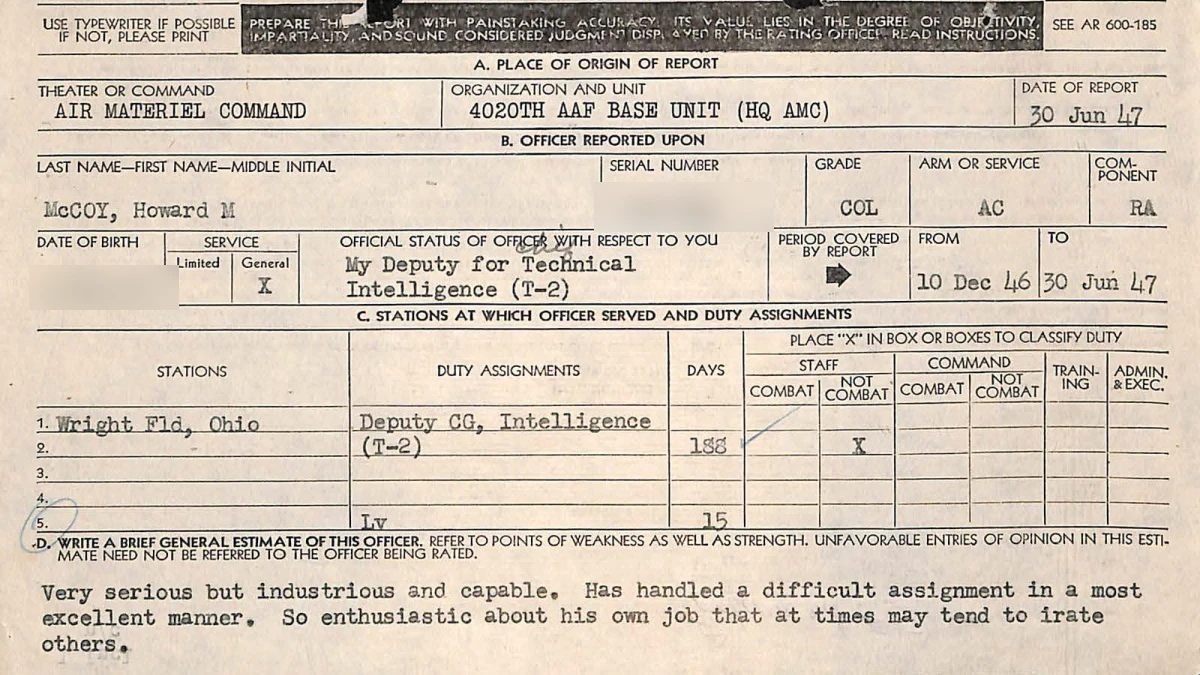
The Department of War released it because of the job he held. From 10 December 1946 McCoy headed T-2, the intelligence arm of Air Materiel Command at Wright Field. From 15 October 1947 to 24 August 1949 he was Chief, Intelligence Department, Headquarters, Air Materiel Command (page 30). Those are exactly the years of Project Sign and the start of its successor, Project Grudge. The key dates, from the file:
- 12 June 1930: commissioned from West Point; later a pursuit pilot and Caltech-trained propeller engineer
- 18 October 1945: joins T-2 intelligence at Wright Field
- 10 December 1946: takes over T-2
- 15 October 1947 to 24 August 1949: Chief, Intelligence Department, Air Materiel Command
- July 1950 to March 1951: Central Intelligence Agency
- 1951 to 1954: Director, Physical Security Equipment Agency
- 31 August 1954: retires as a colonel
His name is on the key documents of that period. He signed the April 1948 Project Sign report on the first 100 UFO sightings and the November 1948 letter saying that the possibility of vehicles from another planet "has not been ignored". In January 1948 he also wrote to the CIA about a magazine's flying disc letters, as told in our post on the CIA, Amazing Stories and the red spider from Mars.
Does the McCoy File Mention Project Sign or UFOs?
No. Howard McCoy's personnel file never mentions flying discs, saucers, unidentified objects, Project Sign, Project Grudge or the Estimate of the Situation, the 1948 paper that, according to later accounts, concluded the discs were interplanetary. General Hoyt Vandenberg appears only as a printed signature block on routine orders about other officers. The only "Cabell" is a different officer in a 1941 orders list, not the General Charles Cabell who wrote to McCoy about flying discs in 1948. "Roswell" turns up only in 1951 orders posting other men to Walker Air Force Base.
The link between McCoy and the UFO projects comes entirely from the Department of War's description of the file. That blurb says he "was among the senior Air Force intelligence officers involved in the early design, administration, and execution of" Sign and Grudge. That is probably fair, given the letters he signed. But it is the Department's summary, not anything the file itself records.
What McCoy Said He Did at Wright Field: The Science Survey Office
McCoy described his Wright Field years himself, in a statement supporting his retirement in July 1954, and he wrote about a secret laboratory, not flying discs. As T-2 chief and then head of the Intelligence Department, from December 1946 to August 1949, he said he "managed a specialized laboratory known as the Science Survey Office (SSO) which developed certain classified types of security and investigative equipment" (page 62). He added that the lab "was abolished for unknown reasons" soon after he left.
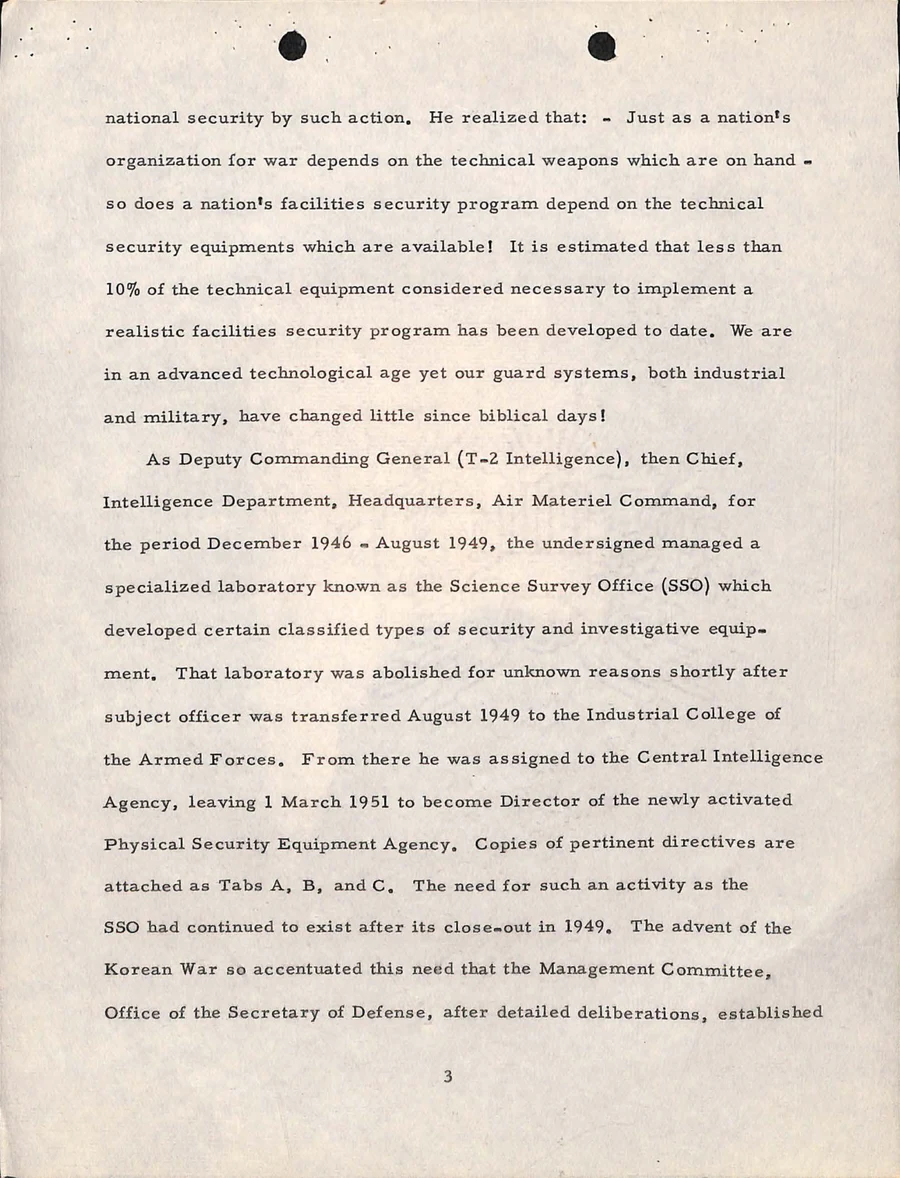
The rest of the file backs this up. A June 1949 directive lists the Science Survey Office inside the Intelligence Department, with the mission "Perform the classified functions as prescribed" (page 70). In early 1949 two of its staff lectured the first class of Air Force special investigators on "Sound Equipment" and investigative photography (page 101). In December 1948 McCoy gave a demonstration to Army counter-intelligence commanders in Maryland (page 102).
He also put a number on it. Since 1946, he wrote, he had spent "about 20,000 hours" "fighting Communism through technical means" (page 61). This was the work he chose to put in front of the board deciding his future. If he thought his flying disc work had mattered most, he didn't say so.
Howard McCoy's Efficiency Reports: How Twining and Chidlaw Rated Him
McCoy's superiors rated him highly but kept noting the same flaw: too much enthusiasm and too little control. Lieutenant General Nathan Twining, who commanded Air Materiel Command and signed the famous September 1947 memo calling the discs "something real and not visionary or fictitious", rated McCoy for December 1946 to June 1947:
"So enthusiastic about his own job that at times may tend to irate others." (DOW-UAP-D180 p.262; "irate" as typed)
For July to October 1947, the months of that memo, Twining wrote that he "Knows his job but does not express himself well" (page 260). Nothing in the file says whether McCoy had a hand in the memo.
From October 1947 his rater was Lieutenant General Benjamin Chidlaw, with General Joseph McNarney, the command's commanding general, signing below. Chidlaw's report for October 1947 to May 1948, the months in which Project Sign was ordered and set up, called him one of "the comparatively few officers" in the Air Force able to do the job, then added:
"His enthusiasms for broadening the horizons of his job have to be continually checked to keep them within balance." (DOW-UAP-D180 p.266)
The next reports keep up the theme. A continuation sheet filed with his 1948 to 1949 report says he was inclined to "forget or overlook the dollar costs" (page 257). In mid-1949 Chidlaw wrote that "in his enthusiasm to enhance the prestige of his activity" he took on more work than his staff could handle (page 255). Back in 1946 another rater had said he started "many projects without following thru to completion" (page 267).
It is tempting to read all this as a comment on flying saucers. Don't. Not one report says what the enthusiasms were. The Science Survey Office, the technical intelligence work and the Air Documents Division he had run are all equally likely candidates, and the reports themselves only talk about technical intelligence, cost control and administration.
Was McCoy Removed Over the Estimate of the Situation?
Nothing in McCoy's personnel file suggests he was removed over the Estimate. A popular account says the Estimate of the Situation, backing the interplanetary idea, was rejected by the Air Force Chief of Staff in 1948 and that Project Sign's people paid for it. McCoy's file shows an officer leaving his post in the normal way.
His 1948 to 1949 report recommends a continued "Intelligence Assignment" and the Industrial College of the Armed Forces, and that is where he went. Orders for the college were cut on 16 May 1949 (page 25). Air Materiel Command General Orders No. 66, dated 8 August 1949, then named Colonel Harold E. Watson as Chief, Intelligence Department, "vice" McCoy, "relieved" (page 92). There is no disciplinary entry anywhere in the file. That adds no support to the removal story. It does not disprove it either, because a personnel file is not where such a decision would be written down.
McCoy After Wright Field: The CIA and a Security Agency
After a year at the Industrial College, McCoy was posted to the Central Intelligence Agency from July 1950 to March 1951 (pages 30 and 250). His rater there was H. Marshall Chadwell, named only as "Assistant Director", who said McCoy was "capable of developing ideas with initiative and imagination" (page 252). By late 1952 Chadwell was the CIA's Assistant Director for Scientific Intelligence and the man pushing for a scientific panel on flying saucers, as covered in our post on the CIA's 1952 UFO memo about Britain. That came after McCoy had left, and nothing in the file says he did any UFO work at the CIA.
From March 1951 he ran the Physical Security Equipment Agency, a small Defense Department body building guard and security technology. One rater wrote that he "is not an empire builder" (page 249). The agency was abolished on 4 March 1954, and McCoy asked to retire. The Air Force's personnel chief agreed, bluntly:
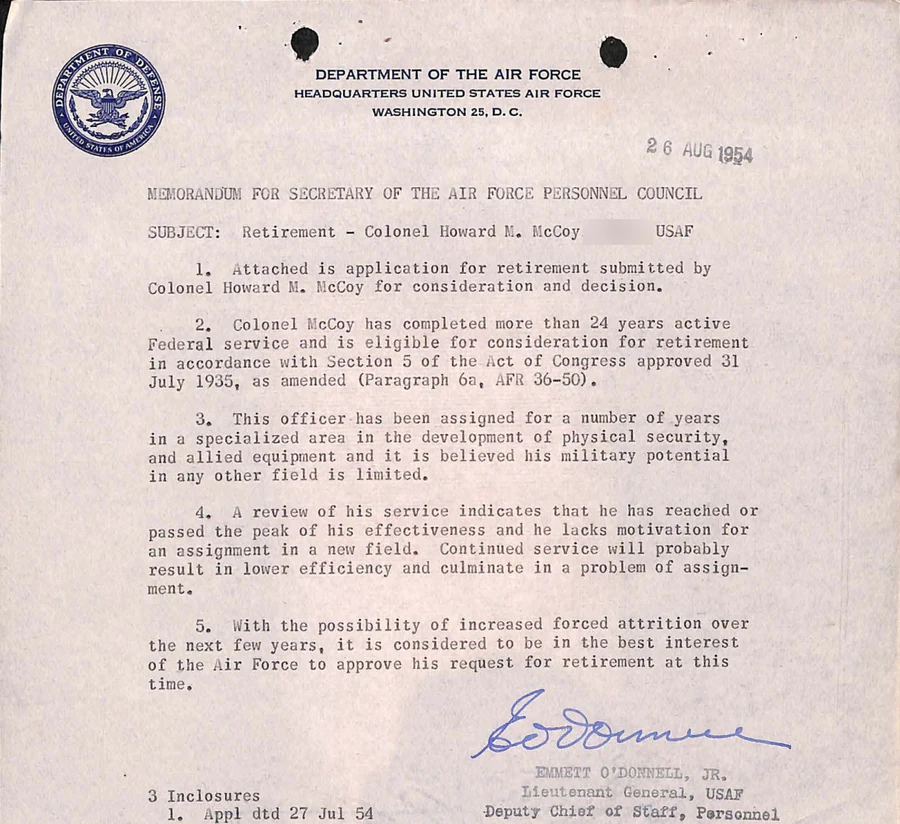
The memo says he "has reached or passed the peak of his effectiveness" (page 55). He retired as a colonel on 31 August 1954. He was never a general.
Why a Personnel File Is Silent on UFOs
A personnel jacket records who someone was and where they served, not what they worked on. Efficiency reports of the 1940s described character and fitness for the next job, and their writers had no reason to name classified projects on a form that followed the officer around. Sign's papers sat in intelligence files instead. The letters McCoy signed came out in August 2026 in DOW-UAP-D100, a headquarters intelligence correspondence file from the fifth release (our guide to every PURSUE release lists them all).
So D180 neither proves nor disproves anything about Project Sign. What it does is pin down the man: an engineer turned intelligence chief, energetic and hard to rein in, who in his own account put security equipment first. When he looked back on the Wright Field years, flying saucers didn't make his list.
The 1940s cases McCoy's office handled were mostly lights in the sky, and his staff even plotted sightings against the close approaches of Venus and Mars. The same checks still work. Before reporting anything, see what you can see in the sky tonight, check for ISS passes tonight, and remember that a bright star low on the horizon can seem to follow your plane. If you're starting out, stargazing for beginners will get you finding your way round the sky in an evening.
Check the sky before you report it
Kit we've reviewed in full
Project Sign's staff spent much of their time on bright planets, balloons and meteors. A good pair of binoculars settles most odd lights in seconds.
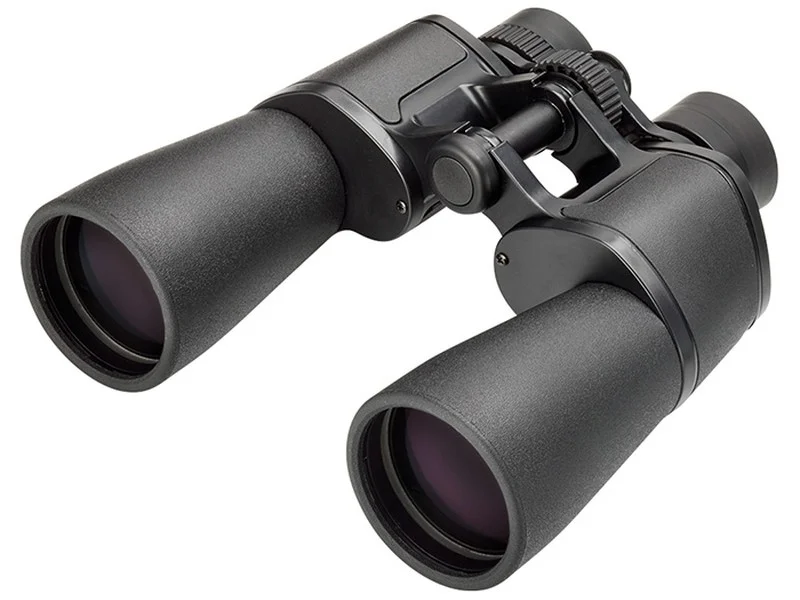
Bright and wide, so you can get onto a moving light quickly and see whether it has navigation lights.
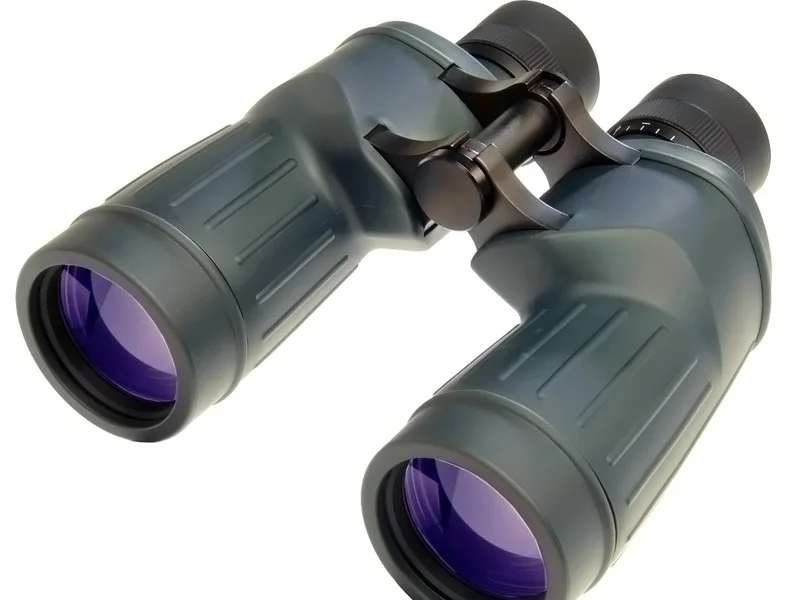
Built for cold, damp nights, which is when a low bright planet causes the most confusion.
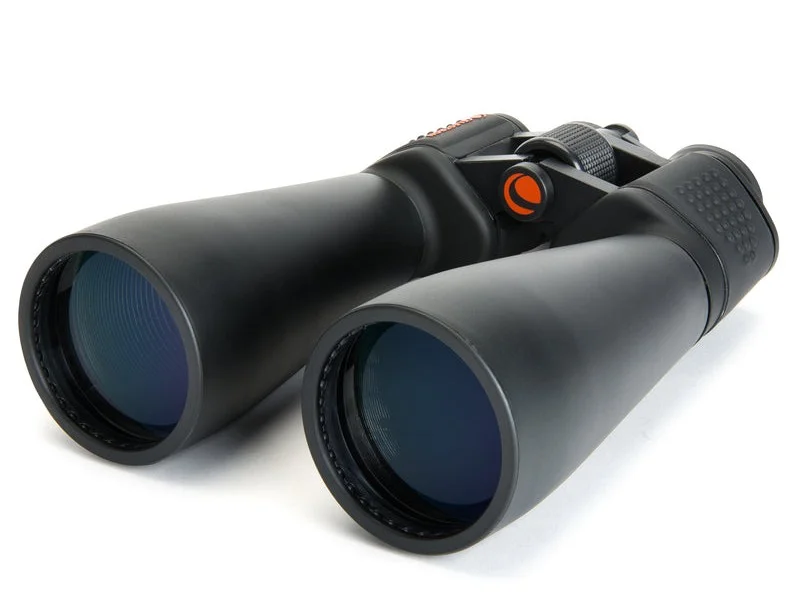
More magnification for a high aircraft or a satellite flare. Best on a tripod.
Affiliate links: you pay the same price, we earn a small commission that helps keep WatchTheStars free.
You can open the full file on our Pentagon UFO file browser, and the UAP document archive shows how all the releases fit together.
Sources:
- DOW-UAP-D180, Final Personnel Record for McCoy, Howard M., US Air Force, 1954: US Department of War, PURSUE Release 7, 23 October 2026. Page numbers are PDF pages.
- Department of War description of DOW-UAP-D180, PURSUE Release 7 catalogue
- Our Project Sign file page, for the 1947 Twining memo and the 1948 Cabell and McCoy letters (DOW-UAP-D100)
Header image: an illustration generated with Google Gemini, not a photograph of McCoy's file. Page images: DOW-UAP-D180, US Air Force records, public domain, released by the US Department of War in PURSUE Release 7.
Frequently Asked Questions
Equipment guides
Related topics
Ian ClaytonAmateur astronomer and founder of WatchTheStars.co.uk, dedicated to helping others explore the wonders of our universe. Full profile →