Key takeaways
- The Turner report (CIA-UAP-019, National Archives of Australia A13693, 3092/2/000) is a Joint Intelligence Organisation minute paper dated 27 May 1971
- The Turner report argues the US hid a serious UFO programme behind a 'facade of ridicule', but it cites no sources and several of its claims don't hold up
- The Turner report's sharpest point is local: the RAAF's 1960 to 1965 list blamed Venus 15 times, and the author says none of those was valid
- Venus is the UK's brightest morning object this week: in our calculation it stands 15 to 19 degrees up in the south-east at 6:30am
Jump to section 7 sections
- What Is the Turner Report? Australia's 1971 UFO Paper
- What the Turner Report Says About US UFO Policy
- Project Blue Book Special Report 14: the Table Turner Quoted
- The RAAF and UFOs: 15 Venus Identifications, None Valid
- What Holds Up in the Turner Report, and What Doesn't
- Can You Mistake Venus for a UFO? Where It Is This Week
- Where to Read the Turner Report (CIA-UAP-019)
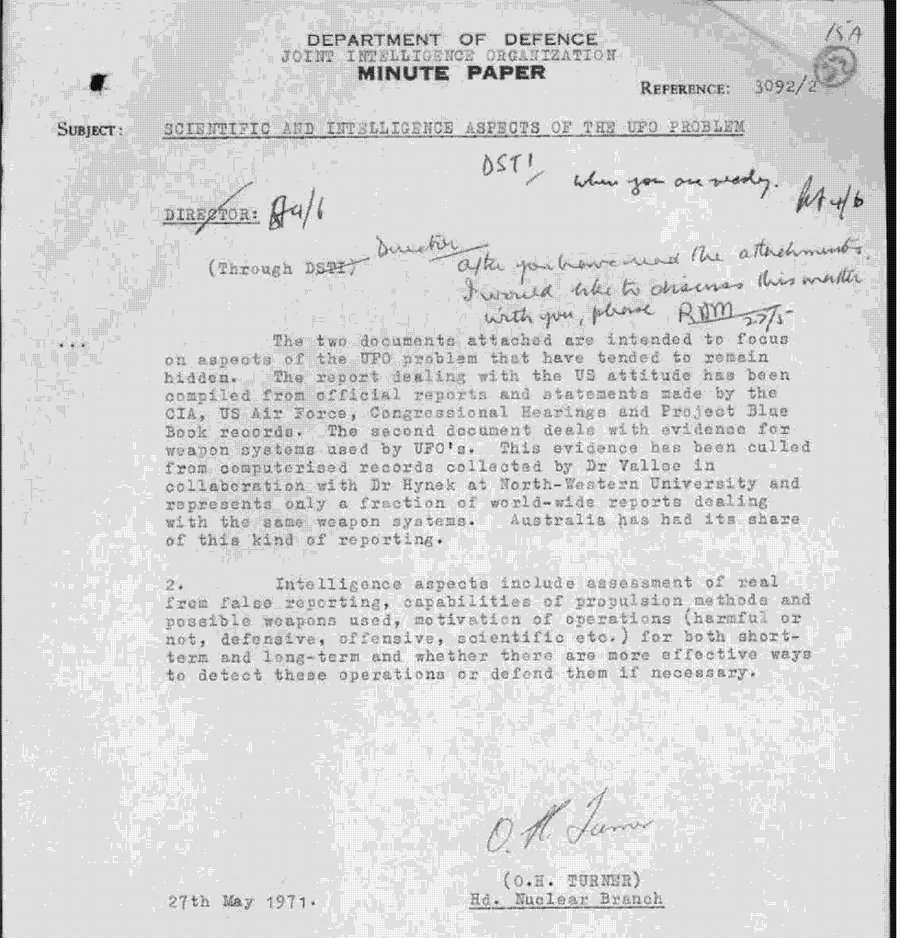
In May 1971 an analyst inside Australia's Department of Defence sent his Director a paper that tore into the way both the US Air Force and the Royal Australian Air Force handled UFO reports. Known in Australian UFO circles as the Turner report, it is one of the best-known Australian UFO files, and it now sits in the Pentagon's PURSUE files as CIA-UAP-019, a 19-page copy from the National Archives of Australia, file NAA: A13693, 3092/2/000. The covering minute carries the reference 3092/2 and the date 27 May 1971.
This is the latest in our Document of the Week series, where we take one file from our declassified UAP document archive and explain in plain English what it says. This one has an astronomy twist: its best evidence against the RAAF is about Venus.
What Is the Turner Report? Australia's 1971 UFO Paper
The Turner report is a Joint Intelligence Organisation minute paper titled "Scientific and Intelligence Aspects of the UFO Problem", signed by O. H. Turner, head of the JIO's Nuclear Branch, and addressed to the Director through the Director of Scientific and Technical Intelligence. The Pentagon filed it under a CIA number in its third UFO file release of 12 June 2026, though it's an Australian document from start to finish.
| CIA-UAP-019 at a glance | |
|---|---|
| Title | Scientific and Intelligence Aspects of the UFO Problem |
| From | Department of Defence, Joint Intelligence Organisation, Nuclear Branch |
| Date | 27 May 1971 |
| References | Minute 3092/2; National Archives of Australia A13693, 3092/2/000 |
| Released | 12 June 2026, PURSUE Release 3 (war.gov) |
| Length | 19-page PDF; PDF pages 8 and 9 are the same page scanned twice |
The covering minute says the two attached papers "are intended to focus on aspects of the UFO problem that have tended to remain hidden" (PDF page 2). Only the first, on the US attitude, is in this PDF. The second, on "weapon systems used by UFO's" drawn from Jacques Vallée's computer files, is missing. The handwritten notes show it was taken seriously: the Director of Scientific and Technical Intelligence passed it on asking to discuss it, and the Director wrote back "when you are ready".
What the Turner Report Says About US UFO Policy
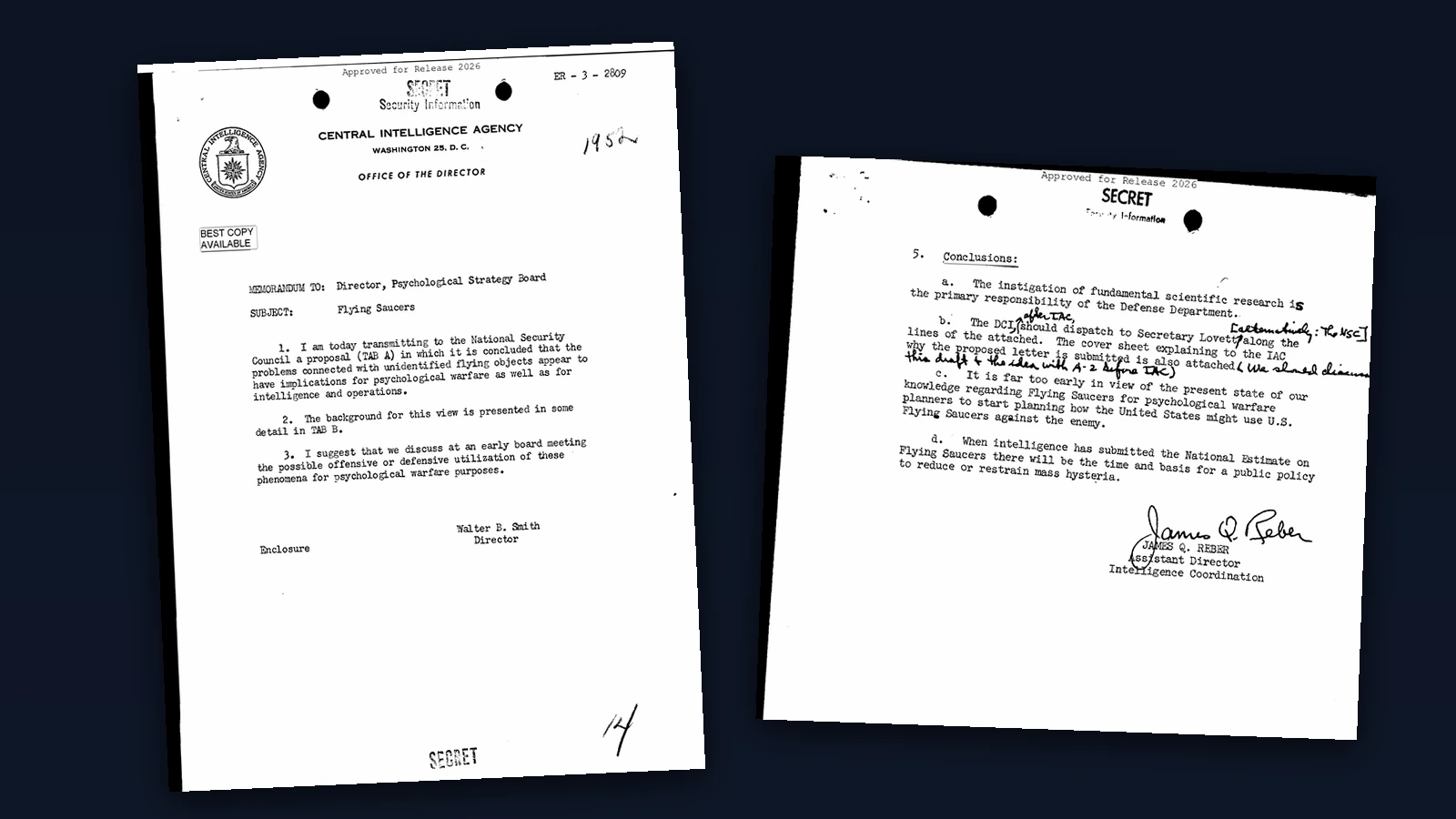
The Turner report argues that early US Air Force analysis pointed to real craft "so far in advance of U.S. aircraft that only an extra-terrestrial origin could be envisaged", and that the CIA then steered the Air Force into public debunking while research went on quietly. Its two-page summary puts it bluntly: "By erecting a facade of ridicule, the U.S. hoped to allay public alarm" (PDF page 3).
The main paper tells the story year by year. Project Sign leaned towards an interplanetary answer in 1948, Grudge tried to kill the subject in 1949, and Blue Book rebuilt it in 1952. Then came the summer wave, when the CIA worried, as its own files show, that floods of reports could clog military communications in a crisis. From there the paper claims the Robertson Panel of January 1953 led to a gutted Blue Book, a gagging order, and a secret push into anti-gravity research.
The last part is the boldest. The report says the US funded the Canadian Avro "saucer", backed six gravity research centres and, by 1966, was paying for "46 separate projects", 33 of them under the Air Force. It calls this drive "entirely irrational" unless the government believed UFOs were real and that whoever flew them "knew how to control gravity" (PDF page 11).
Project Blue Book Special Report 14: the Table Turner Quoted
Project Blue Book Special Report No. 14 is the Air Force's big statistical study of about 3,200 reports up to 1952, and the Turner report builds its strongest data point on one of its tables. Sorted by how reliable each sighting was, the share of "unknowns" goes up, not down, as the reports get better.
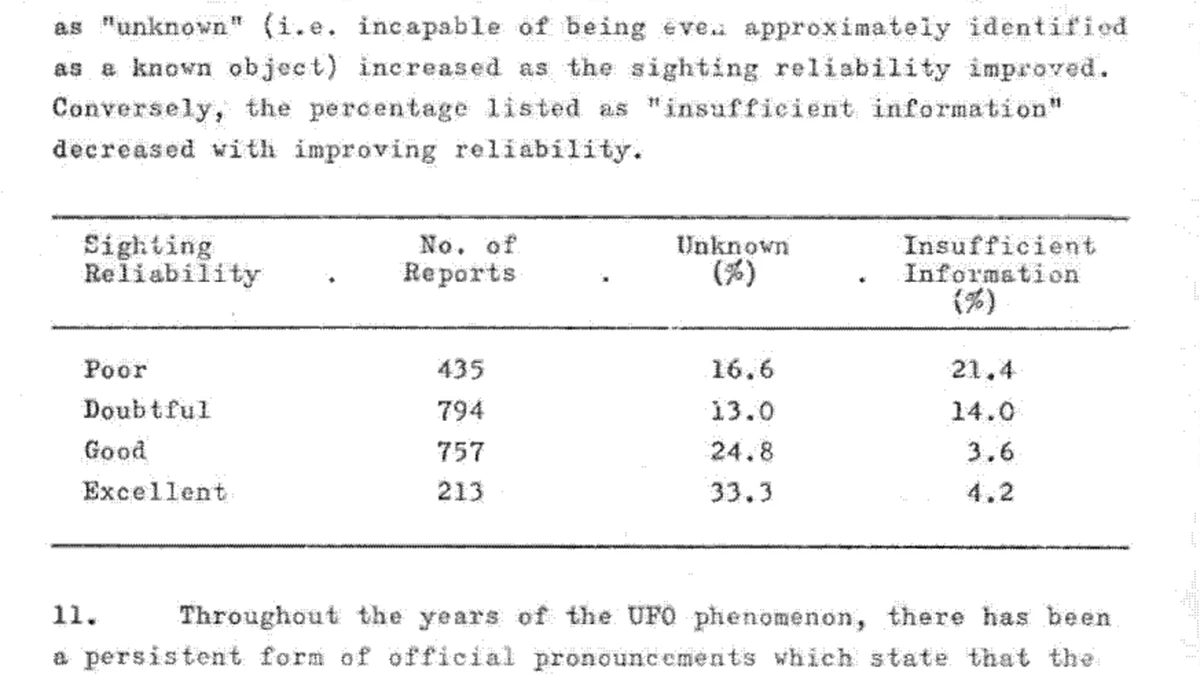
| Sighting reliability | Reports | Unknown | Insufficient information |
|---|---|---|---|
| Poor | 435 | 16.6% | 21.4% |
| Doubtful | 794 | 13.0% | 14.0% |
| Good | 757 | 24.8% | 3.6% |
| Excellent | 213 | 33.3% | 4.2% |
The pattern is real and still gets quoted. What it means is less clear. A detailed report gives an investigator no room to file it as "insufficient information", so some cases that would have been "not enough to go on" land in "unknown" instead. The Special Report 14 authors themselves concluded it was highly improbable that the unknowns were technology beyond present-day knowledge. Turner treats their caution as a cover-up.
The paper also says the consultants "arbitrarily" filed green fireballs and short night-time sightings as astronomical, which is fair comment, and it gives the main report as 116 pages on one page and 316 on another. In a paper that accuses others of sloppy work, slips like that stand out.
The RAAF and UFOs: 15 Venus Identifications, None Valid
The Turner report says the RAAF's UFO investigations were run on a shoestring and leaned on lazy labels, and this is where the paper is on its firmest ground. It says the Directorate of Air Force Intelligence never had more than one part-time officer on UFOs, that a 1957 request for the Joint Intelligence Bureau to take them on was turned down, and that the RAAF's own 1968 plan to find another department never happened.
Then comes the line any stargazer will enjoy. An RAAF identification list covering 1960 to 1965 "contains 15 identifications of Venus, not one of which is valid" (PDF page 13). In every case, the paper says, Venus was in another part of the sky or below the horizon. Of 37 meteor identifications, only nine could have been meteors.
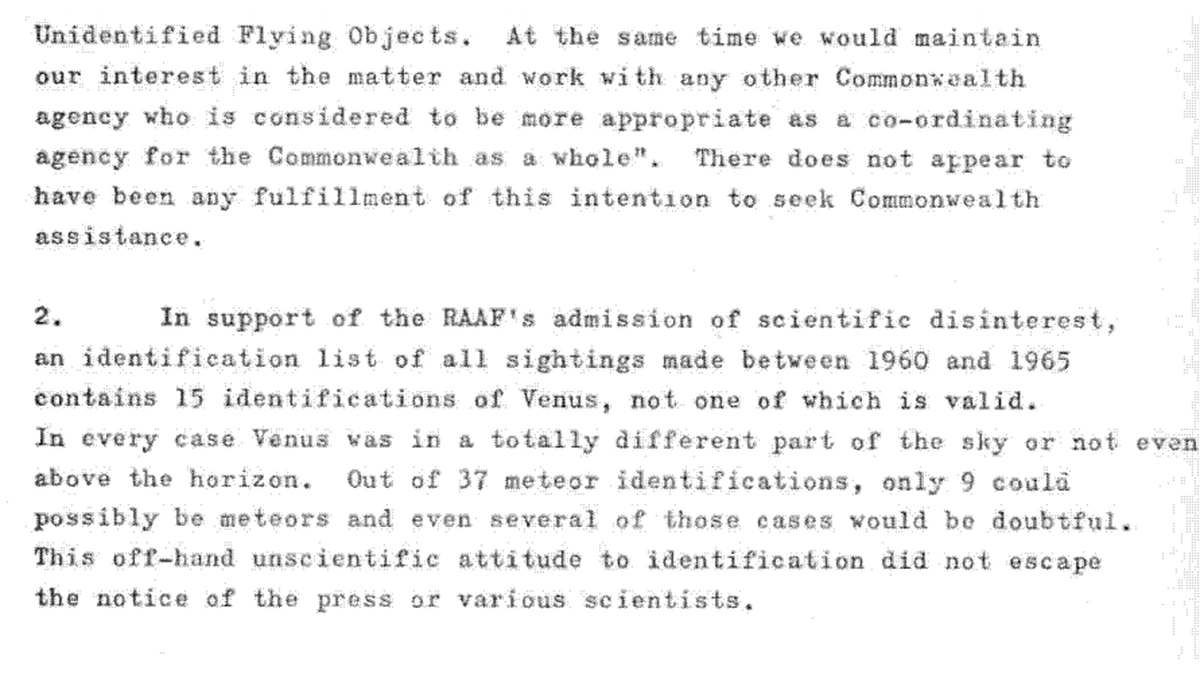
We can't check those 15 cases, because the list isn't in this file. But the complaint is familiar. The US Air Force made the same mistake, as our post on Air Force UFO files that blamed the wrong planet shows, and sometimes Venus really was the answer, as in the 1957 Peru theodolite sighting. A label is only an explanation if someone checked where the planet was.
Check the bright light yourself
Kit we've reviewed in full
Most 'UFOs' that hang low and bright for an hour are planets, and Venus is the usual suspect. Binoculars settle it in seconds: a planet stays a steady disc or crescent, an aircraft shows its lights. New to it? Start with binocular astronomy for beginners.
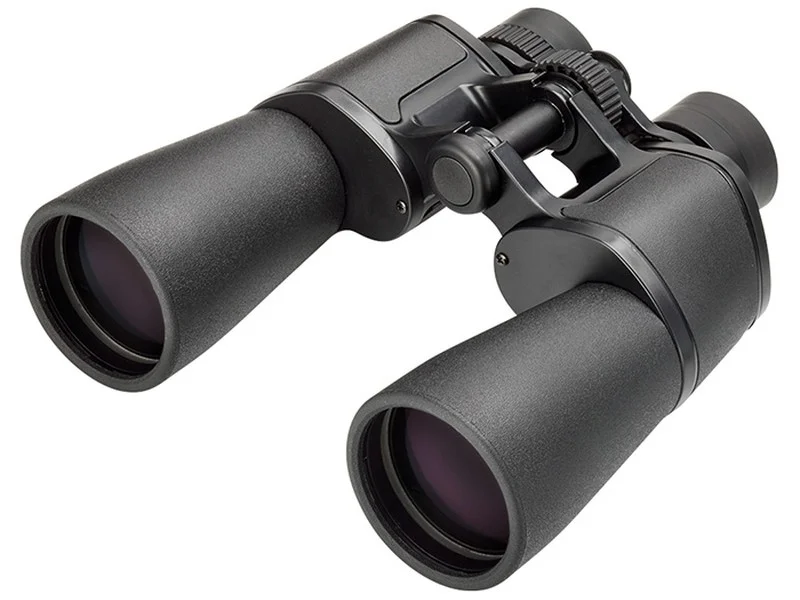
Bright, wide and easy to hold, which is what you want for a quick look at a light low in the dawn sky.
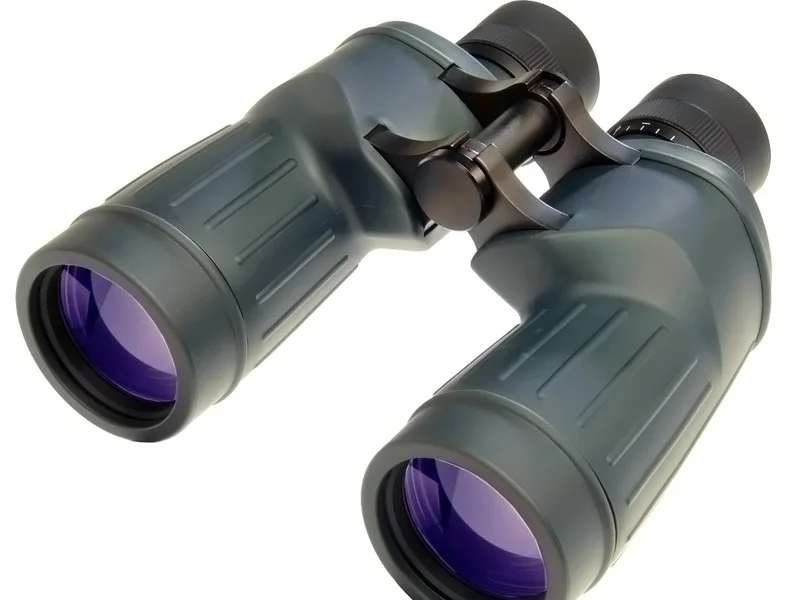
Waterproof, crisp to the edge and good enough to show Venus as a tiny crescent this winter if you hold them steady.
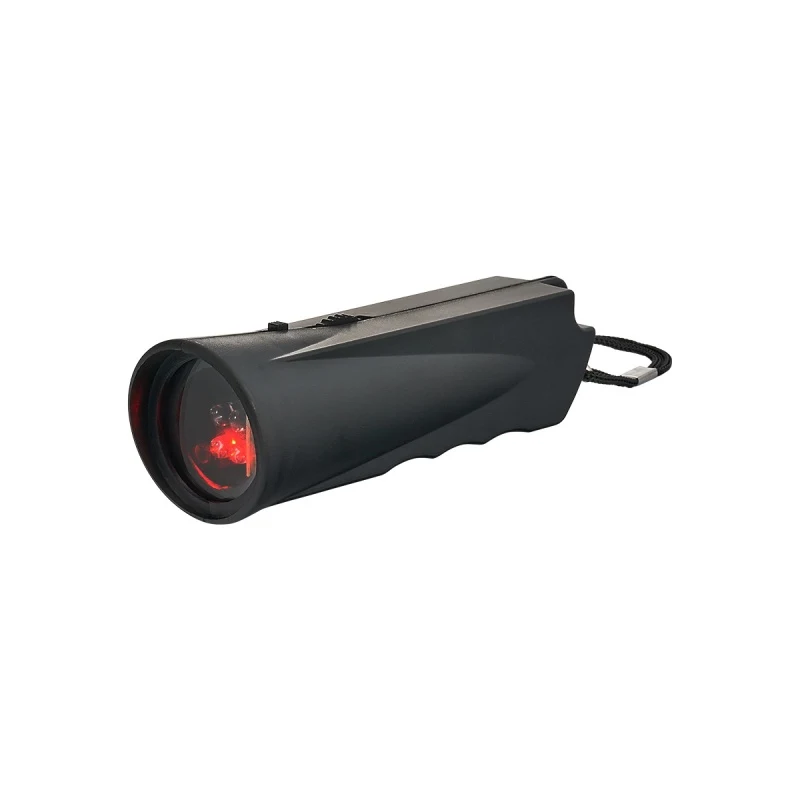
Astro Essentials Red Light Torch
Write down the time, direction and height without ruining your night vision. Those three details are what the RAAF's 1960s files were missing.
Affiliate links: you pay the same price, we earn a small commission that helps keep WatchTheStars free.
What Holds Up in the Turner Report, and What Doesn't
The Turner report is a sharp critique of lazy investigation wrapped round a US history taken largely from UFO books of the 1950s and 1960s. It footnotes nothing, so here is how its main claims compare with what is on the record.
- Holds up: the Blue Book table, the Air Force Scientific Advisory Board's 1966 view that Blue Book lacked the expertise to do the job (the review that set up the Condon study, covered in our post on why Project Blue Book ended), and the RAAF's thin staffing.
- Contradicts itself: the main paper says the Robertson Panel recommended a bigger investigation "with increased personnel and equipment". Its own appendix quotes the panel's real advice, to "strip the UFO's of the special status they have been given" and educate the public.
- Overstated: the paper says Edward Ruppelt and others all "publicly stated" the government knew UFOs were extraterrestrial. Ruppelt's own 1956 book stops well short of that, and his 1952 Blue Book talk is cautious throughout.
- Thin: the gravity "crash programme" rests on aviation-press stories of 1955 and 1956. The Gravity Research Foundation essay prize was real, and still runs, but a prize contest isn't a secret project. The Avro saucer did get US money, and the Avrocar it led to never rose more than a few feet before it was cancelled in 1961.
Turner's conclusion is more measured than his history. If Australia followed the US at all, he wrote, it should follow the quiet research, not the public line. Better still, it should "act independently of the U.S. and initiate a programme that is scientifically sound and intellectually honest" (PDF page 14). As with the CIA's 1952 memo on Britain's UFO work, the most revealing part is what one government thought another was hiding.
Can You Mistake Venus for a UFO? Where It Is This Week
Yes, easily, and this week is a good time to see why. Venus is a brilliant morning object right now, at magnitude −4.9, outshining everything in the sky except the Moon. We ran the numbers with Skyfield for Plymouth, London, Birmingham and Edinburgh (all figures are our calculation).
| 25 November 2026 | Venus rises | Height at 6:30am GMT | Direction | Sunrise |
|---|---|---|---|---|
| Plymouth | 4:16am | 18° | South-east (132°) | 7:46am |
| London | 4:02am | 19° | South-east (136°) | 7:35am |
| Birmingham | 4:10am | 18° | South-east (134°) | 7:46am |
| Edinburgh | 4:22am | 15° | South-east (134°) | 8:09am |
The best window is roughly 5:30 to 7:15am, when Venus is clear of the rooftops and the sky is still dark enough for it to blaze. By 28 November it rises about six minutes earlier. Look low in the south-east for a steady, silver-white light that doesn't twinkle much. In binoculars it's a small crescent, because Venus shows phases like the Moon.
For the rest of the sky, our page on what you can see in the sky tonight lists every bright planet, and ISS passes tonight covers the other light people often report. Fast streaks are usually meteors, and the next meteor shower in the UK is the Geminids in December.
Where to Read the Turner Report (CIA-UAP-019)
The PDF is public on war.gov in the third PURSUE release. You can open it, with a download from our mirror, in the PURSUE file browser. The original paper file is at the National Archives of Australia as A13693, 3092/2/000.
The pages are typewritten and readable, but the built-in text layer is poor, so read the scans rather than searching the text. The chronology at the back (PDF pages 15 to 19) is a handy timeline of US UFO policy from 1947 to 1969, as long as you treat each line as Turner's reading rather than the record. Hynek, who appears throughout, has a newer chapter of his own: AARO's deal over J. Allen Hynek's files.
If you're new to the night sky, our stargazing for beginners guide will have you telling Venus from an aircraft in a week. That's the skill the RAAF's investigators were missing in the 1960s.
Sources:
- CIA-UAP-019, Australian Dept of Defense Scientific and Intel Aspects of the UFO Problem, Joint Intelligence Organisation minute paper 3092/2, 27 May 1971 (National Archives of Australia A13693, 3092/2/000), US Department of War, PURSUE Release 3, 12 June 2026, read from our mirror copy
- Australian UFO science: internal debates, Bill Chalker, The OZ Files, July 2017 (background on the JIO and the author)
- Venus positions, rise times and sunrise: our calculation with Skyfield (JPL DE421 ephemeris) for each city on 25 and 28 November 2026, GMT
Header image: illustration of Venus before dawn over the Australian outback, generated with Gemini. Not a depiction of any specific sighting.
Frequently Asked Questions
Equipment guides
Related topics
Ian ClaytonAmateur astronomer and founder of WatchTheStars.co.uk, dedicated to helping others explore the wonders of our universe. Full profile →