Key takeaways
- Asteroid 2026 RW1 entered Earth's atmosphere at 16:07 UTC on Sunday 6 September 2026 over the Indian Ocean north-west of Australia, about 7 hours 22 minutes after the Catalina Sky Survey first photographed it
- Asteroid 2026 RW1 was roughly 0.6 to 1.3 metres across, burned up harmlessly, and its fireball was photographed from Broome in Western Australia at a distance of 780 km
- 2026 RW1 is only the 13th asteroid ever discovered before it hit Earth, and the first from the Aten group, whose orbits sit mostly inside Earth's own
- One of the 13, asteroid 2023 CX1, produced a fireball over the English Channel in February 2023 that was seen from southern England
Jump to section 6 sections
- Asteroid 2026 RW1: What Hit Earth on 6 September 2026?
- How Was Asteroid 2026 RW1 Detected Before Impact?
- Why 2026 RW1 Is the First Aten Asteroid Caught Before Impact
- Every Asteroid Detected Before Impact: The Full List of 13
- Asteroid 2023 CX1: The One the UK Actually Saw
- Could an Asteroid Hit the UK With Only Hours' Warning?
Asteroid 2026 RW1: What Hit Earth on 6 September 2026?
Asteroid 2026 RW1 hit Earth at 16:07 UTC on Sunday 6 September 2026, which was 17:07 BST, teatime in the UK. It came in over the Indian Ocean, several hundred kilometres off the north-west coast of Australia at roughly 13.8°S 116.4°E, and burned up as a fireball. Nobody was hurt, nothing was damaged and nothing reached the sea. By the standards of what falls on Earth every week it was a nothing event.
What made it news is that we knew it was coming. The Catalina Sky Survey at Mt Lemmon in Arizona photographed it as a faint, fast-moving dot at 08:45 UTC that morning, 7 hours and 22 minutes before it arrived. That makes 2026 RW1 only the 13th asteroid in history to be discovered before it struck, and the second this year after 2026 JN4 in May.
The rock itself was small. ESA's Near-Earth Object Coordination Centre puts it at 0.6 to 1.3 metres across; most reports settle on about 80 centimetres, roughly the size of a washing machine. Objects that size hit Earth's atmosphere a few times a month, somewhere, and almost all of them go unseen. Catching one in space first is still rare enough to count.
There is even a photograph, and the story behind it is the best part. The impact point was hundreds of kilometres offshore and most of the region was under cloud. With five hours to go, Hadrien Devillepoix and Ellie Sansom of Curtin University's Desert Fireball Network looked at flights to South-East Asia (too slow), Bali (cloudy) and finally the clear north-west coast of Western Australia. Broome was 780 km from the predicted point, further than London to Inverness. Ellie found local photographer Richard Young through a Broome Facebook group, talked him through where to aim, and he set his camera taking a 15-second exposure every 15 seconds, pointed at the sea horizon.
He caught a fireball, but it was 20 minutes late and 45° off in direction: an unrelated meteor. Then, going back through the sequence, he found a much fainter streak at exactly the right time, a degree above the horizon. Devillepoix's astrometry put it dead on the impact corridor JPL had predicted. The photograph is Richard Young's copyright, so we have not reproduced it here, but it is on the Global Fireball Observatory blog linked above and it is worth a look.
How Was Asteroid 2026 RW1 Detected Before Impact?
Asteroid 2026 RW1 was detected by an automated 1.5-metre survey telescope at Mt Lemmon, part of the University of Arizona's Catalina Sky Survey, with observer A. Serrano on duty. The first image, at 08:45 UTC, showed a magnitude 19 object, about 100,000 times too faint for the naked eye, moving quickly against the stars. Within the hour it was posted to the Minor Planet Center's NEO Confirmation Page, the public list where new near-Earth candidates go for other telescopes to check.
Two automated systems read that page constantly: JPL's Scout at NASA and ESA's Meerkat. Both are built for exactly this case, an object with only a handful of positions and a short arc. They test thousands of possible orbits against the measurements and report the fraction that hit Earth. For 2026 RW1 that fraction climbed towards certainty as follow-up came in.
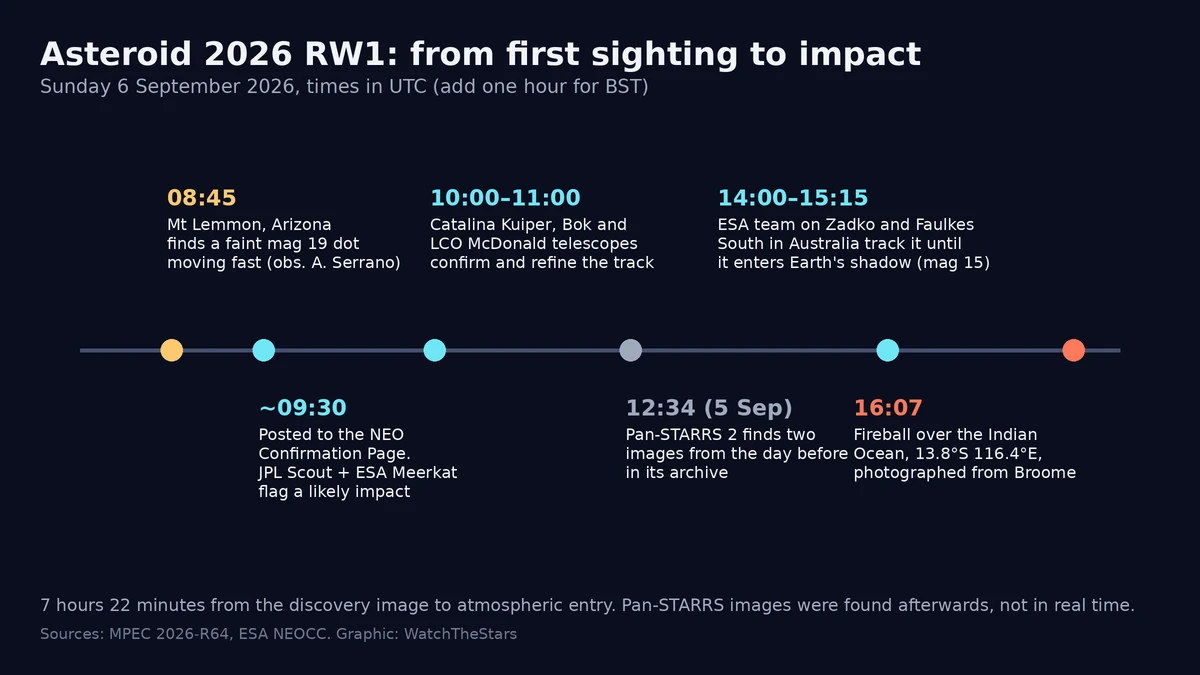
The follow-up came fast. Catalina's own Kuiper telescope, the Bok telescope at Kitt Peak and a Las Cumbres Observatory telescope in Texas all measured it before noon. Pan-STARRS 2 in Hawaii then searched its archive and found two images from the previous day, 5 September, which stretched the measured track from hours to more than a day and tightened the impact prediction to under a kilometre and under a second. Finally an ESA team using the Zadko telescope in Western Australia and the Faulkes Telescope South at Siding Spring tracked it through the last two hours, until at about 15:15 UTC the asteroid passed into Earth's shadow and simply disappeared. It was magnitude 15 by then, less than an hour from impact.
That whole chain, from a survey camera in Arizona to a prediction good to a second, ran on a Sunday with no special effort. It is what the planetary defence network is for, and it now does it routinely.
Why 2026 RW1 Is the First Aten Asteroid Caught Before Impact
2026 RW1 is the first Aten-group asteroid ever found before it hit Earth, a point first made by Adrien Coffinet on the Minor Planet Mailing List and reported by EarthSky. All 12 previous predicted impactors were Apollo asteroids.
The difference is where the orbit sits. An Aten asteroid has an average distance from the Sun of less than 1 astronomical unit, so it spends most of its year inside Earth's orbit. An Apollo asteroid averages more than 1 AU and spends most of its time outside. The Minor Planet Center's orbit for 2026 RW1 has a semi-major axis of 0.94 AU, a period of 0.92 years and an inclination of just 1.4°, so it was circling the Sun almost in Earth's own plane, a little inside Earth's track, and caught us up from behind.
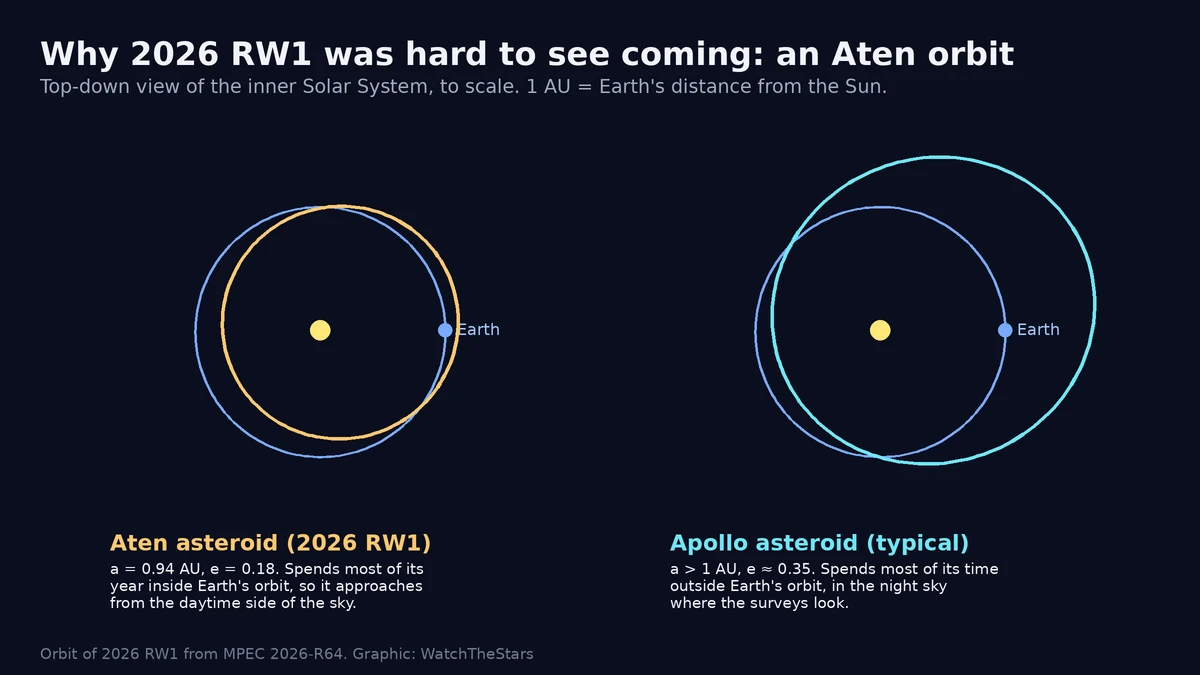
That matters for detection. Survey telescopes work at night, looking away from the Sun. An asteroid approaching from inside Earth's orbit spends its approach in the daytime sky, or low in twilight, and only becomes observable when it has almost arrived. This is the same blind spot that let the Chelyabinsk asteroid arrive unseen in 2013. It is why ESA is building the NEOMIR mission to watch that sunward gap from space, and why 2026 RW1, small as it was, is a first worth noting.
Every Asteroid Detected Before Impact: The Full List of 13
Thirteen asteroids have been discovered in space before hitting Earth, all since 2008. Every one was small, between about 0.7 and 5 metres across, and none caused damage. The warning times run from under two hours to about 21.
| # | Asteroid | Impact date (UTC) | Where it fell | Size | Warning |
|---|---|---|---|---|---|
| 1 | 2008 TC3 | 7 Oct 2008, 02:46 | Nubian Desert, Sudan | ~4 m | ~20 h |
| 2 | 2014 AA | 2 Jan 2014, ~03:06 | Atlantic Ocean | ~3 m | ~21 h, but tracked for only 70 min; impact worked out afterwards |
| 3 | 2018 LA | 2 Jun 2018, 16:44 | Botswana | ~3 m | 8 h |
| 4 | 2019 MO | 22 Jun 2019, 21:25 | Caribbean, south of Puerto Rico | ~5 m | 14 h |
| 5 | 2022 EB5 | 11 Mar 2022, 21:22 | Norwegian Sea, near Jan Mayen | ~1 m | 2 h |
| 6 | 2022 WJ1 | 19 Nov 2022, 08:27 | Ontario, Canada | ~1 m | 3.5 h |
| 7 | 2023 CX1 | 13 Feb 2023, 02:59 | English Channel / Normandy | ~1 m | 7 h |
| 8 | 2024 BX1 | 21 Jan 2024, 00:33 | West of Berlin, Germany | ~1 m | 3.5 h |
| 9 | 2024 RW1 | 4 Sep 2024, 16:39 | Luzon, Philippines | ~1 m | 11 h |
| 10 | 2024 UQ | 22 Oct 2024, 10:54 | Eastern Pacific | ~1 m | Recognised as an impactor only after it fell |
| 11 | 2024 XA1 | 3 Dec 2024, 16:15 | Yakutia, Siberia | ~0.7 m | 10 h |
| 12 | 2026 JN4 | 15 May 2026, 13:44 | Arafura Sea, north of Australia | ~1 m | 5.5 h |
| 13 | 2026 RW1 | 6 Sep 2026, 16:07 | Indian Ocean, NW of Australia | ~0.8 m | 7 h 22 min |
Sizes and times from ESA's NEOCC past-impactors list and the Minor Planet Center. Four of the 13 dropped meteorites that were later picked up: Sudan in 2008, Botswana in 2018, Normandy in 2023 and Berlin in 2024.
The pattern in the dates tells the real story. Two predicted impactors in the first ten years of trying, then eleven in the eight years since 2018. That is not because more rocks are falling. It is because Catalina, Pan-STARRS, ATLAS and the amateur and professional follow-up network have got faster, and because Scout and Meerkat now turn three positions into an impact probability within minutes rather than hours. If you enjoy the smaller version of this story, our guide to the next meteor shower in the UK covers the dust that arrives on a schedule instead.
Asteroid 2023 CX1: The One the UK Actually Saw
Number seven on that list is the one British readers may remember. Asteroid 2023 CX1 was found by Hungarian astronomer Krisztián Sárneczky at the Piszkéstető station of Konkoly Observatory late on the evening of 12 February 2023, and within a couple of hours it was clear it would hit. It entered the atmosphere at 02:59 UTC on 13 February over the Normandy coast, and because the prediction was so precise, people were outside waiting for it.
The fireball was seen from southern England, Wales, France, Belgium, Germany and the Netherlands, and the International Meteor Organization collected more than 80 reports. Videos went online within minutes. Meteorites were found a few days later near Saint-Pierre-le-Viger in Normandy. It remains the only predicted impact that has been visible from the UK, and a good example of what seven hours' notice buys you: a chance to get a camera out.
If you ever see something like it, a bright fireball that lasts several seconds and fragments, report it to the UK Fireball Alliance or the International Meteor Organization. Cameras across the country now record fireballs automatically, and a good visual report can help pin down whether anything reached the ground. It is also worth checking the ISS passes tonight page first; a slow, steady point of light crossing the sky in a few minutes is the space station, not a rock.
Could an Asteroid Hit the UK With Only Hours' Warning?
An asteroid the size of 2026 RW1 could come in over the UK with a few hours' warning, and it would do nothing worse than give people a fireball to photograph. Rocks under about 10 metres across break up high in the atmosphere. The energy goes into light and a sonic boom. At the size of 2026 RW1, even the boom is unlikely to reach the ground.
The rocks that matter are bigger and rarer. Chelyabinsk in 2013 was about 20 metres wide, arrived from the direction of the Sun with no warning at all, and its shockwave injured around 1,500 people through broken glass. Objects that size arrive perhaps once a century. Anything that could damage a city is larger still and, more to the point, brighter, which means the surveys can see it years or decades out rather than hours. NASA's count of near-Earth asteroids over 140 metres, the size that could flatten a region, is thought to be about 40 per cent complete, and the Vera C. Rubin Observatory in Chile, which began its ten-year survey in 2025, is expected to find most of the rest.
For the UK, then. Small rocks: yes, and one already has, over the Channel in 2023. Dangerous rocks: the warning would be years, not hours, for anything that came from the night side, and the remaining gap is the sunward approach that 2026 RW1 used. That gap is being closed from space over the next decade. In the meantime, what 7 hours 22 minutes of warning actually gave us on 6 September was a photograph from 780 km away, a precise impact point in the middle of the sea, and a 13th line on a list that is getting longer faster than it used to.
Kit for watching the sky, not the asteroids
Kit we've reviewed in full
Nothing you can buy will show a metre-wide rock in space. What binoculars and a small telescope will show you is where these things come from: the asteroid belt's brightest member Vesta, the craters they left on the Moon, and the meteor showers that are the same story on a smaller scale.
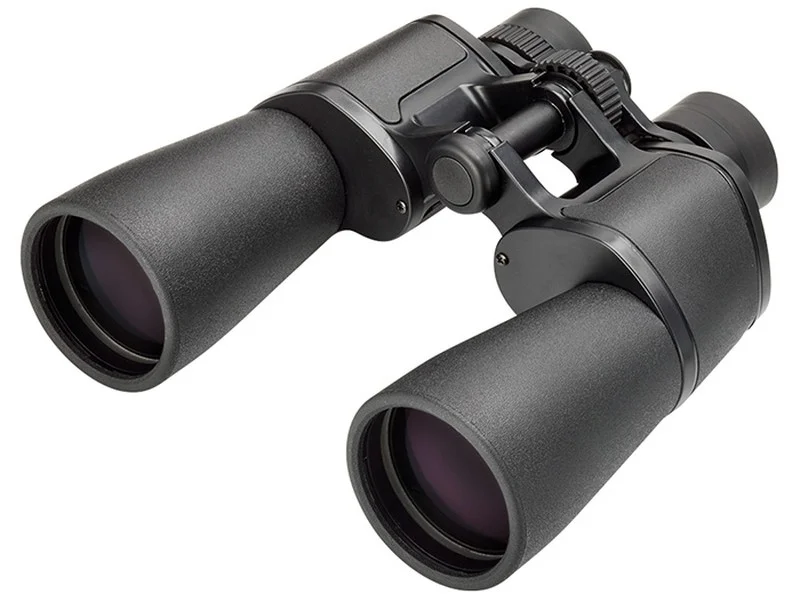
Wide enough for meteor and fireball watching on a shower night, and enough light grasp to pick out Vesta as a star-like point when it is near opposition.
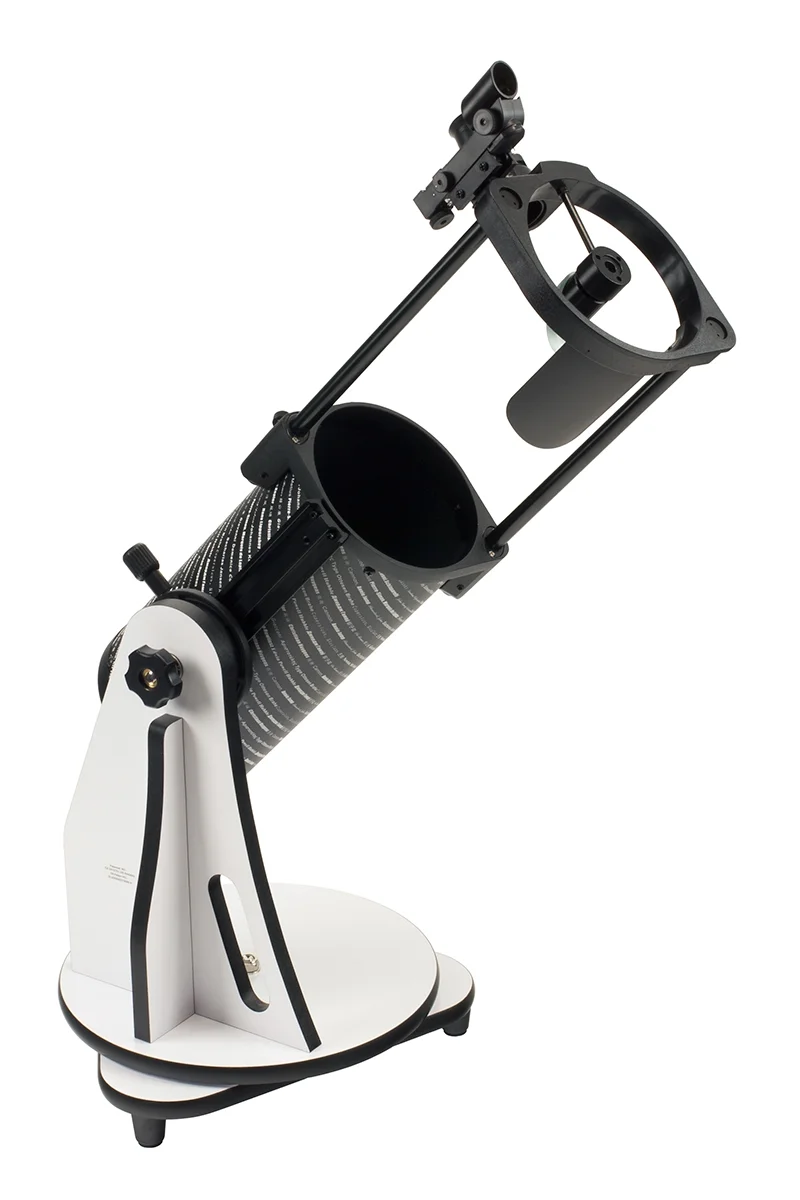
The Moon's terminator at 100× is a record of four billion years of impacts. This is the cheapest telescope that shows the small craters properly.
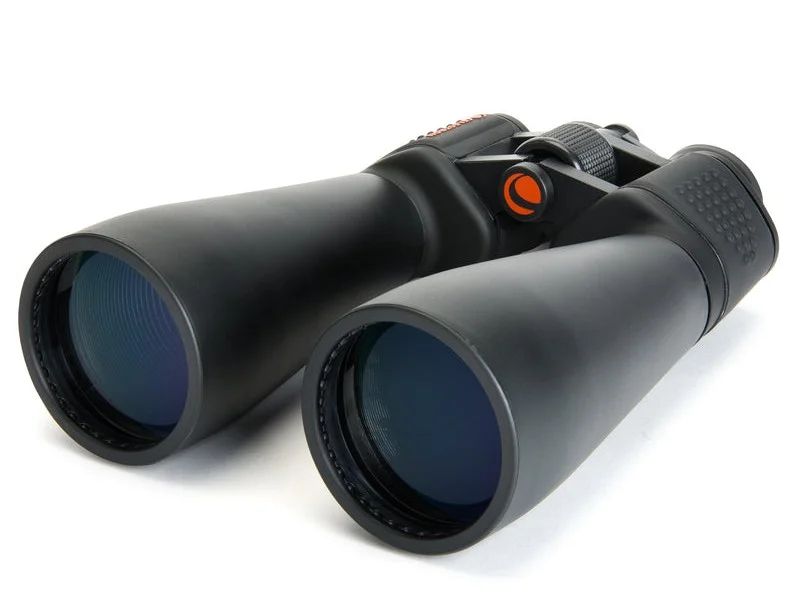
For hunting the fainter asteroids at opposition and sweeping the Milky Way. Mount it on a tripod; at 15× it is too heavy to hand-hold for long.
Affiliate links: you pay the same price, we earn a small commission that helps keep WatchTheStars free.
For the rocks you can see, Vesta is a binocular object every time it comes to opposition, and asteroid 2026 JH2 passed closer than the Moon in May and was tracked by amateur telescopes across the country. The bigger question, what happens when something the size of the Chicxulub impactor comes back, is one the surveys are now equipped to answer decades in advance. If you are new to all this, our stargazing for beginners guide is the place to start, and what you can see in the sky tonight will tell you whether it is worth going out. Next month's Orionids meteor shower is the same physics at a friendlier scale: grains of Halley's Comet, about 20 an hour from a dark site, and no need for a warning.
Sources:
- MPEC 2026-R64: 2026 RW1 — Minor Planet Center (discovery circumstances, observations, orbit)
- 2026 RW1 — ESA Near-Earth Object Coordination Centre (impact summary, follow-up, Broome photograph)
- Just hours before impact: a hi-tech telescope spotted an asteroid, then watched it hit Earth — BBC Sky at Night Magazine
- Small asteroid hit Earth's atmosphere Sunday near Australia — EarthSky (Aten-group point via Adrien Coffinet)
- Asteroid 2026 RW1 impacts Earth over Indian Ocean about 7 hours after discovery — The Watchers (table of all 13 predicted impactors)
- 2026 RW1 = CERNQ52: impact confirmed! — Global Fireball Observatory / Desert Fireball Network, Hadrien Devillepoix (the Broome photograph)
- 2023 CX1 — ESA NEOCC
- CNEOS predicts another small asteroid impact, this one over northwestern France — NASA JPL
Frequently Asked Questions
Equipment guides
Related topics
Ian ClaytonAmateur astronomer and founder of WatchTheStars.co.uk, dedicated to helping others explore the wonders of our universe. Full profile →