Key takeaways
- Six CIA papers in the Pentagon's eighth UFO release trace the CIA's flying saucer study from 29 July to 8 December 1952
- An unsigned 1952 memo from CIA Director Walter B. Smith proposed discussing the 'offensive or defensive utilization' of UFOs for psychological warfare
- On 13 October 1952 the CIA's James Q. Reber wrote that it was 'far too early' for psychological warfare planners to start planning
- The CIA's 1952 UFO paper trail ends with a request for a panel of scientists, which became the Robertson Panel of January 1953
Jump to section 8 sections
- CIA UFO Psychological Warfare: What the 1952 Files Show
- The CIA's 1952 UFO Briefing: 1,500 Reports and a White House Query
- Did the CIA Want to Use UFOs for Psychological Warfare?
- Why the CIA Called UFO Psychological Warfare 'Far Too Early'
- The CIA's 'Noise and Flare' UFO Diary Entry
- How the CIA's UFO Papers Led to the Robertson Panel
- CIA UFO Files: What the Official Descriptions Get Wrong
- Are These CIA UFO Files Newly Declassified?
In 1952 the CIA asked a question that still sounds far-fetched: could flying saucers be used as a psychological weapon? Six CIA papers published in the Pentagon's eighth UFO file release on 20 November 2026 show the idea being raised at the very top of the agency, and then knocked back by its own staff.
We've read all six, 40 pages in total. Together they form one paper trail inside the CIA's Office of Scientific Intelligence (OSI), running from 29 July to 8 December 1952. It starts with the summer's flood of sightings and ends with the request for the scientific panel that met in January 1953 as the Robertson Panel. Here's what the papers actually say, and where the government's own descriptions of them go wrong.
CIA UFO Psychological Warfare: What the 1952 Files Show
The CIA's 1952 UFO files show an agency that took the subject seriously, found no Soviet hand behind it, and worried mostly about confusion. The six records are CIA-UAP-D024 to D029. Several pages carry handwritten folio numbers from a single file, and one is filed to a "'Flying Saucers' File".
In date order:
- 29 July 1952: Ralph L. Clark, Acting Assistant Director for Scientific Intelligence, tells the Deputy Director (Intelligence) that "a special study group has been formed", with a report due about 15 August (D026).
- 14 August 1952: OSI's briefing on "Flying Saucers" (D027, with its second part filed in D025).
- Autumn 1952, undated: Director Walter B. Smith's memo to the Psychological Strategy Board, with a draft National Security Council (NSC) paper (D025).
- 13 October 1952: James Q. Reber's memo saying psychological warfare planning is "far too early" (D028).
- 28 October 1952: an official diary entry on "noise and flare" (D029).
- 1 to 8 December 1952: the request for a panel of scientists, and its return after a committee decision on 4 December (D024).
The trigger was the summer of 1952. Outside context: radar and visual sightings over Washington National Airport on the weekends of 19–20 and 26–27 July made front pages across the US. The briefing itself mentions only "recent Washington sightings". Our post on the 1952 MIT Lincoln Lab flying saucer tape covers the same anxious year from the Air Force side.
The CIA's 1952 UFO Briefing: 1,500 Reports and a White House Query
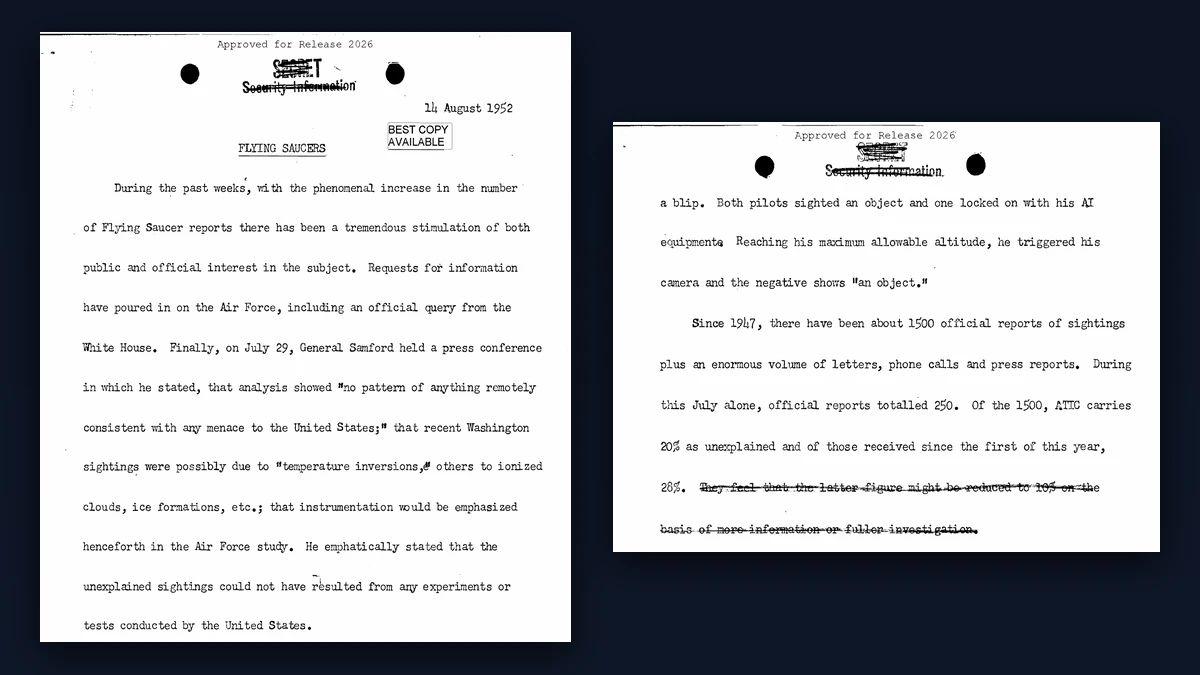
The CIA's main UFO briefing of 1952 was given on 14 August. It opens with the pressure the Air Force was under: "Requests for information have poured in on the Air Force, including an official query from the White House." It then quotes General John Samford's 29 July press conference, where he said analysis showed "no pattern of anything remotely consistent with any menace to the United States".
The numbers are the ones the press picked up, and they're on the page exactly as reported:
- About 1,500 official reports since 1947, "plus an enormous volume of letters, phone calls and press reports".
- 250 in July 1952 alone.
- 20% unexplained overall by the Air Technical Intelligence Center (ATIC), and 28% of those received since the start of 1952. A typed sentence suggesting the 28% "might be reduced to 10%" with fuller investigation is struck through.
That one-in-five figure matches what Blue Book's chief told a Boston audience in March that year, in Edward Ruppelt's 1952 talk. The briefing's history goes back to the Swedish ghost rockets of 1946 and to Kenneth Arnold, who in June 1947 "reported nine discs flying in formation past Mount Rainier at an estimated speed of 1000 miles per hour." That speed is the CIA's figure, not necessarily Arnold's own. From there it walks through the Air Force's own investigations, which began with the reports in our post on the 1948 Project Sign report.
Two lines matter for what came next. The briefing says plainly: "We make no recommendations of action." And on visitors from space it finds "no shred of evidence to support this theory at present." It also warns that outside knowledge of the CIA's interest "carries the risk of making the problem even more serious in the public mind than it already is". Secrecy about the CIA's own interest runs through every paper in the set.
Did the CIA Want to Use UFOs for Psychological Warfare?
The CIA's director did propose talking about it. CIA-UAP-D025 opens with a memo on Office of the Director letterhead from Walter B. Smith to the Director of the Psychological Strategy Board, subject "Flying Saucers". Outside context: the Psychological Strategy Board was set up by President Truman in 1951 to coordinate US psychological operations. A diary entry in the same set refers to briefing the CIA director "in his capacity as Chairman of PSB".
Smith writes that he is "today transmitting to the National Security Council a proposal" which concludes that UFOs "appear to have implications for psychological warfare as well as for intelligence and operations". Then comes the line that gives this post its title:
"I suggest that we discuss at an early board meeting the possible offensive or defensive utilization of these phenomena for psychological warfare purposes."
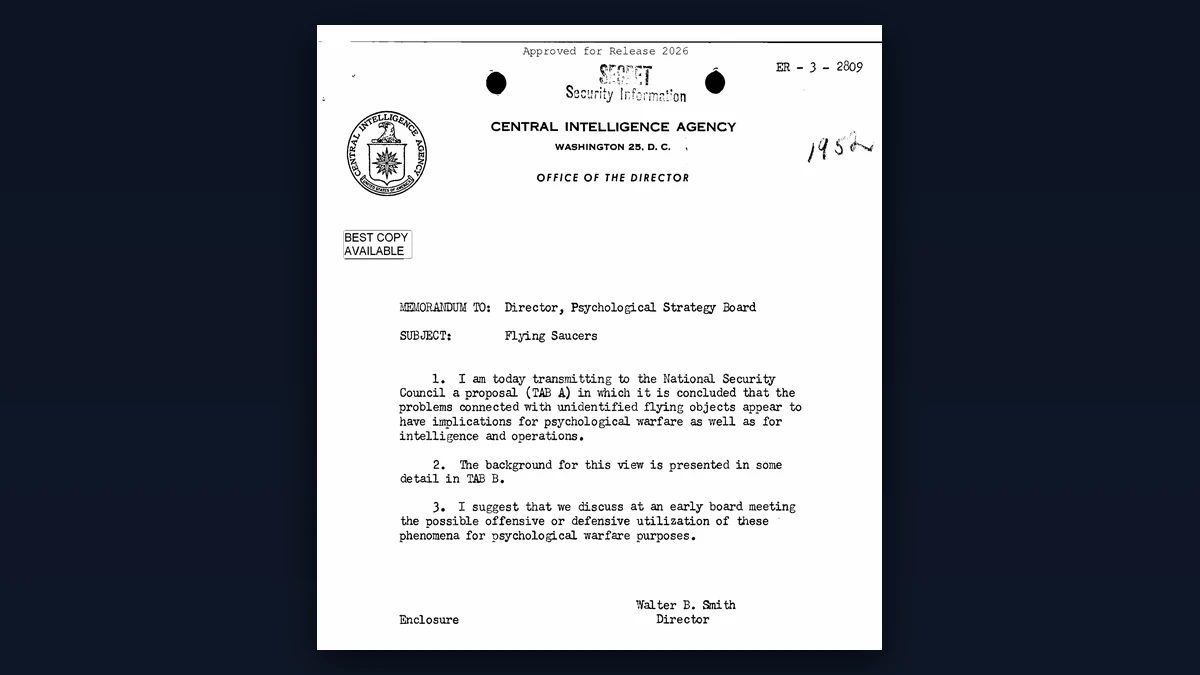
The memo is undated and unsigned, with "1952" written in by hand. Its Executive Registry number is lower than that of Reber's 13 October memo, so it was most likely written in late September or early October.
The study attached to it explains the thinking. OSI listed the "operational" problems first. One was telling UFOs apart from real enemy rockets or planes in an attack. The other was deciding "what if any utilization should be made of these phenomena by US psychological warfare planners and what, if any, defenses should be planned in anticipation of Soviet attempts to utilize them." So the worry ran both ways: could America use the saucer scare, and could Moscow?
On the Soviet side OSI found nothing. A draft letter to the Secretary of Defense in the same bundle says the CIA could find no basis for estimating Soviet intentions to use the phenomena, and notes: "The Soviet Press has been silent on the subject -- which is in itself provocative --".
Scan the skies yourself
Kit we've reviewed in full
The CIA's 1952 analysts kept running into the same problem: reports with no detail. A pair of binoculars turns a vague light into an aircraft, a planet or a satellite within seconds.
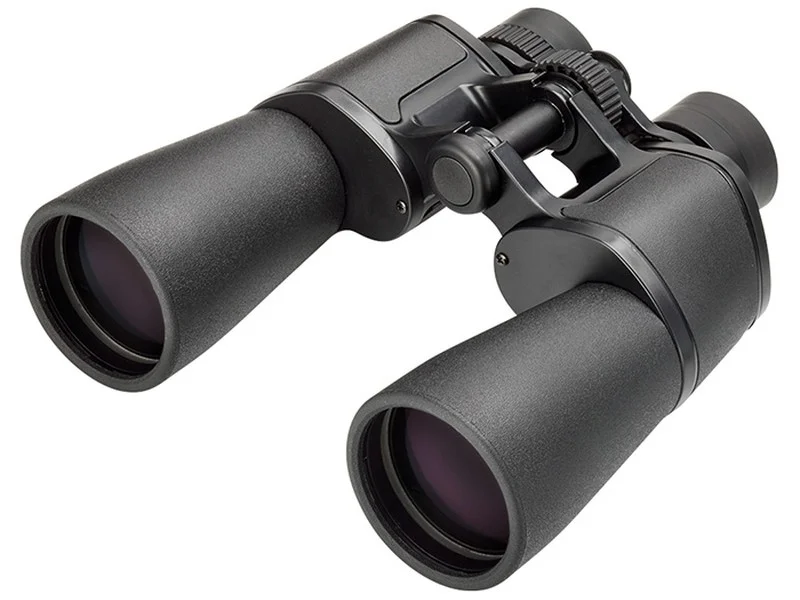
Bright, light and quick to aim, so you can get on a moving light before it's gone.
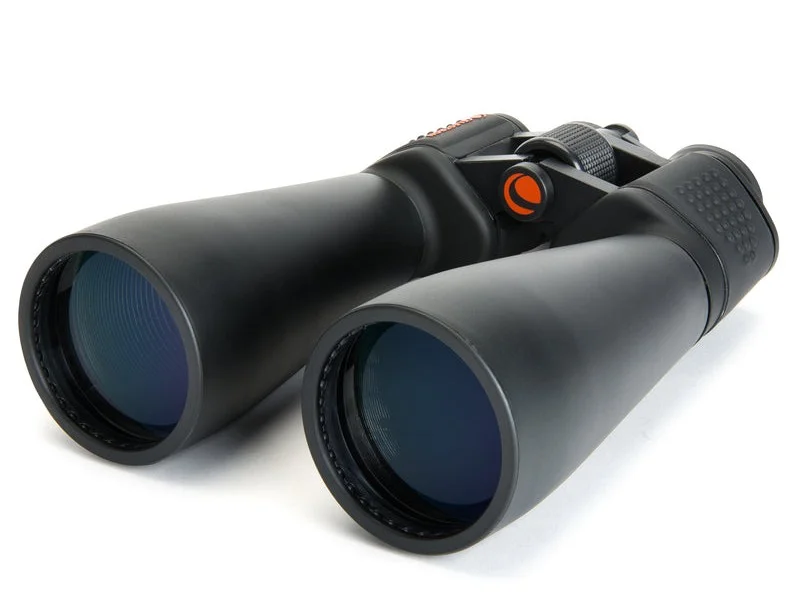
Pulls in distant aircraft lights and planets. Best on a tripod at 15×.
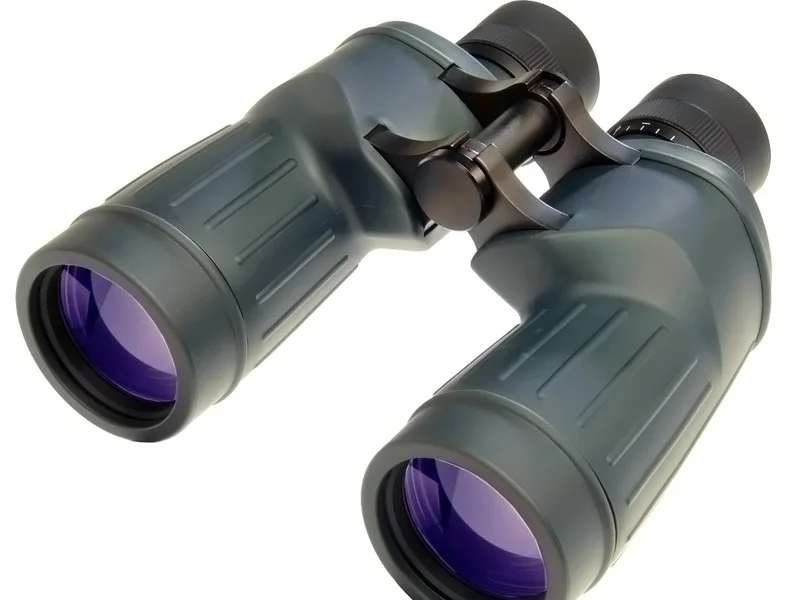
Crisp, high-contrast optics that help you tell a steady planet from a blinking aircraft.
Affiliate links: you pay the same price, we earn a small commission that helps keep WatchTheStars free.
Why the CIA Called UFO Psychological Warfare 'Far Too Early'
James Q. Reber, the CIA's Assistant Director for Intelligence Coordination, set out a cooler view in a SECRET memo to the Deputy Director (Intelligence) dated 13 October 1952 (CIA-UAP-D028). The Air Force watched saucers, he wrote, because they "might conceivably be an attack". The bigger fear was a decoy: "the enemy might take advantage of the confusion created by the Flying Saucers to use at his convenience some air weapon against the United States."
OSI's review "does not lead to the conclusion that the saucers are USSR created or controlled", Reber wrote. His conclusions, signed in ink, include:
"It is far too early in view of the present state of our knowledge regarding Flying Saucers for psychological warfare planners to start planning how the United States might use U.S. Flying Saucers against the enemy."
He added that public policy "to reduce or restrain mass hysteria" should wait for a National Intelligence Estimate. That's the same worry about public reaction, not alien craft, that runs through the CIA's December 1952 memo on Britain and R.V. Jones.
The CIA's 'Noise and Flare' UFO Diary Entry
The CIA's "noise and flare" entry is item 9c in an official diary for 28 October 1952 (CIA-UAP-D029). It's initialled "LEB", which matches Loftus E. Becker, the CIA's Deputy Director (Intelligence) at the time (outside context: the page shows only the initials). It's the line that has drawn most attention since the release, and it's worth reading in full:
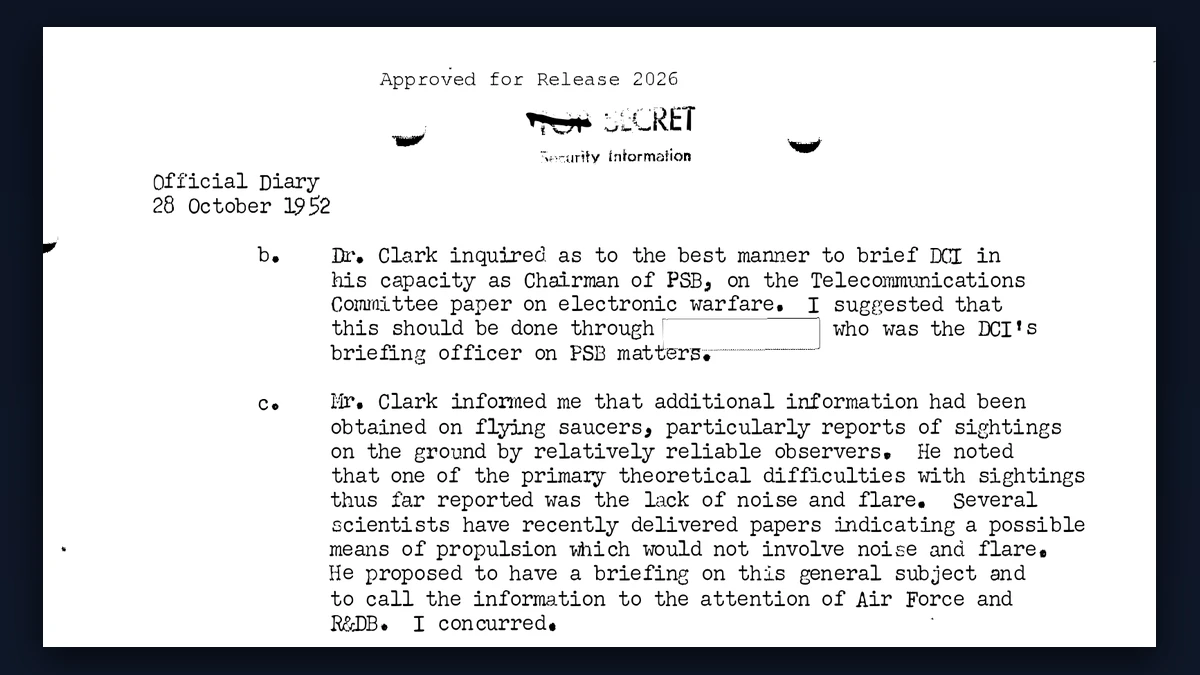
"Mr. Clark informed me that additional information had been obtained on flying saucers, particularly reports of sightings on the ground by relatively reliable observers. He noted that one of the primary theoretical difficulties with sightings thus far reported was the lack of noise and flare. Several scientists have recently delivered papers indicating a possible means of propulsion which would not involve noise and flare. He proposed to have a briefing on this general subject and to call the information to the attention of Air Force and R&DB. I concurred."
Three cautions. This is an official named Clark, probably Ralph L. Clark of OSI, reporting what scientists' papers indicated. It isn't a CIA finding, and no scientist or paper is named. "Sightings on the ground" most likely means sightings made from the ground, but the wording is ambiguous, and nothing here describes landings. And the diarist agreed only to a briefing.
How the CIA's UFO Papers Led to the Robertson Panel
The CIA's 1952 UFO study ended with a request for scientists. In CIA-UAP-D024, H. Marshall Chadwell, Assistant Director for Scientific Intelligence, asks for approval in principle for "an Ad Hoc Panel of top-level scientists" to analyse "the available evidence on Unidentified Flying Objects" and "recommend what further action should be taken toward solution of this problem". It would be run through MIT's Center for International Studies (CENIS) for about $5,000 and would help "the O/SI Task Force which has been working on this problem in cooperation with the Air Force at the request of the DCI since 20 August 1952."
The memo itself has no date, but its routing slips do: 1 and 2 December 1952. The approval boxes are blank. A slip dated 5 December sends it back "for action in light of IAC action of 4 Dec", and it reaches the Intelligence Coordination office on 8 December.
That 4 December decision by the Intelligence Advisory Committee (IAC) is the one that convened the panel. A February 1953 IAC paper in Release 3's Robertson Panel file (CIA-UAP-002) says the report came from "the scientific panel convened as a result of the action taken by the Intelligence Advisory Committee on 4 December". The panel sat from 14 to 17 January 1953, chaired by the physicist H. P. Robertson. Its handling of the Tremonton film is in our Tremonton and Great Falls film analysis.
As for the NSC plans, there were two competing drafts. In D025 the Research and Development Board runs the research. A stray page in D027 has a different draft in which the CIA director leads. Neither was issued. The same February 1953 IAC paper says the panel's work "moved CIA to conclude that no National Security Council Intelligence Directive on this subject is warranted." Air Force UFO work carried on through Blue Book until the late 1960s, as our post on why Project Blue Book ended explains.
CIA UFO Files: What the Official Descriptions Get Wrong
The government's file descriptions for these CIA UFO papers contain four errors worth knowing about before you quote them. Each record on war.gov comes with a short description.
- D027: the description says "OSI recommended no further action". The briefing actually says "We make no recommendations of action", meaning the briefing itself made none. Within weeks OSI was drafting an NSC directive.
- D028: the author is given as "S. Q. Reber". The typed and signed name is James Q. Reber.
- D025: dated "circa 2 October 1952". The memo carries no date at all, only "1952" by hand, and it's unsigned. Its last six pages are the second part of the 14 August briefing, not October material.
- D024: called undated and "Late 1952". The routing slips date it to 1 and 2 December 1952, and show it was sent back after the IAC's 4 December decision, with its approval boxes left blank.
None of these changes the big picture, but they matter if you're citing the files. You can open every one of them in our Pentagon UFO file browser.
Are These CIA UFO Files Newly Declassified?
These CIA UFO files are newly published by the Pentagon, but not necessarily newly declassified. Reber's 13 October memo (D028) has the same text, with the same handwritten notes, as a page already in CIA-UAP-002 from the third release. Outside context: the CIA has put papers from its 1952 saucer study online before, and its own 1997 history of the agency's UFO work already described Smith's interest in psychological warfare. Every 2026 copy still carries redactions, so we can't say whether the other five add anything to earlier versions. The fair description is "re-released in 2026", not "secret files revealed".
What the papers do show clearly is the CIA's real concern in 1952. It wasn't little green men. It was a jammed warning system and a public that might panic. Most of what people report today has a simple answer too. If you see a strange light, note the time and direction, then check what you can see in the sky tonight and ISS passes tonight. Bright planets such as Venus and the space station account for a large share of UFO reports. Our UK night sky this week guide shows what's up, and stargazing for beginners is the place to start if you want to know the sky well enough to spot what doesn't belong.
Sources:
- Central Intelligence Agency, via US Department of War, PURSUE Release 8 (20 November 2026): CIA-UAP-D024, CIA-UAP-D025, CIA-UAP-D026, CIA-UAP-D027, CIA-UAP-D028, CIA-UAP-D029; originals at war.gov/ufo
- Central Intelligence Agency, CIA-UAP-002, Scientific Advisory Panel on Unidentified Flying Objects, PURSUE Release 3 (June 2026)
- Gerald K. Haines, "CIA's Role in the Study of UFOs, 1947–90", Studies in Intelligence, 1997
Header image: Walter B. Smith's memo to the Psychological Strategy Board (CIA-UAP-D025, left) and the conclusions of James Q. Reber's 13 October 1952 memo (CIA-UAP-D028, right).
Frequently Asked Questions
Equipment guides
Related topics

Ian ClaytonAmateur astronomer and founder of WatchTheStars.co.uk, dedicated to helping others explore the wonders of our universe. Full profile →