Key takeaways
- Charon is Pluto's largest moon, about 1,214 km across, which is just over half the width of Pluto itself
- Pluto and Charon circle a point in empty space between them, because Charon holds about 12% of Pluto's mass
- Charon's north pole is stained red by gas that escapes from Pluto and freezes there in the long polar winter
- Charon is about magnitude 16.4 and under 0.8 arcseconds from Pluto, so it is beyond ordinary amateur telescopes
Jump to section 8 sections
Charon: Pluto's Largest Moon
Charon is the largest of the five moons of Pluto, about 1,214 km across, which is just over half Pluto's own width. NASA calls it the largest known satellite relative to its parent body. When New Horizons flew past in July 2015 it found a red polar cap, a belt of canyons more than 1,000 km long and a smooth plain. Charon is far beyond what ordinary amateur telescopes can show.
Charon orbits 19,640 km from Pluto once every 6.39 days, about 20 times closer than our own Moon is to Earth. The two worlds are mutually tidally locked, so each always shows the same face to the other. NASA says Charon neither rises nor sets in Pluto's sky but hovers over the same spot. Their home is the Kuiper Belt, the ring of icy bodies beyond Neptune.
James Christy and Robert Harrington discovered Charon in June 1978 at the US Naval Observatory in Flagstaff, Arizona. They were not looking for moons. Christy noticed that images of Pluto were strangely elongated, with the bulge changing direction every 6.39 days, which is Pluto's rotation period. He named the moon after the ferryman who carried souls across the river Acheron in Greek myth, and NASA notes that its first four letters also match the name of his wife, Charlene.
How Big Is Charon Compared to Pluto?
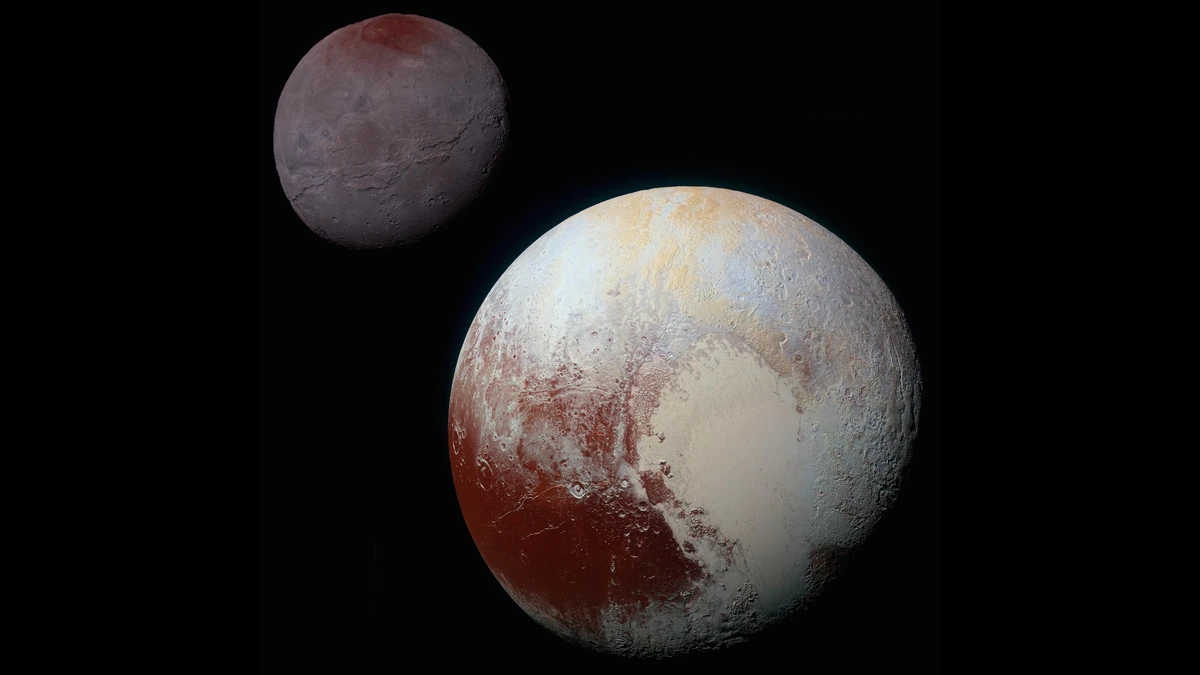
Charon is 1,214 km across and Pluto is 2,377 km, so Charon is 51% of Pluto's width. It is about 35% of the width of our Moon. It also holds about 12% of Pluto's mass, while our Moon has only about 1.2% of Earth's.
| Pluto | Charon | |
|---|---|---|
| Diameter | 2,377 km | 1,214 km |
| Mass | 100% | About 12% of Pluto's |
| Surface gravity | About 6% of Earth's | About 3% of Earth's |
| Density | About 1.85 g/cm³ | About 1.7 g/cm³ |
| Length of day | 6.39 days | 6.39 days |
Do Pluto and Charon Orbit Each Other?
Yes. Charon is so massive compared with Pluto that the point the two circle, called the barycentre, lies outside Pluto. It is about 2,100 km from Pluto's centre and roughly 950 km above its surface. Pluto swings round that empty point once every 6.39 days while Charon goes round it on a much larger loop.
A day on Pluto lasts 6.39 days, the same as Charon's orbit. That is why Charon hangs in one place in Pluto's sky. NASA also notes that the Pluto and Charon system is tipped on its side, like Uranus.
Why Is Charon's North Pole Red?
NASA says Charon's colours are not as varied as Pluto's. The standout is a dark red patch over its north pole, informally named Mordor Macula, and NASA says this polar red terrain resembles Pluto's equatorial red terrain. The colours in NASA's images are processed to bring out differences in the surface, so the red is stronger than you would see by eye.
In September 2016 Grundy and colleagues reported in Nature a model that matches what New Horizons saw. Gas escaping from Pluto's atmosphere is trapped for a time as frost at Charon's cold winter pole, and sunlight and radiation turn it into dark red, tholin-like material. Charon's strongly tilted axis and long seasons give the poles extreme temperatures, which is why the red sits there.
What Does the Surface of Charon Look Like?
In the north, cratered uplands are broken by a series of canyons. In the south they give way to rolling plains that New Horizons scientists informally named Vulcan Planum. A belt of canyons, the Macross and Serenity Chasmata, runs for at least 1,050 km. That is nearly twice the straight-line distance from London to Edinburgh, about 534 km. Serenity Chasma is a double-walled trough about 60 km wide and a few kilometres deep.

Charon's surface is rich in water ice. In October 2024 a team using the James Webb Space Telescope reported carbon dioxide and hydrogen peroxide on its northern hemisphere. The hydrogen peroxide is a sign of sunlight and radiation at work on the ice.
How Did Charon Form?
Nobody knows for certain. A 2025 study in Nature Geoscience by Denton and colleagues simulated what it calls a "kiss-and-capture". In their models Charon and Pluto collided but did not merge, because the strength of their material held them apart. They stayed temporarily connected, and Charon was then raised into a near-circular orbit and migrated outwards to where it is today. Charon survived relatively intact, which means it could be as ancient as Pluto. Neptune's moon Triton is another large moon thought to have been captured.
A July 2026 study in Nature Communications by Chen, Moon and Yin read Charon's early history from its tectonics. They found that Charon probably spun once every 14.3 hours or so early on, before tides slowed it to its present lock. The surface they studied is about 4.0 billion years old.
Can You See Charon from the UK?
No. Charon is out of reach of ordinary amateur telescopes, and you cannot see it by eye. Three things stand in the way, all worked out for October 2026 to August 2027.
- It is faint. Charon is about magnitude 16.4. A common rule of thumb says that takes about 24 inches (60 cm) of aperture, under a dark sky with steady air. Pluto, at magnitude 14.6, needs about 10 inches by the same rule.
- It is very close to Pluto. Charon stays within 0.64–0.78 arcseconds of Pluto, and the widest gap comes at the 2027 opposition. A 200 mm telescope has a resolving limit of about 0.58 arcseconds, and the atmosphere usually blurs more than that.
- Pluto is low. Pluto sits about 24° south of the celestial equator, so from the UK it never rises above about 17°, and it is lower still in the north of the country. Low air dims and blurs it.
Brightness is not the main problem, because Pluto is only about 5.5 times brighter than Charon. Closeness and steadiness are. Pluto was at opposition on 27 July 2026 and is next at opposition on 29 July 2027. This table shows when it is best placed.
| Date | Pluto due south (Birmingham) | Pluto's height then (Plymouth, Birmingham, Edinburgh) | Pluto above 10° and sky dark (Birmingham) |
|---|---|---|---|
| 5 Oct 2026 | 20:35 BST | 16°, 14°, 10° | 19:50–22:20 BST |
| 25 Oct 2026 | 18:16 GMT | 16°, 14°, 10° | 18:10–20:00 GMT |
| 15 Nov 2026 | 16:55 GMT | 16°, 14°, 10° | 17:40–18:40 GMT |
| 29 Jul 2027 (opposition) | 01:20 BST | 16°, 14°, 11° | 23:30–03:10 BST |
Dark means the Sun is more than 12° below the horizon. Edinburgh's windows are shorter: 20:10–21:10 BST on 5 October 2026 and 00:40–02:00 BST on 29 July 2027. Pluto is lost in twilight by mid-December 2026 and is in conjunction with the Sun on 25 January 2027. Everything above is under 20°, so you need a flat, clear southern horizon.
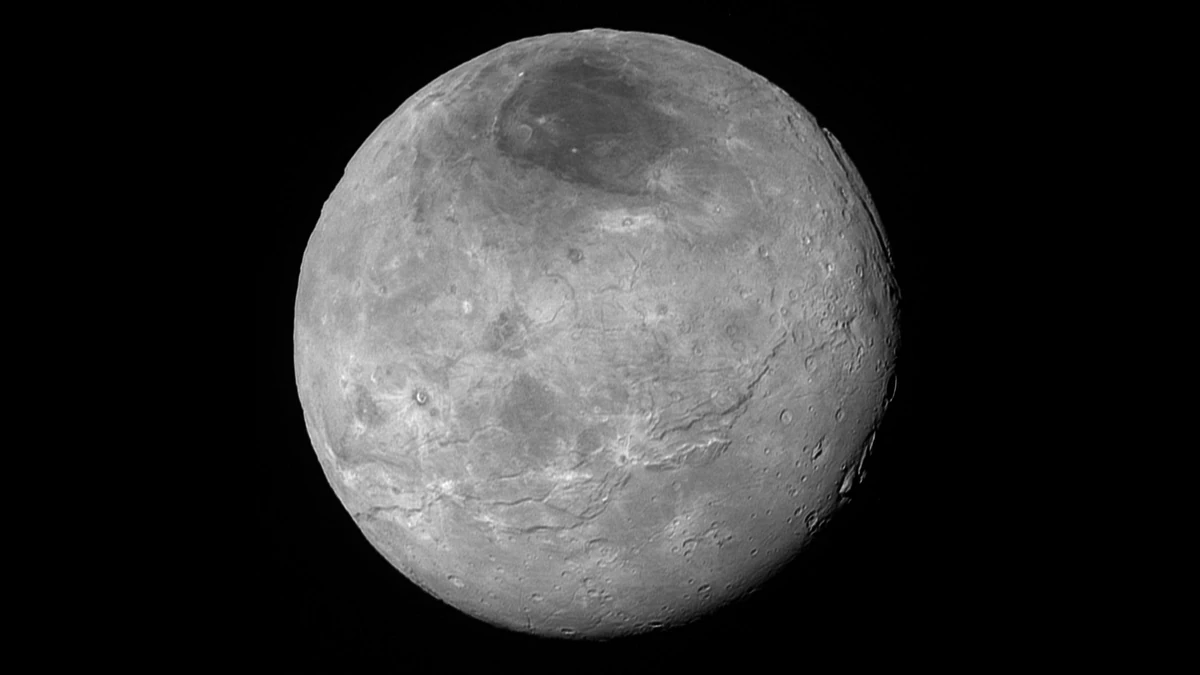
That is Charon from 470,000 km, about 11,000 times closer than Earth is to Pluto now. From Earth it is a point of light less than 0.8 arcseconds from a Pluto that is about 5.5 times brighter.
What it would take to image Charon
A professional telescope can do it. ESO's 8.2-metre Very Large Telescope has recorded Pluto and Charon as separate points using adaptive optics, which cancels out atmospheric blur. For amateurs, Universe Today reported on 30 October 2008 that a team of Italian amateurs led by Daniele Gasparri, with Antonello Medugno taking the image, had recorded Charon with a 14-inch Schmidt-Cassegrain telescope, a CCD camera and Lucy-Richardson deconvolution, a sharpening method. They described it as a first with amateur equipment. So the realistic route is a camera on a large telescope, not a visual observation, and even that is a long shot. It would need many short exposures, very steady air and careful processing.
If you would like to practise on something easier, our planetary imaging for beginners guide is a good start, and our guide on how to use a telescope covers the basics. Check what you can see in the sky tonight and the UK night sky this week for easier targets, and our UK dark sky sites map for darker skies. The astronomy events calendar lists the oppositions to come.
Missions to Charon: New Horizons and Beyond
NASA's New Horizons launched on 19 January 2006 and flew through the Pluto system on 14 July 2015. It passed about 12,500 km above Pluto's surface and about 29,000 km from Charon. It is the only spacecraft to have visited either world, and NASA lists it as an active mission as of 5 October 2026, travelling on beyond Pluto. Our interactive solar system explorer lets you follow the route from the Sun out to Pluto.
| Date | What happened |
|---|---|
| Jun 1978 | Christy and Harrington discover Charon in Flagstaff |
| 19 Jan 2006 | New Horizons launches |
| 14 Jul 2015 | New Horizons passes Charon at about 29,000 km |
| 14 Sep 2016 | Grundy and colleagues model how the red poles form, in Nature |
| 1 Oct 2024 | JWST detects carbon dioxide and hydrogen peroxide on Charon |
| 6 Jan 2025 | Denton and colleagues publish the kiss-and-capture simulations |
| 14 Jul 2026 | Chen, Moon and Yin trace Charon's early spin in its tectonics |
As of 5 October 2026 we know of no approved mission to return to Pluto or Charon.
What you need to try for Pluto, and what Charon would take
Kit we've reviewed in full
Charon is out of reach of ordinary kit. Pluto is a hard but possible target for a large telescope from the UK, and a camera is the next step towards Charon.

Sky-Watcher Skyliner 250PX FlexTube
Ten inches reaches magnitude 14.5 by the usual rule of thumb, right on the edge of Pluto's 14.6. From the UK Pluto stays below about 17°, so it also needs a clear southern horizon and steady air.

ZWO ASI662MC Colour Planetary Camera
A sensitive camera that stacks many short exposures reaches fainter than the eye. Charon would also need a large telescope, very steady air and sharpening of the stacked image, which is how the 2008 amateur attempt was reported to work.
Affiliate links: you pay the same price, we earn a small commission that helps keep WatchTheStars free.
Frequently Asked Questions About Charon
Images: NASA/Johns Hopkins University Applied Physics Laboratory/Southwest Research Institute, New Horizons mission. Main image: Charon in enhanced colour, combining blue, red and infrared images from the Ralph/MVIC camera and processed to highlight differences across the surface, taken just before closest approach on 14 July 2015 (PIA19968). The canyon image is a crop of a larger frame. Sky positions for the UK computed with Skyfield and JPL Horizons.