Key takeaways
- Io is the most volcanically active world in the solar system, with about 400 volcanoes, and Jupiter's tides are what power them
- On 27 December 2024 NASA's Juno spacecraft recorded the most powerful eruption seen on Io, across a region of about 65,000 km² giving off 140 to 260 terawatts
- Io has no shallow global magma ocean: measurements published in December 2024 fit a mostly solid interior
- From the UK, Io is a magnitude 6 dot hugging Jupiter, the hardest of the big moons to catch, and Jupiter reaches opposition on 11 February 2027
Jump to section 7 sections
Io: The Most Volcanic World in the Solar System
Io is a moon of Jupiter, about 3,643 km across, and the most volcanically active world in the solar system. About 400 volcanoes are scattered across its surface, some throwing lava fountains dozens of kilometres high, and Jupiter's gravity squeezes the whole moon so hard that the ground rises and falls by as much as 100 m. On 27 December 2024 NASA's Juno spacecraft recorded the most powerful eruption ever seen there.
Io is the innermost of the four big moons that Galileo Galilei found around Jupiter in 1610, and NASA dates its discovery to 8 January of that year. It is about 5% wider than our own Moon and orbits Jupiter at 422,000 km, a little further out than the Moon is from Earth, once every 1.77 days. Like our Moon, it always keeps the same face turned towards its planet.
The name comes from Greek mythology, where Io was a mortal woman turned into a cow during a dispute between Zeus (Jupiter in Roman mythology) and his wife Juno. It became the official name in the mid-1800s, replacing Galileo's numbering system for the moons.
Jupiter has 115 confirmed moons, but Io is the most volcanically active world of them all. Its surface averages about −155°C, yet its lava is far hotter, and its thin atmosphere is mostly sulphur dioxide.
Why Is Io So Volcanic?
Tides. NASA describes Io as caught in a tug-of-war between Jupiter's huge gravity and the smaller, precisely timed pulls of two moons that orbit further out, Europa and Ganymede. Those pulls keep Io's orbit from being a perfect circle, so Jupiter's grip on it keeps changing as it goes round. The surface bulges in and out by as much as 100 m, and all that flexing heats the inside.
Voyager 1 spotted the first signs of Io's volcanism in 1979. Galileo, which orbited Jupiter from 1995 to 2003, found that its volcanic activity may be 100 times greater than Earth's. Io even has lakes of molten lava, and some of its volcanoes fire plumes. On 28 February 2007 the New Horizons spacecraft photographed a plume from the volcano Tvashtar that rose 290 km.
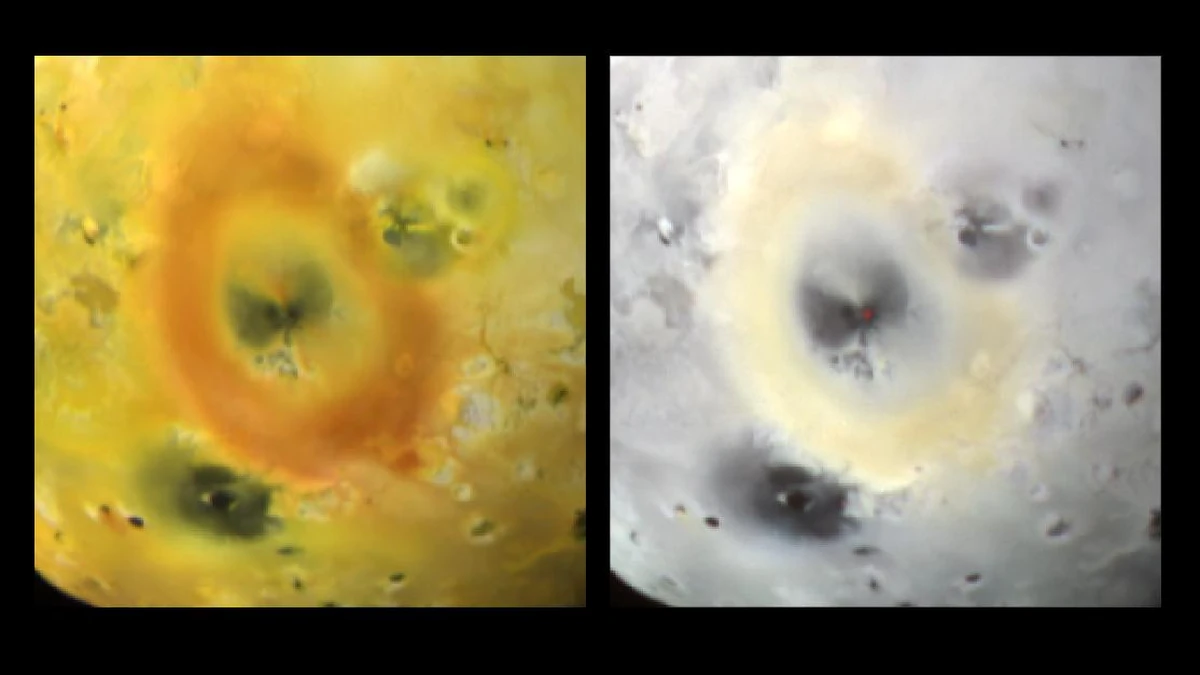
The lava itself is hot. The image below shows the volcano Pele, whose lava has been measured at up to 1,027°C. Its plume has painted a ring of sulphur more than 1,300 km across.
Io's Biggest Eruption: What Juno Saw in December 2024
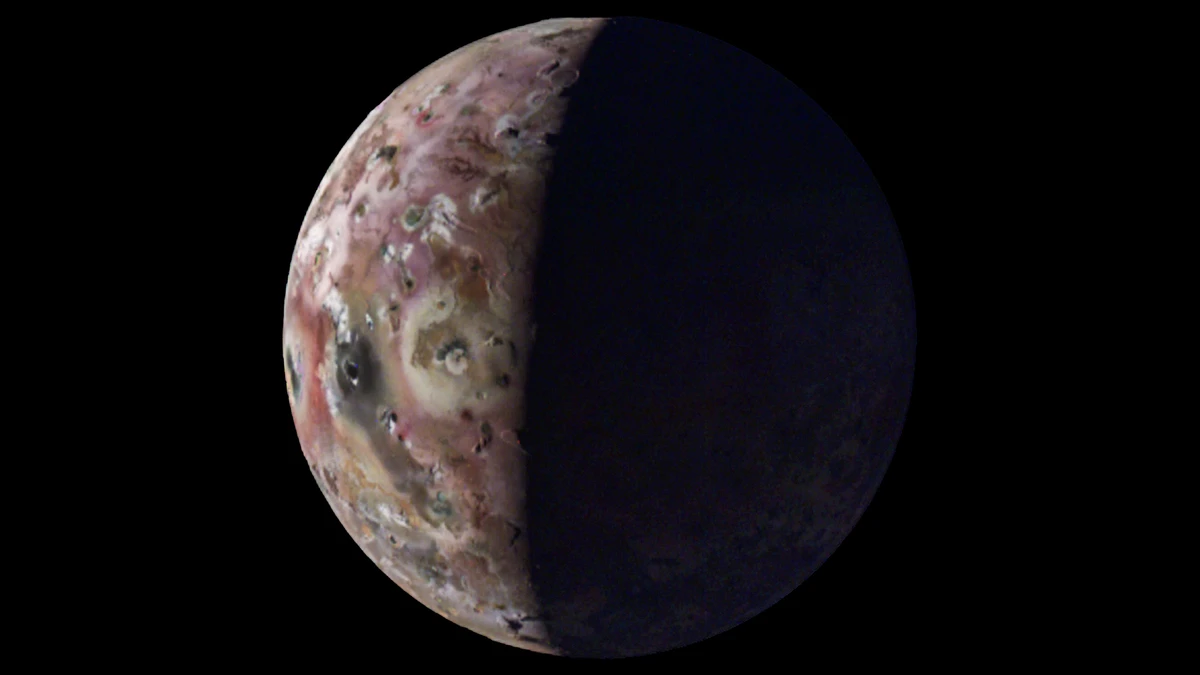
On 27 December 2024 Juno's infrared mapper, JIRAM, recorded an unprecedented volcanic event in Io's southern hemisphere. The peer-reviewed analysis, led by Alessandro Mura and published in JGR Planets on 10 January 2026, puts the affected region at about 65,000 km² near 73°S, giving off 140 to 260 terawatts. A terawatt is a trillion watts. That is more than 1,000 times the earlier estimate for the one hot spot previously known there, and it likely beats the brightest eruption recorded before, Surt in 2001, at about 80 terawatts.
NASA's first announcement, on 28 January 2025, quoted about 100,000 km² and well above 80 trillion watts, so you may see different numbers elsewhere. The figures here come from the paper. Scott Bolton, Juno's principal investigator at the Southwest Research Institute, called it "the most powerful volcanic event ever recorded on the most volcanic world in our solar system".
The brightening spread across hundreds of kilometres in step. The team reads this as possible evidence that magma reservoirs under the surface are linked, rather like a sponge.
Does Io Have a Magma Ocean?
Not a shallow global one. Scientists had suggested that so much tidal heating might have melted much of Io's interior into an ocean of magma. A study published in Nature in December 2024 tested the idea. Using two Juno flybys and older Galileo data, it measured how much Io flexes under Jupiter's pull. The flexing is too small for a shallow global magma ocean, and fits a mostly solid mantle. The authors suggest melt may rise and erupt too fast to pool.
In July 2026 NASA reported the first measurement of temperatures below Io's surface, from Juno's flybys on 30 December 2023 and 3 February 2024, when it passed within about 1,500 km. The temperature rises by more than 40°F (about 22°C) within just a few feet. The background heat flow comes to 1 to 3 watts per square metre, and across the whole moon that represents a release of energy up to 30 times Earth's average. Lead author Shannon Brown, of NASA's Jet Propulsion Laboratory, and colleagues offer two explanations: heat conducted up through the crust, or cooling lava flows under 9 to 11 m of solid crust that cover about 10% of the surface at any time.
Between the mountains, NASA compares Io's smooth ground to the Great Plains of North America, though made of very low-density material.
How Big Is Io?
Io is about 3,643 km across, about 5% wider than our Moon. Its surface gravity is about 18% of Earth's, a little stronger than the Moon's. Io is also the densest of Jupiter's four big moons, at about 3.5 grams per cubic centimetre. Europa comes next at 3.0, then Ganymede at 1.9 and Callisto at 1.8. NASA says Io has no significant water, which fits a dense, rocky world.
| Io | Our Moon | |
|---|---|---|
| Diameter | 3,643 km | 3,475 km |
| Surface gravity | 1.80 m/s² | 1.62 m/s² |
| Distance from its planet | 422,000 km | 384,400 km |
| Time for one orbit | 1.77 days | 27.3 days |
Can You See Io from the UK?
Yes, but Io is the hardest of Jupiter's four big moons to pull away from the planet. It is about magnitude 6.0 now, brightening to about 5.2 by February 2027 as Jupiter comes closer to us, which is bright enough. The problem is the glare. Jupiter is about 1,300 times brighter than Io, and Io never strays far from it. In October it reaches only 106 arcseconds from Jupiter's centre, about three Jupiter-widths. Io is more than two Jupiter-widths from the planet, and clear of its disc, only about half the time.
Jupiter is in the morning sky this October. It rises earlier every night, so by December it is up from late evening, and by February it is out all night. It reaches opposition, at its brightest and biggest, on 11 February 2027. The table gives the window when Jupiter is more than 20° up and the sky is properly dark, for Birmingham. Plymouth and Edinburgh are within about 20 minutes. The clocks go back on 25 October 2026.
| Date | Best window (Birmingham) | Due south | Height when due south (Plymouth, Birmingham, Edinburgh) |
|---|---|---|---|
| 5 October 2026 | 04:40–06:00 BST | 09:45 BST (daylight) | 55°, 53°, 49° |
| 1 November 2026 | 02:15–05:45 GMT | 07:15 GMT (daylight) | 54°, 52°, 48° |
| 1 December 2026 | 00:30–06:30 GMT | 05:25 GMT | 53°, 51°, 47° |
| 1 January 2027 | 22:25–06:45 GMT | 03:20 GMT | 53°, 51°, 48° |
| 1 February 2027 | 20:10–06:05 GMT | 01:10 GMT | 54°, 52°, 49° |
| 11 February 2027 (opposition) | 19:25–05:20 GMT | 00:25 GMT | 55°, 53°, 49° |
Jupiter is brighter than any star, so it is easy to find. On 5 October it rises in the east-north-east at about 02:20 BST from Birmingham and by 05:30 BST is roughly 28° up in the east, about three fists held at arm's length. When due south this winter it is 47° to 55° up from the three cities, well clear of the horizon murk. The what you can see in the sky tonight page and UK night sky this week show where it sits on the day, and our guide to seeing Jupiter this year has the month-by-month detail.
| Period | Io's brightness (magnitude) | Widest distance from Jupiter's centre | Width of Jupiter's disc |
|---|---|---|---|
| 5–31 October 2026 | 6.0 to 5.8 | 106 arcseconds (1.8 arcminutes) | 34–36 arcseconds |
| November 2026 | 5.8 to 5.7 | 115 arcseconds (1.9 arcminutes) | 36–39 arcseconds |
| December 2026 | 5.7 to 5.4 | 126 arcseconds (2.1 arcminutes) | 39–43 arcseconds |
| January 2027 | 5.4 to 5.2 | 133 arcseconds (2.2 arcminutes) | 43–45 arcseconds |
| 1–12 February 2027 | 5.2 | 134 arcseconds (2.2 arcminutes) | 45 arcseconds |
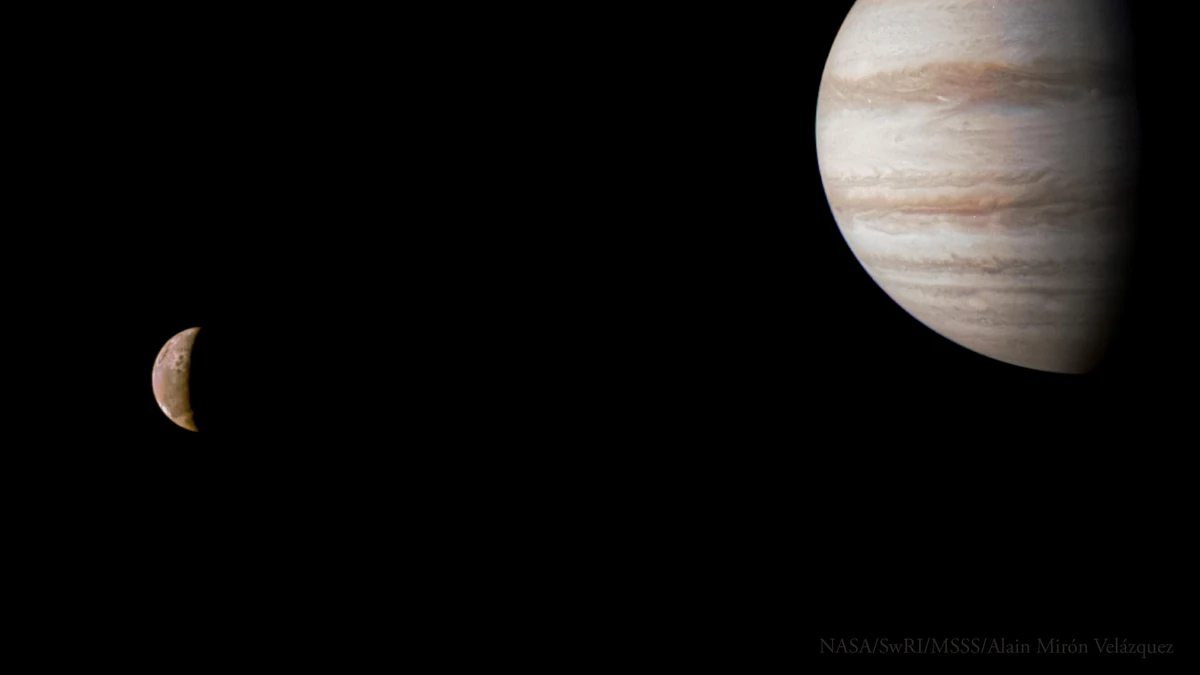
In 10x binoculars, Io at its widest in October sits about 18 arcminutes from Jupiter, a little over half the width of the full Moon to the naked eye. It is a small step from the planet's glare, so a steady view matters.
Tips for spotting Io
- Use at least 10x50 binoculars, and brace them. Rest your elbows on a wall, a gate or a car roof. Our binocular astronomy guide covers holding them steady, and the best binoculars for stargazing page compares the options.
- Time it. Io swings out to its widest point on one side or the other about every 0.9 days, so a good moment comes round on most nights. A planetarium app such as Stellarium or SkySafari shows where it is at any hour.
- Do not worry if you see three. Io is the moon most often lost, whether in the glare, behind the planet or in front of it.
- Tell the moons apart. From Jupiter outwards the order is Io, Europa, Ganymede and Callisto, so the dot nearest the planet is usually Io. A planetarium app settles any doubt.
- Watch it move. Io crosses in front of Jupiter once every orbit, for a little over two hours. Near the planet it shifts by about 16 arcseconds an hour in October, nearly half the planet's width, so a telescope shows it moving within the hour. Our guide on how to use a telescope helps if you are new to it.
- Expect a dot. Io is under 1.2 arcseconds across, even at opposition, so a small telescope will not show surface detail or volcanoes.
A small telescope is the reliable option. Our Sky-Watcher Heritage 130P review explains why it suits Jupiter, and it costs around £194 at First Light Optics. New to the sky? Try stargazing for beginners, and the astronomy events calendar for Jupiter's opposition. If your garden is bright, try our UK dark sky sites map.
Missions to Io: From Voyager 1 to Juno
NASA says most of what we know about Io comes from the Galileo spacecraft, which made a detailed study of the whole Jupiter system. The table lists the main missions and what each did at Io.
| Mission | When | What it did at Io |
|---|---|---|
| Voyager 1 | 1979 | Spotted the first signs of Io's volcanism |
| Galileo | Orbited Jupiter from 7 December 1995 to 21 September 2003 | Made a detailed study of Io, including the near-true-colour mosaic at the top of this page |
| New Horizons | 28 February 2007 | Photographed the 290 km plume from Tvashtar |
| Juno | Flybys on 30 December 2023 and 3 February 2024 | Passed within about 1,500 km, measured temperatures below the surface and recorded the December 2024 eruption |
Juno flew past the small moon Thebe on 1 May 2026. Two newer spacecraft are on their way to the Jupiter system, and neither is aimed at Io. NASA's Europa Clipper, launched on 14 October 2024, reaches Jupiter in April 2030 and targets Europa. ESA's Juice launched on 14 April 2023, reaches Jupiter in July 2031 and will orbit Ganymede. Our guide to Enceladus covers Saturn's moon of icy geysers.
What you need to see Io
Kit we've reviewed in full
Io is bright enough but sits close to a very bright planet, so it is the hardest of the big moons to catch. Steady optics and a bit of patience matter more than size.
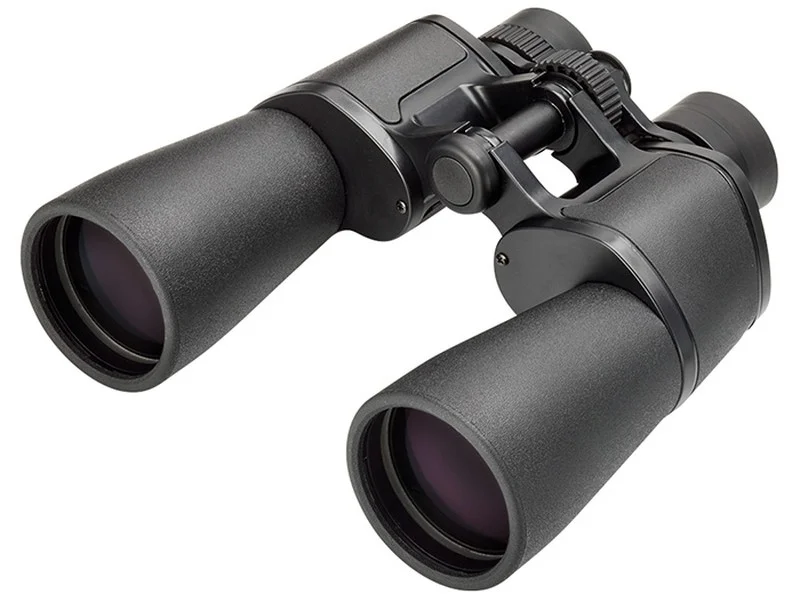
Ten times magnification is enough to separate Io from Jupiter when it is near its widest point. Brace the binoculars on a wall or car roof, and expect to catch it on some nights and not others.
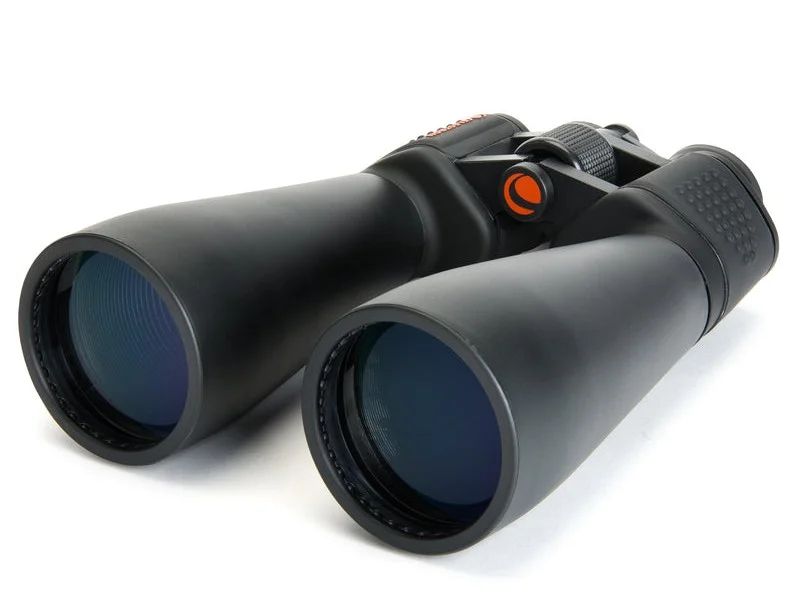
Fifteen times magnification puts Io further from the glare, which is what it needs. They are heavy, so they need a tripod to be steady enough to use.
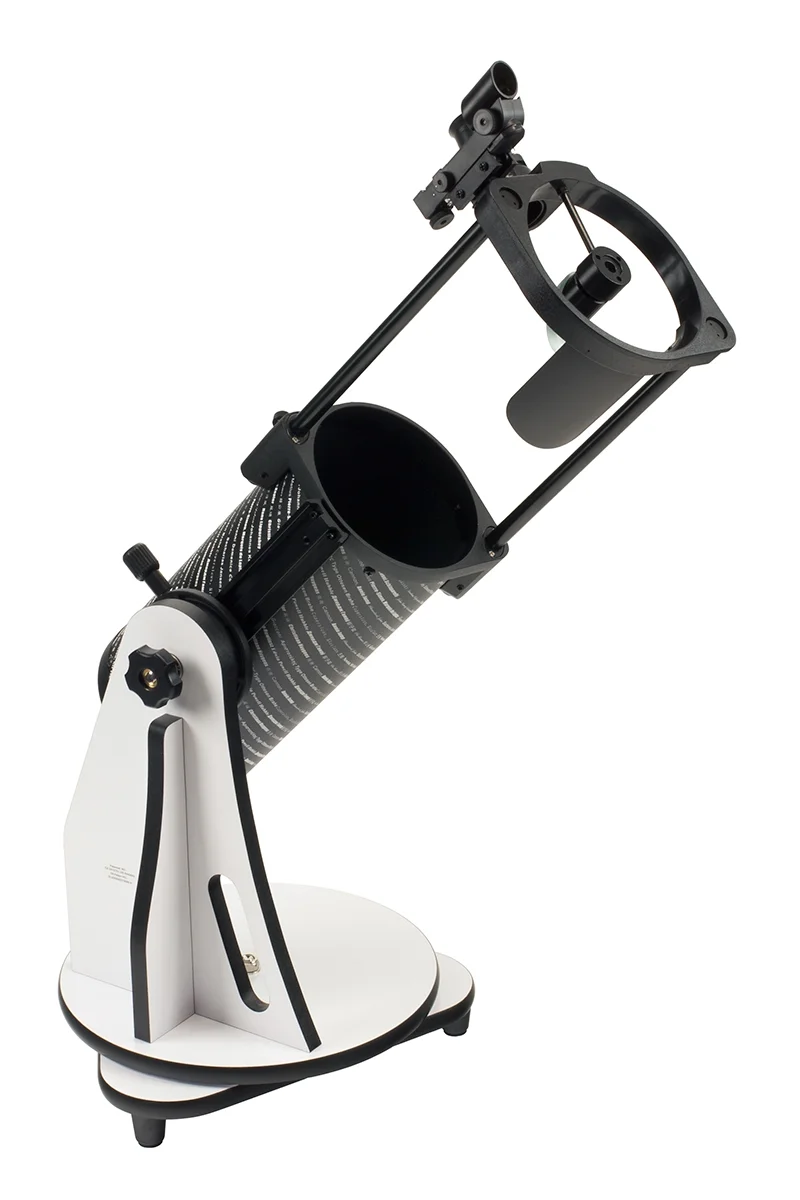
A 130 mm tabletop Dobsonian shows Io as a clean point wherever it sits and lets you watch it move against Jupiter from hour to hour, with the planet's cloud belts alongside.
Affiliate links: you pay the same price, we earn a small commission that helps keep WatchTheStars free.
Frequently Asked Questions About Io
Images: NASA/JPL/University of Arizona (Galileo), NASA/JPL-Caltech/SwRI/MSSS with processing by Gerald Eichstädt and Thomas Thomopoulos (CC BY), and NASA/JPL-Caltech/SwRI/MSSS with processing by Alain Mirón Velázquez (CC BY). Main image: a Galileo mosaic taken on 3 July 1999 from about 130,000 km, in near-natural colour made from near-infrared, green and violet filters (PIA02308). Sky positions for the UK computed with Skyfield and JPL Horizons.