Key takeaways
- Mimas is a small, icy moon of Saturn, about 396 km across, with a 130 km crater called Herschel that makes it look like the Death Star
- A 2024 study of Cassini data found a global ocean 20 to 30 km under Mimas's ice, probably less than 25 million years old
- Cassini's closest flyby of Mimas, on 13 February 2010, passed about 9,500 km from the moon
- From the UK, Mimas is about magnitude 12.9 and roughly 87,000 times fainter than Saturn, which puts it beyond most amateur telescopes
Jump to section 7 sections
Mimas: Saturn's Death Star Moon
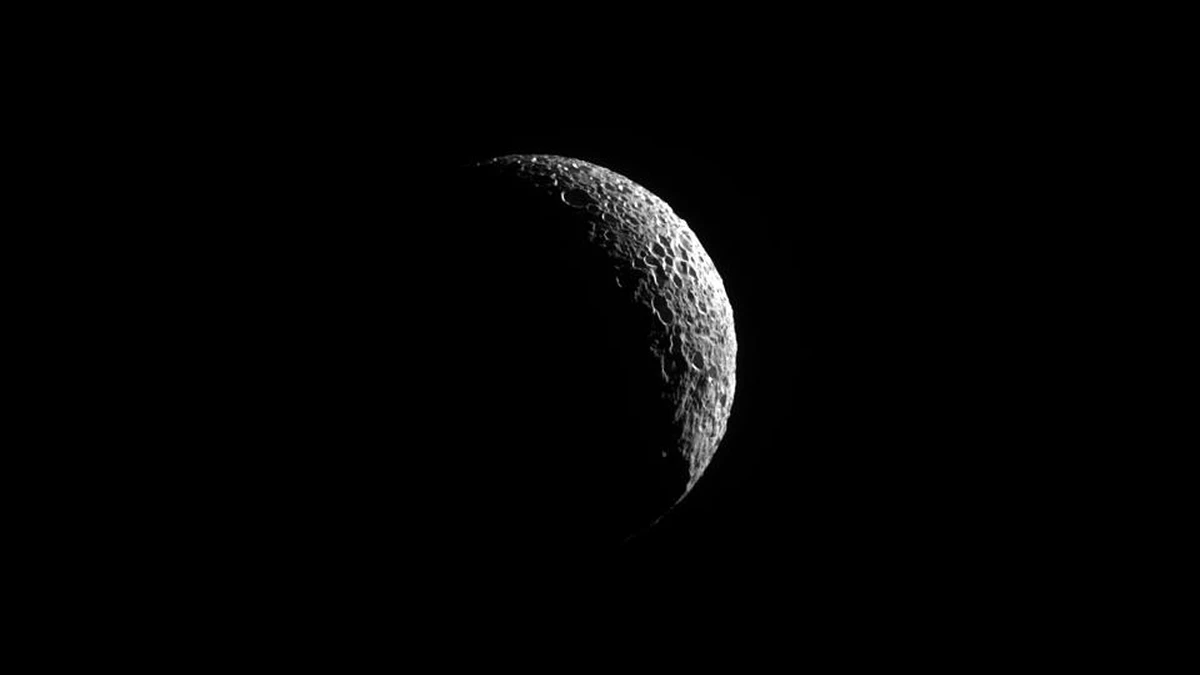
Mimas is a small, icy moon of Saturn, about 396 km across, dominated by one enormous impact crater that makes it look like the Death Star from Star Wars. Under that battered surface, a study published in 2024 found a young ocean of liquid water, which is the last thing anyone expected from such a cratered, frozen-looking world.
It is the innermost of Saturn's major moons, orbiting about 186,000 km from the planet, roughly half the distance from Earth to our own Moon. Mimas goes round once every 22.6 hours, keeping the same face turned towards Saturn. Saturn has 293 known moons, more than any other planet, and Mimas is among the nearest to the rings.
William Herschel discovered Mimas on 17 September 1789, with his 40-foot reflecting telescope. Until the Voyager spacecraft flew past, astronomers on Earth saw it as little more than a dot.
Why Does Mimas Look Like the Death Star?
The crater is called Herschel, after the moon's discoverer. It is 130 km wide, a third of the diameter of Mimas, with outer walls about 5 km high and a central peak about 6 km high. It stretches a third of the way across the face of the moon, and NASA says it makes Mimas look like the Death Star.
The likeness is chance. Star Wars came out in 1977, and the first spacecraft to reach Saturn, Pioneer 11, did not arrive until 1 September 1979. Nobody had a close view of Mimas when the film was made.
Herschel's floor has far fewer craters than the ground around it. Scientists think a pool of melted ice filled the floor during the impact and froze solid after the debris fell back, wiping out older craters. Dark streaks run down some crater walls, where dark material buried below the rim slides slowly downhill.
NASA says the impact that made Herschel probably came close to breaking Mimas apart. Shock waves from it may have cracked the opposite side of the moon.
How Big Is Mimas?
Mimas is about 396 km across on average, roughly a ninth of the width of our Moon. It is slightly oval, about 416 km along its longest axis and 382 km along its shortest. Its density is only 1.15 times that of water, so it is almost entirely water ice.
Gravity at the surface is about 0.064 m/s², under 1% of Earth's. Someone who weighs 70 kg here would read about 0.45 kg on bathroom scales there.
Does Mimas Have an Ocean?
Very probably, and it is a surprise. On 7 February 2024 a team led by Valéry Lainey published a paper in Nature, "A recently formed ocean inside Saturn's moon Mimas". They studied how Mimas's orbit shifts over time in Cassini data, a slow drift in the point where Mimas comes closest to Saturn. The best explanation was a global ocean hidden 20 to 30 km below the ice.
The surprise is that a global ocean usually shows itself through changes in the surface. As the paper puts it, Mimas "would be the most unlikely place to look for the presence of a global ocean". The answer lies in age. The authors say the ocean is likely to be less than 25 million years old and still changing, and that its top surface reached its current depth only 2 to 3 million years ago, too recently for signs of activity to have formed on the surface. Press releases quoted a narrower range of 5 to 15 million years, but the paper's own wording is "less than 25 million years".
That also helps with a puzzle NASA calls the "Mimas Test". Mimas is closer to Saturn than Enceladus and has a more elongated orbit, so it should get more tidal heating, yet its surface looks frozen solid. Any theory that explains Enceladus's geysers has to explain Mimas too. A young ocean that has not yet reached the surface is one way to do it. The result comes from orbital motion, not a direct measurement, and no spacecraft has checked it.
Why Does Mimas Look Like Pac-Man in Temperature Maps?
Cassini's infrared spectrometer mapped Mimas's temperature on 13 February 2010, and the result looked like a game character. One side of the moon is warm, near 92 K (−181°C), and the other is cold, near 77 K (−196°C), with a sharp V-shaped boundary between them. It looks like Pac-Man about to eat a dot, and Herschel Crater sits in the cold region as the dot.
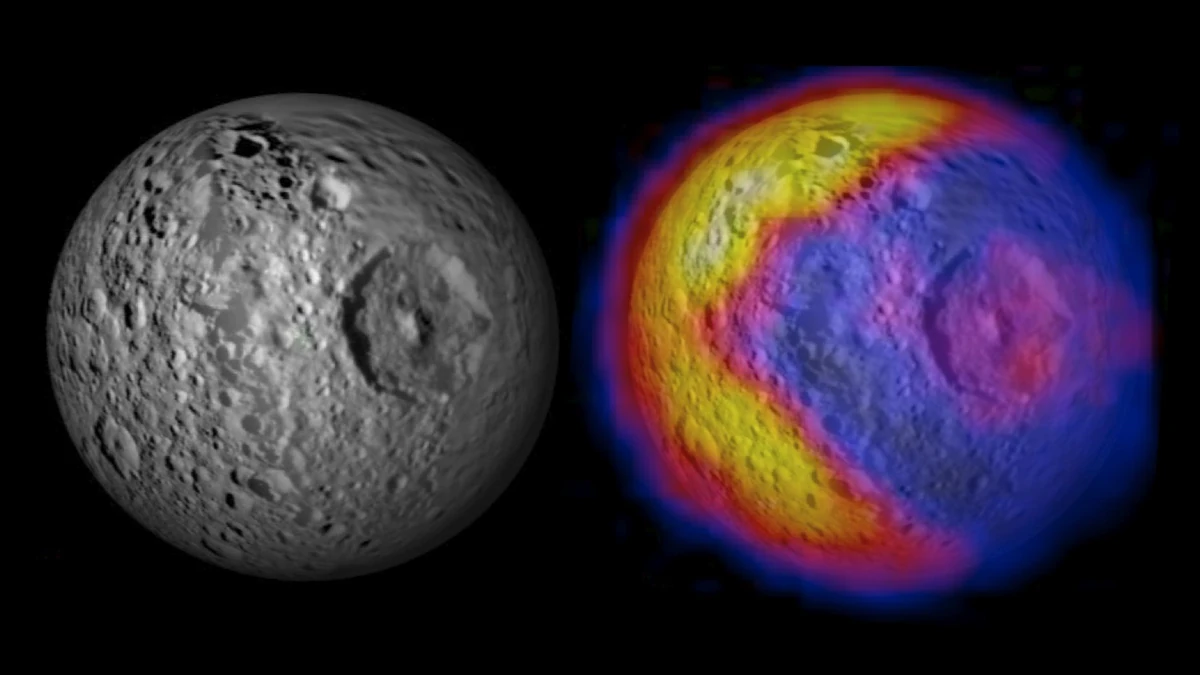
NASA's team expected a smooth gradient, warmest in the afternoon. The pattern they saw is probably due to differences in how well the surface conducts heat. In the cold part, the Sun's energy soaks into the ground instead of warming the surface. Why the surface should vary so sharply is still a mystery.
Can You See Mimas from the UK?
In practice, no. Mimas is one of the hardest moons in the solar system to see, and it is beyond most amateur telescopes. It shines at about magnitude 12.9 from October to December 2026. That would be easy on its own, but Saturn is at about magnitude 0.3 to 0.8 between now and the end of February 2027, which makes the planet roughly 87,000 times brighter than Mimas. At its furthest, Mimas is only about 30 arcseconds from Saturn's centre (an arcsecond is 1/3600 of a degree), falling to about 28 by mid-December as Saturn pulls away. Saturn's disc is about 19.7 arcseconds across and the tips of the rings reach about 22 arcseconds out, so Mimas sits only about 8 arcseconds beyond the rings, deep in the glare.
Here is how it compares with two other moons of Saturn. All the figures are for October to December 2026.
| Moon | Brightness | Furthest from Saturn | Saturn is brighter by | Kit needed |
|---|---|---|---|---|
| Titan | Magnitude 8.3 | About 200 arcseconds | About 1,300 times | Binoculars or any small telescope |
| Enceladus | Magnitude 11.7 | About 39 arcseconds | About 29,000 times | At least an 8-inch telescope |
| Mimas | Magnitude 12.9 | About 30 arcseconds | About 87,000 times | 10 inches or more, with perfect conditions |
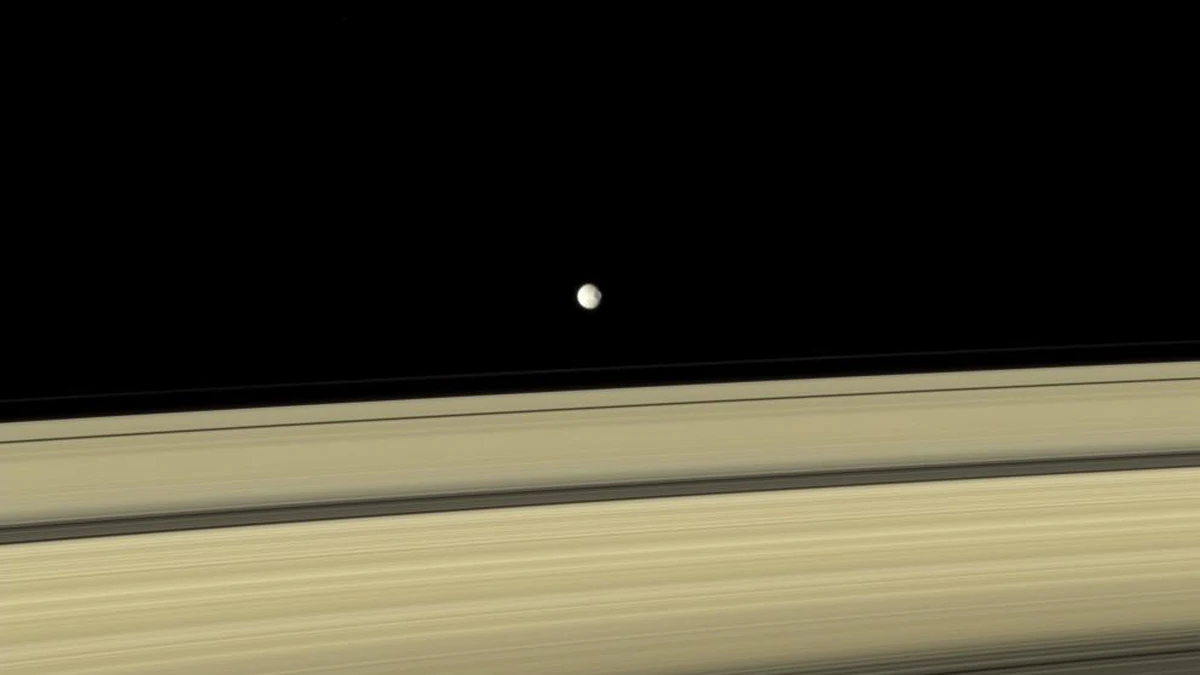
Observers' guides agree it is a very hard catch. Sky at Night says Mimas needs perfect viewing conditions, and the retailer High Point Scientific puts the minimum at 10 inches or larger, depending on the seeing. A telescope of that size is a serious bit of kit, and the air has to be steady.
Saturn reached opposition on 4 October 2026, and it is due south from the UK at about 1am BST in early October, 10pm GMT on 1 November, 8pm GMT on 1 December, 6pm GMT on 1 January and 4pm GMT on 1 February 2027. It is then between 40° and 43° up from Plymouth, 38° and 41° from Birmingham and 35° and 37° from Edinburgh. In early October it is only about 8° up in the east an hour after sunset, so wait until later. By 1 March 2027 it is about 17° up an hour after sunset and sets around 8:45pm GMT, and by April it is lost in the twilight.
If you want to try for Mimas
- Master Enceladus first. Mimas is about three times fainter than Enceladus and closer to Saturn. If you cannot yet catch Enceladus, Mimas is out of reach.
- Use the biggest aperture you have, on the steadiest night. If Saturn's rings look sharp and the Cassini Division holds still, the air is good. Our how to use a telescope guide is a good place to start.
- Catch it at its furthest. Mimas swings from one side of Saturn to the other roughly every 11 hours. A planetarium app shows where it is on the night.
- Add magnification. Around 150x spreads Saturn and the moon apart. Our telescope magnification guide shows how to work out what an eyepiece gives you.
- Hide Saturn. Nudge the planet just outside the field of view and look beside where Mimas should be.
An 8-inch Dobsonian is a long shot. Our Sky-Watcher Skyliner 200P review explains why it suits planets, and it costs around £341 at First Light Optics. If you are new to all this, start with stargazing for beginners, then check what you can see in the sky tonight and the UK night sky this week. Our UK dark sky sites map helps if streetlights are a problem. For an easier first look at Saturn's moons, Titan is the one to find first.
Missions to Mimas: Voyager and Cassini
Only Voyager 1, Voyager 2 and Cassini have sent back close-up pictures of Mimas, and no new mission to it is planned that we know of as of 5 October 2026. Cassini's closest pass was in 2010.
| Date | Mission | What happened |
|---|---|---|
| 12 November 1980 | Voyager 1 | Closest approach to Saturn. Photographed Mimas among other moons (Voyager 2 followed on 26 August 1981) |
| 13 February 2010 | Cassini | Closest-ever flyby, about 9,500 km away. Gave the Herschel mosaic and the temperature map |
| 15 September 2017 | Cassini | Mission ended with a deliberate plunge into Saturn's atmosphere |
Cassini's data is still being mined. The 2024 ocean discovery came from Cassini's measurements of Mimas's orbit, more than six years after the mission ended.
What you would need to try for Mimas
Kit we've reviewed in full
Mimas is a stretch even for experienced observers. The moon is not the problem so much as Saturn's glare beside it, so think big aperture, steady air and keeping the planet out of the field.

Sky-Watcher Skyliner 250PX FlexTube
A 10-inch Dobsonian is where Mimas stops being impossible. Even then you need very steady air, Saturn high in the sky and plenty of patience.
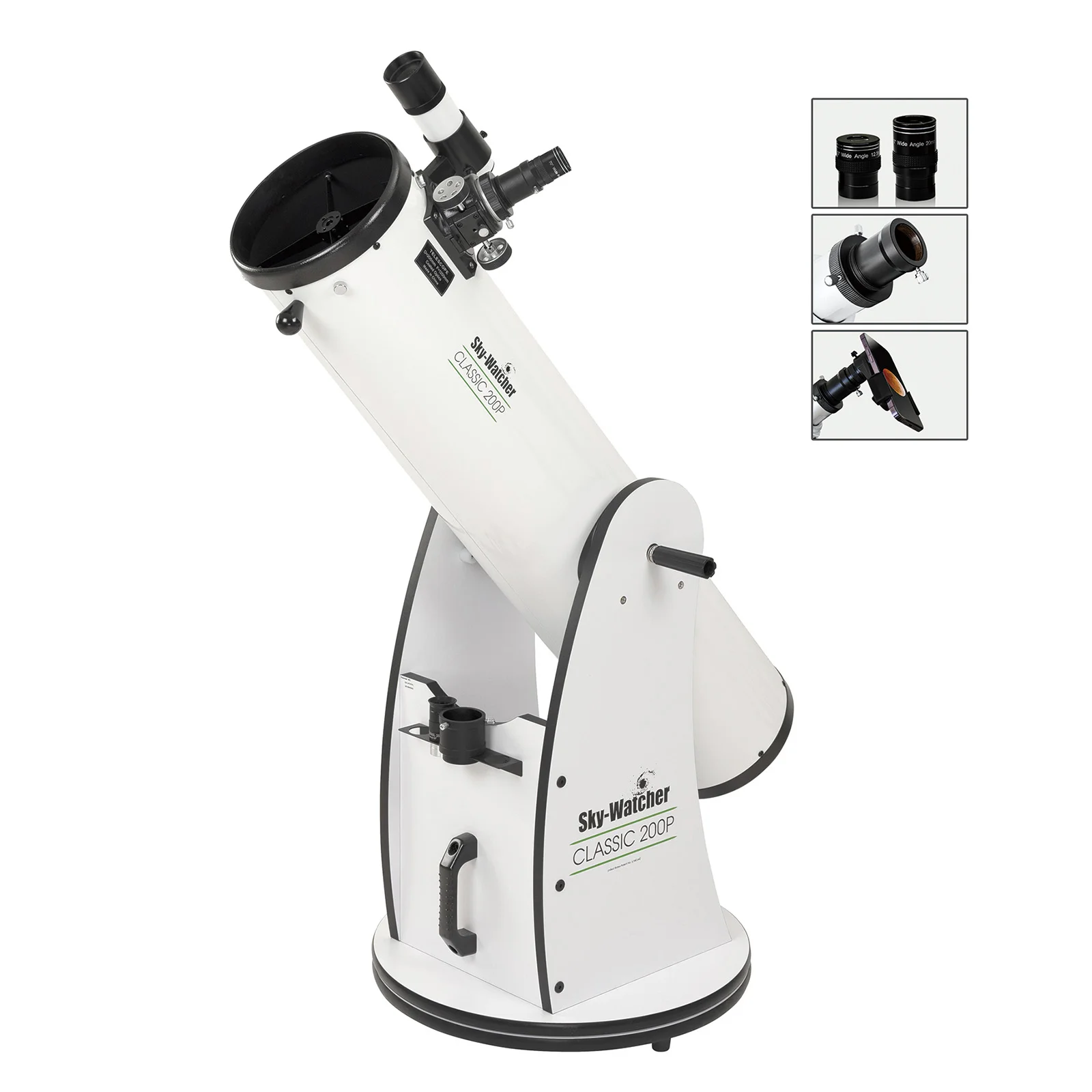
An 8-inch can show Enceladus on a good night. Mimas is about three times fainter than Enceladus and closer to Saturn, so treat it as a long shot.
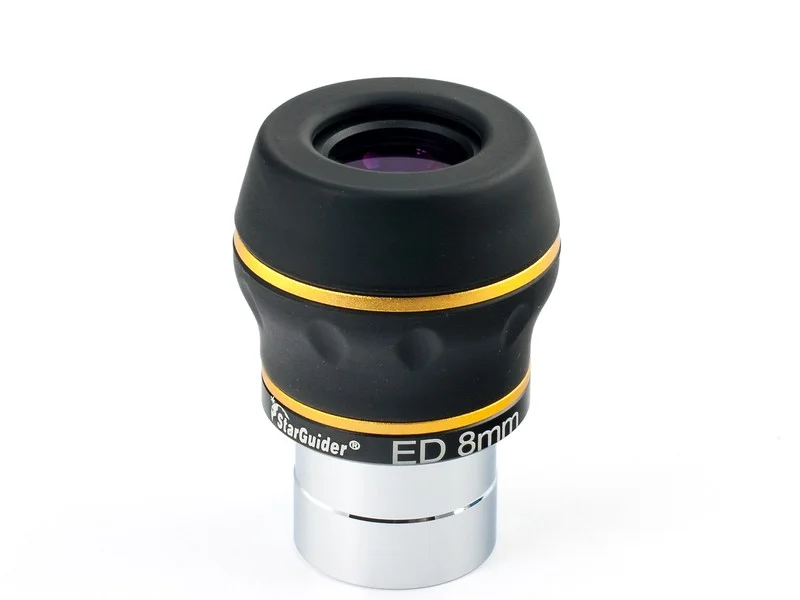
BST StarGuider 60° 8mm ED
In a 1200 mm focal length Dobsonian like the 200P or 250PX this gives 150x, enough to spread Saturn and its inner moons apart. The 60° field makes it easy to nudge Saturn out of view.
Affiliate links: you pay the same price, we earn a small commission that helps keep WatchTheStars free.
Frequently Asked Questions About Mimas
Images: NASA/JPL/Space Science Institute, NASA/JPL-Caltech/Space Science Institute and NASA/JPL/GSFC/SWRI/SSI, Cassini mission. Main image: Mimas with Herschel Crater at the right, from Cassini's closest flyby on 13 February 2010 (PIA12570). Sky positions for the UK computed with Skyfield and JPL Horizons.