Key takeaways
- Titan is Saturn's largest moon, 5,149 km across, wider than the planet Mercury and wrapped in a thick nitrogen atmosphere
- Titan has rivers, lakes and seas of liquid methane and ethane, the only liquid on the surface of any world except Earth
- Titan was visited by ESA's Huygens probe on 14 January 2005, and NASA's Dragonfly rotorcraft is targeted to launch there in a window from 5 to 25 July 2028
- From the UK, Titan is an easy target: a faint star beside Saturn in binoculars or any small telescope
Jump to section 9 sections
- Titan: Saturn's Giant Moon
- How Big Is Titan?
- Does Titan Have an Atmosphere?
- Titan's Lakes and Seas of Liquid Methane
- Does Titan Have an Ocean? The December 2025 Dispute
- Is There Life on Titan?
- When Did Huygens Land on Titan?
- Can You See Titan from the UK?
- Missions to Titan: Cassini, Huygens and Dragonfly
Titan: Saturn's Giant Moon
Titan is the largest moon of Saturn, a world of orange haze, falling rain and seas of liquid methane. It is the only moon in the solar system with a thick atmosphere, and apart from Earth it is the only world known to have liquid lying on its surface. At about −179°C it is cold enough for methane, not water, to fill the lakes.
Titan orbits about 1.22 million km from Saturn, a little over three times the distance from Earth to our own Moon, and goes round once every 15.9 days, keeping one face towards Saturn. Saturn has 293 known moons, more than any other planet, and Titan dwarfs the rest.
The Dutch astronomer Christiaan Huygens discovered it on 25 March 1655. John Herschel later gave it its name, from the Titans of Greek mythology.
How Big Is Titan?
Titan is 5,149 km across. That is about 48% wider than our Moon and just over 5% wider than Mercury, whose diameter is 4,879 km. Only Jupiter's Ganymede is a bigger moon, by about 2%.
Width is not weight, though. Titan is mostly ice, so Mercury, which is mostly metal and rock, has more than twice its mass. Titan's gravity is 13.8% of the pull you feel on Earth, so bathroom scales reading 70 kg at home would show about 9.7 kg there.
Does Titan Have an Atmosphere?
Yes, and a big one. Titan's air is mostly nitrogen, as on Earth, with about 5% methane near the ground. It presses on the surface at roughly 1.5 times sea-level pressure here and reaches about 600 km up, around ten times higher than Earth's atmosphere.
Sunlight and fast particles from Saturn's magnetic field break up the methane and nitrogen high above the ground. The pieces recombine into carbon-rich chemicals that form an orange smog, thick enough that the surface is hidden from view in ordinary light. That is why Voyager 1's pictures, taken in November 1980, showed a plain golden ball.
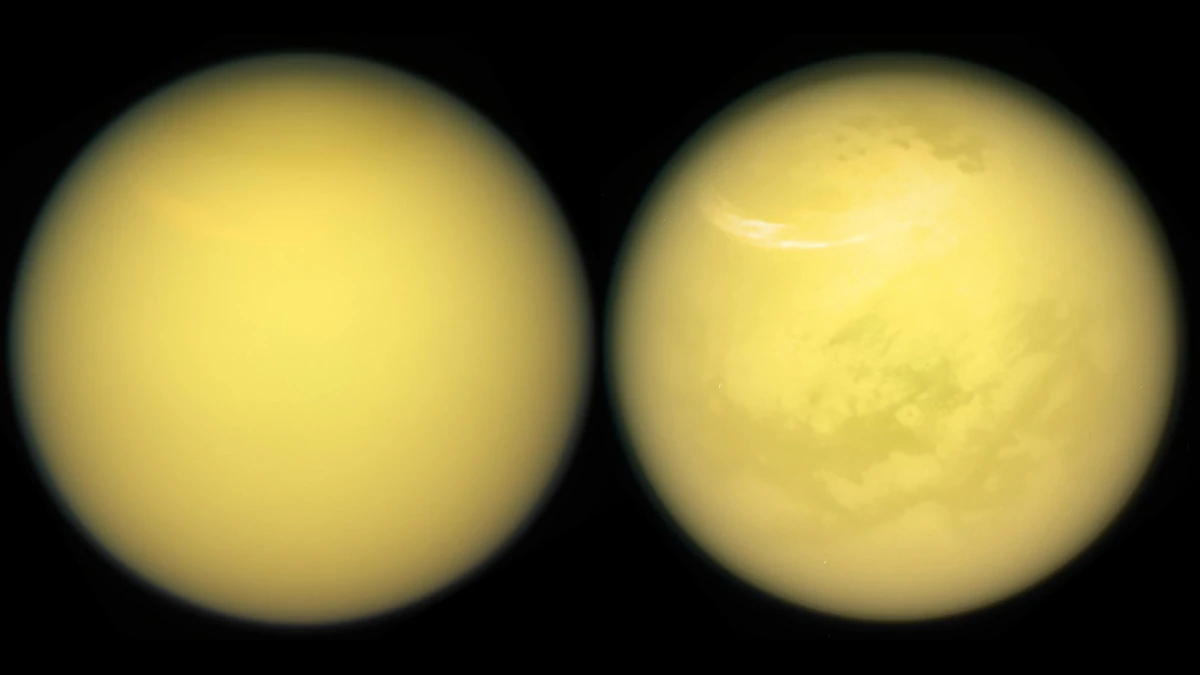
Some infrared wavelengths pass through the haze, which is how Cassini mapped nearly all of Titan's surface. Sunlight keeps destroying the methane, so something must be topping it up. Researchers suspect cryovolcanoes, which erupt cold water instead of molten rock, but they are not certain.
Titan's Lakes and Seas of Liquid Methane
Titan has a weather cycle like Earth's water cycle, with methane doing the job of water: clouds, rain, rivers, lakes and evaporation. Dark dunes of hydrocarbon grains, which NASA says may look something like coffee grounds, fill the equatorial regions.
The big seas are near the north pole. Kraken Mare, the largest, stretches about 1,200 km. Ligeia Mare is about 500 km wide and Punga Mare about 390 km. Kraken Mare holds about 80% of Titan's surface liquid, according to the Cornell team that studied it. The liquid is methane and ethane, and NASA says Cassini data showed that one large sea is mostly pure liquid methane.
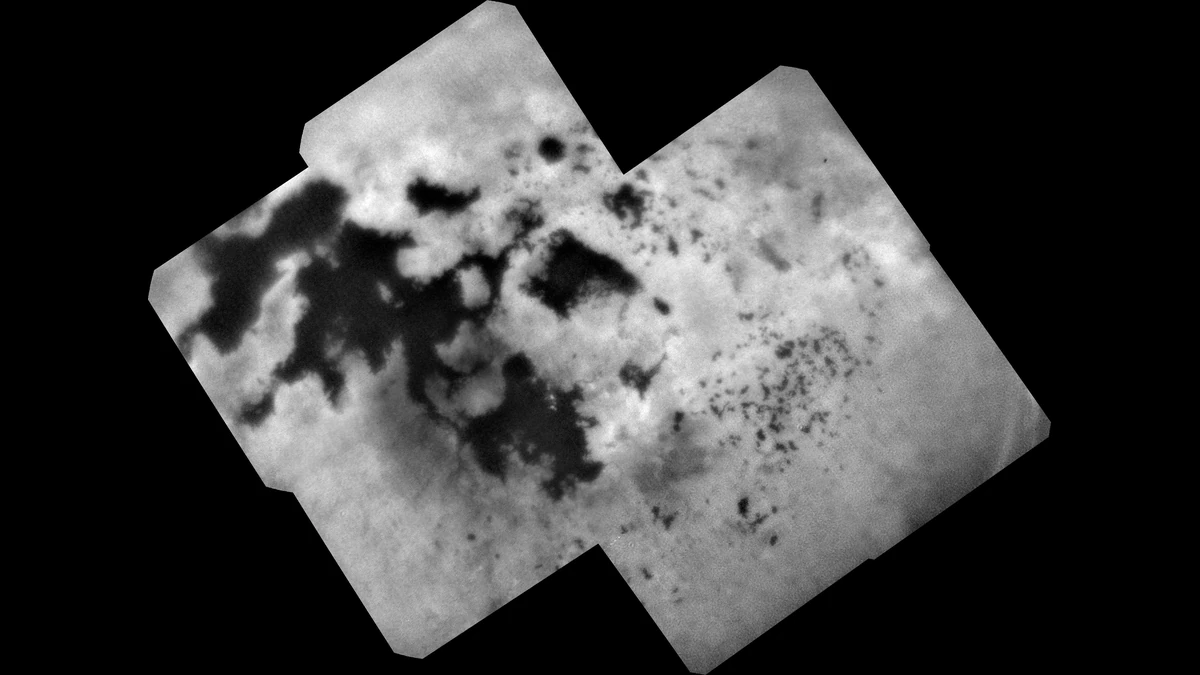
How deep are they? Near a shore of Kraken Mare, Cassini's radar reached the sea floor at depths of 20 to 35 m. It could not find the bottom of the main sea, and a 2020 study concluded that Kraken Mare is more than 100 m deep if its liquid behaves like the bay beside it. Nobody has seen waves yet. A model published in April 2026 predicts that a gentle breeze would raise waves about 3 m (10 feet) tall, but as MIT's Taylor Perron put it, "we don't have any direct observation of what these lakes look like."
Does Titan Have an Ocean? The December 2025 Dispute
Beneath the surface, Titan was long thought to hide a global ocean of liquid water. Cassini watched Titan stretch and squash as it moved round its orbit, and in 2008 researchers argued that this much flexing needed an ocean under the ice. NASA's own Titan pages still describe an underground ocean.
On 17 December 2025 a paper in Nature challenged that picture. The team, led by Flavio Petricca at NASA's Jet Propulsion Laboratory, went back to Cassini's radio tracking data and studied the timing. Titan's shape change lags about 15 hours behind the peak of Saturn's pull, and far more energy is lost inside Titan than a global ocean would allow. "Nobody was expecting very strong energy dissipation inside Titan," Petricca said. "That was the smoking gun indicating that Titan's interior is different from what was inferred from previous analyses."
Their model has ice giving way to slushy tunnels and pockets of meltwater near the rocky core, with water that could be as warm as 20°C. Baptiste Journaux at the University of Washington, who worked on the study, compared it to "something more like Arctic sea ice or aquifers" than an open ocean.
The paper's title is blunt: "Titan's strong tidal dissipation precludes a subsurface ocean". Even so, the authors do not say Titan is frozen solid. This is one reanalysis of one set of Cassini measurements, and it does not settle the question. Expect other teams to test it, and expect the answer to shape what Dragonfly looks for.
Is There Life on Titan?
No life has been found on Titan. NASA points to two possible habitats: water under the ice, which the December 2025 result has made less certain, and the surface hydrocarbons, where any life would be very different from ours. Dragonfly is not built to detect life. NASA describes it as a mission to investigate the chemistry that came before biology, though it will also look for chemical signs that could point to life.
When Did Huygens Land on Titan?
The European Space Agency's Huygens probe rode to Saturn on the side of NASA's Cassini spacecraft. It separated on 25 December 2004 at 02:00 UTC, coasted for 20 days and landed on Titan on 14 January 2005 at about 11:38 UTC, by the probe's own clock. NASA rounds that to about 11:30. The trip down through the atmosphere took about two and a half hours, and the battery-powered probe kept sending data for another 72 minutes on the surface.
You will sometimes see 12:34 GMT given as the landing time, including on ESA's own anniversary page. That is an Earth-received time, not the moment of landing. At Saturn's distance in January 2005 radio waves took about 67 minutes to arrive, so the real touchdown signal reached Earth at around 12:45 GMT, and 12:34 matches ESA's pre-landing schedule more than the actual touchdown.
Huygens is still the only landing in the outer solar system. It found a surface darker than expected, a mix of water ice and hydrocarbons scattered with pebble-sized lumps, some eroded at the base.
Can You See Titan from the UK?
Yes, and it is the easiest of Saturn's moons to find. Titan shines at about magnitude 8.3 through October to December 2026, too faint for the naked eye but well within reach of binoculars. At its furthest it sits roughly 3 to 3.4 arcminutes from Saturn. (An arcminute is a sixtieth of a degree, and an arcsecond a sixtieth of that.) That is about 4.5 times the width of Saturn's ring system. Saturn is about 1,300 times brighter than Titan, but a gap that wide keeps the glare away.
Saturn reached opposition on 4 October 2026. From the UK it is due south at about 1am BST in early October, 10pm GMT on 1 November, 8pm GMT on 1 December, 6pm GMT on 1 January and 4pm GMT on 1 February 2027. At that point it is between 40° and 43° up from Plymouth, 38° and 41° from Birmingham and 35° and 37° from Edinburgh. In early October Saturn is still low in the east after dark, about 8° up an hour after sunset, so wait until later. From January it is high as soon as it gets dark. By 1 March 2027 it is only about 17° up an hour after sunset and sets around 8:45pm GMT, and by April it is lost in the twilight.
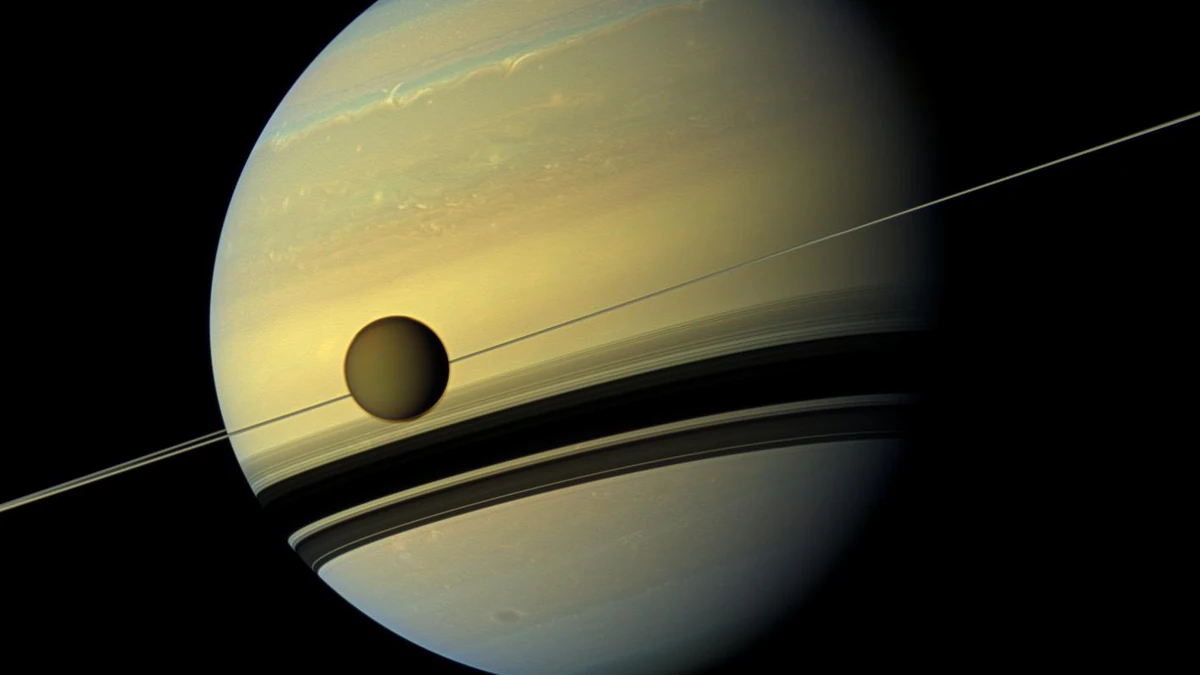
Titan takes about 16 days to orbit Saturn, so it is at its furthest from the planet roughly every eight days, alternating sides. These are the next ones, with the dark window nearest each. Windows are for Birmingham, with the Sun more than 12° below the horizon and Saturn at least 20° up. Plymouth and Edinburgh are within about 20 minutes. UK clocks go back to GMT on 25 October 2026.
| Furthest from Saturn (UK time) | Side | Distance (arcminutes) | Dark window nearest it |
|---|---|---|---|
| Mon 12 Oct, 12:40 BST | West | 3.3 | Mon 12 Oct 20:40 to Tue 13 Oct 04:10 BST |
| Tue 20 Oct, 08:10 BST | East | 3.4 | Mon 19 Oct 20:10 to Tue 20 Oct 03:40 BST |
| Wed 28 Oct, 09:10 GMT | West | 3.3 | Tue 27 Oct 18:40 to Wed 28 Oct 02:10 GMT |
| Thu 5 Nov, 04:50 GMT | East | 3.3 | Wed 4 Nov 18:00 to Thu 5 Nov 01:30 GMT |
| Fri 13 Nov, 07:00 GMT | West | 3.2 | Thu 12 Nov 17:40 to Fri 13 Nov 01:00 GMT |
| Sat 21 Nov, 02:50 GMT | East | 3.2 | Fri 20 Nov 17:30 to Sat 21 Nov 00:30 GMT |
| Sun 29 Nov, 05:00 GMT | West | 3.1 | Sat 28 Nov 17:30 to 23:50 GMT |
The exact moment hardly matters: within a day either side Titan is still more than 90% of the way out. East is the side towards sunrise, on your left as you face south. A telescope may flip or turn the view, so check a planetarium app against what you see.
Tips for spotting Titan
- Start with binoculars. Through 10x binoculars Titan appears about 0.5° from Saturn, roughly the width of the full Moon, so it is easy to separate from the planet. Our guide to binocular astronomy is a good place to start.
- Any small telescope will do. Sky at Night says you will have no trouble seeing Titan in one, and High Point Scientific says even telescopes under 4 inches show it easily. Our how to use a telescope guide is a good place to start.
- Pick the brightest dot. Titan is the brightest moon near Saturn. Rhea, the next, is about 3.6 times fainter. Titan can look faintly orange, and a planetarium app shows which dot is which.
- Do not expect a disc. Titan is only about 0.8 arcseconds across, so it stays a point of light. High Point Scientific says some observers with telescopes of 14 inches or more have glimpsed a disc on very steady nights.
- Add a little magnification. At 50x to 100x, Saturn's rings and Titan fit in the same view. Our telescope magnification guide explains eyepieces.
- Watch it move. Look again an evening or two later. Titan will have shifted noticeably, and in about 16 days it makes a full lap of Saturn. It is a good first target if you are new to stargazing for beginners.
A first telescope such as the Sky-Watcher Heritage 130P is plenty. It costs around £194 at First Light Optics. New to this? Start with stargazing for beginners, then check what you can see in the sky tonight and the UK night sky this week. The astronomy events calendar covers the rest of the year, and our UK dark sky sites map helps if streetlights are a problem.
Missions to Titan: Cassini, Huygens and Dragonfly
Five spacecraft have visited Titan, and a sixth is being built. Dates are as of 5 October 2026.
| Date | Mission | What happened |
|---|---|---|
| 1 September 1979 | Pioneer 11 | First spacecraft to fly past Saturn, and the first to explore Titan |
| 12 November 1980 | Voyager 1 | Closest approach to Saturn. Its images showed a thick atmosphere that completely hid the surface (Voyager 2 followed on 26 August 1981) |
| 24 October 2004 | Cassini | First close encounter with Titan, within 1,200 km of the surface |
| 14 January 2005 | Huygens (ESA) | Landed on Titan at about 11:38 UTC (probe time) |
| 21 April 2017 | Cassini | 127th and final close flyby, 979 km above the surface |
| 15 September 2017 | Cassini | Mission ended with a deliberate plunge into Saturn's atmosphere, chosen to protect moons such as Enceladus and Titan |
| 5–25 July 2028 | Dragonfly (NASA) | Targeted launch window |
| Late 2034 | Dragonfly (NASA) | Planned arrival at Titan |
Dragonfly: a flying laboratory for Titan
Dragonfly is a nuclear-powered rotorcraft, a lander that can fly. It will make flights of several miles across Titan's dunes, stopping to sample the ground. NASA expects about one flight every one to two Titan days, and a Titan day lasts about 16 Earth days. The planned mission is 3.3 years.
It is aimed at Ahmakiq Undae, a dune field about 810 km across, south of the 80 km Selk impact crater. The name, approved by the International Astronomical Union and announced by NASA on 2 September 2026, comes from a Mayan wind spirit and translates as "one who locks up the wind". Deposits from the Selk impact are primary targets.
Dragonfly was selected in 2019. It was meant to launch in April 2026, but replans pushed the date to July 2028, and NASA confirmed it in April 2024 at a lifecycle cost of $3.35 billion. NASA's Inspector General reported on 9 September 2025 that the project had less cost reserve than ideal. Integration and testing began in March 2026, and on 1 July 2026 the team started fitting systems into the nearly 4 m long fuselage. NASA still lists the launch as no earlier than July 2028, with no delay announced as of 5 October 2026. The 5 to 25 July window comes from NASA's November 2024 launch contract announcement. Funding is still moving: a stopgap spending law signed on 2 September 2026 keeps the government funded only until 11 December 2026.
What you need to see Titan
Kit we've reviewed in full
Titan is the friendly one. You do not need a big telescope or a perfect night, just Saturn and a bit of magnification to pull the moon clear of the glare.
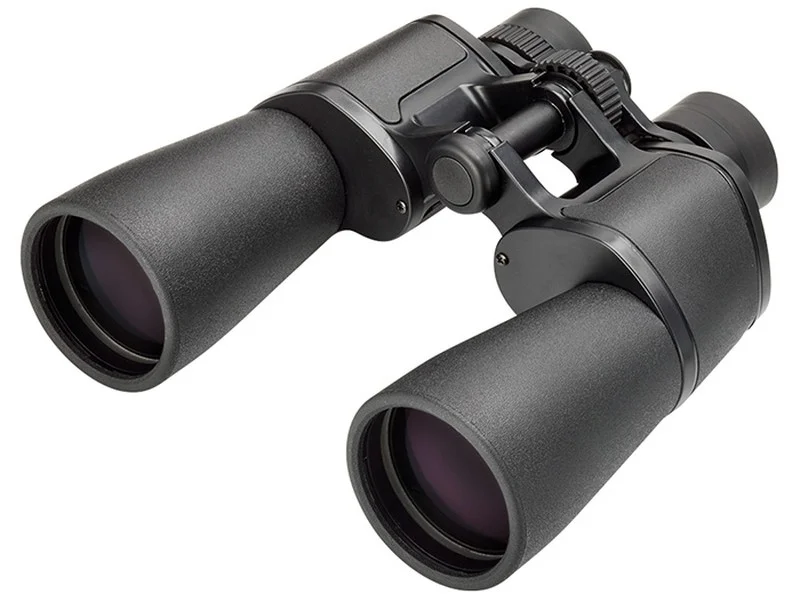
At 10x, Titan appears about half a degree from Saturn, roughly a full Moon's width, so it is easy to split from the planet. Brace your elbows or lean on a wall to keep the view steady.
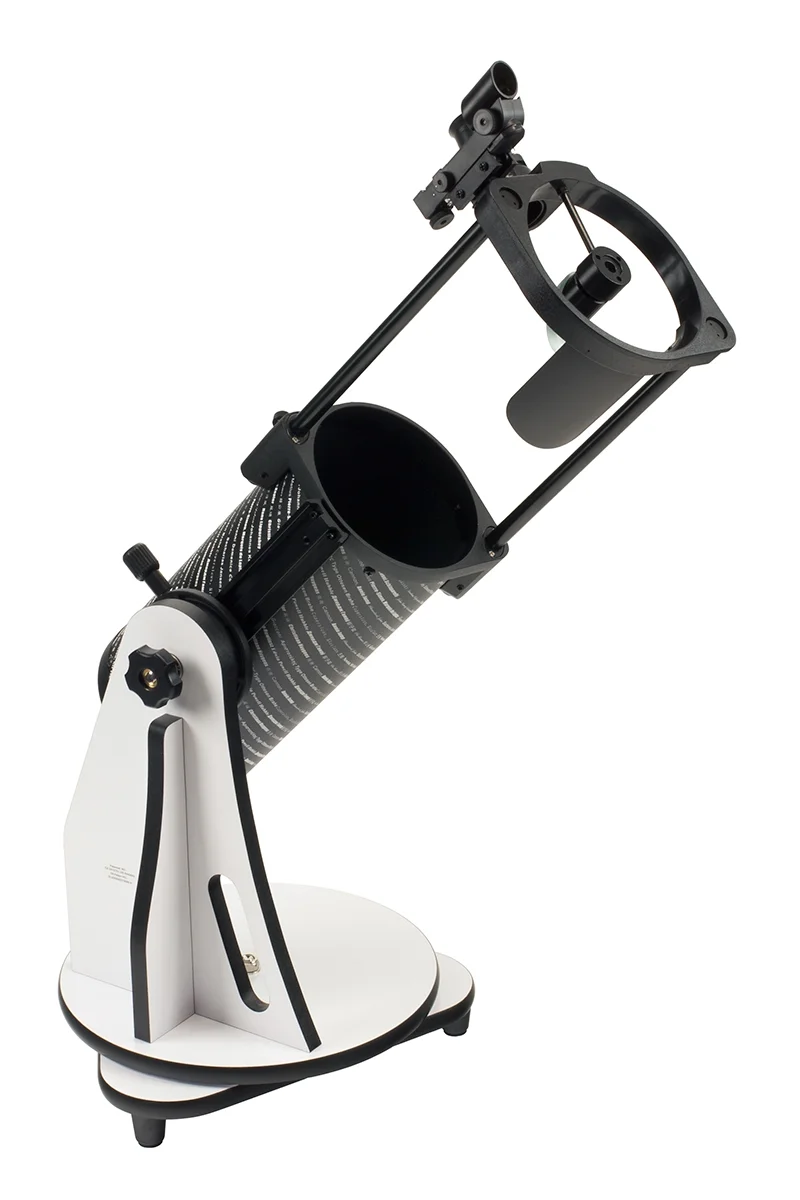
A 130 mm (5-inch) telescope shows Titan with no fuss and Saturn's rings as well. It is compact enough to carry into the garden in one hand.
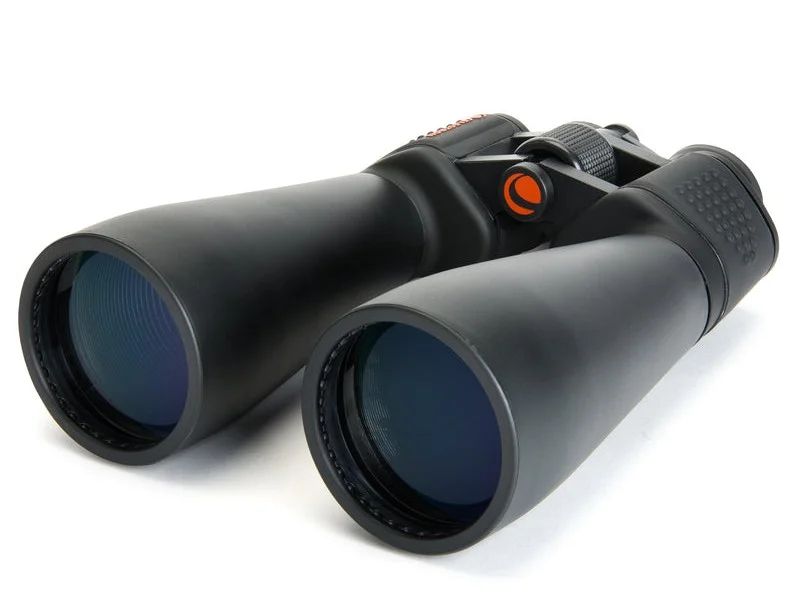
More aperture and 15x magnification make Titan stand out more clearly. At this power hand shake becomes obvious, so rest them on something solid.
Affiliate links: you pay the same price, we earn a small commission that helps keep WatchTheStars free.
Frequently Asked Questions About Titan
Images: NASA/JPL-Caltech/Space Science Institute, Cassini mission. Main image: Titan in natural colour from Cassini's narrow-angle camera on 21 March 2017, from about 986,000 km away, made from red, green and blue filter images (the left-hand view of PIA21624). Sky positions for the UK computed with Skyfield and JPL Horizons.