Key takeaways
- Triton is Neptune's largest moon, about 2,700 km across, and the only large moon that orbits its planet backwards
- Triton is probably a Kuiper Belt object captured by Neptune, and Voyager 2 saw nitrogen geysers there in 1989
- A 2025 study estimates Triton will reach Neptune's Roche limit and be torn apart in about 28 billion years
- From the UK, Triton is about magnitude 13.5 and never more than 17 arcseconds from Neptune, so it needs at least an 8-inch telescope
Jump to section 8 sections
Triton: Neptune's Largest Moon
Triton is the largest moon of Neptune, about 2,700 km across, and the only large moon in the solar system that orbits its planet backwards. It is thought to be a Kuiper Belt object that Neptune captured, and when Voyager 2 flew past in 1989 it found a frozen world with a thin nitrogen atmosphere and dark plumes of material streaking across its south polar region.
Neptune has 16 known moons, and Triton is by far the largest. It circles Neptune at about 354,800 km, a little closer than our own Moon is to Earth, once every 5.88 days. It is about 78% as wide as our Moon and a little wider than Pluto, which is 2,377 km across.
William Lassell discovered Triton on 10 October 1846, just 17 days after Neptune itself was found. Its gravity is about 8% of Earth's, so a 70 kg person would weigh the equivalent of about 5.6 kg there.
Why Does Triton Orbit Backwards?
Moons normally form from a disc of material swirling round a young planet, so they go round in the same direction the planet spins. Triton goes the other way. Astronomers call that a retrograde orbit, and Triton is the only large moon in the solar system that has one.
That points to an outsider. NASA says Triton is thought to be a Kuiper Belt object, one of the icy bodies beyond Neptune, that came too close and was captured by Neptune's gravity. It is a little wider than Pluto and about twice as dense as water.
A capture would have been rough on whatever was already there. A Science Advances study published on 31 July 2026 used the James Webb Space Telescope to look at Neptune's rings and small inner moons. It found clay-like minerals called phyllosilicates on the moons Larissa and Galatea and in the rings. The authors suggest the material is the interior of satellites destroyed when Triton was captured, or of a dwarf planet that Neptune's tides tore apart. A separate paper in May 2026 concluded that Nereid, a small moon on a very wide orbit, is probably the only intact survivor of the moons that formed around Neptune.
Does Triton Have Geysers?
Voyager 2 saw what looked like them. In August 1989 its cameras caught dark plumes rising from Triton's surface, and a team led by L. A. Soderblom reported in Science in 1990 that at least four geyser-like eruptions were active at the time. The dark columns rose about 8 km, then bent over into clouds of dark material that drifted more than 100 km downwind.
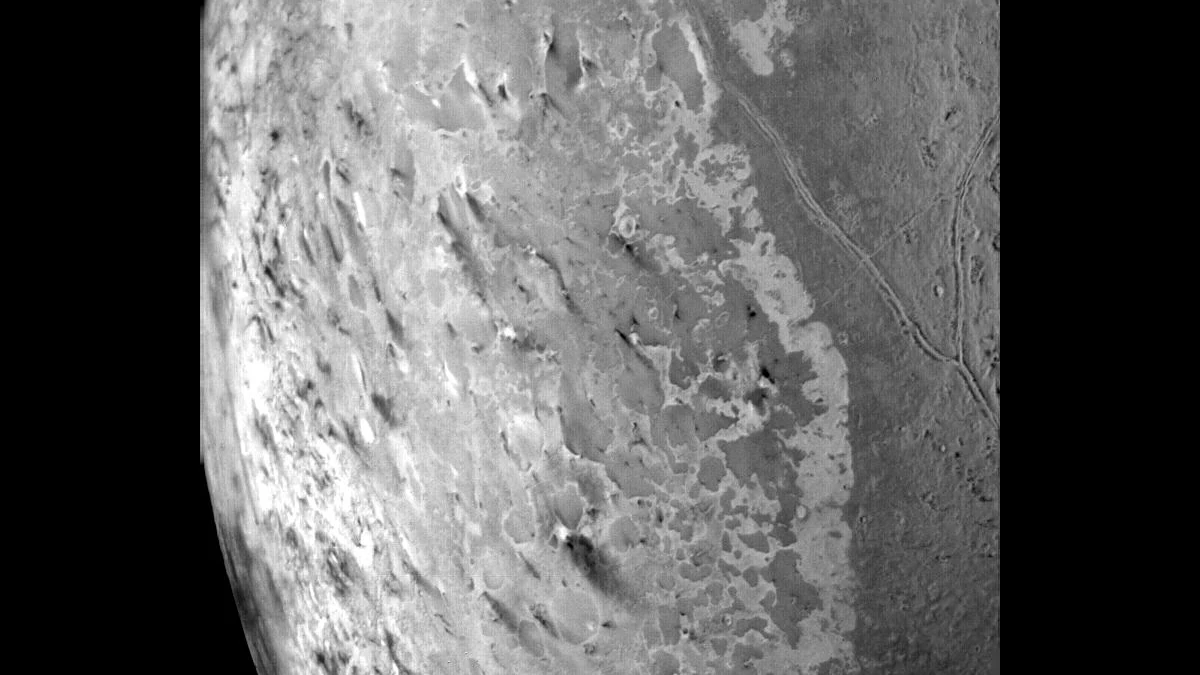
NASA's caption says the streaks start at dark spots, generally a few miles across, that may be vents where gas erupted and carried dark particles into Triton's nitrogen atmosphere. One explanation in the 1990 paper is sunlight heating nitrogen ice from underneath, with the ice acting like a greenhouse roof. NASA adds that the eruptions may be driven by seasonal heating of very shallow deposits.
No spacecraft has been back since, so nobody knows whether the geysers are still erupting. Saturn's moon Enceladus has geysers as well, but those spray water from an ocean, not nitrogen from a frozen surface.
Does Triton Have an Atmosphere?
Yes, a very thin one, made mostly of nitrogen. On 6 October 2022 Triton passed in front of a star, and astronomers timed how the starlight faded as it slipped through the atmosphere. A paper by Sicardy and colleagues, published in Astronomy & Astrophysics in February 2024, used that to work out a surface pressure of 14.54 ± 0.47 microbars. That is about 70,000 times lower than the air pressure at sea level on Earth.
The surprise is how little the pressure has changed overall. Voyager 2 measured about 14 microbars in 1989, and an occultation in 2017 gave 14.1. All three values agree within their uncertainties. In between, occultations in 1995 and 1997 suggested the pressure had risen, perhaps to about double the 1989 value, but the authors urge caution because that rise is only moderately significant. Triton's south pole had an extreme summer around the year 2000, a rare alignment that comes round about every 650 years, and models predicted the pressure should be falling by now. The 2022 measurement did not confirm that.
The surface is about −235°C, and Triton reflects about 70% of the sunlight that reaches it. NASA calls it "one of the coolest objects in our solar system".
What Does the Surface of Triton Look Like?
Voyager 2 showed a surface unlike any other. The colour mosaic at the top of this page picks out three kinds of ground.
- A pink south polar cap. NASA's caption says the pinkish deposits are believed to contain methane ice, which sunlight would have turned into pink or red compounds. The dark geyser streaks lie across it.
- A bluish-green band. It runs all the way round Triton near the equator and may be fresh nitrogen frost.
- Cantaloupe terrain. A greenish area that NASA calls cantaloupe terrain, covered in round depressions. Its origin is unknown.
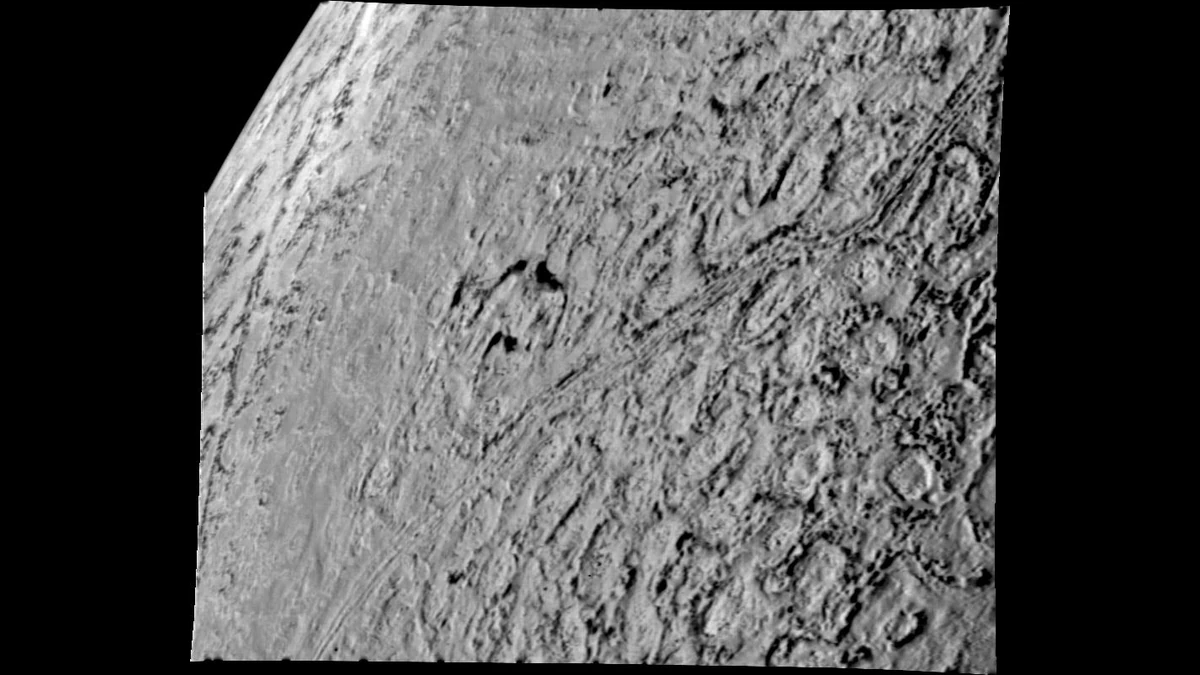
NASA says the depressions are probably not impact craters, because they are too similar in size and too regularly spaced. Terrain like this covers large tracts of the northern hemisphere and is unlike anything seen elsewhere in the solar system.
Will Triton Crash into Neptune?
Not for a very long time, and it would be torn apart first. Neptune's tides are slowly pulling Triton's orbit inwards. In the end Triton would reach Neptune's Roche limit, the distance inside which a planet's tidal pull beats the moon's own gravity and breaks it up.
How long that takes depends on how efficiently Neptune turns tidal squeezing into heat, and that is hard to measure. A 1989 study by Chyba, Jankowski and Nicholson put the time at about 3.6 billion years in its main case. A paper published in Solar System Research in February 2025 by Wang and colleagues fitted Neptune's tidal dissipation to Triton's measured positions over time instead, and got about 28 billion years. That is roughly twice the age of the universe.
The two figures differ because the studies use different tidal models and inputs. The 1989 paper modelled Triton's orbit and spin with a standard tidal model, while the 2025 paper fitted Neptune's tidal dissipation to observed positions and used its own value for Neptune's tidal flexing. We could not find a paper that compares the two directly. The 2025 authors call their value of Neptune's tidal dissipation a plausible minimum, so treat 28 billion years as a model-based estimate, not a forecast.
Can You See Triton from the UK?
Yes, but it is a test for a telescope. Triton shines at about magnitude 13.5 through the coming months, roughly 200 times fainter than Neptune at magnitude 7.7. It never strays more than about 17 arcseconds from the planet, which is about seven times Neptune's own width. Seen from Earth, its orbit is a squashed oval: up to 17 arcseconds north or south of Neptune, about 10 arcseconds east or west, and never closer than 8.
A common rule of thumb says a 6-inch telescope reaches about magnitude 13.4, an 8-inch about 14.0 and a 10-inch about 14.5, under a dark sky with steady air. With Neptune's glare next to the moon, we would start with an 8-inch (200 mm) and prefer a 10-inch. At 150x, 17 arcseconds is stretched to about 1.4 times the width of the full Moon, so it is brightness that limits you, not separation.
Neptune reached opposition on 26 September 2026, so it is at its best now. It is due south at about 00:20 BST on 6 October from Birmingham, about 9 minutes later from Plymouth and about 5 minutes later from Edinburgh. At that moment it stands about 39° up from Plymouth, 37° from Birmingham and 34° from Edinburgh, and it never gets higher, so wait for a clear, steady night.
| Date | Neptune due south (Birmingham) | Neptune above 20° and sky dark (Birmingham) |
|---|---|---|
| 5 Oct 2026 | 00:21 BST on 6 Oct | 20:40–04:00 BST |
| 25 Oct 2026 | 22:00 GMT | 18:30–01:40 GMT |
| 1 Nov 2026 | 21:32 GMT | 18:00–01:10 GMT |
| 1 Dec 2026 | 19:33 GMT | 17:30–23:10 GMT |
| 1 Jan 2027 | 17:31 GMT | 17:30–21:10 GMT |
Dark means the Sun is more than 12° below the horizon. Plymouth and Edinburgh are within about 20 minutes of these windows, and by 1 February 2027 the window has shrunk to 18:20–19:10 GMT, with none left by 15 February. The Moon matters too. It is new on 10 October, 9 November and 9 December and full on 26 October, 24 November and 24 December 2026, so avoid nights around the full Moons. Check tonight's Moon phase before you set up. These are the best evenings we found for catching Triton near its widest, with the Moon below the horizon from Birmingham each time.
| Date and UK time | Triton is | Gap from Neptune | Neptune's height (Plymouth, Birmingham, Edinburgh) |
|---|---|---|---|
| Thu 8 Oct, 22:00 BST | South-west | 15.7 arcseconds | 31°, 31°, 28° |
| Tue 3 Nov, 22:00 GMT | North, a little east | 16.8 arcseconds | 39°, 37°, 33° |
| Fri 6 Nov, 20:00 GMT | South, a little west | 16.8 arcseconds | 36°, 35°, 31° |
| Mon 9 Nov, 19:00 GMT | North, a little east | 16.8 arcseconds | 32°, 31°, 28° |
| Fri 11 Dec, 21:00 GMT | South, a little west | 16.1 arcseconds | 33°, 31°, 28° |
A Newtonian telescope such as a Dobsonian turns the view upside down, so north may appear at the bottom. A planetarium app shows what to expect.
Tips for spotting Triton
- Use at least an 8-inch (200 mm) telescope. A 10-inch makes it much easier.
- Find Neptune first. It is a tiny blue-grey dot, only 2.3 arcseconds wide. Our guide to finding Neptune from the UK has the details, and the Neptune guide for 2026 follows it month by month.
- Push the magnification. About 150x to 200x darkens the background and keeps Neptune's glow off the moon. Our guide to telescope magnification shows how to work out what an eyepiece gives you.
- Sketch the field. Triton looks like a faint star. Draw the stars near Neptune and come back a night or two later. Triton goes round Neptune once every 5.88 days, so the dot that has moved is the moon.
- Wait for a steady night. Steady air matters more than dark skies for this one, though our UK dark sky sites map helps if streetlights are a problem where you live.
An 8-inch Dobsonian is the obvious tool. Our Sky-Watcher Skyliner 200P review explains why it suits planets and their moons, and it costs around £341 at First Light Optics. If you are new to telescopes, start with our guide on how to use a telescope, then check what you can see in the sky tonight before heading out. The UK night sky this week rounds up everything else worth a look.
Missions to Triton: Voyager 2 and What Comes Next
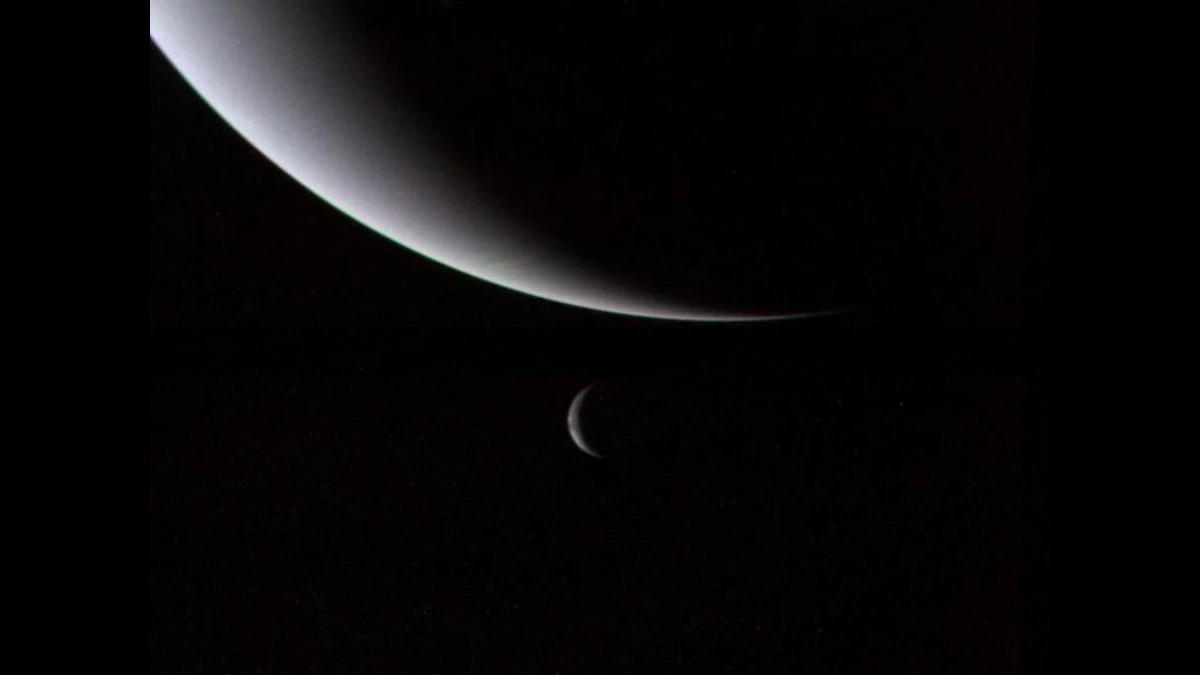
Voyager 2 is the only spacecraft that has visited Neptune or Triton. It passed about 4,800 km above Neptune's cloud tops at 03:56 UT on 25 August 1989 and flew past Triton later the same morning, taking its sharpest pictures of the moon from about 40,000 km. Three days on, heading south, it looked back and photographed Neptune and Triton as a pair of crescents.
| Date | What happened |
|---|---|
| 10 Oct 1846 | William Lassell discovers Triton |
| 25 Aug 1989 | Voyager 2 flies past Triton and photographs the dark plumes |
| 19 Oct 1990 | Soderblom and colleagues report the geyser-like eruptions in Science |
| 13 Feb 2020 | NASA names Trident, a Triton flyby, as one of four Discovery finalists |
| 2 Jun 2021 | NASA picks DAVINCI+ and VERITAS instead, so Trident is not selected |
| 6 Oct 2022 | A stellar occultation measures Triton's atmospheric pressure |
| Feb 2025 | Wang and colleagues estimate about 28 billion years until Triton reaches the Roche limit |
| 31 Jul 2026 | JWST study of Neptune's rings and inner moons links them to Triton's capture |
NASA's announcement of the Trident finalists described Triton as having the second youngest surface in the solar system, because of active resurfacing. As of 5 October 2026 we know of no approved mission to go back to Neptune or Triton. Voyager 2 itself is still working, and our report on NASA's "Big Bang" power fix for Voyager 2 explains how it was kept going.
What you need to see Triton
Kit we've reviewed in full
Triton is about magnitude 13.5 and sits within 17 arcseconds of a planet roughly 200 times brighter. Aperture and steady air do most of the work.
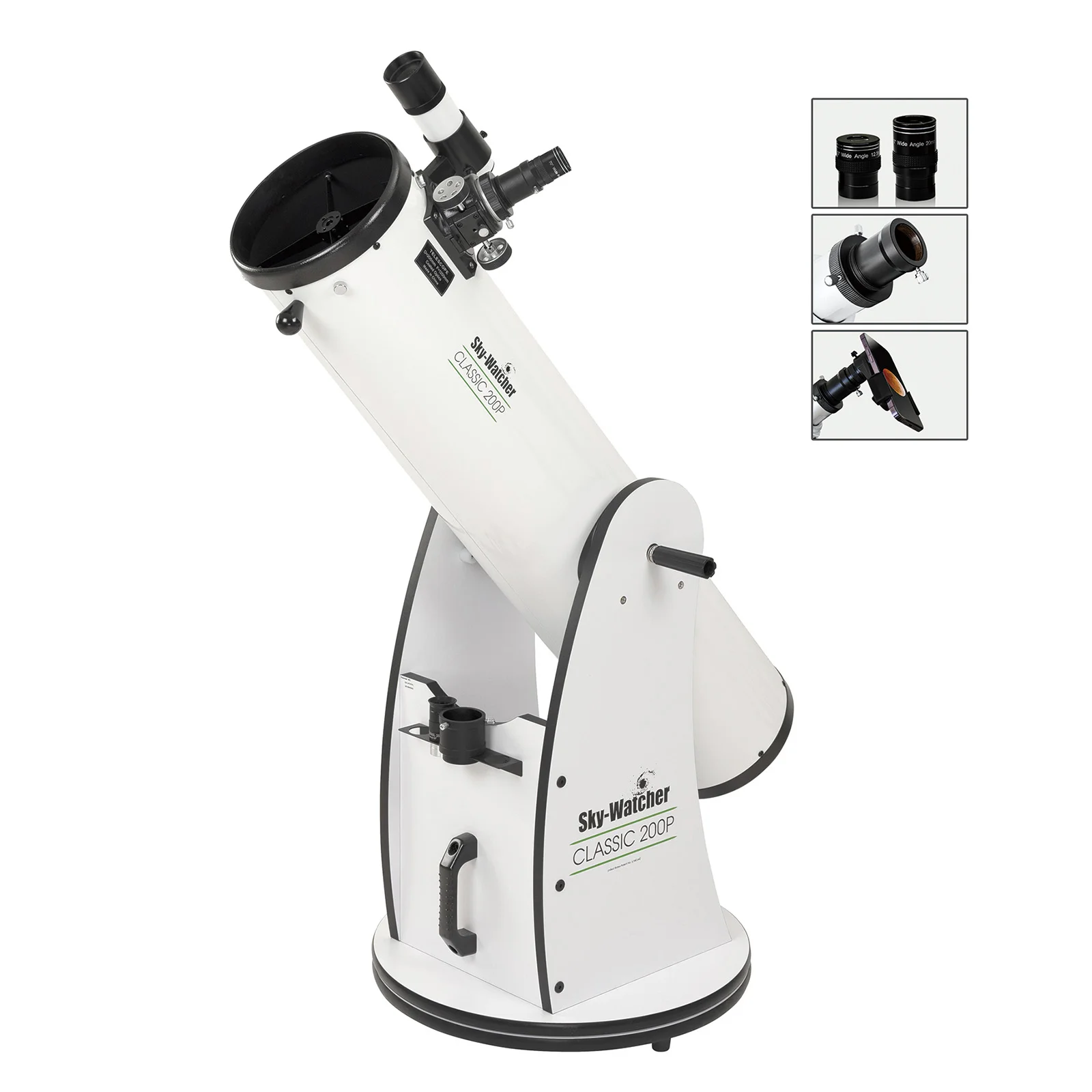
An 8-inch Dobsonian is a sensible starting point for Triton. Pick a night when Triton is near its widest from Neptune, let the telescope settle outdoors, and look for a faint star-like dot beside the planet.

Sky-Watcher Skyliner 250PX FlexTube
Ten inches collects about 56% more light than eight, which lifts Triton further above Neptune's glow. It turns a hard catch into a regular one on a good night.
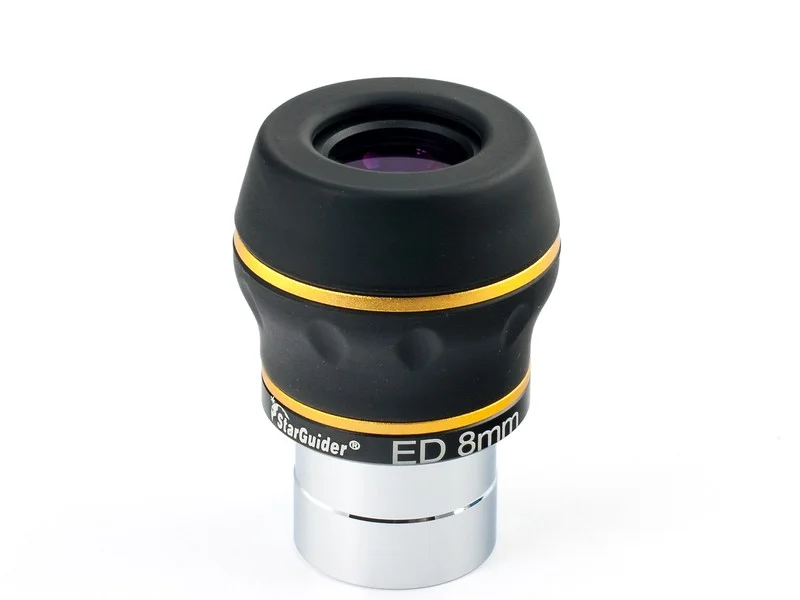
BST StarGuider 60° 8mm ED
In a 1200 mm focal length Dobsonian like the 200P this gives 150x, enough to push the glare of Neptune back and leave Triton clear of the planet. The 60° field is comfortable to use.
Affiliate links: you pay the same price, we earn a small commission that helps keep WatchTheStars free.
Frequently Asked Questions About Triton
Images: NASA/JPL and NASA/JPL/USGS, Voyager 2 mission. Main image: a global colour mosaic of Voyager 2 images from August 1989 (PIA00317). Its colour is synthesised from orange, violet and ultraviolet filter images shown as red, green and blue, so it is not what the eye would see, and it covers only the parts of Triton that Voyager 2 imaged. Sky positions for the UK computed with Skyfield and JPL Horizons.