Key takeaways
- Iapetus is Saturn's third-largest moon, about 1,470 km across, with one jet-black hemisphere and one bright white one
- A ridge roughly 10 to 20 km high runs along Iapetus's equator for more than 1,300 km, and NASA says no other moon has a feature like it
- Iapetus swings between about magnitude 10.1 and 12.0 this autumn, and is brightest when it sits west of Saturn
- From the UK, Iapetus needs a telescope of about 4 to 6 inches on its bright side and 6 inches or more when it is faint
Jump to section 7 sections
Iapetus: Saturn's Two-Faced Moon
Iapetus is Saturn's third-largest moon, about 1,470 km across, with one jet-black hemisphere, one bright white one and a ridge of mountains running along its equator. NASA says no other moon has a feature like that ridge. The two-tone surface is so extreme that Iapetus changes brightness by almost two magnitudes as it goes round Saturn, which is why its discoverer could not find it on one side of the planet for 34 years.
Iapetus orbits about 3.56 million km from Saturn, nearly three times as far out as Titan and about nine times the distance from Earth to our own Moon. It takes 79 days to go round and always keeps the same face towards Saturn. The planet has 293 known moons, more than any other planet, and Iapetus is the most distant of its main ones.
Giovanni Cassini discovered Iapetus on 25 October 1671. He could only ever find it on the western side of Saturn, and he worked out why: one side of the moon is much darker than the other, and the moon keeps the same face to the planet. It took until 1705 for him to see it east of Saturn, where it is almost two magnitudes fainter.
Why Is One Side of Iapetus Black?
Because the two halves are covered in very different material. The side that leads as the moon travels round Saturn, the leading hemisphere, is coated in dark, slightly reddish dust and looks as dark as coal. The trailing hemisphere is bright, icy ground. NASA puts the reflectivity of the dark side at 3 to 5 per cent and the bright side at 50 to 60 per cent, so the bright side bounces back at least ten times as much sunlight.
| Leading hemisphere | Trailing hemisphere | |
|---|---|---|
| Faces | The direction Iapetus is travelling | The direction it has come from |
| Look | Dark, with a slight reddish tinge | Bright and icy, white at the poles |
| Reflectivity | 3–5% | 50–60% |
| Named terrain | Cassini Regio | Roncevaux Terra (north) and Saragossa Terra (south) |
| Faces Earth when Iapetus is | East of Saturn (faint) | West of Saturn (bright) |
The dark region, Cassini Regio, covers about 40 per cent of the surface. Scientists think more than one process made the contrast. Dark dust from space, possibly from the distant dark moon Phoebe, probably landed mostly on the leading side. Iapetus turns once in about 79 days, so the dark ground has a very long day to warm in the Sun. Warm dark ground loses its ice, which makes it darker still, and the ice that escapes freezes onto colder, brighter ground. NASA says this heat-driven sorting, called thermal segregation, is probably the main cause.
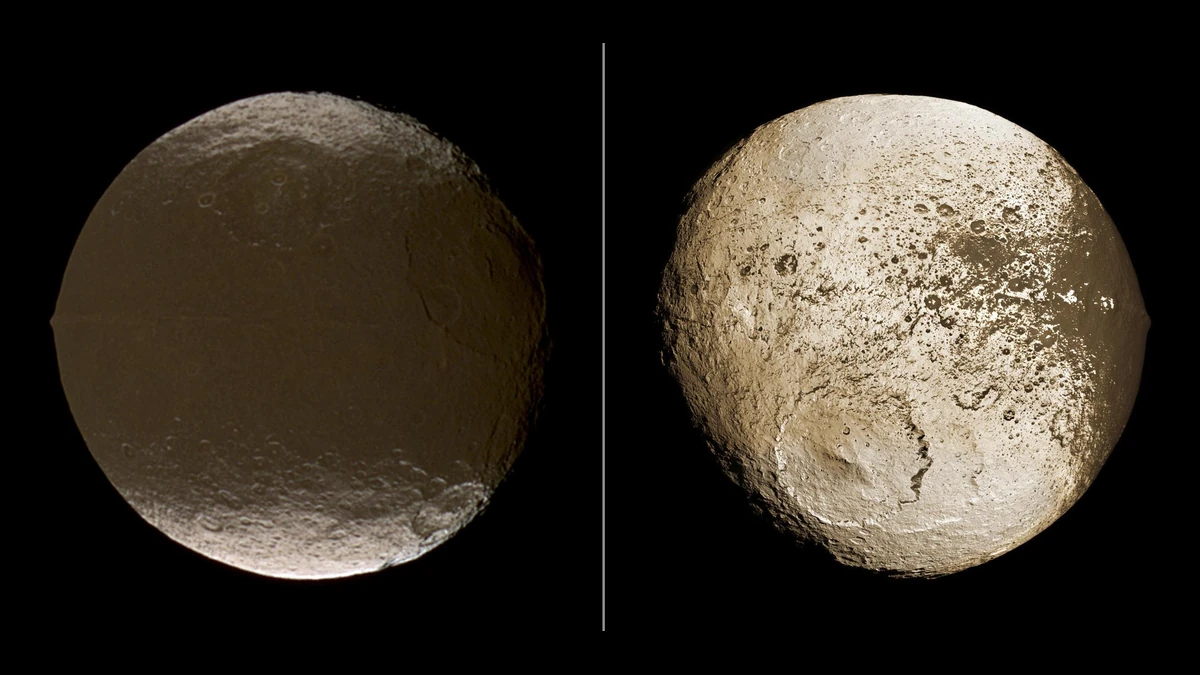
The James Webb Space Telescope added a clue. A 2025 study in the Planetary Science Journal found carbon dioxide on Iapetus from two sources: on the dark leading side it appears to have been carried in from organic material on Phoebe, and on the trailing side it is trapped in water ice. That fits the idea that the dark side owes its colour to material arriving from outside.
What Is the Ridge on Iapetus?
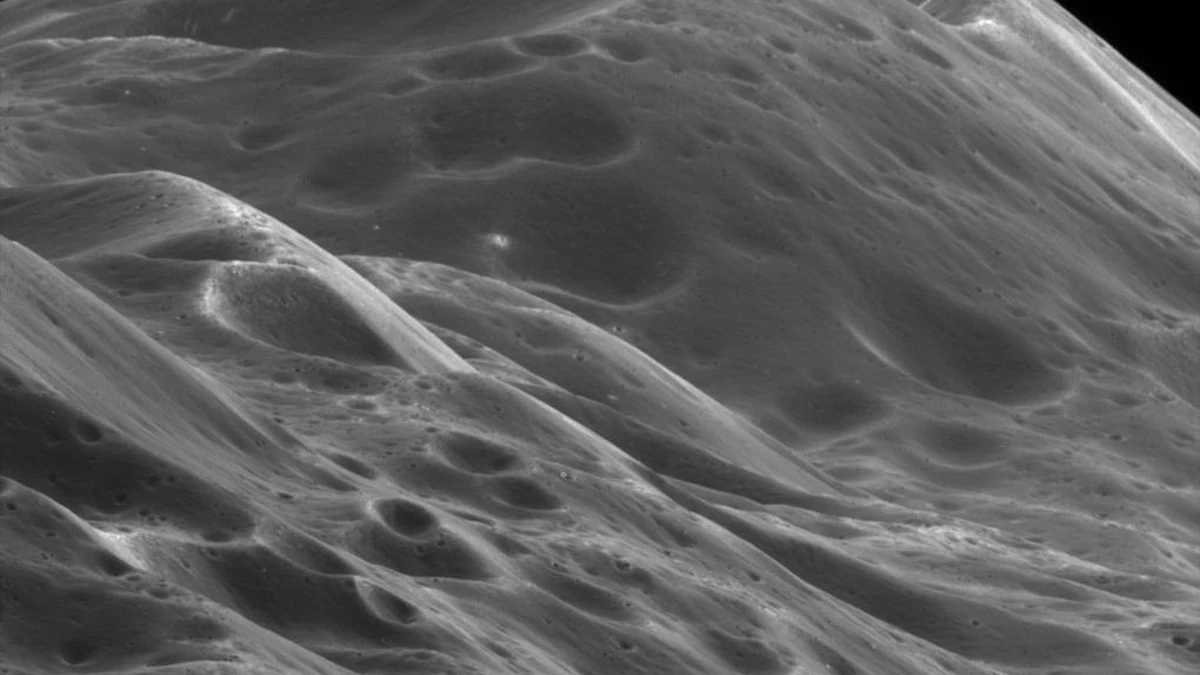
It is a chain of mountains that follows Iapetus's equator almost exactly, staying within a couple of degrees of it. Cassini images from December 2004 revealed it. In a global view NASA measured it at about 20 km wide and traced it for roughly 1,300 km, with the peak on the limb at least 13 km above the ground around it. Other NASA pages say its mountains reach about 10 km and as much as 20 km in places, so the safe summary is roughly 10 to 20 km high. Even the lower figure is taller than Mount Everest, which is about 8.8 km. NASA says the tallest peaks rival Olympus Mons on Mars.
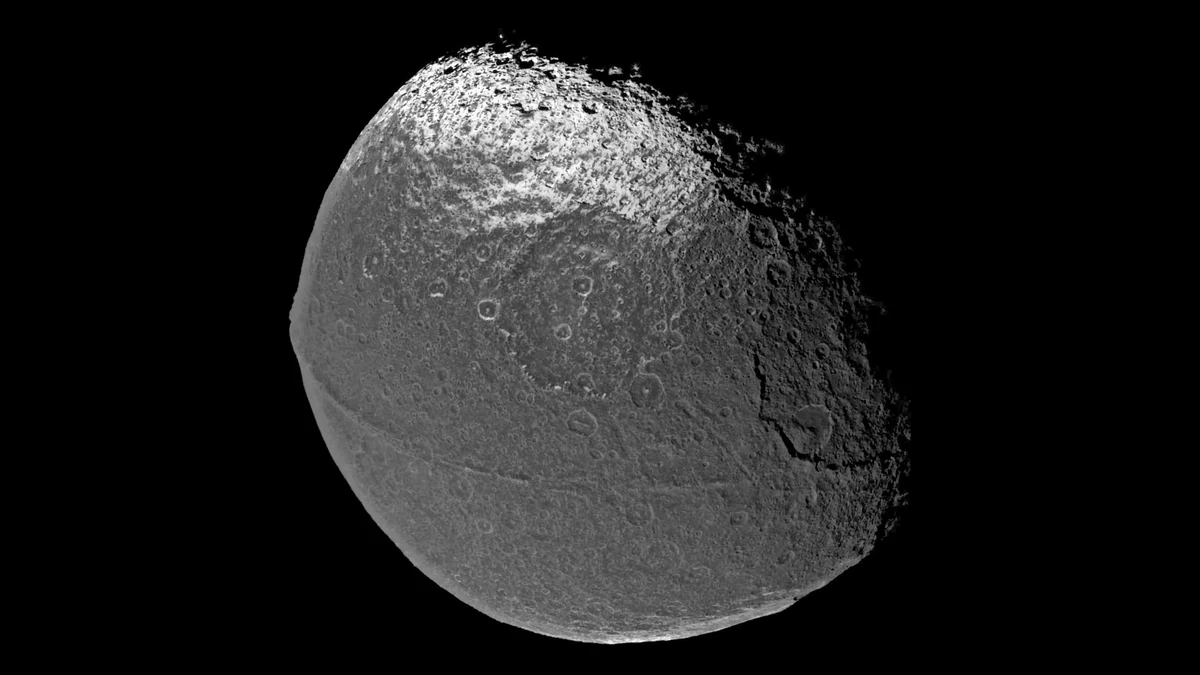
How the ridge formed is still open. Cassini scientists suggested it is either a mountain belt folded upwards or a crack through which material from inside erupted and piled up. NASA's Iapetus page lists two other ideas: that the ridge dates from a time when Iapetus spun much faster, or that it is the remains of a collapsed ring.
A paper published online in Icarus on 1 July 2026 by Chloe Beddingfield, Alex Patthoff and Richard Cartwright added evidence. They checked 595 craters and found 55 with polygonal outlines, a sign of fractures underneath, which means the crust is more cracked than scientists thought. Their results do not fit a ridge built by folding or faulting of the crust. They fit one made of loose material, and the fracture patterns match the stresses of Iapetus slowing down and spinning up again. The same paper says Iapetus's bulge at the equator was probably frozen in when it spun at a faster rate.
Is Iapetus Artificial? The 2001 Connection
No. Iapetus is a natural moon, and the black-and-white surface and the ridge both have natural explanations. The myth owes a lot to fiction. In Arthur C. Clarke's 1968 novel 2001: A Space Odyssey, the final monolith waits on Iapetus, which Clarke spells Japetus, and the book describes a moon with one white hemisphere and one black one.
How Big Is Iapetus and How Far Away?
Iapetus is about 1,470 km across, a little over 40 per cent of the width of our Moon. Its gravity is about 2 per cent of Earth's, so bathroom scales reading 70 kg at home would show about 1.6 kg there. It takes 79.3 days to orbit Saturn and, being tidally locked, 79.3 days to turn once on its axis, which is why the Sun takes so long to cross its sky.
Its distant, tilted orbit makes it the only large moon with a good view of Saturn's rings. NASA says that being so far from Saturn's tidal forces has probably left its surface largely unaffected by the melting and resurfacing seen on closer moons such as Enceladus.
Can You See Iapetus from the UK?
Yes, and it is one of the more rewarding of Saturn's fainter moons, because it sits so far from the planet that Saturn's glare is not the problem. The difficulty is Iapetus itself. It brightens and fades as it orbits, because we see the bright side when it is west of Saturn and the dark side when it is east. Sky at Night gives its range as magnitude +10.1 to +11.9. Magnitude is the astronomers' brightness scale, where a bigger number means a fainter object. A swing of 1.8 magnitudes makes Iapetus about five times brighter at its best than at its worst.
Where is Iapetus now?
On 5 October 2026 Iapetus is about 9.6 arcminutes from Saturn, on its western side, which is the right-hand side as you face south, and a little to the south. An arcminute is a sixtieth of a degree, and the full Moon is about 31 arcminutes wide, so Iapetus is about a third of a Moon-width from the planet. It was at its greatest western distance, 9.7 arcminutes, on 3 October. That puts it on its bright side and near its brightest, around magnitude 10.1. This table shows how the autumn runs.
| Date (UK clock) | Where Iapetus is | Estimated magnitude | What it means |
|---|---|---|---|
| 3 October | West of Saturn at its greatest distance, 9.7 arcminutes out | About 10.1 | The autumn's peak, just passed |
| 5 October | 9.6 arcminutes west, a little south | About 10.1 | Still at its best |
| 14 October | 6 arcminutes west | About 10.5 | The end of the bright spell |
| 22 October | Passes behind Saturn, 1.7 arcminutes south of it | About 11.1 | Too close to Saturn's glare for small telescopes |
| 10 November | East of Saturn at its greatest distance, 9.4 arcminutes out | About 12.0 | The faintest of the autumn, a job for 6 inches or more |
| 30 November | Passes in front of Saturn, 1.7 arcminutes north of it | About 11.1 | Too close to Saturn's glare again |
| 10 to 27 December | West of Saturn again | 10.5 or brighter, about 10.3 from 15 to 23 December | The second bright spell |
These magnitudes are estimates. The standard ephemeris from JPL gives only an average brightness for Iapetus, so we added a simple correction for the two-tone surface, scaled to the published +10.1 to +11.9 range. Treat them as good to about 0.2 of a magnitude. The pattern repeats every 79 days, with the brightest point each time the moon reaches its greatest western distance and the faintest about 40 days later in the east.
When to look from the UK
Early October is a good time. Saturn is due south at about 00:54 BST from Birmingham on 5 October, 39° up, with 42° from Plymouth and 36° from Edinburgh. It is at least 25° up from about 21:38 until about 04:10 BST from Birmingham, and from 22:00 to about 03:58 BST from Edinburgh. The Moon is below the horizon at 22:00 on 5, 8, 11 and 14 October, and new on 10 October, so the sky is dark. Check what you can see in the sky tonight for conditions on the night.
The December spell comes with Saturn in the early evening. On 15 December Saturn is at least 25° up from about 17:20 until about 22:12 GMT from Birmingham, and it is due south at about 38° at 18:39 GMT on 21 December. The Moon is in the way for part of it: 57% lit and only 7° from Saturn at 22:00 on 17 December, then full on 24 December. The darkest evenings are 10 to 14 December, when the Moon is a thin crescent, low or already set by 22:00 and well away from Saturn, and Iapetus is around magnitude 10.5 to 10.3. Our Moon phase tool and astronomy events calendar help you plan.
Tips for spotting Iapetus
- Use a telescope of at least 4 to 6 inches (100 to 150 mm). High Point Scientific says you might spot Iapetus at that size depending on where it is in its orbit, and Sky at Night says about 6 inches is needed at its faintest. An 8-inch makes it a regular catch.
- Pick the bright-side dates. The dates in the table matter more than anything else. A 5-inch that struggles on 10 November can show it on 5 October.
- Stay at low power. Iapetus is up to about 9.7 arcminutes from Saturn, so 50x to 70x keeps both in the same field. Our guide to telescope magnification shows how to work out what an eyepiece gives you.
- Check the field. Saturn lies among faint stars of similar brightness, so confirm which dot is the moon with a planetarium app such as Stellarium or SkySafari before you decide you have it.
- Hide Saturn if you need to. At its closest, on 22 October and 30 November, Iapetus is only about 5 Saturn-widths from the planet. Nudge Saturn out of the field to cut the glare.
- Get away from streetlights. A moon this faint shows better from a dark site. Our UK dark sky sites map shows where to go, and UK night sky this week covers what else is up.
An 8-inch Dobsonian is the comfortable choice. Our Sky-Watcher Skyliner 200P review explains why it suits planets and their moons, and it costs around £341 at First Light Optics. If you are new to telescopes, start with how to use a telescope, and for a wider introduction see stargazing for beginners. Our guide to Saturn in 2026 has the month-by-month detail for the planet itself.
Missions to Iapetus: Voyager and Cassini
Cassini made its only close flyby of Iapetus on 10 September 2007, passing about 1,640 km above the surface at about 2.4 km per second. The picture of the ridge above was taken during that pass. Earlier, Voyager 1 and Voyager 2 had imaged the moon in 1980 and 1981 and confirmed Cassini's old idea that one side is darker than the other.
| Date | What happened |
|---|---|
| 25 October 1671 | Giovanni Cassini discovers Iapetus and sees it only west of Saturn |
| 1705 | Cassini finally sees Iapetus east of Saturn, where it is much fainter |
| 1980 and 1981 | Voyager 1 and 2 image the two-tone surface |
| 25 December 2004 | Cassini images reveal the giant equatorial ridge |
| 31 December 2004 | Cassini's first Iapetus encounter, focused on the dark Cassini Regio |
| 10 September 2007 | Closest flyby, about 1,640 km above the surface |
| 15 September 2017 | Cassini ends its mission in Saturn's atmosphere |
| 1 July 2026 | Icarus paper on polygonal craters published online |
Cassini's 2007 pass concentrated on the transition between the dark and bright hemispheres, and on the ridge. Scientists wanted to know what the dark material is made of. NASA's team has described it as likely to include nitrogen-bearing organic compounds, hydrated minerals and other carbonaceous material.
What you need to see Iapetus
Kit we've reviewed in full
Iapetus sits far from Saturn, so glare is not the problem. Faintness is. Aperture decides whether you catch it, and the date decides how much aperture you need.
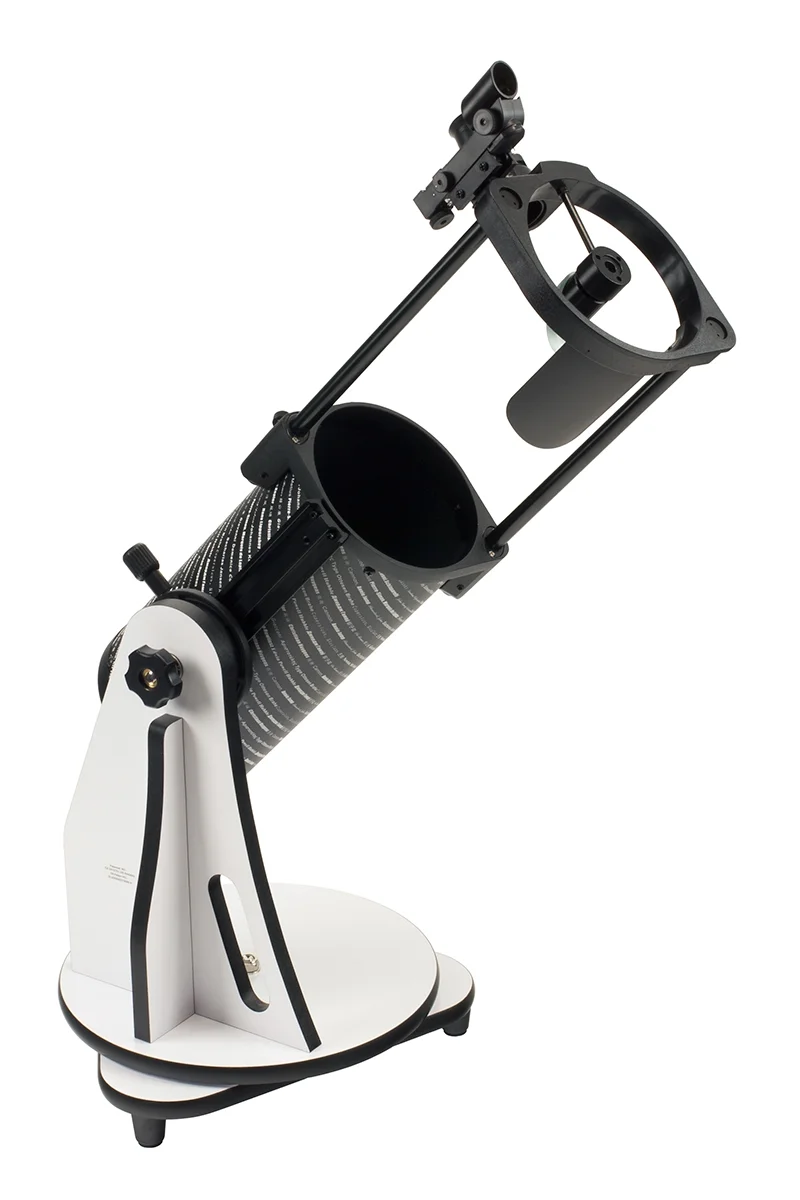
A 5-inch (130 mm) reflector is the smallest telescope that makes sense here. On a clear, Moon-free night it is a fair try for Iapetus on its bright western side, around magnitude 10.1 to 10.5. Expect to work for it.
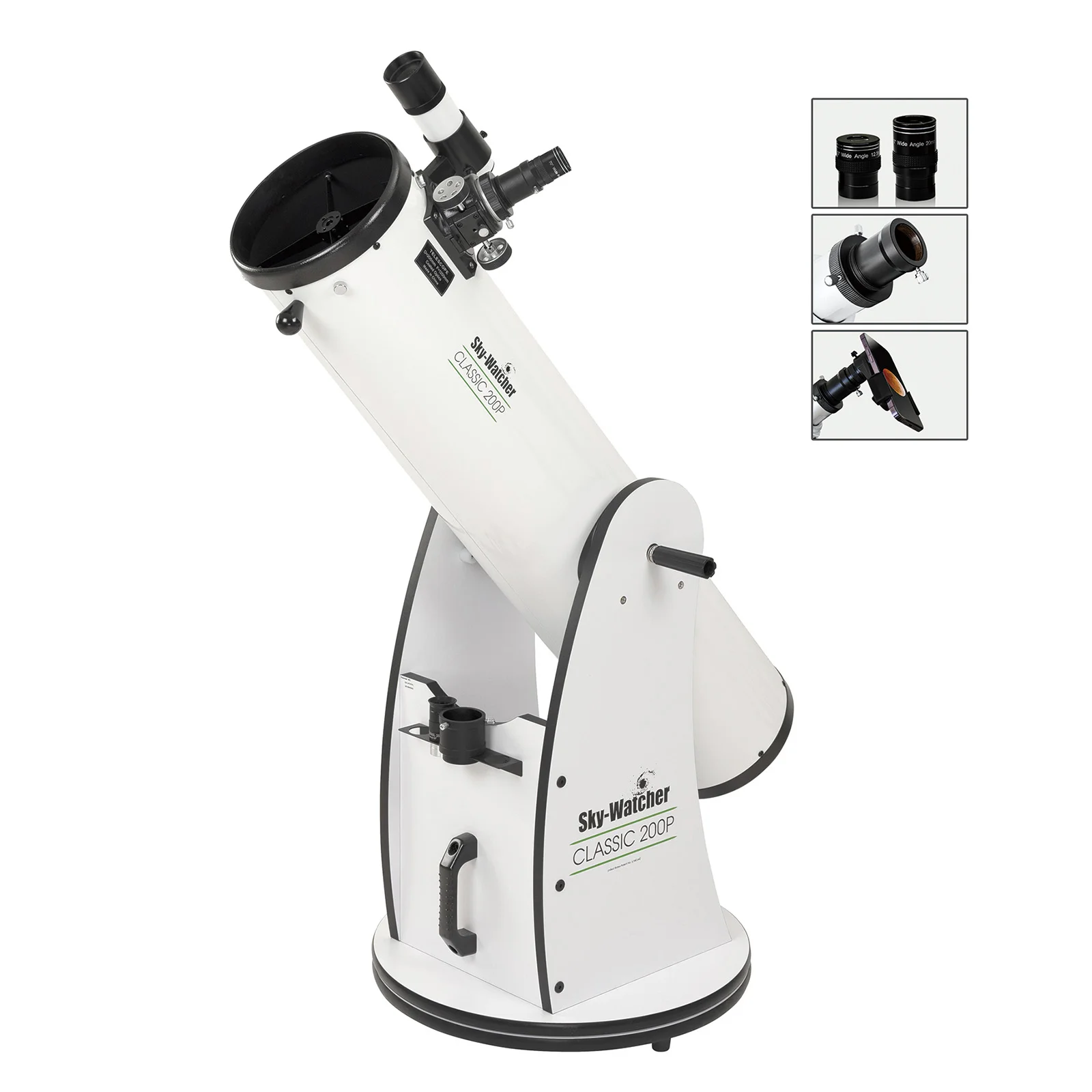
An 8-inch Dobsonian gathers about 2.4 times as much light as a 130 mm telescope. That margin is what you want for the faint eastern side, around magnitude 12 on 10 November.
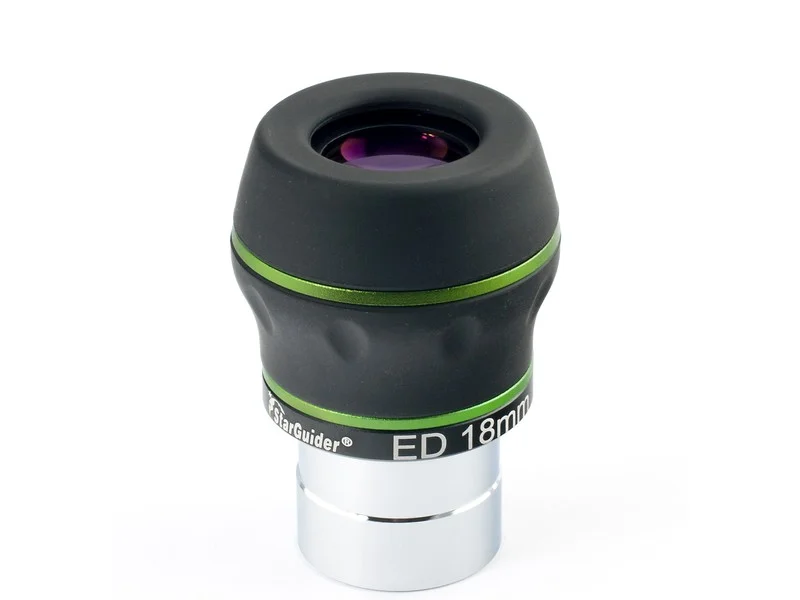
BST StarGuider 60° 18mm ED
In a 1200 mm focal length Dobsonian like the 200P this gives about 67x and a field roughly 54 arcminutes wide, enough to hold Saturn and Iapetus together when the moon is up to 10 arcminutes out.
Affiliate links: you pay the same price, we earn a small commission that helps keep WatchTheStars free.
Frequently Asked Questions About Iapetus
Images: NASA/JPL/Space Science Institute, Cassini mission. Main image: a false-colour mosaic of 60 Cassini images of Iapetus's bright trailing hemisphere, taken on 10 September 2007, in which the colour is enhanced to show the reddish dark material (PIA08384). Sky positions and brightness for the UK computed with Skyfield and JPL Horizons; brightness adds a simple two-tone correction to the Horizons average.