Key takeaways
- Enceladus is Saturn's sixth-largest moon, about 504 km across, with a salty ocean under its ice
- Cassini found 101 geysers at Enceladus's south pole spraying that ocean into space
- Enceladus has water, energy and the chemical ingredients for life, but no life has been found
- From the UK, Enceladus needs at least an 8-inch telescope and a steady night
Jump to section 7 sections
Enceladus: Saturn's Ocean Moon
Enceladus is a small, icy moon of Saturn, about 504 km across, with a salty ocean hidden under its frozen crust. Jets of water vapour and ice spray out of cracks near its south pole, and NASA's Cassini spacecraft flew straight through them and sampled that ocean. Water, a source of energy and the chemical building blocks of life have all been found there, which makes Enceladus one of the best places in the solar system to look for life beyond Earth.
It is Saturn's sixth-largest moon, orbiting about 238,000 km from the planet, a little under two-thirds of the distance from Earth to our own Moon. Enceladus goes round Saturn once every 32.9 hours, always keeping the same face turned towards it. Saturn has 293 known moons, more than any other planet, but none has turned out to be as surprising as this one.
William Herschel discovered Enceladus on 28 August 1789 with the giant 40-foot telescope at his home in Slough. His son John later named it after a giant from Greek mythology.
Is There Life on Enceladus?
Nobody knows yet. No life has been found on Enceladus, and no spacecraft built to look for it has been there. What scientists can say is that Enceladus has the three things life on Earth needs: liquid water, a source of energy and the right chemistry. Only a handful of places beyond Earth come close. Jupiter's moon Europa is one, and Ceres, the dwarf planet in the asteroid belt, shows signs of salty water too.
Almost all of the evidence comes from Cassini, which orbited Saturn from 2004 to 2017 and made 22 close flybys of Enceladus. This is what it found, in order.
| Year | What was found | Why it matters |
|---|---|---|
| 2005 | Jets of water vapour and ice erupting from the south pole | Something under the surface is active |
| 2009 | Sodium salts in the ice grains | Points to a salty, liquid ocean below |
| 2015 | Tiny grains of silica | Hot water, at least 90°C, is reacting with rock on the sea floor |
| 2015 | Enceladus wobbles as it orbits by more than it could if its crust were frozen to the rocky core | The ocean is global, not just a pocket under the south pole |
| 2017 | Hydrogen gas, about 1% of the plume | A chemical energy source, the kind some microbes on Earth live on |
| 2018 | Large, complex organic molecules | Carbon chemistry is going on in the ocean |
| 2023 | Phosphates, at least 100 times more concentrated than in Earth's oceans | Life on Earth needs phosphorus to build DNA and cell membranes |
| 2023 | Hydrogen cyanide and other energy-rich chemicals | Hydrogen cyanide is a key molecule in ideas about how life first formed |
| 2025 | Organic molecules in freshly ejected ice grains | They came straight from the ocean, not altered by long exposure in space |
None of this is life. Every result is an ingredient or a condition, and so far all of them can be explained without biology. The 2018 study of the organic molecules said plainly that Cassini's data could not tell whether they came from rock chemistry or from living things. The only way to find out is to go back with instruments designed to look for life.
Alien Life on Saturn's Moon? The September 2026 Studies
Two papers published in Science Advances on 25 September 2026 led to headlines around the world saying alien life could live on Enceladus. This is what the scientists actually did.
A deep-sea microbe that grew in Enceladus-style water
A team led by Vanessa Helmbrecht and William Orsi at LMU Munich rebuilt the chemistry of Enceladus's sea floor in the lab: very alkaline, salty water, almost no oxygen, and hydrogen gas made by water reacting with rock. Into it they put Methanothermococcus okinawensis, a microbe from deep-sea hot springs on Earth that lives on hydrogen and carbon dioxide and gives off methane.
It grew. The microbe coped with water up to pH 11, far more alkaline than it was known to tolerate, and in the usual lab growth medium at that pH it did not grow at all. It made methane using only the hydrogen from the rock reactions. Carbon dioxide is scarce in water that alkaline, and the cells got round it by turning up an ancient chemical pathway that grabs carbon dioxide even at very low levels.
Orsi was clear about what this means: "Our study doesn't prove that life exists on Enceladus, but it does show that key geochemical features of its environment can support one of life's most ancient metabolisms."
Ice grains that sort themselves
The second study, led by Frank Postberg at Freie Universität Berlin with colleagues in Japan, the UK, the US and Germany, went back to about 1,000 measurements of single ice grains taken by Cassini's dust analyser. The salty grains came in at least five distinct types, each dominated by one kind of salt, such as table salt, baking soda or phosphates.
Lab experiments explained why. Spray from the ocean freezes slowly as it rises through the cracks, and as it freezes the different salts separate out. The frozen droplets are then smashed into smaller grains on their way out of the vents, so each grain ends up carrying mostly one ingredient. Postberg put it simply: "Enceladus actually does a lot of the work for us in preparing samples for analysis that usually take a lot of effort in chemical labs on Earth." The same sorting works on organic molecules, so if there is anything biological in the ocean, a future spacecraft may find it concentrated in single grains instead of spread thinly through all of them.
Neither study found life, and neither claims to. Together they show that an Earth microbe could make a living in Enceladus-like conditions, and that Enceladus packages its ocean in a way that would make life easier to detect.
Enceladus Geysers: Water Jets from the Tiger Stripes
The jets come from four long cracks near the south pole, nicknamed the tiger stripes. Each is about 135 km long, and they are named Alexandria, Cairo, Baghdad and Damascus. Cassini mapped 101 separate geysers along them.
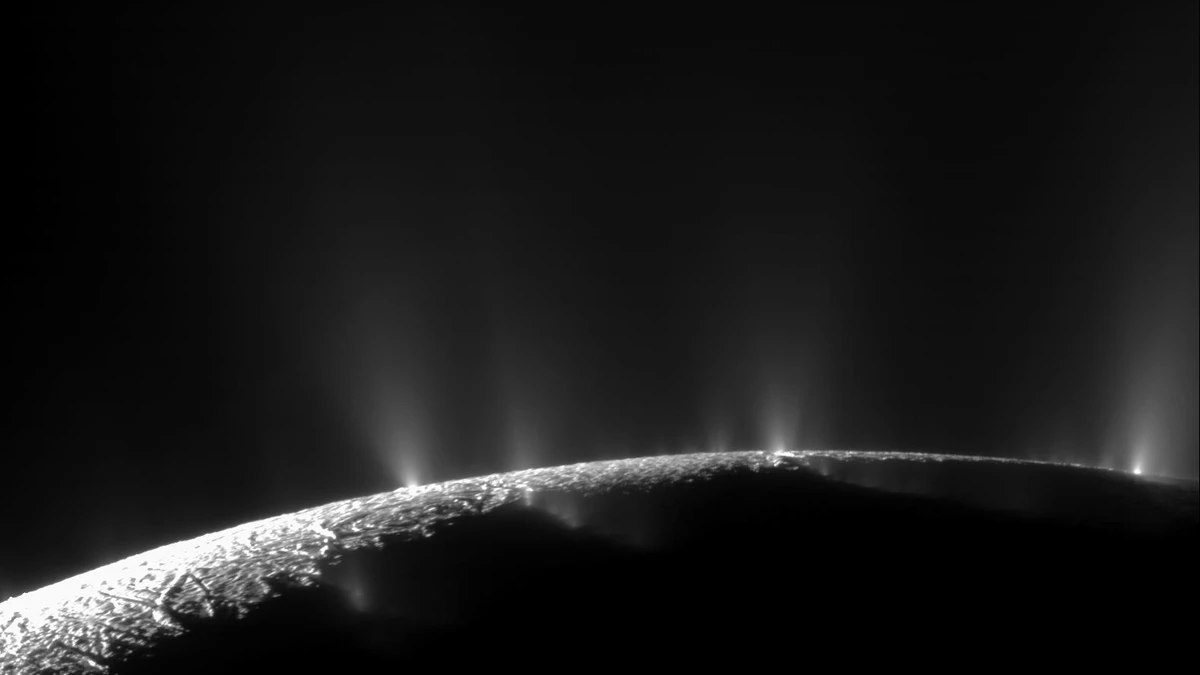
The spray is mostly water vapour, about 98% of the gas Cassini sampled, with around 1% hydrogen, smaller amounts of carbon dioxide and methane, and countless tiny grains of ice. In 2023 the James Webb Space Telescope saw a plume of water vapour stretching nearly 10,000 km, about 20 times the width of Enceladus itself. The moon loses about 300 litres of water a second, enough to fill an Olympic swimming pool in a little over two hours.
What drives it all is tides. Enceladus's orbit is slightly oval, so Saturn's gravity squeezes and stretches it as it goes round. That flexing heats the inside, keeps the ocean liquid and works the cracks open. A 2025 study found that the heat escaping from Enceladus, about 54 gigawatts, roughly matches the heat made by the tides, which suggests the ocean could be stable over long periods.
How Enceladus makes one of Saturn's rings
Not all of the ice falls back. Much of it escapes into orbit around Saturn and forms the E ring, a wide, faint ring running from about 180,000 km to 482,000 km from Saturn's centre, well outside the bright rings you see in a telescope. Enceladus is its main source.
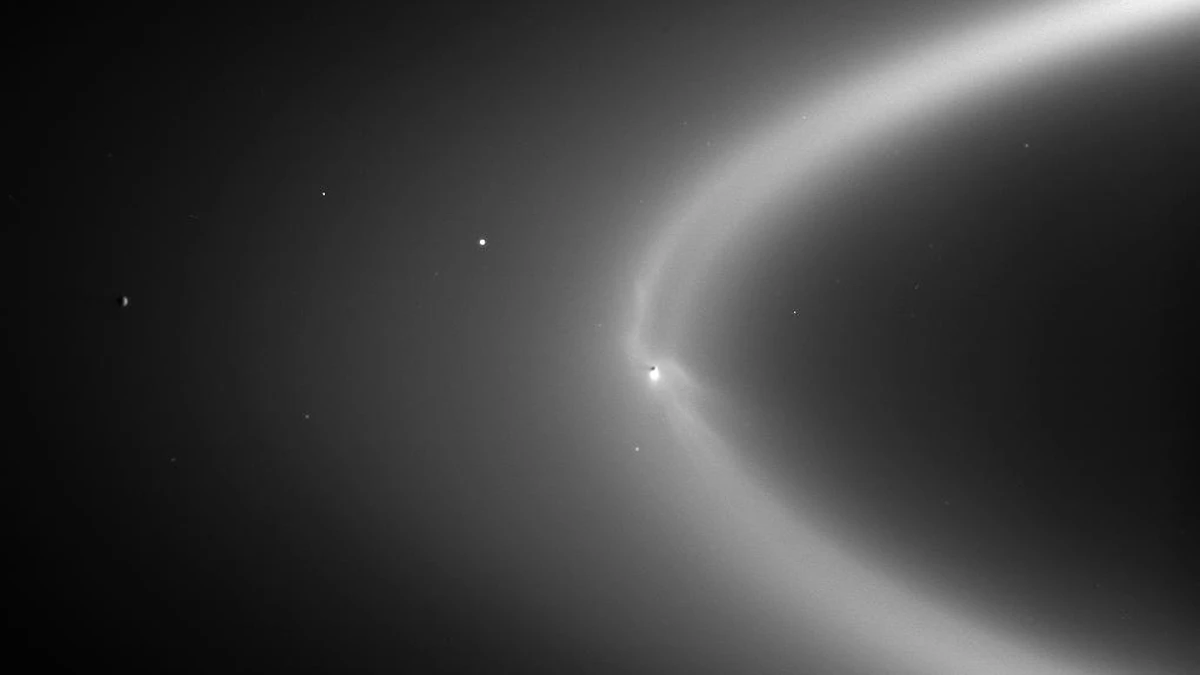
The falling snow also explains why Enceladus looks so bright. NASA calls it the most reflective body in the solar system. Its fresh ice bounces back so much sunlight that the surface stays at around −201°C.
Enceladus's Ocean and How Big It Is
Beneath the surface is a global ocean of salty water resting on a rocky core. The ice above it is around 20 to 25 km thick on average, but at the south pole it thins to perhaps 1 to 5 km, which is why the jets break through there. Models suggest the ocean itself is tens of kilometres deep.
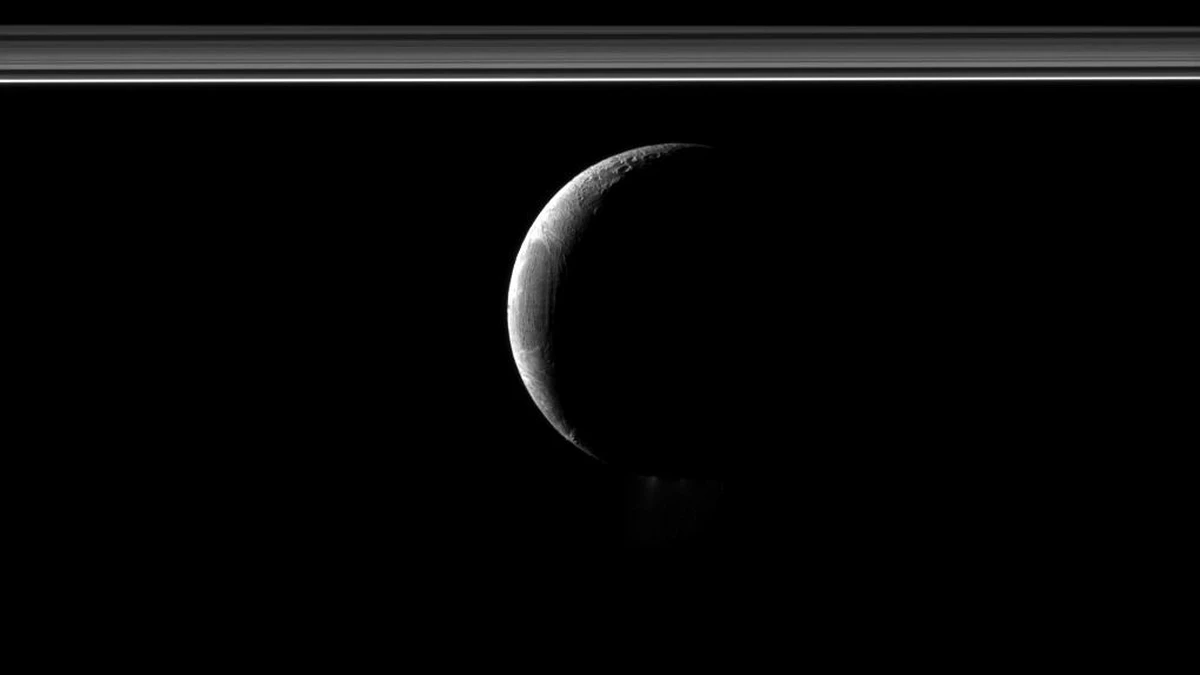
Enceladus is about 504 km across, a little less than the straight-line distance from London to Edinburgh. That is roughly a seventh of the width of our Moon. Its gravity is just over 1% of Earth's, so bathroom scales that read 70 kg here would read under 1 kg there.
Can You See Enceladus from the UK?
Yes, but it is one of the hardest moons in the solar system to see with a backyard telescope. Enceladus shines at about magnitude 11.6, which on its own would be an easy target for an 8-inch telescope. The problem is where it sits. At its furthest it is only about 39 arcseconds from the centre of Saturn, roughly twice the width of the planet's disc, and Saturn is around 30,000 times brighter. Most nights the moon is lost in the glare.
Saturn reached opposition on 4 October 2026, so this autumn is the best time to try. From the UK, Saturn is due south at about 1am BST in early October, 10pm GMT on 1 November and 8pm GMT on 1 December. At that point it is about 42° up from Plymouth, 39° from Birmingham and 36° from Edinburgh, high enough to get above the worst of the low murk, which matters for a target this small. Our guide on how to see Saturn this year has the month-by-month detail.
Tips for spotting Enceladus
- Use at least an 8-inch (200 mm) telescope. A 10-inch makes it much easier. Smaller telescopes will show Titan and some of Saturn's other bigger moons, but Enceladus usually needs more.
- Catch it near its furthest point. Enceladus swings from one side of Saturn to the other in about 16 hours, so it reaches its widest point twice in every 33-hour orbit. A planetarium app such as Stellarium or SkySafari shows where it will be on the night.
- Look along the line of the rings. Because Enceladus orbits in the plane of the rings, at its furthest it sits roughly in line with them, a little less than twice as far from Saturn as the ring tips.
- Push the magnification. Around 150x to 200x spreads Saturn and its moons apart and darkens the background. Our guide to telescope magnification shows how to work out what an eyepiece gives you.
- Hide Saturn. Nudge the planet just outside the field of view and look where Enceladus should be. Without the glare in the eyepiece, a faint point is far easier to pick up.
- Wait for a steady night. If the rings look sharp and the Cassini Division holds still, the air is good enough. Steady air matters more than dark skies for this one, though our UK dark sky sites map helps if streetlights are a problem where you live.
An 8-inch Dobsonian is the obvious tool. Our Sky-Watcher Skyliner 200P review explains why it suits planets and their moons so well, and it costs around £341 at First Light Optics. If you are new to telescopes, start with our guide on how to use a telescope, then check what you can see in the sky tonight before heading out. The UK night sky this week rounds up everything else worth a look.
Missions to Enceladus: Cassini and What Comes Next
Cassini spotted the jets in 2005 and spent the next decade studying them. Its closest pass, on 9 October 2008, took it within 25 km of the surface, and on 28 October 2015 it dived through the plume just 49 km above the south pole to sample it. Its last close flyby was on 19 December 2015, and the mission ended in 2017 when Cassini was sent into Saturn's atmosphere.
Cassini was never built to look for life, so the next step needs a new spacecraft. The European Space Agency is studying a large mission to Enceladus, with an orbiter and a lander, as the first flagship of its long-term Voyage 2050 plan, with a launch planned for 2042. In the US, a NASA concept called Enceladus Orbilander was ranked the second-highest priority flagship mission in the 2023–2032 planetary science decadal survey, but it has no funding and no start date.
Until then, Cassini's data keeps giving. Both of the September 2026 studies leaned on measurements it took years before.
What you need to see Enceladus
Kit we've reviewed in full
Enceladus is a stiff test for any telescope. Its faintness is not really the problem: Saturn's glare right next to it is. Aperture, magnification and a steady night are what get you there.
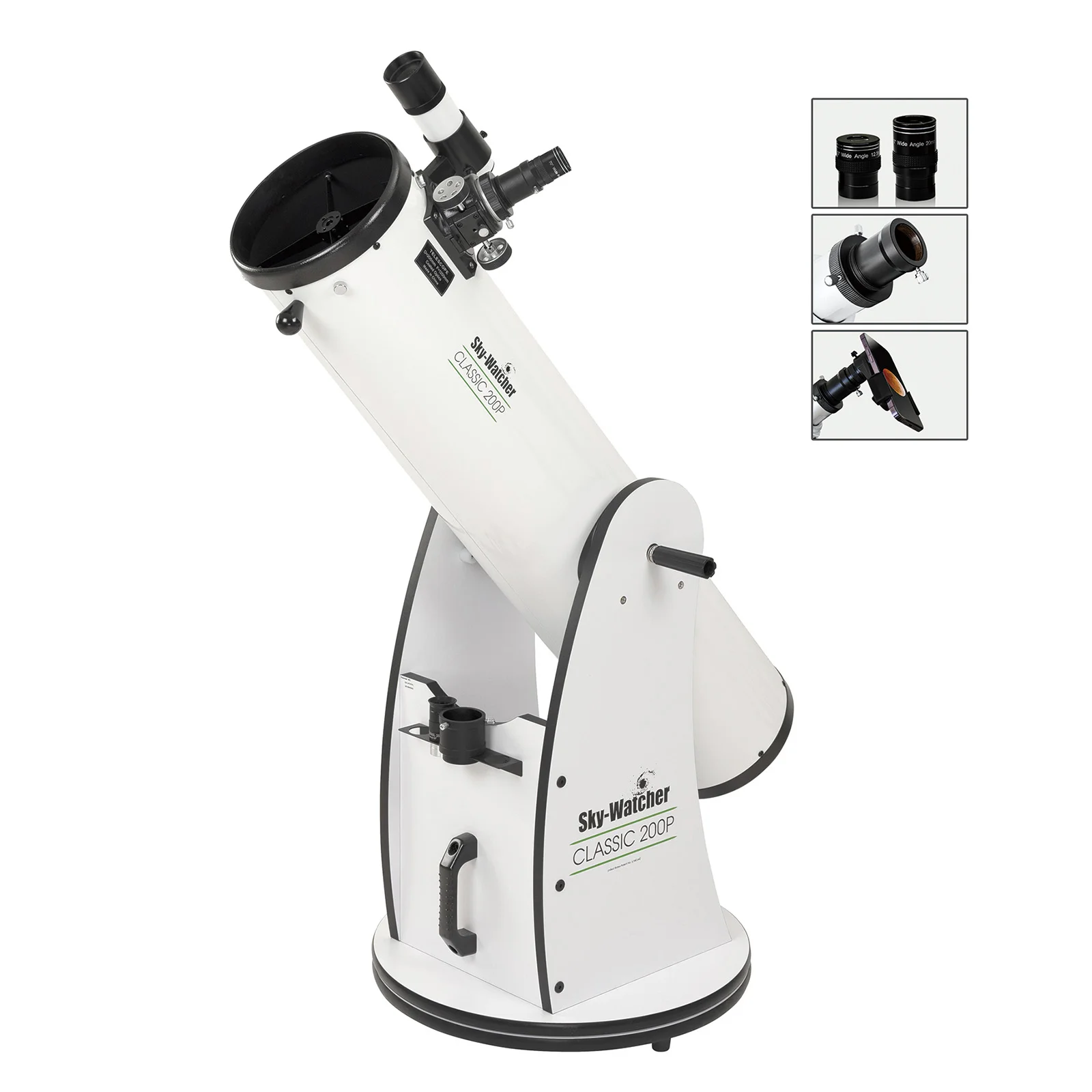
An 8-inch Dobsonian is where Enceladus becomes a fair target. Wait for a night when Saturn looks sharp at 150x, catch the moon near its furthest point from the planet and look just beyond the tips of the rings.

Sky-Watcher Skyliner 250PX FlexTube
Ten inches collects about 56% more light than eight, and that extra reach is what lifts a faint point out of Saturn's glare. Enceladus goes from a maybe to a regular catch on good nights.
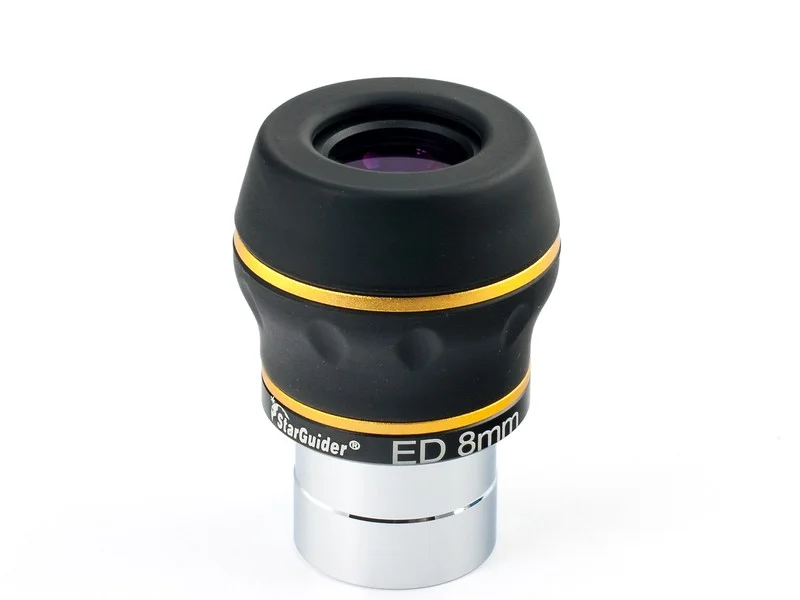
BST StarGuider 60° 8mm ED
In a 1200 mm focal length Dobsonian like the 200P this gives 150x, enough to spread Saturn and its inner moons apart. The comfortable 60° field makes it easy to nudge Saturn just out of view.
Affiliate links: you pay the same price, we earn a small commission that helps keep WatchTheStars free.
Frequently Asked Questions About Enceladus
Images: NASA/JPL/Space Science Institute and NASA/JPL-Caltech/Space Science Institute, Cassini mission. Main image: a false-colour mosaic of 21 Cassini images from the flyby of 14 July 2005, in which blue marks the coarser ice exposed along the fractures (PIA06254). Sky positions for the UK computed with Skyfield and JPL Horizons.