Key takeaways
- Phobos is spiralling towards Mars and will probably crash into it or break into a ring within tens of millions of years
- Where Phobos and Deimos came from is disputed: a February 2025 paper suggests capture as asteroids, while an April 2025 paper starts from formation in a disc of debris and cannot tell two histories of Phobos apart
- Japan's MMX mission is scheduled to launch on 20 October 2026 and bring at least 10 g of Phobos material back in 2031
- From the UK, Deimos (about magnitude 13.2) is an extreme challenge in 2027 and Phobos (about 12.1) is effectively out of reach of ordinary telescopes
Jump to section 7 sections
Phobos and Deimos: The Moons of Mars
Phobos and Deimos are the two small, dark, lumpy moons of Mars, and Phobos is slowly spiralling in towards the planet. Phobos is about 27 by 22 by 18 km and orbits just 6,000 km above the Martian surface, closer to its planet than any other moon in the solar system. Deimos is about 15 by 12 by 11 km and orbits much further out. Neither is round, and both are tiny next to our own Moon.
The American astronomer Asaph Hall found them at the US Naval Observatory in August 1877. He discovered Deimos on 11 August and Phobos about a week later. Their names come from the Greek sons of the war god Ares, who went into battle with him: Phobos means fear and Deimos means dread.
| Phobos | Deimos | |
|---|---|---|
| Size | 27 × 22 × 18 km | 15 × 12 × 11 km |
| Distance from Mars's centre | About 9,400 km | About 23,500 km |
| Time to orbit Mars | 7 h 39 min | About 30 h 18 min |
| Largest crater | Stickney, about 9 km | About 2.3 km |
| Surface | Grooved, with a huge crater | Smoother, under a thick dust blanket |
| Brightness near opposition, 2027 | About magnitude 12.1 | About magnitude 13.2 |
Both moons are dark and reddish. NASA says Phobos is made of C-type material and may be a captured asteroid, which is only one of the ideas about where it came from. Its sunlit surface is about −4 °C and its shadowed ground about −112 °C.
Will Phobos Crash into Mars?
Probably, though it may break up first. Phobos draws nearer to Mars by about 6 ft (1.8 m) every 100 years. NASA's Phobos page says that within about 50 million years it will either crash into Mars or be torn apart and scattered as a ring around the planet. Other NASA material gives 30 to 50 million years, and a 2025 paper in the Planetary Science Journal says Phobos may break into a ring in a few tens of millions of years.
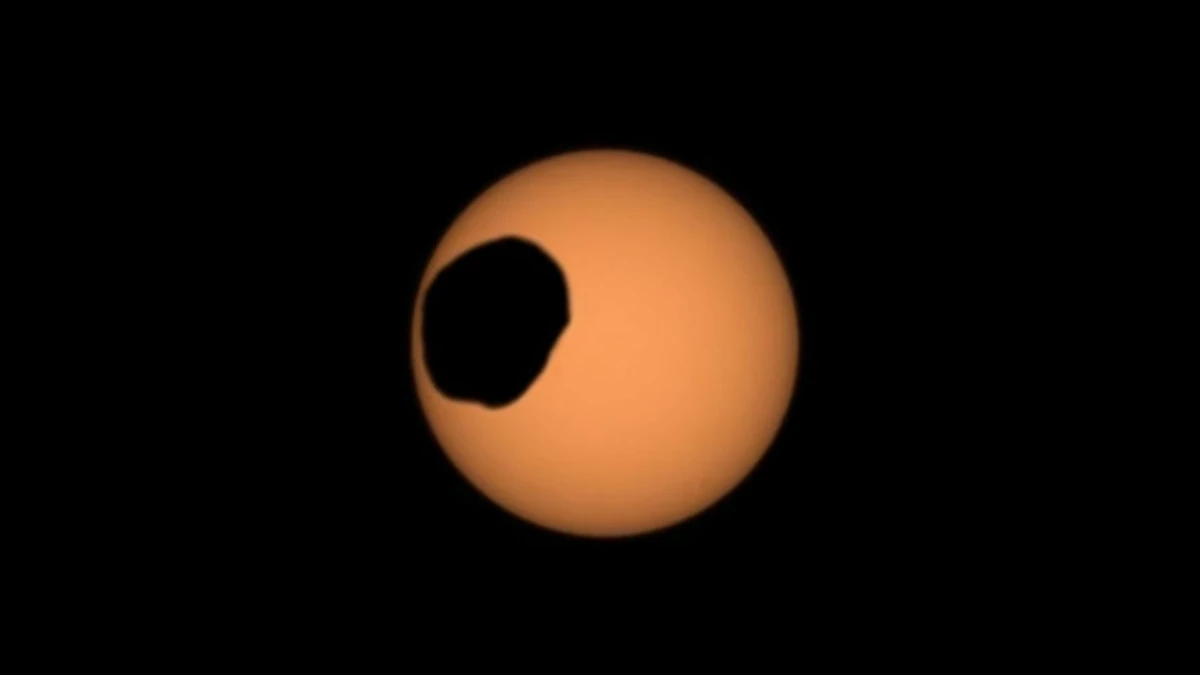
The cause is its unusual orbit. Phobos goes round Mars in 7 hours 39 minutes, faster than Mars turns once on its axis. It circles Mars a little over three times in one Martian day, and from the surface it rises in the west and sets in the east.
What Is the Big Crater on Phobos?
It is called Stickney. At about 9 km across, it is the largest feature on Phobos and about 40 per cent of the moon's own average width. Material on the walls of Stickney and other large craters has slid downhill in landslides, in a gravity less than a thousandth of Earth's.
Troughs and chains of small craters cross Phobos. They look as if they radiate from Stickney, but NASA's caption says studies using ESA's Mars Express suggest they are unrelated, and may have formed when material thrown up by impacts on Mars later hit Phobos. A paper in Monthly Notices of the Royal Astronomical Society in April 2026 by Haser and Andert suggests that the Stickney impact may have compressed the material beneath it, affecting about 7 per cent of Phobos's volume if that explains a feature in its gravity. MMX's gravity measurements can test the idea.
What Is Deimos Like? What Hera Saw
Deimos is smaller, smoother and slower. It takes about 30 hours to orbit Mars, longer than a Martian day of about 24 hours 40 minutes, so from the surface it creeps across the sky. A thick blanket of broken rock and dust covers most of it. Its largest crater is only about 2.3 km across.
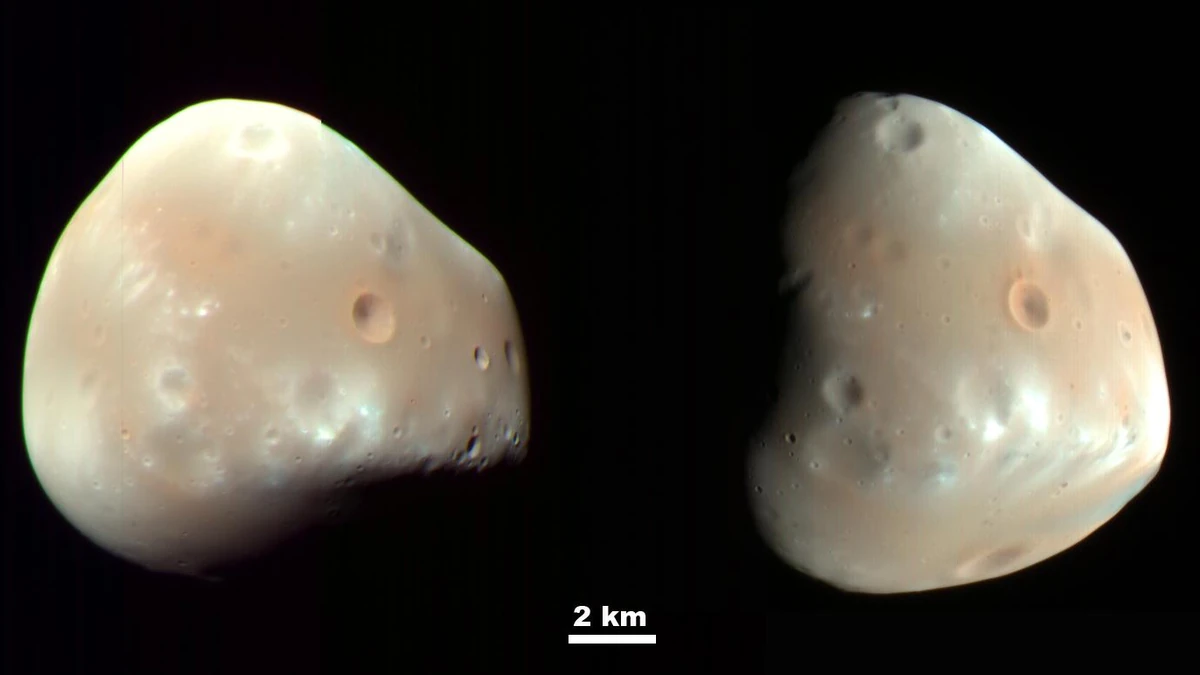
On 12 March 2025, ESA's Hera spacecraft passed about 1,000 km from Deimos on its way to the asteroid Didymos, and imaged its far side, the hemisphere that faces away from Mars and is rarely seen. On 18 August 2026, Nature Astronomy carried a study of what those images show. Lead author Sabina Raducan and colleagues ran about 100 simulations. They suggest that a single impactor about 320 m across, striking at about 45 degrees, formed a large depression at Deimos's south pole and buried older craters under dust more than 200 m deep in places. Deimos appears to be a rubble pile, made of loose, fractured material, which absorbed the shock.
One member of the Hera science team is Sir Brian May. Raducan told ESA that she first made out the buried craters "via spectroscopic depictions of the Hera images made immediately afterwards by Sir Brian May, who is part of the Hera science team." So May made the spectral images, and Raducan recognised the craters in them.
Where Did Phobos and Deimos Come From?
Scientists do not agree, and two papers from 2025 show the range of views. The first, led by Wargnier and published in Astronomy and Astrophysics on 21 February 2025, argues that the moons may be one or two asteroids from the inner part of the main belt that Mars captured. Their colours resemble D-type and Z-type asteroids, and the paper raises a possible link to the Mars Trojans, asteroids that share Mars's orbit.
The second, by Matija Ćuk, Aditya Anand and David Minton, appeared in the Planetary Science Journal on 14 April 2025. It takes the moons' orbits, which lie almost in the plane of Mars's equator, as a sign that they formed from a disc of debris around the planet. Its main aim is to test two possible histories for Phobos: an ancient moon migrating inwards over billions of years, or a much younger one, around 100 million years old, made in a repeating cycle of moons and rings. The authors find both fit Phobos's orbit and say there is no way yet to tell them apart.
Neither is settled. Samples from Phobos are one of the main aims of the MMX mission below, because they could show whether the rock matches the asteroids or the Martian surface.
Can You See Phobos and Deimos from the UK?
Not with ordinary equipment. Both moons are faint and sit right next to the glare of Mars, which makes them among the hardest objects in this guide to catch. Around Mars's opposition on 19 February 2027, Phobos is about magnitude 12.1 and Deimos about 13.2, while Mars is about magnitude −1.3. Magnitude is the astronomers' brightness scale, where a bigger number means a fainter object. On that gap, Mars is about 230,000 times brighter than Phobos and about 625,000 times brighter than Deimos.
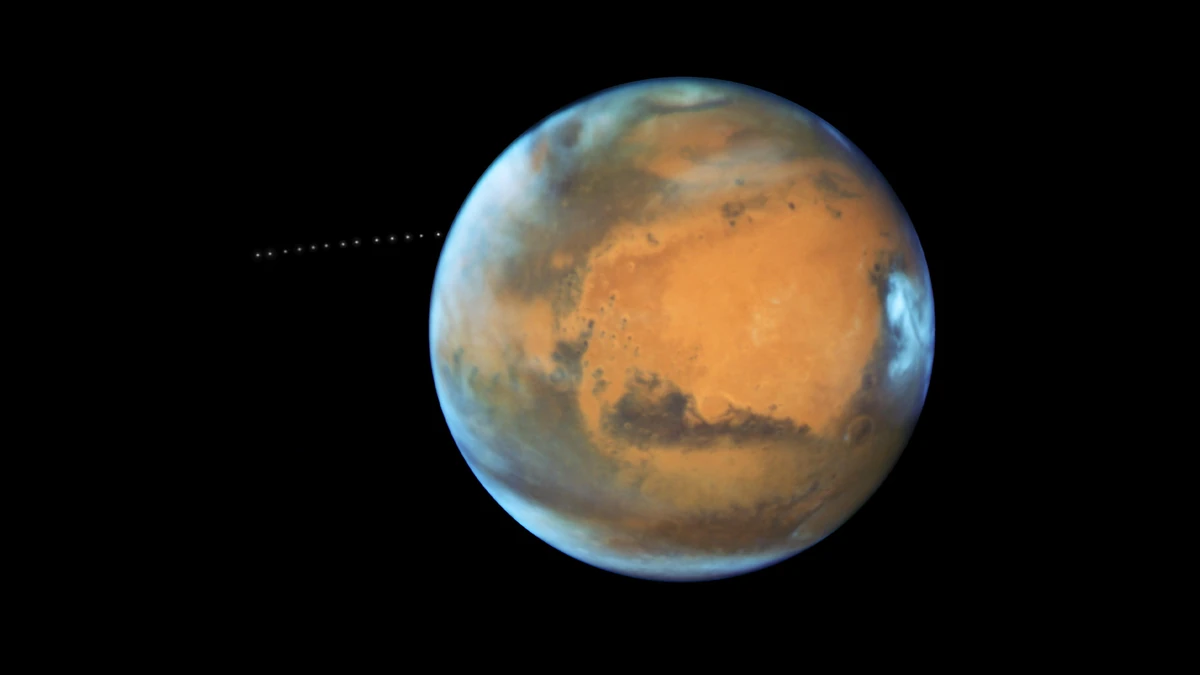
It is not strictly impossible. NASA's Hubble Space Telescope caught Phobos moving round Mars in May 2016. In amateur hands, Astronomy Now's 2018 guide said a 10-inch or larger telescope and excellent seeing were needed, and rated it an extreme challenge even at the much closer 2018 opposition. In that year Phobos was about magnitude 10.5, Deimos 11.6 and Mars 24.3 arcseconds wide. On 19 February 2027 both moons are about 1.6 magnitudes fainter, and Mars is only 13.8 arcseconds wide. The 2027 opposition is harder than 2018.
Where to look
Phobos stays within about 12 arcseconds of Mars's edge at most, less than one Mars-width. It laps Mars every 7 hours 39 minutes, so it reaches its greatest distance on one side or the other about every 3.8 hours. Deimos swings out to about 41 arcseconds from the edge, nearly three Mars-widths, and reaches its greatest distance on alternate sides about every 15 hours. An arcsecond is a 3,600th of a degree.
Mars is no use for the moons yet. On 5 October 2026 it is magnitude +1.1 and only 5.7 arcseconds wide, and it grows steadily through the winter.
| Date | Mars brightness and size | Mars from Birmingham |
|---|---|---|
| 5 October 2026 | Magnitude +1.1, 5.7″ | Rises 00:38 BST; due south at 08:38 BST in daylight |
| 24 December 2026 | Magnitude +0.0, 9.6″ | Rises 21:37 GMT; due south at 04:42 GMT, 49° up |
| 1 February 2027 | Magnitude −0.9, 13.1″ | Due south at 02:06 GMT, 50° up |
| 19 February 2027 | Magnitude −1.3, 13.8″ (opposition) | Due south at 00:31 GMT, 53° up (Plymouth 55°, Edinburgh 49°) |
| 4 March 2027 | Magnitude −1.1, 13.5″ | Due south at 23:15 GMT, 54° up |
The Moon causes a second problem. It is full on 20 February 2027, only 6° from Mars at 22:00 that night, and its light would drown out a moon as faint as Deimos. The dark fortnight around new Moon on 6 February is the better time. These are the best Deimos chances from Birmingham, with Mars at least 30° up and the Sun at least 12° below the horizon. Times are GMT, and the distances are measured from Mars's edge.
| Date and time (GMT) | Deimos position | Mars altitude | The Moon |
|---|---|---|---|
| Tuesday 2 February, 01:30 | East, 38.8″ from the edge | 50° | Below the horizon, 18% lit |
| Wednesday 3 February, 22:50 | West, 39.1″ | 37° | Below the horizon, 6% lit |
| Sunday 7 February, 02:30 | East, 39.7″ | 50° | Below the horizon, 0% lit |
| Monday 8 February, 23:50 | West, 40.0″ | 47° | Below the horizon, 5% lit |
| Thursday 4 March, 22:50 | West, 39.7″ | 54° | Below the horizon, 11% lit |
On opposition night itself the Moon is a poor companion. At 02:00 GMT on 19 February, when Deimos is at its western extreme and Mars is 49° up, the Moon is 95% lit and 28° from Mars. The best window is therefore 2 to 9 February 2027, with 2 to 9 March as a second chance. Our Moon phase tool shows the Moon on the night.
Tips for trying
- Be realistic about aperture. Use a 10-inch (250 mm) telescope at the very least, and 12 inches or more if you can. Phobos is effectively out of reach of ordinary kit. Deimos is a challenge for experienced observers.
- Wait for steady air. Both moons need a still night. Unsteady air spreads the glare of Mars across the field and swamps them.
- Push Mars out of the field. Nudge the telescope so Mars sits just outside the edge of the view. Astronomy Now suggests this to cut the glare.
- Beware diffraction spikes. A Newtonian reflector's supports can turn Mars into a cross of light, which hides a faint moon or fakes one. Our guide to telescope magnification helps you pick a power.
- Use a high power. About 150x darkens the sky background and keeps Deimos well inside the field.
- Check a planetarium app. Phobos moves noticeably within minutes, so see where each moon should be at your time.
- Choose a dark site. Our UK dark sky sites map shows where to go, and UK night sky this week and what you can see in the sky tonight cover conditions on the night.
A 10-inch Dobsonian is the sensible start, such as the Sky-Watcher Skyliner 250PX at around £619 at First Light Optics. If you are new to telescopes, begin with how to use a telescope, and for Mars itself see planetary imaging for beginners. Our guide to Mars in 2026 has the month-by-month detail. Mars itself is a fine target in much smaller telescopes, and our astronomy events calendar lists the dates.
Missions to Phobos and Deimos: MMX and Hera
Japan's Martian Moons eXploration (MMX) is scheduled to launch from the Yoshinobu Launch Complex at Tanegashima on an H3 rocket at 04:41 on 20 October 2026, Japan time. That is 19:41 UTC on 19 October, or 20:41 BST. JAXA has also set a reserve period from 21 October to 7 November 2026, so the date is scheduled and launches can slip. As of 5 October 2026 it has not flown.
MMX is meant to arrive at Mars about a year after launch, study both moons, and bring back at least 10 g of Phobos material in 2031. A rover called Idefix, built by Germany's DLR with France's CNES, weighs 25 kg. DLR says it is due to be released from about 40 m up in 2029 and to work on Phobos for about three months. DLR calls it the first rover to leave tracks on a moon of Mars. In Phobos's weak gravity, ESA says, it would weigh about 15 g.
| Date | What happened or is scheduled |
|---|---|
| August 1877 | Asaph Hall discovers Deimos and then Phobos |
| 1969 | Mariner 7 takes the first crude close-up of Phobos |
| 1977 | The Viking 1 orbiter takes the first detailed photograph of Phobos |
| 23 March 2008 | MRO HiRISE images Phobos from 6,800 km |
| 8 November 2011 | Russia's Phobos-Grunt launches but cannot leave Earth orbit; it re-enters on 15 January 2012 |
| 12 March 2025 | ESA's Hera passes about 1,000 km from Deimos |
| 18 August 2026 | Nature Astronomy study of Deimos's dust and impact history |
| 19 October 2026, 19:41 UTC | MMX scheduled launch (20 October, 04:41 JST); reserve period 21 October to 7 November |
| About a year after launch | MMX scheduled to arrive at Mars |
| 2029 | Idefix scheduled to be released to Phobos |
| 2031 | Phobos sample scheduled to return to Earth |
Kit for the Moons of Mars
Kit we've reviewed in full
These are the hardest moons in this guide to catch. Only large aperture gives a fair chance, so the kit below starts at 10 inches.

Sky-Watcher Skyliner 250PX FlexTube
A 10-inch (250 mm) Dobsonian is the minimum size Astronomy Now's 2018 guide gave for catching the moons. In 2027 Mars is smaller and dimmer than in 2018, so even this needs steady air, a Moon-free night and patience.
ZWO ASI662MC Colour Planetary Camera
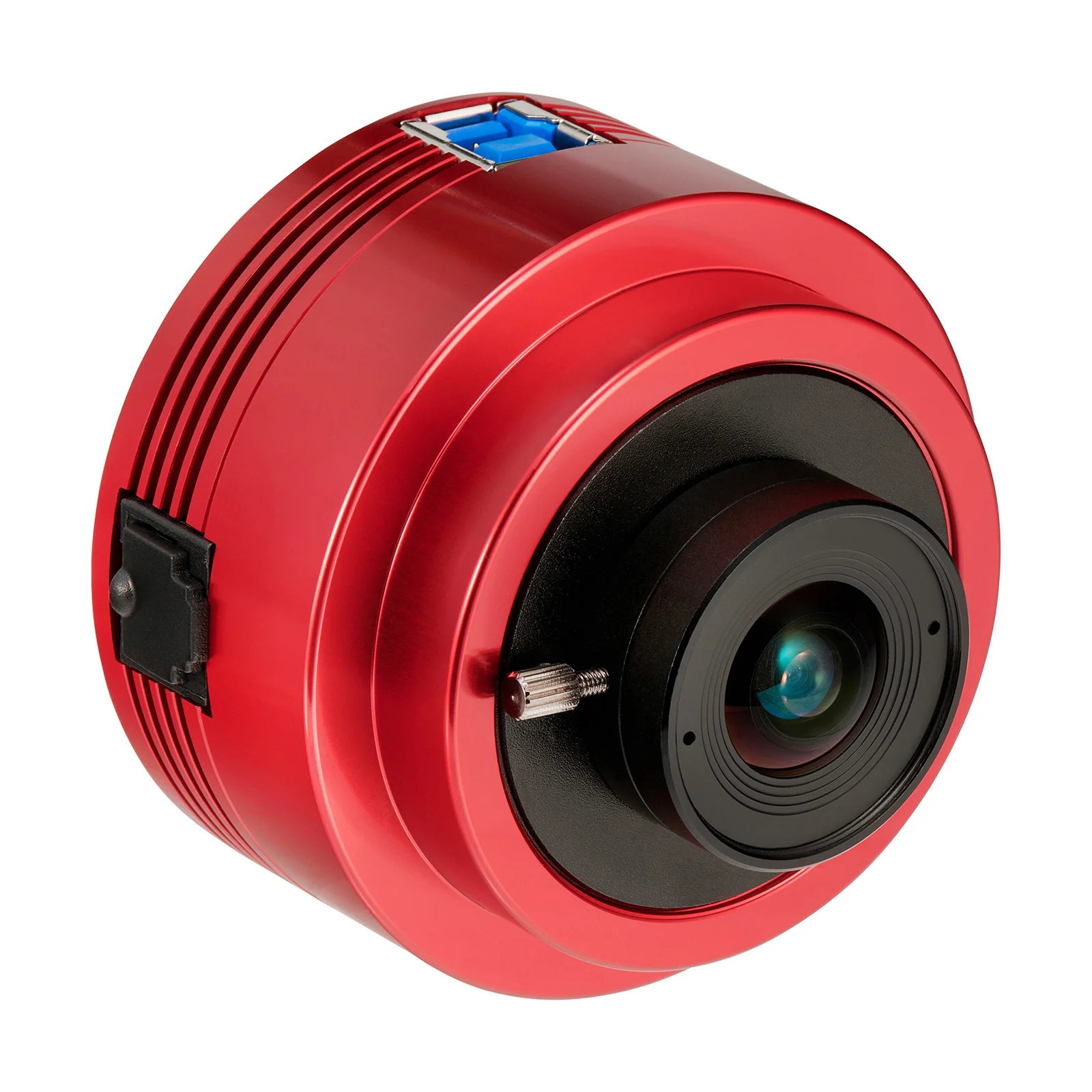
A camera adds light over time, so stacking many short frames can reach fainter than the eye. Mars's glare is still the obstacle, so treat it as an experiment, not a guaranteed result.
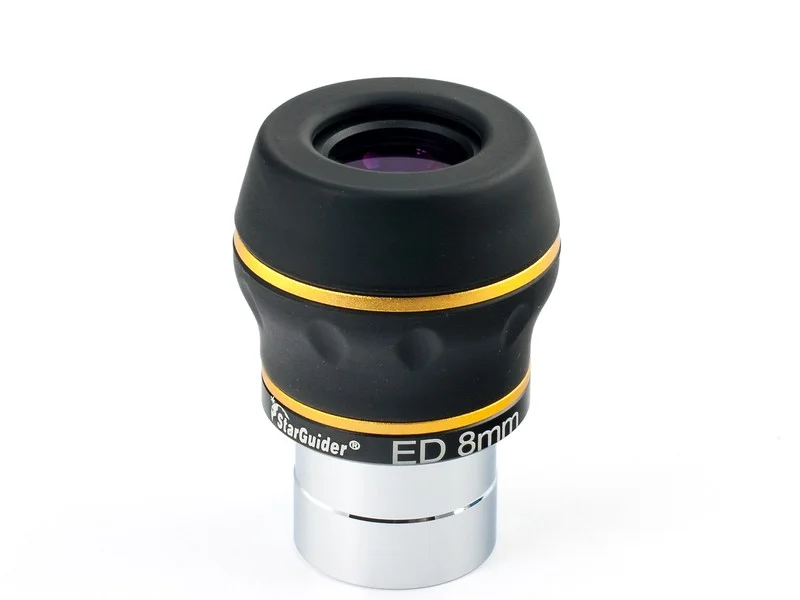
BST StarGuider 60° 8mm ED
In a 1200 mm focal length Dobsonian this gives 150x, a power that darkens the sky background and keeps Deimos, about 41 arcseconds from Mars's edge, well inside the field.
Affiliate links: you pay the same price, we earn a small commission that helps keep WatchTheStars free.
Frequently Asked Questions About Phobos and Deimos
Images: NASA. Main image: Phobos from NASA's Mars Reconnaissance Orbiter HiRISE camera on 23 March 2008, a colour view combining blue-green, red and near-infrared channels, with the large crater Stickney at lower right (NASA/JPL-Caltech/University of Arizona, PIA10368). Sky positions, brightness and Moon phases for the UK computed with Skyfield and JPL Horizons.